
⭐ Đáp ứng chuẩn đầu ra & yêu cầu công việc
Thi thử VSTEP Online Miễn phí (B1, B2, C1)
Luyện tập và thi thử chứng chỉ VSTEP theo Khung năng lực ngoại ngữ 6 bậc của Việt Nam. Hệ thống cung cấp các bài thi thử VSTEP đầy đủ 4 kỹ năng, bám sát cấu trúc đề thi thật của Bộ GD&ĐT. Đây là công cụ không thể thiếu để sinh viên và công chức ôn luyện, đạt mục tiêu B1, B2, C1.
Danh sách đề thi VSTEP
Thi Thử Vstep Online Đề 1 - Practice Test 1 - Listening
Thi Thử Vstep Online Đề 1 - Practice Test 1 - Reading Part 1
Thi Thử Vstep Online Đề 1 - Practice Test 1 - Reading Part 2
Thi Thử Vstep Online Đề 1 - Practice Test 2 - Listening
Thi Thử Vstep Online Đề 1 - Practice Test 2 - Reading Part 1
Thi Thử Vstep Online Đề 1 - Practice Test 2 - Reading Part 2
Thi Thử Vstep Online Đề 1 - Practice Test 3 - Listening
Thi Thử Vstep Online Đề 1 - Practice Test 3 - Reading Part 1
Thi Thử Vstep Online Đề 1 - Practice Test 3 - Reading Part 2
Thi Thử Vstep Online Đề 1 - Practice Test 4 - Listening
Thi Thử Vstep Online Đề 1 - Practice Test 4 - Reading Part 1
Thi Thử Vstep Online Đề 1 - Practice Test 4 - Reading Part 2
Thi Thử Vstep Online Đề 1 - Practice Test 5 - Listening
Thi Thử Vstep Online Đề 1 - Practice Test 5 - Reading Part 1
Thi Thử Vstep Online Đề 1 - Practice Test 5 - Reading Part 2
Thi Thử Vstep Online Đề 1 - Practice Test 6 - Listening
Thi Thử Vstep Online Đề 1 - Practice Test 6 - Reading Part 1
Thi Thử Vstep Online Đề 1 - Practice Test 6 - Reading Part 2
Thi Thử Vstep Online Đề 1 - Practice Test 7 - Listening
Thi Thử Vstep Online Đề 1 - Practice Test 7 - Reading Part 1
Thi Thử Vstep Online Đề 1 - Practice Test 7 - Reading Part 2
Thi Thử Vstep Online Đề 2 - Reading Test 1 - Part 1
Thi Thử Vstep Online Đề 2 - Reading Test 1 - Part 2
Thi Thử Vstep Online Đề 2 - Reading Test 10 - Part 1
Thi Thử Vstep Online Đề 2 - Reading Test 10 - Part 2
Thi Thử Vstep Online Đề 2 - Reading Test 2 - Part 1
Thi Thử Vstep Online Đề 2 - Reading Test 2 - Part 2
Thi Thử Vstep Online Đề 2 - Reading Test 3 - Part 1
Thi Thử Vstep Online Đề 2 - Reading Test 3 - Part 2
Thi Thử Vstep Online Đề 2 - Reading Test 4 - Part 1
Thi Thử Vstep Online Đề 2 - Reading Test 4 - Part 2
Thi Thử Vstep Online Đề 2 - Reading Test 5 - Part 1
Thi Thử Vstep Online Đề 2 - Reading Test 5 - Part 2
Thi Thử Vstep Online Đề 2 - Reading Test 6 - Part 1
Thi Thử Vstep Online Đề 2 - Reading Test 6 - Part 2
Thi Thử Vstep Online Đề 2 - Reading Test 7 - Part 1
Thi Thử Vstep Online Đề 2 - Reading Test 7 - Part 2
Thi Thử Vstep Online Đề 2 - Reading Test 8 - Part 1
Thi Thử Vstep Online Đề 2 - Reading Test 8 - Part 2
Thi Thử Vstep Online Đề 2 - Reading Test 9 - Part 1
Thi Thử Vstep Online Đề 2 - Reading Test 9 - Part 2
Thi Thử Vstep Online Đề 3 - Practice Test 1 - Listening
Thi Thử Vstep Online Đề 3 - Practice Test 1 - Reading Part 1
Thi Thử Vstep Online Đề 3 - Practice Test 1 - Reading Part 2
Thi Thử Vstep Online Đề 3 - Practice Test 2 - Listening
Thi Thử Vstep Online Đề 3 - Practice Test 2 - Reading Part 1
Thi Thử Vstep Online Đề 3 - Practice Test 2 - Reading Part 2
Thi Thử Vstep Online Đề 3 - Practice Test 3 - Listening
Thi Thử Vstep Online Đề 3 - Practice Test 3 - Reading Part 1
Thi Thử Vstep Online Đề 3 - Practice Test 3 - Reading Part 2
Thi Thử Vstep Online Đề 3 - Practice Test 4 - Listening
Thi Thử Vstep Online Đề 3 - Practice Test 4 - Reading Part 1
Thi Thử Vstep Online Đề 3 - Practice Test 4 - Reading Part 2
Thi Thử Vstep Online Đề 3 - Practice Test 5 - Listening
Thi Thử Vstep Online Đề 3 - Practice Test 5 - Reading Part 1
Thi Thử Vstep Online Đề 3 - Practice Test 5 - Reading Part 2
Thi Thử Vstep Online Đề 4 - Practice Test 1 - Listening
Thi Thử Vstep Online Đề 4 - Practice Test 1 - Reading Part 1
Thi Thử Vstep Online Đề 4 - Practice Test 1 - Reading Part 2
Thi Thử Vstep Online Đề 4 - Practice Test 2 - Listening
Thi Thử Vstep Online Đề 4 - Practice Test 2 - Reading Part 1
Thi Thử Vstep Online Đề 4 - Practice Test 2 - Reading Part 2
Thi Thử Vstep Online Đề 4 - Practice Test 3 - Listening
Thi Thử Vstep Online Đề 4 - Practice Test 3 - Reading Part 1
Thi Thử Vstep Online Đề 4 - Practice Test 3 - Reading Part 2
Thi Thử Vstep Online Đề 4 - Practice Test 4 - Listening
Thi Thử Vstep Online Đề 4 - Practice Test 4 - Reading Part 1
Thi Thử Vstep Online Đề 4 - Practice Test 4 - Reading Part 2
Thi Thử Vstep Online Đề 4 - Practice Test 5 - Listening
Thi Thử Vstep Online Đề 4 - Practice Test 5 - Reading Part 1
Thi Thử Vstep Online Đề 4 - Practice Test 5 - Reading Part 2
VSTEP Đại học Bách Khoa – Listening – Đề 1
VSTEP Đại học Bách Khoa – Listening – Đề 10
VSTEP Đại học Bách Khoa – Listening – Đề 2
VSTEP Đại học Bách Khoa – Listening – Đề 3
VSTEP Đại học Bách Khoa – Listening – Đề 4
VSTEP Đại học Bách Khoa – Listening – Đề 5
VSTEP Đại học Bách Khoa – Listening – Đề 6
VSTEP Đại học Bách Khoa – Listening – Đề 7
VSTEP Đại học Bách Khoa – Listening – Đề 8
VSTEP Đại học Bách Khoa – Listening – Đề 9
VSTEP Đại học Bách Khoa – Reading – Đề 1
VSTEP Đại học Bách Khoa – Reading – Đề 10
VSTEP Đại học Bách Khoa – Reading – Đề 11
VSTEP Đại học Bách Khoa – Reading – Đề 2
VSTEP Đại học Bách Khoa – Reading – Đề 3
VSTEP Đại học Bách Khoa – Reading – Đề 4
VSTEP Đại học Bách Khoa – Reading – Đề 5
VSTEP Đại học Bách Khoa – Reading – Đề 6
VSTEP Đại học Bách Khoa – Reading – Đề 7
VSTEP Đại học Bách Khoa – Reading – Đề 8
VSTEP Đại học Bách Khoa – Reading – Đề 9
VSTEP Đại học Công Nghiệp (IUH) – Listening – Đề 1
VSTEP Đại học Công Nghiệp (IUH) – Listening – Đề 2
VSTEP Đại học Công Nghiệp (IUH) – Reading – Đề 1
VSTEP Đại học Công Nghiệp (IUH) – Reading – Đề 2
VSTEP Đại học Ngân Hàng – Listening – Đề 1
VSTEP Đại học Ngân Hàng – Listening – Đề 2
VSTEP Đại học Ngân Hàng – Listening – Đề 3
VSTEP Đại học Ngân Hàng – Listening – Đề 4
VSTEP Đại học Ngân Hàng – Listening – Đề 5
VSTEP Đại học Ngân Hàng – Reading – Đề 1
VSTEP Đại học Ngân Hàng – Reading – Đề 10
VSTEP Đại học Ngân Hàng – Reading – Đề 11
VSTEP Đại học Ngân Hàng – Reading – Đề 12
VSTEP Đại học Ngân Hàng – Reading – Đề 2
VSTEP Đại học Ngân Hàng – Reading – Đề 3
VSTEP Đại học Ngân Hàng – Reading – Đề 4
VSTEP Đại học Ngân Hàng – Reading – Đề 5
VSTEP Đại học Ngân Hàng – Reading – Đề 6
VSTEP Đại học Ngân Hàng – Reading – Đề 7
VSTEP Đại học Ngân Hàng – Reading – Đề 8
VSTEP Đại học Ngân Hàng – Reading – Đề 9
VSTEP Đại học Ngoại Ngữ – Listening – Đề 1
VSTEP Đại học Ngoại Ngữ – Reading – Đề 1
Vstep Đại học Sư phạm (TPHCM) – Practice Test 1 – Listening
Vstep Đại học Sư phạm (TPHCM) – Practice Test 1 – Reading Part 1
Vstep Đại học Sư phạm (TPHCM) – Practice Test 1 – Reading Part 2
Vstep Đại học Sư phạm (TPHCM) – Practice Test 2 – Listening
Vstep Đại học Sư phạm (TPHCM) – Practice Test 2 – Reading Part 1
Vstep Đại học Sư phạm (TPHCM) – Practice Test 2 – Reading Part 2
Vstep Đại học Sư phạm (TPHCM) – Practice Test 3 – Listening
Vstep Đại học Sư phạm (TPHCM) – Practice Test 3 – Reading Part 1
Vstep Đại học Sư phạm (TPHCM) – Practice Test 3 – Reading Part 2
Vstep Đại học Sư phạm (TPHCM) – Practice Test 4 – Listening
Vstep Đại học Sư phạm (TPHCM) – Practice Test 4 – Reading Part 1
Vstep Đại học Sư phạm (TPHCM) – Practice Test 4 – Reading Part 2
Vstep Đại học Sư phạm (TPHCM) – Practice Test 5 – Listening
Vstep Đại học Sư phạm (TPHCM) – Practice Test 5 – Reading Part 1
Vstep Đại học Sư phạm (TPHCM) – Practice Test 5 – Reading Part 2
Vstep Đại học Văn Lang - Practice Test 1 - PDF Speaking Test
Vstep Đại học Văn Lang - Practice Test 2 - PDF Speaking Test
Vstep Đại học Văn Lang - Practice Test 3 - PDF Speaking Test
Vstep Đại học Văn Lang - Practice Test 4 - PDF Speaking Test
Vstep Đại học Văn Lang - Practice Test 5 - PDF Speaking Test
Vstep Đại học Văn Lang - Practice Test 6 - PDF Speaking Test
Vstep Đại học Văn Lang – Practice Test 1 – Listening
Vstep Đại học Văn Lang – Practice Test 1 – PDF Writing Test
Vstep Đại học Văn Lang – Practice Test 1 – Reading Part 1
Vstep Đại học Văn Lang – Practice Test 1 – Reading Part 2
Vstep Đại học Văn Lang – Practice Test 2 – Listening
Vstep Đại học Văn Lang – Practice Test 2 – PDF Writing Test
Vstep Đại học Văn Lang – Practice Test 2 – Reading Part 1
Vstep Đại học Văn Lang – Practice Test 2 – Reading Part 2
Vstep Đại học Văn Lang – Practice Test 3 – Listening
Vstep Đại học Văn Lang – Practice Test 3 – PDF Writing Test
Vstep Đại học Văn Lang – Practice Test 3 – Reading Part 1
Vstep Đại học Văn Lang – Practice Test 3 – Reading Part 2
Vstep Đại học Văn Lang – Practice Test 4 – Listening
Vstep Đại học Văn Lang – Practice Test 4 – PDF Writing Test
Vstep Đại học Văn Lang – Practice Test 4 – Reading Part 1
Vstep Đại học Văn Lang – Practice Test 4 – Reading Part 2
Vstep Đại học Văn Lang – Practice Test 5 – Listening
Vstep Đại học Văn Lang – Practice Test 5 – PDF Writing Test
Vstep Đại học Văn Lang – Practice Test 5 – Reading Part 1
Vstep Đại học Văn Lang – Practice Test 5 – Reading Part 2
Vstep Đại học Văn Lang – Practice Test 6 – Listening
Vstep Đại học Văn Lang – Practice Test 6 – PDF Writing Test
Vstep Đại học Văn Lang – Practice Test 6 – Reading Part 1
Vstep Đại học Văn Lang – Practice Test 6 – Reading Part 2
A: LISTENING
Directions: This is the listening test for levels from 3 to 5 of the Vietnam's 6-level Language Proficiency Test. There are three parts to the test. You will hear each part once. For each part of the test there will be time for you to look through the questions and time for you to check your answers. Write your answers on the question paper. You will have 5 minutes at the end of the test to transfer your answers onto the answer sheet.
PART 1
There are eight questions in this part. For each question there are four options and a short recording. For each question, choose the correct answer A, B, C or D. You now have 45 seconds to look through the questions and the options in each question.
1. When is the man's appointment?
- Wednesday
- Thursday
- Friday
- Tuesday
2. Which is the aunt's postcard?
- a pretty village right by the sea
- big trees
- a pretty village behind the tall trees
- a pretty village on the hills
3. What time will the plane to Milan leave?
- 01:00
- 07:15
- 08:15
- 06:15
4. Which present has the girl bought her mother?
- earrings
- music CD
- pen
- notebook
5. What time will the pie be ready?
- four fifteen
- five o'clock
- twenty past five
- fifty past four
6. What time is the swimming lesson today?
- half past four
- fifteen to five
- fifteen past five
- four thirty
7. Which subject does the boy like best?
- information technology
- geography
- sports
- design
8. Which T-shirt does the boy decide to buy?
- a short-sleeved T-shirt with round neck
- a V-neck black T-shirt
- a long-sleeved T-shirt
- a sleeveless white T-shirt
PART 2
You will hear three different conversations. In each conversation there are four questions. For each question, choose the correct answer A, B, C or D. You will hear the conversations only once.
Conversation 1. You will hear a conversation between a girl, Kate, and a boy, George.
9. What is Kate's health problem?
- She has coughs
- She has headache
- She has toothache
- She has stomach ache
10. How does Kate's problem affect her classmates?
- It makes them funny.
- It makes them annoyed.
- It makes them happy.
- It makes them excited.
11. What did Kate have last year?
- She had coughs
- She had headache
- She had a fall off her bike
- She had stomach ache
12. What does Kate have now, too?
- She has backache
- She has headache
- She has toothache
- She has temperature
Conversation 2. You will hear a conversation between a man and a woman at home.
13. Why does the man want to go out?
- Because he feels bored staying at home.
- Because he feels safe staying at home.
- Because he feels cold staying at home.
- Because he feels hot staying at home.
14. Why does the woman want to stay at home?
- Because she has coughs.
- Because she feels tired.
- Because she has toothache.
- Because she has stomach ache.
15. Why doesn't the woman want to watch an Italian film?
- Because she is short of money.
- Because she is serious about it.
- Because she's afraid she will fall asleep watching it.
- Because she has stomach ache
16. Why doesn't the woman want to watch a Robert de Niro film?
- Because she feels too busy to watch it.
- Because she feels too serious to watch it.
- Because she doesn't want to watch it the third time.
- Because she doesn't want to watch it the second time.
Conversation 3. You will hear a conversation between a girl, Lisa, and a boy, Ben, about holidays.
17. What does the girl think about a good holiday?
- It may be cheap.
- It may be very cheap.
- It may be expensive.
- It may be very expensive.
18. Why doesn't the boy want to walk?
- Because he feels too hot to do it.
- Because he finds it hard to do it.
- Because he doesn't like hard work.
- Because she doesn't like the sounds of people walking.
19. What does the girl think about the food in Youth Hostels?
- It is comfortable.
- It is good.
- It is not good.
- It is clean and cheap.
20. What does the boy decide to do in the end?
- go home
- leave home
- sell his home
- enjoy his holiday home
PART 3
You will hear three different talks or lectures. In each talk or lecture there are five questions. For each question, choose the correct answer A, B, C or D. You will hear the talks or lectures only once.
Talk/Lecture 1. You will hear a girl talking about her life since she left Vietnam.
21. Why did the speaker have to help her mother with the shopping?
- There were no Vietnamese people living near her.
- There were no Vietnamese working in the stores.
- There wasn't always someone to go shopping with her.
- Her mother could speak a little English.
22. Why did her father find working in a factory difficult?
- He couldn't speak any English.
- He didn't have many friends there.
- He had had a much better job in Vietnam.
- He couldn't get used to the working style.
23. Why are the speaker and her brother more fortunate than their sisters?
- They did not need extra English lessons.
- They look more American.
- They speak with American accents.
- They quickly adopted the way of life.
24. What has the speaker forgotten about life in Vietnam?
- Living close to other people
- The warm weather
- Wearing traditional clothes
- Traditional food
25. Why does she find it difficult to invite friends to her home?
- Her parents do not have much money.
- Her parents haven't adopted an American way of life.
- Her parents only know how to cook Vietnamese food.
- Her parents do not speak English well.
Talk/Lecture 2. Listen to a woman talking about boys and girls in American schools.
26. What happened in American schools before 1972?
- Girls didn't go to school.
- Every classroom was a mix of boys and girls.
- Boys could learn what they wanted.
- They didn't teach girls some subjects.
27. What is the reason that most American schools have mixed classes?
- Scientists said that it was the best thing.
- Teachers did not want to teach single-gender classes.
- A law gave girls an equal chance to learn.
- Boys and girls behave better in such classes.
28. Why might girls not get a chance to talk much in a class with boys?
- Because the teacher doesn't ask them questions
- Because boys are louder and often talk first
- Because boys know the correct answers
- Because girls are often shy.
29. What is NOT the reason that some schools are reconsidering separating classes?
- They prefer the old teaching styles.
- Boys learn differently than girls.
- Boys and girls can bother each other.
- Boys and girls like different things.
30. Which is one class that is not mentioned as being separated?
- Math
- Social Studies
- Science
- Physical Education
Talk/Lecture 3. Listen to a talk about body language in American Culture at a student orientation meeting.
31. Who is listening to the orientation talk?
- the director of international students
- new international students
- the teachers of international department
- all first-year students in the college
32. What is the purpose of this talk?
- to introduce the director for international student affairs
- to deal with all international students' problems.
- to inform the importance of using English in class.
- to introduce common problems in non-verbal communication.
33. According to the speaker, what is body language?
- It's the use of verb tenses and modals.
- It's the way to ask for directions
- It's the language used in class only.
- It's the language of movements and facial expressions.
34. In American culture, ...
- Eye contact is the same as most cultures.
- making eye contact is a sign of disrespect.
- people don't look in others' eyes while talking.
- eye contact is considered as a sign of honesty.
35. According to the speaker, what is TRUE about handshakes in American Culture?
- A handshake shouldn't be too strong.
- Handshakes are not common.
- Handshakes need to be firm.
- Shaking hands is not important.
Kết quả: [[score]]/35
Cần luyện tập thêm: Kỹ năng nghe của bạn cần được củng cố nhiều hơn. Hãy bắt đầu với các đoạn hội thoại ngắn và các bài nói đơn giản để làm quen dần.
Kết quả: [[score]]/35
Khá tốt: Bạn có khả năng nghe hiểu ở mức ổn. Để đạt kết quả cao hơn, hãy tập trung vào việc nghe các bài giảng dài hơn và chú ý đến các chi tiết quan trọng.
Kết quả: [[score]]/35
Xuất sắc: Chúc mừng! Kỹ năng nghe của bạn rất tốt. Bạn có thể nghe và hiểu được các bài nói dài với nhiều thông tin phức tạp.
PASSAGE 1 – Questions 1-10
A new study, conducted by scientists from Oxford University, the Chinese Academy of Medical Sciences and the Chinese Center for Disease Control, has warned that a third of all men currently under the age of 20 in China will eventually die prematurely if they do not give up smoking.
The research, published in The Lancet medical journal, says two-thirds of men in China now start to smoke before 20. Around half of those men will die from the habit, it concludes.
In 2010, around one million people in China died from tobacco usage. But researchers say that if current trends continue, that will double to two million people - mostly men - dying every year by 2030, making it a "growing epidemic of premature death".
But co-author Richard Peto said there was hope - if people can be persuaded to quit. "The key to avoid this huge wave of deaths is cessation, and if you are a young man, don't start," he said.
In many parts of China, meals often fit a comfortable pattern. After putting down their chopsticks, men commonly push their chairs back from the table and light cigarettes. No wonder China has struggled to impose a smoking ban in public places. Here, relationships are often built amid clouds of smoke.
Expensive brands of cigarettes, often decorated with gold detailing on the cartons, are given as gifts. And ordinary brands are affordable to all but the very poor, costing just 2.5 yuan ($0.4; £0.25) a pack.
In a country where smoking is so ingrained in daily life, few understand the harmful effects of tobacco use. According to the World Health Organization (WHO), only 25% of Chinese adults can list the specific health hazards of smoking, from lung cancer to heart disease.
Perhaps it should come as no surprise, then, that only 10% of Chinese smokers quit by choice. Instead, most are forced to give up their cigarettes because they're too sick to continue.
While smoking rates have fallen in developed countries - to less than one in five in the US - they have risen in China, as cigarettes have become more available and consumers richer.
Authorities have shown concern over the rise, with Beijing even introducing a public smoking ban. But efforts have been hampered by the habit's popularity, and its usefulness as a source of tax - the government collects about 428 billion yuan (£44billion, $67billion) in tobacco taxes each year.
Globally, tobacco kills up to half of its users, according to the World Health Organization.
1. How many Chinese men start to smoke before the age of 20?
- one-third
- two-thirds
- half
- all of them
2. What does the word "those men" in paragraph 2 refer to?
- Men who smoke under the age of 20
- Men who smoke above the age of 20
- Men who give up smoking
- Men who smoke in public
3. By 2030, how many men in China may die from smoking every year?
- one million
- two million
- three million
- four million
4. In many areas of China, when do men usually smoke?
- Before a meal
- After a meal
- Before they go to sleep
- When they get up
5. According to WHO, only ______ of Chinese adults can list bad effects of smoking.
- one-third
- one-fourth
- one-fifth
- a half
6. "Beijing" refers to ..........
- China
- The city of Beijing
- The Chinese government
- People who live in Beijing
7. What is Richard Peto's attitude toward smoking in China?
- He doesn't believe that people will give up smoking
- He is disappointed with the Chinese government.
- He thinks that people possibly stop smoking if they see reasons.
- He is sure about the rise of future deaths in China.
8. Which of the following words does the word "hamper" have closest meaning to?
- basket
- assist
- prohibit
- restrict
9. What is the writer's purpose?
- To argue over smoking policy in China
- To support smoking in China
- To warn and prevent smoking in China
- To report the result of a research paper
10. What does the writer imply about Chinese government?
- They do not want to stop people from smoking.
- They have tried to stop people from smoking in public but with little success.
- They have tried to close tobacco companies.
- They do not care about smoking.
PASSAGE 2 – Questions 11-20
The evidence that humans are causing global warming is strong, but the question of what to do about it remains controversial. Economics, sociology, and politics are all important factors in planning for the future.
Even if we stopped emitting greenhouse gases (GHGs) today, the Earth would still warm by another degree Fahrenheit or so. But what we do from today forward makes a big difference. Depending on our choices, scientists predict that the Earth could eventually warm by as little as 2.5 degrees or as much as 10 degrees Fahrenheit.
A commonly cited goal is to stabilize GHG concentrations around 450-550 parts per million (ppm), or about twice pre-industrial levels. This is the point at which many believe the most damaging impacts of climate change can be avoided. Current concentrations are about 380 ppm, which means there isn't much time to lose. According to the IPCC, we'd have to reduce GHG emissions by 50% to 80% of what they're on track to be in the next century to reach this level.
Is this possible?
Many people and governments are already working hard to cut greenhouse gases, and everyone can help.
Researchers Stephen Pacala and Robert Socolow at Princeton University have suggested one approach that they call "stabilization wedges." This means reducing GHG emissions from a variety of sources with technologies available in the next few decades, rather than relying on an enormous change in a single area. They suggest 7 wedges that could each reduce emissions, and all of them together could hold emissions at approximately current levels for the next 50 years, putting us on a potential path to stabilize around 500 ppm.
There are many possible wedges, including improvements to energy efficiency and vehicle fuel economy (so less energy has to be produced), and increases in wind and solar power, hydrogen produced from renewable sources, biofuels (produced from crops), natural gas, and nuclear power. There is also the potential to capture the carbon dioxide emitted from fossil fuels and store it underground—a process called "carbon sequestration."
In addition to reducing the gases we emit to the atmosphere, we can also increase the amount of gases we take out of the atmosphere. Plants and trees absorb CO2 as they grow, "sequestering" carbon naturally. Increasing forestlands and making changes to the way we farm could increase the amount of carbon we're storing.
Some of these technologies have drawbacks, and different communities will make different decisions about how to power their lives, but the good news is that there are a variety of options to put us on a path toward a stable climate.
11. The word "we" in paragraph 2 refers to ..........
- humans
- economists, sociologists, and politicians
- animals
- scientists
12. According to paragraph 2, how many degrees could the Earth warm up?
- 2.5
- 2.5 or 10
- 10
- from 2.5 to 10
13. According to paragraph 3, why should we stabilize GHG concentrations around 450-550 parts per million?
- to avoid the most serious effects of climate change
- to avoid all damaging impacts of climate change
- to mend the most damaging impacts of climate change
- to stop climate change
14. What does "which" in paragraph 3 refer to?
- current concentrations
- that current concentrations are about 380 ppm
- 380 ppm
- ppm
15. Why does the author mention Stephen Pacala and Robert Socolow?
- To introduce two researchers in the field
- To proves that researchers are working to reduce GHG emission
- To introduce one way to reduce GHG emission
- To introduce Princeton University
16. What stabilization wedges are NOT mentioned in the passage?
- create environment-friendly materials
- capture and store carbon dioxide underground
- increase the use of renewable energy
- grow more trees
17. What does "them" refer to?
- researchers
- humans
- renewable resources
- wedges
18. What is the best title for this passage?
- Arguments over Global Warming
- Global Warming and its Causes
- Global Warming Solutions
- Global Warming's Effect on Earth
19. "Sequestering" has closest meaning to ..........
- absorb
- isolate
- release
- emit
20. Why does the writer mention "drawbacks" in the last paragraph?
- To introduce the disadvantages of solutions in the following paragraph
- To emphasize the disadvantages of the solutions in the previous paragraph
- To recommend readers not to use the solutions
- To emphasize the advantages of the solutions in different contexts
Kết quả: [[score]]/20
Cần cố gắng: Kỹ năng đọc hiểu của bạn cần được cải thiện. Hãy tập trung đọc và hiểu ý chính của từng đoạn trước khi trả lời câu hỏi.
Kết quả: [[score]]/20
Khá tốt: Bạn có khả năng đọc và nắm bắt thông tin tốt. Để đạt điểm cao hơn, hãy chú ý hơn đến các câu hỏi suy luận và từ vựng.
Kết quả: [[score]]/20
Xuất sắc: Chúc mừng! Kỹ năng đọc hiểu và phân tích thông tin của bạn rất ấn tượng.
PASSAGE 3 – Questions 1-10
Art communicates to us primarily through our eyes. We look at art, and we try to find some meaning in the experience. If we are to begin to think about art more seriously, we might do well to become more aware of the process of seeing itself.
Science tells us that seeing is a mode of perception, or the recognition and interpretation of sensory data-in other words, how information comes in our senses, and what we make of it. In visual perception our eyes take in information in the form of light patterns; the brain processes these patterns to give them meaning. The mechanics of perception work much the same way for everyone, yet in a given situation we do not all see the same things.
We can take great pleasure in merely looking at art, just as we take pleasure in the view of a distant mountain range or watching the sun set over the ocean. But art, unlike nature, is a human creation. It is one of the many ways we express ourselves and attempt to communicate. A work of art is the product of human intelligence, and we can meet it with our own intelligence on equal footing. This is where study comes in.
The understanding of process - the how - often contributes quite a lot to our appreciation of art. If you understand why painting in watercolor may be different from painting in oil, why clay responds differently to the artist's hands than does wood or glass - you will have a richer appreciation of the artist's expression.
Knowing the place of a work of art in history - what went before and came after - can also deepen your understanding. Artists learn to make art by studying the achievements of the past and observing the efforts of their contemporaries. They adapt ideas to serve their own needs and then bequeath those ideas to future generations of artists. For example, Matisse assumed that his audience would know that Venus was the ancient Roman goddess of love. But he also hoped that they would be familiar with one Venus in particular, a famous Greek statue known as the Venus de Milo.
An artist may create a specific work for any of a thousand reasons. An awareness of the why may give some insight as well. Looking at Van Gogh's The Starry Night, it might help you know that Van Gogh was intrigued by the belief that people journeyed to a star after their death, and that there they continued their lives. "Just as we take the train to get to Tarascon or Rouen," he wrote in a letter, "we take death to reach a star." This knowledge might help you understand why Van Gogh felt so strongly about the night sky, and what his painting might have meant to him.
But no matter how much you study, Van Gogh's painting will never mean for you exactly what it meant for him, nor should it. Great works of art hold many meanings. The greatest of them seem to speak anew to each generation and to each attentive observer. The most important thing is that they mean something for you, that your own experiences, thoughts, and emotions find a place in them.
1. According to paragraph 2, the process of visual perception ..........
- is not the same for all people
- begins with patterns of light
- is not very scientific
- requires other senses to function
2. What did Matisse reinterpret?
- A goddess from mythology
- A painting by another artist
- An ancient sculpture
- A man in history
3. The word "them" in the last paragraph refers to ..........
- each attentive observer
- thoughts and emotions
- a lifetime of experiences
- great works of art
4. The word "bequeath" in the passage is closest in meaning to ..........
- make out
- pass on
- look over
- take in
5. The author mentions all of the following ways to enhance the appreciation of art EXCEPT ......
- understanding the artistic process
- becoming familiar with the history
- experiencing the art by copying
- knowing about the life of the artist
6. What is the main topic of this passage?
- Visual perception of sensory material
- The historical context for artistic expression
- Studying Van Gogh's The Starry Night
- The appreciation of works of art
7. Which of the sentences below best expresses the information in the highlighted statement in the passage?
- We see images differently because of the mode of perception.
- Although we see images differently, the mode of perception is similar.
- Since the mode of perception is similar, we see images in the same way.
- When the mode of perception is the same, we see the same images
8. Why might Van Gogh have painted The Starry Night?
- To symbolize the journey of life after death
- To create a dramatic contrast with the sky
- To place a strong image in the foreground
- To include nature from his early experience
9. The word "intrigued" in the passage is closest in meaning to ..........
- very pleased
- very confused
- very interested
- very surprised
10. What can be inferred from the last paragraph?
- Greatest artworks are impossible to understand.
- The author shows negative feelings toward contemporary art.
- People need knowledge to understand art.
- What we see in art is determined by our emotions, experiences, and thoughts.
PASSAGE 4 – Questions 11-20
Antibiotics block the life cycle of bacteria that invade the human body. The first of these antibiotics, penicillin, works by blocking the molecules that construct the cell walls of particular bacteria. The bacteria, with incomplete cell walls, are not able to reproduce.
When penicillin was introduced during World War II, it was truly a "miracle drug." Until that time, anyone who was cut or wounded stood a great risk of infection. Once penicillin became available, the situation changed. Wounded soldiers, children with ear infections, and many others began to benefit from the ability to block the growth of bacteria.
While humanity may have won that particular battle against bacteria, the war is far from over. The reason is that in any bacterial population, there are bound to be a few bacteria that, for one reason or another, are not affected by a particular antibiotic. For example, they may have a slightly differently shaped enzyme that builds cell walls, so that penicillin will not fit onto that particular shape of the enzyme. These bacteria will not be affected by that particular drug.
For that small group, the antibiotic is a real godsend. It doesn't affect them, but it does wipe out all of their competition. They are thus free to multiply, and, over time, all of the bacteria will have whatever properties that made those individuals resistant.
Traditionally, medical scientists have dealt with this phenomenon by developing a large number of antibiotics, each of which intervenes in the bacterial life cycle in a slightly different way.
Consequently, if you happen to have a bacterium that is resistant to one antibiotic, probably it will succumb to the action of another. You may, in fact, have had the experience of going to a doctor with an infection, being given an antibiotic, and then finding that it didn't work. In all likelihood, all your doctor had to do then was prescribe a different antibiotic and everything was fine.
The problem is that as time has passed, more and more bacteria have become resistant to antibiotics. In fact, currently, there is one strain of bacteria- Staphylococcus-that is resistant to every commercially available antibiotic except one, and in 1996, a bacterium with lowered resistance to that last antibiotic appeared in Japan.
The appearance of drug-resistant bacteria is not particularly surprising; in fact, it probably should have been anticipated. Nevertheless, in the late 1980s, there was a general sense of complacency among scientists on the antibiotic question. Little profit was to be made by developing the one-hundred-and-first antibiotic. Drug companies concentrated their efforts on other areas. Therefore, a gap developed between the production of new antibiotics and the development of resistance among bacteria.
By the early 1990s, this gap was recognized and highlighted in several national news magazines. More companies returned to develop new kinds of antibiotics, and currently, a number are undergoing clinical trials. By early in the twenty-first century, some of these new drugs will start to come on the market, and the problem will be "solved," at least for the moment.
Additional research will focus on the processes by which cells repair the constant damage to DNA, but the computer design of new drugs, the development of new antibiotics, and techniques to combat bacteria should remain a top priority.
11. How do antibiotics treat infections?
- They interfere with the reproductive cycle of bacteria.
- They construct cell walls to resist bacteria.
- They inject enzymes that explode in affected cells.
- They increase the mitosis of healthy cells
12. The word "them" in paragraph 4 refers to ..........
- whatever properties
- resistant bacteria
- their competition
- those individuals
13. The word "anticipated" in the passage is closest in meaning to .......
- predicted
- concealed
- investigated
- disregarded
14. Which of the following best expresses the main idea of this passage?
- The "miracle drug" penicillin
- Drug-resistant bacteria
- Staphylococcus infections
- Gene therapy treatments
15. According to paragraph 4, why do some bacteria benefit from antibiotics?
- The antibiotic eliminates competing bacteria, allowing resistant bacteria to reproduce.
- The resistant bacteria compete with the antibiotic, and the bacteria become stronger.
- The competition helps the resistant bacteria to multiply by reproducing with the resistant type.
- The properties of the antibiotic are acquired by the bacteria, making it resistant to the competition.
16. The word "complacency" in the passage is closest in meaning to ......
- consensus of agreement
- fear of consequences
- lack of concern
- awareness of potential
17. Which of the sentences below best expresses the information in the highlighted statement in the passage?
- Some antibiotics affect a population of bacteria more efficiently than others.
- There are several reasons why some bacteria do not respond to most antibiotics.
- The effect of antibiotics on bacteria is to bind them together into one population.
- A small number of bacteria in any sample will probably be resistant to a specific antibiotic.
18. The author mentions all of the following reasons for drug resistant bacteria to appear EXCEPT.......
- there was not enough profit incentive for companies to continue developing new antibiotics
- statistically, some drug-resistant bacteria will occur naturally in any large population of bacteria
- the newer antibiotics were not as strong and effective as the original penicillin-based drugs
- competing bacteria are destroyed by antibiotics, allowing resistant bacteria to prosper.
19. It can be inferred from the passage that ......
- research to develop new antibiotics will not be necessary in the future
- the scientific community was not surprised by the resistant strains of bacteria
- antibiotics are not very expensive when they are made available commercially
- it takes years for a new drug to be made available commercially for consumers
20. Which of the following statements is NOT a main idea of the passage?
- Many strains of bacteria have become resistant to the antibiotics currently available.
- Funding for the production of new antibiotics has been allocated to drug companies.
- The first antibiotics were very effective in blocking the reproduction of bacteria.
- New antibiotics are being developed to combat bacteria that resist the older antibiotics.
Kết quả: [[score]]/20
Cần cố gắng: Kỹ năng đọc hiểu của bạn cần được cải thiện. Hãy tập trung vào việc đọc kỹ câu hỏi và tìm thông tin tương ứng trong bài đọc.
Kết quả: [[score]]/20
Khá tốt: Bạn có khả năng đọc và nắm bắt thông tin tốt. Để đạt điểm cao hơn, hãy chú ý đến các từ khóa và các câu hỏi suy luận.
Kết quả: [[score]]/20
Xuất sắc: Chúc mừng! Kỹ năng đọc hiểu của bạn rất ấn tượng. Hãy tiếp tục duy trì phong độ này.
A: LISTENING - TEST 2
Directions: This is the listening test for levels from 3 to 5 of the Vietnam's 6-level Language Proficiency Test. There are three parts to the test. You will hear each part once. For each part of the test there will be time for you to look through the questions and time for you to check your answers. Write your answers on the question paper. You will have 5 minutes at the end of the test to transfer your answers onto the answer sheet.
PART 1
There are eight questions in this part. For each question there are four options and a short recording. For each question, choose the correct answer A, B, C or D.
1. What colour is Mary's coat?
- yellow
- blue
- brown
- black
2. What did the woman repair?
- chair
- shelf
- desk
- bed
3. What are they going to buy for Pam?
- a book
- a plant
- some chocolates
- candies
4. What has the girl lost?
- mobile phone
- purse
- pen
- bag
5. Which sport will the boy do soon at the centre?
- waterskiing
- diving
- sailing
- swimming
6. Who lives with Josh in his house?
- his grandmother
- his father
- his sister
- his mother
7. What will the girl take with her on holiday?
- suitcase
- sports bag
- backpack
- overhead bag
8. Where do the boys decide to go?
- cinema
- game store
- park
- library
PART 2
You will hear three different conversations. In each conversation there are four questions. For each question, choose the correct answer A, B, C or D. You will hear the conversations only once.
Conversation 1: Questions 9-12
9. Where was Geoff Thompson born?
- In London.
- In the North of England.
- In the South of London.
- In Britain.
10. How did he know about karate?
- He discovered karate by himself.
- He's interested in karate owing to a sports center during a school visit.
- His friend introduced it to him.
- He knew it when moving to London.
11. When did he take part in the World Championships in Taiwan?
- In 1972.
- In 1980.
- In 1982.
- After starting training with a British coach.
12. How many times has he got the World Champion?
- Two times.
- Three times.
- Four times.
- Five times.
Conversation 2: Questions 13-16
13. Which position does this hotel need?
- A temporary staff.
- A stable staff.
- A part-time receptionist.
- A full-time waiter.
14. What about the hour of work?
- There are two shifts and two days off.
- There are two shifts and one day off.
- There's a day shift from 7 to 2 and a late shift from 4 till 11.
- There is only afternoon shift.
15. What does the woman mention about the uniform?
- It's prepared by the hotel.
- He needs to wear dark clothes.
- He needs a white shirt and dark trousers.
- He needs wear uniform five days a week.
16. When does he start his job?
- At the end of May.
- On the 10th of May.
- On the 10th of June.
- On the 28th of June.
Conversation 3: Questions 17-20
17. What does the man plan to write his paper on?
- The preservation of old books.
- The local coal industry.
- The famous archives librarian.
- The collection of rare books.
18. What security procedures does the librarian tell the man he must follow?
- Show her his note cards before leaving.
- Show her his ID card.
- Pay a fee.
- Allow his ID card to be copied; sign in and out of the archives room.
19. Why did the librarian mention the age of the books?
- They need to be handled with gloves.
- The man can only look at photographs of them.
- They were added to the collection recently.
- They are value books.
20. How did the man collect his needed information about his paper?
- He took a picture.
- He scanned these images.
- He could just look them.
- He photocopied these books.
PART 3
You will hear three different talks or lectures. In each talk or lecture there are five questions. For each question, choose the correct answer A, B, C or D. You will hear the talks or lectures only once.
Talk/Lecture 1: Questions 21-25
21. The presenter doesn't wear a suit because...
- He is not an important person.
- He wants to talk about different fashion trend.
- The presentation is not formal.
- He works for a fashion company.
22. According to the speaker, which statement is TRUE?
- It's important to look casually-dressed in public.
- A suit is necessary when meeting clients.
- Wearing shorts is OK, sometimes.
- Nobody can describe the way he's dressed.
23. What does the phrase "Dress-down Fridays" mean?
- Employees must wear fashionable clothes on Fridays.
- Employees can wear anything they want on Fridays.
- Employees are allowed to wear informally on Fridays.
- Employees are required to wear special clothes on Fridays.
24. According to the speaker, who may be the most informal dressers?
- People working in IT
- People working in banks.
- People working in customer services.
- People working with clients.
25. What does a customer feel about a man in uniform?
- reliable
- recognized
- expertised
- reassured
Talk/Lecture 2: Questions 26-30
26. How many hours of sleep do experts suggest for kids?
- Ten
- About fifteen
- 1,400
- 70
27. According to the speaker, why is sleep important for the brain?
- Sleep generates dreams so brain can relax.
- Brain can rest in a sleep.
- Sleep can save energy for the brain.
- Sleep improves the effectiveness of the brain.
28. Why don't the students learn well when they are tired?
- They can't finish their homework.
- They can't deal with troubles in class.
- They get very excited.
- They can't pay attention very well
29. Which is NOT a reason for poor sleep?
- drinking soda
- playing computer games
- staying up late
- exercising before sleep
30. What should students try to do each night?
- Watch a scary movie
- Drink some hot tea
- Go to bed at a regular time
- relax with a TV show
Talk/Lecture 3: Questions 31-35
31. Which is NOT the shape of the northern lights?
- a straight line
- a curved line
- a round shape
- an oval shape
32. What does "aurora borealis" exactly mean?
- northern lights
- northern dawn
- northern sky
- early morning lights
33. Where is the best place to see the northern lights?
- The northernmost point of Earth
- The north of Poland
- Anywhere in Scandinavian countries
- Most parts of the world
34. What is one of the stories developed by people before modern science?
- The lights were caused by foxes.
- The lights were the dance of animals.
- The lights appeared when people.
- The lights came from fires of northern gods.
35. Which of the following is NOT mentioned in this talk?
- A description of the lights
- The scientific explanation for the lights
- The discovery of the lights
- Beliefs about the lights
Kết quả: [[score]]/35
Cần cố gắng (Bậc 3): Bạn cần luyện tập thêm kỹ năng nghe hiểu các đoạn hội thoại ngắn và các bài nói chuyện đơn giản. Hãy tập trung nắm bắt ý chính và các thông tin cụ thể.
Kết quả: [[score]]/35
Khá tốt (Bậc 4): Bạn có khả năng nghe và hiểu tương đối tốt. Để đạt điểm cao hơn, hãy luyện tập nghe các bài giảng dài hơn và chú ý đến các chi tiết phức tạp hơn trong bài.
Kết quả: [[score]]/35
Xuất sắc (Bậc 5): Chúc mừng! Kỹ năng nghe của bạn rất tốt. Bạn có thể hiểu được các bài nói dài, phức tạp và suy luận được ý của người nói.
Time permitted: 60 minutes
Number of questions: 40
Directions: In this section you will read FOUR different passages. Each one is followed by 10 questions about it. For questions 1-40, you are to choose the best answer A, B, C or, to each question. Then, on your answer sheet, find the number of the question and fill in the space that corresponds to the letter of the answer you have chosen. Answer all questions following a passage on the basis of what is stated or implied in that passage. You have 60 minutes to answer all the questions, including the time to transfer your answers to the answer sheet.
PASSAGE 1 – Questions 1-10
Doctors treat patients for free at clinic in Ha Noi
For 20 years, Dang Thi Nhan, 67, has been waking up about 30 minutes earlier each day to bake cakes or prepare tea for two retired doctors in a clinic near her house in Ha Noi's Giap Bat Ward. That is all Nhan can offer as thanks to doctors who provide free health checks for herself, her paralysed husband and their 43-year-old disabled son. "If one day they cannot take care of themselves and need some one to look after, I will do it voluntarily till the day they are gone," Nhan said.
The small clinic, situated on Kim Dong Street, has become familiar to many people in Ha Noi. It was established in 1992 by Dr Truong Thi Hoi To, 84, a former principal of Nam Dinh Medical College, Le Thi Soc, 87, a retired nurse from Saint Paul Municipal Hospital, and Le Thanh Thuoc, the late deputy director of the Viet Nam National Cancer Hospital, who died last year. The clinic used to open every Monday and Thursday. However, after doctor Thuoc died and due to the deteriorating health of the two other medics, the clinic now only opens on Monday mornings at 8 am. Patients not only receive health checks, but they also receive free medicine.
Since 2014, the clinic has treated about 8,500 patients, according to Giap Bat ward's Red Cross Association. On its first days, the clinic faced numerous difficulties due to lack of money. Mrs. To, founder of the clinic, had to spend her own pension and encourage her children and relatives to donate money to purchase medical equipment and medicine. The clinic also had to relocate seven times as To and her co-workers could not afford high rents. Despite these difficulties, they never thought of giving up. "Being able to help my patients brings me unspeakable joy. This is also my life target. It warms my heart to see the happy faces of the patients," To said.
Tran Thi Toan, 64, a patient from Nam Dinh Province, now works as a servant in Ha Noi. She is grateful to doctor To and nurse Soc not just for the free treatment, but for their caring manner. Toan said: "They give me meticulous treatment and clear, detailed instruction as well as advise me on a healthy and happy lifestyle". Toan feels shy about her job, so the doctors' care and compassionate attitude have become her inspiration in life.
To the doctors, the most precious thing they receive from their patients is confidence in their skills, which can only be achieved through ethics and medical excellence. "The success of a doctor does not lies in how much money they earn, but how many people they help", Soc said. Sharing Soc's opinion, To said that "Medical practitioners should not consider their profession as a tool to get rich. They should not benefit from their patients' pain. Patients come first, not money."
Question 1
How old was Dang Thi Nhan when she first started to bake cakes or prepare tea for the two doctors?
- 20
- 67
- 43
- 47
Question 2
The word "they" in paragraph 1 refers to
- two doctors
- husband and son
- health checks
- cakes
Question 3
The word "late" in paragraph 2 is closest in meaning to
- last-minute
- behind
- delayed
- deceased
Question 4
The word "its" in paragraph 3 refers to
- Red Cross Association
- the clinic
- medicine
- pension
Question 5
Who probably did not work in a hospital before retirement?
- Le Thi Soc
- Le Thanh Thuoc
- Truong Thi Hoi To
- All of them
Question 6
In which lines does the author mention about the bad health condition of the doctors at the clinic.....
- line 5
- line 13
- line 23
- line 28
Question 7
The word "donate" in paragraph 3 could be best replaced by
- give
- take
- keep
- get
Question 8
What has helped Mrs. Tran Thi Toan gain confidence in her life?
- her job as a servant
- her gratitude to all doctors
- her healthy and happy lifestyle
- doctors' caring manner and free treatment at clinic
Question 9
In which space (marked A, B, C and D in the passage) will the following sentence fit? "They treat me as a close member of their family. There is no discrimination between the rich and the poor. Everyone is treated equally." She added.
- A
- B
- C
- D
Question 10
The last paragraph indicates Mrs. Soc's opinion that a doctor is successful if ....
- he/she earns a lot of money
- he/she is confident in his/her skills
- he/she helps a lot of patients
- he/she benefits from their patients' pain
PASSAGE 2 – Questions 11-20
To Get a Job in Your 50s, Maintain Friendships in Your 40s.
We hear it all the time: People who are over 50 take longer to find jobs than younger people. Connie Wanberg, a professor at the Carlson School of Management at the University of Minnesota, had long heard gloom-and-doom stories to that effect, but she wondered how strong the data was to support them.
Very, as it turned out. According to a study by Professor Wanberg and others, job seekers over 50 were unemployed 5.8 weeks longer than those from the ages of 30 to 49. That number rose to 10.6 weeks when the comparison group was from 20 to 29. Professor Wanberg and three other researchers - Darla J. Hamann, Ruth Kanfer and Zhen Zhang arrived at those numbers by analyzing and synthesizing hundreds of studies by economists, sociologists and psychologists.
But it is important not to jump to conclusions about the cause, Professor Wanberg said. "It's not very unusual for everybody to think that the reason for the difficulty in finding jobs at 50s is discrimination," she said. That can sometimes be the case, but the reality is that the behavior required to find work does not play to many older people's strengths. Once they become aware of this, they can act to compensate.
In their study, the researchers found that older people on average had smaller social networks than younger people, Professor Wanberg said. This is not necessarily bad – as we age, many of us find that the quality of our relationships is more important than the quantity. But in the job search process, the number of connections we maintain in our professional and personal networks is often critical.
As people age, they also tend to stay in the same job longer, consistent with a pattern of wanting to put down roots. During that time, the skills people have learned and the job search strategies they once used may become outdated - especially as technology evolves ever more quickly.
The cure for these drawbacks is fairly straightforward. Once you hit your early 40s, even if you are not looking for a job, work to learn new skills and stretch yourself, Professor Wanberg said. Also, keep your networks strong by staying in touch with former colleagues and classmates, along with current co-workers and clients whom you don't see regularly, she said.
Finding a job after 50 doesn't have to be as discouraging as it is often portrayed to be, Professor Wanberg said. Just recognize that some of the obstacles you face are inherent to the aging process, she said. She stressed that her findings reflected only averages and that individual behavior varies greatly. Certainly, many older people maintain wide social circles and often learn skills. But in general, older job seekers must take more steps to find employment than younger ones, she said.
Once older workers do find a new employer, they can use their knowledge, wisdom and emotional intelligence qualities that older people often possess in abundance to thrive in their new positions.
Question 11
The word "gloom-and-doom" in the first paragraph could be best replaced by
- hopeless
- interesting.
- cheerful
- strange
Question 12
According to the study, which age group has the least unemployed time?
- less than 20
- from 20 to 29
- from 30 to 49
- over 50
Question 13
In the third paragraph, what best paraphrases the sentence "It's not very unusual for everybody to think that the reason for the difficulty in finding jobs at 50s is discrimination"?
- People do not usually think about the cause of discrimination in finding jobs at 50s.
- People do not usually think that discrimination is the reason for the difficulty at 50s.
- People commonly believe that finding jobs at 50s causes discrimination.
- People commonly believe that discrimination makes finding jobs at 50s difficult.
Question 14
The word "their" in paragraph 4 refers to
- the researchers
- older people
- social networks
- younger people
Question 15
The word "critical" in paragraph 4 could be best replaced by
- huge
- demanding
- trivial
- important
Question 16
What advice does Professor Wanberg give to over 50 year-old job seekers when they are still at early 40s?
- maintaining small but strong social networks
- becoming aware of their strengths
- learning new skills and keeping wide social circles
- staying in the same job longer.
Question 17
The word "these drawbacks" in paragraph 6 refers to
- outdated skills and job search strategies
- small numbers of connection networks
- lost social circles with co-workers and clients
- low quality and small quantity of relationships
Question 18
What of the following statements is not true according to the passage?
- Finding a job after 50 is not at all hopeless
- Older people hardly learn new skills and maintain wide social networks.
- Older people often have many good qualities
- Findings of the study does not hold true for all older people.
Question 19
Which of the following would best describe Professor Wanberg's attitude towards finding a job after 50?
- hopeless
- frustrated
- optimistic
- discouraging
Question 20
What is the purpose of this passage?
- To report the difficulties of finding jobs at 50s.
- To discuss the advantages and disadvantages of 50 year-old job seekers.
- To warn people against skipping jobs at later ages.
- To raise awareness on the importance of maintaining social connections and learning new skills at early stages.
Kết quả: [[score]]/20
Cần luyện tập thêm: Kỹ năng đọc hiểu của bạn cần được cải thiện. Hãy tập trung vào việc xác định ý chính của đoạn văn và tìm thông tin chi tiết để trả lời câu hỏi.
Kết quả: [[score]]/20
Khá tốt: Bạn đã có nền tảng đọc hiểu tốt. Để tiến bộ, hãy chú ý đến các câu hỏi suy luận và từ vựng trong ngữ cảnh.
Kết quả: [[score]]/20
Rất tốt: Chúc mừng! Bạn có kỹ năng đọc hiểu và phân tích văn bản rất vững chắc. Hãy tiếp tục phát huy!
MARY'S FIRST JOB
When I was just fifteen, my father purchased an old hostel in the country where we lived and decided to turn it into a luxury hotel. At the early stages of the hotel, he experimented with everything. None of us had ever worked in a hotel before, but my dad had a vision of what guests wanted. His standards were extremely high and he believed that to reach those standards the most important thing was work.
For a month that summer I worked as a waitress at breakfast and dinner. As part of the job I had to lay the tables in the dining room beforehand and clean up afterwards. This gave me the middle of the day free for studying because my school report predictably had not lived up to my father's high expectations.
Like all the other waitresses, I was equipped with a neat uniform and told to treat the guests as though they were special visitors in my own home. Although I felt more like a stranger in theirs, I did not express my feelings. Instead I concentrated on doing the job as well as, if not better than, the older girls.
In the kitchen I learned how to deal with Gordon, the chef, who I found rather daunting. He had an impressive chef's hat and a terrifying ability to lose his temper and get violent for no clear reason. I avoided close contact with him and always grabbed the dishes he gave me with a cold look on my face. Then, as I walked from the kitchen to the dining room, my cold expression used to change into a charming smile.
I found waiting at breakfast was more enjoyable than at dinner. The guests came wandering into the dining room from seven-thirty onwards, staring with pleasure at the view of the sea and the islands through the dining room window. I always made sure that everyone got their order quickly and I enjoyed getting on well with the people at each table.
In the evenings it was funny how differently people behaved; they talked with louder, less friendly voices, and did not always return my smile. However, that all changed when Dad created a special role for me which improved my status considerably.
I started by making simple cakes for guests' picnics and soon progressed to more elaborate cakes for afternoon teas. I found that recipes were easy to follow and it was amusing to improvise. This led to a nightly event known as Mary's Sweet Trolley. I used to enter the dining room every evening pushing a trolley carrying an extraordinary collection of puddings, cakes and other desserts. Most of them were of my own invention, I had cooked them all myself, and some were undeniably strange.
1. The word "it" in line 2 refers to
- an old hostel
- the country
- a luxury hotel
- Mary's first job
2. What did the people working at the hotel have in common?
- They knew what the guests expected.
- They shared all the jobs.
- They lacked experience.
- They enjoyed the work.
3. Mary's working day was organized in order to give her
- time for her school work.
- working experience.
- time at midday to relax.
- time to have lunch with her father.
4. In the second paragraph, what best paraphrases the sentence "my school report predictably had not lived up to my father's high expectations"?
- The school made a report about my expectations to my father.
- My father has not satisfied with my results at school.
- The report from school is highly predictable to my father.
- My father expects to receive the school report soon.
5. What does the writer mean by "daunting" in line 16?
- disgusting
- frightening
- interesting
- strange
6. What did Mary do while she walked from the kitchen to the dining room?
- She smiled at Gordon in a friendly way.
- She avoided touching Gordon.
- She checked the food Gordon gave her.
- She started to look more friendly.
7. Why did Mary enjoy serving breakfasts more than dinners?
- She enjoyed the view from the dining room while working.
- She had a better relationship with the guests.
- The guests were more punctual than at dinner.
- She worked more efficiently at breakfast.
8. How did Mary's father improve her position in the hotel?
- He put her in charge of the restaurant.
- He asked her to provide entertainment for the guests.
- He made her responsible for part of dinner.
- He gave her a special uniform.
9. What was special about the food on Mary's Sweet Trolley?
- Mary made it following traditional recipes.
- Mary made the same food for picnics.
- Mary and Gordon made it together.
- Mary made most of it without following recipes.
10. What impression does Mary give of her job throughout the passage?
- It brought her closer to her father.
- It was sometimes uncomfortable.
- It was always enjoyable.
- It was quite easy to do.
Potash (the old name for potassium carbonate) is one of the two alkalis (the other being soda, sodium carbonate) that were used from remote antiquity in the making of glass, and from the early Middle Ages in the making of soap: the former being the product of heating a mixture of alkali and sand, the latter a product of alkali and vegetable oil. Their importance in the communities of colonial North America need hardly be stressed.
Potash and soda are not interchangeable for all purposes, but for glass-or soap-making either would do. Soda was obtained largely from the ashes of certain Mediterranean sea plants, potash from those of inland vegetation. Hence potash was more familiar to the early European settlers of the North American continent.
The settlement at Jamestown in Virginia was in many ways a microcosm of the economy of colonial North America, and potash was one of its first concerns. It was required for the glassworks, the first factory in the British colonies, and was produced in sufficient quantity to permit the inclusion of potash in the first cargo shipped out of Jamestown. The second ship to arrive in the settlement from England included among its passengers experts in potash making.
The method of making potash was simple enough. Logs was piled up and burned in the open, and the ashes collected. The ashes were placed in a barrel with holes in the bottom, and water was poured over them. The solution draining from the barrel was boiled down in iron kettles. The resulting mass was further heated to fuse the mass into what was called potash.
In North America, potash making quickly became an adjunct to the clearing of land for agriculture, for it was estimated that as much as half the cost of clearing land could be recovered by the sale of potash. Some potash was exported from Maine and New Hampshire in the seventeenth century, but the market turned out to be mainly domestic, consisting mostly of shipments from the northern to the southern colonies. For despite the beginning of the trade at Jamestown and such encouragements as a series of acts to encourage the making of potash, beginning in 1707 in South Carolina, the softwoods in the South proved to be poor sources of the substance.
11. What aspect of potash does the passage mainly discuss?
- How it was made
- Its value as a product for export
- How it differs from other alkalis
- Its importance in colonial North America
12. All of the following statements are true of both potash and soda EXCEPT............
- They are alkalis.
- They are made from sea plants.
- They are used in making soap.
- They are used in making glass.
13. The phrase "the latter" in paragraph 1 refers to
- alkali
- glass
- sand
- soap
14. The word "stressed" in paragraph 1 could be best replaced by
- defined
- emphasized
- adjusted
- mentioned
15. The word "interchangeable" in paragraph 2 is closest in meaning to .....
- convenient
- identifiable
- equivalent
- advantageous
16. It can be inferred from the passage that potash was more common than soda in colonial North America because
- the materials needed for making soda were not readily available
- making potash required less time than making soda
- potash was better than soda for making glass and soap
- the colonial glassworks found soda more difficult to use
17. According to paragraph 4, all of the following were needed for making potash EXCEPT ......
- wood
- fire
- sand
- water
18. The word "adjunct" in paragraph 5 is closest in meaning to
- addition
- answer
- problem
- possibility
19. According to the passage, a major benefit of making potash was that
- it could be exported to Europe in exchange for other goods
- it helped finance the creation of farms
- it could be made with a variety of materials
- stimulated the development of new ways of glassmaking
20. According to paragraph 5, the softwoods in the South posed which of the following problems for southern settles?
- The softwoods were not very plentiful.
- The softwoods could not be used to build houses.
- The softwoods were not very marketable.
- The softwoods were not very useful for making potash.
Kết quả: [[score]]/20
Cần cố gắng: Kỹ năng đọc hiểu của bạn cần được cải thiện. Hãy dành thời gian đọc lại các đoạn văn và phân tích kỹ câu hỏi để tìm ra đáp án chính xác.
Kết quả: [[score]]/20
Khá tốt: Bạn đã có khả năng đọc hiểu tốt. Để tiến bộ hơn, hãy chú ý đến các câu hỏi yêu cầu suy luận và tìm ý chính của đoạn văn.
Kết quả: [[score]]/20
Xuất sắc: Chúc mừng! Bạn có kỹ năng đọc và phân tích thông tin rất tốt. Hãy tiếp tục phát huy!
TEST 3 - A. LISTENING
Directions: This is the listening test for levels from 3 to 5 of the Vietnam's 6-level Language Proficiency Test. There are three parts to the test. You will hear each part once.
PART 1 - Questions 1-8
For each question, choose the correct answer A, B, C or D.
1. What have they forgotten?
- ticket
- camera
- passport
- bag
2. What time does the train go?
- 06:15
- 07:40
- 06:10
- 07:10
3. How did the woman get to work?
- by bicycle
- by bus
- by car
- by train
4. Where are the man's shoes?
- under the chair
- by the television
- by the door with the other rubbish
- under the table
5. What will Paul get at the shop?
- mushrooms
- onions
- carrots
- red pepper
6. How were they told to do their homework?
- write it in the books
- write it on paper
- type it
- email it
7. What did Helen buy?
- gloves
- sweater
- socks
- hat
8. How did the woman get to work today?
- by bus
- a neighbour offered her a lift
- by bike
- walk
PART 2 - Questions 9-20
You will hear three different conversations. For each question, choose the correct answer A, B, C or D.
Conversation 1: Questions 9-12
9. What hours does the speaker work on Monday?
- Noon to 6 PM
- 8:15 AM to 5 PM
- 7 AM to 12 PM
- 5 PM to 9 PM
10. On which two days does the speaker have the same schedule?
- Monday and Tuesday
- Wednesday and Thursday
- Tuesday and Thursday
- Thursday and Friday
11. What is the main purpose of the speaker's talk?
- To discuss the importance of the job
- To compare the work of doctors and dentists
- To describe a typical week at work
- To explain the details of a day at work
12. What does the speaker think of her work?
- She enjoys sleeping late every morning.
- It is difficult to describe her schedule.
- She enjoys helping the patients.
- It is too complicated to remember.
Conversation 2: Questions 13-16
13. According to the conversation, which item did the woman NOT purchase with her credit card?
- a digital camera
- DVD player
- a TV
- a stereo
14. What is one reason to explain why the woman obtained a student credit card?
- She wants to buy things at a discount using the card
- She hopes to establish a good credit rating.
- She doesn't want to borrow from her parents.
- She can be financially independent.
15. What does the woman imply about how she plans on resolving her credit card problems?
- She hopes that someone will give her the money.
- She plans on getting rid of her student credit cards.
- She'll get a part-time job
- She is going to return the items she purchased on the card.
16. What is the man going to do for the woman to help her manage her money?
- help her find a better paying job to cover her expenses
- teach her how to prepare a financial management plan
- show her how she can apply for low-interest student credit cards
- teach her how to shop wisely.
Conversation 3: Questions 17-20
17. Why does the customer not buy the recommended sandwich at the beginning of the conversation?
- It is too expensive.
- He is not interested in ordering a burger.
- It is not tasty.
- He fears the food will make him sick.
18. How does the specialty drink get its name?
- It contains a wide range of ingredients.
- It is prepared in the kitchen sink.
- It contains chicken soup.
- It comes in a very large cup.
19. Why was the man surprised by the price of his meal?
- He thought the drink should have been included.
- He felt the meal was way overpriced.
- He was charged for two sandwiches instead of one.
- It was lower than he had expected.
20. What does the customer decide to do at the end of the conversation?
- He orders something from the restaurant menu.
- He plans to come back at weekend.
- He decides to look for another place to eat.
- He plans to come in a week when the prices are lower.
PART 3 - Questions 21-35
You will hear three different talks or lectures. For each question, choose the correct answer A, B, C or D.
Talk/Lecture 1: Questions 21-25
21. What did Sandy Duffy want to be when she was at school?
- a journalist
- a musician
- A director
- A basketball player
22. What did Sandy study at university?
- Math and Physics
- film making
- Technology
- Art
23. How did Sandy get her first job as a video game writer?
- She answered a job advertisement.
- She met someone at a conference.
- She sent some information about herself to a company.
- She was invited by a friend.
24. What does Sandy like best about being a video game writer?
- the prizes she has won.
- the high salary
- the people she works with
- the great working condition
25. What does Sandy dislike about being a video game writer?
- She has to travel a lot.
- She has to work long hours.
- She often has to change her job.
- She has to live far from home.
Talk/Lecture 2: Questions 26-30
26. How long does the trek last?
- a day
- three days
- five days
- a week
27. The trek aims to raise money for
- health care
- school education
- hospital
- the old people
28. The cost of the trek includes
- flight and airport taxes
- medical provision and taxes
- Foods
- Food and accommodation
29. Participants must
- walk across a glacier.
- complete a fitness course.
- agree to raise funds for the charity.
- pay amount of money.
30. The trip starts on
- 1st of November
- 3rd of November
- 13th of November
- 23th of November
Talk/Lecture 3: Questions 31-35
31. Where do many of the rich people live?
- next to the new road
- in the cities.
- in the countryside.
- in isolated places.
32. How long is the road?
- 600 kilometres
- 6,000 kilometers
- 60,000 kilometres
- 60 miles
33. What can you see on the computers at the road's headquarters in Delhi?
- small vehicles on the road.
- any vehicle and problems on the road
- big vehicles on the road
- serious problems on the road
34. What types of transport can you see on the road?
- all types
- mostly cars
- mostly motorbikes
- the presenter doesn't say
35. Why does the presenter describe the new road as a symbol of India's future?
- because it's the same shape as the country of India.
- because it is modern, it is helping the economy grow.
- Because India has big population
- Because India has lots of transport
Kết quả: [[score]]/35
Cần cố gắng: Kỹ năng nghe hiểu của bạn cần được cải thiện. Hãy tập trung nghe và nhận biết các thông tin cơ bản trong các đoạn hội thoại ngắn.
Kết quả: [[score]]/35
Khá tốt: Bạn có khả năng nghe hiểu ổn định. Để đạt điểm cao hơn, hãy luyện tập nghe các bài giảng dài hơn và chú ý đến các chi tiết cụ thể.
Kết quả: [[score]]/35
Xuất sắc: Chúc mừng! Kỹ năng nghe hiểu của bạn rất ấn tượng. Hãy tiếp tục duy trì phong độ để chinh phục các mục tiêu cao hơn.
B: READING
Time permitted: 60 minutes
Number of questions: 40
Directions: In this section you will read FOUR different passages. Each one is followed by 10 questions about it. For questions 1-40, you are to choose the best answer A, B, C or D, to each question. Then, on your answer sheet, find the number of the question and fill in the space that corresponds to the letter of the answer you have chosen. Answer all questions following a passage on the basis of what is stated or implied in that passage. You have 60 minutes to answer all the questions, including the time to transfer your answers to the answer sheet.
Questions 1-10
Phillis Wheatley was born in Gambia (in Africa) on May 8, 1753 and died in Boston on December 5, 1784.
When she was 7 or 8, she was sold as a slave to John and Susanna Wheatley of Boston. She was named after the ship that brought her to America, The Phillis.
The Poetry Foundation describes her sale:
In August 1761, "in want of a domestic," Susanna Wheatley, ... purchased "a slender, frail female child ... for a trifle"... The captain of the slave ship believed that the waif was terminally ill, and he wanted ... at least a small profit before she died.... The family surmised the girl-who was "of slender frame and evidently suffering from a change of climate," nearly naked, with "no other covering than a quantity of dirty carpet about her" - to be "about seven years old ... from the circumstances of shedding her front teeth." (http://www.poetryfoundation.org/bio/phillis-wheatley)
Phillis was very intelligent. The Wheatley family taught her to read and write, and encouraged her to write poetry. Her first poem "On Messrs. Hussey and Coffin" was published when she was only twelve. In 1770, "An Elegiac Poem, on the Death of that Celebrated Divine, and Eminent Servant of Jesus Christ, the Reverend and Learned George Whitefield" made her famous. It was published in Boston, Newport, and Philadelphia.
When she was eighteen, Phillis and Mrs. Wheatley tried to sell a collection containing twenty-eight of her poems. Colonists did not want to buy poetry written by an African. Mrs. Wheatley wrote to England to ask Selina Hastings, Countess of Huntingdon, for help. The countess was a wealthy supporter of evangelical and abolitionist (anti-slavery) causes. She had Poems on Various Subjects, Religious and Moral published in England in 1773. This book made Phillis famous in England and the thirteen colonies. She wrote a poem for George Washington in 1775, and he praised her work. They met in 1776. Phillis supported independence for the colonies during the Revolutionary War.
After her master died, Phillis was emancipated. She married John Peters, a free black man, in 1778. She and her husband lost two children as infants. John would be imprisoned for debt in 1784. Phillis and her remaining child died in December of 1784 and were buried in an unmarked grave. Nevertheless, the legacy of Phillis Wheatly lives on. She became the first African American and the first slave in the United States to publish a book. She proved that slaves or former slaves had a valuable voice in the Revolutionary era.
1. It can be inferred from the passage that the Countess of Huntingdon
- didn't care about Phillis' poetry
- helped Phillis get her writings published
- believed in slavery
- was surprised that Phillis could read and write
2. What question is answered in last paragraph?
- Who did Phillis marry?
- Where were Phillis' works published?
- What did Phillis prove?
- Why was Phillis a slave?
3. Phillis finally became free ...
- when she published her poems in England
- after meeting the Countess of Huntingdon
- when she became wealthy
- after her master died
4. Phillis' first attempt at selling her poetry in America (the colonies) was ...
- illegal
- imaginary
- unsuccessful
- successful
5. Which of the following is TRUE about Phillis Wheatley?
- She was the first African-American slave to visit England.
- She was the first African-American and slave to publish a book in the United States.
- She was the first African-American and slave to be able to read and write
- She was the first African-American and slave to meet George Washington.
6. The Wheatley family estimated the age of the slave girl they named "Phills" by
- her size
- the condition of her teeth
- her color
- her weight
7. By the age of twelve, Phillis was
- no longer a slave
- married
- a published poet
- still not able to read or write
8. The slaveowner who sold Phillis to the Wheatley family believed
- she would soon recover from her illness
- she was very intelligent
- she was worth a lot of money
- she would soon die
9. Who was George Whitefield?
- A military general
- Somebody who Phillis admired greatly
- Phillis' husband
- A slave owner
10. Where is Phillis Wheatley buried?
- No one knows
- Africa
- Boston
- Virginia
Questions 11-20
The conservatism of the early English colonists in North America, their strong attachment to the English way of doing things, would play a major part in the furniture that was made in New England. The very tools that the first New England furniture makers used were, after all, not much different from those used for centuries- even millennia: basic hammers, saws, chisels, planes, augers, compasses, and measures. These were the tools used more or less by all people who worked with wood: carpenters, barrel makers, and shipwrights. At most the furniture makers might have had planes with special edges or more delicate chisels, but there could not have been much specialization in the early years of the colonies.
The furniture makers in those early decades of the 1600' s were known as "joiners," for the primary method of constructing furniture, at least among the English of this time, was that of mortise- and-tenon joinery. The mortise is the hole chiseled and cut into one piece of wood, while the tenon is the tongue or protruding element shaped from another piece of wood so that it fits into the mortise; and another small hole is then drilled (with the auger) through the mortised end and the tenon so that a whittled peg can secure the joint- thus the term "joiner." Panels were fitted into slots on the basic frames. This kind of construction was used for making everything from houses to chests.
Relatively little hardware was used during this period. Some nails- forged by hand- were used, but no screws or glue. Hinges were often made of leather, but metal hinges were also used. The cruder varieties were made by blacksmiths in the colonies, but the finer metal elements were imported. Locks and escutcheon plates - the latter to shield the wood from the metal key- would often be imported. Above all, what the early English colonists imported was their knowledge of, familiarity with, and dedication to the traditional types and designs of furniture they knew in England.
11. The phrase "attachment to" in line 1 is closest in meaning to
- control of
- distance from
- curiosity about
- preference for
12. The word "protruding" in line 12 is closest in meaning to
- parallel
- simple
- projecting
- important
13. The relationship of a mortise and a tenon is most similar to that of
- a lock and a key
- a book and its cover
- a cup and a saucer
- a hammer and a nail
14. For what purpose did woodworkers use an auger
- To whittle a peg
- To make a tenon
- To drill a hole
- To measure a panel
15. Which of the following were NOT used in the construction of colonial furniture?
- Mortises
- Nails
- Hinges
- Screws
16. The author implies that colonial metalworkers were.
- unable to make elaborate parts
- more skilled than woodworkers
- more conservative than other colonists
- frequently employed by joiners
17. The word "shield" in line 20 is closest in meaning to
- decorate
- copy
- shape
- protect
18. The word "they" in line 25 refers to
- designs
- types
- colonists
- all
19. The author implies that the colonial joiners ........
- were highly paid
- based their furniture on English models
- used many specialized tools
- had to adjust to using new kinds of wood in New England
20. Which of the following terms does the author explain in the passage?
- "millennia"
- "joiners"
- "whittled"
- "blacksmiths"
Kết quả: [[score]]/20
Cần cố gắng: Kỹ năng đọc hiểu của bạn cần được củng cố thêm. Hãy tập trung vào việc đọc kỹ và xác định thông tin chính trong mỗi đoạn văn.
Kết quả: [[score]]/20
Khá tốt: Bạn có khả năng đọc và nắm bắt thông tin tương đối tốt. Để cải thiện, hãy chú ý hơn đến các câu hỏi suy luận và từ vựng trong ngữ cảnh.
Kết quả: [[score]]/20
Xuất sắc: Chúc mừng! Kỹ năng đọc hiểu của bạn rất ấn tượng. Hãy tiếp tục duy trì và thử thách bản thân với các đoạn văn phức tạp hơn.
In addition to their military role, the forts of the nineteenth century provided numerous other benefits for the American West. The establishment of these posts opened new roads and provided for the protection of daring adventurers and expeditions as well as established settlers. Forts also served as bases where enterprising entrepreneurs could bring commerce to the West, providing supplies and refreshments to soldiers as well as to pioneers. Posts like Fort Laramie provided supplies for wagon trains traveling the natural highways toward new frontiers. Some posts became stations for the pony express; still others, such as Fort Davis, were stagecoach stops for weary travelers. All of these functions, of course, suggest that the contributions of the forts to the civilization and development of the West extended beyond patrol duty.
Through the establishment of military posts, yet other contributions were made to the development of western culture. Many posts maintained libraries or reading rooms, and some - for example, Fort Davis- had schools. Post chapels provided a setting for religious services and weddings. Throughout the wilderness, post bands provided entertainment and boosted morale. During the last part of the nineteenth century, to reduce expenses, gardening was encouraged at the forts, thus making experimental agriculture another activity of the military. The military stationed at the various forts also played a role in civilian life by assisting in maintaining order, and civilian officials often called on the army for protection.
Certainly, among other significant contributions the army made to the improvement of the conditions of life was the investigation of the relationships among health, climate, and architecture. From the earliest colonial times throughout the nineteenth century, disease ranked as the foremost problem in defense. It slowed construction of forts and inhibited their military functions. Official documents from many regions contained innumerable reports of sickness that virtually incapacitated entire garrisons. In response to the problems, detailed observations of architecture and climate and their relationships to the frequency of the occurrence of various diseases were recorded at various posts across the nation by military surgeons.
Question 1
Which of the following statements best expresses the main idea of the passage?
- By the nineteenth century, forts were no longer used by the military.
- Surgeons at forts could not prevent outbreaks of disease.
- Forts were important to the development of the American West
- Life in nineteenth-century forts was very rough.
Question 2
The word "daring" in line 3 is closest in meaning to
- lost
- bold
- lively
- foolish
Question 3
Which of the following would a traveler be LEAST likely to obtain at Fort Laramie?
- Fresh water
- Food
- Formal clothing
- Lodging
Question 4
The word "others" in line 7 refers to
- posts
- wagon trains
- frontiers
- highways
Question 5
The word "boosted" in line 13 is closest in meaning to
- influenced
- established
- raised
- maintained
Question 6
Which of the following is the most likely inference about the decision to promote gardening at forts?
- It was expensive to import produce from far away.
- Food brought in from outside was often spoiled
- Gardening was a way to occupy otherwise idle soldiers.
- The soil near the forts was very fertile.
Question 7
According to the passage, which of the following posed the biggest obstacle to the development of military forts?
- Insufficient shelter
- Shortage of materials
- Attacks by wild animals
- Illness
Question 8
The word "inhibited" in line 22 is closest in meaning to
- involved
- exploited
- united
- hindered
Question 9
How did the military assist in the investigation of health problems?
- By registering annual birth and death rates
- By experiments with different building materials
- By maintaining records of diseases and potential causes
- By monitoring the soldiers' diets
Question 10
The author organizes the discussion of forts by
- describing their locations
- comparing their sizes
- explaining their damage to the environment
- listing their contributions to western life
Anyone who has handled a fossilized bone knows that it is usually not exactly like its modern counterpart, the most obvious difference being that it is often much heavier. Fossils often have the quality of stone rather than of organic materials, and this has led to the use of the term " petrifaction" (to bring about rock). The implication is that bone, and other tissues, have somehow been turned into stone, and this is certainly the explanation given in some texts. But it is wrong interpretation; fossils are frequently so dense because the pores and other spaces in the bone have become filled with minerals taken up from the surrounding sediments. Some fossil bones have all the interstitial spaces filled with foreign minerals, including the marrow cavity, if there is one, while others have taken up but little from their surroundings. Probably all of the minerals deposited within the bone have been recrystallized from solution by the action of water percolating thru them. The degree of mineralization appears to be determined by the nature of the environment in which the bone was deposited and not by the antiquity of the bone. For example, the black fossil bones that are so common in many parts of Florida are heavily mineralized, but they are only about 20,000 years old, whereas many of the dinosaur bones from western Canada, which are about 75 million years old, are only partially filled in. Under optimum conditions the process of mineralization probably takes thousands rather than millions of years, perhaps considerably less.
The amount of change that has occurred in fossil bone, even in bone as old as that of dinosaurs, is often remarkably small. We are therefore usually able to see the microscopic structures of the bone, including such fine details as the lacunae where the living bone cells once resided. The natural bone mineral, the hydroxyapatite, is virtually unaltered too - it has the same crystal structure as that of modern bone. Although nothing remains of the original collagen, some of its component amino acids are usually still detectable, together with amino acids of the noncollagen proteins of bone.
Question 11
What does the passage mainly discuss?
- The location of fossils in North America
- The composition of fossils
- Determining the size and weight of fossils
- Procedures for analyzing fossils
Question 12
The word "counterpart" in line 2 is closest in meaning to
- species
- version
- change
- material
Question 13
Why is fossilized bone heavier than ordinary bone?
- Bone tissue solidifies with age.
- The marrow cavity gradually fills with water
- The organic materials turn to stone
- Spaces within the bone fill with minerals.
Question 14
The word "pores" in line 6 is closest in meaning to............
- joints
- tissues
- lines
- holes
Question 15
What can be inferred about a fossil with a high degree of mineralization?
- It was exposed to large amounts of mineral-laden water throughout time.
- Mineralization was complete within one year of the animal's death.
- Many colorful crystals can be found in such a fossil.
- It was discovered in western Canada.
Question 16
Which of the following factors is most important in determining the extent of mineralization in fossil bones?
- The age of fossil
- Environmental conditions
- The location of the bone in the animal's body.
- The type of animal the bone came from
Question 17
Why does the author compare fossils found in western Canada to those found in Florida?
- To prove that a fossil's age cannot be determined by the amount of mineralization.
- To discuss the large quantity of fossils found in both places
- To suggest that fossils found in both places were the same age.
- To explain why scientists are especially interested in Canadian fossils
Question 18
The word "it" in line 20 refers to
- hydroxyapatite
- microscopic structure
- crystal structure
- modern bone
Question 19
The word "detectable" in line 22 is closest in meaning to
- sizable
- active
- moist
- apparent
Question 20
Which of the following does NOT survive in fossils?
- Noncollagen proteins
- Hydroxyapatite
- Collagen
- Amino acid
Kết quả: [[score]]/20
Cần cố gắng: Điểm số của bạn cho thấy cần củng cố lại các kỹ năng đọc hiểu cơ bản. Hãy tập trung vào việc xác định ý chính và tìm thông tin chi tiết trong đoạn văn.
Kết quả: [[score]]/20
Khá tốt: Bạn có khả năng đọc hiểu ổn định. Để cải thiện, hãy luyện tập thêm các dạng câu hỏi suy luận và từ vựng trong ngữ cảnh.
Kết quả: [[score]]/20
Xuất sắc: Chúc mừng! Kỹ năng đọc hiểu và phân tích thông tin của bạn rất ấn tượng. Hãy tiếp tục duy trì phong độ này.
Listen to the audio and answer questions 1-35.
TEST 4
A: LISTENING
Directions: This is the listening test for levels from 3 to 5 of the Vietnam's 6-level Language Proficiency Test. There are three parts to the test. You will hear each part once. For each part of the test there will be time for you to look through the questions and time for you to check your answers. Write your answers on the question paper. You will have 5 minutes at the end of the test to transfer your answers onto the answer sheet.
PART 1
There are eight questions in this part. For each question there are four options and a short recording. For each question, choose the correct answer A, B, C or D. You now have 48 seconds to look through the questions and the options in each question.
1. What is John going to do tonight?
- swimming
- cycling
- playing football
- running
2. Which bag does the woman buy?
- square bag
- small and round bag
- a big bag
- an oval bag
3. How much did the woman pay for the apples?
- 30 pence
- 35 pence
- 40 pence
- 34 pence
4. When must the boys get on the coach?
- 12:50
- 01:30
- 02:30
- 03:20
5. What fruit do they take?
- oranges
- bananas
- grapes
- apples
6. Which present has the man bought?
- book
- bag
- gloves
- flowers
7. Where are the photographs?
- on the bookshelf
- on the TV
- on the table with the coffee cups
- in the café shop
8. What did Ben break?
- vase
- glass
- cup
- dinner bowls
PART 2
You will hear three different conversations. In each conversation there are four questions. For each question, choose the correct answer A, B, C or D. You will hear the conversations only once.
Conversation 1. You will hear a conversation between a boy, Tyrone, and a receptionist.
9. When is the picnic?
- on Thursday
- on Friday
- on Saturday
- on Sunday
10. Where is the picnic being held?
- at a park
- at the beach
- at Dave's house
- by a river
11. How many packages of hot dogs do they decide to buy?
- 6
- 7
- 8
- 9
12. What does Dave suggest Scott make for the picnic dessert?
- cherry pie
- chocolate cake.
- oatmeal cookies
- fudge brownies
Conversation 2: Listen and answer the following questions.
13. What does the boy want to do at the beginning of the conversation?
- go play outside
- play video games
- watch TV
- play football
14. What does the boy have to do in his bedroom?
- put away his books
- make his bed
- pick up his dirty clothes.
- clean the floor.
15. What is the father going to do while the boy is doing his household chores?
- wash the car
- paint the house.
- work in the yard
- clean the floor
16. Where will the father and son go after the housework is done?
- to a movie
- out to eat
- to a ball game
- to a shopping center.
Conversation 3: Listen and answer the following questions.
17. What time does the plane depart?
- 6:00 AM
- 7:30 AM
- 8:00 AM
- 9:00 AM
18. How will the group get to the hotel from the airport?
- They will take taxis
- They will ride the subway.
- They will be going by bus.
- They can choose either bus or subway
19. What is the group planning to do around Times Square for about an hour?
- They're going to have lunch.
- They will have time to do some shopping.
- They will see a festival.
- They will be having a tour of the area.
20. What are they going to do after dinner?
- The group is going to watch a musical.
- They will catch an exciting movie.
- They will be attending a Broadway play.
- They will see a football match.
PART 3
You will hear three different talks or lectures. In each talk or lecture there are five questions. For each question, choose the correct answer A, B, C or D. You will hear the talks or lectures only once.
Talk/Lecture 1. You will hear a man called Frank, talking on the radio about looking for ships that sank at sea long ago.
21. The first old ship which Frank found was
- covered by rocks
- older than he first thought
- easy to find
- had a lot of gold
22. Why did Frank find the ships so quickly?
- reads history books.
- is a professional driver.
- his friends helped him.
- uses the latest equipment.
23. What does Frank say about the ship called The Seabird?
- It was so expensive.
- It was built in 1859.
- It sank in a storm.
- It was badly made.
24. What did Frank say about his wedding ring?
- was made from gold he found himself.
- it was given by someone
- is worth 88,000 pounds.
- was found by a friend.
25. How did Frank learn to dive?
- by joining a diving club
- by asking the dive tutor
- by teaching himself
- by going on a diving holiday
Talk/Lecture 2. You will hear an interview with a woman called Rachel who is taking about the shows she puts on for children.
26. The Black Rock Caves have been home for....
- Two million years
- A million year
- A half a million year
- centuries
27. When can the cave attract the tourists?
- from April to October
- April
- October
- August
28. Salter house was built in
- 1765s
- 1756s
- 1928s
- 1982s
29. The things that are worth to visit in Salter house is
- the furniture
- the paintings
- the enormous meals
- the kitchen
30. What should tourists do as visiting The Old Port?
- take an old trek to visit the riverside
- buy different traditional costumes
- try sweets made in the Tea Shop
- visit the village factory
Talk/Lecture 3. Listen to a lecture about culture study.
31. What does the professor say about the elements in the body?
- Ideally, these should be different amounts of each.
- The amount of each in the body is not very important.
- They can be out of balance.
- Different people have different elements.
32. According to the professor, what are yin and yang?
- They are opposite forces.
- They are what make a person healthy.
- They are four different elements.
- They are the land and the ocean.
33. What does the professor say about yin and yang?
- They are always in balance.
- They are always changing.
- They don't need to be in balance.
- They compare with each other.
34. According to the Chinese, five elements of Yin and Yang are studied for the work of
- the body and spirit
- body, mind and spirit work
- balance and harmony
35. Why does the professor says "Yin and Yang should be considered as opposite forces like, uhh, like land and ocean, for example"?
- To correct something she said earlier
- To explain a term she just introduced
- To explain what is wrong with a particular theory
- To remind the students of something discussed earlier
Kết quả: [[score]]/35
Cần cố gắng (Dưới B1): Kỹ năng nghe của bạn cần được cải thiện nhiều. Hãy bắt đầu với các bài nghe ngắn, đơn giản và tăng dần độ khó.
Kết quả: [[score]]/35
Khá tốt (Trình độ B1): Bạn có khả năng nghe hiểu ở mức cơ bản và có thể nắm bắt các ý chính trong các cuộc hội thoại quen thuộc. Hãy luyện tập thêm để cải thiện tốc độ và khả năng nghe chi tiết.
Kết quả: [[score]]/35
Xuất sắc (Trình độ B2-C1): Chúc mừng! Kỹ năng nghe của bạn rất tốt. Bạn có thể hiểu được các bài nói dài, phức tạp và theo kịp các lập luận tinh vi.
B: READING
Time permitted: 60 minutes
Number of questions: 40
Directions: In this section you will read FOUR different passages. Each one is followed by 10 questions about it. For questions 1-40, you are to choose the best answer A, B, C or, to each question. Then, on your answer sheet, find the number of the question and fill in the space that corresponds to the letter of the answer you have chosen. Answer all questions following a passage on the basis of what is stated or implied in that passage. You have 60 minutes to answer all the questions, including the time to transfer your answers to the answer sheet.
Questions 1-10
In the last third of the nineteenth century a new housing form was quietly being developed. In 1869 the Stuyvesant, considered New York's first apartment house was built on East Eighteenth Street. The building was financed by the developer Rutherfurd Stuyvesant and designed by Richard Morris Hunt, the first American architect to graduate from the Ecole des Beaux Arts in Paris. Each man had lived in Paris, and each understood the economics and social potential of this Parisian housing form. But the Stuyvesant was at best a limited success. In spite of Hunt's inviting fagade, the living space was awkwardly arranged. Those who could afford them were quite content to remain in the more sumptuous, single-family homes, leaving the Stuyvesant to young married couples and bachelors.
The fundamental problem with the Stuyvesant and the other early apartment buildings that quickly followed, in the 1870's and early 1880's was that they were confined to the typical New York building lot. That lot was a rectangular area 25 feet wide by 100 feet deep - a shape perfectly suited for a row house. The lot could also accommodate a rectangular tenement, though it could not yield the square, well-lighted, and logically arranged rooms that great apartment buildings require. But even with the awkward interior configurations of the early apartment buildings, the idea caught on. It met the needs of a large and growing population that wanted something better than tenements but could not afford or did not want row houses.
So while the city's newly emerging social leadership commissioned their mansions, apartment houses and hotels began to sprout in multiple lots, thus breaking the initial space constraints. In the closing decades of the nineteenth century, large apartment houses began dotting the developed portions of New York City, and by the opening decades of the twentieth century, spacious buildings, such as the Dakota and the Ansonia finally transcended the tight confinement of row house building lots. From there it was only a small step to building luxury apartment houses on the newly created Park Avenue, right next to the fashionable Fifth Avenue shopping area.
1. The new housing form discussed in the passage refers to
- single-family homes
- apartment buildings
- row houses
- hotels
2. The word "inviting" in line 6 is closest in meaning to
- open
- encouraging
- attractive
- asking
3. Why was the Stuyvesant a limited success?
- The arrangement of the rooms was not convenient.
- Most people could not afford to live there.
- There were no shopping areas nearby.
- It was in a crowded neighborhood.
4. The word "sumptuous" in line 8 is closest in meaning to
- luxurious
- unique
- modern
- distant
5. It can be inferred that the majority of people who lived in New York's first apartments were
- highly educated
- unemployed
- wealthy
- young
6. It can be inferred that the typical New York building lot of the 1870's and 1880's looked MOST like which of the following?
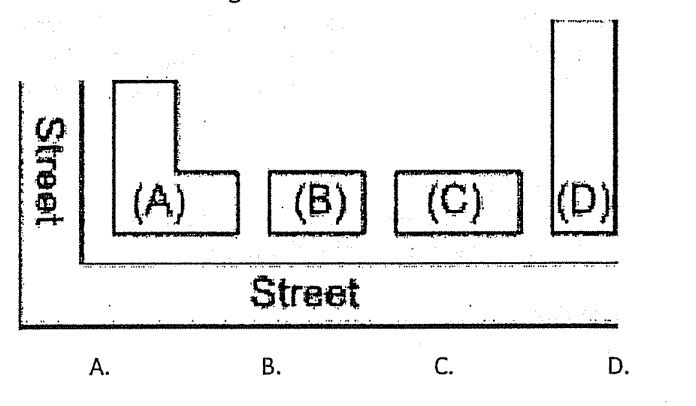
- A
- B
- C
- D
7. It can be inferred that a New York apartment building in the 1870's and 1880's had all of the following characteristics EXCEPT
- Its room arrangement was not logical.
- It was rectangular.
- It was spacious inside.
- It had limited light.
8. The word "yield" in line 13 is closest in meaning to
- harvest
- surrender
- amount
- provide
9. Why did the idea of living in an apartment become popular in the late 1800's?
- Large families needed housing with sufficient space.
- Apartments were preferable to tenements and cheaper than row houses.
- The city officials of New York wanted housing that was centrally located.
- The shape of early apartments could accommodate a variety of interior designs.
10. The author mentions the Dakota and the Ansonia in line 22 because
- they are examples of large, well designed apartment buildings
- their design is similar to that of row houses
- they were built on a single building lot
- they are famous hotels
Questions 11-20
A snowfall consists of myriads of minute ice crystals that fall to the ground in the form of frozen precipitation. The formation of snow begins with these ice crystals in the subfreezing strata of the middle and upper atmosphere when there is an adequate supply of moisture present. At the core of every ice crystal is a minuscule nucleus, a solid particle of matter around which moisture condenses and freezes. Liquid water droplets floating in the supercooled atmosphere and free ice crystals cannot coexist within the same cloud, since the vapor pressure of ice is less than that of water. This enables the ice crystals to rob the liquid droplets of their moisture and grow continuously. The process can be very rapid, quickly creating sizable ice crystals, some of which adhere to each other to create a cluster of ice crystals or a snowflake. Simple flakes possess a variety of beautiful forms, usually hexagonal, though the symmetrical shapes reproduced in most microscope photography of snowflakes are not usually found in actual snowfalls. Typically, snowflakes in actual snowfall consists of broken fragments and clusters of adhering ice crystals.
For a snowfall to continue once it starts, there must be a constant inflow of moisture to supply the nuclei. This moisture is supplied by the passage of an airstream over a water surface and its subsequent lifting to higher regions of the atmosphere. The Pacific Ocean is the source of moisture for most snowfalls west of the Rocky Mountains, while the Gulf of Mexico and the Atlantic Ocean feed water vapor into the air currents over the central and eastern sections of the United States. Other geographical features also can be the source of moisture for some snowstorms. For example, areas adjacent to the Great Lakes experience their own unique lake-effect storms, employing a variation of the process on a local scale. In addition, mountainous section or rising terrain can initiate snowfalls by the geographical lifting of a moist airstream.
11. Which of the following questions does the author answer in the first paragraph?
- Why are snowflakes hexagonal?
- What is the optimum temperature for snow?
- In which months does most snow fall?
- How are snowflakes formed?
12. The word "minute" in line 1 is closest in meaning to
- tiny
- quick
- clear
- sharp
13. What is at the center of an ice crystal?
- A small snowflake
- A nucleus
- A drop of water
- A hexagon
14. The word "adhere" in line 8 is closest in meaning to
- belong
- relate
- stick
- speed
15. What is the main topic of the second paragraph?
- How ice crystals form
- How moisture affects temperature
- What happens when ice crystals melt
- Where the moisture to supply the nuclei comes from
16. The word "it" in line 13 refers to
- snowfall
- snowflake
- cluster
- moisture
17. What is necessary for a snowfall to persist?
- A decrease in the number of snowflakes
- Lowered vapor pressure in ice crystals
- A continuous infusion of moisture
- A change in the direction of the airstream
18. How do lake-effect snowstorms form?
- Water temperature drop below freezing.
- Moisture rises from a lake into the airstream.
- Large quantities of wet air come off a nearby mountain.
- Millions of ice crystals form on the surface of a large lake.
19. The word "initiate" in line 20 is closest in meaning to
- enhance
- alter
- increase
- begin
20. Which of the following could account for the lack of snowfall in a geographical location close to mountains and a major water source?
- Ground temperatures below the freezing point
- Too much moisture in the air
- Too much wind off the mountains
- Atmospheric temperatures above the freezing point.
Kết quả: [[score]]/20
Cần cố gắng: Điểm số của bạn cho thấy cần củng cố lại kỹ năng đọc hiểu và tìm ý chính trong đoạn văn. Hãy luyện tập thường xuyên hơn.
Kết quả: [[score]]/20
Khá tốt: Bạn có khả năng đọc và nắm bắt thông tin tốt. Để đạt điểm cao hơn, hãy chú ý đến các câu hỏi suy luận và từ vựng.
Kết quả: [[score]]/20
Xuất sắc: Chúc mừng! Kỹ năng đọc hiểu của bạn rất ấn tượng. Hãy tiếp tục duy trì phong độ này.
Questions 1-10
Social parasitism involves one species relying on another to raise its young. Among vertebrates, the best known social parasites are such birds as cuckoos and cowbirds; the female lays an egg in a nest belonging to another species and leaves it for the host to rear.
The dulotic species of ants, however, are the supreme social parasites. Consider, for example, the unusual behavior of ants belonging to the genus Polyergus. All species of this ant have lost the ability to care for themselves. The workers do not forage for food. feed their brood or queen, or even dean their own nest. To compensate for these deficits, Polyergus has become specialized at obtaining workers from the related genus Formica to do these chores.
In a raid, several thousand Polyergus workers will travel up to 500 feet in search of a Formica nest, penetrate it, drive off the queen and tier workers, capture the pupal brood, and transport it back to their nest. The captured brood is then reared by the resident Formica workers until the developing pupae emerge to add to the Formica population, which maintains the mixed-species nest Th e Formica workers forage for food and give it to colony members of both species. They also remove wastes and excavate new chambers as the population increases.
The true extent of the Polyergus ants' dependence on the Formica becomes apparent when the worker population grows too large for the existing nest. Formica scouts locate a new nesting site, return to the mixed-species colony, and recruit additional Formica nest mates. During a period that may last seven days, the Formica workers carry to the new nest all the Polyergus eggs, larvae, and pupae, every Polyergus adult, and even the Polyergus queen.
Of the approximately 8,000 species of ants in the world, all 5 species of Polyergus and some 200 species in other genera have evolved some degree of parasitic relationship with other ants.
Question 1
Which of the following statements best represents the main idea of the passage?
- Ants belonging to the genus Formica are incapable of performing certain tasks.
- The genus Polyergus is quite similar to the genus Formica.
- Ants belonging to the genus Polyergus have an unusual relationship with ants belonging to the genus Formica.
- Polyergus ants frequently leave their nests to build new colonies.
Question 2
The word "raise" in line 1 is closest in meaning to...............
- rear
- lift
- collect
- increase
Question 3
The author mentions cuckoos and cowbirds in line 2 because they
- share their nests with each other
- are closely related species
- raise the young of other birds
- are social parasites
Question 4
The word "it" in line 3 refers to
- species
- nest
- egg
- female
Question 5
What does the author mean by stating that "The dulotic species of ants... are the supreme social parasites" (line 4)?
- The Polyergus are more highly developed than the Formica.
- The Formica have developed specialized roles.
- The Polyergus are heavily dependent on the Formica.
- The Formica do not reproduce rapidly enough to care for themselves
Question 6
Which of the following is a task that an ant of the genus Polyergus might do?
- Look for food.
- Raid another nest
- Care for the young.
- Clean its own nest.
Question 7
The word "excavate" in line 14 is closest in meaning to
- find
- clean
- repair
- dig
Question 8
The word "recruit" in line 18 is closest in meaning to
- create
- enlist
- endure
- capture
Question 9
What happens when a mixed colony of Polyergus and Formica ants becomes too large?
- The Polyergus workers enlarge the existing nest.
- The captured Formica workers return to their original nest.
- The Polyergus and the Formica build separate nests.
- The Polyergus and the Formica move to a new nest.
Question 10
According to the information in the passage, all of the following terms refer to ants belonging to the genus Formica EXCEPT the
- dulotic species of ants
- captured brood
- developing pupae
- worker population
Questions 11-20
The Winterthur Museum is a collection and a house. There are many museums devoted to the decorative arts and many house museums, but rarely in the United States is a great collection displayed in a great country house. Passing through successive generations of a single family, Winterthur has been a private estate for more than a century. Even after the extensive renovations made to it between 1929 and 1931, the house remained a family residence. This fact is of importance to the atmosphere and effect of the museum. The impression of a lived-in house is apparent to the visitor; the rooms look as if they were vacated only a short while ago whether by the original owners of the furniture or the most recent residents of the house can be a matter of personal interpretation. Winterthur remains, then, a house in which a collection of furniture and architectural elements has been assembled. Like an English country house, it is an organic structure; the house, as well as the collection and manner of displaying it to the visitor, has changed over the years. The changes have coincided with developing concepts of the American arts, increased knowledge on the part of collectors and students, and a progression toward the achievement of a historical effect in period-room displays. The rooms at Winterthur have followed this current, yet still retained the character of a private house.
The concept of a period room as a display technique has developed gradually over the years in an effort to present works of art in a context that would show them to greater effect and would give them more meaning for the viewer. Comparable to the habitat group in a natural history museum, the period room represents the decorative arts in a lively and interesting manner and provides an opportunity to assemble objects related by style, date, or place of manufacture.
Question 11
What does the passage mainly discuss?
- The reason that Winterthur was redesigned
- Elements that make Winterthur an unusual museum
- How Winterthur compares to English country houses
- Historical furniture contained in Winterthur
Question 12
The phrase "devoted to" in line 1 is closest in meaning to
- surrounded by
- specializing in
- successful with
- sentimental about
Question 13
What happened at Winterthur between 1929 and 1931?
- The owners moved out.
- The house was repaired.
- The old furniture was replaced.
- The estate became a museum.
Question 14
What does the author mean by stating "The impression of a lived-in house is apparent to the visitor" (line 6)?
- Winterthur is very old.
- Few people visit Winterthur.
- Winterthur does not look like a typical museum.
- The furniture at Winterthur looks comfortable.
Question 15
The word "assembled" in line 9 is closest in meaning to
- summoned
- appreciated
- brought together
- fundamentally changed
Question 16
The word "it" in line 10 refers to
- Winterthur
- collection
- English country house
- visitor
Question 17
The word "developing" in line 11 is closest in meaning to
- traditional
- exhibiting
- informative
- evolving
Question 18
According to the passage, objects in a period room are related by all of the following EXCEPT .........
- date
- style
- place of manufacture
- past ownership
Question 19
What is the relationship between the two paragraphs in the passage?
- The second paragraph explains a term that was mentioned in the first paragraph.
- Each paragraph describes a different approach to the display of objects in a museum.
- The second paragraph explains a philosophy of art appreciation that contrasts with the philosophy explained in the first paragraph.
- Each paragraph describes a different historical period.
Question 20
Where in the passage does the author explain why displays at Winterthur have changed?
- lines 1-3
- lines 4-6
- lines 5-7
- lines 9-12
Kết quả: [[score]]/20
Cần luyện tập thêm: Bạn cần đọc kỹ hơn để nắm bắt ý chính và các chi tiết quan trọng trong bài đọc.
Kết quả: [[score]]/20
Khá tốt: Bạn đã có kỹ năng đọc hiểu tốt. Hãy tiếp tục rèn luyện để tăng tốc độ và độ chính xác khi làm bài.
Kết quả: [[score]]/20
Xuất sắc: Chúc mừng! Kỹ năng đọc hiểu của bạn rất ấn tượng.
TEST 5
A: LISTENING
Directions: This is the listening test for levels from 3 to 5 of the Vietnam's 6-level Language Proficiency Test. There are three parts to the test. You will hear each part once. For each part of the test there will be time for you to look through the questions and time for you to check your answers. Write your answers on the question paper. You will have 5 minutes at the end of the test to transfer your answers onto the answer sheet.
PART 1
There are eight questions in this part. For each question there are four options and a short recording. For each question, choose the correct answer A, B, C or D. You now have 48 seconds to look through the questions and the options in each question.
1. What time is it?
- 02.10
- 02.20
- 02.30
- 03.20
2. What's Michelle going to read?
- book
- letter
- newspaper
- magazine
3. How much did the tickets cost?
- $19
- $90
- $99
- $9
4. What is the man going to buy?
- sunglasses
- something to read
- pills
- food
5. Which dress is Kate talking about?
- a dress with no button
- a dress with many buttons
- a dress with collar
- a dress with no collar
6. When will Jane meet them?
- 08:00
- 08:30
- 08:45
- 03:15
7. Which morning activity is for beginners?
- windsurfing
- swimming
- sailing
- running
8. Which painting does the woman decide to buy?
- a painting with boats
- a painting with flowers
- a painting with horses
- a painting with white clouds
PART 2
You will hear three different conversations. In each conversation there are four questions. For each question, choose the correct answer A, B, C or D. You will hear the conversations only once.
Conversation 1. You will hear a conversation between Matthew and his mother
9. Why doesn't his mother lend him her car?
- Because her car doesn't work well today
- Because he can't drive
- Because she needs the car
- Because he can walk
10. What will Matthew do after class?
- move his books
- move his flat
- help his friend
- repair his car
11. When is his mother's meeting?
- Thursday 19th
- Friday 9th
- Wednesday 9th
- Not discussed
12. What is true about the conversation?
- Matthew forgot to ask his mother about her car
- His mother refused to lend him her car.
- His mother agrees to take him to school by car
- This problem is due to his mother's mistake
Conversation 2. Listen to an interview about indoor skydiving.
13. Where does he play this sport?
- in a wind tunnel
- from an aeroplane outdoor
- in a park
- from a high hill
14. What is the name of the sport center?
- Vertical Tunnel center
- Extreme sports center
- Runaway
- Adventure sports center
15. What is it like to be in the wind tunnel?
- you stand on bars
- you stay afloat
- your hair is dried
- you fly up high.
16. How dangerous is this sport?
- Glass might break and hurt you
- You suffer from small injuries
- You might fly off the tunnel
- You can't stop flying up
Conversation 3. Listen to a conversation between a director of study in an English language center and a student representative talking about their self-access center.
17. What is the main topic of the conversation?
- to know how students used the center
- to know what to do with the center
- to talk about the effectiveness of the library
- to learn how to use the library effectively
18. What is the main problem of the center?
- too many resources
- slow computers
- lack of valuable resource
- lack of computers
19. The director complains that students are using computers for
- looking for personal resources
- relocating documents
- reading their emails
- learning computer skills
20. What are they likely to do with the center?
- move it to the library
- purchase more equipment
- ask teacher to come to the center
- ask students to stop using emails
PART 3
You will hear three different talks or lectures. In each talk or lecture there are five questions. For each question, choose the correct answer A, B, C or D. You will hear the talks or lectures only once.
Talk/Lecture 1. You'll hear part of a talk about dolls
21. What is the main purpose of the talk?
- To describe how the man's favorite dolls look like.
- To explain how dolls used to look like in the twelfth century.
- To compare the differences in all doll examples in the museum.
- To explain how dolls were made differently in times
22. The dolls that the man is interested in
- Existed from the twentieth century.
- Existed from the seventeenth century.
- Existed from the eighteenth century.
- Existed from the nineteenth century.
23. At the beginning of the twentieth century, dolls were
- Babies.
- Adults.
- Elderly.
- Males.
24. What makes the dolls in the seventeenth century special?
- They existed fairly early.
- They were made from solid wood.
- They are very expensive today.
- Their decorations are original.
25. What can you do with the nineteenth-century dolls?
- Buy them with thousands of pounds.
- Take off their hair.
- Replace their hair with real hair.
- See the maker's name on the body.
Talk/Lecture 2. Listen to a man called Stephen Mills talking to a group of people about a trip to India to see tigers.
26. When is the best time to see the tigers?
- November
- October
- September
- The following day
27. How long will they be in the park?
- Twenty days.
- Eighteen days.
- Ten days
- No information
28. What is arranged to make sure the visitors are comfortable?
- Meals.
- Transportation.
- Accommodation
- Schedule.
29. What is Stephen Mill's profession?
- Photographer.
- Tour guide.
- Traveller.
- Artist.
30. What is not included in the program?
- Going sightseeing in Delhi.
- Going shopping in Delhi.
- Breakfast on the last day.
- Lunch on the last day.
Talk/Lecture 3. You'll hear a talk on local radio about a children's theme park.
31. Simon's idea for a theme park came from
- his childhood hobby.
- his interest in landscape design.
- his visit to another park
- his wife's idea.
32. When they started, the family decided to open the park only when
- The weather was expected to be good.
- There were not many people in the neighborhood.
- The children weren't at school.
- There were fewer farming commitments.
33. Since opening, the park has had
- 50,000 visitors.
- 1,000,000 visitors.
- 5000 visitors.
- 1,500,000 visitors.
34. What did their children love?
- Trains.
- Theme park.
- Farm work.
- Wet weather.
35. The park today is
- Closed on holidays.
- Opened all year.
- Closed every two months.
- Opened on weekdays.
Kết quả: [[score]]/35
Cần cố gắng: Kỹ năng nghe hiểu của bạn cần được cải thiện. Hãy tập trung vào việc nghe các đoạn hội thoại ngắn và làm quen với các dạng câu hỏi cơ bản.
Kết quả: [[score]]/35
Khá tốt: Bạn có khả năng nghe và nắm bắt thông tin tốt. Để đạt điểm cao hơn, hãy luyện tập nghe các đoạn nói dài và chú ý đến các chi tiết nhỏ.
Kết quả: [[score]]/35
Xuất sắc: Chúc mừng! Kỹ năng nghe hiểu của bạn rất ấn tượng. Hãy tiếp tục duy trì phong độ để chinh phục các mục tiêu cao hơn.
Directions: In this section you will read FOUR different passages. Each one is followed by 10 questions about it. For questions 1-40, you are to choose the best answer A, B, C or D, to each question. Then, on your answer sheet, find the number of the question and fill in the space that corresponds to the letter of the answer you have chosen. Answer all questions following a passage on the basis of what is stated or implied in that passage. You have 60 minutes to answer all the questions, including the time to transfer your answers to the answer sheet.
PASSAGE 1 – Questions 1-10
The Association of Southeast Asian Nations (ASEAN) is the main political and economic organization for that area. The leaders summit is their last meeting before the launch of the ASEAN Economic Community, or AEC, on December 31.
The AEC will be equivalent to the world's seventh largest economy. It was set up to create a highly competitive single market and production area. Organizers hope it will ease the movement of capital, goods, investment, services and skilled labor across ASEAN countries. The goal is to make the whole area more competitive and economically successful. But, some business leaders have low expectations for the ASEAN summit. Anthony Nelson is a director at the US-ASEAN Business Council in Washington. He believes that security will be an important issue at the meetings, especially after the terrorist attacks in Paris last week.
"The November summit includes the East Asia Summit, which primarily focuses on political and security issues. So that's going to be a big part of what is actually going on around the summit. A lot of the work that business gets really involved in tends to happen around the ASEAN economic ministers' meeting in August." But, the AEC may have only limited influence on business activity when it comes into being next year. Experts expect little to change at first because there is still much to be done.
"The ASEAN single window, which is a customs project, is still very much a work in progress. But beginning next year they will start limited trials with five of the 10 ASEAN countries. And there have been past mutual recognition agreements for credentials of skilled professionals. But there's still a lot of work to be done in terms of actually implementing those agreements." Some critics say the AEC will mainly help businesses, not the majority of people in Southeast Asia. Earlier this year, the ASEAN Civil Society Conference and ASEAN Peoples' Forum expressed concern about regional economic integration. In a statement, the group said such a move would mean unequal and unsustainable economic growth. This, it said, would result "in worsening poverty and inequalities of wealth." Jerald Joseph is co-chair of the ASEAN People's Forum. He says people crossing borders to find employment need more protections. He said: "Cross-border migrant workers don't have the same level of protection or interest in the whole negotiation. So that's a little bit of a pity, a wasted chance, if it's not reflected in the coming document." The 27th ASEAN Summit includes the organization's partners. Nations including China, India, Japan and the United States are to attend.
1. ASEAN is the main political and economic organization in...........
- East Asia
- Southeast Asia
- West Asia
- North Asia
2. What does the word "It" in paragraph 2 refer to?
- ASEAN
- Organizer
- AEC
- Business Council
3. According to Anthony Nelson, what is the important issue at the meetings?
- Security
- Climate change
- Business
- Economy
4. According to the passage, what aspect tends to happen around the ASEAN economic ministers?
- Security
- Climate change
- Business
- Economy
5. According to the passage, how many countries in the ASEAN will start limited trials?
- 3
- 5
- 7
- 10
6. The word "credentials" in line 19 can be replaced by
- letters
- salutations
- invitations
- certificates
7. The word "implementing" in line 20 is closest in meaning to
- carrying out
- producing
- concentrating
- focusing
8. The word "integration" in line 23 can be replaced by
- utilization
- contribution
- combination
- separation
9. According to the passage, what would delay the increase of the economy?
- the recession
- the poverty
- the move
- the employment
10. According to the passage, who require more assurance?
- travellers
- immigrants
- residents
- tourists
PASSAGE 2 – Questions 11-20
In 1969, a key milestone in space travel was reached when Neil Armstrong set foot on the moon. In 2001, another landmark event took place when the first civilian traveled into space as a paying tourist. As a teenager, Dennis Tito dreamed of visiting outer space. As a young man, he aspired to become an astronaut and earned a bachelor's and a master's degree in aerospace engineering. However, Tito did not have all the qualities necessary to become a professional astronaut; so instead, he went to work as a space engineer in one of NASA's laboratories for five years. Later, Tito set up his own financial investment company and, eventually, he became a multi-millionaire. Later in life, the ex rocket engineer, still passionate about space travel, began looking into ways to make a trip into space.
In the early 1990s, the Soviet Space Agency was offering tickets for a visit to the Mir space station to anyone who could afford it. Tito jumped at the chance for this once-in-a- lifetime experience. Due to political and economic changes in the former Soviet Union, however, Tito's trip was postponed and later, Mir was decommissioned. In 2001, Tito's dream was finally came true when he paid a rumored $20 million and took off aboard a SOYUZ rocket to deliver supplies to the International Space Station, a joint venture between the space agencies of Japan, Canada, Europe, Russia, and the U.S.
In preparation for the trip, Tito trained at the Gagarin Cosmonauts Training Center at Star City in Russia. There, he underwent eight months of physical fitness training, weightless simulations, and a variety of other exercises to prepare him for space travel. Although the Russians believed that Tito was adequately prepared for the trip, NASA thought otherwise. Dennis Tito had to sign an agreement with international space officials taking financial responsibility for any equipment he damaged or broke on his trip. He was also barred from entering any part of the space station owned by the U.S. unless escorted.
Although Tito made history and paved the way for the future of space tourism, factors such as cost, and the amount of training required, stand in the way of space vacations becoming an option for most people in the near future. In spite of this, Japanese and North American market data shows that there is definite public interest in space travel. In a 1993 survey of 3,030 Japanese, 80 percent of those under the age of forty said they would like to visit space at least once. Seventy percent of this group would pay up to three month's salary for the trip. In 1995, 1,020 households in North America were surveyed and of those, 60 percent were interested were under forty years of age. Just over 45 percent said they would pay three month's salary, around 18 percent said they would pay six month's salary, and nearly 11 percent would pay a year's salary. Two - thirds of those who want to visit space would like to do so several times. Since the nature of this type of travel makes it hazardous to humans, it would have to be restricted to those who are physically fit and able to take responsibility for the risks involved.
11. According to the passage, what was the main event in 1969?
- Scientists planned to travel to space.
- People started to concern space travel.
- The dream of space travel became true.
- Neil Armstrong was ready for heading to the moon.
12. When did Dennis Tito dream of becoming an astronaut?
- When he was at kindergarten.
- When he was at primary school.
- When he was at his teen.
- When he was at university.
13. Dennis Tito made the first trip as a space tourist
- in the late '60s.
- in the early '90s.
- this century.
- in the late '50s.
14. Which of the following is NOT true about Dennis Tito?
- He has an advanced degree in aerospace engineering.
- He is now an astronaut for NASA.
- He eventually became a very wealthy man.
- He used to dream of travelling to outer space.
15. Tito's first trip into space was with __________ to __________
- the Russian/ the International Space Station.
- the Americans/SOYUZ
- members of the former Soviet Union/ the Mir space station
- the Japanese agency
16. Which of the following describes NASA's feelings about Tito's trip into space?
- extremely proud
- somewhat eager
- very concerned
- disappointed
17. According to Japanese survey, which of the following is true?
- Eighty percent of all those interviewed would be interested in travelling to space.
- Some people would pay a quarter of their annual salary to visit space.
- Only people under the age of forty are interested in space travel.
- Seventy percent of Japanese would pay three quarters of their annual salary to visit space.
18. According to a North American survey on space travel, which is true?
- Seventy - five percent of those surveyed would be interested in travelling to space.
- Most people would pay a year's salary to visit space as a tourist.
- Most of the people interested in space travel were under the age of forty.
- Nearly sixty percent of those surveyed were interested in a vacation in space travel.
19. According to the passage, who did not believe that Tito was trained well enough for the trip to space?
- Russian Training Center.
- Japanese Training Center.
- European Training Center.
- NASA
20. Which of the following would probably prevent you from becoming a space tourist in the near future?
- health
- wealth
- youth
- age
Kết quả: [[score]]/20
Cần cố gắng: Điểm số cho thấy bạn cần củng cố thêm kỹ năng đọc hiểu và tìm kiếm thông tin chi tiết trong đoạn văn.
Kết quả: [[score]]/20
Khá tốt: Bạn đã có khả năng đọc và hiểu các ý chính. Hãy luyện tập thêm để tăng tốc độ và độ chính xác.
Kết quả: [[score]]/20
Xuất sắc: Chúc mừng! Kỹ năng đọc hiểu của bạn rất tốt. Hãy tiếp tục duy trì phong độ này.
PASSAGE 3 – Questions 1-10
During the heyday of the railroads, when America's rail system provided the bulk of the country's passenger and freight transportation, various types of railroad cars were in service to accomplish the varied tasks handled by the railroads. One type of car that was not available for public use prior to the Civil War, however, was a sleeping car; ideas for sleeping cars abounded at the time, but these ideas were unworkable. It unfortunately took the death of a president to make the sleeping car a viable reality.
Cabinet - maker George M. Pullman had recognized the demand for sleeping cars and had worked on developing experimental models of sleeping cars in the decade leading up to the Civil War. However, in spite of the fact that he had made successful test runs on the Chicago and Alton Railroads with his models, he was unable to sell his idea because his models were too wide and too high for existing train station and bridges. In 1863, after spending time working as a storekeeper in a Colorado mining town, he invested his savings of twenty thousand dollars, a huge fortune at that time and all the money that he had in the world, in a luxurious sleeping car that he named the Pioneer. Pullman and friend Ben Field built the Pioneer on the site of the present - day Chicago Union Station. For two years, however; the Pioneer sat on a railroad siding, useless because it could not fit through train stations and over bridges.
Following President Lincoln's assassination in 1865, the state of Illinois, Lincoln's birthplace, wanted to transport the presidential casket in the finest fashion possible. The Pullman Pioneer was the most elegant car around; in order to make the Pullman part of the presidential funeral train in its run from Springfield to Chicago, the state cut down station platforms and raised bridges in order to accommodate the luxurious railway car. The Pullman car greatly impressed the funeral party, which included Lincoln's successor as president, General Ulysses S. Grant, and Grant later requested the Pioneer for a trip from Detroit to Chicago. To satisfy Grant's request for the Pioneer, the Michigan Central Railroad made improvements on its line to accommodate the wide car, and soon other railroads followed. George Pullman founded the Pullman Palace Car Company in partnership with financier Andrew Carnegie and eventually became a millionaire.
Pullman cars were normally a dark "Pullman green", although some were painted in the host railroad's colors. The cars carried individual names, but usually did not carry visible numbers. In the 1920s, the Pullman Company went through a series of restructuring steps, which in the end resulted in a parent company, Pullman incorporated, controlling the Pullman Company (which owned and operated sleeping cars) and the Pullman - Standard Car Manufacturing Company.
1. Which of the following best states the main idea of the passage?
- America's railroads used to provide much of the country's transportation.
- President Lincoln's assassination in 1865 shocked the nation.
- George Pullman was the only one to come up with the idea for a sleeping car.
- Pullman's idea for a sleeping car became workable after Lincoln's death.
2. A "heyday" in line 1 is most probably a
- time for harvest.
- a period with low prices.
- a period of great success.
- a type of railroad schedule.
3. It can be inferred from the passage that before the Civil War, sleeping cars
- were used abundantly.
- were thought to be a good idea.
- were only used privately.
- were used by presidents.
4. What is the main idea of paragraph 2?
- Pullman had been successful in selling his sleeping cars.
- Though Pullman had been successful in test runs with his sleeping cars model; it could not be suitable with the transportation in Chicago.
- Pullman had recognized the demand for sleeping cars.
- Pullman had invested much money on developing the sleeping cars.
5. What was the initial problem that made Pullman's card unusable?
- They were too large.
- They were too expensive.
- They were too slow.
- They were too unusual.
6. What is stated in the passage about George Pullman?
- He once had a job in a store.
- He always lived in Chicago.
- He worked in a mine.
- He saved money for his project.
7. What is true about the sleeping cars?
- The experimental models of sleeping cars had not been successful until 1863.
- The Pioneer did not cost Pullman a fortune.
- The Pioneer was considered to be the most charming cars in comparison with others.
- The Pullman car was extremely beneficial because of its fitness through train station and bridges.
8. Why did the state of Illinois want to use the Pullman in Lincoln's funeral train?
- It was superior to other cars.
- It was the only railroad car that could make it from Springfield to Chicago.
- Ulysses S. Grant requested it.
- The Pullman Palace Car Company was a major Illinois business.
9. It can be inferred from the passage that the Michigan Central Railroad
- was owned by George Pullman.
- controlled the railroad tracks between Detroit and Chicago.
- was the only railroad company to accommodate wider cars.
- was the sole manufacturer of the Pioneer.
10. This passage would most likely be assigned in which of the following courses?
- Engineering
- Political science
- Finance
- History
PASSAGE 4 – Questions 11-20
Garbage cans are not magical portals. Trash does not disappear when you toss it in a can. Yet, the average American throws away an estimated 1,600 pounds of waste each year. If there are no magic garbage fairies, where does all that trash go? There are four methods to managing waste: recycling, land-filling, composting, and incinerating. Each method has its strengths and weakness. Let's take a quick look at each.
Recycling is the process of turning waste into new materials. For example, used paper can be turned into paperboard, which can be used to make book covers. Recycling can reduce pollution, save materials, and lower energy use. Yet, some argue that recycling wastes energy. They believe that collecting, processing, and converting waste uses more energy than it saves. Still, most people agree that recycling is better for the planet than land-filling.
Land-filling is the oldest method of managing waste. In its simplest form, land-filling is when people bury garbage in a hole. Over time the practice of land-filling has advanced. Garbage is compacted before it is thrown into the hole. In this way more garbage can fit in each landfill. Large liners are placed in the bottom of landfills so that toxic garbage juice doesn't get into the ground water. Sadly; these liners don't always work. Landfills may pollute the local water supply. Not to mention that all of that garbage stinks. Nobody wants to live next to a landfill. This makes it hard to find new locations for landfills.
As landfill space increases, interest in composting grows. Composting is when people pile up organic matter, such as food waste, and allows it to decompose. The product of this decomposition is compost. Compost can be added to the soil to make the soil richer and better for growing crops. While composting is easy to do onsite somewhere, like home or school, it's hard to do after the garbage gets all mixed up. This is because plastic and other inorganic materials must be removed from the compost pile or they will pollute the soil. There's a lot of plastic in garbage, which makes it hard to compost on a large scale.
One thing that is easier to do is burning garbage. There are two main ways to incinerate waste. The first is to create or harvest a fuel from the waste, such as methane gas, and burn the fuel. The second is to burn the waste directly. The heat from the incineration process can boil water, which can power steam generators. Unfortunately, burning garbage pollutes the air. Also, some critics worry that incinerators destroy valuable resources that could be recycled.
Usually, the community which you live manages waste. Once you put your garbage in that can, what happens to it is beyond your control. But you can make choices while it is still in your possession. You can choose to recycle, you can choose to compost, or you can choose to let someone else deal with it. The choice is yours.
11. Which best explains why the author begins the text by talking about magical garbage fairies?
- He is putting a common misconception to rest.
- He is trying to get the reader's attention.
- He is addressing his concern in a serious way.
- He is supporting his argument with evidence.
12. Which best expresses the meaning of the word "compacted" as it is used in the third paragraph?
- Garbage is burned before it is thrown in a hole.
- Garbage is put in trucks before it is thrown in a hole.
- Garbage is crushed smaller before it is thrown in a hole.
- Garbage is put in a can before it is thrown in a hole.
13. Which was NOT cited in the third paragraph as an issue with land-filling?
- Landfills are smelly.
- Usable materials are wasted in landfills.
- Landfills may pollute the water supply.
- It is difficult to find locations for landfills.
14. Which best expresses the main idea of the fourth paragraph?
- Landfills take up a lot of space.
- Composting is good for the soil but it can be difficult.
- The process of composting is very complicated and scientific.
- There is a lot of plastic garbage in landfills.
15. Which best defines the meaning of incineration as it is used in the text?
- To bury waste materials in a large hole
- To allow waste products to decompose and become fertilizer
- To burn waste materials and harvest the energy
- To turn waste materials into products like book covers
16. Which conclusion could be supported with text from the passage?
- Each method of waste management has its drawbacks.
- Recycling is without a doubt the best way to handle waste.
- Incineration is the best way to process waste.
- All large cities should create massive compost piles.
17. Which best expresses the author's main purpose in writing this?
- To convince readers to recycle and compost
- To persuade readers that recycling is a waste of resources
- To compare and contrast recycling and land-filling
- To inform readers of methods of waste management
18. Which is NOT included in this text?
- A description of how trash is collected
- A description of the uses of compost
- A description of the two methods of incinerating trash
- A description of how landfills have advanced over time
19. Which best explains why composting is not feasible on a large scale?
- People wouldn't want to touch all of that gross rotting food.
- It would smell too bad in densely populated cities.
- It would attract rodents that would spread disease.
- Plastic would get into the compost and turn it into a pollutant.
20. Which title best expresses the main idea of this text?
- The Magic of Recycling: Bringing Back What Was Once Lost
- Methods of Waste Management: Pros and Cons
- Recycling Land-filling or Composting: Which is Best For You?
- Do Your Part: How to Save the Earth by Recycling and Composting
Kết quả: [[score]]/20
Cần cố gắng: Điểm số của bạn cho thấy cần củng cố lại các kỹ năng đọc hiểu cơ bản. Hãy luyện tập thêm để cải thiện khả năng nắm bắt ý chính và thông tin chi tiết.
Kết quả: [[score]]/20
Khá tốt: Bạn có khả năng đọc hiểu ổn định. Để đạt điểm cao hơn, hãy tập trung vào việc phân tích các câu hỏi suy luận và tìm ý nghĩa của từ trong ngữ cảnh.
Kết quả: [[score]]/20
Xuất sắc: Chúc mừng! Kỹ năng đọc hiểu và phân tích thông tin của bạn rất tốt. Hãy tiếp tục duy trì phong độ này.
Listen to the audio and answer questions 1-35.
TEST 6 - A: LISTENING
Directions: This is the listening test for levels from 3 to 5 of the Vietnam's 6-level Language Proficiency Test. There are three parts to the test. You will hear each part once. For each part of the test there will be time for you to look through the questions and time for you to check your answers.
PART 1
There are eight questions in this part. For each question there are four options and a short recording. For each question, choose the correct answer A, B, C or D.
Question 1: How will Mary travel to Scotland?
- bus
- car
- train
- plane
Question 2: Where are the shoes?
- under the window
- under the table
- on the chair
- by the door
Question 3: When will the football match start next week?
- 11.45 a.m
- 12.15 p.m
- 02.00 p.m
- 04.25 p.m
Question 4: What is Sarah's mother doing?
- going out
- cooking
- washing-up
- cleaning the house
Question 5: What luggage is the man taking on holiday?
- two suitcases and a bag
- two bags and a suitcase
- two suitcases
- one suitcase and a bag
Question 6: Where will the woman go first after work?
- the restaurant
- the market
- the cinema
- tennis court
Question 7: What can festival visitors see everyday?
- plays
- paintings
- films
- concerts
Question 8: What souvenir will the boy's mother bring?
- a T-shirt
- baseball cap
- a model car
- a taxi
PART 2
You will hear three different conversations. In each conversation there are four questions. For each question, choose the correct answer A, B, C or D.
Conversation 1. You will hear part of a local radio programme in which someone is talking about a shopping center.
Question 9: When was the center first opened?
- three years ago
- three weeks ago
- two months ago
- two weeks ago
Question 10: How can you get to the center?
- by car and taxi
- by train and taxi
- by car, taxi and train
- by car, train and coach
Question 11: What time do the shops close on Saturday?
- 9:00 am
- 10:00 am
- 8:00 pm
- 9:00 pm
Question 12: What should people do before shopping in the center?
- collect money from the bank
- watch a movie
- rest by the lake
- buy a map
Conversation 2. Listen to an interview with a representative of a wildlife park called Paradise Wildlife Park.
Question 13: Why did Serengeti lions die?
- attacked by domestic dogs
- infected with a disease from domestic dogs
- killed by other wild animals
- sent to villages
Question 14: What events are NOT organized in the park?
- product introduction
- charity events
- family camping
- barbecue
Question 15: You can try this when coming to the park:
- introducing programs on the radio
- deliver discounted tickets
- organize competition
- host an event
Question 16: Which one is not a programme of the park?
- Project Life Lion
- Atlantic Rainforest Project
- Discounted Tickets
- None of the above
Conversation 3. Listen to a conversation about a heater.
Question 17: How many main controls are there on the heater?
- two
- three
- four
- none
Question 18: What is the reason for the problem of the heater?
- the switch doesn't light up
- the little square is black
- the switch is off
- the switch is on
Question 19: When does the woman have to restart the heater?
- When there isn't enough water
- when the water is too hot
- when the heater is switched off
- When there is no light
Question 20: How does the woman feel after listening to the instruction?
- confused
- motivated
- interested
- encouraged
PART 3
You will hear three different talks or lectures. In each talk or lecture there are five questions. For each question, choose the correct answer A, B, C or D.
Talk/Lecture 1. You'll hear someone talking to a group of students about a visit to an Arts Centre.
Question 21: There are still tickets for...
- The piano concert.
- The movie.
- Twelfth Night.
- Spider and Rose.
Question 22: The coach will leave at 3.30 because...
- it's the earliest.
- they don't want to miss the shows.
- they want free time at the Arts Centre.
- it's a long journey to the Arts Centre.
Question 23: You have to pay to see...
- the Russian ballet exhibition.
- the shoes store.
- the Scottish jewellery.
- the South American photographs.
Question 24: You can buy clothes...
- on the first floor.
- on the second floor.
- in the souvenir shop.
- close to the Arts Centre.
Question 25: If you want a snack and a hot drink, try...
- the nearby café.
- the fountain.
- Charlie's.
- the cinema kiosk.
Talk/Lecture 2. You'll hear part of a radio programme about bags for walkers.
Question 26: Rod's shop sells bags and...
- camping equipment.
- hiking clothes.
- walking holiday stuffs.
- maps.
Question 27: A 35-litre bag is good for...
- a day trip.
- a four day trip.
- a five day trip.
- a weekend trip.
Question 28: A bag that allows you to separate your belongings has...
- a solid bottom.
- a leather base.
- two compartments inside.
- pockets outside.
Question 29: It's important that shoulder straps are...
- light.
- flexible.
- fashionable.
- strong.
Question 30: Another essential part of the bags includes...
- straps.
- air holes.
- sweat absorption.
- a cooler tool.
Talk/Lecture 3. You will hear a representative from a holiday company called PS Camping.
Question 31: PS Camping has been organising holidays for...
- 15 years.
- 20 years.
- 25 years.
- 30 years.
Question 32: The company has most camping sites in...
- France.
- Italy.
- Europe.
- Switzerland.
Question 33: Which organized activity can children do every day of the week?
- Singing and dancing.
- Football.
- Drama.
- Model making.
Question 34: Some areas of the sites have a "no-noise" rule after...
- 9.30 pm
- 10.00 pm
- 10.30 pm
- 11.30 pm
Question 35: Customers who recommend PS Camping to friends will receive...
- a free gift.
- an upgrade to a luxury tent.
- a discount.
- an insurance.
Kết quả: [[score]]/35
Cần cố gắng: Điểm số của bạn cho thấy cần củng cố lại các kỹ năng nghe cơ bản. Hãy tập trung nghe các đoạn hội thoại ngắn và làm quen với các dạng câu hỏi.
Kết quả: [[score]]/35
Khá tốt: Bạn có khả năng nghe hiểu ổn định. Để đạt điểm cao hơn, hãy tập trung vào việc nhận biết các thông tin gây nhiễu và luyện tập nghe các bài nói dài hơn.
Kết quả: [[score]]/35
Xuất sắc: Bạn sở hữu kỹ năng nghe hiểu rất ấn tượng. Hãy tiếp tục duy trì phong độ này để chinh phục các mục tiêu cao hơn.
B: READING
Time permitted: 60 minutes
Number of questions: 40
Directions: In this section you will read FOUR different passages. Each one is followed by 10 questions about it. For questions 1-40, you are to choose the best answer A, B, C or D, to each question. Then, on your answer sheet, find the number of the question and fill in the space that corresponds to the letter of the answer you have chosen. Answer all questions following a passage on the basis of what is stated or implied in that passage. You have 60 minutes to answer all the questions, including the time to transfer your answers to the answer sheet.
PASSAGE 1 – Questions 1-10
TV REVIEW
Lucy Chang tells you what's new (and not so new!) on your screens this summer.
I always look forward to this time of year, and I'm always disappointed! It's the time of year when the TV channels tell us their plans for the summer and every year I tell myself that it might be different. It never is. Take SuperTV, for example. This channel, on our screens for five years now, broadcasts a depressing mix of game shows and music videos. So what do we find in the new schedule? I'm The One, a game show with holidays as prizes, and VJ-TV, yet another music video programme with brainless presenters. They're also planning to repeat the dreadful chat show Star Quality, which is about as entertaining as watching grass grow. Why can't they come up with new ideas?
Channel 9 does a little better. Now that Train Driver has finished, they've decided to replace it with Staff Room, a reality show that follows teachers around all day. It should be the hit of the summer, giving us an idea of what really goes on when the lesson is over. Who doesn't want to see and hear what teachers say about their students at the end of the school day? Great stuff! Together with Life in Aylesford Street, the soap opera that everyone's talking about, it looks like Channel 9 could be the channel to watch this summer.
Over on BTV1, Max Read is back with Joke-a-Cola, the comedy show. The first series was slightly amusing, the second hilarious. Let's wait and see what the third series is like. Comedy is difficult to get right, but it ought to be great. I wish I could say the same about the sitcom, Oh! Those Kids! It's enough to look at the expressions on the faces of the cast! It's obvious they know it's rubbish and the script is just so badly written! Oh! Those writers!
The programme makers must think we'll watch anything. That's just not true. People might have hundreds of channels on their TV or might live near a cinema with a dozen screens. There is so much choice of entertainment these days - TV, the cinema, the theatre, even the internet that they have to work hard to keep their audience. What they should be doing is making new, exciting programmes. Where are the programmes that make people think they must stay in to watch them?
We have to ask ourselves what entertainment is. We have to think about what people do with their leisure time. Television has been popular for about 50-60 years but it might not be popular forever. More people are going to the cinema and theatre than ever before. More people are surfing the internet or playing computer games than ever before. If Oh! Those Kids! is all that the TV can offer, why should we watch it? With one or two exceptions, this summer's programmes will make more people turn off than turn on.
1. At this time of year
- the TV channels change all their programmes.
- the writer disappoints the TV channels with her reviews.
- the writer hopes for something that never happens.
- the writer's favourite programmes often disappear.
2. How does the writer describe the current programmes on SuperTV?
- exciting
- informative
- strange
- disappointing
3. What does 'They' in line 7 refer to?
- SuperTV
- the TV channels
- the presenters of VJ-TV
- TV viewers
4. The writer says that Staff Room will probably
- be successful.
- shock students.
- be worse than Train Driver.
- be on instead of Life in Aylesford Street.
5. Characters of the show Staff Room are
- students
- teachers
- travelers
- Channel 9's audience
6. The word "hilarious" in line 15 can be best replaced by
- amusing
- informative
- strange
- up-to-date
7. The writer thinks that Joke-a-Cola is now 3
- more difficult to understand.
- more popular with viewers.
- funnier than before.
- more like a sitcom.
8. Because of the various choice of entertainment
- people watch more television.
- people move to areas with more facilities.
- programme makers have to tell lies.
- programmes have to be more exciting.
9. The writer thinks that television
- will never be as popular as the theatre is.
- should show more programmes about hobbies.
- could lose its popularity in the future.
- ought to provide more than just entertainment.
10. Which of the following channels would the author most probably recommend viewers to watch?
- SuperTV
- Channel 9
- BTV1
- All of them
PASSAGE 2 - Questions 11-20
The reluctant hero
The most endearing thing about Aaron Green - and there are many - is his refusal to accept how famous he's about to become. 'I can walk down the street and not be hassled, which is really nice. I kind of hope that continues and I'm sure it will,' he says earnestly. He seems genuinely to believe that the job won't change his life. 'There's nothing fascinating about my life, and there's absolutely no reason why that should start happening.' You can only wish him well.
How lovely if this turned out to be true, but the chances are it won't, and he must know this. Aaron has been cast as the hero in the latest fantasy blockbuster that will hit our screens next year. The first photo of him in his costume was released last week to Internet frenzy.
After an award nomination for his last film, Aaron is having the biggest year of his life, but it hasn't gone to his head. 'It's nice if your work is praised, but it's all very new to me, this,' he says. 'I really like working in this profession and exploring its possibilities. Who knows what the future holds? We could dream about what might happen next, but there's not much point. I'm just enjoying my job and want to do well in it in the future, but that's kind of it, really. No big hassles.'
Of all the characters in his last film, which is based on a true story about a group of university students who start an influential blog, Aaron's character is the one who emerges as most likeable. But he insists that the plot is not as straightforward as it might appear. 'What's wonderful about this film is that everyone feels they are the good guy. I don't think anyone in the cast felt they were playing the villain. It was just a group of human beings that had different opinions.'
It's a typically thoughtful answer from the 27-year-old, who seems to be a bit of a worrier and prefers to avoid watching himself on screen. Doubtless he doesn't care for interviews either, but he is so open and engaging that you wouldn't know it. He felt 'a heightened sense of responsibility' playing a real-life person in his last film, but had no contact with the person concerned. These people are living and breathing somewhere - of course that has a great effect on the care with which you approach your work. I kept wondering if he'd come and see the film, if he'd recognize himself in my performance or be angered by it.'
His performance has a vulnerability about it that is almost painful to watch. Does he seek out those parts or do directors see that quality in him? 'I don't know, I think it's probably a bit of both. I certainly have that unwillingness to lose naivety; to lose that childlike way of looking at the world. I find it a very real and profound theme in my life and, talking to other people my age, I think it's universal.'
11. According to the text, what does Aaron think about his job?
- It helps him become famous.
- It can't make his life change
- It's a boring job.
- It brings him many opportunities.
12. The word "fascinating" in line 4 can be best replaced by
- modern
- ordinary
- frightening
- interesting
13. In the first paragraph, the writer suggests that he thinks Aaron
- has a sensible attitude towards fame.
- seems confident that he can deal with fame.
- seems unaware that he's about to become famous.
- has unrealistic ideas about what it's like to be famous.
14. According to the text, when will Aaron's latest film probably be released?
- at the end of this year
- next year
- in the next 2 years
- in the next 5 years
15. The phrase 'hasn't gone to his head' (line 9) suggests that Aaron
- doesn't think much about his achievements.
- is used to receiving so much praise.
- is doubtful whether he will win an award.
- would like to receive great attention.
16. What does Aaron say about his last film?
- There are clear heroes in it.
- The plot is not as simple as it may appear.
- He knows why people liked his character best.
- There were often disagreements between the actors.
17. What makes the writer think that Aaron is a bit of a worrier?
- He avoids watching his own films.
- He doesn't like giving interviews.
- He feels responsible for the character he plays.
- He thinks carefully before answering a question.
18. How did Aaron feel when playing a real-life person in his last film?
- curious
- fantastic
- confused
- highly responsible
19. What does Aaron say about playing a real-life person on screen?
- He was disappointed that he never met that person.
- He was sure that person wouldn't want to see the film.
- He was concerned that the person might feel angry.
- He was pleased that the person approved of the fact he was playing it.
20. According to the final paragraph, what do Aaron and the directors of his films have in common?
- the fame
- the professionalism
- the appearance
- the unwillingness to lose naivety
Kết quả: [[score]]/20
Cần cố gắng: Kỹ năng đọc hiểu của bạn cần được cải thiện. Hãy dành thời gian đọc kỹ lại các đoạn văn và câu hỏi để nắm bắt thông tin chính xác hơn.
Kết quả: [[score]]/20
Khá tốt: Bạn đã có khả năng đọc và hiểu các ý chính. Để đạt điểm cao hơn, hãy chú ý đến các chi tiết nhỏ và các câu hỏi suy luận.
Kết quả: [[score]]/20
Xuất sắc: Chúc mừng! Bạn có kỹ năng đọc hiểu rất tốt. Hãy tiếp tục phát huy và thử sức với các bài đọc phức tạp hơn.
PASSAGE 3 - Questions 1-10
ADVERTISING - ART OR POLLUTION?
How many adverts do you think you'll see today? 10? 30? According to the market research firm Yankelovich, some of us see as many as 2,000-5,000 adverts a day! There are adverts all around us. Most of the time we're not even consciously aware of them. But think about your town or city. How many billboards, shop signs and posters does it have?
Tokyo, in Japan, takes urban advertising to the extreme. Although the city temples may still lay claim to being more impressive, the explosion of sound and colour in the commercial centre can take your breath away. Whether you find the overall effect stunning or nightmarish is a question of personal taste. However, it would be hard not to admire the advertisers' ingenuity. Recent innovations include interactive games projected onto walls for people to play. 'Smellvertising' is also catching on - that's the idea of using pleasant smells like chocolate to attract consumers' attention!
Innovations in Tokyo are of huge significance in the world of advertising because where Tokyo leads, other cities soon follow. Big cities from New York to London already have outdoor television screens. Although Tokyo is far from being universally admired, many urban authorities find its approach to advertising exciting and dynamic. So what's the problem?
If every city copied Tokyo, it would be absolutely terrible!' exclaims Roberta Calvino of the advertising watchdog group, Ad Alert. 'At the moment, Tokyo's futuristic style sets it apart. It invites our attention because there's simply nothing like it. But we don't need 100 poor imitations. In many cities, advertising is as bad as litter or vandalism - it spoils our environment. Go beyond the city outskirts and you'll find that advertising is taking over the countryside, too. The world's biggest advert was actually in a field in Austria, below the flight path to Vienna airport. It was the size of 50 football pitches!'
According to Roberta, advertising can also influence the way we think and feel. 'Advertisers want to convince us that their products will make us happy or successful. Unfortunately, that's all an illusion - you can't simply "buy" a celebrity lifestyle at the shops! Nevertheless, advertisers work hard to get us to swallow this message. For instance, fashion brands prefer to advertise using images of glamorously made-up supermodels because they want "ordinary" girls to feel inadequate in comparison as the more dissatisfied we feel with our lives, the more we'll spend to cheer ourselves up! Although outdoor advertising may seem to make less of an immediate impression than TV commercials, its message can have greater force.
In 2007, one Brazilian city made a radical protest. Gilberto Kassab, the mayor of São Paulo, ordered the removal of more than 15,000 adverts! In justification, he condemned urban advertising in very strong terms as 'visual pollution'. Unsurprisingly, this made many local businesses unhappy. One marketing executive argued that adverts 'are more like works of art, hiding grey office blocks and industrial estates,' However, a more typical response can be summed up in this statement from Isuara dos Santos, 19. 'If we'd known what a difference it would make, we'd have got rid of the adverts years ago. Now we can see the real Sào Paulo, and it's wonderful!'
1. What is the main point of the first paragraph?
- We see more adverts than we realise.
- Many people are annoyed by television advertising.
- We do not pay enough attention to adverts.
- Advertising has increased in towns and cities.
2. Yankelovich is
- A marketing company
- A manufacturing company
- A market research company
- A consulting firm
3. What do we learn about the writer's opinion of advertising in Tokyo in the second paragraph?
- It lacks a personal appeal for him.
- He thinks that it is very creative.
- It seems excessive to him.
- He thinks it is Tokyo's main attraction.
4. Why do advertisers see Tokyo as important?
- It sets trends which are often copied.
- Its distinctive style is popular with everyone.
- It reflects trends that are popular elsewhere.
- Its style is imitated in every city.
5. What does the writer mean by 'sets it apart' in line 16?
- makes it seem individual and different.
- is something which visitors find very inviting
- gives it something in common with other cities
- lends it a highly unattractive appearance
6. In the fourth paragraph, Roberta Calvino suggests that
- the largest adverts can usually be found in rural areas.
- advertising is a particularly bad problem in Austria.
- outdoor advertising extends beyond urban areas.
- modern adverts are continuing to grow in size.
7. What does Roberta tell us about urban advertising in the fifth paragraph?
- It can be rather unconvincing.
- It helps us to fulfil our dreams.
- It particularly affects women.
- It can lower our self-confidence.
8. What comparison does Roberta make between urban advertising and TV advertising?
- TV advertising is more effective in the long term.
- It is easier to ignore urban advertising.
- Urban advertising can have more impact.
- There is greater variety in urban advertising.
9. What did the mayor of São Paulo do in 2007?
- He ordered the removal of more than ten thousand adverts.
- He encourages the establishment of advertising companies in the area.
- He wrote an article about urban advertising.
- He was strongly impressed by the development of advertising firms in the area.
10. What response did the mayor get when he removed advertising from Sao Paulo?
- The majority of private individuals and commercial people supported him.
- Advertisers were willing to display fewer advertisements in the city.
- Local artists were unsure how attractive the office blocks would look.
- Most of the people who lived in the city welcomed his decision.
PASSAGE 4 - Questions 11-20
Until fairly recently explaining the presence of human beings in Australia was not such a problem. At the beginning of the twentieth century, it was thought that Aborigines had been on the continent for no more than 400 years. As recently as the 1960s, the time-frame was estimated to be perhaps 8,000 years. Then in 1969 a geologist from the Australian National University in Canberra was poking around on the shores of a long-dried lake bed called Mungo in a dry and lonely comer of New South Wales when something caught his eye. It was the skeleton of a woman sticking out slightly from a sandbank. The bones were collected and sent off for carbon dating. When the report came back, it showed that the woman had died 23,000 years ago. Since then, other finds have pushed the date back further. Today the evidence points to an arrival date of at least 45,000 years ago but probably more like 60,000.
The first occupants of Australia could not have walked there because at no point in human times has Australia not been an island. They could not have arisen independently because Australia has no apelike creatures from which humans could have descended. The first arrivals could only have come by sea, presumably from Timor or the Indonesian archipelago, and here is where the problems arise.
In order to put Homo sapiens in Australia you must accept that at a point in time so remote that it precedes the known rise of behaviourally modem humans, there lived in southern Asia a people so advanced that they were fishing inshore waters from boats of some sort. Never mind that the archaeological record shows no one else on earth doing this for another 30,000 years.
Next we have to explain what led them to cross at least sixty miles of open sea to reach a land they could hardly have known was there. The scenario that is usually described is of a simple fishing craft - probably little more than a floating platform - accidentally earned out to sea probably in one of the sudden storms that are characteristic of this area. This craft then drifted helplessly for some days before washing up on a beach in northern Australia. So far, so good.
The question that naturally arises - but is seldom asked - is how you get a new population out of this. If it's a lone fisherman who is carried off to Australia, then clearly he must find his way back to his homeland to report his discovery and persuade enough people to come with him to start a colony. This suggests, of course, the possession of considerable sailing skills.
By any measure this is a staggeringly momentous achievement. And how much notice is paid to it? Well, ask yourself when was the last time you read anything about it. When was the last time in any context concerning human movements and the rise of civilizations that you saw even a passing mention of the role of Aborigines? They are the planet's invisible people. A big part of the problem is that for most of us it is nearly imposible to grasp what an extraordinary span of time we are considering here. Assume for the sake of argument that the Aborigines arrived 60,000 years ago (that is the figure used by Roger Lewin of Harvard in Principles of Evolution, a standard text). On that scale, the total period of European occupation of Australia represents about 0.3 per cent of the total.
11. According to the text, Aborigines arrived in Australia
- 400 years ago
- 8,000 years ago
- 23,000 years ago
- more than 45,000 years ago
12. What did the discovery of the skeleton show?
- Aborigines used to live in very remote parts of Australia.
- The area called Mungo, now dry, was once a lake.
- Aborigines have been in Australia far longer than previously thought.
- The Aborigine population was larger than originally thought.
13. Which of the following statements is NOT true, according to the text?
- Australia has always been an island since people existed.
- Australian apes became extinct before human times.
- Aborigines probably originated in Timor or Indonesia.
- Aborigines must have arrived in Australia by sea.
14. Why is it so surprising that Homo sapiens got to Australia?
- It required skills that people generally developed very much later.
- People in that area were less advanced than other peoples at this time.
- Only much smaller boats have been found elsewhere from this period.
- Aborigines are not particularly known for their sailing skills.
15. What usually provides the explanation for the Aborigines' arrival in Australia?
- their curiosity
- bad weather
- a desire for better fishing
- hunger for land
16. This author is puzzled by how...
- the boat managed to travel across such dangerous seas
- the aborigines got enough food and water to survive the crossing
- enough people got there to found a settlement
- the Aborigines chose not to return to their homeland
17. Which word could replace 'staggeringly' in line 33 without changing the meaning?
- extraordinarily
- shockingly
- wonderfully
- desperately
18. What does the writer seem most surprised by at the end of this extract?
- the way that Aborigines managed to establish themselves in Australia
- how badly European settlers treated Australian Aborigines
- how long Australian Aborigines have lived on the continent
- the fact that so little attention is paid to this aspect of human history
19. In which space (marked (A), (B), (C) and (D) in the passage) will the following sentence fit? In other words, for the first 99.7 per cent of its inhabited history, the Aborigines had Australia to themselves. They have been there an unimaginably long time.
- (A)
- (B)
- (C)
- (D)
20. What is the main point the writer is making in the last paragraph?
- The Europeans had no right to take over Aborigine land in Australia.
- No one can be exactly certain as to when the Aborigines first arrived in Australia.
- The Aborigines have inhabited Australia for much longer than the Europeans have Europe.
- The Aborigines were the only people in Australia for most of the time since it was settled.
Kết quả: [[score]]/20
Cần cố gắng: Kỹ năng đọc hiểu và suy luận của bạn cần được cải thiện. Hãy đọc chậm lại, chú ý đến các chi tiết và từ khóa trong bài.
Kết quả: [[score]]/20
Khá tốt: Bạn có khả năng đọc và nắm bắt ý chính của đoạn văn. Để đạt điểm cao hơn, hãy tập trung vào việc phân tích các câu hỏi phức tạp và loại trừ các đáp án sai.
Kết quả: [[score]]/20
Xuất sắc: Chúc mừng! Kỹ năng đọc hiểu của bạn rất ấn tượng. Bạn có khả năng phân tích sâu và hiểu rõ hàm ý của tác giả.
Listen to the audio and answer questions 1-35.
TEST 7
A: LISTENING
Directions: This is the listening test for levels from 3 to 5 of the Vietnam's 6-level Language Proficiency Test. There are three parts to the test. You will hear each part once. For each part of the test there will be time for you to look through the questions and time for you to check your answers. Write your answers on the question paper. You will have 5 minutes at the end of the test to transfer your answers onto the answer sheet.
PART 1
There are eight questions in this part. For each question there are four options and a short recording. For each question, choose the correct answer A, B, C or D. You now have 48 seconds to look through the questions and the options in each question.
1. Which box of chocolates do they buy?
- the small round one
- the big round one
- the square one
- the oval one
2. When's Wendy's birthday?
- 16th May
- 18th May
- 21st May
- 26th May
3. How much petrol does the woman want?
- 13 litres
- 30 litres
- 33 litres
- 43 litres
4. What time is the woman's hair appointment?
- Saturday at 9.30 am
- Saturday at 12.00
- Friday at 10.00
- Friday at 11.30
5. Where's the TV guide?
- top of the TV
- by the chair
- under the cushion
- by the telephone
6. What does the man decide to take Tracy?
- flowers
- a CD
- sweets
- fruit
7. Which sport has the man just started?
- windsurfing
- sailing
- horse-riding
- swimming
8. What was damaged in the storm?
- the house roof
- window glass
- a car
- a tree
PART 2
Directions: You will hear three different conversations. In each conversation there are four questions. For each question, choose the correct answer A, B, C or D. You will hear the conversations only once.
Conversation 1. You will listen to a conversation between a boy John and a girl Louise
9. What are they both doing here?
- to meet Mrs Thompson
- to listen to John singing
- to attend singing class
- to dance in a musical show
10. What does John think of Mrs Thompson?
- she isn't strict
- she can sing well
- she is a good teacher
- she makes him nervous
11. What does John imply about his performance?
- He does well in a real show
- He practices it well
- He really likes it
- He makes some big mistakes
12. What does Louise think of a musical show?
- she is not interested
- she is keen on that
- she thinks she will try it
- she would love it.
Conversation 2. Listen to the conversation and answer the questions.
13. How many children competed for roles in the show?
- 6
- 1,000
- 7
- a few hundreds
14. What was the first success of Olivia?
- When they came to London
- When they visit Palladium
- When she got the leading role
- After she visited the local theatre
15. How did Olivia practice for the role in Annie?
- Learned 200 pages
- Practiced two hours a day
- Her mother helped her.
- Learned it with her homework
16. What did Jackie feel about her daughter's performance?
- She was ashamed
- She was amazed
- She didn't like it much
- She couldn't sing
Conversation 3. Listen to a conversation between an English teacher, Paul and a foreign student in his course, Kira.
17. What is true about Kira?
- She went home last year
- She started a course in Pharmacy over again.
- She is a third year student
- She will finish her course in 12 months
18. What does she think about her course now?
- it is difficult
- it is similar to the course she did
- it is easier
- she doesn't like it
19. Why does she say her assignment is difficult?
- she is not familiar with it
- she is expected to be critical
- she feels terrible
- her lecturer is terrible
20. What does she mean about lecturers in her country?
- They are horrible
- You can talk to them easily
- They are knowledgeable
- It's hard to discuss with them
PART 3
You will hear three different talks or lectures. In each talk or lecture there are five questions. For each question, choose the correct answer A, B, C or D. You will hear the talks or lectures only once.
21. You do not have to provide...............
- a letter of recommendation.
- school records.
- exam results.
- health certificate.
22. Your required English level depends on........
- your age.
- your chosen course.
- your grades.
- your nationality.
23. Some science courses require you to...
- take an exam.
- complete a foundation year.
- do extra personal study.
- have a higher level of English.
24. Application for undergraduate courses is.
- always via UCAS.
- direct with universities.
- either via UCAS or direct with universities.
- via a placement agency.
25. British universities.......
- are the best in the world.
- rank among the top universities in the world.
- are all well respected.
- are generally well respected.
Talk/Lecture 2. You will hear a man called Dan Pearman talking on the radio about Pedal Power, a UK charity which sends bicycles to people in developing countries.
26. In 1993 Dan Pearman went to Ecuador
- as a tour guide.
- as part of his studies.
- as a voluntary worker.
- a student.
27. Dan's neighbour was successful in business because he
- employed carpenters from the area.
- was the most skilled craftsman in the town.
- found it easy to reach customers.
- worked very hard.
28. Dan says the charity relies on
- getting enough bicycles to send regularly.
- finding new areas which need the bicycles.
- charging for the bicycles it sends abroad.
- getting the second-hand bikes from the rich.
29. What does Dan say about the town of Rivas?
- It has received the greatest number of bikes.
- It has almost as many bikes as Amsterdam.
- Its economy has been totally transformed.
- Everyone there owns a bicycle.
30. What problem did the charity face in August 2000?
- It couldn't meet its overheads.
- It had to delay sending the bikes.
- It was criticized in British media.
- It didn't get enough bikes ready to send.
Talk/Lecture 3. You're going to hear a radio talk on back pain given by doctor Paula Clayburg of Liverpool's Wilton Clinic.
31. According to the speaker, the main cause of back pain in women is
- pregnancy.
- osteoporosis.
- lack of exercise.
- too much exercise.
32. As treatment for back pain the Clinic mainly recommends
- pain killers.
- relaxation therapy.
- exercise routines.
- bed rest.
33. The back is different from other parts of the body because
- it is usually better at self-repair.
- a back injury is usually more painful.
- its response to injury often results in more damage.
- it is worse if we keep the back as immobile as possible.
34. Bed rest is advised
- for a maximum of two days.
- for less than two days.
- for pain lasting more than two days.
- for extreme pain only.
35. Being overweight
- is a major source of back pain.
- worsens existing back pain.
- reduces the effectiveness of exercise.
- is the only cause of back pain.
Kết quả: [[score]]/35
Cần cố gắng (B1): Kỹ năng nghe hiểu của bạn cần được cải thiện. Hãy tập trung vào việc nghe các đoạn hội thoại ngắn và làm quen với các dạng câu hỏi cơ bản.
Kết quả: [[score]]/35
Khá tốt (B2): Bạn có khả năng nghe và nắm bắt thông tin tốt. Để đạt điểm cao hơn, hãy luyện tập nghe các đoạn nói dài và chú ý đến các chi tiết nhỏ.
Kết quả: [[score]]/35
Xuất sắc (C1): Chúc mừng! Kỹ năng nghe hiểu của bạn rất ấn tượng. Hãy tiếp tục duy trì phong độ để chinh phục các mục tiêu cao hơn.
Directions: In this section you will read FOUR different passages. Each one is followed by 10 questions about it. For questions 1-40, you are to choose the best answer A, B, C or D, to each question. Then, on your answer sheet, find the number of the question and fill in the space that corresponds to the letter of the answer you have chosen. Answer all questions following a passage on the basis of what is stated or implied in that passage. You have 60 minutes to answer all the questions, including the time to transfer your answers to the answer sheet.
PASSAGE 1 – Questions 1-10
Take me out to the Ballpark
Baseball, hot dogs, apple pie... you just can't get more American than that! Frank Bell gives us a look at baseball, no longer just America's favourite sport!
Baseball is sometimes called a national pastime in America because it is a much loved national sport. Of course, baseball is not limited to the USA. It has played for many years in the countries of South America and is very popular in Japan. Europe is another matter, not many baseball teams exist in Europe today. That, however, is slowly changing. Since baseball is an Olympic sport, more and more countries are putting together teams and joining the game! (A)
Going to baseball games is a way of life for many fans. They sit in the stands on hot and sunny spring and summer days, eat hot dogs or popcorn, sip cola or lemonade and enjoy the game. Adults and children alike attend games, and it's a sport that everyone seems to love. Baseball is such a part of American life that nearly everyone's favourite childhood memory includes a day at the ballpark.
When and where did the game of baseball start? Well, people have been playing games with a stick and a ball for hundreds of years! Modern baseball, however, about 150 years ago in New York, USA and has been a popular sport ever since. It has changed a little bit over the years but the basic game remains the same.
Baseball is played with a bat, which a stick about 100 cm long is made of metal or wood, and a small hard ball. Each player also wears one heavy leather glove to catch the ball. Baseball gear usually consists of a lightweight shirt and trousers that come down just past the knees. (B)
Baseball is played on a special outdoor field which has two parts, the infield and the outfield. In the infield is an area shaped like a diamond that indicates the boundaries of the playing area. On the diamond, there are also the three bases that the players must run over to score. The outfield is an open grassy area where players wail to catch balls that are hit by other players.
The game of baseball is divided into nine parts, called innings. During an inning, each of the two teams takes its turn to bat, which means trying to hit the ball that is thrown to them by the pitcher of the other team. After the ball is hit, the player tries to run and touch three different bases before running to home base. The team not batting tries to catch the balls that are hit and stop the runners before they score. The team that scores the most runs by the end of the ninth inning wins. It's a game that can go very slowly for a while then suddenly have a series of fast and exciting moves! (C)
Fans love baseball games! The stands are usually filled for the games. People enjoy a day at the ballpark cheering on their favourite team and relaxing in the summer sun. So what are you waiting for? Put on your baseball cap and give it a try! (D)
Question 1
The writer says that baseball ..........
- is played only in America.
- is not popular in countries like Japan.
- started in South America.
- is becoming more popular all over the world.
Question 2
According to the text, baseball is played in more and more countries because ..........
- it is an exciting game.
- it is included in the Olympic Games.
- Many American people live there.
- It is easy to play.
Question 3
Which sentence isn't true about baseball?
- It was first played during the 1850s.
- It is an Olympic sport.
- The rules have changed quite a lot over the years.
- It started in New York.
Question 4
Which piece of equipment is not mentioned in the text?
- bat
- ball
- glove
- mask
Question 5
In which space (marked (A), (B), (C) and (D) in the passage) will the following sentence fit?
Players wear shoes with spikes to help them run, just as football players do, and a baseball cap, which is something everyone is familiar with!
- (A)
- (B)
- (C)
- (D)
Question 6
What is the baseball field like?
- It has an infield, an outfield and a middle field.
- There are three diamonds on the ground.
- There are three bases on the diamond.
- It is usually in an indoor stadium.
Question 7
The game is divided into ..........
- two halves.
- nine innings.
- three bases.
- an infield and an outfield.
Question 8
The object of the game is to ..........
- catch as many balls as you can.
- hit the ball the farthest.
- score the most runs.
- bat as often as you can.
Question 9
What is true about a baseball match?
- It's slow.
- It often takes place on hot summer days.
- Spectators are not allowed to bring foods to the ballpark.
- The speed of the match may change suddenly.
Question 10
According to the text, most American people have ..........
- childhood memory at a ballpark.
- a baseball gear.
- experience of participating in at least a baseball inning.
- all of them
PASSAGE 2 - Questions 11-20
Ten Events, One Champion: THE DECATHLON
Fay Webster takes a look at the world of athletics and finds out what it takes to be a true champion.
The Olympic Games have changed a lot since their origins in Ancient Greece. Today, athletes from countries all over the world take part and the Olympics are big business, watched by millions on television. Some things, though, have stayed the same. The athletes then could make a lot of money from winning, just like today's competitors. In the ancient Games, a great champion might have received as much as a year's pay for winning a race.
Another thing that hasn't changed is the search for an all-round champion, somebody who can defeat their opponents at a number of different sporting events. In the ancient Olympics, athletes competed in the pentathlon. This consisted of the long jump, the discus, the javelin, a running race and wrestling. The first winner, in 708 BC, was Lampis of Sparta, who must have been a great athlete to beat so many others from all over the Hellenic world. The pentathlon was an important part of the Olympics until Emperor Theodosius of Rome banned the Games in 393 AD.
The Stockholm Olympics of 1912 brought back this tradition of the search for all round greatness. The modern pentathlon was included (shooting, swimming, fencing, riding and running) and so was the modern decathlon (ten events), with the heptathlon (seven events) for women being introduced later. So what drives someone to take on this running, throwing, jumping challenge and push their body to its limits? I met American decathlete Bruce Thorpe in New York and told him he must have been crazy to take up the decathlon. He laughed.
'Yes, I think I probably was. I could have done lots of different sports, but I chose the decathlon. It's very tough and it demands a lot of different skills. You have to train just as hard as other athletes, only you have to do it in ten different events! I think we're probably all a little crazy, but it's very satisfying in the end,' he said. I asked him to explain what happens in the decathlon.
'The way it works is you complete each event and you get points, depending on how well you do in that event. At the end of two days, the person with the most points is the champion and takes the gold medal, the second person gets the silver and the third the bronze medal. We start with the 100 metres, the long jump, the shot put, the high jump and the 400 metres. The second day, it's the 110 metre hurdles, the discus, the javelin, the pole vault and the one that we all dread, the 1500 metres.' I asked him what made the 1500 metres such a struggle. 'All the other events demand speed or strength. With the long race, it's stamina. Really, decathletes aren't built for that event.'
So what tips does Bruce have for those of you thinking of taking up the decathlon? 'Start as early as you can and join a good club,' he said. 'It takes a long time to master ten different events, or seven for the heptathlon, and you need expert help. And don't expect to have much free time!'
Ten events, one champion. Think you might be the one? If you're Interested in finding out more about the decathlon, contact your local athletics club.
Question 11
In the first paragraph, the writer says that athletes today
- are more popular than in ancient times.
- are much better than in ancient times.
- treat the Olympics like a business.
- can become wealthy through sport.
Question 12
What does the word "This" in line 8 refer to?
- the champion
- the running race
- Greece
- the pentathlon
Question 13
The ancient pentathlon didn't test athletes' abilities to
- throw things.
- jump high.
- run fast.
- jump far.
Question 14
Lampis of Sparta was ..........
- the organizer of the first ancient Olympics
- Emperor Theodosius of Rome
- the first winner of the ancient Olympics
- the greatest athlete in history
Question 15
According to the passage, the heptathlon for women ..........
- became an Olympic event after 1912.
- similar to the ancient pentathlon.
- tests the ability to ride a horse.
- is much easier than the decathlon.
Question 16
How many sporting events were included in the modern decathlon of Stockholm Olympics in 1912?
- only one
- five
- seven
- ten
Question 17
What did Bruce Thorpe say about decathlon?
- It is challenging and requires athletes to have various skills.
- There's no need for participants to train hard.
- It has only seven events.
- It takes one day to decide the winner.
Question 18
What do you have to do to win a gold medal in the decathlon?
- Score more points than all the other competitors.
- Beat the other competitors in at least three events.
- Finish each event in the top three.
- Complete the events in the right order.
Question 19
What does Bruce say about the events?
- The 1500 metres should be on the first day.
- The first day is tougher than the second.
- The 1500 metres is different from the other events.
- It looks easier than it actually is.
Question 20
What is Bruce's advice for people thinking of becoming decathletes?
- Get a trainer to guide you.
- Get up early to start training
- Take up the heptathlon instead.
- Try to get a good time in all the events.
Kết quả: [[score]]/20
Cần cố gắng: Bạn cần củng cố thêm kỹ năng đọc hiểu và tìm kiếm thông tin chi tiết trong bài đọc.
Kết quả: [[score]]/20
Khá tốt: Bạn đã nắm được ý chính của các đoạn văn. Hãy luyện tập thêm để tăng tốc độ và độ chính xác.
Kết quả: [[score]]/20
Xuất sắc: Kỹ năng đọc hiểu của bạn rất tốt. Chúc mừng bạn đã hoàn thành xuất sắc bài thi!
PASSAGE 1 - Questions 1-10
COAST TO COAST
A 27-year-old graphic designer from Oxfordshire in England completed a record-breaking journey across Australia yesterday. It was a 5,800 kilometre odyssey - and he travelled the whole distance on a skateboard. David Cornthwaite, who started skateboarding less than two years ago, decided on his epic journey after waking up one morning and realising he hated his job. 'I thought, the only thing keeping me going is the skate to and from work. I was a bit disillusioned and I was looking for something new,' he said. 'I saw a Lonely Planet guide to Australia. There was a map on the back. Perth was on one side and Brisbane on the other and I thought, "that'll do".'
He decided to prepare by skateboarding from John O'Groats to Lands End: the two points furthest apart on the British mainland. That 1.442 kilometre trek, which he finished in June, took just over a month, during which an infected blister swelled to the 'size of a tennis ball'.
Crossing Australia on a skateboard brought unique challenges. The wind caused by huge road trains, the articulated lorries that thunder across the Outback, was so powerful that he was sometimes blown off his board. Multiple blisters and aching ankles, toes and feet, have kept him in almost constant pain for the last six weeks. 'I feel like an old man. I'm not sure that anyone has ever had this many blisters,' he said. Temperatures of 40°C and above mean that he has used more than a dozen tubes of factor 30 sunscreen. 'There have been moments where I thought "this is ridiculous, I have to rest", but I never contemplated giving up.' He has worn through 13 pair of shoes and has an over-developed right calf muscle which he compares to 'a giant chicken fillet'.
Skating an average of 50 kilometres a day and hitting speeds of up to 50kph on downhill runs, he left Perth, Western Australia, and skated across the fearsome Nullarbor Plain into South Australia. After reaching Adelaide he made his way to Melbourne and from there to Sydney. A support team of seven people trailed him all the way in a four-wheel drive vehicle, which included camping equipment for night stops. The journey has smashed the previous record for a long-distance skateboard, set by an American, Jack Smith, who covered 4,800 kilometres across the US in 2003.
David Cornthwaite was less than three kilometres from the end of his epic journey when he hit a hole and was so thrown off his skateboard, suffering cuts and bruises to his shoulders, knees, hips and elbows. 'I was only going at 40km at the time, so although it wasn't pretty, it could have been a lot worse,' he said.
In the short term, he hopes to spend the next few days surfing on the Gold Coast, south of Brisbane, to build up some much-needed upper body strength. I've got huge legs but a skinny body - it's a bit ridiculous. I need to give my body a chance to warm down and surfing sounds ideal. For the time being I'm hanging up my skateboard.' In the longer term, he plans to give motivational speeches and write a book. Another long-distance journey is also on the cards. 'I'm certainly not going back to the day job,' he said.
Question 1
Why did David Cornthwaite decide to skateboard across Australia?
- He was an experienced skateboarder
- He wanted to break a world record
- He was bored with his life and wanted to try something different
- Somebody gave him a guidebook about Australia
Question 2
The word "disillusioned" in line 5 can be best replaced by
- disappointed
- embarrassed
- fascinated
- delighted
Question 3
His preparation in Britain was ..........
- successful, but painful
- successful, but more time-consuming than planned
- successful, but more difficult than he had realised
- unsuccessful because he got injured
Question 4
What made David fall off his skateboard several times in Australia?
- thunderstorms in the Outback
- the trains that race across the Outback
- the injuries on his feet
- the wind created by huge lorries going past
Question 5
At times, David felt as though he ..........
- needed to stop for a while.
- wanted to give up completely.
- wanted to get out of the sun.
- needed a new pair of shoes.
Question 6
During the journey, where did David sleep at night?
- in a four-wheel drive vehicle
- in a tent
- outdoors on the Nullarbor Plain
- in the homes of his supporters
Question 7
David fell off his skateboard because ..........
- he was going too fast his journey
- he was exhausted and in pain
- he didn't see a hole in the road
- he was thinking about finishing his journey
Question 8
Why does David think surfing is a good thing to do after his journey ..........
- He can stay close to Brisbane.
- He's always wanted to surf on the Gold Coast.
- He wants to strengthen the top half of his body.
- He needs to keep his legs strong.
Question 9
What does David hope to do eventually?
- encourage other people to feel more positive about themselves
- put his skateboard away
- return to work as a designer
- persuade other people to make long-distance journeys
Question 10
According to the text, in some days, David plans to skate on
- Perth
- Adelaide
- Melbourne
- Gold Coast
PASSAGE 2 - Questions 11-20
On Tour with the London Symphony Orchestra
'Footballers and musicians are in the same business. They both do stressful jobs in front of critical audiences. The only difference is that football crowds are noisier.' So says Rod Franks. And he should know. Franks started his working life with Leeds United Football Club, neatly changed direction, started playing the trumpet instead of football, and is now principal trumpeter with the LSO (London Symphony Orchestra). Franks might have made a further observation about the similarities between orchestras and football clubs: it is playing away that presents the real challenges.
London's oldest orchestra has been playing away since it was formed almost a century ago. Nowadays, the orchestra's trips abroad are kept to tours of a maximum of two and a half weeks. But since touring is clearly expensive and presents major organisational and technical problems, why bother to tour at all? Clive Gillinson, the managing director, says: 'A'great international orchestra needs to work with the greatest conductors and soloists. No recording company will record a conductor or soloist if he or she is only known in one territory - they need an international reputation. So for the recording side to work, you have to visit the key markets; you need to tour.'
By touring with projects or festivals, Gillinson is able to create an event, not just provide a series of concerts. It is more expensive to do, but when you leave town you are not so easily forgotten.
For Sue Mallet, the orchestra's administrator, the difficulties of her job lie in getting a symphony orchestra and its instruments on stage, on time and in one piece. However well she plans each tour, and she does her planning with scientific accuracy, events sometimes take an upper hand. On one occasion a concert had been advertised for the wrong night, and on another the lorry carrying the instruments from the airport to the concert hall broke down and got stuck in snow.
It is a tiring and stressful business flying around the world, and yet on balance it is one of the rewards of the job. Certain moments are unforgettable. At the end of a concert in Moscow an enthusiastic audience had brought the orchestra to its feet. As one of the musicians was about to sit down, an elderly lady in the front row pressed a piece of paper into his hand. It said, in words of simple English, what lovely music the orchestra had made.
Question 11
What do footballers and musicians have in common?
- Their work abroad earns a lot of praise.
- They receive too much unfair criticism.
- They enjoy extremely noisy audiences.
- They experience tension in their work.
Question 12
What are we told about Rod Franks?
- He used to be the director of a football club.
- He switched from one career to another.
- He used to be a professional trumpeter.
- He disliked his original choice of career.
Question 13
Before joining London Symphony Orchestra, Rod Franks worked for ..........
- a football club
- a travel agency
- a consulting firm
- an event organizing firm
Question 14
The word "principal" in line 4 can be best replaced by
- original
- main
- prime
- initial
Question 15
The LSO began playing abroad ..........
- only fairly recently.
- over a hundred years ago.
- when it was first set up.
- when it needed money.
Question 16
Orchestras have to travel abroad ..........
- to play with foreign conductors.
- to record with foreign companies.
- to make themselves better known.
- to record with new solo players.
Question 17
What does 'It' in line 15 refer to?
- organising a number of recordings
- visiting the most important markets
- the expense of touring in a country
- providing more than just concerts
Question 18
Sue Mallet's arrangements for the LSO can be ..........
- affected by external circumstances.
- made difficult by awkward players.
- spoilt by overlooking tiny details.
- spoilt by very careless planning.
Question 19
What does the phrase 'with scientific accuracy' (line 18) suggest about Sue Mallet's planning?
- It's very neat and tidy.
- Her figures are correct.
- She used to be a scientist.
- The details are excellent.
Question 20
According to the writer, what made a certain moment 'unforgettable' (line 23)?
- the fact that the orchestra stood up
- an individual's appreciation
- the enthusiastic applause
- the fact that a message was in English
Kết quả: [[score]]/20
Cần cố gắng: Bạn cần đọc kỹ hơn để nắm bắt các chi tiết và ý chính của đoạn văn. Hãy luyện tập thêm để cải thiện tốc độ và độ chính xác.
Kết quả: [[score]]/20
Khá tốt: Bạn đã có kỹ năng đọc hiểu tương đối tốt. Để đạt điểm cao hơn, hãy chú ý đến các câu hỏi suy luận và từ vựng trong ngữ cảnh.
Kết quả: [[score]]/20
Xuất sắc: Chúc mừng! Kỹ năng đọc hiểu của bạn rất chắc chắn. Bạn có thể tự tin với các bài đọc có độ khó tương đương.
PASSAGE 1
We always went to Ireland in June. Ever since the four of us began to go on holidays together we had spent the first fortnight of the month at Glencom Lodge in County Antrim. It's a large house by the sea, not far from the village of Ardbeag. The English couple who bought the house, the Malseeds, have had to add to the building, but everything has been done most discreetly.
It was Strafe who found Glencorn for us. He'd come across an advertisement in the days when the Malseeds still felt the need to advertise. 'How about this?' he said one evening and read out the details. We had gone away together the summer before, to a hotel that had been recommended by friends, but it hadn't been a success because the food was so appalling.
The four of us have been playing cards together for ages, Dekko, Strafe, Cynthia and myself. They call me Milly, though strictly speaking my name is Dorothy Milson. Dekko picked up his nickname at school, Dekko Deacon sounding rather good, I suppose. He and Strafe were at school together, which must be why we call Strafe by his surname as the teachers used to. We're all about the same age and live quite close to the town where the Malseeds were before they decided to make the change from England to Ireland. Quite a coincidence, we always think.
'How very nice,' Mrs Malseed said, smiling her welcome again this year. Some instinct seems to tell her when guests are about to arrive, for she's rarely not waiting in the large, low-ceilinged hall that always smells of flowers. 'Arthur, take the luggage up,' she commanded the old porter. 'Rose, Tulip, Lily and Geranium.' She referred to the names of the rooms reserved for us. Mrs Malseed herself painted flowers on the doors of the hotel instead of putting numbers. In winter, when no one much comes to Glencom Lodge, she sees to little details like that; her husband sees to redecoration and repairs.
'Well, well, well,' Mr Malseed said, now entering the hall through the door that leads to the kitchen. 'A hundred thousand welcomes,' he greeted us in the Irish manner. He was smiling broadly with his dark brown eyes twinkling, making us think we were rather more than just another group of hotel guests. Everyone smiled, and I could feel the others thinking that our holiday had truly begun. Nothing had changed at Glencorn, all was well. Kitty from the dining room came out to greet us. 'You look younger every year, all four of you,' she said, causing everyone in the hall to laugh again. Arthur led the way to the rooms, carrying as much of our luggage as he could manage and returning for the remainder.
1. Why did the Malseeds no longer advertise Glencorn Lodge?
- It was too expensive.
- It was not necessary.
- It was too complicated.
- It was not effective.
2. The word ‘come across’ in paragraph 2 is closest in meaning to
- found
- covered
- placed
- published
3. What did Dekko and the writer have in common?
- They did not like their names.
- People used their surnames when speaking to them.
- They chose their own nicknames.
- People did not call them by their real names.
4. The ‘coincidence’ referred to in paragraph 3 is that the four friends and the Malseeds
- came from the same area.
- preferred Ireland to England.
- lived close to one another.
- were all about the same age.
5. What was special about the rooms at Glencorn Lodge?
- They had been painted by Mrs Malseed herself.
- There was no paint on the doors.
- They did not have numbers.
- There were different flowers in all of them.
6. What did the writer particularly like about Mr Malseed?
- He had nice brown eyes.
- He always came to welcome them.
- He made guests feel like friends.
- He spoke in the Irish way.
7. The word ‘see to’ in paragraph 4 is closest in meaning to
- overcomes
- turns to
- takes care of
- observes
8. Why did the writer feel contented after Mr Malseed had spoken?
- Everything was as it had always been.
- The holiday would start at any moment.
- A few things had improved at Glencorn.
- Her friends had enjoyed the holiday.
9. What did Kitty do which made the friends laugh?
- She told them a joke.
- She pretended to insult them.
- She laughed when she saw them.
- She paid them a compliment.
10. What is the main idea of the passage?
- a two-week holiday in Glencom Lodge
- successful business of Glencom Lodge
- a perfect accommodation for people travelling in groups
- tips to find a good accommodation in Ireland
PASSAGE 2
How does a person become an Olympic champion – someone capable of winning the gold? In reality, a combination of biological, environmental, and psychological factors, as well as training and practice, all go into making a super athlete.
[A] Perhaps the most important factor involved in becoming an elite athlete is genetics. Most Olympic competitors are equipped with certain physical characteristics that differentiate them from the average person. Take an elite athlete's muscles, for example. In most human skeletal muscles (the ones that make your body move), there are fast-twitch fibers and slow-twitch fibers. Fast-twitch fibers help us move quickly. Olympic weightlifters, for example, have a large number of fast-twitch fibers in their muscles – many more than the average person. These allow them to lift hundreds of kilos from the ground and over their heads in seconds. Surprisingly, a large, muscular body is not the main requirement to do well in this sport. It is more important to have a large number of fast-twitch fibers in the muscles.
The legs of an elite marathon runner, on the other hand, might contain up to 90 percent slow-twitch muscle fibers. These generate energy efficiently and enable an athlete to control fatigue and keep moving for a longer period of time. When we exercise long or hard, it’s common to experience tiredness, muscle pain, and difficulty breathing. These feelings are caused when the muscles produce high amounts of lactate and can’t remove it quickly enough. Athletes with many slow-twitch muscle fibers seem to be able to clear the lactate from their muscles faster as they move. Thus, the average runner might start to feel discomfort halfway into a race. A trained Olympic athlete, however, might not feel pain until much later in the competition. [B]
[C] For some Olympic competitors, size is important. Most male champion swimmers are 180 cm (six feet) or taller, allowing them to reach longer and swim faster. For both male and female gymnasts, though, a smaller size and body weight mean they can move with greater ease, and are less likely to suffer damage when landing on the floor from a height of up to 4.5 meters (15 feet).
[D] Those raised at high altitudes in countries such as Kenya, Ethiopia, and Morocco have blood that is rich in hemoglobin. Large amounts of hemoglobin carry oxygen around the body faster, enabling these athletes to run better. Cultural factors also help some athletes do well at certain sports. Tegla Loroupe, a young woman from northern Kenya, has won several marathons. She attributes some of her success to her country's altitude (she trains at about 2,400 meters, or 8,000 feet) and some to her cultural background. As a child, she had to run ten kilometers to school every day. “I'd be punished if I was late,” she says.
Although genetics, environment, and even culture play a part in becoming an elite athlete, training and practice are needed to succeed. Marathon runners may be able to control fatigue and keep moving for long periods of time, but they must train to reach and maintain their goals. Weightlifters and gymnasts perfect their skills by repeating the same motions again and again until they are automatic. Greg Louganis, winner of four Olympic diving gold medals, says divers must train the same way to be successful: “You have less than three seconds from takeoff until you hit the water, so it has to be reflex. You have to repeat the dives hundreds, maybe thousands, of times.” Training this way requires an athlete to be not only physically fit but psychologically healthy as well. “They have to be,” says Sean McCann, a sports psychologist at the Olympic Training Center in the U.S. “Otherwise, they couldn't handle the training loads we put on them. [Athletes] have to be good at setting goals, generating energy when they need it and managing anxiety.”
11. What is the passage mainly about?
- factors that make someone a super athlete
- the different muscle types of a super athlete
- the size of a super athlete
- how to qualify for the Olympics
12. The word ‘more’ in paragraph 2 refers to
- Olympic weightlifters
- fast-twitch fibers
- muscles
- average people
13. The word ‘generate’ in paragraph 3 is closest in meaning to
- waste
- devote
- save
- release
14. Having a lot of slow-twitch muscle fibers is particularly important for
- cyclists
- divers
- weightlifters
- runners
15. When lactate builds up in their muscles, people feel
- strength
- energy
- dizziness
- pain
16. What advantage do athletes from high-altitude countries have?
- a strong sense of culture
- hemoglobin-rich blood
- lower amounts of lactate in their muscles
- more muscles in their legs
17. What is the main idea of paragraph 6?
- Genetics is an important part of athletic success.
- Divers must train to be successful.
- Marathon runners must train hard to succeed.
- Success in sports comes from a lot of practice.
18. In which space (marked A, B, C and D in the passage) will the following sentence fit? "Some athletes’ abilities are naturally enhanced by their environment."
- [A]
- [B]
- [C]
- [D]
19. What does Greg Louganis do?
- a marathon runner
- weightlifter
- diver
- swimmer
20. What is NOT mentioned as a factor that make an athlete successful?
- cultural background
- genetics
- nationality
- practice
Kết quả: [[score]]/20
Cần cố gắng: Kỹ năng đọc hiểu của bạn cần được cải thiện. Hãy tập trung vào việc đọc hiểu ý chính của đoạn văn và tìm kiếm thông tin chi tiết.
Kết quả: [[score]]/20
Khá tốt: Bạn có khả năng đọc và nắm bắt thông tin tốt. Hãy luyện tập thêm các dạng câu hỏi suy luận để đạt điểm cao hơn.
Kết quả: [[score]]/20
Xuất sắc: Chúc mừng! Kỹ năng đọc hiểu của bạn rất ấn tượng. Hãy tiếp tục duy trì phong độ này.
PASSAGE 3
At the end of the 1800's, Thomas Edison introduced the incandescent light bulb and changed the world. Remarkably, the incandescent bulb used today has changed little in over a hundred years. An incandescent light consists of a glass bulb filled with an inert gas such as argon. Inside the bulb, electricity passes through a metal filament. Because of resistance, the filament becomes so hot that it glows. But 95% of the energy goes to produce heat and is basically wasted. Given that 20% of the world's electricity is used to power lights, this represents an enormous amount of wasted energy.
In the 1940's a new, more efficient form of lighting, the fluorescent bulb, was introduced. Fluorescents work by passing electrical current through gas in a tube, producing invisible ultraviolet light. A phosphor coating on the inside of the tube then converts the ultraviolet to visible light. Little heat is wasted. Fluorescents have proved popular in offices, factories, and stores, but they never took over the residential lighting market. The harsh color isn't as pleasing as the warmer glow of incandescent lamps. Besides, they have a tendency to flicker on and off and to produce an annoying buzz.
Now, lighting engineers are developing a new form of lighting that is both pleasing to the eyes and energy efficient. This is the light-emitting diode, or LED. LEDs are made up of layers of electron-charged substances. When an electrical current passes through the layers, electrons jump from one layer to another and give off light without producing heat. Different types of materials result in light of different colors. Red, green, and orange LEDs have been used for decades in devices such as digital clocks, calculators, and electronic toys. In the future, however, white-light-emitting diodes (WLEDs) may be used to light homes. Engineers say that they are significantly more efficient than either incandescent or fluorescent lights.
The next challenge for researchers is to develop an efficient, bright, inexpensive WLED. A few years ago, a Japanese scientist named Shuji Nakamura discovered that, by using layers of gallium nitride, he could create a powerful blue LED. Later, engineers devised two ways to use this blue LED to create a WLED. Red, green, and blue LEDs can be combined, creating a pleasant white light. Another way is to use a chemical coating similar to that inside a fluorescent bulb that converts the blue light to white. Nevertheless, it will still be some time before WLEDs are commonly used in homes. WLEDs are currently only twice as energy efficient as incandescent. They are also very expensive. But researchers believe that they can create WLEDs that are ten times as efficient and one thousand times as long-lasting as incandescent lights, making them cost effective.
LEDs may someday have an even greater impact on developing countries than in the developed world. Worldwide, an estimated 2 billion people lack access to electricity. Lighting is usually provided by kerosene lamps. Kerosene is expensive, creates indoor pollution, does not provide very bright light, and worst of all, causes many fires. A low-energy (1-watt) WLED can provide enough light for a person to read by – more light, in fact, than most kerosene lamps. An entire rural village could be lighted with less energy than that used by a single conventional 100-watt light bulb. Energy to light these efficient LEDs can be provided by batteries that are charged by pedal-driven generators, by hydroelectricity from rivers or streams, by wind-powered generators, or by solar energy.
Question 1
In paragraph 2, which of the following is NOT mentioned as one of the problems with fluorescent lights?
- The need to replace them often
- An annoying sound
- The harsh quality of the light they produce
- Their tendency to flicker
Question 2
According to the passage, a red LED is different from a green LED because it
- is made from different materials
- uses a different amount of energy
- uses a red plastic filter, not a green one
- produces less heat
Question 3
The word ‘they’ in paragraph 3 refers to
- white-light-emitting diodes
- digital clocks, calculators, toys, and similar devices
- engineers
- red, orange, and green LEDs
Question 4
In paragraph 4, what achievement of Shuji Nakamura does the author mention?
- He discovered the chemical compound gallium nitride.
- He invented the first WLED.
- He found a way to combine blue, green, and yellow LED light.
- He developed a bright blue LED.
Question 5
It can be inferred from the passage that the most recently developed type of LED is a powerful
- red LED
- white LED
- blue LED
- green LED
Question 6
In paragraph 4, the author compares one type of WLED with fluorescent light because they both
- use ultraviolet light
- are filled with gas
- employ a chemical coating
- are energy efficient
Question 7
From the information in paragraph 4, it is clear that WLEDs could be used in homes today if they were
- not so expensive
- easier to install
- twice as efficient as incandescent lights
- available in various colors
Question 8
The author gives details about the use of kerosene lights in paragraph 5 in order to
- explain why people in developing countries prefer kerosene to electrical light
- show the problems and dangers associated with this form of lighting
- give an example of a type of lighting that is not as important as it once was
- demonstrate that kerosene is brighter and easier to use than WLEDs
Question 9
The electricity to power WLEDs in rural villages would come directly from
- the energy of the sun
- batteries
- water power
- a human-powered generator
Question 10
The word ‘conventional’ in paragraph 5 is closest in meaning to
- inexpensive
- powerful
- standard
- experimental
PASSAGE 4
An important part of marketing is determining what price to charge consumers for goods and services. Companies aspire to set prices that are high enough to allow them to make a profit but low enough to encourage people to purchase their products. To determine these prices, marketing specialists must consider a variety of factors and use a number of different pricing approaches.
Cost-based approaches determine the price of a product based on how much it costs to make. This is the simplest method because manufacturers can easily determine how much it will cost them to produce their goods. After they calculate the price of materials and labor, they add a set percentage to that cost, called a standard markup, which covers advertising, marketing, and other administrative costs, as well as a profit. The main advantage to this approach is its simplicity. Businesses do not need to adjust their prices constantly based on changes in the market for their goods. However, the inability to account for important factors relating to the market is also the weakness of the cost-based approach. This is why many businesses also use more complex approaches to determine their prices.
In many industries, producers often pay less attention to their own costs and set prices based on those of their leading competitors instead. This is called competition-based pricing. It sometimes puts small businesses at a disadvantage. Because very large companies can buy their materials or production machinery in bulk, they often have lower production costs than smaller companies do. In order to compete, smaller companies cannot depend on cost-based pricing. They often set their prices lower than those of their larger competitors, even though their production costs may be higher, in order to make their products attractive to consumers and build or maintain their customer base.
While cost-based and competition-based pricing are largely based on objective mathematical factors, like production costs and average prices, buyer-based approaches are based on individual perspective. [A] Perceived value is how much consumers feel an item is worth, as opposed to its actual monetary value. [B] For example, a product like a pet rock, which is simply an ordinary rock marketed as a pet, has very little actual monetary value. [C] Marketers will not use production costs to set their price, because this would make the price too low. [D] Instead, they must determine how much consumers feel their product is worth.
Because perceived value is subjective, it is difficult to calculate. One common strategy for determining the perceived value of a product is to interview people in focus groups, small groups of people who share their feelings about a product with market experts. The responses of focus groups often change according to the group being interviewed, so experts try to interview a large enough sample to get useful information. Along with focus groups and market experts, some businesses may even employ psychologists to help them understand the minds and emotions of consumers so that they can create products that people will see as valuable. The more perceived value an item has, the more a company can charge for that item, regardless of its production costs or the prices set by competitors.
Question 11
The word ‘aspire’ in paragraph 1 is closest in meaning to
- decide
- hurry
- aim
- attempt
Question 12
What is NOT a disadvantage of competition-based pricing for small businesses?
- it provides benefits for companies that buy materials in bulk.
- it favors companies with low production costs.
- it promotes the use of a single pricing strategy.
- it encourages sellers to set prices lower than their costs will allow.
Question 13
What can be inferred about large businesses?
- They are more likely to use only one pricing approach.
- Their prices are influenced by the pricing strategies of small businesses.
- They spend less money on marketing than small businesses do.
- They tend to have higher production costs when using competition-based pricing.
Question 14
The word ‘objective’ in paragraph 4 is closest in meaning to
- accessible
- improper
- impartial
- precise
Question 15
What do cost-based and competition-based approaches have in common?
- They are based on the value of a product or service.
- They depend on measurable information.
- They rely equally on personalized information and averages.
- They focus on the costs to the customer.
Question 16
Why does the author mention a pet rock in paragraph 4?
- To give an example of a product with a low perceived value
- To illustrate why using perceived value is appropriate for certain products
- To contrast the actual and perceived value of a specific item
- To explain how buyer-based and competition-based pricing can be used together
Question 17
In which space (marked A, B, C and D in the passage) will the following sentence fit? "In buyer-based pricing, companies set prices based on the perceived value of a commodity."
- [A]
- [B]
- [C]
- [D]
Question 18
What best paraphrases the following sentence in paragraph 5? "One common strategy for determining the perceived value of a product is to interview people in focus groups, small groups of people who share their feelings about a product with market experts."
- In order to determine the perceived value of a product, some focus groups interview experts about their feelings on a product.
- Interviewing people in focus groups is one way that market experts determine the perceived value of a product.
- Focus groups allow market experts to interview people about how they form their ideas about the value of an item.
- One strategy for interviewing small groups of people about perceived value involves asking them how they feel about a product.
Question 19
The word ‘they’ in paragraph 5 refers to
- market experts
- businesses
- psychologists
- consumers
Question 20
What is NOT true about an item’s perceived value?
- It allows companies to set prices without concern for other marketing factors.
- It may vary from group to group.
- It reflects the psychology of the consumer.
- It is often higher than the actual value.
Kết quả: [[score]]/20
Cần cố gắng: Kỹ năng đọc hiểu của bạn cần được cải thiện. Hãy tập trung vào việc đọc kỹ để nắm bắt ý chính và tìm kiếm thông tin chi tiết trong bài.
Kết quả: [[score]]/20
Khá tốt: Bạn có khả năng đọc hiểu ổn. Để đạt điểm cao hơn, hãy chú ý đến các câu hỏi suy luận và từ vựng trong ngữ cảnh.
Kết quả: [[score]]/20
Xuất sắc: Chúc mừng! Kỹ năng đọc hiểu của bạn rất tốt. Bạn đã nắm vững các yêu cầu của bài thi.
Directions: In this section of the test, you will read FOUR different passages, each followed by 10 questions about it. For questions 1-40, you are to choose the best answer A, B, C or D, to each question. Then, on your answer sheet, find the number of the question and fill in the space that corresponds to the letter of the answer you have chosen. Answer all questions following a passage on the basis of what is stated or implied in that passage.
You have 60 minutes to answer all the questions, including the time to transfer your answers to the answer sheet.
PASSAGE 1
Questions 1-10
Early humans watched their fires blacken the ceilings of the caves where they lived. They saw blue and red in the sky and brown and green on the ground. In time, people began to understand that color not only made the world more beautiful, it was also able to convey emotion and symbolize power. In the 19th century, a young chemistry student became the first to manufacture a synthetic dye, and suddenly the world became a much more colorful place. By the 20th century, as scientists discovered the psychological effects of colors, everyone from advertisers to educators found ways to make use of color to influence our feelings and behavior. [A]
Red, the color of human blood, has traditionally symbolized intensity, fire, love, and anger. In Eastern cultures, it also represents luck, wealth, and success. In humans, the color red can send different messages. Some people redden, for example, when they are angry or embarrassed. British anthropologists Russell Hill and Robert Barton of the University of Durham found that when opponents in a game are equally matched, the team dressed in red is more likely to win. Why? According to Barton, red seems to be the color, across species, that signals dominance” – giving those dressed in red an advantage in sporting events. In many animal species, contact with this bold color causes the heart rate to accelerate. However, one of red’s lighter shades, pink, can have the opposite effect on people. Men in prisons are reported to be more passive when the walls are painted a specific shade of pink. Humans have also used the color red in everything from politics to advertising. Many food products in the U.S, for example, are packaged in red containers. Why? [B]
Yellow, the color we most often associate with sunshine, is found throughout nature and the man-made world as a color that commands attention; indeed, it is one of the easiest colors to see. This highly visible shade is found on everything from school buses to traffic signs and pens used to highlight important information in a text. The color is also used to caution people. [C] Soccer players, for example, are shown yellow as a reminder to behave. It can be used as a stimulant as well: In a number of studies, yellow has been found to help children focus on their work and do better in school.
Blue has long been associated in many cultures with water, holy or religious objects, and protection against evil. Over the years, darker shades of the color have also come to represent calm, stability, and power. Dark blue, for example, is the color of the business suit or police uniform. In other cultures, blue has been associated with sadness. It’s common in English, for example, when feeling sad or depressed, to talk about “feeling blue,” while in Iran, blue is the color of mourning, worn when a person dies. Like pink, blue has a neutral, calming effect on people. Rooms painted blue help people relax or sleep. (Sleeping pills are often colored blue to suggest exactly this idea.) [D]
Question 1
What is the passage mainly about?
- how color influences our lives
- the various sources for extracting color
- how views about color have changed
- how certain colors can have a calming effect
Question 2
The first non-natural colors were produced
- many centuries ago
- in the 19th century
- in the 20th century
- only recently
Question 3
What does the red color NOT symbolize for?
- dominance
- anger
- attention
- success
Question 4
According to the passage, which color can give a sports team a competitive advantage?
- black
- yellow
- blue
- red
Question 5
In paragraph 2, what does the word accelerate mean?
- go slower
- go faster
- become uneven
- become louder
Question 6
What do people use the yellow color for?
- to warn people of something
- to decorate things
- to express the feeling of sadness.
- to reduce one’s hunger
Question 7
Which color has been used to help children study better?
- red
- yellow
- blue
- pink
Question 8
In paragraph 4, the phrase ‘this idea’ refers to
- inhibiting hunger
- blue food
- relaxation
- painting rooms
Question 9
According to the passage, what do the colors pink and blue have in common?
- They both have a calming effect.
- They both make people less hungry.
- They both express sadness.
- They both represent power.
Question 10
In which space (marked A, B, C and D in the passage) will the following sentence fit? *The color makes the product look as if it is advancing toward a shopper.*
- [A]
- [B]
- [C]
- [D]
PASSAGE 2
Questions 11-20
In what is probably the first memorable sporting action photo, we see a tiny man with a moustache, bent backwards, eyes closing in exhaustion, a handkerchief slipping off his head, surrounded by officials as he finishes the marathon at the London Olympics of 1908. [A] The man was Dorando Pietri, an Italian baker. In many ways, this was the beginning of global media coverage for big sporting events, and Pietri became the first global sporting celebrity. [B]
Early last century, when Pietri began running in his home town of Carpi in northern Italy, the ancient Greek idea of the marathon race was just being rediscovered. The course for the London Games was set by Britain’s Queen Alexandra, who decided that for her grandchildren’s convenience, the race should start beneath the nursery window at their home, Windsor Castle. The finish line in London’s White City stadium was 26 miles and 385 yards away - which remains the marathon’s official distance today.
Back then, the best preparation for running a marathon was believed to be steak for breakfast. Pietri had also taken a chemical called strychnine - today typically used in rat poison - in the mistaken belief that it would improve his performance. By the time he approached White City he understandably felt a little unwell. He later recalled seeing ‘a grey mass in front’, which proved to be the stadium. He added, ‘After that, I remember little.’
It soon became obvious that Pietri was struggling. He began running the wrong way around the track. When officials pointed this out to him, he fell over. He got up, then collapsed again. Arthur Conan Doyle, creator of Sherlock Holmes, was watching from a few metres away, reporting for the Daily Mail. He wrote: ‘It is horrible, and yet fascinating, this struggle between a set purpose and an utterly exhausted frame.’
The crowd - including Queen Alexandra - began urging the officials to help Pietri. Pietri kept collapsing, but eventually they practically pushed him across the finish line. Conan Doyle was impressed: ‘No ancient Roman had known how to accept the laurels of victory better than Pietri.’ Seconds after Pietri, the American runner Johnny Hayes, a sales clerk at Bloomingdale’s department store in New York, trotted over the line. Quite naturally, Hayes pointed out that Pietri had been helped, which was against the rules. After much debate, Hayes was declared the winner. Pietri fell unconscious, and several newspapers prematurely reported his death.
There is no celebrity without mass media. If you could choose anyone on earth to write up your drama in 1908, it would be Conan Doyle in the Daily Mail, which in 1902 had become the bestselling newspaper on earth, with circulation topping one million. Newspapers around the world reprinted Conan Doyle’s article. He also started a collection to help Pietri set up his own bakery. Throw in the startling action picture by an unknown photographer, and Pietri’s story went global.
[C] Nowadays people dressed in Donald Duck costumes run double marathons for charity, but in 1908 completing a marathon was considered an almost superhuman feat. [D] To my mind, that distinguishes Pietri from the Olympic heroes of today. Most of them have lived since childhood in a higher realm of top-performance sport. They are better prepared than Pietri in every way, but it is much easier to see ourselves in him.
Question 11
What can be the best title for the passage?
- The original Olympic hero
- the length of ancient Olympic marathon
- the history of Olympic Games.
- preparation for Olympic marathon
Question 12
What is true about the length of the modern marathon race?
- it was based on measurements used in ancient games.
- it used to be changed quite often at the Olympic Games.
- it used to be much longer than it is in the current Games.
- it was originally fixed at the 1908 London Olympic Games.
Question 13
What is mentioned about Pietri’s preparation for the race?
- it had ignored expert advice.
- it hadn’t really been appropriate.
- it had been interrupted by illness.
- it had not involved running the course itself.
Question 14
Where did Pietri come from?
- Britain
- Greece
- Italy
- the US
Question 15
The word ‘this’ in paragraph 4 refers to
- Pietri’s state of health.
- an error which Pietri made.
- an attempt to give Pietri first aid.
- the correct direction in which Pietri should run.
Question 16
What impressed Sir Arthur Conan Doyle about the end of the race?
- Pietri’s determination to finish it.
- Pietri’s willingness to accept defeat.
- The way Pietri was helped to complete it.
- The respect which Pietri showed for the rules.
Question 17
The word ‘prematurely’ in paragraph 5 is closest in meaning to
- surprisingly
- too soon
- immediately
- finally
Question 18
What does the author suggest in paragraph 6?
- Conan Doyle felt that he had treated Pietri badly.
- Pietri didn’t approve of what was written about him.
- Pietri benefitted from the fact that Conan Doyle was famous.
- The photograph of Pietri was more important than the newspaper article.
Question 19
What does the author want to express in paragraph 7?
- admiration for Pietri’s attempt at the marathon.
- surprise that Pietri attracted so much media attention.
- doubts about the commitment of some modern athletes.
- disappointment with the way modern marathons are organised.
Question 20
In which space (marked A, B, C and D in the passage) will the following sentence fit? *What moved the world in 1908 was the sight of an ordinary man attempting something extraordinary*
- [A]
- [B]
- [C]
- [D]
Kết quả: [[score]]/20
Cần cố gắng: Điểm số của bạn cho thấy cần củng cố thêm kỹ năng đọc hiểu và tìm kiếm thông tin chi tiết. Hãy luyện tập nhiều hơn.
Kết quả: [[score]]/20
Khá tốt: Bạn có khả năng đọc hiểu ổn. Để cải thiện, hãy chú ý hơn đến các câu hỏi suy luận và ý chính của đoạn văn.
Kết quả: [[score]]/20
Xuất sắc: Kỹ năng đọc hiểu của bạn rất tốt. Chúc mừng bạn!
PASSAGE 3 - Questions 1-10
In 1969, in her book On Death and Dying, psychologist Elisabeth Kübler-Ross introduced the idea that there are several distinct stages of grief. The book, which was based on her work with terminally ill and dying patients, posited that people who were going through the grieving process went through unique and separate stages. These stages are as follows: denial, anger, bargaining, depression, and acceptance.
While there are five commonly accepted stages in the Kübler-Ross model, other interpretations of her model use seven stages of grief, which are shock and denial, pain and guilt, anger and bargaining, depression and loneliness, beginning to heal, reconstruction, and acceptance and hope. The main differences are that the five stages model considers anger and bargaining to be two separate stages, does not include guilt, and considers the final three stages of the seven stages model to be one stage.
The five stages of the Kübler-Ross model can be summarized and applied to a wide variety of grief situations. The first stage, denial, consists of a phase in which the victim can’t believe that something bad is actually happening. It takes time for the victim to process the bad event is actually happening, and this stage may be lengthened by the unfolding of the news of the situation.
The second stage, anger, consists of a phase in which the victim becomes upset and filled with rage and jealousy of those outside of the bad situation. While the victim may feel justified in having these feelings, this stage can isolate the victim from people who would care for him or her by pushing them away.
In bargaining, the third stage, the victim feels a temporary hope that something they can do, give, or sacrifice will stop the bad situation from occurring or make the bad situation that has already happened (such as the death of a loved one or a divorce) go away. While this is rarely true, the hope provides the victim with a brief respite from the negative feelings of the anger stage, and can cause a temporary positive outlook. While this makes the victim easier to be around, those around the victim who know that the bad situation will continue also know that the victim’s negative feelings will return as soon as it is discovered that no bargain can be struck that will end the bad situation.
The fourth stage of grief, depression, consists of the victim’s realization that the bad situation is not going to end, and that he or she will not be able to escape it. Some victims become so mired in the sadness and other negative feelings of this stage that they lose interest in maintaining their lives and relationships. Ironically, the sadness and other negative feelings of the depression stage show that the victim is finally realizing that the bad situation is real and beginning to process that reality.
The fifth stage, acceptance, is when the victim begins to find peace with the bad situation and his or her place in it. While acceptance contains sadness, it is not the paralyzing sadness of the depression stage that makes the victim lose interest in others or in maintaining daily activities. Acceptance is the stage referred to as “coming out the other side.”
Question 1
What is the main idea of the passage?
- to describe the stages of grief
- to explain who Elisabeth Kübler-Ross was
- to detail the differences in the five stages versus the seven stages of grief
- to question the importance of the stages of grief theory
Question 2
The word ‘grief’ in paragraph 1 is closest in meaning to
- sadness
- mourning
- theory
- death
Question 3
Kübler-Ross based her theory on her experience
- working with children whose parents were divorcing
- working with people who were dying
- working with researchers who had a theory of seven stages of grief
- working with the author of the book On Death and Dying
Question 4
What is NOT a stage of grief by Kübler-Ross?
- depression
- bargaining
- reconstruction
- acceptance
Question 5
The word ‘stage’ in paragraph 3 is closest in meaning to
- theory
- theater
- phase
- denial
Question 6
What is true about the denial stage?
- It results from information received by the victim.
- It is the shortest stage.
- It always lasts from a few days to a week.
- It is combined with guilt.
Question 7
What best paraphrases the following sentence in paragraph 5? *While this is rarely true, the hope provides the victim with a brief respite from the negative feelings of the anger stage, and can cause a temporary positive outlook.*
- Although nothing the victim does can affect the outcome of the situation, he or she may temporarily have hope that something can become happy.
- The victim may become very happy that something he or she does can change the outcome of the situation.
- The victim may become very happy to think that something he or she does can change the outcome of the situation.
- Nothing the victim does can change the outcome of the situation positively or negatively.
Question 8
The word ‘it’ in paragraph 5 refers to
- the theory
- Kübler-Ross
- the victim
- the bad situation
Question 9
What is characteristic of the acceptance stage?
- feeling jealous
- feeling guilty
- feeling peaceful
- feeling angry
Question 10
It can be inferred from the passage that
- people who are dying will not survive to reach the acceptance stage
- the seven stages model is more robust than the five stages model
- Kübler-Ross’s critics have more experience with grief than she did
- the grieving person is not always dying
PASSAGE 4 - Questions 11-20
A new trend in vehicle technology is to design systems that run on natural gas instead of gasoline or diesel. Compressed natural gas (CNG) is far better for the environment than either gasoline or diesel because it burns cleaner, vehicles that run on natural gas instead of gasoline or diesel are more fuel efficient, and CNG is less expensive than more traditional options. Auto and truck manufacturers are rushing to bring new engines to market that run on natural gas and to modify existing engines to run on natural gas.
There is a growing market for fuel-efficient vehicles in the United States and around the world, and vehicles that run on natural gas are at the forefront of meeting this demand. Most of the market for fuel-efficient vehicles that run on natural gas are companies with large fleets of trucks, specifically energy companies, field service companies, telecom companies, and government fleets. They are making the decision to switch to CNG vehicles primarily because of the fuel savings, but also for the environmental benefits and the push toward supporting a domestic fuel source that creates economic growth in the United States.
Compressed natural gas is produced in the United States as well as around the world, so using CNG gives American companies a way to use a local fuel source that is not subject to fluctuations in the international market or external factors affecting the price of gasoline, such as conflicts in oil-producing regions, OPEC, or other political maneuverings. Increasing CNG use and production in the United States also contributes to the country’s gross domestic product (GDP), a number that indicates the health and strength of the country’s economy overall. Using CNG is good for the economy.
In addition, because of the political visibility of the vast benefits of CNG, many states are implementing tax incentives that further reduce the cost of converting current vehicles from using gasoline to using CNG. At the same time, vehicles are being designed to use either CNG alone or to have duel-combustion systems that can run on either gasoline or compressed natural gas. Because of rapid industry growth and the increased availability of CNG technology, companies producing CNG or developing CNG conversion technology are investing in the development of infrastructure (CNG fueling stations) needed to support the rising number of CNG vehicles on the road.
Converting a vehicle that currently runs on gasoline or diesel to run on CNG is a simple process consisting of installing a converter unit to the existing engine. These units are produced by companies that have obtained certification from environmental agencies that have determined the parameters for considering a CNG engine conversion “clean” enough to be environmentally friendly. The companies that produce these conversion units install them into existing vehicles owned by the companies that request them, or to new vehicles delivered straight from the vehicle manufacturer to the CNG conversion company. Technicians install the CNG converter units, test the installation, and deliver them to the customer company, which can begin using the vehicles immediately.
Because of the simplicity and relatively low cost of converting engines to using CNG, it makes solid financial sense for companies running large fleets of trucks to convert them. Once the tax savings and incentives to these companies are figured in, the conversion process is a negligible expense that pays for itself almost immediately. As more and more companies running fleets of trucks discover the financial benefits of running their trucks on CNG instead of gasoline, the market for CNG conversions and CNG-native engines will continue to increase.
Question 11
What is the passage mainly about?
- what compressed natural gas is.
- why companies are becoming more environmentally friendly.
- compressed natural gas as a fuel source that is good for the environment and for companies that convert to it.
- how CNG conversion is performed on a truck that runs on gasoline.
Question 12
The word ‘modify’ in paragraph 1 is closest in meaning to
- substitute
- make less intense
- change
- reduce
Question 13
Why does the author mention energy companies in paragraph 2?
- to give examples of companies that use fleets of trucks and might use CNG vehicles.
- to question whether the market is so narrow that the technology is not worth pursuing
- to examine the motivations for these companies to make such a radical choice for fuel
- to describe the process of converting a gasoline engine to a CNG engine
Question 14
What is NOT a reason for companies using CNG vehicles?
- to protect the environment
- to save fuel
- to promote use of local fuel source
- to be forced by the government
Question 15
The word ‘factors’ in paragraph 3 is closest in meaning to
- issues
- disasters
- products
- benefits
Question 16
What best paraphrases the following sentence in paragraph 4? *Because of rapid industry growth and the increased availability of CNG technology, companies producing CNG or developing CNG conversion technology are investing in the development of infrastructure (CNG fueling stations) needed to support the rising number of CNG vehicles on the road.*
- CNG producers would like to see more CNG fueling stations available for users of CNG and companies that convert trucks to using CNG.
- Companies that install CNG converters do not know where to refuel on CNG because there are still very few CNG fueling stations.
- CNG producers are investing in CNG fueling stations to support the companies that perform CNG conversions on trucks.
- CNG producers and companies that sell truck conversions are investing in building CNG fuel stations to support growth in the use of CNG.
Question 17
The phrase ‘these units’ in paragraph 5 refers to
- CNG fueling stations
- gasoline engines
- CNG engines
- CNG engine conversion units
Question 18
Why is converting truck engines using gasoline to CNG easy?
- the conversion is financed by environmental groups
- the conversion simply requires installing one premade unit onto the engine
- the conversion can be done by the driver of the truck
- the conversion is done when the truck is manufactured in the factory
Question 19
Which is NOT true about trucks that run on CNG?
- They are cheaper to run than trucks that run on gasoline.
- The conversion process makes them more difficult to drive than trucks that run on gasoline.
- They have a smaller environmental impact than trucks that run on gasoline.
- Companies can have them converted to run CNG before delivery.
Question 20
The passage implies that
- trucks that run on CNG have more cargo space than trucks that run gasoline
- more trucks will run on CNG in the future
- CNG fueling stations will be subsidized by CNG producers
- the long-term environmental benefits of running a truck on CNG do not outweigh the significant costs of converting the truck
Kết quả: [[score]]/20
Cần cố gắng: Kỹ năng đọc hiểu của bạn cần được cải thiện. Hãy luyện tập đọc các đoạn văn ngắn và trả lời câu hỏi để nâng cao khả năng nắm bắt thông tin.
Kết quả: [[score]]/20
Khá tốt: Bạn có khả năng đọc hiểu ổn định. Hãy tiếp tục luyện tập với các bài đọc dài và phức tạp hơn để nâng cao trình độ.
Kết quả: [[score]]/20
Xuất sắc: Chúc mừng! Kỹ năng đọc hiểu của bạn rất tốt. Bạn đã sẵn sàng để chinh phục các thử thách khó hơn.
PASSAGE 1
No one travels alone to the hottest place on Earth. You need, for starters, a driver and a Jeep stocked with water and four days of non-perishable food. There are no places to lodge or dine in this desert, so you'll need space for beds and someone who knows how to cook. And finally, because a journey like this costs many thousands of dollars, you'll need some fellow travelers to split the bill - the sort of people who like to fry themselves on vacation.
My father is the easiest recruit. Dad, who naps best roasting in the afternoon sun, is a lover of extreme heat. He's also an extreme traveler, drawn to the fringes of places, all the countries where no one vacations. From my father, I've inherited both tendencies: I'm known for getting bright pink sunburns, and also for stalking the edges of maps. The Danakil desert lies on the fringes of several countries, which claim a sliver of this sweltering, low-lying desert, named the cruelest place on earth. I don't have to mention this to my father - not the endless salt flats, lakes the bright color of mouthwash, or camels by the thousands. When dad starts calling this desert 'the frying pan', I know he's in.
We enlist three more people and in Mekele, the starting place for our voyage, we merge with four others. We fill five Jeeps and have nothing in common but a love of travel, and a willingness to sweat for it. The Jeeps plunge down mountains for hours. The heat, of course, is brutal. I remind myself this is just a warm-up. The real heat won't strike until we reach the sizzling edge of the frying pan, an uninhabited region, roughly 130 meters below sea level, called Dallol, which holds the record for the highest average annual temperature: 94 degrees.
As we continue, sand gives way to salt, and soon we're in a landscape of white crystals glinting in the fresh morning light. The ground is miraculously flat. Our driver, who has been battling fine sand, cannot resist the urge to go for it. We surge ahead of the other cars in what looks like a Jeep race across some frozen lake. Suddenly, in the pure white expanse, a huge brown mound appears. We're ordered by our guides to find a full liter of bottled water, and to bring it with us up the lumpy brown mountain.
At the summit, I find my travel mates standing in a kind of silent daydream. Astonished, they crouch down beside pale green toadstools - mineral formations whose glossy tabletops are smooth as marble. The hottest place on earth is an assault of color: yellow and deep rust, pea green and purple. Some of the formations look like coral reefs, others like egg shells, air-blown from the hot breath of the earth below. Everyone wanders off alone, crunching over the earth, heads down, staring at the ground and shaking their heads.
I know the ground is hot - you can even hear water boiling underground. Everywhere we step, things break and splinter. Just when I work up the nerve to step with force, the purple ground collapses beneath my foot. The sneaker I pull back out is covered in bright yellow stuff. You start to think: we really shouldn't be here. This desert wasn't built to handle a human intrusion, and the human body certainly wasn't built to handle this desert.
1. What is NOT a thing to prepare for the desert trip?
- food and water
- a dining table
- a place for sleep
- a Jeep
2. Which of the following does the author agree with?
- Planning for a trip in the desert is straightforward.
- High temperatures can cause problems for travellers.
- Travelling individually in the desert is unwise.
- The expense of desert travel puts many people off.
3. What does the writer say about her father?
- He's passed on his love of travelling in remote places to his daughter.
- He misses having company when he goes to unusual places.
- He prefers to research places for himself than listen to others.
- He likes to plan every detail of a journey by studying maps.
4. How many people were there on the trip?
- 2
- 3
- 4
- 9
5. The word ‘it’ in paragraph 3 refers to
- heat
- willingness
- travel
- voyage
6. Why does the author mention ‘remind myself this is just a warm-up’ in paragraph 3?
- to say that the writer is still getting to know her fellow travelers.
- to show that the real challenge of the journey is still ahead of them
- to say that they have a long way to go before they reach their destination
- to say that the drivers are still learning how to find their way in the mountains
7. What does the writer compare the landscape to in paragraph 4?
- a beach
- mud
- ice
- dust
8. What is mentioned about the fellow travelers in paragraph 5?
- They find it difficult to look at the brightness of the colours.
- They are disappointed by some of the things they see.
- Their surroundings are impossible to make sense of.
- They are unable to take their eyes off the scene in front of them.
9. How does the writer feel as she is walking around on her own?
- shocked by the fact that the ground is so soft
- afraid that she might never find her way out of the place
- worried that she is going to hurt herself
- uncertain about whether she is doing the right thing
10. What is the purpose of the passage?
- to describe difficulties people might have on a desert trip
- to report a journey to the hottest place on earth
- to give advantages of travelling with others to a desert
- to describe beautiful desert landscapes
PASSAGE 2
Volcanoes are both creators and destroyers. They can shape lands and cultures, but can also cause great destruction and loss of life. Two of the best-known examples are found at opposite ends of the world, separated by the Pacific Ring of fire.
Japan’s Sacred Summit
Located in the center of Japan, Mount Fuji is a sacred site. Japan's native religion, Shintoism, considers Fuji a holy place. Other people believe the mountain and its waters have the power to make a sick person well. For many, climbing Fuji is also a rite of passage. Some do it as part of a religious journey; for others, it is a test of strength. Whatever their reason, reaching the top in order to stand on Fuji's summit at sunrise is a must for many Japanese – and every July and August, almost 400,000 people attempt to do so.
Fuji is more than a sacred site and tourist destination, however. It is also an active volcano around which four million people have settled, and sits just 112 kilometers (70 miles) from the crowded streets of Tokyo. The last time Fuji exploded, in 1707, it sent out a cloud of ash that covered the capital city and darkened the skies for weeks. [A]
Today, new data have some volcanologists concerned that Fuji may soon erupt again. According to Motoo Ukawa and his associates at the National Research Institute for Earth Science and Disaster Prevention, there has been an increase in activity under Fuji recently, which may be caused by low-frequency earthquakes. Understanding what causes these quakes may help scientists predict when Fuji, the largest of Japan's 86 active volcanoes, will come back to life. In the meantime, locals living near Fuji hold special festivals each year to offer gifts to the goddess of the volcano – as they have for generations – so that she will not erupt and destroy the land and its people below.
Mexico’s Smoking Mountain
Halfway across the globe from Fuji, El Popo – one of the world's tallest and most dangerous active volcanoes – stands just 60 kilometers (37 miles) southeast of Mexico City. Although the volcano has erupted many times over the centuries, scientists believe its last great eruption occurred around 820 A.D. In recent years, however, El Popo has been threatening to explode once more; in December 2000; almost 26,000 people were evacuated when it started to send out ash and smoke. As with all active volcanoes, the question is not if it will erupt again (an eruption is inevitable); the question is when it will happen. [B]
“Every volcano works in a different way,” explains Carlos Valdés González, a scientist who monitors El Popo. “What we're trying to learn here are the symptoms signaling that El Popo will erupt.” These include earthquakes, or any sign that the mountain's surface is changing or expanding. The hope is that scientists will be able to warn people in the surrounding areas so they have enough time to escape. A powerful eruption could displace over 20 million people – people whose lives can be saved if the warning is delivered early enough. [C]
For many people living near El Popo – especially the farmers – abandoning their land is unthinkable. As anyone who farms near a volcano knows, the world's richest soils are volcanic. They produce bananas and coffee in Central America, fine wines in California, and enormous amounts of rice in Indonesia. [D] People who live near El Popo consider it as a god, a mountain, and a human all at the same time and present their offerings, asking the volcano to protect and provide for one more season.
11. What is paragraph 2 mainly about?
- how Mount Fuji became an important religious site
- the healing properties of Mount Fuji
- reasons people climb Mount Fuji
- the visitors to Mount Fuji
12. What is NOT a reason for people who climb Mount Fuji?
- religion
- testing their health
- finding a cure for a disease
- seeing the sunset
13. Which of these statements about Mount Fuji is NOT true?
- It is the largest volcano in Japan.
- Scientists believe it may erupt soon.
- It has erupted recently.
- Locals have traditions concerning the mountain.
14. How can scientists date the last great eruption of El Popo?
- by looking at old paintings
- by talking to people who experienced the event
- from investigating geological evidence
- from descriptions in religious books
15. In paragraph 6, the word ‘symptoms’ could be replaced with
- earthquakes
- signs
- sounds
- lessons
16. What was the reason for the evacuation from El Popo in 2000?
- Ash and smoke were seen coming from the mountain.
- A large earthquake was felt.
- A change in the mountain’s surface was noticed.
- A powerful eruption took place.
17. Which statement is true about both Mount Fuji and El Popo?
- They have both erupted recently.
- They are both less than 100 kilometers from a very large city.
- Locals present gifts to both volcanoes for protection.
- They both provide rich soil used for producing coffee.
18. The word ‘abandoning’ in paragraph 6 is closest in meaning to
- leaving
- reaching
- cultivating
- farming
19. In which space (marked A, B, C and D in the passage) will the following sentence fit?
"For this reason, people will stay on their land, even if they face danger."
- [A]
- [B]
- [C]
- [D]
20. Which of the following would be the best title for this passage?
- Volcanoes as religious sites
- Destructive volcanoes
- Two most famous volcanoes worldwide
- Mount Fuji and El Popo – examples of active volcanoes
Kết quả: [[score]]/20
Cần cố gắng hơn: Bạn cần rèn luyện thêm kỹ năng đọc hiểu và xác định ý chính của đoạn văn.
Kết quả: [[score]]/20
Khá tốt: Bạn đã có khả năng đọc và nắm bắt thông tin tương đối tốt. Hãy chú ý hơn đến các chi tiết nhỏ để cải thiện điểm số.
Kết quả: [[score]]/20
Xuất sắc: Chúc mừng! Kỹ năng đọc hiểu của bạn rất tốt. Bạn có thể tự tin với phần thi này.
PASSAGE 3
It’s 1:45 a.m, and 21-year-old Thomas Murphy is burning the midnight oil, studying for an important engineering exam he has at 2:00 in the afternoon later today. To stay awake and focused, he’s had two cups of coffee in the last three hours and is now downing a popular energy drink – one that has two to three times the amount of caffeine as a similar sized can of soda. Many students like Murphy, as well as marathon runners, airline pilots, and long-distance travelers, owe their energy – and sometimes their efficiency – to one of humankind’s oldest stimulants: caffeine. [A]
The power to counter physical fatigue and increase alertness is part of the reason caffeine ranks as the world’s most popular mood-altering drug. It is found not only in sodas, energy drinks, coffee, and tea, but also in diet pills, pain relievers (like aspirin), and chocolate bars. Many societies around the world have also created entire rituals around the use of caffeine: afternoon tea in the U.K., the cafe culture of France, the tea ceremony in Japan, and the morning cup of coffee or tea that in many cultures marks the start of the day.
Caffeine is present in many of the foods or drinks we consume, but is it really good for us? Charles Czeisler, a scientist and sleep expert at Harvard Medical School, believes that caffeine causes us to lose sleep, which he says is unhealthy. “Without adequate sleep – the typical eight hours – the human body will not function at its best, physically, mentally, or emotionally.” Too often, Czeisler says, we consume caffeine to stay awake, which later makes it impossible for us to get the rest we need.
Health risks have also been tied to caffeine consumption. Over the years, studies have attributed higher rates of certain types of cancer and bone disease to caffeine consumption. To date, however, there is no proof that caffeine actually causes these diseases. [B]
A number of scientists, including Roland Griffiths, a professor at the Johns Hopkins School of Medicine in the U.S believe that regular caffeine use causes physical dependence. Heavy caffeine users, Griffiths says, exhibit similar behaviors: Their moods fluctuate from high to low; they get mild to severe headaches; or they feel tired or sad when they can’t have a coffee, a soft drink, an energy drink, or a cup of tea. To minimize or stop these feelings, users must consume caffeine – a behavior Griffiths says is characteristic of drug addiction.
Despite these concerns, the general opinion in the scientific community is that caffeine is not dangerous when consumed moderately – for example, having one or two small cups of coffee (about 300 milligrams of caffeine) per day. Furthermore, a lot of current research contradicts long-held negative beliefs about caffeine, and suggests that it may, in fact, have health benefits. For instance, studies have shown that caffeine can help ease muscle pain. Because it is a stimulant, caffeine can also help improve one’s mood. Research has also shown that some caffeinated drinks – specifically certain teas – have disease-fighting chemicals that can help the body fight a number of illnesses, including certain types of cancer. [C]
Moreover, despite its nearly universal use, caffeine has rarely been abused. “With caffeine, overuse tends to stop itself,” says Jack Bergman, a specialist at Harvard Medical School. If you consume too much, “you get uncomfortable, and you don’t want to continue.” [D]
1. What is the passage mainly about?
- the popularity of coffee
- the effects of caffeine on the body
- healthy vs. unhealthy caffeine products
- the dangers of caffeine intake
2. The word ‘downing’ in paragraph 1 could be replaced with
- holding
- waking
- decreasing
- drinking
3. Which group do NOT use caffeine regularly?
- marathon runners
- airline pilots
- students
- city bus travellers
4. The word ‘which’ in paragraph 3 refers to
- adequate sleep
- lack of sleep
- food containing caffeine
- consuming caffeine
5. Which statement would sleep expert Charles Czeisler probably agree with?
- It’s a good idea to consume caffeine if you want to maintain your energy.
- Regular consumption of caffeine will make it difficult for you to get enough rest.
- How caffeine affects your sleep depends on the type of caffeine you consume.
- Caffeine can help you get an adequate amount of sleep if consumed in moderation.
6. Which of the following is NOT listed as a possible side effect of drinking caffeine?
- addiction
- mood changes
- painful headaches
- muscle inflammation
7. What best paraphrases the following sentence in paragraph 7?
Moreover, despite its nearly universal use, caffeine has rarely been abused.
- Even though caffeine is consumed almost the world over, there aren’t many instances of misuse.
- Even though caffeine is often misused, it is consumed almost the world over.
- Despite caffeine’s popularity, addiction isn’t a problem.
- Caffeine is used all over the world, so it is commonly misused.
8. In which space (marked A, B, C and D in the passage) will the following sentence fit?
Many say they couldn’t live without it.
- [A]
- [B]
- [C]
- [D]
9. Which statement do most scientists agree with?
- caffeine causes loss of sleep.
- caffeine is beneficial in moderate use.
- caffeine leads to certain types of cancer and bone disease
- caffeine leads to severe headaches.
10. The author’s attitude toward caffeine can be best described as
- skeptical
- positive
- negative
- critical
PASSAGE 4
The human body contains muscle, a soft tissue made of protein filaments. The filaments move and flex in different ways to make the muscles contract and expand, supporting the body and producing motion. There are two primary types of muscle – skeletal (“voluntary”) muscle and smooth (“involuntary”) muscle. While the differences between skeletal muscle and smooth muscle are taught in elementary schools around the world, few of us were taught the differences between the two types of skeletal muscles: slow-twitch muscles and fast-twitch muscles. Slow-twitch and fast-twitch muscles are named for the relative speeds at which they twitch, or contract. The two types of muscle have different structures, compositions, actions, and functions and work together to keep our bodies in motion.
Slow-twitch muscles, officially called Type I muscles, are the muscles that provide endurance. They conduct oxygen and contain blood capillaries that give them a red color, so they are sometimes referred to as "red muscles." Slow-twitch muscles do not contract with significant force, but this is offset by the fact that they can contract for longer periods of time. Slow-twitch muscles process fats and carbohydrates to use as fuel for aerobic activity, carrying oxygen for endurance activities, such as long-distance running and cycling.
Fast-twitch muscles, officially called Type II muscles, are the muscles that provide strength and speed. There are two subtypes of fast-twitch muscles. Type IIa muscles are called intermediate fast-twitch muscles, and perform both aerobic and anaerobic functions equally. Type IIb muscles are what are traditionally thought of as fast-twitch muscles. Fast-twitch muscles do not conduct oxygen, and are not red in color but white. They perform anaerobic activity, not aerobic, but contract quickly and forcefully. Fast-twitch muscles are the muscles that build through weightlifting and other use because of the strength of contraction, and are useful in activities requiring speed and force, such as sprinting.
In general, the muscle fibers in our skeletal muscles are divided evenly between slow-twitch and fast-twitch muscles, but each individual’s specific mix of types of muscles is determined genetically. It may be true that we are “born runners,” or weightlifters, or swimmers because of our skeletal and muscle structures. However, humans have the ability to change our bodies and prevail over genetics by altering which form of muscle is prominent in our bodies. The more we work one of the two types, the more dominant that type will become. This can be seen in professional and elite athletes, who have muscle structures that reflect the different demands of their particular sports. For example, sprinters’ bodies and long-distance runners’ bodies reflect the fact that sprinters use fast-twitch muscles more predominately and long-distance runners use slow-twitch muscles more predominately. This change does not happen overnight, however, and is the result of years of specific and intentional training.
This is not to say that elite athletes only focus on one type of muscle and ignore the other type. Even endurance athletes need well-developed fast-twitch muscles, and sprint and weight athletes need well-developed slow-twitch muscles. Many athletes focus on working both types of muscles specifically, through different forms of athletic training, to maintain balance and support for their sports. They also support the development of balanced muscle types through diet, as the two types of muscle are fueled by different nutrients.
11. What is the passage mainly about?
- The two main types of muscle are skeletal and smooth.
- Skeletal and smooth muscles are known as Type I and Type II muscles, respectively.
- The two types of skeletal muscles, slow-twitch and fast-twitch, have different functions and uses.
- Slow-twitch and fast-twitch muscles can be trained with different exercises.
12. The word ‘twitch’ in paragraph 1 is closest in meaning to
- shake
- freeze
- run
- fiber
13. The phrase ‘two types’ in paragraph 1 refers to
- smooth and skeletal
- voluntary and involuntary
- Type IIa and Type IIb
- slow-twitch and fast-twitch
14. Why does the author mention the length of contractions in paragraph 2?
- to explain how slow-twitch muscles provide endurance
- to give evidence that slow-twitch muscles are red
- to show why capillaries carry oxygen
- to describe why strength training is necessary
15. The word ‘anaerobic’ in paragraph 3 is closest in meaning to
- cardio
- using oxygen
- not using oxygen
- fast
16. Which can be inferred about the color of fast-twitch muscles?
- The color of fast-twitch muscles is determined by the strength of their contractions.
- The color of fast-twitch muscles varies from person to person.
- The color of fast-twitch muscles is red.
- The color of fast-twitch muscles is determined by them not carrying oxygen.
17. Sprinters use more fast-twitch muscles than slow-twitch muscles because
- sprinting involves endurance more than speed and strength
- sprinting involves speed and strength more than endurance
- sprinters are born with more fast-twitch muscles
- sprinters use more oxygen than long-distance runners
18. According to the passage, who probably use fast-twitch muscles most?
- long distance runners
- swimmers
- weightlifters
- cyclists
19. Which is NOT true about fast-twitch and slow-twitch muscles?
- Each person has a mix of slow-twitch and fast-twitch muscles.
- A person can change the mix of fast-twitch and slow-twitch muscles in the body.
- Athletes can train both fast-twitch and slow-twitch muscles.
- Working one type of muscle strengthens that type of muscle.
20. The passage implies that
- athletes have more muscles than non-athletes
- there is a connection between athletic performance and medicine
- athletes cannot train for their sports if they do not understand the differences between fast-twitch and slow-twitch muscles
- People can change which form of muscle is prevalent in their bodies with enough work.
Kết quả: [[score]]/20
Cần cố gắng: Kỹ năng đọc hiểu của bạn cần được cải thiện. Hãy tập trung vào việc xác định ý chính của đoạn văn và tìm kiếm thông tin chi tiết.
Kết quả: [[score]]/20
Khá tốt: Bạn có khả năng đọc và nắm bắt thông tin tốt. Để đạt điểm cao hơn, hãy chú ý đến các câu hỏi suy luận và ý nghĩa của từ vựng trong ngữ cảnh.
Kết quả: [[score]]/20
Xuất sắc: Chúc mừng! Kỹ năng đọc hiểu của bạn rất ấn tượng. Hãy tiếp tục duy trì phong độ để chinh phục các bài thi khó hơn.
Directions: In this section of the test, you will read FOUR different passages, each followed by 10 questions about it. For questions 1-40, you are to choose the best answer A, B, C or D, to each question. Then, on your answer sheet, find the number of the question and fill in the space that corresponds to the letter of the answer you have chosen. Answer all questions following a passage on the basis of what is stated or implied in that passage.
You have 60 minutes to answer all the questions, including the time to transfer your answers to the answer sheet.
PASSAGE 1
Questions 1-10
Starry nights and sunflowers, self-portraits and café settings – all painted in bold, intense colors. Today, people around the world immediately recognize these as the work of Vincent Van Gogh, the Dutch painter. [A]
Vincent van Gogh was born on March 30, 1853, in a small village in southern Holland. As a child, he was serious and sensitive. He loved to draw, and his work showed talent, but no one encouraged him to become an artist. Instead, his father thought he should take a “sensible” job – something like a salesclerk or carpenter. As a young adult, he wandered from job to job with little success and very little money, becoming more depressed with each failure. In March 1880, however, just before his 27th birthday, something changed inside Van Gogh. He realized that he was meant to be a painter, and he began to study art in Brussels, receiving a subsidy from his brother Theo, who helped him to live. [B]
In 1886, Van Gogh moved to Paris, hoping to learn more about color techniques being used by Impressionist artists there. Instead of grays and browns, his work began to emphasize blue and red and then yellow and orange. Soon he began to see life differently: Go slow. Stop thinking. Look around. You’ll see something beautiful if you open yourself. These were the principles that guided his art. With his innovative color combinations, Van Gogh wanted to show his viewers how to better appreciate a flower, the night sky, or a person’s face.
Few who lived in Van Gogh’s time appreciated his work, however. Many laughed when they saw his paintings, which hurt the sensitive artist terribly. In February 1888, he moved away from Paris to Arles, a town in southern France. Often he could not eat or sleep, and stayed up into the early morning hours painting. Days passed, and he spoke to no one. Following an argument with fellow artist Paul Gauguin, Van Gogh took a razor and cut off his own earlobe.
He never explained why, but by now, many were convinced that Van Gogh was crazy, and indeed, his mental health started to decline. He began to have attacks during which he would hear strange sounds and think people were trying to hurt him. In the spring of 1889, he was sent to a mental hospital in St. Rémy, a town near Arles.
What exactly was van Gogh suffering from? No one knows for sure, but some now think it may have been a form of manic depression. Whatever his condition, Van Gogh’s illness both inhibited and inspired his creativity. When his attacks came, he could not paint. But during his periods of calm, he was able to complete more than a hundred masterpieces, including the classic Starry Night. “Working on my pictures is almost a necessity for my recovery,” he wrote.
Following his release from the hospital in May 1890, Van Gogh took a room in a town just north of Paris. For the 70 days that he lived there, he produced, on average, a painting a day. Until his death, however, he was unable to sell a single one; today, those paintings would be worth more than a billion U.S. dollars. [C]
It was at this time that Van Gogh either borrowed or stole a gun. On the afternoon of July 27, 1890, he went out to the country and shot himself in the stomach. Two days later, Vincent Van Gogh died at age 37. What caused him to take his own life – his lack of financial success, mental illness, his loneliness? [D]
1. Which statement is NOT true about Van Gogh’s youth?
- He grew up in Holland.
- He was born in a small village.
- His parents encouraged his artistic talent.
- He tried several jobs but was unsuccessful.
2. What is the purpose of paragraph 2?
- to advise when Van Gogh was born
- to describe how Van Gogh became a painter
- to show that Van Gogh was a troubled man
- to show how Van Gogh survived on his own
3. What is the main idea in paragraph 3?
- Van Gogh was unhappy working with painters in Holland.
- Van Gogh’s move to Paris changed his attitude toward art.
- Van Gogh was less successful than other Impressionist painters.
- Van Gogh’s paintings of flowers were very popular in Paris.
4. What best paraphrases the following sentence in paragraph 6? *Working on my pictures is almost a necessity for my recovery.*
- I need to paint in order to heal myself.
- I need to get better so that I can paint again.
- I will improve only if I stop painting.
- I will paint only after I feel better.
5. In paragraph 7, the word ‘took’ is closest in meaning to
- left
- moved into
- stole from
- sold
6. What health problem did Van Gogh have before his death?
- manic depression
- sleeplessness
- heart attack
- people are unsure about his illness.
7. How many paintings did Van Gogh produce during his stay in the town north of Paris?
- 27
- about 70
- 100
- more than 100
8. What is NOT suggested as a possible motive for Van Gogh’s suicide?
- lack of financial success
- mental illness
- his parents’ lack of support
- loneliness
9. What is true about Van Gogh’s paintings?
- They were sold after his death.
- They were loved by people at his time.
- Van Gogh used different colors especially gray and brown in his paintings.
- Most of them were painted during his attacks.
10. In which space (marked A, B, C and D in the passage) will the following sentence fit? *The question, like so many others in Van Gogh's life, remains unanswered.*
- [A]
- [B]
- [C]
- [D]
PASSAGE 2
Questions 11-20
(The following is a reconstruction of the passage about the Anasazi, based on the questions provided.)
The Anasazi were a culture that inhabited the Four Corners region of the southwestern United States. Early Anasazi were hunters and gatherers, pursuing animals like deer, sheep, and rabbits, and collecting wild plants. Their diet was varied and dependent on seasonal availability.
A significant shift occurred as the Anasazi began to cultivate crops. Farming, especially the growing of corn, beans, and squash, became the cornerstone of their society, providing a more stable food source than hunting and gathering. This agricultural focus allowed them to build more permanent settlements. Turkeys were domesticated, not for meat, but primarily for their feathers, which were used in rituals and for making blankets.
Before settling, some groups were nomadic, moving across the landscape. The first settled period is known as the Early Pueblo Period. During this time, they lived in pit houses and began to master pottery. They crafted jewelry from materials like turquoise and shell, and made various goods from leather.
The Great Pueblo Period, from approximately 1100 to 1300, marked the height of Anasazi culture. It was during this time that they began constructing impressive multi-story buildings made of stone, often plastered with mud. They moved from the mesa tops to alcoves on sheer cliff walls, building complex cliff dwellings. These structures were architectural marvels, with some buildings containing hundreds of rooms. These dwellings often featured T-shaped doorways and ceremonial structures known as kivas. Kivas were circular, subterranean rooms used for religious ceremonies, clan meetings, and as tribal councils.
By 1300, the Anasazi had abandoned their magnificent cliff dwellings at Mesa Verde. The exact reasons remain a mystery, but several theories exist. A prolonged drought and subsequent crop failure likely put immense pressure on their society. Overpopulation may have depleted resources, and there is some evidence of conflict, though widespread war is considered an unlikely primary cause.
11. Which animal was NOT hunted by the Anasazi?
- sheep
- turkeys
- deer
- rabbit
12. What is the most important activity for the Anasazi?
- growing crops
- hunting wild animals
- raising domestic animals
- gathering wild plants
13. The word ‘nomadic’ in paragraph 3 is closest in meaning to
- mobile
- cultural
- ethnic
- small
14. During the Early Pueblo period, the Anasazi did NOT make
- pots
- leather goods
- metal tools
- jewelry
15. When did the Anasazi first begin to build houses from stone?
- Before they came to Mesa Verde
- During the Early Pueblo Period
- Between 850 and 1100
- During the Great Pueblo Period
16. Where did the Anasazi move during the Great Pueblo Period?
- To pueblo villages in the south
- Onto the tops of the mesa
- Onto the floors of the canyon
- To settlements on the ledges of cliff walls
17. During the Great Pueblo Period, Anasazi houses were mainly made of
- wood
- mud
- stone
- plaster
18. The word ‘they’ in the original passage's paragraph 5 refers to
- buildings
- dwellings
- doors
- rooms
19. According to the passage, kivas were used for all of the following purposes EXCEPT
- clan meetings
- food storage
- religious ceremonies
- tribal councils
20. According to the passage, the least likely reason that the Anasazi abandoned Mesa Verde was
- drought
- overpopulation
- war
- crop failure
Kết quả: [[score]]/20
Cần ôn luyện thêm: Bạn cần đọc kỹ hơn để nắm bắt thông tin chi tiết và ý chính của đoạn văn.
Kết quả: [[score]]/20
Khá tốt: Kỹ năng đọc hiểu của bạn ổn định. Hãy chú ý đến các câu hỏi suy luận và từ vựng để cải thiện điểm số.
Kết quả: [[score]]/20
Xuất sắc: Chúc mừng! Bạn có khả năng đọc và phân tích văn bản rất tốt.
PASSAGE 3
In April 1870, an art exhibit opened in Paris featuring famous and priceless works of art. However, at the time, no one knew that these paintings would one day be considered masterpieces. The paintings and the painters were virtually unknown at the time and would remain that way for several years.
In the nineteenth century, French art was dominated by the Academy of Fine Arts. Every year the academy held an art show called Le Salon. In 1863, the Academy rejected one of the paintings of Edouard Manet. Manet and a group of other independent artists organized their own show, which they called Salon des Refuses (Salon of the Rejected) opened on April 15,1874. A newspaper critic named louis Leroy visited the gallery and was not pleased with what he saw. A painting by Claude Monet particularly enraged him. Leroy wrote that this piece, and in fact most of the pieces in the show, looked like “impressions” – a term for a preliminary, unfinished sketch made before a painting is done. Leroy’s newspaper review was jokingly called “The Exhibition of the Impressionists.” Within a few years of Leroy’s review, the term Impressionists had clearly stuck, not as a term of derision but as a badge of honor, and a new movement was born.
The Impressionist movement included the French painters Edouard Manet, Claude Monet, Pierre-Auguste Renoir, Edgar Degas, Paul Cezanne, and the American painter Mary Cassatt. The techniques and standards employed within the Impressionist movement varied widely, and though the artists shared a core of values, the real glue which bound the movement together was its spirit of rebellion and independence. This spirit is clear when you compare Impressionist paintings with traditional French paintings of the time. Traditional painters tended to paint rather serious scenes from history and mythology. Many Impressionist paintings feature pleasant scenes of urban life, celebrating the leisure time that the Industrial Revolution had won for the middle class, as shown in Renoir’s luminous painting Luncheon of the Boating Party. Renoir once said that paintings should be “...likable, joyous, and pretty.” He said, “There are enough unpleasant things in this world. We don’t have to paint them as well.”
The Impressionists delighted in painting landscapes (except for Edgar Degas, who preferred painting indoor scenes, and Mary Cassatt, who mainly painted portraits of mothers and children). [A]. Traditional painters, too, painted landscapes, but their landscapes tended to be somber and dark. [B] The Impressionists’ landscapes sparkle with light. [C] Impressionists insisted that their works be “true to nature.” [D] When they painted landscapes, they carried their paints and canvases outdoors in order to capture the ever-changing light. Traditional painters generally made preliminary sketches outside but worked on the paintings themselves in their studios.
“Classic” Impressionist paintings are often easy to spot because of the techniques used by the painters. For an example, colors should be dropped pure on the canvas instead of getting mixed on the palette and most Impressionsts mixed their paints as little as possible. The traditional technique at the time was to make sketches or outlines on the subject before painting them. Unlike traditional painters, Impressionists applied one layer of paint on top of the last one without waiting for the paint to dry. These techniques created paintings that seemed strange and unfinished to the general public when they were first painted, but are much loved in our time.
Question 1
The word ‘virtually’ in the passage is closest in meaning to the word
- almost
- infinitely
- seemingly
- forever
Question 2
What is true about the art show Salon des Refuses?
- It was more popular with visitors and critics than the “Le Salon” show.
- It made the painters and paintings shown there instantly successful.
- Its organizers refused to display paintings by Edouard Manet.
- It a featured famous paintings by painters of a new movement.
Question 3
Why did Louis Leroy use the term “Impressionists”?
- because he thought that these artists only got a quick impression of what they painted.
- because he thought that all the paintings at the show looked like unfinished drawings.
- because he thought that the name would help those artists become famous.
- because he thought that the painting Impression: Sunset was the best painting at the show.
Question 4
What best paraphrases the following sentence?
*The techniques and standards employed within the Impressionist movement varied widely, and though the artists shared a core of values, the real glue which bound the movement together was its spirit of rebellion and independence.*
- Although there were artistic differences among the Impressionists, they were united by an independent spirit and shared values.
- The core of values shared by the Impressionists was the most important connection between them.
- At first the Impressionist movement was held together by a shared set of techniques and standards, but in time they rebelled against these core values.
- Although the Impressionists’ values differed, their techniques and standards helped create a strong, independent spirit.
Question 5
Renoir’s painting *Luncheon of the Boating Party* is an example of
- an industrial scene
- a study of some urban buildings
- a picture of people enjoying their leisure time
- a traditional French painting
Question 6
What did the painters Edgar Degas and Mary Cassatt have in common?
- They both painted portraits of children and mothers.
- Neither of them was originally from France.
- Neither of them was primarily interested in landscapes.
- They both preferred painting unpleasant scenes.
Question 7
When traditional painters worked on landscape paintings, they
- studied the ever-changing light
- did not make any preliminary sketches
- never left their studios
- sketched outdoors but painted indoors
Question 8
In which space (marked A, B, C and D in the passage) will the following sentence fit?
*This play of light can be seen in Claude Monet’s paintings* Water Lilies, Green Harmony, *and* The Bridge at Argenteuil.
- [A]
- [B]
- [C]
- [D]
Question 9
The word ‘spot’ in paragraph 6 is closest in meaning to
- paint
- identify
- admire
- ignore
Question 10
The phrase ‘the last one’ in the passage refers to
- an artist
- a painting
- a brush stroke
- a layer of paint
PASSAGE 4
In many countries, access to capital markets and low-interest loans is limited to large corporations and government monopolies. Small businesses and suppliers do not have access to liquid cash, and run the risk of failing to fulfil orders because they do not have the capital to purchase supplies for the products they make. As a result of this credit crisis, a practice called factoring has become popular in many areas of the world.
In factoring, a bank or financial organization – called a factor – gives a supplier cash in exchange for the right to collect payment when the supplier delivers an order to a buyer. In effect, the factor is buying the supplier’s Accounts Receivables at a discount off the face value of the accounts. The supplier benefits by receiving cash more quickly than it could from the buyer, but does not receive full payment for the accounts. The factor takes on a huge amount of risk by buying a supplier’s Accounts Receivables, as each individual buyer must be researched to determine what the risk is of that buyer defaulting on payment. In some cases, these buyers are so small or obscure that risk cannot be determined, and a factor is buying a complete unknown. In this case, if a buyer defaults, the factor may go back to the supplier and ask for compensation for the default. Thus, factoring is risky for both the supplier and the factor.
In recent years, a new practice called reverse factoring has become increasingly popular because it shifts the anchor from supplier to buyer to virtually eliminate risk from the transaction. In reverse factoring, instead of buying a supplier’s Accounts Receivables, a factor provides loans to a single large buyer’s suppliers.
For example, a large corporation with an excellent credit rating and an extremely low chance of defaulting will have a list of suppliers. Many of these suppliers are small businesses without adequate access to liquid cash. When a factor contracts with the large buyer to supply payments to suppliers, the transaction works as follows: 1) the supplier signs an agreement to be entered into the factor’s system, 2) the supplier delivers an order to the buyer, 3) the buyer approves the delivery and signs off with the factor, 4) the factor pays the supplier a percentage (usually 80 to 90 percent) of the price of the order immediately, 5) the buyer pays the factor for the order at whatever terms the agreement states, 6) the factor pays the supplier the remaining balance for the order. The factor takes a percentage of the transaction and charges interest to the buyer.
By originating the transaction with a large, risk-free buyer instead of a supplier, reverse factoring improves all three parties’ positions and liquidity. The factor earns a steady interest rate with very little risk, and by working with large buyers, has access to large volumes of business at one time. The buyers gain the ability to pay on better terms for lower interest than they would with traditional capital market structures. Suppliers get paid far more rapidly and at a far lower interest rate than they would be able to with a traditional factoring or capital market arrangement.
Question 11
Why has factoring increased as a practice in countries around the world?
- it has a common language
- it attracts investors to foreign countries
- it solves a problem with credit
- it requires large amounts of land
Question 12
The word ‘capital’ in paragraph 1 is closest in meaning to
- financial
- principal
- important
- knowledgeable
Question 13
The word ‘defaults’ in paragraph 2 is closest in meaning to
- does not ask
- does not know
- does not pay
- does not loan
Question 14
What is the benefit of reverse factoring?
- it removes risk almost entirely from the transaction
- it does not involve an exchange of money
- it can be done on a boat or other sailing vessel
- it can be done by anyone, regardless of income
Question 15
How is reverse factoring different from traditional factoring?
- Both suppliers and factors might be at risk.
- Factors buy suppliers’ Accounts Receivables
- Suppliers receive cash directly from buyers.
- Suppliers can receive money from the factors contracted with buyers.
Question 16
The word ‘liquid’ in paragraph 4 is closest in meaning to
- accessible
- wet
- complex
- thin
Question 17
In reverse factoring, after the factor pays the supplier a percentage of the order amount
- the supplier officially enters the factor’s system
- the buyer pays the factor for the order
- the supplier delivers the order to the buyer
- the factor contracts with the buyer
Question 18
The phrase ‘all three parties’ in paragraph 5 refers to
- bank, factor, buyer
- factor, bank, supplier
- supplier, bank, product
- factor, buyer, supplier
Question 19
Why does the author mention the benefits of reverse factoring to the factor in paragraph 6?
- prove that there is not a strong connection between a role in the reverse factoring transaction and the benefits received
- show that the factor benefits more from reverse factoring than the supplier or the buyer
- support the topic sentence of the paragraph that states that all three parties benefit from reverse factoring
- connect the concept of factoring more closely with reverse factoring
Question 20
Which of the following can be inferred from the passage?
- There are multiple ways to finance purchases from suppliers.
- A factor must be prequalified to borrow money from a supplier.
- Reverse factoring only works in European countries.
- Small suppliers are more likely to have access to credit than small buyers.
Kết quả: [[score]]/20
Cần cố gắng: Kỹ năng đọc hiểu của bạn cần được cải thiện nhiều. Hãy bắt đầu với các đoạn văn ngắn và đơn giản hơn.
Kết quả: [[score]]/20
Khá tốt: Bạn có khả năng nắm bắt thông tin tốt. Hãy tiếp tục luyện tập để tăng tốc độ và độ chính xác khi xử lý các câu hỏi khó.
Kết quả: [[score]]/20
Xuất sắc: Chúc mừng! Kỹ năng đọc hiểu của bạn rất ấn tượng. Bạn đã sẵn sàng cho những thử thách cao hơn.
Directions: In this section of the test, you will read FOUR different passages, each followed by 10 questions about it. For questions 1-40, you are to choose the best answer A, B, C or D, to each question. Then, on your answer sheet, find the number of the question and fill in the space that corresponds to the letter of the answer you have chosen. Answer all questions following a passage on the basis of what is stated or implied in that passage.
You have 60 minutes to answer all the questions, including the time to transfer your answers to the answer sheet.
PASSAGE 1
Questions 1-10
Never before have so many people packed into cities – places such as Los Angeles, Istanbul, Tokyo, and Lima – that are regularly affected by earthquakes. Located near the edge of Earth’s huge, shifting plates, these cities face the risk of death and economic disaster from large quakes – and from the tsunamis, fires, and other destruction they often cause. We understand earthquakes better than we did a century ago. Now, scientists would like to predict them, but is this possible?
In Japan, government scientists say they have an answer to the question. [A] “We believe that earthquake prediction is possible.” says Koshun Yamaoka, a scientist at the Earthquake Research Institute at the University of Tokyo. Earthquakes follow a pattern; they have observable signs, Yamaoka believes. In fact, Japan has already predicted where its next great earthquake will be: Tokai, a region along the Pacific coast about 160 kilometers (100 miles) southwest of Tokyo. Here, two plate boundaries have generated huge earthquakes every 100 to 150 years. And it could be a massive quake. The section along Tokai hasn’t had a major quake since 1854. The theory is that strain is building up in this region, and that it’s time for this zone to reduce its stress. Unfortunately, this is more a forecast than a prediction. It’s one thing to say that an earthquake is likely to happen in a high-risk area. It’s another to predict exactly where and when the quake will occur.
The desire for a precise prediction of time and place has led to another theory: the idea of “pre-slip.” Naoyuki Kato, a scientist at the Earthquake Research Institute, says his laboratory experiments show that before a fault in the Earth’s crust finally breaks and causes an earthquake, it slips just a little. If we can detect these early slips taking place deep in the Earth’s crust, we may be able to predict the next big quake.
Clues in the Desert
Scientists working in Parkfield, California, in the U.S. are also trying to see if predicting earthquakes is possible. They’ve chosen the town of Parkfield not only because the San Andreas Fault runs through it but because it’s known for having earthquakes quite regularly – approximately every 22 years. In the late 1980s, scientists in Parkfield decided to study the fault to see if there were any warning signs prior to a quake. [B] To do this, they drilled deep into the fault and set up equipment to register activity. Then they waited for the quake. [C]
Year after year, nothing happened. When a quake did finally hit on September 28, 2004, it was years off schedule, but most disappointing was the lack of warning signs. Scientists reviewed the data but could find no evidence of anything unusual preceding the September 28th quake. It led many to believe that perhaps earthquakes really are random events. Instead of giving up, though, scientists in Parkfield dug deeper into the ground. By late summer 2005, they had reached the fault’s final depth of three kilometers (two miles), where they continued collecting data, hoping to find a clue.
[D]. In an article published in the July 2008 journal Nature, the researchers in Parkfield claimed to have detected small changes in the fault shortly before an earthquake hit. What had they noticed? Just before a quake, the cracks in the fault had widened slightly. Scientists registered the first changes ten hours before an earthquake of 3.0 on the Richter scale hit: they identified identical signs two hours before a 1.0 quake – demonstrating that perhaps the “preslip” theory is correct. In other words, it may in fact be possible to predict an earthquake.
1. What is the passage mainly about?
- earthquake prediction failures
- the Japanese government’s work on earthquakes
- efforts to predict when an earthquake will happen
- the Parkfield investigations
2. In the first paragraph, what best paraphrases the sentence “Never before have so many people packed into cities – places such as Los Angeles, Istanbul, Tokyo, and Lima – that are regularly affected by earthquakes.”?
- Many people who live in big cities have experienced earthquakes.
- Cities crowded with people are more likely to have serious earthquakes.
- Some of the biggest cities in the world suffer damage from earthquakes.
- More people than ever live in cities that are affected by earthquakes.
3. The word ‘detect’ in paragraph 3 is closest in meaning to
- distinguish
- cover
- discover
- predict
4. In paragraph 4, what does ‘do this’ refer to?
- wait for an earthquake
- study the fault
- predict an earthquake
- set up equipment
5. In paragraph 5, the word ‘reviewed’ could be replaced with
- recorded
- deleted
- saw
- studied
6. What is true about the pre-slip theory?
- It says an earthquake always occur in a high-risk area.
- It was first mentioned by the US scientists.
- The study of slips before an earthquake help predict the following earthquake.
- the theory is that the Earth’s crust has many faults after an earthquake occur.
7. Which of the following statements is NOT true?
- A major earthquake occurs in Tokai every 100-150 years.
- Scientists believe that the “pre-slip” theory could help predict earthquakes.
- Data supporting the “pre-slip” theory was found in Parkfield.
- There was a major earthquake in Parkfield in late summer 2005.
8. According to Parkfield scientists, how did cracks in the fault change before an earthquake hit?
- They became much wider.
- They became slightly narrower.
- They became slightly wider.
- They became much narrower.
9. In which space (marked [A], [B], [C] and [D] in the passage) will the following sentence fit? *And then they found something.*
- [A]
- [B]
- [C]
- [D]
10. Which of the following could best describe the message that the author wants to pass to readers?
- Earthquakes occur in crowded cities in the world.
- Earthquakes are not entirely random but possible to predict.
- Earthquake research has had a long and successful history.
- It is unlikely we will ever be able to predict the Earth’s movement accurately.
PASSAGE 2
Questions 11-20
As different countries have different currencies of money, an international market exists for these currencies. “Exchange rates” refers to the formulas used to determine how much any one country’s currency can be bought or sold for relative to another country’s currency. Some currencies, including the U.S. dollar, the European euro, and the Japanese yen, are considered standard currencies, so the prices of other less-popular currencies are often expressed by exchange rates compared to them. Exchange rates are determined primarily by the movement of the markets, which means that when there is more demand for one particular currency, the price of that currency will go up, and when there is less demand for a currency, the price of that currency will go down.
Because exchange rates fluctuate, companies that do business internationally need to be mindful of the way they structure purchases and sales and what currency they use. For example, if an American company is selling something to a Japanese company, both companies need to think carefully about whether the sale should be transacted in U.S. dollars or Japanese yen (or some other currency entirely). It can be very costly for a company to make the wrong decision. In general, the company whose currency is being used for the transaction bears less risk than the company which is converting their currency for the sale. So if the two companies agree that the Japanese company will pay the U.S. company 500,000 U.S. dollars, the U.S. company will still receive that sum whether the exchange rate for yen to U.S. dollars goes up or down. In contrast, the Japanese company has to buy U.S. dollars to pay the bill.
The risks of doing transactions across currencies is called exposure. There are three types of exposure companies doing business internationally must contend with. The first, translation exposure, is simply a matter of the risk involved in converting one currency to another and how that is reflected in a company’s statement of profits and losses. For example, a company that sells many of its products in U.S. dollars but has to report its earnings to shareholders in Euros will look like it has made less money simply because the dollar is weaker than the euro.
The second type of exposure, transaction exposure, is described in the example above of the Japanese company and the American company making a sale. Transaction exposure is really a time problem. Between the time you agree to the deal and the time you have to pay for or receive money for the deal, what will happen to the exchange rate?
The third type of exposure is called economic exposure. [A] This refers to the decisions a company makes about how to structure their business to take advantage of exchange rates. [B] For instance, a company that sells its products in a country with a stronger currency but manufactures them in a country with a weaker currency benefits from the exchange rates on both sides of the transaction. [C] However, there is always the risk that the stronger currency will get weaker, which means the sales revenue will go down or the weaker currency will get stronger, which in turn means that the manufacturing costs will go up. [D]
11. What is the passage mainly about?
- how exchange rates are determined
- transaction exposure for companies
- purchasing power parity and interest rate parity
- to describe the concepts of exchange rates for currency and how that affects international business
12. The word ‘standard’ in paragraph 1 is closest in meaning to
- European
- foreign
- common
- inflated
13. The phrase ‘that currency’ in paragraph 1 refers to
- the U.S. dollar
- an undetermined amount
- the currency in greater demand
- the currency in less demand
14. The word ‘fluctuate’ in paragraph 2 is closest in meaning to
- go up and down
- cross international borders
- be indecisive
- stay at one level
15. What can be mentioned about the Japanese company doing business with the U.S. company in dollars in paragraph 2?
- The U.S. company is buying something from the Japanese company in dollars.
- The U.S. company is buying something from the Japanese company in yen.
- The Japanese company is buying something from the U.S. company in yen.
- The Japanese company is buying something from the U.S. company in dollars.
16. Why does the author mention the words translation exposure, transaction exposure, and economic exposure in the passage?
- to give an example of what can happen when the exchange rate goes unexpectedly
- to list the three types of exposure a company doing business internationally faces
- to explain the process of causing exchange rates to fluctuate
- to question the assumption that there is no risk in doing business internationally
17. It can be inferred from the passage that
- things made in the United States are paid for in U.S. dollars
- companies that are not located in the United States may need to purchase things in dollars
- companies can minimize translation exposure by purchasing in U.S. dollars
- using hedges to protect from exchange rate risk is illegal
18. All of the following can be inferred from the passage EXCEPT
- Currencies that are purchased more often will be stronger than currencies that are not in demand.
- Some currencies tend to be stronger than others.
- The U.S. dollar is stronger than the Canadian dollar.
- There is no one universal currency used by all countries worldwide.
19. The company whose home currency is the currency chosen for payment bears
- more risk, because there is no way to determine what the final payment will be
- more risk, because the other company will get a better exchange rate
- less risk, because the other company controls how much it will pay
- less risk, because that company will receive the exact amount of money specified in the deal
20. In which space (marked [A], [B], [C] and [D] in the passage) will the following sentence fit? *If either the amount of money received from sales or the amount of money required to produce products changes, the company’s profits are affected.*
- [A]
- [B]
- [C]
- [D]
Kết quả: [[score]]/20
Cần cố gắng: Điểm số cho thấy bạn cần củng cố các kỹ năng đọc hiểu cơ bản. Hãy luyện tập đọc các đoạn văn ngắn và xác định ý chính.
Kết quả: [[score]]/20
Khá tốt: Bạn đã có khả năng đọc và nắm bắt thông tin tương đối tốt. Để cải thiện, hãy chú ý đến các câu hỏi suy luận và từ vựng trong ngữ cảnh.
Kết quả: [[score]]/20
Xuất sắc: Chúc mừng! Kỹ năng đọc hiểu của bạn rất tốt. Bạn có thể tự tin với các bài đọc phức tạp hơn.
PASSAGE 3
Despite modern society’s heavy dependence on fossil fuels for energy, most people are aware that the supply of these fuels is finite. As oil, in particular, becomes more costly and difficult to find, researchers are looking at alternative energy sources, including solar, wind, and even nuclear power. But which substitute – if any – is the right one?
Solar
Solar panels catch energy directly from the sun and convert it into electricity. One of the world’s largest solar power stations is located near Leipzig, Germany, where more than 33,000 solar panels have the capacity to generate enough energy to power about 1,800 homes. But unlike the burning of fossil fuels, the process used to create all that solar energy produces no emissions.
Today, however, solar power provides less than one percent of the world’s energy, primarily because the cost of the panels is still very high. And price is only one issue. Clouds and darkness also cause solar panels to produce less energy, which requires one to have additional power sources (such as batteries) available.
Some scientists think the solution to this problem can be found in space – which they say is the ideal place to gather energy from the sun. With no clouds and no nighttime, a space-based solar power station could operate constantly producing continuous, clean energy which is cheaper than other fuels and sufficient for everyone on Earth.
Wind
Wind – the fastest-growing alternative energy source – is another way of collecting energy from the sun. Wind is caused by the sun’s heat rather than its light, and therefore, unlike solar power, it works well even on cloudy days.
All over Europe, incentives designed to decrease the dependence on oil and coal have led to a steep increase in wind-powered energy. Today, Europe leads the world in wind power, producing almost 35,000 megawatts, the equivalent of 35 large coal-powered plants. North America remains a distant second, producing just over 7,000 megawatts.
Despite its success, some oppose wind power development, saying the turbines are both noisy and ugly. There are other challenges, too. If the wind doesn’t blow, the turbines are not able to produce adequate energy. In contrast, a strong wind can create too much power leading the energy company to sell the extra power at a much-reduced rate.
What’s needed for both wind and solar is a way to store a large energy surplus. However, most systems are still decades away from making this a reality. On the plus side, both wind and solar enable people to generate their own energy where they live: People can have their own windmills or solar panels, with batteries for calm days.
Nuclear
In the 1970s, nuclear was seen as the main energy alternative because of its cheap production and no carbon emissions. For a number of years in the 1980s and ‘90s, however, use of nuclear power declined due to accidents, concerns about nuclear waste storage and disposal, and high construction costs. However, nowadays worldwide, about 432 plants now generate 13 percent of the planet’s electric power, and some countries have invested heavily in nuclear energy. France, for instance, gets three quarters of its electricity from nuclear power, the highest of any country. China has started to build one or two new plants a year, and India has also begun to utilize nuclear energy on a large scale.
In the end, is any of these sources alone the answer to our current energy problems? The short answer is no, but used in some combination – along with other power sources – we may find ways to reduce and eventually eliminate our dependence on fossil fuels.
Question 1
What is the passage mainly about?
- possible replacements for fossil fuels for energy
- the various causes of the energy crisis the world over
- the benefits of solar power over other other alternate energy sources
- problems caused by our overdependence on fossil fuels
Question 2
The word ‘it’ in paragraph 2 refers to
- electricity
- the sun
- energy
- panel
Question 3
In paragraph 2, the word ‘emissions’ is closest in meaning to
- panels
- electricity
- pollution
- accidents
Question 4
Which of these statements about solar energy is stated in the text?
- Solar is currently the biggest contributor to the world’s energy.
- Solar energy is cheap to produce due to the low price of solar panels.
- Solar energy is not enough for use on cloudy days.
- Solar energy can have a harmful effect on the environment.
Question 5
What is said about electricity from space-based solar power station?
- It is as clean as other sources of energy.
- It provides less than 1% of the world’s energy.
- It can provide enough energy that everyone in the world needs.
- It is more expensive to produce than other sources.
Question 6
Which region produces the largest amount of wind power?
- China
- Japan
- North America
- Europe
Question 7
What is NOT mentioned as a disadvantage of wind power?
- Strong winds produce too much power.
- Strong winds can damage the turbines.
- The turbines create a lot of noise.
- The turbines are seen as ugly.
Question 8
Which of these statements is true about nuclear energy?
- It is a more expensive form of energy than coal or gas.
- It produces a lot of carbon waste.
- Safety concerns made nuclear energy unpopular for several decades.
- Nuclear energy is becoming less popular than other energy sources.
Question 9
Which country gets most of its power from nuclear power?
- France
- Germany
- India
- China
Question 10
What best paraphrases the following sentence in the last paragraph? "In the end, is any of these sources alone the answer to our current energy problems?"
- Is there an energy source that can solve all of our energy problems on its own?
- Can our current energy problems be solved by making sure we stop burning fossil fuel?
- Can we solve our energy problems by using all the alternative energy sources together?
- Is finding a new alternate to fossil fuels the only way to solve our energy problems?
PASSAGE 4
In the 1966 science-fiction film Fantastic Voyage, a team of scientists and doctors are shrunk and injected into the body of an injured man to save his life. The tiny crew travels through the body’s dangerous environment to locate and repair the damaged part of the man’s body. Eventually, the group manages to complete their task and the man awakens, fully cured.
[A] But what if it were possible to cure a disease like cancer using tiny particles injected into a person – particles that would not only find the cancer, but also destroy it without harming anything else in the body? Although it may seem like science fiction, tools like this are now being developed and may, in fact, become common in the near future – thanks to research currently being done in the field of nanotechnology. The main thing to know about nanotechnology is that it’s small – really small. The prefix nano refers to a nanometer, which is one-billionth of a meter. A comma on a page of a book or magazine, for instance, may be more than half a million nanometers wide. [B]
Researcher Ted Sargent, a leader in the field of nanotechnology, describes how using quantum dots – particles that are a few nanometers in size – will help diagnose a disease. The particles, Sargent explains, shine brightly when exposed to UV light and can be inserted into the body. They can also be programmed to bond only to a certain type of cell – a particular cancer cell, for example. Doctors can then use a camera and look for the colored particles, which will help them determine where cancer cells are growing in a person’s body.
[C] Using this technology, it will be possible to detect cancer at a stage when there are perhaps only a thousand bad cells. Compare this to what happens today: doctors can diagnose cancer only after the dangerous cells have multiplied into the millions and developed into a tumor. One of the advantages of detecting and treating cancer at an early stage is that the cells are less likely to become resistant to drug treatment. In later stages, cancer cells often change and adapt to certain drugs so rapidly that many medicines become ineffective.
Once a certain type of cancer is detected, nanotechnology will also radically improve the way it is treated. Right now, most cancer treatments kill not only the cancerous cells but the healthy ones as well, causing a number of side effects in people. Nanoparticles, on the other hand, will allow doctors to attack cancerous tumors without disturbing healthy cells by delivering cancer-killing drugs to the bad cells only. A second method will be to destroy cancer cells (identified by nanoparticles) using laser rays. Ultimately, technologies like this will allow doctors to deliver cancer treatment earlier, faster, and more thoroughly, with fewer side effects. [D]
Unfortunately, even though nanoparticles have great medical potential, there are serious concerns that these same materials could have negative environmental and health effects. In recent studies, researchers found that half the human cells died after exposing lab-grown human cells to water containing large amounts of nanoparticles.
Because nanotechnology is so potentially useful, many scientists don’t think research into its many uses should be stopped; learning more about nanotechnology should remain a priority. But scientists do believe that governments should allocate more money for safety-related studies – to make sure that large concentrations of nanoparticles do not get into our food and water supplies and cause serious problems.
Question 11
What is the passage mainly about?
- a fantastic voyage within the human body
- how nanotechnology can be used in medical science
- the dangers and side effects of nanotechnology
- the various ways of detecting cancer
Question 12
How big is a nanometer?
- the size of a comma
- the same size as a quantum dot
- a billion nanoparticles wide
- one-billionth of a meter
Question 13
The word ‘they’ in paragraph 3 refers to
- quantum dots
- cells
- doctors
- UV rays
Question 14
In paragraph 3, the word ‘determine’ could be replaced by
- discover
- report
- miss
- hide
Question 15
What is NOT a problem with most cancer treatments instead of nanotechnology?
- They cause many side effects
- They kill both cancerous and healthy cells.
- They use laser rays which are harmful to people’s health.
- They might be ineffective in later stages because of drug resistance.
Question 16
Exposing human cells to large amounts of nanoparticles
- has no effect
- should remain a priority
- is how cancer can be treated
- can result in 50% cell death
Question 17
Which of these statements about nanotechnology is NOT true?
- It could lead to early diagnosis of cancer.
- Doctors could potentially use it to destroy cancer cells.
- It will allow doctors to avoid destroying healthy cells.
- It is completely safe for humans and animals.
Question 18
Why do scientists concern about using nanotechnology to cure cancer?
- It causes many side effects.
- It costs a lot of money to use it.
- It has bad effects on the environment and people’s health.
- It has too little research about it.
Question 19
What is the main idea of paragraph 7?
- Nanotechnology has not proved useful, and most scientists want the research halted.
- Scientists want to see research into nanotechnology continue, but carefully.
- Nanotechnology is so useful that many governments are investing in research.
- Many scientists think that nanotechnology is too dangerous to be permitted.
Question 20
In which space (marked [A], [B], [C] and [D] in the passage) will the following sentence fit? "Such an idea, while fun, sounds extraordinary to many."
- [A]
- [B]
- [C]
- [D]
Kết quả: [[score]]/20
Cần cố gắng: Điểm số của bạn cho thấy cần củng cố thêm kỹ năng đọc hiểu và tìm kiếm thông tin chi tiết. Hãy luyện tập thường xuyên để cải thiện.
Kết quả: [[score]]/20
Khá tốt: Bạn có khả năng đọc hiểu ổn. Để đạt điểm cao hơn, hãy tập trung vào các câu hỏi suy luận và quản lý thời gian làm bài.
Kết quả: [[score]]/20
Xuất sắc: Chúc mừng! Kỹ năng đọc hiểu và phân tích của bạn rất ấn tượng. Hãy tiếp tục phát huy!
Directions: In this section of the test, you will read FOUR different passages, each followed by 10 questions about it. For questions 1-40, you are to choose the best answer A, B, C or D, to each question. Then, on your answer sheet, find the number of the question and fill in the space that corresponds to the letter of the answer you have chosen. Answer all questions following a passage on the basis of what is stated or implied in that passage.
You have 60 minutes to answer all the questions, including the time to transfer your answers to the answer sheet.
PASSAGE 1 – Questions 1-10
In pursuit of the perfect beach, travel writer Stanley Stewart heads to Brazil, where he discovers some of the world’s most beautiful sandy escapes.
I’m standing on Rio de Janeiro’s Copacabana beach, one of Brazil’s – and the world’s –most famous stretches of sand. As I watch life go by here in all its varied forms, I’ve come to realize that any understanding of Brazil really begins on its beaches. In this vibrant, multicultural country, the beach is not just a place; it’s a state of mind – a way of thinking and living.
Rio alone, I’m told, has over 70 beaches, each with its own community: Some are for bodybuilders, others are for senior citizens, still others are popular with parents and children. But Rio’s beaches are just the starting point for my exploration of Brazil’s Atlantic coastline, which at more than 8,000 kilometers (5,000 miles), and with more than 2,000 beaches, is the longest in the world. Every Brazilian has his or her own ideas of the perfect beach and is eager to tell you where to find it. I’m happy to take people’s advice, but my ultimate goal is to find my own dream beach.
I head to a place said to have some of Brazil’s best coastline: the state of Bahia in the northeast. Portuguese settlers established themselves at Bahia’s present-day capital, Salvador da Bahia, in 1549. Over the centuries, people of many races have arrived and intermarried here, creating a distinctive cultural mix, which influences Bahia’s language, religion, cuisine, music, and dance.
I’d been told that one of Bahia’s best beaches – Prainha – lies just south of Salvador, near the town of Itacare. On arriving at Prainha’s beach, I discover its golden sand lined by a row of perfect palm trees, moving softly in the ocean breeze. Under the moon, silver waves roll onto the sand. As I enter the water, I have the feeling of swimming through moonlight. Prainha’s beauty is magnificent – its perfect curves and graceful lines are like something you might see in a postcard. But for me, it’s a little too perfect. The beach I’m searching for needs to be a little wilder...
I continue my search, heading north to one of Brazil’s legendary beaches: Jericoacoara. Twenty years ago, only a handful of people were living in Jeri. Today it’s an international destination, considered one of the best beach hangouts in the world (especially if you like windsurfing). It attracts visitors from Tokyo to Toronto and has grown from a small village into a lively little town. Despite the changes, Jeri hasn’t been spoiled by tourists, mostly because of its isolated location – it’s at least five hours from any airport.
Everyone in Jeri rents a beach buggy, which comes with a driver. I tell my driver to take me as far along the coast as he can. We drive for three hours, finally arriving at Maceió, a fisherman’s beach. Boats lie on their sides while nets hang out to dry on lines between fishermen’s houses. We eat on the beach and later rest in hammocks near the table. It’s a great day on an amazing beach. How can it possibly get any better? I wonder. But I have one final place to visit.
Of the many beach destinations in this country, there is one that all Brazilians hold in high regard – the islands of Fernando de Noronha. More than a dozen beautiful beaches ring the island of Fernando alone, three of which rank among the top ten in Brazil. The islands of Fernando de Noronha lie a few hundred kilometers out in the Atlantic. For years, people were prohibited from visiting these islands because they were used as a prison and later by the army. Today the islands are a national park and UNESCO World Heritage Site, rich with diverse bird and sea life.
1. What is the passage mainly about?
- Brazilian beach tourism
- an educational tour of South America’s beaches
- the author’s search for the dream beach
- little-known beaches of South America
2. Which is NOT a group of popular visitors to Rio?
- newly married couples
- bodybuilders
- parents with children
- old people
3. What best paraphrases the following sentences in paragraph 3: "Every Brazilian has his or her own ideas of the perfect beach and is eager to tell you where to find it. I’m happy to take people’s advice, but my ultimate goal is to find my own dream beach."
- I don’t like the beaches Brazilian people tell me so I try to find my own dream beach.
- Brazil have so many beautiful beaches that I cannot visit all of them.
- Brazilian people are proud of their beaches and tell me to visit their perfect beaches.
- I feel pleased to know beautiful beaches recommended by Brazilian but what I like most is to seek for the best beach for myself.
4. What is the purpose of paragraph 4?
- to describe Bahia’s many beaches
- to explain why Bahia has the perfect beach
- to describe Bahia’s music and dance scene
- to give information on Bahia’s cultural background
5. In paragraph 6, the word ‘legendary’ can be replaced with
- oldest
- isolated
- picturesque
- famous
6. Which of these beaches is the most isolated?
- Copacabana
- Prainha
- Jericoacoara
- Maceió
7. Which of these beaches is famous for golden sand and palm trees?
- Copacabana
- Prainha
- Jericoacoara
- Maceió
8. The islands of Fernando de Noronha now
- contain a prison
- are a national park
- are used by the army
- have many beach buggies
9. In paragraph 8, the phrase ‘a dozen’ is closest in meaning to
- a small number of
- many
- a few
- about twelve
10. Which type of beach would probably appeal to the author the most?
- busy, near a city, with lots of beach activities
- warm, isolated, a little wild, with rich animal life
- trendy, with a distinctive cultural mix
- crowded, with music and dance, blue water and palm trees
PASSAGE 2 – Questions 11-20
In September 1994, a violent disease erupted among a group of racehorses in a small town in Australia. The first victim was a female horse that was last seen eating grass beneath a fruit tree. One of her caretakers noticed that the horse didn’t appear to be well, and brought the animal back to her stable for observation. Within hours, the horse’s health declined rapidly and died two days later, leaving the cause of her death uncertain. Had she been bitten by a snake, or eaten something poisonous? Within two weeks, most of the other horses in the stable became ill and died as well. Meanwhile, the trainer and his assistant also became ill and within days, the trainer was dead, too. Laboratory analysis finally discovered the root of the problem: The horses and men had been infected by a previously unknown virus, which doctors eventually labeled Hendra. This virus had originated in bats that lived in the tree where the first horse had been eating grass. The virus passed from the bats to the horse, which then transmitted the virus to other horses and to people – with disastrous results.
Infectious disease is all around us. Disease-causing agents, such as viruses, usually have specific targets. Some viruses affect only humans. Other viruses live in or affect only animals. Problems start when animal viruses are able to infect people as well, a process known as zoonosis. When an animal virus passes to a human, the results can be fatal. Often, our immune systems are not accustomed to these viruses, and are unable to stop them before they harm us and even kill us.
In the last three decades, more than 30 zoonotic diseases – the kind that live only in animals but somehow pass to people – have emerged around the globe. HIV is an example; it evolved from a virus originally carried by African monkeys and later, chimps. Today, conservative estimates suggest that HIV has infected more than 70 million people in the past three decades, though this number may be higher. SARS, a type of flu that jumped from chickens to humans, is another type of zoonotic disease.
But how do these viruses – like Hendra, SARS, and HIV – pass from animals to humans? Contact is crucial. Human destruction of animal habitats, for example, is forcing wild animals to move closer to the places people live – putting humans at risk for exposure to animal viruses. The closer humans are to animals, the greater the risk of being bitten, scratched, or exposed to animal waste, which can enable a virus to pass from an animal to a human. Raising animals (for example, on a farm) or keeping certain kinds of wild animals (like monkeys) as pets increases the risk of exposure. Eating animals that are diseased can also result in a virus being transmitted.
The factor that is probably most responsible for the spread of zoonotic diseases worldwide is international travel. In 1999, for example, a deadly disease appeared in the United States. There were several incidences of both birds and people becoming sick and dying in New York City, and doctors couldn’t explain why. Subsequently, they discovered that the deaths had been caused by the same thing: the West Nile virus, found typically in birds and transmitted by mosquitoes that live in parts of northern Africa. Somehow this virus – probably carried by an infected mosquito or bird on a plane or ship – arrived in the U.S.
11. What is the passage mainly about?
- the unexplained deaths of horses and humans
- the symptoms of zoonotic diseases seen in humans
- the effect of international travel on the spread of disease
- the rise in the spread of viruses from animals to humans
12. The word ‘transmitted’ in paragraph 1 can be best replaced by
- transferred
- spread
- taken
- converted
13. What caused the Australian racehorses to get sick?
- a virus spread by snakes
- a virus spread by bats
- a virus spread by humans
- a virus spread by a fruit tree
14. The word ‘fatal’ in paragraph 2 could be replaced by
- scary
- painful
- harmful
- deadly
15. What animals have HIV virus?
- mosquitoes
- bats
- chickens
- monkeys
16. What is the purpose of paragraph 3?
- to discuss the rise in zoonotic diseases in the past three decades
- to inform the reader where the HIV virus came from and how it evolved
- to give examples and explain the meaning of zoonotic diseases
- to compare the spread of HIV and SARS with other zoonotic diseases
17. In paragraph 5, the phrase ‘a deadly disease’ refers to
- Hendra
- Ebola
- West Nile virus
- HIV
18. Which virus is NOT mentioned in the passage as being zoonotic?
- SARS
- HIV
- Flu
- Hendra
19. Which is the main reason for the increase in zoonotic diseases?
- raising animals
- destruction of habitat
- eating animals
- international travel
20. What topic can be discussed after this passage?
- causes of zoonotic diseases
- effects of zoonotic diseases
- solutions to zoonotic diseases
- animals causing zoonotic diseases
Kết quả: [[score]]/20
Cần cố gắng: Điểm số của bạn cho thấy cần củng cố lại các kỹ năng đọc hiểu cơ bản. Hãy luyện tập đọc các đoạn văn ngắn và xác định ý chính.
Kết quả: [[score]]/20
Khá tốt: Bạn có khả năng đọc và nắm bắt thông tin tốt. Để cải thiện, hãy chú ý hơn đến các câu hỏi suy luận và từ vựng trong ngữ cảnh.
Kết quả: [[score]]/20
Xuất sắc: Chúc mừng! Kỹ năng đọc hiểu của bạn rất vững chắc. Bạn đã sẵn sàng để chinh phục các bài đọc phức tạp hơn.
PASSAGE 3
Today we know that the mind is a product of the brain, but how exactly does this 1.5-kilo (three-pound) piece of flesh create a mind that allows you to think about yourself, experience happiness and anger, or remember events that happened 20 minutes or 20 years ago? This isn’t a new question. Today, however, powerful new techniques for visualizing the sources of thought, emotion, behavior, and memory are transforming the way we understand the brain and the mind it creates.
Have you ever stopped and thought, “What’s wrong with me today? I just don’t feel like myself”? This self-awareness – the ability to think about yourself and how you’re feeling – is an important part of being human. This part of your mind has its origins in the prefrontal cortex – a region of your brain just behind your forehead that extends to about your ears. Before this area began to function (around age two), you didn’t understand that you were a separate entity with your own identity. In time, as this part of your brain developed, you became more aware of yourself and your thoughts and feelings.
Perhaps one of the most important factors involved in shaping our identity is memory. Most scientists define it as a stored pattern of connections between neurons in the brain. Every feeling you remember, every thought you think, alters the connections within the vast network of brain cells, and memories are reinforced, weakened, or newly formed. Most people’s earliest memories reach back to about age three or so. Very few people recall anything before this time because the part of the brain that helps form long-term memories (the hippocampus) was not yet mature, or fully developed. This doesn’t mean earlier memories don’t exist in your mind, though. Some scientists believe highly emotional memories might be stored in another structure in the brain (the amygdala) that may be functional at birth. Though these memories are not accessible to the conscious mind, they might still influence the way we feel and behave, even into adulthood.
But where do our emotions come from, and how do they shape the people we are and the way we perceive the world? Forty years ago, psychologist Paul Ekman demonstrated that facial expressions used to exhibit certain emotions are recognized by people everywhere. Ekman suggested that these emotions and their corresponding facial expressions evolved to help us deal quickly with situations that can affect our welfare. Though humans may share certain emotions and recognize them in others, we don’t all have the same emotional response to every situation. In fact, most emotional responses are learned and stored in our memories. The smell of freshly cut grass, for example, will generate happy feelings in someone who spent enjoyable childhood summers in the countryside, but not in someone who was forced to work long hours on a farm. Once an emotional association like this is made, it is very difficult to reverse it. But we can learn to control our emotions by becoming consciously aware of their underlying causes and by not reacting automatically to things in our environment.
But is it really possible to control our emotions? Researcher Richard Davidson has demonstrated that people who experience negative emotions display activity in the right prefrontal cortex. In those with a more positive perspective, the activity occurs in the left prefrontal cortex. He conducted a study on whether or not people can shift their negative feelings toward a calmer state of mind. In his research, one group of volunteers received eight weeks of training using meditation and relaxation techniques and at the end of the study, they showed a clear shift in brain activity toward the left happier frontal cortex.
For centuries, people have studied the brain, but it is only in recent years that we have really started to learn how it works. Nevertheless, there is still a long way to go before we understand our mind’s many complexities.
Question 1
What is the passage mainly about?
- how memory works
- how the mind works
- mind reading
- how our emotions are processed
Question 2
The phrase ‘piece of flesh’ in paragraph 1 refers to
- heart
- mind
- brain
- body
Question 3
Which of these statements is NOT true?
- Self-awareness develops around the age of two.
- The prefrontal cortex affects a person’s emotions.
- The prefrontal cortex is located at the back of the brain.
- Memories depend on the connections between brain cells.
Question 4
What can be the heading for paragraph 3?
- Who am I?
- Why do I have emotions?
- How do I remember?
- Can I control how I feel?
Question 5
Why don’t most people remember what happened before three years of age?
- The prefrontal cortex is not developed at this stage.
- Early memories disappear soon after they are formed.
- The part of the brain that forms memory is not fully developed at this stage.
- After the age of three, children tend to forget emotional memories.
Question 6
What is true about unconscious memories?
- They don’t exist in people’s mind.
- They cannot affect people’s emotions.
- They are inaccessible to the conscious mind.
- They are stored in the hippocampus.
Question 7
The word ‘corresponding’ in paragraph 4 is closest in meaning to
- sending
- changing
- powerful
- related
Question 8
Why did the author mention ‘the smell of freshly cut grass’ in paragraph 4?
- to say that people share the same emotions in every situation.
- to give an example of different emotions people have in the same situation.
- to demonstrate that most people love spending their summers in the countryside
- to show that it relates to the negative feelings of people working on a farm.
Question 9
Where is the activity center for negative emotions?
- in the amygdala
- in the hippocampus
- in the left prefrontal cortex
- in the right prefrontal cortex
Question 10
According to researcher Richard Davidson, what helps people shift away from a negative state of mind?
- meditation and relaxation
- memory-retention techniques
- changing facial expressions
- being conscious of underlying emotions
PASSAGE 4
In recent years, the oceans have been seen as a potential source of renewable energy. Some estimates say that during the second decade of this century, ocean energy sources will generate more than 1,000 megawatts of electricity, which is enough to power a million homes in the industrialized world. Several technologies have been developed for exploiting these resources in a practical way, among which ocean thermal energy conversion (OTEC) is one of the most promising. Experimental OTEC plants have been constructed using different operating principles, although as yet no large-scale commercially viable plant has been launched.
The basic operation behind this system uses the heat energy stored in the oceans as a source of power. The plant exploits the difference in water temperature between the warm surface waters heated by the sun and the colder waters found at ocean depths. A minimum temperature difference of 20 degrees Celsius between surface and depth is required for efficient operation, and this situation is typically found only in tropical and subtropical regions of the world. There are two basic kinds of OTEC system: the open cycle system and the closed cycle system. In the open cycle system, the warm surface water is converted into steam in a partial vacuum and this steam drives a turbine connected to an electrical generator. In a closed cycle system, the warm surface water is used to boil a fluid, such as ammonia, which has a low boiling point. In both systems cold water pumped up from the ocean depths condenses the vapor. In the open system, the steam is condensed back into a liquid by cold water pumped from deep-ocean water and then discharged. In the closed system, the condensed ammonia is used to repeat the cycle continuously.
The OTEC system is potentially an important source of clean, renewable energy, which could significantly reduce our reliance on fossil fuels and nuclear fission. [A] Unlike other forms of renewable energy, such as those provided directly by the sun and wind, OTEC plants can generate power all the time. Furthermore, the design of this technology avoids any significant release of carbon dioxide into the atmosphere. [B] Aquaculture is one important spinoff. [C] It may also be economically feasible to extract minerals from the pumped seawater. [D] Freshwater for drinking and irrigation is another by-product, and this will be an important advantage in regions where freshwater is limited.
Some drawbacks to this form of power generation have been noted. Perhaps the biggest drawback at present is the high capital cost of initial construction due mainly to the expense of the large pipeline used to pump water from 1,000 meters below the surface. Furthermore, the conversion of thermal to electrical energy in the OTEC system works at very low efficiency as the output power needed to pump a lot of water for production. There are also potential ecological drawbacks, since the water discharges will change the water temperature and disturb some marine habitats.
The main obstacle created by high initial expenses will have to be met before OTEC competes with conventional alternatives, and until such time, OTEC will remain restricted to experimental plants. When technology permits lower start-up costs, this technology will make an important contribution to world energy requirements.
Question 11
The word ‘viable’ in paragraph 1 is closest in meaning to
- clever
- feasible
- optimistic
- convenient
Question 12
It can be inferred from the passage that
- renewable energy can be put into reservoirs
- the experimental plants are ready to be launched
- the oceans could be used in the future to generate electricity
- 1,000 megawatts of electricity is the amount needed in the average home
Question 13
How are the two basic kinds of OTEC systems similar?
- They turn surface water into steam.
- They use cold water to cause condensation.
- They discharge unused water into the ocean.
- They convert water in a vacuum.
Question 14
The phrase ‘other forms’ in paragraph 3 refers to energy produced through
- fossil fuels and nuclear fission
- chemical reactions
- OTEC systems
- the sun and wind
Question 15
What can be inferred about the different sources of energy?
- We rely too much on fossil fuels and nuclear fission.
- Renewable energy releases a lot of carbon dioxide into the atmosphere.
- Energy from OTEC is provided directly by the sun and wind.
- Energy forms other than OTEC do not have important benefits.
Question 16
Why does the author mention aquaculture and mineral extractions in paragraph 3?
- To give examples of possible developments related to OTEC
- To demonstrate what other activities can be done in the ocean
- To point out OTEC’s advantages in regions of limited resources
- To show how the environment can be improved by using clean, renewable energy
Question 17
In which space (marked A, B, C and D in the passage) will the following sentence fit? *The nutrient-rich cold water is an excellent medium for growing phytoplankton, which provide support for various commercially exploitable fish and shellfish.*
- [A]
- [B]
- [C]
- [D]
Question 18
What is NOT a problem with the OTEC system as a power-generating system?
- the costs of constructing the power system
- the damage caused to fishing grounds
- the effect of discharged water on the environment
- the amount of water needed to produce a useful amount of electricity
Question 19
The word ‘conventional’ in paragraph 5 is closest in meaning to
- conservative
- traditional
- tentative
- natural
Question 20
Which of the following best describes the author’s opinion about OTEC technology?
- OTEC will eventually supply most of the world’s energy needs.
- The disadvantages of OTEC energy outweigh its advantages.
- OTEC technology has a useful role to play in total energy production.
- Only very large OTEC plants can be made efficient.
Kết quả: [[score]]/20
Cần cố gắng nhiều hơn: Bạn cần rèn luyện thêm kỹ năng đọc hiểu và phân tích thông tin. Hãy bắt đầu với các đoạn văn ngắn hơn.
Kết quả: [[score]]/20
Khá tốt: Bạn đã có khả năng đọc và nắm bắt các ý chính. Hãy tiếp tục luyện tập để cải thiện tốc độ và độ chính xác.
Kết quả: [[score]]/20
Rất tốt: Chúc mừng! Kỹ năng đọc hiểu của bạn rất ấn tượng. Bạn đã sẵn sàng cho những thử thách khó hơn.
Directions: In this section of the test, you will read FOUR different passages, each followed by 10 questions about it. For questions 1-40, you are to choose the best answer A, B, C or D, to each question. Then, on your answer sheet, find the number of the question and fill in the space that corresponds to the letter of the answer you have chosen. Answer all questions following a passage on the basis of what is stated or implied in that passage.
You have 60 minutes to answer all the questions, including the time to transfer your answers to the answer sheet.
PASSAGE 1 – Questions 1-10
A diver descends into an underwater cave, a scientist researches a dangerous disease, and an entrepreneur invests in a new business.
Each time we try something new, we take a risk. Sometimes, like the diver or the businessman, we take big risks, usually for obvious reasons – for fame, for money, or to save lives. Most people will take some risk to achieve one of these goals. But as the danger increases, the number of people willing to go forward decreases. Only extreme risk-takers continue on. The question is: What exactly drives these people to go on when others would stop? [A]
The Biology of Risk
To answer this question, scientists are studying the biological factors involved in risk-taking. Their research focuses on certain chemicals in the brain. An important chemical in risk-taking is dopamine. It motivates us to seek out and learn new things, and it helps us process emotions like anxiety and fear. People whose brains don’t produce enough dopamine often lack motivation and interest in life. On the other hand, “someone who takes risks to accomplish something – to climb a mountain or start a company – that’s driven by motivation, and motivation is driven by dopamine,” says Larry Zweifel, a neurobiologist at the University of Washington. “It’s what compels humans to move forward.”
When we accomplish a task, dopamine produces a feeling of satisfaction; it makes us feel good. The riskier the task, the more dopamine we produce, and the better we feel. Given this, why isn’t everyone trying to climb mountains or start businesses? In part, it’s because of small molecules called autoreceptors. These receptors control dopamine use in the brain. A person with more autoreceptors tends to be more careful, as there is less dopamine moving freely around his or her brain. “Think of dopamine like gasoline,” says neuropsychologist David Zald. The autoreceptors, on the other hand, are like the brakes on a car. A person who is less able to use brakes is more likely to take risks. [B]
Dealing with Fear
Dopamine production may make us feel good, but being in a high-risk situation for an extended period of time is also stressful and can be dangerous. Successful risk-takers must learn to deal with the fear associated with high-risk situations to reduce stress and stay safe.
In reality, adapting to risk is something we all learn to do. Take, for example, learning to drive a car. At first, a new driver may be afraid to travel on freeways. In time, as the driver gains experience, he or she will move comfortably into speeding traffic and will worry less about the danger. Similarly, a tightrope walker first learns to walk on a beam on the ground. Later, he or she moves to a rope just off the ground, and then finally to the high wire. By this point, the tightrope walker is in control and the activity doesn’t feel dangerous. By practicing a challenging activity, humans can become used to the risk, manage the danger, and control the fear that they feel in those situations. [C]
The work that marine biologist and deep-sea diver Rhian Waller does illustrates this well. She studies life in some of the deepest and coldest waters on Earth. How does Waller control her fear and stay safe in these high-risk situations? “It comes with practice,” she says. “It’s knowing exactly what to do when something goes wrong. We prepare well for each of our expeditions, and we try to minimize the number of risks we take.”
Of course, a person doesn’t have to be a tightrope walker or a deep-sea diver to be a risk-taker. Taking risks is part of being human. We are all motivated to experience new things. In order to do so, we have to take chances and of course, we may fail. [D]
1. According to the article, what is a common reason for people to take large risks?
- a desire for fame
- a lack of dopamine
- to control motivation
- to learn new things
2. What is one of the main functions of dopamine?
- It allows us to talk.
- It allows us to be alert.
- It helps us process emotions.
- It makes us fear dangerous situations.
3. The word ‘compels’ in paragraph 3 is closest in meaning to
- takes
- forces
- makes
- discourages
4. What do autoreceptors do?
- They make us less careful.
- They make us feel better.
- They control dopamine in our brain.
- They connect molecules in our brain.
5. How do people with high dopamine for a long time feel?
- motivated
- satisfied
- stressed
- safe
6. The word ‘just’ in paragraph 6 could be replaced with
- slightly
- only
- recently
- finally
7. What is the purpose of paragraph 6?
- to show why driving and tightrope walking are such risky activities
- to give examples of how practicing a risky activity can reduce fear of it
- to illustrate how some people are attracted to risky activities while others aren’t
- to explain why some activities are riskier and more dangerous than others
8. What can we infer about marine biologist Rhian Waller?
- She has learned to adapt to risk.
- She has been afraid of the ocean for most of her life.
- She prefers to do her job when there is danger involved.
- She thinks it is impossible to prepare for most risks.
9. In which space (marked [A], [B], [C] and [D] in the passage) will the following sentence fit? "But with enough practice, we might also succeed."
- [A]
- [B]
- [C]
- [D]
10. Which of the following would be the best title for this article?
- The nature of risk
- The biology of risk
- Problems of risks taking and solutions
- Connection between risks and dopamine
PASSAGE 2 – Questions 11-20
Astronomers rate the darkness of our skies on a scale of 9 (brightest) to 1 (darkest). Most of us spend our lives in the radiance of levels 5 to 8, only rarely venturing into areas ranked 3 or darker. Because of the rapid growth of light pollution over recent decades, most Americans under 40 have never known real darkness. All over the globe, our nights are growing brighter, and almost nowhere are they growing darker. We are just beginning to learn the true cost of all this light. Studies increasingly link our overuse of light at night with health concerns such as sleep disorders and disease. Other studies report the damaging ecological consequences, the tremendous waste of energy, and even the decrease in safety and security. But the steady loss of darkness from our lives is not easily measured, for like the similarly endangered qualities of solitude and quiet, the true value of darkness is something we are barely aware of.
Take a brilliantly starry sky. Since the beginning of time, a sky plush with stars was part of the common human experience. [A] Everywhere on Earth, on most nights, our predecessors came face to face with the universe. [B] Today, because of light pollution, many of us live under a night sky showing 25 stars or fewer, it is nearly impossible to imagine a natural sky of some 2,500 individual stars backed by great swathes of uncountable billions. [C] Our night sky continues to shape us, but now it is the absence of the universe around us that influences our beliefs, our myths, our impulse to create. We are being shaped by a diminished experience of darkness, and most of us don’t even know what we are missing. [D]
Our Milky Way galaxy is home to several hundred billion stars, and the universe home to several hundred billion other galaxies. A sky wiped clear of stars encourages us to exaggerate our importance, to imagine humanity as the centre of all things. Face to face with the endless immensity of the universe, we have the chance to know how insignificant we really are. But we might also realise the true largeness of our living on this planet, and realise that we have an enormous responsibility to care, that there is no other place to go, that home is here.
And what of beauty? ‘Everyone needs beauty as well as bread,’ wrote John Muir, American naturalist and author, and varied degrees of darkness are rich with this. Lighting designers in Paris understand that without darkness, there is no ‘city of light’, and work constantly to create their city’s atmospheric beauty by subtly mixing artificial light with darkness. And with night’s moonlit geographies, its scents of desert rain and autumn fires, its pulsing insect symphonies punctuated by a bird’s solo call on a northern lake, natural darkness has many offerings of its own.
Yet we live immersed in artificial light. Much of this lighting is wholly unnecessary, born of habit and lack of awareness. So let us become aware: simply by shielding our existing lights we could significantly reduce their negative effects on our body, our mind, our soul. Artificial light at night is a miracle, a wonder, a quality that enriches our lives. But the same has always been true of darkness, and can be again.
11. What levels of darkness are people often exposed to?
- levels 1 to 3
- levels 3 to 5
- levels 5 to 8
- levels 1 to 9
12. What does the writer say about lack of darkness in paragraph 1?
- It is impossible to reverse its effects.
- It is something that many people are unhappy about.
- Its effects are something that need to be studied further.
- It can be compared with other things that people often fail to appreciate.
13. What is NOT a negative effect of overusing light at night?
- eye problems
- energy waste
- safety problems
- sleeping problems
14. What is the effect of light pollution on us?
- we are considerably less creative than our ancient ancestors.
- we experience the world in a different way to previous generations.
- we are aware that we are missing out on a great natural phenomenon.
- we need a great deal of imagination in order to understand the universe.
15. In which space (marked [A], [B], [C] and [D] in the passage) will the following sentence fit? "This experience influenced their beliefs, mythologies, art – their very understanding of their place in the world."
- [A]
- [B]
- [C]
- [D]
16. What does the writer think about humans in paragraph 3?
- We ignore the need to look after our planet.
- We have an over-confident belief in our own value.
- We behave as though nothing exists apart from ourselves.
- We prefer to avoid thinking too deeply about our role on Earth.
17. What does the word ‘this’ in paragraph 4 refer to?
- beauty
- darkness
- variety
- lighting
18. Why does the writer mention rain, fires and wildlife in paragraph 4?
- to describe what he enjoys least about night-time
- to explain why some people think that lighting is necessary at night
- to provide an example of the attractive qualities of night-time
- to highlight the differences between urban and natural environments
19. In the final paragraph, we understand that the author is
- irritated by people’s lack of interest in darkness.
- understanding of the reasons why artificial light is essential.
- keen to draw comparisons between artificial light and darkness.
- hopeful that people are becoming aware of the negative impact of light.
20. What is the purpose of the passage?
- to describe the importance of darkness
- to describe levels of darkness
- to describe light pollution
- to describe the importance of human in the universe
Kết quả: [[score]]/20
Cần cố gắng nhiều hơn: Bạn cần rèn luyện thêm kỹ năng đọc hiểu để nắm bắt ý chính và tìm kiếm thông tin chi tiết trong đoạn văn.
Kết quả: [[score]]/20
Khá tốt: Bạn đã có khả năng đọc hiểu tương đối tốt. Hãy tiếp tục luyện tập để cải thiện tốc độ và độ chính xác khi trả lời các câu hỏi suy luận.
Kết quả: [[score]]/20
Xuất sắc: Chúc mừng! Kỹ năng đọc hiểu của bạn rất vững vàng. Bạn đã sẵn sàng để chinh phục các bài đọc khó hơn.
PASSAGE 3
Very few scientists acknowledged that animals were capable of thought. Most believed that animals reacted to things in their environment but lacked the ability to think or feel. How, then, could a scientist demonstrate that animals might, in fact, possess intelligence? Irene Pepperberg, a recent graduate of Harvard University began her research in 1977. She bought an African grey parrot she named Alex and taught him to reproduce the sounds of the English language. “I thought if he learned to communicate, I could ask him questions about how he sees the world.” she explains.
Certain skills are considered key signs of higher mental abilities: a good memory, an understanding of symbols, self-awareness, understanding of others’ motives, and creativity. Little by little, researchers have documented these abilities in other species. Sheep and elephants can recognize faces. Chimpanzees – who are genetically similar to humans – use a variety of primitive tools for eating, drinking, and hunting; they also laugh when pleased and spit to show disgust with something. Octopuses in captivity are known to amuse themselves by shooting water at laboratory staff. They may even exhibit basic emotions by changing color.
Alex the parrot was a surprisingly good talker. He learned how to use his voice to imitate almost 100 English words, including those for foods, colors, shapes, and numbers. Although imitation was once considered a simple skill, in recent years, cognitive scientists have revealed that it’s an extremely difficult ability. It requires the imitator to form a mental image of the other person’s body and actions and then adjust his own body parts into the same position. It is a behavior that shows an awareness of one’s self. Because Alex had mastered many English words, Pepperberg could ask him questions about a bird’s basic understanding of the world. Alex could count, as well as describe shapes, colors, and sizes for Pepperberg; he even had an elementary understanding of the abstract concept of zero.
Many of Alex’s cognitive skills, such as his ability to understand the concepts of same and different, are generally attributed only to higher mammals, particularly primates such as humans and apes. But parrots, like great apes (and humans), live a long time in complex societies. And like primates, these birds must monitor the changing relationships within the group. This may explain Alex’s ability to learn a human language. “When we take [parrots] into captivity, what they start to do is treat us as their flock,” explains Pepperberg. Parrots learn to pronounce and use our words so they can become a part of our group.
Researchers in Germany and Austria have also been studying language ability in dogs. One named Betsy has shown that she is able to learn and remember words as quickly as a two-year-old child. She has an extraordinary vocabulary of over 340 words (and counting), knows at least 15 people by name, and can link photographs with the real objects they represent. Like Alex, she’s pretty smart. This is the larger lesson of animal cognition research: It humbles us. We are not alone in our ability to invent, communicate, demonstrate emotions, or think about ourselves. Still, humans remain the creative species. No other animal has built cities, created music, or made a computer.
Question 1
What is the passage mainly about?
- ways of teaching animals to become more intelligent
- research that shows intelligence is not limited to humans
- how animals can communicate with humans
- how human and animal intelligence are different
Question 2
Which can NOT show higher mental abilities?
- understanding signs
- remembering words
- being aware of one’s self
- being able to drink water
Question 3
Which of the following is NOT mentioned in the passage?
- how an octopus displays basic emotions
- ways in which elephants communicate with each other
- how chimps evolved tool-making abilities
- the language ability of dogs
Question 4
The word ‘exhibit’ in paragraph 2 is closest in meaning to
- cover
- control
- experience
- display
Question 5
What could Alex do that showed self-awareness?
- count
- learn vocabulary
- copy human sounds
- understand the concept of zero
Question 6
In paragraph 3, ‘It’ refers to
- counting
- talking
- imitating
- asking questions
Question 7
What do parrots and primates have in common?
- They both live a long time in complex societies.
- They both learn to use tools while in captivity.
- They both teach new human words to their young.
- Neither likes to participate in or be part of a group.
Question 8
In paragraph 5, the word ‘link’ could be replaced with
- match
- take
- count
- view
Question 9
How are animals different from humans?
- They can invent things.
- They can express emotions.
- They can show awareness.
- They can show creativity.
Question 10
Which statement would the author probably agree with?
- Only humans and primates are capable of thought.
- Birds share a common ancestry with humans.
- Some birds are more intelligent than humans.
- We can find intelligence in species we don’t normally consider intelligent.
PASSAGE 4
Pénicillium chrysogenum, or Pénicillium notatum is a common mold – a fungus that has multicellular arms or filaments called hyphae. It can be found living indoors on food. Its spores, units of asexual reproduction that can evolve into a new organism, and are a major cause of allergens in humans. In 1928, Scottish scientist Alexander Fleming discovered that Pénicillium notatum contained a bacteria-killing antibiotic that he named penicillin.
Alexander Fleming was born in 1881 in Scotland. At the age of twenty, he entered St. Mary’s Hospital in London and studied medicine, then went on to become the assistant bacteriologist to Sir Almroth Wright, a pioneer in immunology and vaccine therapy. During World War I, Fleming served as a captain in the Royal Army Medical Corps and worked on the frontlines where he witnessed firsthand soldiers dying of sepsis. Sepsis, or systematic inflammatory response (SIRS), is blood poisoning due to the presence of bacteria in the blood. Fleming witnessed widespread sepsis, most of which was caused by infected wounds. Antiseptics were widely available yet Fleming believed they killed only surface bacteria while failing to eradicate deeper bacteria. After the war, Fleming was determined to find a cure for sepsis. In 1928, while researching the properties of staphylococci, a genus of gram-positive bacteria, he stumbled upon Pénicillium notatum.
By 1928, Fleming was regarded as a brilliant researcher whose laboratory was, more often than not, a mess. That same year, returning to his lab after an August holiday, he discovered that his staphylococci cultures had been contaminated by a fungus. Fleming was intent on throwing the cultures out when he noticed that the staphylococci colonies had been surrounded by an invading blue-green mold. Much to Fleming’s surprise, the invading mold had eradicated the staphylococci it had surrounded; whereas, those colonies of staphylococci that had not been touched by the mold were still thriving. He set about isolating and growing the mold which produced a substance that killed not only staphylococci, but also a number of other disease-causing bacteria, such as pneumonia, scarlet fever, meningitis and diphtheria. He called the bacteria-killing substance “mold juice.” Once he’d established that the mold was in fact part of the genus pénicillium, he called it penicillin.
In 1929, Fleming published the results of his experiments in the British Journal of Experimental Pathology. Yet despite such initial promise, his work garnered little attention, for growing pénicillium was difficult while extracting the antibiotic agent, the bacteria-killing penicillin itself, was even harder. These results, combined with tests proving that penicillin worked slowly, convinced Fleming that penicillin had no commercial appeal. By 1939, Fleming, having labored long and hard over penicillin, finally turned his attention to other matters. Then, in that same year, the Australian scientist Howard Walter Florey, director of the Sir William Dunn School of Pathology at Oxford University, read Fleming’s paper in which he described the anti-bacterial effects of pénicillium. Florey immediately saw the potential of pénicillium and, with the help of Ernst Chain, did more research on the effects of penicillin and produced it on a large scale successfully in the US. By 1943, frontline soldiers with infections were being treated with a new wonder drug called penicillin.
Question 11
What is the passage mainly about?
- the history of penicillin
- the use of penicillin
- the production of penicillin
- side effects of penicillin
Question 12
According to paragraph 1, what are able to reproduce asexually?
- filaments
- hypha
- spores
- penicillin
Question 13
Where did Fleming see evidence of widespread SIRS?
- in the Royal Medical Corps
- in St. Mary’s Hospital
- in Ayrshire, Scotland
- in frontline soldiers
Question 14
What did Fleming think about antiseptics?
- They were ineffective.
- They killed deeper bacteria.
- They were difficult to be found.
- They were too expensive.
Question 15
The word ‘eradicate’ in paragraph 2 is closest in meaning to
- reduce
- surround
- protect
- destroy
Question 16
What did Alexander Fleming find by chance in 1928?
- Pénicillium notatum
- gram-positive bacteria
- lysozyme
- sepsis
Question 17
According to paragraph 3, what did the blue-green mold do?
- It contaminated a fungus.
- It destroyed the staphylococci.
- It built colonies of staphylococci.
- It turned into staphylococci cultures.
Question 18
The word ‘it’ in paragraph 3 refers to
- the invading mold
- staphylococci
- bacteria
- a substance
Question 19
What is NOT a disease that a penicillin can cure?
- flu
- pneumonia
- scarlet fever
- meningitis
Question 20
According to paragraph 4, by 1939 what had Fleming concluded?
- that penicillin was a wonder drug all would benefit from
- that he had wasted his life researching penicillin
- that Sir William Dunn should read his 1929 research paper
- that penicillin was not economically successful.
Kết quả: [[score]]/20
Cần luyện tập thêm: Kỹ năng đọc hiểu của bạn cần được củng cố. Hãy chú ý đến việc tìm ý chính và các chi tiết hỗ trợ trong đoạn văn.
Kết quả: [[score]]/20
Khá tốt: Bạn đã có khả năng đọc và nắm bắt thông tin tốt. Hãy tiếp tục luyện tập để tăng tốc độ và độ chính xác.
Kết quả: [[score]]/20
Rất tốt: Chúc mừng! Kỹ năng đọc hiểu của bạn rất ấn tượng. Bạn có thể tự tin với các bài đọc phức tạp hơn.
Directions: In this section of the test, you will read FOUR different passages, each followed by 10 questions about it. For questions 1-40, you are to choose the best answer A, B, C or D, to each question. Then, on your answer sheet, find the number of the question and fill in the space that corresponds to the letter of the answer you have chosen. Answer all questions following a passage on the basis of what is stated or implied in that passage.
You have 60 minutes to answer all the questions, including the time to transfer your answers to the answer sheet.
PASSAGE 1
Questions 1-10
Humanitarian Dorothea Dix was born in the tiny village of Hampden, Maine, in 1802. An avid reader and fast learner, she was taken in by her grandmother, who lived in Boston, and was educated there. When only nineteen years old, she established the Dix Mansion School for girls in Boston. There was no lack of students, and the school provided a good source of income for her and her two brothers, whom she had brought to Boston to live with her. She also wrote and published the first of many books for children in 1824. In 1836, however, her health failed. She suffered most of her life from “lung trouble” (probably tuberculosis) and depression. She was forced to stop teaching and had to close her school.
Later that same year, having partially recovered, Dix set off for Italy to rest and recover her health in the warm Italian sunshine. She never made it to Italy, however. By the time her ship arrived in England, she was too ill to continue. She was taken care of by a kind British friend, William Rathbone. During her time in England, she became friends with Samuel Tuke, who directed the York Retreat for the Mentally Disordered. From Tuke, she learned new, more humane methods for taking care of the mentally ill.
Returning to the United States, Dix volunteered to teach classes at a prison for women in Cambridge, Massachusetts. Over the objections of the jailer, she went to the lower level of the jail where the mentally ill were housed. She was shocked to see that they were treated far worse even than ordinary criminals and were forced to live in filthy, miserable, brutal conditions. She vowed to spend the rest of her life improving conditions for the mentally ill.
For the next eighteen months, Dix toured Massachusetts prisons, poor-houses, and local jails where other mental patients were confined. She reported on the terrible conditions that she found to the Massachusetts legislature, which soon passed laws to improve conditions. After that, she turned her attention to neighboring New England states and then to the West and South. She traveled thousands of miles by train, coach, carriage, and riverboat, systematically gathering facts in order to convince those in power.
When the Civil War broke out in 1861, Dix was nearly sixty years old. However, she volunteered to form the Army Nursing Corps. At first, military authorities, who were not accustomed to female nurses, were skeptical, but she convinced them that women could perform this work acceptably. She recruited over 3,000 women and raised money for medical supplies for the troops. Under her leadership, army nursing care greatly improved.
After the war, Dix returned to her life’s work and resumed her travels. She saw special hospitals for the mental ill built in fifteen states. She asked the federal government to use the income from public lands to help poor mental patients, and although both houses of Congress approved this bill, President Pierce vetoed it. Even though this plan failed, Dix was able to arouse concern for the problem of mental illness all over the United States as well as in Canada and Europe. Dix’s success was due to her independent and thorough research, her gentle but persistent manner, and her ability to convince powerful and wealthy patrons to help her.
1. Why was the Dix Mansion school closed?
- because Dix was in poor health
- because Dix could not attract enough students
- because Dix decided to travel to Europe
- because Dix had to take care of her brothers
2. Who taught Dix new ideas about caring for the mentally ill?
- Her grandmother
- William Rathbone
- Samuel Tuke
- A jailer at a prison in Cambridge
3. Why did Dorothea Dix first go to the women’s prison in Cambridge, Massachusetts?
- She was sent there by the Massachusetts legislature.
- She wanted to do research on prison conditions.
- She was hired to be the jailer.
- She was teaching a class there.
4. Where was Dorothea Dix first able to bring about reforms in the treatment of the mentally ill?
- England
- Massachusetts
- The southern part of the U.S.
- Maine
5. The word ‘they’ in paragraph 3 refers to
- jailers
- ordinary criminals
- mentally ill prisoners
- classes
6. What does the author say about the military authorities in paragraph 5?
- They were not used to women nurses.
- They asked Dix to become superintendent.
- They improved army nursing care during the war.
- They did not allow Dix to recruit nurses herself.
7. The word ‘them’ in paragraph 5 refers to
- military authorities
- nurses
- women
- the troops
8. Dix was NOT successful in her attempt to
- publish books for children
- arouse concern for the mentally ill
- obtain income from public lands
- become superintendent of nurses
9. Which of the following is NOT given as one of the reasons for Dix’s success?
- Her research was independent and methodical.
- She attracted rich, influential sponsors to her cause.
- Although she had a gentle manner, she didn’t give up.
- Her personal wealth allowed her to finance projects herself.
10. The word ‘vetoed’ in paragraph 6 is best replaced with
- accepted
- refused
- voted for
- agreed
PASSAGE 2
Questions 11-20
For centuries, the power of Chinese emperors rose and fell with their control of the Grand Canal. Today, this important waterway is shorter than it once was, but it is still the longest man-made river in the world, and continues to play an important cultural and economic role in modern China. [A]
Construction Begins
The original canal system began around the year 605, when Emperor Yang realized that – in order to feed his army – he needed a way to move food quickly from China’s southern rice-growing region to the country’s north. An estimated one million people, mostly farmers, worked to build the first section of the Grand Canal, which connected existing canals, lakes, and rivers. Construction took six years and was completed in 611.
Over the next 500 years, the canal’s importance grew throughout China, but by 1127, parts were deteriorating. In 1279, Kublai Khan began to repair and build new parts of the canal. This renovation created a more direct north-south route to and from Beijing. Future rulers then continued to expand and improve the canal.
Nation’s Lifeline
In addition to moving rice around China, the Grand Canal was also an important cultural conduit. Soldiers, merchants, and artists transported ideas, regional foods, and cultural practices from one part of China to another along the country’s watery highway. According to legend, this is how Beijing acquired two of its best-known trademarks: Peking duck, a dish from Shandong Province in the south, and Peking opera, from Anhui and Hubei, also in the south. [B]
The Modern Canal
For more than a thousand years, goods have been transported along the Grand Canal. Even today, the country’s watery highway plays an important economic role in China. Boats continue to carry tons of coal, food, and other goods to points between Hangzhou and Jining. In addition, local governments – eager to increase tourism and real estate development – are working to beautify areas along the canal. [C]
This development comes at a price, though. In Yangzhou, the city has torn down almost all of the older canal-side buildings. Farther south in the cities of Zhenjiang, Wuxi, and Hangzhou, the situation is similar. In Hangzhou, for example, almost all of the ancient buildings have been demolished. “Traditionally we talk about 18 main cities on the Grand Canal, and each had something unique and special about it.” Explains Zhou Xinhua, the former vice director of the Grand Canal museum in Hangzhou. “But now many of these cities are all the same: a thousand people with one face.”
In 2005, a group of citizens proposed that the historic Grand Canal be made a UNESCO World Heritage site, to protect both the waterway and the architecture around it. “Every generation wants the next generation to understand it, to look at its monuments.” said Zhu Bingren, an artist who cowrote this proposal. The hope is that the Grand Canal, a site of cultural and economic importance – and one of the world’s great engineering accomplishments – will continue to link north and south China for centuries to come. [D]
11. Why was the Grand Canal originally built?
- to allow the army to move quickly from the north to the south
- to transport food from the southern regions of China to the northern regions
- to enable more people to visit remote parts of China
- to promote the cultural and traditional diversity of the south of China
12. What is NOT true about the Grand Canal?
- It originally took six years to complete its construction.
- Even today, it is the longest man-made river in the world.
- Around a million people worked on the first section of the canal.
- It allowed Peking duck and Peking opera to spread to southern China.
13. What is the main idea of paragraphs 2 and 3?
- the origin of the Grand Canal
- the history of the Grand Canal
- the modernization of the Grand Canal
- the cultural importance of the Grand Canal
14. What would be the best alternative heading for paragraph 4?
- Renewed Importance
- Cultural Connections
- The Army’s Highway
- The Origins of Peking Opera
15. The word ‘practices’ in paragraph 4 could be replaced with
- traditions
- repetitions
- instructions
- improvements
16. Why did the writer mention Peking duck in paragraph 4?
- to give an example of a famous food in Beijing.
- to show that it is a favourite dish of people from Shandon Province.
- to demonstrate a trademark in Beijing.
- to give an example of the cultural importance of the Grand Canal.
17. What best paraphrases the following sentence in paragraph 6? *This development comes at a price, though.*
- But developing the canal involves spending a lot of money.
- But even after spending money, people might not like the development.
- But developing it is a lot more expensive than one can imagine.
- But there are some negative consequences to having this development.
18. The word ‘demolished’ in paragraph 6 is closest in meaning to
- destroyed
- built
- renovated
- restored
19. The artist Zhu Bingren would probably most like to see that
- the canal and the area around it are declared a heritage site
- the canal is further expanded in an east-west direction
- more changes are made to modernize the canal
- a monument is created to honor China’s economic and cultural importance
20. In which space (marked [A], [B], [C] and [D] in the passage) will the following sentence fit? *The city of Yangzhou, for example, has created a beautiful park near its waterfront.*
- [A]
- [B]
- [C]
- [D]
Kết quả: [[score]]/20
Cần cố gắng nhiều hơn. Hãy đọc lại các đoạn văn cẩn thận hơn và chú ý đến các chi tiết trong câu hỏi để cải thiện điểm số.
Kết quả: [[score]]/20
Khá tốt! Bạn đã nắm được ý chính của các đoạn văn. Để làm tốt hơn, hãy luyện tập tìm kiếm thông tin cụ thể và suy luận từ nội dung.
Kết quả: [[score]]/20
Rất xuất sắc! Kỹ năng đọc hiểu của bạn rất vững chắc. Hãy tiếp tục phát huy nhé!
PASSAGE 3
The word noise is derived from the Latin word nausea, meaning “seasickness.” Noise is among the most pervasive pollutants today. Noise pollution can be broadly defined as unwanted or offensive sounds that unreasonably intrude into our daily activities. Noises from traffic, jet engines, barking dogs, garbage trucks, construction equipment, factories, lawn mowers, leaf blowers, televisions, boom boxes, and car radios, to name a few, are among the audible litter that is routinely broadcast into the air.
One measure of pollution is the danger it poses to health. Noise negatively affects human health and well-being. Problems related to noise include hearing loss, stress, high blood pressure, sleeplessness, fright, distraction, and lost productivity. Noise pollution also contributes to a general reduction in the quality of life and eliminates opportunities for tranquility.
A number of factors contribute to problems of growing noise levels. One is increasing population, particularly when it leads to increasing urbanization and urban consolidation, because activities associated with urban living generally lead to increased noise levels. Another is the increasing volume of road, rail, and air traffic. Some people would add to this list a diminishing sense of civility and a growing disrespect for the rights of others.
We experience noise in a number of ways. On some occasions, we can be both the cause and the victim of noise, such as when we are operating noisy appliances or equipment. There are also instances when we experience noise generated by others, just as people experience secondhand smoke. In both instances, noise is equally damaging physically. Secondhand noise is generally more troubling, however, because it is put into the environment by others, without our consent.
The air into which secondhand noise is emitted and on which it travels is “a commons.” [A] It belongs not to an individual person or a group, but to everyone. [B] People, businesses, and organizations, therefore, do not have unlimited rights to broadcast noise as they please, as if the effects of noise were limited only to their private property. [C] Those that disregard the obligation to not interfere with others’ use and enjoyment of the commons by producing noise pollution are, in many ways, acting like a bully in a school yard. [D] Although they may do so unknowingly, they disregard the rights of others and claim for themselves rights that are not theirs.
Noise pollution differs from other forms of pollution in a number of ways. Noise is transient; once the pollution stops, the environment is free of it. This is not the case with air pollution, for example. We can measure the amount of chemicals and other pollutants introduced into the air. Scientists can estimate how much material can be introduced into the air before harm is done. The same is true of water pollution and soil pollution.
Though we can measure individual sounds that may actually damage human hearing, it is difficult to monitor cumulative exposure to noise or to determine just how much noise is too much. The definition of noise pollution itself is highly subjective. To some people, the roar of an engine is satisfying or thrilling; to others it is an annoyance. Loud music may be a pleasure or a torment, depending on the listener and the circumstances.
The actual loudness of a sound is only one component of the negative effect noise pollution has on human beings. Other factors that have to be considered are the time and place, the duration, the source of the sound, and even the mood of the affected person. Most people would not be bothered by the sound of a 21-gun salute on a special occasion. On the other hand, the thump-thump of music coming from the apartment downstairs at 2 A.M., even if barely audible, might be a major source of stress. The sound of a neighbor’s lawn mower may be unobjectionable on a summer afternoon, but if someone is hoping to sleep late on a Saturday morning, the sound of a lawn mower starting up just after sunrise is an irritant.
Question 1
The word ‘routinely’ in paragraph 1 is closest in meaning to
- regularly
- accidentally
- recently
- unfortunately
Question 2
The phrase ‘this list’ in paragraph 3 refers to a list of
- types of noise pollution
- factors that explain why noise pollution is getting worse
- activities that are associated with life in the city
- methods of transportation
Question 3
In paragraph 4, the author implies that secondhand noise pollution
- is not as damaging physically as noise that one generates oneself
- damages a person’s health as much as secondhand smoke
- makes people both the cause and the victim of noise pollution
- is usually more annoying because it is out of one’s control
Question 4
In paragraph 5, the author explains the concept of interfering with others’ use and enjoyment of a commons by
- comparing it to another common negative experience
- pointing out ways in which people, businesses, and organizations sometimes interfere with the rights of others
- explaining that sometimes this interference is intentional and sometimes unintentional
- giving examples of various forms of commons and of ways people interfere with them
Question 5
In which space (marked [A], [B], [C], and [D] in the passage) will the following sentence fit?
*On the contrary, they have an obligation to use the commons in ways that are compatible with or do not detract from other uses.*
- [A]
- [B]
- [C]
- [D]
Question 6
The word ‘transient’ in paragraph 6 is closest in meaning to
- irritating
- persistent
- temporary
- immeasurable
Question 7
What best paraphrases the following sentence?
*Though we can measure individual sounds that may actually damage human hearing, it is difficult to monitor cumulative exposure to noise or to determine just how much noise is too much.*
- It’s hard to monitor cumulative exposure to sound because it is difficult to measure individual sounds.
- The louder the sound, the more difficult it is to measure.
- Individual sounds can be measured, but not the effects of long-term exposure to noise, and it’s hard to say what level of sound is safe.
- Individual sounds are not usually very damaging to human hearing, but multiple sounds that occur at the same time can be very harmful.
Question 8
The word ‘thrilling’ in paragraph 7 is closest in meaning to
- unusual
- exciting
- irritating
- unexpected
Question 9
Which of the following is NOT one of the components of the negative effects that noise pollution has on people?
- The volume of the sound
- The time when the sound is heard
- The source of the sound
- The combination of one sound and another
Question 10
In paragraph 8, the author mentions a 21-gun salute as an example of
- a particularly irritating form of noise pollution
- a type of noise pollution that can cause physical damage and fright
- a loud noise that most people tolerate on special occasions
- a noise that is much more annoying than soft music
PASSAGE 4
In the mid-1800s, scientists discovered the complete skeleton of a dinosaur called Archaeopteryx lithographica. The creature was thought to have lived approximately 150 million years ago and, curiously, had features that resembled not only dinosaurs, but modern birds as well. For instance, while it had sharp teeth and a bony tail like the dinosaurs of its time, it also had wings and feathers like modern birds. Despite these similarities to birds, the general consensus within the scientific community was that the closest living relatives of dinosaurs were reptiles, like lizards and alligators. It wasn’t until 1969, when paleontologists discovered the fossils of a dinosaur called Deinonychus antirrhopus, that the debate about whether or not birds evolved from dinosaurs was reopened.
The main problem with the theory linking dinosaurs to modern birds – which was also the main support for arguments that reptiles were, in fact, the closest living ancestors of dinosaurs – was the belief that dinosaurs did not have furculae, or wishbones. The main function of this fork-shaped bone, which is located at the base of the neck on birds, is to reinforce the skeleton against the many stresses of flight. However, fossil evidence found in recent years has revealed that many dinosaurs did indeed have furculae. For example, the dinosaurs in the Dromaeosauridae family, a group of bird-like dinosaurs, are all believed to have had furculae. This discovery contradicts the theory that the bones are unique to birds.
[A] In addition to the observation of furculae in dinosaur fossils, paleontologists have identified a number of other structural similarities between birds and dinosaurs. [B] For example, comparisons between the skeletons of birds and those of dinosaurs like Velociraptor mongoliensis and Deinonychus reveal that birds and dinosaurs share many unique skeletal features. [C] For instance, Velociraptor fossils show that the creature’s front limbs, the construction of which would have presumably allowed for great flexibility are similar to those of modern birds. [D] On the other hand, no such likenesses exist between dinosaurs and early reptiles.
Another compelling piece of evidence that paleontologists now generally agree that birds evolved from dinosaurs is the presence of feathers in both organisms. Fossils of Archaeopteryx feature imprints of feathers that closely resemble those found on modern birds. Since the discovery of Archaeopteryx, paleontologists have discovered fossils demonstrating that a number of other dinosaurs that were likely related to Archaeopteryx also had feathers. Furthermore, even the fossils of dinosaurs that were not related to Archaeopteryx, such as Tyrannosaurus rex, have been found to have long, feather-like structures that are commonly referred to as protofeathers which help to insulate dinosaurs from cold temperatures, not to assist with flight, which accounts for why many flightless dinosaurs may have had them.
Paleontologists have also found evidence that the lungs of dinosaurs were shaped similarly to birds’ lungs. Birds have extra air sacs in front of and behind their lungs that allow them to keep their lungs inflated constantly and some dinosaurs also had lungs with extra chambers. However, most animals, including primates, lizards, and frogs, have lungs with two compartments. The similarities in skeletal structures, the existence of feathers and extra lung chambers in both groups reveal that birds probably evolved from dinosaurs and are thus their closest living relatives.
Question 11
Why does the author mention wings and feathers?
- to point out features shared by Archaeopteryx and modern birds.
- to explain the small size of Archaeopteryx fossils.
- to argue that Archaeopteryx was most likely a bird and not a dinosaur.
- to describe what Archaeopteryx probably looked like.
Question 12
The word ‘consensus’ in paragraph 1 is closest in meaning to
- question
- debate
- evidence
- agreement
Question 13
What best paraphrases the following sentence in paragraph 2?
*The main problem with the theory linking dinosaurs to modern birds – which was also the main support for arguments that reptiles were, in fact, the closest living ancestors of dinosaurs – was the belief that dinosaurs did not have furculae, or wishbones.*
- The idea that dinosaurs did not have wishbones was the chief difficulty in proving that modern birds were related to dinosaurs.
- Many people believed that reptiles were the closest living ancestors of dinosaurs because, like dinosaurs, they do not have furculae.
- The main reason that scientists couldn’t link modern birds and dinosaurs was because they could not find furculae in most modern bird species.
- Dinosaurs’ presumed lack of wishbones made people think that birds, not reptiles, were their closest living ancestors.
Question 14
Why was the discovery of dinosaur fossils with furculae important?
- it indicated that several bird species had already evolved during the time of dinosaurs.
- it proved that many reptilian animals, including dinosaurs, had furculae.
- it made people uncertain about the theory that reptiles were the closest living relatives of dinosaurs.
- it helped scientists determine the purpose of furculae in non-bird species.
Question 15
What can be inferred about dinosaurs in the Dromaeosauridae family?
- They were closely related to Archaeopteryx.
- They were able to fly.
- They were the only dinosaurs that had furculae.
- They were small compared to other dinosaurs.
Question 16
The word ‘those’ in paragraph 3 refers to
- Velociraptor fossils.
- front limbs.
- likenesses.
- early reptiles.
Question 17
In which space (marked [A], [B], [C], and [D] in the passage) will the following sentence fit?
*Scientists have also observed structural similarities in the skulls and necks of some dinosaurs and birds.*
- [A]
- [B]
- [C]
- [D]
Question 18
The word ‘compelling’ in paragraph 4 is closest in meaning to
- persuasive
- conflicting
- recent
- sufficient
Question 19
What is true about protofeathers?
- They were likely the type of feathers that Archaeopteryx had.
- Only bird-like dinosaurs had them.
- They probably helped dinosaurs stay warm.
- Some modern birds have been found to have them.
Question 20
What do primates and lizards have in common?
- They have a more elaborate lung structure than dinosaurs did.
- They are able to keep their lungs full of air constantly.
- Their lungs have a similar structure.
- They have other organs in addition to lungs to help them breathe.
Kết quả: [[score]]/20
Cần cố gắng: Điểm số của bạn cho thấy cần củng cố lại các kỹ năng đọc hiểu cơ bản. Hãy luyện tập đọc các đoạn văn ngắn và nắm ý chính.
Kết quả: [[score]]/20
Khá tốt: Bạn có khả năng đọc và phân tích thông tin tốt. Để cải thiện, hãy chú ý hơn đến các câu hỏi suy luận và từ vựng trong ngữ cảnh.
Kết quả: [[score]]/20
Xuất sắc: Tuyệt vời! Kỹ năng đọc hiểu của bạn rất ấn tượng. Hãy tiếp tục thử thách bản thân với các bài đọc khó hơn.
Directions: In this section of the test, you will read FOUR different passages, each followed by 10 questions about it. For questions 1-40, you are to choose the best answer A, B, C or D, to each question. Then, on your answer sheet, find the number of the question and fill in the space that corresponds to the letter of the answer you have chosen. Answer all questions following a passage on the basis of what is stated or implied in that passage.
You have 60 minutes to answer all the questions, including the time to transfer your answers to the answer sheet.
PASSAGE 1 – Questions 1-10
Though we have sent unmanned spacecraft to Mars and other parts of our solar system for decades, humans haven’t ventured more than 650 kilometers (400 miles) from Earth since 1973. However, there is increasing interest in sending new missions – both robotic and manned – into space. But unlike in the past, this renewed interest is not primarily being driven by government agencies. Instead, private companies are leading today’s new age of space exploration.
Take, for example, SpaceX, a private company based near Los Angeles. In early 2012, it sent an unmanned rocket to the International Space Station (ISS). Until now, astronauts and supplies from the U.S have been transported by space shuttle to the ISS. SpaceX and other companies are competing to replace the U.S. government shuttle and become the ISS’s supply ship.
Another company called Planetary Resources – which is backed by billionaires from Google – plans to use robotic spacecraft to mine asteroids for precious metals. One that the company hopes to find is platinum, a metal so rare on Earth that an ounce (about 28 grams) costs $1,600. Robots will have to travel millions of kilometers to locate and mine asteroids, and this requires technology that doesn’t exist yet. This isn’t stopping companies like Planetary Resources and others from trying, though. They are investing millions into research, hoping to create tools that will make space mining possible. “This is the beginning of the new space age,” says Mason Peck, who works for NASA, the U.S. space organization. “The energy we see now – the economic motivation to go into space – we haven’t seen that before.”
For centuries, economics has driven exploration. A thousand years ago, merchants risked the dangers of the Silk Road to reach the markets of China. In the 15th century, European ships traveled to new worlds, searching less for knowledge than for gold and spices. “Historically, the driver has always been the search for resources.” explains investor Peter Diamandis. If you want people to explore space, he says, create an economic incentive.
Entrepreneur Elon Musk, the founder of SpaceX and other companies, is spending a large part of his fortune on his own space program. SpaceX, as mentioned earlier, is developing a new rocket that can transport supplies to the ISS. It will be capable of carrying twice the cargo of the U.S. government’s space shuttle, Musk says, for about one-fifth the price. He wants to reduce costs by creating reusable rockets – in the same way that we reuse a plane after a flight. “Creating reusable rockets will be extremely difficult, and most people think it’s impossible, but I do not.” Musk says. “If we threw away airplanes after every flight, no one would fly.”
For Musk, creating reusable rockets is part of a much bigger plan: He wants to establish a human colony on Mars. NASA has had enormous success on Mars with unmanned spacecraft, but it has yet to launch a manned mission. Musk says SpaceX could put astronauts on Mars within 20 years, and then keep sending them for decades after that. “We can’t send one little group to Mars,” he says. “We have to take millions of people and lots of equipment to Mars to make it a self-sustaining civilization.” It will be the hardest thing that humanity has ever done, but Musk thinks his company can do it and he’s eager to see it happen. “It’s about making life multi-planetary,” he says. “It’s about getting out there and exploring the stars.”
1. Which statement about space exploration is NOT true?
- In 2012, a private company sent an unmanned rocket to the ISS.
- Humans have recently traveled more than 650 kilometers from Earth.
- There is newfound interest in manned and unmanned missions to space.
- More and more private companies are beginning to explore space.
2. What is mentioned about Planetary Resources company?
- It is a government agency.
- It has sent manned missions into space.
- It has sent robotic missions into space to search for rare metals.
- It is supported by some people working for Google.
3. What does ‘one’ in paragraph 3 refer to?
- one asteroid
- one metal
- one spacecraft
- one reason
4. What could the word ‘energy’ in paragraph 3 be replaced with?
- fuel
- enthusiasm
- investments
- capacity
5. What is true about space mining?
- Spacecraft transport people to mine precious metals.
- Robots locate and mine asteroids millions of kilometers faraway.
- Space mining is not available at present.
- The government has invested a lot of money into space mining.
6. What is the main idea of paragraph 4?
- Making money has always encouraged exploration, and space exploration is not different.
- It will take many more resources to convince people to travel to space.
- The development of space travel has been slow due to economic reasons.
- The search for knowledge is what should drive space exploration rather than economics.
7. What does SpaceX want to do?
- build a space station that can replace the ISS
- get the government’s approval to transport astronauts to the ISS
- partner with Planetary Resources to mine asteroids for platinum
- develop a reusable rocket that can take supplies to the ISS
8. What is said about the new rocket of SpaceX?
- It can carry the same number of people as planes.
- It can carry the same number of supplies as the government’s shuttle.
- Its transportation cost is 20 percent of the government’s shuttle.
- It will be used for space mining.
9. What does ‘it’ in paragraph 6 refer to?
- putting a few astronauts on Mars
- sending several unmanned spacecraft to Mars
- making a self-sustaining civilization on Mars
- transporting supplies to the ISS
10. The word ‘civilization’ in paragraph 6 is closest in meaning to
- society
- group
- government
- life
PASSAGE 2 – Questions 11-20
Why do we spend so much of our time not doing the work we should be doing, or putting off minor tasks that have since piled up to create one enormous, insurmountable obstacle? Procrastinating, as putting things off like this is called, is in our genetic make-up; we avoid dull or difficult jobs, opting to browse the internet instead, until it’s too late to do anything else.
‘We often put things off despite knowing that it will make life harder and more stressful,’ says Dr Piers Steel, the author of a book on procrastination and an authority on the science of motivation. ‘If these tasks were fun, we’d just do them now, but we put off what is difficult or unpleasant.’ Such as the paperwork that needs doing before leaving the office or cleaning the bits of your home that people can’t see.
However, getting on and doing things bring people many benefits. The fact is, the less people procrastinate, the better relationships they have, and the healthier they are. This is obvious when you look at the couples who don’t argue about whether anyone has cleaned the kitchen yet, then they can have more time to do physical exercise together, thus helping them keep fit and becoming closer. Some others, on the other hand, have endlessly rescheduling in their own heads and feel the chores piling up around them daily.
‘We’ve evolved to respond to the moment, and not to set our sights too far in an uncertain world,’ Dr Steel adds. ‘We are not set up to appreciate long-term rewards, whether it’s the benefit of a four-year degree, doing exercise or dieting. You feel the cost now and the reward comes much later. But humans value the short term.’ Procrastination is often associated with unhappiness, so now is the time to unlearn your time-wasting techniques and work-avoidance tactics. ‘You have two decision-making systems in your brain,’ Dr Steel says, ‘the limbic - which is responsible for the short term, and the prefrontal cortex, which deals with the future - it’s responsible for civilisation. We bounce between long-term goals and short-term temptations, so we need goals that will translate our plans for the limbic system.’
For example, take students writing dissertations; they set themselves targets and word counts per day. These are thus turned from seemingly endless tasks into something concrete with easily measured progress. Dr Steel recommends such techniques, or ‘pre-commitments’, adding that engaging yourself and others a month or so before the ‘deadline’ makes it more likely a task will be completed.
Overcoming procrastination ultimately comes down to planning, which, if you’re not careful, becomes procrastination in itself. But it’s worth making sure you have everything in place to change your strategies for the better - a separate computer log-on screen for work and for play, the former with a plain background, fewer applications and limited internet access. If you wish to check your personal emails, make sure they’re a log-out, rather than a click, away and remember every time you disengage, that it takes 15 minutes fully to re-immerse yourself in the task at hand.
11. What is true about procrastinating?
- It is something people use as an excuse.
- It is something many people can’t help.
- It is caused by the technology in people’s lives.
- It is more common when people have small jobs to do.
12. Why does the author mention the paperwork in paragraph 2?
- to give an example of something people often put off
- to show a task people feel pleasant to do.
- to compare it with housework
- to talk about a subject of the book by Dr Piers Steel.
13. What best paraphrases the following sentence in paragraph 3? "The fact is, the less people procrastinate, the better relationships they have, and the healthier they are."
- People can improve their relationships and health when they do not procrastinate.
- The more people procrastinate; the more relationships they can have.
- Relationships can be badly affected when people put things off.
- The less people procrastinate, the more relationships they have and the stronger they become.
14. According to paragraph 4, what should people who procrastinate do?
- find out more about the way they make decisions.
- be aware that their problem is relatively small.
- attempt to overcome their natural tendencies.
- take the advice of others in the same situation.
15. The word ‘temptations’ in paragraph 4 is closest in meaning to
- targets
- goals
- wishes
- values
16. What does the word ‘these’ in paragraph 5 refers to?
- students
- dissertations
- targets
- word counts
17. Why does Dr Steel recommend making ‘pre-commitments’?
- They are an alternative to impossible goals.
- They are an effective way of impressing others.
- They allow people to achieve their aims sooner.
- They make challenges feel more manageable.
18. What does the author do in paragraph 6?
- reminds the reader to take the time to focus properly on a task
- warns the reader against spending too long planning.
- advises the reader to deal with non-work tasks quickly
- encourages the reader to use breaks effectively
19. Which of the following idea will the author probably agree with?
- Family members or friends can help avoid procrastination.
- People should do minor tasks before challenging ones.
- People should stay focused on important tasks only.
- People should get on with things however difficult they are.
20. What is the passage mainly about?
- causes of procrastination
- benefits of not putting things off
- effects of procrastination
- causes, effects and solutions of procrastination
Kết quả: [[score]]/20
Cần cố gắng: Kỹ năng đọc hiểu của bạn cần được cải thiện. Hãy tập trung vào việc xác định ý chính của đoạn văn và tìm các từ khóa trong câu hỏi.
Kết quả: [[score]]/20
Khá tốt: Bạn đã có khả năng đọc và hiểu tương đối tốt. Để tiến bộ hơn, hãy chú ý đến các câu hỏi suy luận và ý nghĩa của từ vựng trong ngữ cảnh.
Kết quả: [[score]]/20
Xuất sắc: Chúc mừng! Kỹ năng đọc hiểu của bạn rất chắc chắn. Hãy tiếp tục duy trì phong độ và luyện tập với các bài đọc dài và phức tạp hơn.
PASSAGE 3
A few languages have only one class of nouns and treat all nouns the same way, but most languages have different classes of nouns. One common way to classify nouns is by gender. In Indo-European languages, genders typically include feminine, masculine, and neuter. Latin has all three of these, but in many of its modern descendants, such as Spanish and French, the neuter gender has all but disappeared. However, a few words in French, especially pronouns with no clear gender, such as cela (this), are considered neuter by some grammarians.
English is one language that uses natural gender (also called logical gender). Gender depends on biology. Mother is feminine, father is masculine, and chair is neuter. There are, however, a few oddities. Ships are sometimes referred to as she, and so are nations. Animals can be neuter or follow natural gender.
Other languages use grammatical gender. Languages that have only two genders, such as Arabic, Spanish, French, and Urdu, all use grammatical gender. So do some languages, such as German, Russian, and Greek, which have masculine, feminine, and neuter nouns. Sometimes grammatical gender is logical, especially for nouns that refer to people. In Spanish, for example, hijo (son) is masculine and hija (daughter) is feminine. However, while the assignment of gender to certain nouns seems obvious to a native speaker of these languages, it seems arbitrary and confusing to non-native speakers. Why is chaise (chair) feminine in French but banc (bench) masculine? Why, in German, is Fels (rock) masculine, Fenster (window) and Tür (door) feminine? And noun gender varies by culture. In French, soleil (sun) is masculine, while lune (moon) is feminine. The reverse is true in German: Sonne (sun) is feminine, but Mond (moon) is masculine.
In some languages, such as modern Greek, it is impossible to predict the gender of a noun by the form of the noun. Gender must simply be memorized. In other languages, it is possible, or at least it is sometimes possible. In Latin, most singular nouns that end in a are feminine, most singular nouns that end in us are masculine, and most nouns that end in um are neuter. There are, however, exceptions, such as agricola (farmer), which is masculine, and ulmus (elm tree), which is feminine. For some languages, there are complicated and often incomplete rules that relate form to gender. This is true in German. It may be useful to learn the rule that nouns that end in lein and chert (meaning young or small) are all neuter. The noun Mädchen (little girl) is, rather unexpectedly, neuter. However, is it worth learning that, of the 107 single-syllable nouns ending in a nasal sound plus another consonant, 70% are masculine? A student may end up learning more rules than nouns.
Besides gender, there are many other classes of nouns. According to the linguist Carl Meinhof, the Bantu language family has a total of 22 noun classes. Tamil – spoken in Sri Lanka – divides nouns into rational versus non-rational. In Ojibwa (a Native American language), there is a distinction between animate and inanimate nouns. The names of all living things, as well as sacred things and things connected to the earth, belong to the animate class. Still, the assignment is somewhat arbitrary, as the word for raspberry is animate but the word for strawberry is inanimate.
1. What is the passage mainly about?
- grammatical gender of nouns
- noun classification
- animate and inanimate nouns
- rational and non-rational nouns.
2. What is true about Spanish language?
- it has only one class of nouns.
- the neuter gender exists.
- It originates from the Latin language.
- gender depends on biology.
3. According to the grammarians, the French word cela...
- can be either feminine or masculine
- is not really a pronoun
- is neither masculine nor feminine
- should not be considered neuter
4. What is true about the oddities in paragraph 2?
- they are exceptions to the general gender rules in English
- they prove that English follows grammatical gender
- they always follow natural gender
- they show that natural gender is always logical
5. What language does NOT use grammatical gender?
- French
- Spanish
- English
- Russian
6. What best expresses the author’s opinion of rules about the gender of nouns in German?
- They are more important for native speakers of German than for non-native learners.
- It is more important for students to learn these rules than to memorize nouns.
- The only rule that students must know is the one about nouns that end in lein and chen.
- Some of them are confusing and are probably not very useful.
7. What is the main idea of paragraph 5?
- noun classes other than gender
- the work of linguist Carl Meinhof
- noun classes in the Bantu language family
- gender in non-Western languages
8. The word ‘arbitrary’ in paragraph 5 is closest in meaning to...
- logical
- inconsistent
- sensible
- rational
9. The author gives Tamil as an example of a language that...
- distinguishes between animate and inanimate
- has 22 noun classes
- distinguishes between thinking and non-thinking
- has a class for all nouns that don’t fit into other classes
10. How does the author show that noun class assignment in Ojibwa is somewhat arbitrary?
- By pointing out that sacred things are considered animate
- By explaining that two types of fruit belong to the same class
- By showing that two very similar items belong to different classes
- by suggesting that raspberries and strawberries are connected to the earth
PASSAGE 4
Nickel (Ni), a precious metal with unique resistance to high temperatures, corrosion, and other extreme conditions, is occasionally used alone but is more often combined with another metal or metals to form an alloy used for different industrial applications. Different combinations of nickel and other metals can be combined to form alloys with specific characteristics.
One common nickel-based alloy is stainless steel, which generally contains 10 percent nickel and 90 percent iron. Alloys containing lower percentages of nickel resist stress and extreme temperatures more poorly compared to alloys with higher percentages of nickel. Alloys with higher percentages of nickel are called super-alloys, and may have nickel percentages as high as 70 percent, along with other substances that give them very specific performance features. Substances commonly combined with nickel to make super-alloys are chromium, iron, and cobalt. Super-alloys are used for chemical processing, the aerospace industry, various medical applications, and power plants.
It is vital that nickel mined for use in super-alloys is as pure as possible, because the parts manufactured from super-alloys are generally responsible for the proper functioning of the larger unit, or “safety-critical.” For this reason, mined nickel is refined specifically until it reaches the proper level of purity to be combined in a super-alloy for safety-critical parts. This extremely pure nickel is called high-purity nickel, and is extremely valuable because only a small portion of the nickel mined worldwide is ever refined to the required state of purity to be labeled high-purity nickel.
Nickel is extracted from ore by roasting at high temperatures. [A] This achieves up to a 75 percent purity level, which is enough for the many alloys creating stainless steel. [B] For more resistant alloys, however, the nickel must be refined further. [C] The most common nickel-refining process is a three-step procedure of flotation, smelting, and something called the Sherritt-Gordon process, in which the nickel is treated with hydrogen sulfide (which removes any copper) and then a solvent that separates the nickel from any cobalt. [D] This procedure can achieve 99 percent purity, which is enough for most industrial applications, but is still not high-purity nickel.
High-purity nickel is further refined using the Mond process achieving 99.99 percent purity to create high-purity nickel. Named after its creator, the Mond process has been in use for over a century and involves several steps of refining. The first involves changing the nickel to nickel carbonyl by combining the nickel with carbon monoxide at a very specific temperature. Then the nickel carbonyl is put through a chamber filled with nickel pellets and stirred until it decomposes and sticks to the pellets, or heated to a temperature of 230 degrees Celsius at which it turns into a fine, pure powder called carbonyl nickel, or high-purity nickel.
Because the refining process to create high-purity nickel requires so many steps and such specific conditions, it is not performed in many locations. This means that high-purity nickel is quite expensive, and the producers of high-purity nickel have significant control over the market price. This creates a unique industry situation, and the two main producers of high-purity nickel have been investigated by authorities in several countries to determine if they have been colluding on price or exercising undue control over prices through the duopoly in the industry.
11. What is the passage mainly about?
- Nickel-based common alloys
- Nickel-based super alloys
- Nickel extraction
- Nickel mining
12. What can be inferred from paragraph 2?
- super-alloys resist stress and extreme temperatures better than regular alloys do
- super-alloys contain iron just as stainless steel does
- super-alloys contain cobalt instead of iron
- stainless steel is a super-alloy with stress-resistant characteristics
13. The word ‘refined’ in paragraph 3 is closest in meaning to...
- paid
- mined
- combined
- purified
14. How are super-alloys different from alloys?
- they contain higher percentages of nickel
- they contain higher percentages of stainless steel
- they require longer mining times
- they do not contain nickel
15. Part of the Sherritt-Gordon process involves...
- mining the nickel
- removing copper from the nickel
- creating a super-alloy
- achieving 99.9 percent purity
16. The phrase ‘This procedure’ in paragraph 4 refers to...
- the alloy process
- the Sherritt-Gordon process
- the Mond process
- the carbonyl nickel process
17. What is true about the Mond process?
- The Mond process and Sherritt-Gordon process are interchangeable.
- The Mond process achieves lower purity than the Sherritt-Gordon process does.
- The Mond process must be started immediately after mining the nickel to be effective.
- The Mond process achieves higher purity than the Sherritt-Gordon process does.
18. In which space (marked [A], [B], [C] and [D] in the passage) will the following sentence fit? *There are two processes used to refine nickel to a high-enough level of purity to be used in more resistant alloys.*
- [A]
- [B]
- [C]
- [D]
19. Which is NOT implied in the passage?
- Nickel not refined and made into super-alloys is made into stainless steel.
- Nickel must be refined before it can be combined into a super-alloy.
- The Mond process produces high-purity nickel.
- The Sherritt-Gordon process is not sufficient to refine nickel enough to make safety-critical parts.
20. Why does the author mention the cost of refining high-purity nickel in paragraph 6?
- to explain why safety-critical parts are so expensive to manufacture
- to propose a solution to the revenue problems the producers of high-purity nickel face
- to question why producers can’t lower prices to the market
- to explain why the two producers of high-purity nickel have such influence over the price of high-purity nickel
Kết quả: [[score]]/20
Cần cố gắng: Điểm số của bạn cho thấy cần củng cố lại các kỹ năng đọc hiểu cơ bản. Hãy luyện tập đọc các đoạn văn ngắn và trả lời các câu hỏi về ý chính trước.
Kết quả: [[score]]/20
Khá tốt: Bạn có khả năng đọc và nắm bắt thông tin tốt. Để cải thiện, hãy chú ý hơn đến các câu hỏi suy luận và tìm ý nghĩa của từ trong ngữ cảnh.
Kết quả: [[score]]/20
Xuất sắc: Chúc mừng! Kỹ năng đọc hiểu của bạn rất ấn tượng. Bạn có thể thử thách bản thân với các bài đọc dài và phức tạp hơn.
Directions: In this section of the test, you will read FOUR different passages, each followed by 10 questions about it. For questions 1-40, you are to choose the best answer A, B, C or D, to each question. Then, on your answer sheet, find the number of the question and fill in the space that corresponds to the letter of the answer you have chosen. Answer all questions following a passage on the basis of what is stated or implied in that passage.
You have 60 minutes to answer all the questions, including the time to transfer your answers to the answer sheet.
PASSAGE 1
Questions 1-10
Failure: We all avoid it, and most of us fear it. However, without failure, progress would be impossible. Indeed, the word success comes from the Latin succedere, meaning “to come after.” And what does success usually come after? Failure. It seems that one cannot exist without the other.
Learning from Failure
Every failure – even the worst ones – helps us learn to do things differently in the future. “I learned how not to climb the first four times I tried to summit Everest.” says mountaineer Pete Athans, who has now reached the world’s highest peak seven times. “Failure gives you a chance to refine your approach. You’re taking risks more and more intelligently.” In Athans’ case, his setbacks taught him that it was important to choose a less challenging route for his first climb up Everest. Learning from past mistakes and making changes helped him to reach the top successfully.
Failure also reminds us that things can go wrong – sometimes with disastrous results. Austrian Gerlinde Kaltenbrunner is the first woman to summit all 14 of the world’s 8,000-meter peaks without extra oxygen. In 2007, while climbing in Nepal, she was in an avalanche. Luckily, she survived, but two nearby Spanish climbers died. The experience taught Kaltenbrunner that no matter how prepared a person is, bad things can still happen. The events of that day troubled her deeply, but in time, Kaltenbrunner decided she had to learn from the experience and move on. “I realized that I couldn’t make the tragedy unhappen.” she says, “and I couldn’t stop climbing – this is my life.”
The Value of Negative Results
Accepting failure is not easy for many, though. We are often reluctant to admit failure because our professional reputations depend on success. However, things are slowly changing, notably in the fields of business and science. In the past decade, for instance, some scientific journals – mostly in medicine and conservation have published reports of failed experiments. The belief is that the science community can also learn from “negative” results and that this can eventually lead to positive outcomes.
In many ways, the business world already understands the value of negative results. To encourage entrepreneurship, the Netherlands-based ABN AMRO bank started an Institute of Brilliant Failures to learn more about what works and what doesn’t in banking. Similarly, Eli Lilly and Company, the pharmaceutical corporation, has “R&D outcome celebrations”– failure parties – to study data about drugs that don’t work. (Almost 90 percent of all drug trials fail and the drugs cannot be sold.)
In fact, one of the business world’s most famous failures eventually became one of its biggest successes, in part because the product’s makers learned from their mistakes. In the early 1990s, Apple Corporation created a handheld device called the Apple Newton. The product, though unique at the time, was expensive and heavy; moreover, some of its most important features didn’t work properly. Consequently, it became one of Apple’s biggest failures, and in 1998, the company stopped selling it. However, Apple’s CEO, Steve Jobs, believed the product had potential and he began to explore ways of improving it. In time, this led to the creation of the iPhone and the iPad, two of the company’s most successful products.
The story of the Apple Newton can teach us another important lesson about failure. Not only should we try to learn from it; if we want to succeed, we must also be persistent. Though Apple stopped selling the Newton in 1998, the first iPhone wasn’t available until 2007. It took a lot of research and hard work to go from the Apple Newton to iPhone, but in the end, the effort paid off.
Ultimately, there is a lot we can learn by studying mistakes. Perhaps the most important lesson is that failure and success are two sides of the same coin. One truly cannot exist without the other
1. What is the passage mainly about?
- Success and fear are basically the same thing.
- Failure is always followed by success.
- You may need to fail before you can succeed.
- Accepting failure is very difficult.
2. What is true about Pete Athans?
- He successfully climbed up Everest seven times.
- He set back his climb to wait for other mountaineers.
- He chose a challenging route for his first climb up Everest.
- He made many mistakes even on his successful climb up Everest.
3. What did Gerline say about failure?
- If people are well prepared; they can do whatever they like.
- She learned that she had to continue her climb even though disasters occurred.
- She made some mistakes in her climb in 2007.
- She stopped climbing because she saw two climbers die.
4. What is the purpose of the second and third paragraphs?
- to teach us what not to do when mountain climbing
- to convince us that success is something anyone can achieve
- to show how bad things can happen in any situation
- to give examples of how failure can be a good thing
5. Why are some scientific journals starting to publish the results of failed experiments?
- to encourage new experiments in other fields
- so that people can discuss and share their findings at failure parties
- to admit that the scientific community makes mistakes
- because of the belief that negative results can lead to successful outcomes
6. Which of the following is NOT true about the Apple Newton?
- It was heavy and expensive.
- Some of its features didn’t work properly.
- It was a unique handheld device.
- It was Apple’s first successful product.
7. According to the passage, what did the experience of the Apple Newton eventually lead to?
- Steve Jobs becoming Apple’s CEO
- the creation of the iPad and iPhone
- a move toward selling more expensive products
- the introduction of a cheaper version of the product
8. In paragraph 6, the word ‘persistent’ could be replaced by
- sociable
- hard-working
- ambitious
- determined
9. Which advice would the author most likely agree with?
- If you want to be successful, ask successful people what they did to succeed.
- Accept that some people fail and not everyone is meant to succeed.
- If you make a mistake, ask yourself what went wrong and try to learn from it.
- You should think of failure and success as the same thing.
10. In paragraph 7, the word ‘Ultimately’ could be replaced by
- Finally
- However
- After that
- For example
PASSAGE 2
Questions 11-20
A new road that connects the Pacific with the Atlantic could bring riches – and environmental ruin.
Bridging a Continent
In early 2012, the Transoceanic Highway opened to public vehicles for the first time. A dream of Peru’s leaders since the 1950s, work on the vast network of roads and bridges began in 2006 and was completed in late 2011. Today, the east-west passageway spans 2,600 kilometers (1,600 miles). From Peru’s Pacific Ocean coastline, it continues across the Andes Mountains and through a large part of the Amazon rain forest in the Peruvian state of Madre de Dios. It then travels into Brazil, where it connects with a network of existing highways to the Atlantic.
Improving People’s Lives
In addition to making travel faster and easier, supporters say the highway will also be good for business. There is enormous demand in North America and Asia for Brazilian and Peruvian products, including soybeans, beef, and gold. A number of companies in Cusco and Puerto Maldonado also sell wood to different corners of the world. Many of these companies transport their lumber to the Pacific, where it travels by ship to other countries. Thanks to the highway, wood can now reach the Pacific in days; in the past, it could take a week or more. This lowers costs and allows the wood to reach a company’s customers sooner, and also in better condition. In the long run, say many business owners, this will mean more profit.
Environmental Challenges
Despite the highway’s many potential benefits, environmentalists are concerned. The Transoceanic passes directly through a large part of the Amazon rain forest, in the state of Madre de Dios in Peru. According to a Peruvian government study, the forested area in the western mountains of this state has the greatest biodiversity of any place on Earth, and until recently, large parts of the forest were in pristine condition. As more people are moving into the region, environmentalists are worrying about the impact this will have on the Amazon’s plants and animals, many of which are found nowhere else.
Shortly after the highway opened, large numbers of people began coming into Puerto Maldonado from all over Peru – and the world – to mine gold. There’s a lot of money to be made in mining, as well as in farming, says environmental photographer Gabby Salazar. “I think we’re going to see a big increase in farming,” she says. “Right across the border in Brazil, you see soybean farms all over the place.” Studies show three-quarters of the deforestation of the Brazilian Amazon occurs within 50 kilometers (30 miles) of a highway, and environmentalists like salazar are concerned that the same thing will happen in Peru. “It’s having an impact on the environment,” she explains. “It’s having an impact on the people as well.”
Faced with these risks, many Peruvians talk about the importance of being practical. “In rural Peru, a lot of people are living in poverty, so it’s very difficult to say don’t build the highway.” explains Roger Mustalish, president of the Amazon Center for Environmental Education and Research. “But every time you see a road like this going through, you soon see major changes.” Will these changes be mostly positive or negative? Many Peruvians are hopeful, but only time will tell.
11. What is the passage mainly about?
- the impact a highway will have on the environment and people of Peru
- how the Brazilian government helped the people of Peru build a new highway
- a new development that is resulting in mining and farming jobs
- how environmentalists are protecting the Amazon’s diverse wildlife
12. What is true about the Transoceanic Highway?
- Its construction began in the 1950s.
- It helps connect the Pacific Ocean with Brazil.
- It was opened to the public in 2006.
- It begins at the Atlantic Ocean.
13. What is NOT a product exported from Brazil to North America?
- soybeans
- diamond
- wood
- beef
14. The phrase ‘in the long run’ in paragraph 3 could be replaced by
- on the other hand
- as expected
- eventually
- optimistically
15. What is NOT given as a reason the highway will be good for Peru?
- The cost of transporting goods will be lower.
- Goods will reach customers in better condition.
- It will increase the number of tourists in Peru.
- Goods will reach customers faster.
16. Which of the following concerns does the reading specifically mention?
- Increased mining will lead to soil erosion.
- Farming will lead to an increase in water pollution.
- The highway will have an impact on plants and animals.
- The cities along the highway will become overpopulated.
17. According to the passage, which activity has an impact on the environment?
- Cutting down trees for wood.
- Building hotels and restaurants along the highway.
- Killing animals in the forest.
- Mining gold and farming.
18. What does ‘these risks’ in paragraph 6 refer to?
- environmental risks
- financial risks
- transportation risks
- depopulation risks
19. What would be the best heading for the final paragraph?
- A Positive Future
- Finding the Right Balance
- An End to Poverty
- Say No to Highways
20. The author’s attitude toward the impact of the highway can be described as
- positive
- negative
- unsure
- indifferent
Kết quả: [[score]]/20
Cần cố gắng: Kỹ năng đọc hiểu của bạn cần được cải thiện. Hãy tập trung vào việc đọc kỹ câu hỏi và tìm thông tin tương ứng trong bài đọc.
Kết quả: [[score]]/20
Khá tốt: Bạn có khả năng đọc và nắm bắt ý chính. Để đạt điểm cao hơn, hãy chú ý đến các chi tiết nhỏ và các từ đồng nghĩa.
Kết quả: [[score]]/20
Xuất sắc: Kỹ năng đọc hiểu của bạn rất tốt! Bạn có thể tự tin chinh phục các bài đọc phức tạp hơn.
PASSAGE 3
Questions 1-10
After 45 years of the queen’s rule, James I succeeded Elizabeth I to the English throne in 1603, at which point the English economy was struggling. The population of England was swelling, food production was insufficient, and prices were high. Despite its instability, a few industries brought reliable income to the English economy. In particular, many merchants relied on the export of cloth to continental Europe. For the first decade of James I’s reign, the cloth trade prospered and was an important source of revenue for the English. However, the king was to make a serious mistake that would eventually lead to the fall of the English cloth trade.
In 1614, William Cockayne, an English merchant and politician, proposed that James I make a dramatic change to the way the English exported cloth. At the time, the English produced primarily unfinished cloth. This meant that they sold cloth that had not been dyed, bleached, or otherwise processed. Most often, companies in the Netherlands bought the plain cloth from England and finished it themselves. The Dutch were experts in the complex procedures and technologies required to finish cloth, and these processes added significant value to the unfinished cloth they had purchased from England. As a result, Dutch cloth companies could sell their goods at much higher prices than the English could. Hoping to transfer these profits to English companies, Cockayne proposed that the English finish the cloth themselves to increase the value of their cloth exports. He also asked James I to establish a company, which was to function under Cockayne’s leadership, that would control and monopolize the export of finished cloth to continental Europe. The king was in need of money, and the prospect of increased revenue appealed to him. Thus, he agreed to Cockayne’s plan and, per Cockayne’s request, founded the King’s Merchant Adventurers, a company with a primary purpose of exporting finished cloth.
However, Cockayne’s plan disrupted the previously steady English cloth trade and was ultimately ineffective for a number of reasons. First, James I’s support of Cockayne’s company created a rift between the king and many powerful English merchants, particularly the members of the unfinished cloth company called the Merchant Adventurers, which had been cast aside in favor of Cockayne’s group. Furthermore, the Dutch, who had previously been Europe’s main supplier of finished cloth, responded to English competition by refusing to purchase any English cloth products, and many other European nations did the same. In addition, merchants in other countries refused to ship English cloth or charged English businesspeople inflated fees for shipping. The resistance from abroad was particularly damaging to the King’s Merchant Adventurers because it could not afford the ships that were necessary to transport its goods to European markets.
In addition to the difficulties caused by its widespread unpopularity, Cockayne’s company was unable to produce quality goods. For one, Cockayne did not have the funds to acquire the machines needed to finish cloth. [A] Moreover, English cloth makers were not experts in the finishing process and could not match the high-quality finished cloth produced by their competitors in the Netherlands. [B] By 1617, just three years after the company was established, James I had dissolved the King’s Merchant Adventurers. [C] The failure of the King’s Merchant Adventurers did more than bankrupt those who had supported its efforts. [D] The damage Cockayne’s plan inflicted on the cloth trade had disastrous economic effects on other industries as well.
Question 1
The word ‘succeeded’ in paragraph 1 is closest in meaning to
- did away with
- came after
- turned aside
- kept back
Question 2
The word ‘its’ in paragraph 1 refers to
- population
- food production
- income
- the English economy
Question 3
Why does the author mention insufficient food production in paragraph 1?
- to show the need for the expansion of the English cloth trade.
- to show the consequences of heavily emphasizing the cloth trade.
- to show the poor state of the English economy in 1603.
- to show the king’s mismanagement of the country.
Question 4
What is NOT a change that William Cockayne proposed to the English cloth trade?
- The establishment of a company that would exclusively handle the cloth trade
- A focus on increasing the value of cloth created in England
- The interruption of cloth supply to merchants in the Netherlands
- A shift in the primary activities of the English cloth industry
Question 5
What best paraphrases the following sentence in paragraph 2? *The Dutch were experts in the complex procedures and technologies required to finish cloth, and these processes added significant value to the unfinished cloth they had purchased from England*
- The procedures and technologies used to create finished cloth, which were often very complex, were primarily used by Dutch workers.
- Unfinished cloth from England was typically finished by the Dutch, who were experts in the complicated procedures that resulted in more valuable cloth.
- Finished cloth from England was often more valuable than Dutch cloth due to the complicated processes used to treat the cloth.
- Unfinished cloth from England lost its value because the Dutch were able to create finished cloth by using expert techniques.
Question 6
Why did the king agree to Cockayne’s proposals?
- He wanted to improve the English economy quickly.
- He believed that the changes would allow England to expand the cloth industry.
- He worried about England’s overreliance on trade partnerships with the Netherlands.
- He wanted to encourage technological advancement in English industries.
Question 7
What is true about the Merchant Adventurers?
- It continued to sell cloth to the Dutch after the execution of Cockayne’s plan.
- Its members objected to the changes proposed by Cockayne.
- It was forced to focus primarily on shipping instead of the cloth trade.
- It became the top English trader due to the unpopularity of Cockayne’s plan.
Question 8
The word ‘inflated’ in paragraph 3 is closest in meaning to
- unfair
- special
- secret
- increased
Question 9
Which of the following was a factor in the King’s Merchant Adventurers inability to create quality goods?
- It did not have financial support from the king.
- It couldn’t afford to pay cloth-finishing experts.
- Its employees didn’t have the necessary knowledge about finishing cloth.
- It had an inadequate supply of unfinished cloth.
Question 10
In which space (marked A, B, C and D in the passage) will the following sentence fit? *He also reinstated the previous cloth export company, the Merchant Adventurers.*
- [A]
- [B]
- [C]
- [D]
PASSAGE 4
Questions 11-20
In 1997, multinational corporate giant Unilever joined with the World Wildlife Fund (WWF) to create the Marine Stewardship Council (MSC), an organization created to set standards for sustainable, environmentally sound practices for the fishing industry. These standards were voluntary for fisheries and fish suppliers, but full compliance with the standards earned any supplier MSC certification, which assured buyers that the seafood was caught and handled responsibly. Seafood with MSC certification earns higher prices on the wholesale and retail markets, so achieving MSC certification is worth it for producers. The cost of making the changes required to become MSC certified ranges from $50,000 to $500,000 for each fishing boat operator or processor, and can take up to two years to complete the rigorous process. Despite this, becoming MSC certified makes sense for operators and processors because of the higher prices their products command.
There are two standards managed by the MSC: the environmental standard for sustainable fishing and the chain of custody standard for seafood traceability. The environmental standard contains three practices: 1) sustainable fish stocks, 2) minimizing environmental impact, and 3) effective management. Each of these 3 practices is supported by approximately 10 more detailed criteria.
Sustainable fish stocks are important so that the seafood population continues to thrive. Overfishing of certain species threatens their existence, so to prevent extinction, the MSC requires boat operators and fisheries to prove that they are fishing numbers of each species that allow for repopulation. The standard states that “The fishing activity must be at a level which is sustainable for the fish population. Any certified fishery must operate so that fishing can continue indefinitely and is not overexploiting the resources.”
Minimizing environmental impact means that fisheries commit to leave the ecosystems and neighborhoods in which they operate undamaged by their operations. The standard states, “Fishing operations should be managed to maintain the structure, productivity, function and diversity of the ecosystem on which the fishery depends.”
The effective management requirement is designed to prevent fisheries from receiving MSC certification once and then not responding to changes in the environment, local laws and policies, or fish populations. This requires fisheries to think about possible changes that can occur and how they will respond to those changes in a way that keeps them in compliance with MSC certification standards.
The chain of custody standard is designed to ensure that fish that is labeled with the MSC certification was caught at a certified fishery, and that noncertified fish does not enter the MSC-certified system. This standard establishes processes to check origin and chain of custody at all steps in the chain.
The actual MSC certification process relies on independent agencies, certified by the MSC, that audit fishing boat, fishery, and processing plant practices and chains of custody to guarantee that seafood is managed according to procedure from the time it is caught to the time it is sold to consumers. Because of the structure of the fishing industry, with many small, independent boat owners fishing and selling to various processors and suppliers, this chain of command can be complex and confusing. In addition, there is room for abuse of the system, with unscrupulous dealers selling frozen and thawed seafood as fresh, or lying about the location of origin or fishing practices they participate in.
Question 11
The word ‘rigorous’ in paragraph 1 is closest in meaning to
- dead
- difficult
- ancient
- renewable
Question 12
What is NOT true about the process of obtaining MSC certification?
- It can be costly.
- It can be lengthy.
- It is obligatory.
- It is worth because of the economic benefits.
Question 13
What best paraphrases the following sentence in paragraph 3? *Overfishing of certain species threatens their existence, so to prevent extinction, the MSC requires boat operators and fisheries to prove that they are fishing numbers of each species that allow for repopulation.*
- Catching too many of one type of fish can lead to extinction, so the MSC asks fisheries to ensure that they aren’t catching so many of any one type so that they can reproduce.
- If too many of one type of fish are caught, the MSC cannot certify people who catch that type of fish because there won’t be enough fish left to reproduce.
- If too many of one type of fish are caught, none of them can be certified by the MSC because no one can be certain that the fish that repopulate are caught in a responsible way.
- If too many of one type of fish are caught, boat operators and fisheries may end up putting themselves out of business because they won’t have any fish left to catch.
Question 14
The word ‘indefinitely’ in paragraph 3 is closest in meaning to
- earlier than expected
- after a certain date
- at no specific time
- without authorization
Question 15
The MSC is concerned with sustainable fish stocks because it wants to
- bill fisheries more for overfished species
- breed new species of fish
- guarantee delivery of species ordered by retailers
- preserve fish species from extinction
Question 16
The word ‘them’ in paragraph 5 refers to
- fisheries
- fish
- changes
- MSC
Question 17
The phrase ‘This standard’ in paragraph 6 refers to
- the chain of custody standard
- the fisheries standard
- the environmental standard
- the sustainable standard
Question 18
Why does the MSC use a network of independent agencies in the certification process?
- it cannot finance certification processes alone
- certification is too difficult for the MSC to earn without help
- no single agency can be responsible for standards as stringent as the MSC’s standards
- the chain of suppliers is too complex for one agency alone to monitor
Question 19
What can describe the author’s attitude toward MSC certification?
- supportive
- opposed
- skeptical
- indifferent
Question 20
Why does the author mention illegal activities in the supply chain in the seventh paragraph?
- to give reasons for the MSC’s use of multiple agencies to help with certification
- to show examples of crimes committed by MSC-certified fisheries
- to explain how fisheries can meet the standards set by the MSC
- to question the usefulness of MSC certification entirely
Kết quả: [[score]]/20
Cần cố gắng: Kỹ năng đọc hiểu của bạn cần được cải thiện nhiều. Hãy tập trung vào việc đọc chậm, nắm ý chính và xác định từ khóa trong câu hỏi.
Kết quả: [[score]]/20
Khá tốt: Bạn có khả năng đọc và tìm thông tin tương đối tốt. Để đạt điểm cao hơn, hãy luyện tập phân tích các câu hỏi suy luận và quản lý thời gian hiệu quả.
Kết quả: [[score]]/20
Xuất sắc: Chúc mừng! Bạn có kỹ năng đọc hiểu và phân tích văn bản rất tốt. Hãy tiếp tục duy trì phong độ này.
Listen to the audio and answer questions 1-35.
LISTENING
Directions: In this section of the test, you will have an opportunity to demonstrate your ability to understand conversations and talks in English. Answer all the questions on the basis of what is stated or implied by the speakers in the recording. There will be time for you to read the instructions and you will have a chance to check your work. The recording will be played ONCE only. Time allowance: about 40 minutes, including 05 minutes to transfer your answers to your answer sheet.
PART 1
Directions: In this part, you will hear EIGHT short announcements or instructions. There is one question for each announcement or instruction. For each question, choose the right answer A, B, C, or D. Then, on the answer sheet, find the number of the question and fill in the space that corresponds to the letter of the answer that you have chosen.
Question 1: What is the reason for the call?
- To get Mr. Clifford's contact information
- To receive payment for a service
- To discuss available Internet packages
- To set up an installation date
Question 2: Where was the first facility?
- Portland
- Milton
- Rochester
- St. Louis
Question 3: What is the man calling about?
- A piece of luggage
- An airline delay
- A document
- A travel itinerary
Question 4: Who most likely is the speaker?
- A cook
- A receptionist
- A waiter
- A food critic
Question 5: When will St. Paul Street be closed to vehicles?
- November 9
- November 10
- November 12
- Next weekend
Question 6: What type of event is being held?
- A sporting event
- An awards ceremony
- A concert
- A theatrical performance
Question 7: What is the caller waiting for?
- A medical prescription
- A payment invoice
- Test results
- Hospital forms
Question 8: How does the master bedroom differ from the other rooms?
- It was decorated first.
- It is much bigger than the others.
- It has more furniture.
- It looks more modern.
PART 2
Directions: In this part, you will hear THREE conversations. The conversations will not be repeated. There are four questions for each conversation, choose the correct answer A, B, C, or D.
Questions 9 to 12 refer to the following conversation.
Question 9: What would the man like Julie to do?
- Meet with the president
- Come to the office later
- Change the appointment time
- Contact some clients
Question 10: What time is the appointment originally set?
- At 1 o'clock
- At 2 o'clock
- At 3 o'clock
- At 4 o'clock
Question 11: What will the man do this afternoon?
- Go to the emergency room
- Relocate his office
- Meet with some clients
- Call the president's office
Question 12: What time will the man start his appointment this afternoon?
- At 1 o'clock
- At 2 o'clock
- At 3 o'clock
- At 4 o'clock
Questions 13 to 16 refer to the following conversation.
Question 13: What is the man's problem?
- His Internet is slow.
- His computer is broken.
- He cannot contact technical support.
- His Internet provider closed down.
Question 14: What will the man get when he calls the company?
- A new account.
- A new contract discount.
- A new credit card.
- A new computer.
Question 15: Why does the woman recommend Roger's Inc.?
- They give discounts on used computers.
- They offer great technical assistance.
- They provide a money-back guarantee.
- They repair computers free of charge.
Question 16: What does the woman ask the man to do?
- Give her name when ordering a service.
- Email the company his details.
- Go to a nearby computer shop.
- Talk to a service staff member.
Questions 17 to 20 refer to the following conversation.
Question 17: Where would the speakers most likely be?
- At a convention center
- At a local hotel
- At a shopping mall
- At a company warehouse
Question 18: What will the woman give Mr. Dyson?
- A name tag
- A guest list
- An information package
- An operating manual
Question 19: What time does the event begin?
- At 8 a.m
- At 9 a.m
- At 10 a.m
- At 11 a.m
Question 20: What does Mr. Dyson inquire about?
- The name of the conference
- The venue of the event
- The number of guests
- Things he can bring to the event
PART 3
Directions: In this part, you will hear THREE talks or lectures. The talks or lectures will not be repeated. There are five questions for each talk or lecture. For each question, choose the right answer A, B, C, or D.
Questions 21 to 25 refer to the following lecture.
Question 21: What is the lecture mainly about?
- A process for meeting human needs
- A system of classifying human needs
- A comparison of different approaches to human development
- Experiments testing a theory of human development
Question 22: According to the professor, what did Maslow realize from studying monkeys?
- They are very genetically similar to humans
- They need very little other than food and water
- They placed meeting certain needs before meeting others
- They need the same things humans need
Question 23: According to the professor, which of the following is a feature of self-actualized individuals?
- Having completed growth
- Being well-loved by all people
- Having a limited sense of humor
- Having a well-developed awareness of ethics
Question 24: Why does the professor say “get the idea”?
- To challenge students to explain what she meant
- To check the students’ understanding of the preceding levels
- To introduce the next idea in the lecture
- To see if students need additional examples
Question 25: What would the professor be most likely to talk about next?
- How educators have applied Maslow's ideas in classrooms
- What a person can do to attain self-actualization
- How Maslow's ideas are challenged by experts
- Why certain people meet more of their needs than others
Questions 26 to 30 refer to the following lecture.
Question 26: What is the lecture mainly about?
- The differences between salt and pepper.
- How pepper made it to our dinner table.
- The structure of the medieval European spice trade.
- The symbolic importance of spices in the Middle Ages.
Question 27: According to the professor, Europeans probably did NOT ________.
- use salt and herbs to preserve food
- use pepper and spices to preserve food
- use salt and herbs to flavor food
- use pepper and spices to flavor food
Question 28: According to the professor, why was salt so valuable to ancient people?
- It tasted better than pepper, cinnamon, or other spices.
- It could keep foods from spoiling.
- It had its origins in mysterious and distant lands.
- It is necessary to human health.
Question 29: What does the professor suggest about medieval Europeans’ attitudes toward pepper and salt?
- Pepper tasted better than salt.
- Salt had less symbolic value than pepper.
- Salt had become part of European culture but pepper had not.
- Pepper had less preservative value than salt.
Question 30: Why does the professor mention that most Europeans in the Dark Ages only knew about the world within a ten-mile radius of their homes?
- To illustrate how common spices today could seem exotic to them
- To show students how the spice trade changed European social organization
- To emphasize their mistrust of outsiders and dependence on the Church
- To point out how spices were generally traded only short distances
Questions 31 to 35 refer to the following conversation.
Question 31: Why does the student go to see her professor?
- To ask if the professor's website is working properly
- To let the professor know she finds the online site very informative
- To request help with her computer
- To see why she's the one having trouble understanding the course
Question 32: What problem does the professor think the student is having with her computer?
- He doesn't think she is using the software correctly.
- Her trouble could be caused by something other than a virus.
- The problem he was having with the website has been fixed.
- She's been having difficulty with the website all long.
Question 33: What problem is the student having?
- She can't access the material on the website.
- She is having trouble with the class.
- The website seems to respond slowly to her input.
- When she talks, she hears her words shortly after she says them.
Question 34: What does the professor think about the computer help desk?
- Its staff create a lot of nuisance programs.
- Its staff run an ethical business.
- Its staff often cause delays to computer systems.
- Its staff are professional and helpful.
Question 35: What will the student probably do next?
- Go to the store to buy an anti-spyware program for her computer
- Get a second opinion from another professor
- Have her computer checked for adware and spyware problems
- Check with her classmates to see if any of them are having problems
Kết quả: [[score]]/35
Cần cố gắng nhiều: Điểm số của bạn cho thấy cần củng cố lại các kỹ năng nghe cơ bản và làm quen với các dạng câu hỏi của bài thi VSTEP.
Kết quả: [[score]]/35
Khá tốt: Bạn có khả năng nghe hiểu ổn định. Để đạt điểm cao hơn, hãy tập trung vào việc nghe các bài nói dài và phức tạp hơn.
Kết quả: [[score]]/35
Xuất sắc: Chúc mừng! Kỹ năng nghe của bạn rất tốt. Hãy tiếp tục duy trì phong độ để đạt được kết quả cao nhất trong kỳ thi.
READING
Directions: In this section of the test, you will read FOUR different passages, each followed by 10 questions about it. For questions 1-40, you are to choose the best answer A, B, C, or D to each question. Then, on your answer sheet, find the number of each question and fill in the space that corresponds to the letter of the answer you have chosen. Answer all questions following a passage on the basis of what is stated or implied in that passage.
Time allowance: You have 60 minutes to answer all the questions, including the time to transfer your answers to the answer sheet.
PASSAGE 1 QUESTIONS 1 - 10
It was previously believed that dinosaurs were cold-blooded creatures, like reptiles. However, a recent discovery has led researchers to believe they may have been warm-blooded. The fossilized remains of a 66 million-year-old dinosaur's heart were discovered and examined by x-ray. The basis for the analysis that they were warm-blooded is the number of chambers in the heart as well as the existence of a single aorta.
Most reptiles have three chambers in their hearts, although some do have four. But those that have four chambers, such as the crocodile, have two arteries to mix the oxygen-heavy blood with oxygen-lean blood. Reptiles are cold-blooded, meaning that they are dependent on the environment for body heat. Yet the fossilized heart had four chambers in the heart as well as a single aorta. The single aorta means that the oxygen-rich blood was completely separated from the oxygen-poor blood and sent through the aorta to all parts of the body.
Mammals, on the other hand, are warm-blooded, meaning that they generate their own body heat and are thus more tolerant of temperature extremes. Birds and mammals, because they are warm-blooded, move more swiftly and have greater physical endurance than reptiles.
Scientists believe that the evidence now points to the idea that all dinosaurs were actually warm-blooded. Ironically, the particular dinosaur in which the discovery was made was a Tescelosaurus, which translates to “marvelous lizard”. A lizard, of course, is a reptile.
Question 1
The word “they” in the first paragraph refers to ________.
- researchers
- dinosaurs
- reptiles
- discoveries
Question 2
According to the author, what theory was previously held and now is being questioned?
- That dinosaurs were cold-blooded.
- That dinosaurs were warm-blooded.
- That dinosaurs had four-chambered hearts.
- That dinosaurs were swifter and stronger than reptiles.
Question 3
What is the basis of the new theory?
- They performed mathematical calculations and determined that dinosaurs must have had four-chambered hearts.
- They found a fossil of an entire dinosaur and reviewed the arteries and veins flowing from and to the heart.
- They viewed a fossil of a dinosaur’s heart and discovered that it had two aortas.
- They found a fossil of a dinosaur’s heart and discovered it had four chambers and one aorta.
Question 4
The word “those” in the second paragraph refers to ________.
- hearts
- chambers
- reptiles
- arteries
Question 5
The author implies that reptiles ________.
- are cold-blooded
- have four-chambered hearts
- have one aorta
- are faster and have more endurance than mammals
Question 6
The word “completely” in the second paragraph is closest in meaning to ________.
- constantly
- unevenly
- partially
- entirely
Question 7
The word “generate” in the third paragraph is closest in meaning to ________.
- use
- lose
- produce
- tolerate
Question 8
The author implies that birds ________.
- move slower and have less endurance than reptiles
- move faster and have greater endurance than reptiles
- move faster and have greater endurance than dinosaurs
- move slower and have less endurance than dinosaurs
Question 9
What does the author imply by the sentence: Ironically, the particular dinosaur in which the discovery was made was a Tescelosaurus, which translates to “marvelous lizard”.
- It is unusual that the creature would have a name with the suffix of a dinosaur.
- It is surprising that the fossilized heart was discovered.
- It is paradoxical that the dinosaur’s name includes the word lizard, because now scientists believe it is not a lizard.
- It should have been realized long ago that dinosaurs were warm-blooded.
Question 10
The word “particular” in the last paragraph is closest in meaning to ________.
- special
- specific
- sparse
- spatial
PASSAGE 2 QUESTIONS 11 - 20
Sometimes people worry about the germs that they come into contact with daily. In fact, most people would be surprised to learn just how many microbes actually inhabit a human’s body at any given time, in addition to the larger visitors that come around occasionally. Such natural species that regularly come into contact with our bodies include mites, lice, yeast, and fungus, just to name a few. We are, in fact, an ecosystem much like a rainforest is to the natural flora and fauna that call it home.
Lice, or nits, are particularly horrible to even think about. To learn that one’s child has been found in school with head lice can cause trauma and shame. People think that having lice is a symptom of being unclean, although one can be infected by contact with somebody else who has them. Although lice are not that common in general circles, children can easily acquire them just because of their close contact with other children at school or play. Some large cities host high-priced nitpickers who make a living removing head lice from children.
Mites on the human body are much more common, and cleanliness does not eliminate the chance of having them. They are also microscopic, so they are invisible to the naked eye. There are a number of different species of mites, two of which have the human face as their natural habitat, particularly the skin of the forehead. Others are very content among human hair, living among the follicles of the eyelashes, eyebrows, and scalp hair.
Not all such inhabitants are harmful. In fact, even the annoying mite lives on dead skin cells, actually doing us a favor by removing them. The dreaded dust mite, for example, blamed for causing allergies, removes dead skin from bed coverings. And harmless bacteria often keep potentially harmful bacteria from being able to survive. So people should not try to eliminate mites from their bodies, although some have tried. Some sufferers of obsessive/compulsive disorder have scrubbed themselves raw trying to eliminate all scavengers from their bodies, only to damage their skin, and all to no avail.
Certain types of yeast also regularly live on the human body, sometimes causing annoyances. One common type lives on the oil produced in the skin of the face or scalp, causing a condition known as pityriasis versicolor, which is a scaling and discoloration of the skin.
Ailments such as athlete’s foot are caused by a fungus that grows in warm, moist conditions. To avoid them or avoid a recurrence, patients are encouraged to keep their feet dry and cool, which of course may not be easy, depending on one’s work or personal habits. Ringworm is also a fungus acquired by contact with keratin-rich soil in many parts of the world.
Besides the tiny inhabitants, we are also regularly harassed by insects that feed off of our bodies, like mosquitoes, ticks, and fleas, which sometimes deposit harmful illnesses at the same time they probe the skin for the blood on which they live. Mosquitoes have been known to cause malaria and yellow fever, as well as encephalitis. Fleas have transmitted bubonic plague, and ticks have caused lyme disease.
Just like a river, an ocean, a rainforest, or any other ecological wonder in which numerous species survive, feeding upon other inhabitants, our bodies are natural providers of nutrition and life for various small and microscopic species.
Question 11
The word “inhabit” in the first paragraph is closest in meaning to ________.
- escape
- feed on
- live in
- abuse
Question 12
The author's main point is ________.
- to describe how the human body is host to a number of different harmful and harmless inhabitants and visitors
- to describe the dangerous ailments that can result from insects and microbes
- to warn people about the dangers of being attacked by small life forms
- to describe how to rid oneself of bacteria and insects
Question 13
The author infers that lice and mites are different in that ________.
- lice are not harmful, but mites are
- mites live only on the skin, and lice live only in the hair
- mites are treatable, and lice are not
- mites are totally unavoidable, while lice may be avoidable
Question 14
The word “shame” in the second paragraph is closest in meaning to ________.
- anger
- embarrassment
- disbelief
- contentment
Question 15
The word “their” in the second paragraph refers to ________.
- lice's
- schools'
- circles
- children's
Question 16
The word “Others” in the third paragraph refers to ________.
- foreheads
- follicles
- mite species
- habitats
Question 17
The author indicates that lice are also known as ________.
- yeast
- nits
- microbes
- ticks
Question 18
The author indicates that a nitpicker is ________.
- somebody who removes lice professionally
- somebody who is afraid of mites
- a doctor who treats patients for infection
- somebody who has been bitten by a tick
Question 19
The author infers that ________.
- being host to insects and microbes is unwise
- one can avoid infestation by microbes
- insects are the cause of microbial infestation
- being host to insects and microbes is inevitable
Question 20
What does the author mean by the statement “Not all such inhabitants are harmful” at the beginning of the fourth paragraph?
- Mites are the same as yeast.
- Some mites eat other harmful mites.
- Mites actually are beneficial because they remove dead skin particles from the body and habitat.
- The diseases mites carry do not pass to humans.
Kết quả: [[score]]/20
Cần cố gắng: Kỹ năng đọc hiểu của bạn cần được cải thiện. Hãy bắt đầu bằng việc đọc các đoạn văn ngắn và tập trung vào việc xác định ý chính.
Kết quả: [[score]]/20
Khá tốt: Bạn có khả năng đọc và hiểu thông tin tương đối tốt. Hãy luyện tập thêm để tăng tốc độ và độ chính xác khi trả lời câu hỏi.
Kết quả: [[score]]/20
Xuất sắc: Chúc mừng! Kỹ năng đọc hiểu của bạn rất ấn tượng. Bạn đã sẵn sàng để chinh phục các thử thách khó hơn.
PASSAGE 1 QUESTIONS 1 - 10
The Asian migration hypothesis is today supported by most of the scientific evidence. The first “hard” data linking American Indians with Asians appeared in the 1980s with the finding that Indians and Northeast Asians share a common and distinctive pattern in the arrangement of the teeth. But perhaps the most compelling support for the hypothesis comes from genetic research. Studies comparing the DNA variation of populations around the world consistently demonstrate the close genetic relationship of the two populations, and recently geneticists studying a virus sequestered in the kidneys of all humans found that the strain of virus carried by Navajos and Japanese is nearly identical, while that carried by Europeans and Africans is quite different.
The migration could have begun over a land bridge connecting the continents. During the last Ice Age 70,000 to 10,000 years ago, huge glaciers locked up massive volumes of water and sea levels were as much as 300 feet lower than today. Asia and North America were joined by a huge subcontinent of ice-free, treeless grassland, 750 miles wide. Geologists have named this area Beringia, from the Bering Straits. Summers there were warm, winters were cold, dry and almost snow-free. This was a perfect environment for large mammals-mammoth and mastodon, bison, horse, reindeer, camel, and saiga (a goat-like antelope). Small bands of Stone Age hunter-gatherers were attracted by these animal populations, which provided them not only with food but with hides for clothing and shelter, dung for fuel, and bones for tools and weapons. Accompanied by a husky-like species of dog, hunting bands gradually moved as far east as the Yukon River basin of northern Canada, where field excavations have uncovered the fossilized jawbones of several dogs and bone tools estimated to be about 27,000 years old.
Other evidence suggests that the migration from Asia began about 30,000 years ago - around the same time that Japan and Scandinavia were being settled. This evidence is based on blood type. The vast majority of modern Native Americans have type O blood and a few have type A, but almost none have type B. Because modern Asian populations include all three blood types, however, the migrations must have begun before the evolution of type B, which geneticists believe occurred about 30,000 years ago.
By 25,000 years ago human communities were established in western Beringia, which is present-day Alaska. [A] But access to the south was blocked by a huge glacial sheet covering much of what is today Canada. How did the hunters get over those 2,000 miles of deep ice? The argument is that the climate began to warm with the passing of the Ice Age, and about 13,000 B.C.E., glacial melting created an ice-free corridor along the eastern front range of the Rocky Mountains. [B] Soon hunters of big game had reached the Great Plains.
In the past several years, however, new archaeological finds along the Pacific coast of North and South America have thrown this theory into question. [C] The most spectacular find, at Monte Verde in southern Chile, produced striking evidence of tool making, house building, rock painting, and human footprints conservatively dated at 12,500 years ago, long before the highway had been cleared of ice. [D] Many archaeologists now believe that migrants moved South in boats along a coastal route rather than overland. These people were probably gatherers and fishers rather than hunters of big game.
There were two later migrations into North America. About 5,000 B.C.E., the Athapascan or Na-Dene people began to settle the forests in the northwestern area of the continent. Eventually, Athapascan speakers, the ancestors of the Navajos and Apaches, migrated across the Great Plains to the Southwest. The final migration began about 3,000 B.C.E after Beringia had been submerged, when maritime hunting people crossed the Bering Straits in small boats. The Inuits (also known as the Eskimos) colonized the polar coasts of the Arctic, the Yupiks the coast of southwestern Alaska, and the Aleuts the Aleutian Islands. While scientists debate the timing and mapping of these migrations, many Indian people hold to oral traditions that include a long journey from a distant place of origin to a new homeland.
Question 1
The word “distinctive” in the first paragraph is closest in meaning to ________.
- new
- simple
- particular
- different
Question 2
According to the second paragraph, why did Stone Age tribes begin to migrate into Beringia?
- To hunt for animals in the area
- To intermarry with tribes living there
- To trade with tribes that made losses
- To capture domesticated dogs
Question 3
The phrase “Accompanied by” in the second paragraph is closest in meaning to ________.
- found with
- detoured with
- threatened by
- joined by
Question 4
The word “which” in the third paragraph refers to ________.
- evolution
- migrations
- geneticists
- population
Question 5
Why does the author mention blood types in the third paragraph?
- Blood types offered proof that the migration had come from Scandinavia.
- Comparisons of blood types in Asia and North America established the date of migration.
- The presence of type B in Native Americans was evidence of the migration.
- The blood typing was similar to data from both Japan and Scandinavia.
Question 6
How did groups migrate into the Great Plains?
- By following a mountain trail
- By walking on a corridor covered with ice
- By using the path that big game had made
- By detouring around a huge ice sheet
Question 7
The word “Eventually” in the last paragraph is closest in meaning to ________.
- In this way
- Nevertheless
- Without doubt
- In the end
Question 8
Which of the sentences below best expresses the information in the highlighted statement in the last paragraph?
- Beringia sank after the last people had crossed the straits in their boats about 3000 B.C.E.
- About 3.000 B.C.E., the final migration of people in small boats across Beringia had ended.
- Beringia was under water when the last people crossed the straits in boats about 3.000 B.C.E.
- About 3.000 B.C.E., Beringia was flooded, preventing the last people from migrating in small boats.
Question 9
According to the last paragraph, all of the following are true about the later migrations EXCEPT ________.
- The Athapascans traveled into the Southwest United States
- The Eskimos established homes in the Arctic polar region
- The Yupiks established settlements on the Great Plains
- The Aleuts migrated in small boats to settle coastal islands
Question 10
Look at the four squares [...] that indicate where the following sentence can be added to the passage. Newly excavated early human sites in Washington State, California, and Peru have been radiocarbon dated to be 11,000 to 12,000 years old. Where would the sentence best fit?
- [A]
- [B]
- [C]
- [D]
PASSAGE 2 QUESTIONS 11 - 20
One of the primary ways of approaching the Greek theatre is through archeology, the systematic study of material remains such as architecture, inscriptions, sculpture, vase painting, and other forms of decorative art. [A] Serious on-site excavations began in Greece around 1870, but W. Dorpfeld did not begin the first extensive study of the Theatre of Dionysus until 1886. [B] Since that time, more than 167 other Greek theatres have been identified and many of them have been excavated. [C] Nevertheless, they still do not permit us to describe the precise appearance of the skene (illustrations printed in books are conjectural reconstructions), since many pieces are irrevocably lost because the buildings in later periods became sources of stone for other projects and what remains is usually broken and scattered. [D] That most of the buildings were remodeled many times has created great problems for those seeking to date both the parts and the successive versions. Despite these drawbacks, archeology provides the most concrete evidence we have about the theatre structures of ancient Greece. But, if they have told us much, archeologists have not completed their work, and many sites have scarcely been touched.
Perhaps the most controversial use of archeological evidence in theatre history is vase paintings, thousands of which have survived from ancient Greece. (Most of those used by theatre scholars are reproduced in Margarete Bieber’s The History of the Greek and Roman Theatre.) Depicting scenes from mythology and daily life, the vases are the most graphic pictorial evidence we have. But they are also easy to misinterpret. Some scholars have considered any vase that depicts a subject treated in a surviving drama or any scene showing masks, flute players, or ceremonials to be valid evidence of theatrical practice. This is a highly questionable assumption, since the Greeks made widespread use of masks, dances, and music outside the theatre and since the myths on which dramatists drew were known to everyone, including vase painters, who might well depict the same subjects as dramatists without being indebted to them. Those vases showing scenes unquestionably theatrical are few in number.
Written evidence about ancient Greek theatre is often treated as less reliable than archeological evidence because most written accounts are separated so far in time from the events they describe and because they provide no information about their own sources. Of the written evidence, the surviving plays are usually treated as the most reliable. But the oldest surviving manuscripts of Greek plays date from around the tenth century, C.E., some 1,500 years after they were first performed. Since printing did not exist during this time span, copies of plays had to be made by hand, and therefore the possibility of textual errors creeping in was magnified. Nevertheless, the scripts offer us our readiest access to the cultural and theatrical conditions out of which they came. But these scripts, like other kinds of evidence, are subject to varying interpretations. Certainly performances embodied a male perspective, for example, since the plays were written, selected, staged, and acted by men. Yet the existing plays feature numerous choruses of women and many feature strong female characters. Because these characters often seem victims of their own powerlessness and appear to be governed, especially in the comedies, by sexual desire, some critics have seen these plays as rationalizations by the male-dominated culture for keeping women segregated and cloistered. Other critics, however, have seen in these same plays an attempt by male authors to force their male audiences to examine and call into question this segregation and cloistering of Athenian women.
By far the majority of written references to Greek theatre date from several hundred years after the events they report. The writers seldom mention their sources of evidence, and thus we do not know what credence to give them. In the absence of material nearer in time to the events, however, historians have used the accounts and have been grateful to have them. Overall, historical treatment of the Greek theatre is something like assembling a jigsaw puzzle from which many pieces are missing: historians arrange what they have and imagine (with the aid of the remaining evidence and logic) what has been lost. As a result, though the broad outlines of Greek theatre history are reasonably clear, many of the details remain open to doubt.
Question 11
According to the first paragraph, why is it impossible to identify the time period for theatres in Greece?
- It is confusing because stones from early sites were used to build later structures.
- There are too few sites that have been excavated and very little data collected about them.
- The archeologists from earlier periods were not careful, and many artifacts were broken.
- Because it is very difficult to date the concrete that was used in construction during early periods.
Question 12
What can be inferred from the first paragraph about the skene in theatre history?
- Drawings in books are the only accurate visual records.
- Archaeologists have excavated a large number of them.
- It was not identified or studied until the early 1800s.
- Not enough evidence is available to make a precise model.
Question 13
The word “primary” in the first paragraph is closest in meaning to ________.
- important
- reliable
- unusual
- accepted
Question 14
In the second paragraph, the author explains that all vases with paintings of masks or musicians may not be evidence of theatrical subjects by ________.
- identifying some of the vases as reproductions that were painted years after the originals
- casting doubt on the qualifications of the scholars who produced the vases as evidence
- arguing that the subjects could have been used by artists without reference to a drama
- pointing out that there are very few vases that have survived from the time of early dramas
Question 15
In the third paragraph, the author states that female characters in Greek theatre ________.
- had no featured parts in plays
- frequently played the part of victims
- were mostly ignored by critics
- did not participate in the chorus
Question 16
According to the third paragraph, scripts of plays may not be accurate because ________.
- copies by hand may contain many errors
- the sources cited are not well known
- they are written in very old language
- the printing is difficult to read
Question 17
The word “them” in the fourth paragraph refers to ________.
- events
- writers
- sources
- references
Question 18
Why does the author mention a jigsaw puzzle in the fourth paragraph?
- To compare the written references for plays to the paintings on vases
- To justify using accounts and records that historians have located
- To introduce the topic for the next reading passage in the textbook
- To demonstrate the difficulty in drawing conclusions from partial evidence
Question 19
Which of the following statements most accurately reflects the author’s opinion about vase paintings?
- Evidence from written documents is older than evidence from vase paintings.
- There is disagreement among scholars regarding vase paintings.
- The sources for vase paintings are clear because of the images on them.
- The details in vase paintings are not obvious because of their age.
Question 20
Look at the four squares [...] that indicate where the following sentence can be added to the passage. These excavations have revealed much that was previously unknown, especially about the dimensions and layout of theatres. Where would the sentence best fit?
- [A]
- [B]
- [C]
- [D]
Kết quả: [[score]]/20
Cần cố gắng: Kỹ năng đọc hiểu của bạn cần được cải thiện. Hãy tập trung vào việc đọc và nắm bắt ý chính của từng đoạn.
Kết quả: [[score]]/20
Khá tốt: Bạn đã có khả năng đọc và phân tích thông tin tốt. Hãy luyện tập thêm các dạng câu hỏi suy luận để nâng cao điểm số.
Kết quả: [[score]]/20
Xuất sắc: Chúc mừng! Kỹ năng đọc hiểu của bạn rất ấn tượng. Hãy tiếp tục thử thách bản thân với các bài đọc phức tạp hơn.
Listen to the audio and answer questions 1-35.
LISTENING
Directions: In this section of the test, you will have an opportunity to demonstrate your ability to understand conversations and talks in English. Answer all the questions on the basis of what is stated or implied by the speakers in the recording. There will be time for you to read the instructions and you will have a chance to check your work. The recording will be played ONCE only. Time allowance: about 40 minutes, including 05 minutes to transfer your answers to your answer sheet.
PART 1 QUESTIONS 1 - 8
Directions: In this part, you will hear EIGHT short announcements or instructions. There is one question for each announcement or instruction. For each question, choose the right answer A, B, C, or D.
1. What is the purpose of the message?
- To schedule a checkup
- To delay a meeting
- To confirm an appointment
- To request some files
2. What is being advertised?
- A city tour
- A spa package
- A hotel
- A hospital
3. According to the announcement, what will be built near Berryville?
- A university
- A high school
- A new hospital wing
- An airport terminal
4. Who is this announcement probably for?
- Factory employees
- Office managers
- Safety supervisors
- Hotel workers
5. What is the purpose of the message?
- To make a reservation at a restaurant
- To ask about a new employee
- To invite a co-worker for dinner
- To offer a ride home
6. What is the purpose of the message?
- To make an appointment
- To offer a position
- To cancel an interview
- To confirm receipt of an application
7. What is this message about?
- A new security policy
- The business hours
- An office relocation
- A permanent closure
8. Who is the speaker?
- A new employee
- The founder
- The chairman of the board
- The personnel director
PART 2 QUESTIONS 9 - 20
Directions: In this part, you will hear THREE conversations. The conversations will not be repeated. There are four questions for each conversation, choose the correct answer A, B, C, or D.
Questions 9 to 12 refer to the following conversation.
9. Why is the woman calling?
- To make an appointment
- To speak with Dr. Johnson
- To confirm an appointment
- To receive some medical advice
10. What is probably true about the man?
- He is a doctor.
- He is very busy these days.
- He is the woman's friend.
- He will be late for the appointment.
11. What does the woman ask the man to do?
- Show up to his appointment a little earlier
- Get more medical insurance
- Wait 10 minutes in the waiting area
- Always arrange his appointments a day early
12. What will the man likely take to his appointment?
- His past medical records
- Some insurance documents
- His appointment book
- An application form
Questions 13 to 16 refer to the following conversation.
13. Who most likely are they?
- Journalists
- Doctors
- Lawyers
- Restaurant owners
14. Who has been mentioning the study to the woman?
- Her patients
- Her mother-in-law
- Her doctor
- Her friends
15. When will they likely attend the conference?
- Today
- Friday
- Saturday
- Sunday
16. Who is going to visit the woman?
- Her friends
- Her husband
- Her mother-in-law
- Her patients
Questions 17 to 20 refer to the following conversation.
17. What are they talking about?
- A newly released product
- The duration of the warranty
- A customer they helped
- A vehicle the man recently fixed
18. According to the man, what was the customer most satisfied with?
- The low cost of the repair work
- The free service they provided
- The competitive price of their products
- The length of the warranty period
19. What do the speakers feel makes customers happy?
- The low price
- The great service
- The free gifts
- The store hours
20. What is true about the customer?
- He is a loyal one.
- He thought the warranty had expired.
- He will definitely come back to the store.
- He will recommend the store to his friend.
PART 3 QUESTIONS 21 - 35
Directions: In this part, you will hear THREE talks, lectures or conversations. The talks, lectures or conversations will not be repeated. There are five questions for each talk, lecture or conversation. For each question, choose the right answer A, B, C, or D.
Questions 21 to 25 refer to the following conversation.
21. Why is the woman visiting this office?
- She wants to be a science major.
- She wants to learn about politics.
- She is interested in registering for a course.
- She is interested in Political Science.
22. Why are there few people in the honors program?
- It is not considered a prestigious program.
- The requirements are difficult to meet.
- No one likes the economics requirement.
- It is an unpopular program.
23. What subject is NOT included, if the woman chooses Political Science?
- Political Science 1
- Political Science 2
- Writing seminar
- Economics
24. Which is one of the requirements if the woman chooses International Relation program?
- Students have to maintain over a “B” average in all required courses.
- Students have to study Economics and a second History credit.
- Students need to be realistic in their expectations.
- Students have to take Economics exams.
25. What is NOT a reason for the Political Science Department's elaborate registration process?
- To make students think carefully about what courses they will take
- To have a similar system with other majors
- To make students have a planned program
- To ensure students have realistic expectations
Questions 26 to 30 refer to the following conversation.
26. What happened to the debate club meeting?
- They painted instead of debating.
- The club was disbanded.
- The meeting was moved to another room.
- The meeting was postponed.
27. Why couldn't the man receive the email?
- He was too busy with his classes.
- He was in a meeting.
- His computer has been out of order.
- His friend forgot to tell him.
28. What is going to happen with the debate club's meeting room?
- It is going to be demolished.
- It is going to be sold.
- It is going to be repainted.
- It is going to be closed.
29. What is true about the debate club's meeting room?
- It is too small for the group.
- It is called “Turner Auditorium”.
- It will soon be enlarged to accommodate everyone.
- It is the most run-down room in the student building.
30. What can be inferred about the man?
- He does not enjoy the debate club.
- He is not taking many classes.
- He is a weak debater.
- He is not ready for his debate yet.
Questions 31 to 35 refer to the following professor's talk.
31. What is the professor mainly talking about?
- The science of space travel
- Scientific problems in Star Wars
- The erroneous science in science fiction
- Why science fiction is bad literature
32. According to the lecture, what is wrong with space travel in most science fiction?
- There are no aliens in outer space.
- There is no way to go faster than light speed.
- There are many other stars and galaxies.
- There is nowhere to go in outer space.
33. According to the professor, how long does it take to travel to the closest star to Earth?
- Three light years
- One hundred light years
- Hundreds light years
- A million light years
34. What does the professor NOT say about the movie 2001: A Space Odyssey?
- It is exceptionally good.
- It portrays gravity correctly.
- It does not have faster-than-light travel.
- It does not depict sound in space.
35. What can be inferred about science fiction?
- Many people do not like watching science fiction.
- It is costly to make science fiction.
- Science fiction is not meant to teach us about science.
- The film Space Odyssey is a famous science fiction film.
Kết quả: [[score]]/35
Dưới B1: Bạn cần củng cố thêm kỹ năng nghe hiểu cơ bản. Hãy tập trung nghe các đoạn hội thoại và thông báo ngắn, đơn giản để làm quen với phát âm và từ vựng thông dụng.
Kết quả: [[score]]/35
Đạt B1 - B2: Khá tốt! Bạn có thể nghe hiểu các ý chính trong các cuộc hội thoại và bài giảng quen thuộc. Để đạt điểm cao hơn, hãy luyện tập nghe các bài nói dài và phức tạp hơn.
Kết quả: [[score]]/35
Đạt C1: Xuất sắc! Kỹ năng nghe của bạn rất tốt, có thể hiểu được các bài nói dài ngay cả khi chúng không có cấu trúc rõ ràng và các mối quan hệ không được diễn đạt tường minh.
READING
Directions: In this section of the test, you will read FOUR different passages, each followed by 10 questions about it. For questions 1-40, you are to choose the best answer A, B, C, or D to each question. Then, on your answer sheet, find the number of each question and fill in the space that corresponds to the letter of the answer you have chosen. Answer all questions following a passage on the basis of what is stated or implied in that passage.
Time allowance: You have 60 minutes to answer all the questions, including the time to transfer your answers to the answer sheet.
PASSAGE 1 QUESTIONS 1 - 10
Mount Rushmore is a well-known monument in the Black Hills of South Dakota that features the countenances of four United States presidents: Washington, Jefferson, Roosevelt, and Lincoln. What is not so well known is that the process of creating this national treasure was not exactly an uneventful one.
Mount Rushmore was the project of the visionary sculptor John Gutzon de la Mothe Borglum, who was born in Idaho but studied sculpture in Paris in his youth and befriended the famous French sculptor Auguste Rodin. In 1927, Borglum was granted a commission by the federal government to create the sculpture on Mount Rushmore. Although he was nearly sixty years old when he started, he was undaunted by the enormity of the project and the obstacles that it engendered. He optimistically asserted that the project would be completed within five years, not caring to recognize the potential problems that such a massive project would involve, the problems of dealing with financing with government bureaucracy, and with Mother Nature herself. An example of what Mother Nature had to throw at the project was the fissure, or large crack, that developed in the granite where Jefferson was being carved. Jefferson had to be moved to the other side of Washington, next to Roosevelt because of the break in the stone. The work that had been started on the first Jefferson had to be dynamited away.
Mount Rushmore was not completed within the five years predicted by Borglum and was in fact not actually completed within Borglum's lifetime, although it was almost finished. Borglum died on March 6, 1941, at the age of seventy-four, after fourteen years of work on the project. His son, Lincoln Borglum, who had worked with his father throughout the project, completed the monument within eight months of his father's death.
Question 1
Which of the following best expresses the main idea of the passage?
- Mount Rushmore is a famous American monument.
- John Gutzen de la Mothe Borglum created Mount Rushmore.
- Mount Rushmore has sculptures of four United States presidents on it.
- Mount Rushmore was a huge project filled with numerous obstacles.
Question 2
Which of the following best describes the relationship between Borglum and Rodin in Borglum's early years?
- Borglum was far more famous than Rodin as a sculptor.
- Borglum and Rodin were friends.
- Borglum and Rodin were born and raised in the same place.
- Borglum studied about Rodin in Paris.
Question 3
The word “nearly” in the second paragraph could best be replaced by which of the following?
- Almost
- Closely
- Over
- Barely
Question 4
Which of the following is NOT true about Borglum?
- He predicted that Mount Rushmore would be finished around 1932.
- Borglum worked on Mount Rushmore for more than a decade.
- Mount Rushmore was finished when Borglum predicted it would be.
- He began Mount Rushmore around the age of sixty.
Question 5
It can be inferred from the passage that Borglum was someone who ________.
- set realistic goals
- was always afraid that bad things were going to happen
- never tried anything too challenging
- expected the best to happen
Question 6
The word “fissure” in the second paragraph is closest in meaning to ________.
- break
- softness
- discoloration
- unevenness
Question 7
Why does the author mention the fact that the carving of Thomas Jefferson was moved?
- It demonstrates Borglum's artistic style.
- It is an example of a problem caused by nature.
- It shows what a perfectionist Borglum was.
- It gives insight into Jefferson's character.
Question 8
The pronoun “it” in the third paragraph refers to which of the following?
- Mount Rushmore
- The first Jefferson
- Fourteen years of work
- Borglum's lifetime
Question 9
Which of the following is closest in meaning to the expression “within eight months of his father's death”?
- Less than eight months before his father's death
- Less than eight months after his father's death
- More than eight months after his father's death
- More than eight months before his father's death
Question 10
This passage would most likely be assigned reading in a course on ________.
- Management
- Geography
- Art history
- Government
PASSAGE 2 QUESTIONS 11 - 20
Narcolepsy is a disease characterized by malfunctioning sleep mechanics. It can consist of a sudden and uncontrollable bout of sleep during daylight hours and disturbed sleep during nighttime hours. It occurs more often in men than in women, and it commonly makes its appearance during adolescence or young adulthood. At least a half million Americans are believed to be affected by narcolepsy.
Narcolepsy can take a number of forms during daylight hours. One common symptom of the disease during daytime hours is a sudden attack of REM (rapid-eye movement) sleep during normal waking hours. This occurs in some people hundreds of times in a single day, while others only have rare occurrences. During a sleep attack, narcoleptics may experience automatic behavior; even though asleep, they may continue automatically performing the activity they were involved in prior to falling asleep. They may, for example, continue walking, or driving, or stirring a pot until the activity is interrupted by external forces. Others experience cataplexy during daytime hours; cataplexy involves a sudden loss of muscle tone that may cause the head to droop or the knees to wobble in minor attacks or a total collapse in more serious attacks. Cataplexy seems to occur most often in conjunction with intense emotion or excitement.
During sleep hours, narcolepsy can also manifest itself in a variety of ways. During the transitional phase that precedes the onset of sleep, it is common for hallucinations to occur. These hallucinations, known as hypnagogic phenomena, consist of realistic perceptions of sights and sounds during the semi-conscious state between wakefulness and sleep. Narcoleptics may also suffer from night wakening during sleep, resulting in extremely fragmented and restless sleep. Then, upon waking, a narcoleptic may experience sleep paralysis, the inability to move, perhaps for several minutes, immediately after waking.
Question 11
According to the passage, narcolepsy is a ________.
- syndrome
- symptom
- disease
- disorder
Question 12
The word “malfunctioning” in the first paragraph is closest in meaning to ________.
- regularly waking
- improperly working
- harshly interpreting
- incorrectly classifying
Question 13
At which of the following ages would a person be most likely to develop narcolepsy?
- 10
- 20
- 30
- 40
Question 14
Approximately how many narcoleptics are there in the United States?
- Fewer than 500,000
- More than 500,000
- Fewer than 1,500,000
- More than 1,500,000
Question 15
The word “bout” in the first paragraph is closest in meaning to ________.
- period
- illness
- lack
- symptom
Question 16
Which of the following would be most likely to occur during daily activities?
- Hallucinations
- Automatic behavior
- Sleep paralysis
- Night wakening
Question 17
Which of the following involves a complete collapse?
- Cataplexy
- Automatic behavior
- REM sleep
- Hallucinations
Question 18
The word “resulting in” in the third paragraph is closest in meaning to ________.
- bringing on
- making up
- leading to
- getting to
Question 19
When would hypnagogic phenomena most likely occur?
- Soon after waking
- Just after going to bed
- After getting up
- In the middle of the night
Question 20
Which of the following would be the most appropriate title for the passage?
- Cure for Narcolepsy
- A Good Night's Sleep
- Hallucinations during Sleep
- An Unusual Sleep Disturbance
Kết quả: [[score]]/20
Cần ôn tập thêm: Bạn cần củng cố lại các kỹ năng đọc hiểu cơ bản như tìm ý chính và xác định thông tin chi tiết.
Kết quả: [[score]]/20
Khá tốt: Bạn đã có khả năng đọc hiểu tương đối. Hãy luyện tập thêm để tăng tốc độ và độ chính xác khi làm bài.
Kết quả: [[score]]/20
Rất tốt: Chúc mừng! Kỹ năng đọc hiểu của bạn rất vững vàng. Hãy tiếp tục phát huy nhé!
PASSAGE 3 QUESTIONS 1-10
EARLY CINEMA
The cinema did not emerge as a form of mass consumption until its technology evolved from the initial “peepshow” format to the point where images were projected on a screen in a darkened theater. In the peepshow format, a film was viewed through a small opening in a machine that was created for that purpose. Thomas Edison's peepshow device, the Kinetoscope, was introduced to the public in 1894. It was designed for use in Kinetoscope parlors, or arcades, which contained only a few individual machines and permitted only one customer to view a short, 50-foot film at any one time. The first Kinetoscope parlors contained five machines. For the price of 25 cents (or 5 cents per machine), customers moved from machine to machine to watch five different films (or, in the case of famous prizefights, successive rounds of a single fight).
These Kinetoscope arcades were modeled on phonograph parlors, which had proven successful for Edison several years earlier. In the phonograph parlors, customers listened to recordings through individual ear tubes, moving from one machine to the next to hear different recorded speeches or pieces of music. The Kinetoscope parlors functioned in a similar way. Edison was more interested in the sale of Kinetoscopes (for roughly $1,000 a piece) to these parlors than in the films that would be run in them (which cost approximately $10 to $15 each). He refused to develop projection technology, reasoning that if he made and sold projectors, then exhibitors would purchase only one machine - a projector - from him instead of several.
[A] Exhibitors, however, wanted to maximize their profits, which they could do more readily by projecting a handful of films to hundreds of customers at a time (rather than one at a time) and by charging 25 to 50 cents admission. [B] About a year after the opening of the first Kinetoscope parlor in 1894, showmen such as Louis and Auguste Lumière, Thomas Armat and Charles Francis Jenkins, and Orville and Woodville Latham (with the assistance of Edison’s former assistant, William Dickson) perfected projection devices. [C] These early projection devices were used in vaudeville theaters, legitimate theaters, local town halls, makeshift storefront theaters, fairgrounds, and amusement parks to show films to a mass audience. [D]
With the advent of projection in 1895-1896, motion pictures became the ultimate form of mass consumption. Previously, large audiences had viewed spectacles at the theater, where vaudeville, popular dramas, musical and minstrel shows, classical plays, lectures, and slide-and-lantern shows had been presented to several hundred spectators at a time. But the movies differed significantly from other forms of entertainment, which depended on either live performance or (in the case of the slide-and-lantern shows) the active involvement of a master of ceremonies who assembled the final program.
Although early exhibitors regularly accompanied movies with live acts, the substance of the movies themselves is mass-produced, pre-recorded material that can easily be reproduced by theaters with little or no active participation by the exhibitor. Even though early exhibitors shaped their film programs by mixing films and other entertainments together in whichever way they thought would be most attractive to audiences or by accompanying them with lectures, their creative control remained limited. What audiences came to see was the technological marvel of the movies; the lifelike reproduction of the commonplace motion of trains, of waves striking the shore, and of people walking in the streets; and the magic made possible by trick photography and the manipulation of the camera.
With the advent of projection, the viewer's relationship with the image was no longer private, as it had been with earlier peepshow devices such as the Kinetoscope and the Mutoscope, which was a similar machine that reproduced motion by means of successive images on individual photographic cards instead of on strips of celluloid. It suddenly became public - an experience that the viewer shared with dozens, scores, and even hundreds of others. At the same time, the image that the spectator looked at expanded from the minuscule peepshow dimensions of 1 or 2 inches (in height) to the life-size proportions of 6 or 9 feet.
Question 1
According to the first paragraph, all of the following were true of viewing films in Kinetoscope parlors EXCEPT ________.
- prizefights were the most popular subjects for films
- customers could view one film after another
- one individual at a time viewed a film
- each film was short
Question 2
The author discusses phonograph parlors in paragraph 2 in order to ________.
- describe the model used to design Kinetoscope parlors
- explain Edison's financial success
- contrast their popularity to that of Kinetoscope parlors
- illustrate how much more technologically advanced Kinetoscope parlors were
Question 3
Which of the sentences below best expresses the essential information in the highlighted sentence in the second paragraph?
- Edison did not want to develop projection technology because it limited the number of machines he could sell.
- Edison was more interested in developing a variety of machines than in developing a technology based on only one.
- Edison would not develop projection technology unless exhibitors agreed to purchase more than one projector from him.
- Edison refused to work on projection technology because he did not think exhibitors would replace their projectors with newer machines.
Question 4
The word “readily” in the third paragraph is closest in meaning to ________.
- easily
- frequently
- intelligently
- obviously
Question 5
The word “assistance” in the third paragraph is closest in meaning to ________.
- help
- leadership
- criticism
- approval
Question 6
According to paragraph 4, how did the early movies differ from previous spectacles that were presented to large audiences?
- They were more educational.
- They were viewed by larger audiences.
- They were a more expensive form of entertainment.
- They did not require live entertainers.
Question 7
According to paragraph 5, what role did early exhibitors play in the presentation of movies in theaters?
- They often took part in the live-action performances.
- They advised film-makers on appropriate movie content.
- They decided how to combine various components of the film program.
- They produced and prerecorded the material that was shown in the theaters.
Question 8
The word “It” in the last paragraph refers to ________.
- the viewer's relationship with the image
- the advent of projection
- a similar machine
- celluloid
Question 9
According to paragraph 6, the images seen by viewers in the earlier peepshows, compared to the images projected on the screen, were relatively ________.
- small in size
- unfocused
- inexpensive to create
- limited in subject matter
Question 10
Look at the four squares [...] that indicate where the following sentence can be added to the passage. "When this widespread use of projection technology began to hurt his Kinetoscope business, Edison acquired a projector developed by Armat and introduced it as “Edison’s latest marvel, the Vitascope.”" Where would the sentence best fit?
- [A]
- [B]
- [C]
- [D]
PASSAGE 4 QUESTIONS 11 - 20
DESERT FORMATION
The deserts, which already occupy approximately a fourth of the Earth’s land surface, have in recent decades been increasing at an alarming pace. The expansion of desert-like conditions into areas where they did not previously exist is called desertification. It has been estimated that an additional one-fourth of the Earth’s land surface is threatened by this process.
Desertification is accomplished primarily through the loss of stabilizing natural vegetation and the subsequent accelerated erosion of the soil by wind and water. In some cases, the loose soil is blown completely away, leaving a stony surface. In other cases, the finer particles may be removed, while the sand-sized particles are accumulated to form mobile hills or ridges of sand.
Even in the areas that retain a soil cover, the reduction of vegetation typically results in the loss of the soil’s ability to absorb substantial quantities of water. The impact of raindrops on the loose soil tends to transfer fine clay particles into the tiniest soil spaces, sealing them and producing a surface that allows very little water penetration. Water absorption is greatly reduced, consequently runoff is increased, resulting in accelerated erosion rates. The gradual drying of the soil caused by its diminished ability to absorb water results in the further loss of vegetation, so that a cycle of progressive surface deterioration is established.
In some regions, the increase in desert areas is occurring largely as the result of a trend toward drier climatic conditions. Continued gradual global warming has produced an increase in aridity for some areas over the past few thousand years. The process may be accelerated in subsequent decades if global warming resulting from air pollution seriously increases.
There is little doubt, however, that desertification in most areas results primarily from human activities rather than natural processes. The semiarid lands bordering the deserts exist in a delicate ecological balance and are limited in their potential to adjust to increased environmental pressures. Expanding populations are subjecting the land to increased pressures to provide them with food and fuel. In wet periods, the land may be able to respond to these stresses. During the dry periods that are common phenomena along the desert margins, though, the pressure on the land is often far in excess of its diminished capacity, and desertification results.
Four specific activities have been identified as major contributors to the desertification processes: over-cultivation, overgrazing, firewood gathering, and over-irrigation. The cultivation of crops has expanded into progressively drier regions as population densities have grown. These regions are especially likely to have periods of severe dryness, so that crop failures are common. Since the raising of most crops necessitates the prior removal of the natural vegetation, crop failures leave extensive tracts of land devoid of a plant cover and susceptible to wind and water erosion.
The raising of livestock is a major economic activity in semiarid lands, where grasses are generally the dominant type of natural vegetation. The consequences of an excessive number of livestock grazing in an area are the reduction of the vegetation cover and the trampling and pulverization of the soil. This is usually followed by the drying of the soil and accelerated erosion.
Firewood is the chief fuel used for cooking and heating in many countries. The increased pressures of expanding populations have led to the removal of woody plants so that many cities and towns are surrounded by large areas completely lacking in trees and shrubs. The increasing use of dried animal waste as a substitute fuel has also hurt the soil because this valuable soil conditioner and source of plant nutrients is no longer being returned to the land.
The final major human cause of desertification is soil salinization resulting from over-irrigation. Excess water from irrigation sinks down into the water table. If no drainage system exists, the water table rises, bringing dissolved salts to the surface. The water evaporates and the salts are left behind, creating a white crustal layer that prevents air and water from reaching the underlying soil.
The extreme seriousness of desertification results from the vast areas of land and the tremendous numbers of people affected, as well as from the great difficulty of reversing or even slowing the process. Once the soil has been removed by erosion, only the passage of centuries or millennia will enable new soil to form. In areas where considerable soil still remains, though, a rigorously enforced program of land protection and cover-crop planting may make it possible to reverse the present deterioration of the surface.
Question 11
The word “threatened” in the first paragraph is closest in meaning to ________.
- restricted
- endangered
- prevented
- rejected
Question 12
According to paragraph 3, the loss of natural vegetation has which of the following consequences for soil?
- Reduced water absorption
- Increased numbers of spaces in the soil
- Increased stony content
- Reduced water runoff
Question 13
The word “delicate” in the fifth paragraph is closest in meaning to ________.
- predictable
- fragile
- complex
- valuable
Question 14
According to paragraph 5, in dry periods, border areas have difficulty ________.
- adjusting to stresses created by settlement
- providing water for irrigating crops
- retaining their fertility after desertification
- attracting populations in search of food and fuel
Question 15
The word “progressively” in the sixth paragraph is closest in meaning to ________.
- impressively
- openly
- objectively
- increasingly
Question 16
According to paragraph 6, which of the following is often associated with raising crops?
- failure of crops
- Excessive use of dried animal waste
- Lack of proper irrigation techniques
- Removal of the original vegetation
Question 17
According to paragraph 9, the ground’s absorption of excess water is a factor in desertification because it can ________.
- limit the evaporation of water
- interfere with the irrigation of land
- bring salts to the surface
- require more absorption of air by the soil
Question 18
All of the following are mentioned in the passage as contributing to desertification EXCEPT ________.
- soil erosion
- insufficient irrigation
- global warming
- the raising of livestock
Question 19
Which of the sentences below best expresses the essential information in the highlighted sentence in the last paragraph?
- The spread of deserts is considered a very serious problem that can be solved only if large numbers of people in various countries are involved in the effort.
- Slowing down the process of desertification is difficult because of population growth that has spread over large areas of land.
- Desertification is a significant problem because it is so hard to reverse and affects large areas of land and great numbers of people.
- Desertification is extremely hard to reverse unless the population is reduced in the vast areas affected.
Question 20
As inferred from the passage, which of the following does the author most likely believe about the future of desertification?
- Desertification will continue to increase.
- Desertification will soon occur in all areas of the world.
- Governments will act quickly to control further desertification.
- The factors influencing desertification occur in cycles and will change in the future.
Kết quả: [[score]]/20
Cần cố gắng: Kỹ năng đọc hiểu của bạn cần được cải thiện. Hãy bắt đầu bằng việc đọc các đoạn văn ngắn và tập trung vào việc tìm ý chính.
Kết quả: [[score]]/20
Khá tốt: Bạn đã có khả năng đọc hiểu ổn. Để đạt điểm cao hơn, hãy luyện tập kỹ năng quản lý thời gian và phân tích các câu hỏi phức tạp.
Kết quả: [[score]]/20
Xuất sắc: Chúc mừng! Kỹ năng đọc và phân tích thông tin của bạn rất ấn tượng.
Listen to the audio and answer questions 1-35.
LISTENING
Directions: In this section of the test, you will have an opportunity to demonstrate your ability to understand conversations and talks in English. Answer all the questions on the basis of what is stated or implied by the speakers in the recording. There will be time for you to read the instructions and you will have a chance to check your work. The recording will be played ONCE only. Time allowance: about 40 minutes, including 05 minutes to transfer your answers to your answer sheet.
PART 1 QUESTIONS 1 - 8
Directions: In this part, you will hear EIGHT short announcements or instructions. There is one question for each announcement or instruction. For each question, choose the right answer A, B, C, or D.
1. What is the purpose of the message?
- To schedule a checkup
- To delay a meeting
- To confirm an appointment
- To request some files
2. What is being advertised?
- A city tour
- A spa package
- A hotel
- A hospital
3. According to the announcement, what will be built near Berryville?
- A university
- A high school
- A new hospital wing
- An airport terminal
4. Who is this announcement probably for?
- Factory employees
- Office managers
- Safety supervisors
- Hotel workers
5. What is the purpose of the message?
- To make a reservation at a restaurant
- To ask about a new employee
- To invite a co-worker for dinner
- To offer a ride home
6. What is the purpose of the message?
- To make an appointment
- To offer a position
- To cancel an interview
- To confirm receipt of an application
7. What is this message about?
- A new security policy
- The business hours
- An office relocation
- A permanent closure
8. Who is the speaker?
- A new employee
- The founder
- The chairman of the board
- The personnel director
PART 2 QUESTIONS 9 - 20
Directions: In this part, you will hear THREE conversations. The conversations will not be repeated. There are four questions for each conversation, choose the correct answer A, B, C, or D.
Questions 9 to 12 refer to the following conversation.
9. Why is the woman calling?
- To make an appointment
- To speak with Dr. Johnson
- To confirm an appointment
- To receive some medical advice
10. What is probably true about the man?
- He is a doctor.
- He is very busy these days.
- He is the woman's friend.
- He will be late for the appointment.
11. What does the woman ask the man to do?
- Show up to his appointment a little earlier
- Get more medical insurance
- Wait 10 minutes in the waiting area
- Always arrange his appointments a day early
12. What will the man likely take to his appointment?
- His past medical records
- Some insurance documents
- His appointment book
- An application form
Questions 13 to 16 refer to the following conversation.
13. Who most likely are they?
- Journalists
- Doctors
- Lawyers
- Restaurant owners
14. Who has been mentioning the study to the woman?
- Her patients
- Her mother-in-law
- Her doctor
- Her friends
15. When will they likely attend the conference?
- Today
- Friday
- Saturday
- Sunday
16. Who is going to visit the woman?
- Her friends
- Her husband
- Her mother-in-law
- Her patients
Questions 17 to 20 refer to the following conversation.
17. What are they talking about?
- A newly released product
- The duration of the warranty
- A customer they helped
- A vehicle the man recently fixed
18. According to the man, what was the customer most satisfied with?
- The low cost of the repair work
- The free service they provided
- The competitive price of their products
- The length of the warranty period
19. What do the speakers feel makes customers happy?
- The low price
- The great service
- The free gifts
- The store hours
20. What is true about the customer?
- He is a loyal one.
- He thought the warranty had expired.
- He will definitely come back to the store.
- He will recommend the store to his friend.
PART 3 QUESTIONS 21 - 35
Directions: In this part, you will hear THREE talks, lectures or conversations. The talks, lectures or conversations will not be repeated. There are five questions for each talk, lecture or conversation. For each question, choose the right answer A, B, C, or D.
Questions 21 to 25 refer to the following conversation.
21. Why is the woman visiting this office?
- She wants to be a science major.
- She wants to learn about politics.
- She is interested in registering for a course.
- She is interested in Political Science.
22. Why are there few people in the honors program?
- It is not considered a prestigious program.
- The requirements are difficult to meet.
- No one likes the economics requirement.
- It is an unpopular program.
23. What subject is NOT included, if the woman chooses Political Science?
- Political Science 1
- Political Science 2
- Writing seminar
- Economics
24. Which is one of the requirements if the woman chooses International Relation program?
- Students have to maintain over a “B” average in all required courses.
- Students have to study Economics and a second History credit.
- Students need to be realistic in their expectations.
- Students have to take Economics exams.
25. What is NOT a reason for the Political Science Department's elaborate registration process?
- To make students think carefully about what courses they will take
- To have a similar system with other majors
- To make students have a planned program
- To ensure students have realistic expectations
Questions 26 to 30 refer to the following conversation.
26. What happened to the debate club meeting?
- They painted instead of debating.
- The club was disbanded.
- The meeting was moved to another room.
- The meeting was postponed.
27. Why couldn't the man receive the email?
- He was too busy with his classes.
- He was in a meeting.
- His computer has been out of order.
- His friend forgot to tell him.
28. What is going to happen with the debate club's meeting room?
- It is going to be demolished.
- It is going to be sold.
- It is going to be repainted.
- It is going to be closed.
29. What is true about the debate club's meeting room?
- It is too small for the group.
- It is called “Turner Auditorium”.
- It will soon be enlarged to accommodate everyone.
- It is the most run-down room in the student building.
30. What can be inferred about the man?
- He does not enjoy the debate club.
- He is not taking many classes.
- He is a weak debater.
- He is not ready for his debate yet.
Questions 31 to 35 refer to the following professor's talk.
31. What is the professor mainly talking about?
- The science of space travel
- Scientific problems in Star Wars
- The erroneous science in science fiction
- Why science fiction is bad literature
32. According to the lecture, what is wrong with space travel in most science fiction?
- There are no aliens in outer space.
- There is no way to go faster than light speed.
- There are many other stars and galaxies.
- There is nowhere to go in outer space.
33. According to the professor, how long does it take to travel to the closest star to Earth?
- Three light years
- One hundred light years
- Hundreds light years
- A million light years
34. What does the professor NOT say about the movie 2001: A Space Odyssey?
- It is exceptionally good.
- It portrays gravity correctly.
- It does not have faster-than-light travel.
- It does not depict sound in space.
35. What can be inferred about science fiction?
- Many people do not like watching science fiction.
- It is costly to make science fiction.
- Science fiction is not meant to teach us about science.
- The film Space Odyssey is a famous science fiction film.
Kết quả: [[score]]/35
Dưới B1: Bạn cần củng cố thêm kỹ năng nghe hiểu cơ bản. Hãy tập trung nghe các đoạn hội thoại và thông báo ngắn, đơn giản để làm quen với phát âm và từ vựng thông dụng.
Kết quả: [[score]]/35
Đạt B1 - B2: Khá tốt! Bạn có thể nghe hiểu các ý chính trong các cuộc hội thoại và bài giảng quen thuộc. Để đạt điểm cao hơn, hãy luyện tập nghe các bài nói dài và phức tạp hơn.
Kết quả: [[score]]/35
Đạt C1: Xuất sắc! Kỹ năng nghe của bạn rất tốt, có thể hiểu được các bài nói dài ngay cả khi chúng không có cấu trúc rõ ràng và các mối quan hệ không được diễn đạt tường minh.
Directions: In this section of the test, you will read FOUR different passages, each followed by 10 questions about it. For questions 1-40, you are to choose the best answer A, B, C, or D to each question. Then, on your answer sheet, find the number of the question and fill in the space that corresponds to the letter of the answer you have chosen. Answer all questions following a passage on the basis of what is stated or implied in that passage.
Time allowance: You have 60 minutes to answer all the questions, including the time to transfer your answers to the answer sheet.
PASSAGE 1 QUESTIONS 1 - 10
It takes a long time to raise a family of owlets, so the great horned owl begins early in the year. In January and February, or as late as March in the North, the male calls to the female with a resonant hoot. The female is larger than the male. She sometimes reaches a body length of twenty-two to twenty-four inches, with a wingspread up to fifty inches. To impress her, the male does a strange courtship dance. He bobs. He bows. He ruffles his feathers and hops around with an important air. He flutters from limb to limb and makes flying sorties into the air. Sometimes he returns with an offering of food. They share the repast, after which she joins the dance, hopping and bobbing about as though keeping time to the beat of an inner drum.
Owls are poor home builders. They prefer to nest in a large hollow in a tree or even to occupy the deserted nest of a hawk or crow. These structures are large and rough, built of sticks and bark and lined with leaves and feathers. Sometimes owls nest on a rocky ledge, or even on the bare ground.
The mother lays two or three round, dull white eggs. Then she stoically settles herself on the nest and spreads her feather skirts about her to protect her precious charges from snow and cold. It is five weeks before the first downy white owlet peeks its way out of the shell. As the young birds feather out, they look like wise old men with their wide eyes and quizzical expressions. They clamor for food and keep the parents busy supplying mice, squirrels, rabbits, crayfish, and beetles. Later in the season baby crows are taken. Migrating songsters, waterfowl, and game birds all fall prey to the hungry family. It is nearly ten weeks before fledglings leave the nest to search for their own food. The parent birds weary of family life by November and drive the young owls away to establish hunting ranges of their own.
Question 1
What is the topic of this passage?
- Raising a family of great horned owls
- Mating rituals of great horned owls
- Nest building of great horned owls
- Habits of young great horned owls
Question 2
The phrase “a resonant hoot” in the first paragraph is closest in meaning to ________.
- an instrument
- a sound
- a movement
- an offering of food
Question 3
It can be inferred from the passage that the courtship of great horned owls ________.
- takes place on the ground
- is an active process
- happens in the fall
- involves the male alone
Question 4
According to the passage, great horned owls ________.
- are discriminate nest builders
- need big nests for their numerous eggs
- may inhabit a previously used nest
- build nests on tree limbs
Question 5
According to the passage, which of the following is the mother owl's job?
- To initiate the courtship ritual
- To feed the young
- To sit on the nest
- To build the nest
Question 6
The phrase “precious charges” in paragraph 3 refers to ________.
- the eggs
- the nest
- the hawks and crows
- other nesting owls
Question 7
According to the passage, young owlets eat everything EXCEPT ________.
- other small birds
- insects
- small mammals
- nuts and seeds
Question 8
The word “they” in the last paragraph refers to ________.
- the wise old men
- the adult birds
- the young birds
- the prey
Question 9
What can be inferred from the last paragraph about the adult parents of the young great horned owls?
- They are sorry to see their young leave home.
- They are lazy and careless about feeding the small owlets.
- They probably won’t see their young after November.
- They don’t eat while they are feeding their young.
Question 10
The phrase “weary of” in the last paragraph is closest in meaning to ________.
- tire of
- become sad about
- support
- are attracted to
PASSAGE 2 QUESTIONS 11 - 20
In the early 1800s, to reach the jump-off point for the West, a family from the East of the United States could either buy steamboat passage to Missouri for themselves, their livestock or - as happened more often - simply pile everything into a wagon, hitch up a team, and begin their overland trek right in their front yard.
Along the macadamized roads and turnpikes East of the Missouri River, travel was comparatively fast, camping easy, and supplies plentiful. Then, in one river town or another, the neophyte emigrants would pause to lay in provisions. For outfitting purposes, the town of Independence had been preeminent ever since 1827, but the rising momentum of pioneer emigration had produced some rival jump-off points. Westport and Fort Leavenworth flourished a few miles upriver. St. Joseph had sprung up 55 miles to the northwest; in fact, emigrants who went to Missouri by riverboat could save four days on the trail by staying on the paddle-wheelers to St. Joe before striking overland.
At whatever jump-off point they chose, the emigrants studied guidebooks and directions, asked questions of others as green as themselves, and made their final decisions about outfitting. They had various, sometimes conflicting, options. For example, either pack animals or two-wheel carts or wagons could be used for the overland crossing. A family man usually chose the wagon. It was the costliest and slowest of the three, but it provided space and shelter for children and for a wife who as likely as not was pregnant. Everybody knew that a top-heavy covered wagon might blow over in a prairie wind or be overturned by mountain rocks, that it might mire in river mud or sink to its hubs in desert sand - but maybe if those things happened on this trip, they would happen to someone else. Anyway, most pioneers, with their farm background, were used to wagons.
Question 11
What is the topic of this passage?
- Important river towns
- Getting started on the trip west
- The advantages of traveling by wagon
- Choosing a point of departure
Question 12
All of the following can be inferred from the passage about travel East of the Missouri EXCEPT that it ________.
- was faster than in the West
- was easier than in the West
- took place on good roads
- was usually by steamboat
Question 13
The phrase “jump-off point” in the first paragraph is closest in meaning to ________.
- a bridge across a river
- a point of departure
- a gathering place
- a trading post
Question 14
Which of the cities that served as a jump-off point can be inferred from the passage to be farthest West?
- Independence
- St. Joseph
- Westport
- Fort Leavenworth
Question 15
The word “preeminent” in the second paragraph is closest in meaning to ________.
- oldest
- superior
- most easily reached.
- closest
Question 16
The author implies in the passage that the early emigrants ________.
- knew a lot about travel
- were well stocked with provisions when they left their homes
- left from the same place in Missouri
- preferred wagon travel to other types of travel
Question 17
The word “neophyte” in the second paragraph is closest in meaning to ________.
- eager
- courageous
- prosperous
- inexperienced
Question 18
All of the following were mentioned in the passage as options for modes of transportation from the Missouri River to the West EXCEPT ________.
- a wagon
- a riverboat
- a pack animal
- a two-wheel cart
Question 19
The word “striking” in the second paragraph is closest in meaning to ________.
- hitting
- orienting
- departing
- marking
Question 20
All of the following features of the covered wagon made it unattractive to the emigrants EXCEPT ________.
- speed at which it could travel
- its bulk
- its familiarity and size
- its cost
Kết quả: [[score]]/20
Cần cố gắng: Điểm số của bạn cho thấy cần củng cố lại các kỹ năng đọc hiểu cơ bản. Hãy luyện tập đọc các đoạn văn ngắn và trả lời câu hỏi để cải thiện.
Kết quả: [[score]]/20
Khá tốt: Bạn có khả năng đọc hiểu ổn định. Để đạt điểm cao hơn, hãy tập trung vào các câu hỏi suy luận và tìm ý chính của đoạn văn.
Kết quả: [[score]]/20
Xuất sắc: Kỹ năng đọc hiểu của bạn rất tốt. Hãy tiếp tục duy trì phong độ và thử sức với các bài đọc phức tạp hơn.
PASSAGE 3 QUESTIONS 21 - 30
Alexander the Great commissioned the city of Alexandria to create a Mediterranean stronghold in Egypt to rival Rome and cities in Greece. He died before his idea came to fruition, but his successors built it into one of the greatest cities of the Hellenistic world. The Royal Library of Alexandria has achieved an almost mythical status among scholars of classical studies. As with many ancient topics, scholarship on the matte roften conflicts and relies heavily on hearsay and supposition. We will examine the importance of the library during its heyday and how it operated.
As with many ancient landmarks, there is much debate and controversy over Alexandria’s library, especially regarding its destruction. The tale has been retold by countless historians and attributed to just as many different factions and rulers, not to profile this landmark of education, but as a tool for political slander. It is estimated that there are over 4,000 writings regarding its destruction, yet very little data exists regarding the structure, layout, organization, administration, or whereabouts of the complex. The accuracy of the available information is suspect. However, 20th century scholars have reached some general consensus from the remaining sources.
Most historians come to the conclusion that the original library (also known as the Temple of the Muses) was commissioned by Ptolemy I, Alexander’s key general. More accurately, it was commissioned by the Athenian exile Demetrius of Phaleron under Ptolemy I’s patronage. Traditionally it was attributed to his son Ptolemy II. However, it was later shown that Demetrius was antagonistic toward Ptolemy II and did not survive for much of his reign. Ptolemy II can be seen as responsible for the fruition and completion of the library and museum complex. H.G. Wells asserts that Ptolemy and his son encouraged “a blaze of knowledge and discovery at Alexandria through their funding of the library and other endowments.”
The library itself was not a "library" in modern etymology. In fact, the library was essentially a collection of scholars and scribes encouraged to expand scientific and philosophical wisdom and musings brought about because of the ambition and drive of Ptolemy I. It was not the first institution of its type, developing about a half-century after Plato’s Academy and Aristotle’s Lyceum. About 30-50 scholars were probably permanently housed there, fed, and funded, first by the royal family, and later, according to an early Roman scroll, by public money. It served a religious, as well as an intellectual, function and it was the centerpiece of a so-called cult of the muses, governed by a priest.
[A] The library’s output was created through observation and deduction in math, medicine, astronomy, and geometry, the editing of texts and manuscripts, and debating various advances in Western knowledge. [B] For two or three generations, the scientific output at Alexandria was considerably good. Its achievements included the introduction of the first steam engine, the first star map, and an astoundingly accurate estimate of the Earth’s diameter. [C] Famous scholars employed there included Euclid, Eratosthenes, Apollonius, and Hero. [D]
The library may have consisted of a group of buildings, including lecture halls, study rooms, dining rooms, gardens, and an astronomical observatory. In organization of the library, it is believed that, in the time of Ptolemy II, the scrolls were haphazardly stored and grouped by general category. From the time of Callimachus onwards, they used an early iteration of a subject catalog. Subject divisions outlined by Callimachus included mathematics, medicine, astronomy, and geometry, as well as philology. At its peak, it is estimated about 600,000 scrolls were held within its walls, although that is likely an overstatement.
The Ptolemys achieved their goal of creating the largest collection of its kind by varied and often forceful means. At the time of its founding, Greek libraries were usually collections of manuscripts by private individuals. Ptolemy had a vision to collect all accepted literature on all matters scientific, philosophical and spiritual. The a library tried to get copies of all known books and would send agents far and wide to acquire them. Ptolemy III wrote a letter “to all the world’s sovereigns” asking to borrow their books. On more than a few occasions, scribes made copies and kept the originals. Supposedly, all ships entering Alexandria’s harbor were searched for books to copy.
The Royal Library of Alexandria was created at an ideal time and place in world history. It was able to combine the deductive techniques of Greek thought toward the learning of other world cultures. As such, it holds a legendary position among historians as an important center of classical knowledge. Although much of the story has been buried with time and conflict, the importance and significance of its contributions are CLEAR.
Question 1
All of the following sentences express important ideas in the passage EXCEPT ________.
- The library was essentially a collection of scholars and scribes encouraged to expand scientific and philosophical wisdom.
- In the time of Callimachus, the scrolls were haphazardly stored and grouped by general category.
- It is estimated that there were over 4,000 writings about its destruction, yet very little evidence exists.
- The library tried to get copies of all known books and would employ several methods of acquiring them.
Question 2
The word “factions” in the second paragraph is closest in meaning to ________.
- sections
- insubordinates
- cliques
- conspiracies
Question 3
The word “its” in the second paragraph refers to ________.
- data
- education
- the Royal Library of Alexandria
- destruction
Question 4
The author mentions “its destruction” in the second paragraph in order to ________.
- introduce the idea that the destruction was caused by natural disaster
- illustrate that there are so many arguments surrounding its demise and disappearance
- indicate the difference between its destruction and other libraries destruction
- highlight the difference between the library and other historic sites
Question 5
Which of the following best expresses the essential information in the highlighted sentence in the fourth paragraph?
- Commissioned by Ptolemy I, the Royal Library was a place where people who wanted to learn gathered to study and record their philosophies.
- The library was a large building where students gathered to research and study.
- Philosophers often visited the library to further their studies.
- Many people gathered at the Royal Library in Alexandria in order to socialize with their friends.
Question 6
According to paragraph 6, what was true about the early iteration of a subject catalog?
- All the books were grouped within two general categories.
- The books were chosen for their innovation, thematic impact, and popular appeal.
- The librarians organized the collection of books systematically.
- The library achieved an astonishing collection and many developments.
Question 7
The word “overstatement” in the sixth paragraph is closest in meaning to ________.
- estimation
- falsehood
- exaggeration
- presumption
Question 8
Which of the following can be inferred about the Royal Library from the passage?
- Most of the manuscripts from the library are preserved in modern museums.
- Several writings from the library have been scanned and can be viewed on the internet.
- Little of the manuscripts contained in the library are in existence today.
- The library is currently being reconstructed.
Question 9
According to historians, all of the following were true about the Royal Library of Alexandria EXCEPT ________.
- It probably contained over 600,000 writings.
- Little is known of its exact location.
- It was responsible for the first star map.
- It was the largest and most magnificent library in history.
Question 10
Look at the four squares [A], [B], [C], [D] that indicate where the following sentence can be added to the passage. It remained an important intellectual center for over 500 years until numerous fires and other problems eroded its significance. Where would the sentence best fit?
- [A]
- [B]
- [C]
- [D]
PASSAGE 4 QUESTIONS 31 - 40
The Pacific Ocean contains approximately 20,000 to 30,000 islands. Islands, excluding Australia, that are South of the Tropic of Cancer are grouped into three divisions: Melanesia, Micronesia, and Polynesia.
Melanesia includes the nation of Papua New Guinea, provinces of Indonesia, and the Solomon Islands. Micronesia means ‘small islands’, most of which are North of the equator. Polynesia, which means ‘many islands’, includes the Hawaiian Islands, Tonga, Tuvalu, and Easter Island, among others. Migrants from South East Asian cities were the first settlers. The next wave of migrants populated New Guinea, gradually spreading to Fiji. The last of the Pacific islands to be settled was Polynesia. Hawaii was discovered sometime between the 7th and 13th centuries.
Bats were the only mammals on these islands until the arrival of the first humans. Birds adapted to environmental niches, like grazers and insectivores. Due to the cool and humid location, New Zealand lost plants and animals, like the giant flightless bird, that were intolerant of its climate. However, the extinction coincided with the arrival of the Melanesians, so it was probably caused by hunting and fires. Adding to that, mining and a natural drought destroyed a majority of the natural habitat. This was repeated on Easter Island, where early settlers wiped out 22 species of sea birds and land birds. By the time the Europeans had arrived, most of the plant life was extinct and nearly 30% of the forests were cleared.
The invasion of New Zealand by the Europeans resulted in a complete transformation of the island, importing over 3,198 species of plants and animals and filling most of the wetlands. Australia also imported animals and plants from many Pacific island countries. Sheep, pigs, goats, and foxes were brought to Australia, which further disrupted the native ecosystems. Many plants and animals are presently endangered.
The plants and animals that inhabit Pacific islands are found nowhere else on Earth. They are often adapted to specific habitats and live on a small part of a few islands. New Caledonia is an island that has been isolated from other lands for over 80 million years. 66 percent of the plant life there evolved on the island. Numerous plant species, unique in the world, are on a small area of one mountain and are represented by only a few specimens.
This varied genetic heritage is of such scientific importance that New Caledonia has been listed as one of the ten hot spots where the primary forest is in danger of extinction. It also boasts 68 species of bird, the most diverse bird life in the Southwest Pacific.
During the first Ice Age, ocean levels were much lower than they are at present. Levels in the shallow seas, now separating Asia from North America near the present-day Bering strait, dropped approximately 300 feet, creating 1,000 miles of grassland plain. Called the ‘Bering Land Bridge,’ this linked Asia and North America together. The Bering Sea has a long history of stable animal populations, despite the harsh environments, which sustain human life. Lemmings, ox, and mammoths all made the journey across the land bridge. Although mammoths have been extinct for quite a while now, the other two have remained.
Pacific walruses inhabit shallow waters of the Bering Sea during winter. They congregate to feed on clams, their principal food. [A] This type of feeding releases nutrients into the water, providing food for starfish and increasing the roughness of the sea floor. [B] Actual impact of the ecology of bottom communities is unknown, but walruses, along with other animals like beavers and sea otters, have huge effects on the biological communities they occupy. [C] Animals such as seals, bowhead whales, and walruses are important for the subsistence of their community. [D]
Pacific islands have the same pollution and overfishing problems as most countries. Destructive forms of fishing in Asian nations have taken their toll on marine animals such as birds and tuna. Many of these nations have now entered joint venture agreements to enable them to develop their marine resources more efficiently.
Question 11
The word “populated” in the second paragraph is closest in meaning to ________.
- inhabited
- exiled
- traveled
- governed
Question 12
The word “it” in the third paragraph refers to ________.
- arrival
- extinction
- climate
- hunting
Question 13
Why does the author mention “The invasion of New Zealand by the Europeans” in the fourth paragraph?
- To demonstrate its destructive effect on local ecosystems
- To explain how many of New Zealand’s species came into being
- To show the lack of responsibility that early settlers had toward new places
- To draw a comparison to the way Australia expanded in the Pacific
Question 14
According to paragraph 5, what is unique about the Pacific Islands?
- They have a long history of traditional management approaches for marine resources.
- They are home to rare and unique animals.
- They are made up of 66% plant life.
- They have all been damaged by European settlers.
Question 15
The word “specimens” in the fifth paragraph is closest in meaning to ________.
- genres
- features
- examples
- images
Question 16
According to paragraph 7, how has the Bering Sea aided life forms in the past?
- By providing creatures with plentiful food
- By being home to a diverse and varied ecosystem
- By allowing transit across the great ice shelves in the Americas
- By keeping creatures cool and comfortable in the ice
Question 17
According to the passage, which of the following is true of walruses?
- They protect the surrounding ecosystem by preventing overfishing.
- Their unique feeding habits enrich the ecosystem with nutrients.
- They are solitary animals which hunt and eat by themselves.
- They are usually found living in the deepest regions of the Bering Sea.
Question 18
Which of the following best expresses the essential information in the highlighted sentence in paragraph 8?
- Although ecological impacts are not known, many species are largely dependent on animals occupying a sub-level.
- The true biological diversity of all the walruses is revealed only below the species level.
- Beavers and otters are strongly related to the walrus family because there is a clear cause-effect relationship.
- There is a great deal that still needs to be learned about biological communities and ecosystems.
Question 19
According to paragraph 9, what measures have been taken to protect sea creatures?
- Protection agencies have begun guarding areas known for high fish populations.
- Destructive fishing methods such as drag-nets have been outlawed.
- Agreements have been made to ensure that marine resources are used carefully.
- Restrictions have been placed on amounts permitted to be fished in certain areas.
Question 20
Look at the four squares [A], [B], [C], [D] that indicate where the following sentence can be added to the passage. Walruses blow the clams loose with a jet of water, then suck them from their shells. Where would the sentence best fit?
- [A]
- [B]
- [C]
- [D]
Kết quả: [[score]]/20
Cần cố gắng nhiều hơn: Bạn cần rèn luyện thêm kỹ năng đọc hiểu và xác định ý chính của đoạn văn.
Kết quả: [[score]]/20
Khá tốt: Bạn đã có khả năng đọc hiểu ổn. Hãy chú ý hơn đến các câu hỏi yêu cầu suy luận và từ vựng.
Kết quả: [[score]]/20
Xuất sắc: Kỹ năng đọc hiểu của bạn rất tốt. Bạn đã nắm vững các yêu cầu của bài thi.
LISTENING
Directions: In this section of the test, you will have an opportunity to demonstrate your ability to understand conversations and talks in English. Answer all the questions on the basis of what is stated or implied by the speakers in the recording. There will be time for you to read the instructions and you will have a chance to check your work. The recording will be played ONCE only. Time allowance: about 40 minutes, including 05 minutes to transfer your answers to your answer sheet.
PART 1 QUESTIONS 1 - 8
Directions: In this part, you will hear EIGHT short announcements or instructions. There is one question for each announcement or instruction. For each question, choose the right answer A, B, C, or D. Then, on the answer sheet, find the number of the question and fill in the space that corresponds to the letter of the answer that you have chosen.
1. Who is probably talking on the phone?
- A hotel receptionist
- A receptionist at the dentist's
- A travel agent
- A real estate agent
2. Why has the meeting been relocated?
- Because a building is being renovated
- Because the North Tower is being painted
- Because the South Tower is sold
- Because the North Tower is more spacious
3. What is the main cause of decreased domestic sales?
- A weak economy
- Competition
- Retail clothing sector
- Domestic economy
4. What should the listeners do before they skate?
- Get permission from the safety coordinator
- Pay the proper safety equipment
- Pay a nominal fee
- Have membership cards
5. What profession does the speaker work in?
- Sports therapy
- Sports broadcasting
- Physical training
- Sports fashion
6. What is the purpose of Ricardo's visit?
- To train staff members
- To oversee a project
- To learn business methods
- To see a client
7. What kind of business would be making this announcement?
- A gas station
- A hotel
- A restaurant
- A store
8. Why has confidence increased?
- Because of increased investment
- Because of low inflation
- Because of higher production
- Because of government data
PART 2 QUESTIONS 9 - 20
Directions: In this part, you will hear THREE conversations. The conversations will not be repeated. There are four questions for each conversation, choose the correct answer A, B, C, or D.
Questions 9 to 12 refer to the following conversation.
9. What is the problem?
- The woman does not know how to get to the office.
- The copy machine is not working properly
- The man is late for his appointment.
- The woman can't go to the office today.
10. Who most likely is the man?
- An auto mechanic
- A photocopier technician
- A new assistant
- A coffee shop owner
11. What does the man ask the woman to do?
- To have a clinic check-up
- To turn off the machine
- To check the inside paper jam
- To call another technician
12. When will the man most likely get to the woman's office?
- In the morning
- During lunch
- In the afternoon
- In the evening
Questions 13 to 16 refer to the following conversation.
13. What is the woman's problem?
- She lost a library book.
- She does not know where Germany is.
- The library does not have a book she needs.
- The library will not let her sign out a book.
14. Why does the woman need to find the book?
- She wants to borrow it for a friend.
- She wants it for her essay.
- She wants to learn about computer systems.
- She wants to collect it.
15. What does the man offer to do for the woman?
- He will help her to locate the material she wants from other libraries.
- He will ask his friends about the material she needs.
- He asks her to go to the nearest library.
- He asks her to go to the bookstore.
16. What if the woman borrows more than 5 books from other libraries?
- She has to return the books earlier than usual.
- She has to pay a small service charge.
- She has to fill in a special form.
- She has to deposit.
Questions 17 to 20 refer to the following conversation.
17. When is the woman supposed to meet James?
- At noon
- At four o'clock
- At four fifteen
- At ten o'clock
18. What can be inferred about James?
- He is very lazy.
- He is punctual.
- He is not very punctual.
- He is very busy.
19. What is true about the man?
- He is a friend of Jane's and James'.
- He is Jane's teacher.
- He doesn't know James.
- He is an irresponsible man.
20. Why does Jane have this appointment?
- To meet her old friends
- To complain about James' behavior
- To prepare for her exam
- To have an interview
PART 3 QUESTIONS 21 - 35
Directions: In this part, you will hear THREE talks, lectures or conversations. The talks, lectures or conversations will not be repeated. There are five questions for each talk, lecture or conversation. For each question, choose the right answer A, B, C, or D.
Questions 21 to 25 refer to the following conversation.
21. What did the woman do last night?
- Studied for a final test
- Worked on her paper
- Stayed in the computer lab
- Turned the paper in early
22. What is probably true about the woman?
- She called Professor Kensington and asked for an extension.
- She had her friend help to complete her paper.
- She had plenty of time to complete her paper last night.
- She completed his paper without help from anyone else.
23. What can be inferred about the man?
- He is too unhappy to express his anger to the woman.
- He does not feel the extension was necessary at all.
- He understands the reasoning behind the extension.
- He is planning to hand in the paper today no matter what.
24. What is the extension for the assignment submission?
- They have 1 more day.
- They have 2 more days.
- They have 1 more week.
- They have 2 more weeks.
25. What is the woman probably going to do next?
- She is going to revise the paper.
- She is going to talk with the professor.
- She is going to submit her paper.
- She is going to prepare for the exam.
Questions 26-30 refer to the following conversation.
26. Who is Professor Atkins?
- A math teacher
- A physics teacher
- A chemistry teacher
- A laboratory manager
27. What is the acceptable range of difference off the textbook?
- 4% or 5%
- 10%
- Less than 10%
- 45 %
28. What will the woman most likely do?
- Redo the experiment in the evenings
- Ask the professor for more time
- Hand in the experiment as it is
- Lower her results by 10% from the textbook
29. When is the experiment due day?
- Tomorrow
- Next week
- Tuesday
- Friday
30. What does the professor advise Julie to do?
- Spend more time in the lab
- Clean the tubes before the experiment
- Ask someone to help her
- Meet him after class hours in the lab
Questions 31 to 35 refer to the following professor's lecture.
31. What is true about Alaska?
- It is the second largest state in the USA.
- It is bordered by Canada on the East.
- It is smaller than California and Texas combined.
- It is populous.
32. What is the average number of students in a middle school classroom?
- 10
- 15
- 20
- 25
33. Which of the following is a popular transportation system in Alaska?
- Airplane
- Ship
- Railway
- A complex highway system
34. What will the professor probably talk about in the next class?
- The volcanic eruption of Mount Katmai in the early 20th century.
- The type of airplanes used by Alaskans to move from point to point.
- The amount of food imported by the Alaskans to balance out their miniscule farming production.
- The effects of seismic sea waves that reach tar inland and destroy communities.
35. What can be inferred about life in Alaska?
- It is a fantastic place to dwell for anyone.
- It is probably not very desirable for some to live in.
- It is not a place that he knows much about.
- It is a peaceful place without any worries to think about.
Kết quả: [[score]]/35
Cần cố gắng: Điểm số của bạn cho thấy cần củng cố lại các kỹ năng nghe cơ bản. Hãy tập trung nghe và làm quen với các dạng câu hỏi thường gặp.
Kết quả: [[score]]/35
Khá tốt: Bạn có khả năng nghe hiểu ổn định. Để đạt điểm cao hơn, hãy luyện tập nghe các bài nói dài và chú ý đến các chi tiết gây nhiễu.
Kết quả: [[score]]/35
Xuất sắc: Chúc mừng! Kỹ năng nghe của bạn rất ấn tượng. Hãy tiếp tục duy trì phong độ để đạt được kết quả cao nhất trong kỳ thi thật.
Reading
Directions: In this section of the test, you will read FOUR different passages, each followed by 10 questions about it. For questions 1-40, you are to choose the best answer A, B, C, or D to each question. Then, on your answer sheet, find the number of the question and fill in the space that corresponds to the letter of the answer you have chosen. Answer all questions following a passage on the basis of what is stated or implied in that passage.
Time allowance: You have 60 minutes to answer all the questions, including the time to transfer your answers to the answer sheet.
PASSAGE 1 QUESTIONS 1 - 10
Scientists do not yet thoroughly understand just how the body of an individual becomes sensitive to a substance that is harmless or even wholesome for the average person. Milk, wheat, and egg, for example, rank among the most healthful and widely used foods. Yet these foods can cause persons sensitive to them to suffer greatly. At first, the body of the individual is not harmed by coming into contact with the substance. After a varying interval of time, usually longer than a few weeks, the body becomes sensitive to it, and an allergy has began to develop. Sometimes it's hard to figure out if you have a food allergy, since it can show up in so many different ways. Your symptoms could be caused by many other problems. You may have rashes, hives, joint pains mimicking arthritis, headaches, irritability, or depression. The most common food allergies are to milk, eggs, seafood, wheat, nuts, seeds, chocolate, oranges, and tomatoes. Many of these allergies will not develop if these foods are not fed to an infant until her or his intestines mature at around seven months. Breast milk also tends to be protective.
Migraines can be set off by foods containing tyramine, phenethylamine, monosodium glutamate, or sodium nitrate. Common foods which contain these are chocolate, aged cheeses, sour cream, red wine, pickled herring, chicken livers, avocados, ripe bananas, cured meats, many Oriental and prepared foods (read the labels!). Some people have been successful in treating their migraines with supplements of B-vitamins, particularly B6 and niacin. Children who are hyperactive may benefit from eliminating food additives, especially colorings, and foods high in salicylates from their diets. A few of these are almonds, green peppers, peaches, tea, and grapes. This is the diet made popular by Benjamin Feingold, who has written the book “Why Your Child is Hyperactive”. Other researchers have had mixed results when testing whether the diet is effective.
Question 1
The topic of this passage is ________.
- reactions to foods
- food and nutrition
- infants and allergies
- a good diet
Question 2
According to the passage, the difficulty in diagnosing allergies to foods is due to ________.
- the vast number of different foods we eat
- lack of a proper treatment plan
- the similarity of symptoms of the allergy to other problems
- the use of prepared formula to feed babies
Question 3
The word “symptoms” is closest in meaning to ________.
- indications
- diet
- diagnosis
- prescriptions
Question 4
The phrase “set off” is closest in meaning to ________.
- relieved
- identified
- avoided
- triggered
Question 5
What can be inferred about babies from this passage?
- They can eat almost anything.
- They should have a carefully restricted diet as infants.
- They gain little benefit from being breastfed.
- They may become hyperactive if fed solid food too early.
Question 6
The word “hyperactive” is closest in meaning to ________.
- overly active
- unusually low activity
- excited
- inquisitive
Question 7
The author states that the reason that infants need to avoid certain foods related to allergies has to do with the infant's ________.
- lack of teeth
- poor metabolism
- underdeveloped intestinal tract
- inability to swallow solid foods
Question 8
The word “these” refers to ________.
- food additives
- food colorings
- innutritious foods
- foods high in salicylates
Question 9
Which of the following was a suggested treatment for migraines in the passage?
- Using vitamin B in addition to a good diet
- Avoiding all Oriental foods
- Getting plenty of sodium nitrate
- Eating more ripe bananas
Question 10
According to the article, the Feingold diet is NOT ________.
- available in book form
- verified by researchers as being consistently effective
- beneficial for hyperactive children
- designed to eliminate foods containing certain food additives
PASSAGE 2 QUESTIONS 11 - 20
Until recently, most American entrepreneurs were men. Discrimination against women in business, the demands of caring for families, and lack of business training had kept the number of women entrepreneurs small. Now, however, businesses owned by women account for more than $40 billion in annual revenues, and this figure is likely to continue rising throughout the 1990s. As Carolyn Doppelt Gray, an official of the Small Business Administration, has noted, “The 1970s was the decade of women entering management, and the 1980s turned out to be the decade of the woman entrepreneur”.
What are some of the factors behind this trend? For one thing, as more women earn advanced degrees in business and enter the corporate world, they are finding obstacles. Women are still excluded from most executive suites. Charlotte Taylor, a management consultant, had noted, “In the 1970s women believed if they got an MBA and worked hard they could become chairman of the board. Now they’ve found out that isn’t going to happen, so they go out on their own”.
In the past, most women entrepreneurs worked in “women’s” fields: cosmetics and clothing, for example. But this is changing. Consider ASK Computer Systems, a $22-million-a-year computer software business. It was founded in 1973 by Sandra Kurtzig, who was then a housewife with degrees in Math and Engineering. When Kurtzig founded the business, her first product was software that let weekly newspapers keep tabs on their newspaper carriers and her office was a bedroom at home, with a shoebox under the bed to hold the company’s cash. After she succeeded with the newspaper software system, she hired several bright computer-science graduates to develop additional programs. When these were marketed and sold, ASK began to grow. It now has 200 employees, and Sandra Kurtzig owns $66.9 million of stock.
Of course, many women who start their own businesses fail, just as men often do. They still face hurdles in the business world, especially problems in raising money: the banking and finance world is still dominated by men, and old attitudes die hard. Most businesses owned by women are still quite small. But the situation is changing; there are likely to be many more Sandra Kurtzigs in the years ahead.
Question 11
What is the main idea of this passage?
- Women today are better educated than in the past, making them more attractive to the business world.
- The computer is especially lucrative for women today.
- Women are better at small businesses than men are.
- Women today are opening more businesses of their own.
Question 12
The word “excluded” in the second paragraph has the closest meaning to ________.
- not permitted in
- often invited to
- decorators of
- charged admission to
Question 13
All of the following are mentioned in the passage as detriments to women in the business world EXCEPT ________.
- women were required to stay at home with their families
- women lacked ability to work in business
- women faced termination in business
- women were not trained in business
Question 14
In paragraph 2, “that” refers to ________.
- a woman becoming the chairman of the board
- women working hard
- women achieving advanced degrees
- women believing that business is a place for them
Question 15
According to the passage, Charlotte Taylor believes that women in the 1970s ________.
- were unrealistic about their opportunities in business management
- were still more interested in education than business opportunities
- had fewer obstacles in business than they do today
- were unable to work hard enough to succeed in business
Question 16
The author mentions the “shoebox under the bed” in the third paragraph in order to ________.
- show the frugality of women in business
- show the resourcefulness of Sandra Kurtzig
- point out that initially the financial resources of Sandra Kurtzig’s business were limited
- suggest that the company needed to expand
Question 17
The word “this” in the third paragraph refers to ________.
- women becoming entrepreneurs
- women buying cosmetics and clothing
- women working in “women’s fields”
- women staying at home
Question 18
The expression “keep tabs on” in the third paragraph has the closest meaning to ________.
- recognize the appearance of
- keep records of
- provide transportation for
- pay the salaries of
Question 19
It can be inferred from the passage that the author believes that businesses operated by women are small because ________.
- women prefer a small intimate setting
- women can’t deal with money
- women are not able to borrow money easily
- many women fail at large businesses
Question 20
The author’s attitude about the future of women in business is ________.
- skeptical
- optimistic
- frustrated
- negative
Kết quả: [[score]]/20
Cần cố gắng: Kỹ năng đọc hiểu của bạn cần được cải thiện thêm. Hãy tập trung vào việc đọc kỹ và xác định ý chính của từng đoạn.
Kết quả: [[score]]/20
Khá tốt: Bạn đã có khả năng đọc và nắm bắt thông tin tốt. Hãy tiếp tục luyện tập để tăng tốc độ và độ chính xác.
Kết quả: [[score]]/20
Xuất sắc: Chúc mừng! Kỹ năng đọc hiểu của bạn rất ấn tượng.
PASSAGE 1 (QUESTIONS 1 - 10)
Symbiosis is a close ecological relationship between two dissimilar organisms. They assist each other with feeding, defending, and reproducing. In symbiosis, at least one of the pair benefits from the relationship. The other may be injured (parasitism), unaltered (commensalism), or may also benefit (mutualism).
An interesting mutually dependent relationship exists between the pine and the pinon jay. Blue pinon jays settle on the tops of pine trees and pick at conund seeds from the sticky cones. They store the seeds in their throats, fly off and hide them somewhere, and then return to repeat the process again. It seems the reproductive cycle of a pine jay corresponds with the ripening of the pine's seed. Similarly, the pine is dependent on the pinon jays for distribution of the seeds.
Seeds are stored in the bark of a tree or in the ground. Using their long bills, pinon jays plant and store them for later consumption. Their throats can expand to hold a large number of seeds; one pinon jay has been reported carrying 50 seeds in one trip. After they have planted the seeds, they return to eat them. Using their bills like a woodpecker, they hammer the seed until the shell breaks. Any unrecovered nuts are then grown into new trees. This fascinating relationship has been ongoing for thousands of years.
When both species benefit each other, it is called mutualism. An example of mutualism is a plant and fungi. The fungus occupies the cortex cells of the secondary roots of the plant. This relationship is called a 'mycorrhiza.' It helps the plant absorb inorganic nitrogen and phosphorus from the soil. Some fungi also produce antibiotics which may prevent the invasion of parasitic fungi and bacteria. Another example of mutualism is pollination. Bees carry pollen from one plant to the next when they seek out plants for nectar. They feed themselves on the nectar, and the plants reproduce after fertilization by the pollen from other plants.
Mutualism can also bring together two very different organisms, a buffalo and an ox bird. These birds journey on the backs of African buffalo eating their parasites. The bird receives food, and the buffalo is rid of irritating insects. There are also a number of fish that provide an excellent example of mutualism. Known as 'cleaner fish,' these fish get rid of parasites and dead skin found on other fish. The best-known example is the 'cleaner wrasse,' which dwells in the Pacific and Indian oceans. They clean large predatory fish by eating tissue and parasites off their skin. This relationship provides food and protection for the wrasse and several health benefits for the other fish.
The other two types of symbiosis, besides mutualism, are commensalism and parasitism. [A] Commensalism refers to a symbiotic relationship where one organism eats the unused food of another. [B] One benefits, but the other is not affected. Examples include the remora and the shark. The remora attaches itself to the shark, when the shark feeds itself, the remora picks up scraps. [C] One example of commensalism in humans is bacteria living in our intestines that feed on food in our gut. [D]
In parasitism, one organism benefits and the other is harmed. Parasites live off the body of other organisms and receive nourishment from their tissues, while also inflicting damage on their hosts. Plants are parasitized by bacteria, fungi, and a handful of other plants. Pararistes cause harm by entering the tissue of the host for their own nutritional benefit.
None of these relationships are fixed, and it is likely that what starts as a parasitic relationship may gradually evolve into a mutualistic one. For example, in 1966, amebas were discovered that had become infected with bacteria. However, after five years, it was found that the core of the amebas had become dependent on the bacteria; thus, parasitism had evolved into mutualism. Unfortunately, the inverse is also possible; mutualistic associations may evolve into parasitic ones.
Question 1
According to paragraph 2, what does the pinon jay do for the pine tree?
- It gives the tree important nutrition.
- It provides a primary means of seed dissemination for pinon trees
- It keeps the tree free from parasites.
- It helps the tree produce larger seeds.
Question 2
The word “corresponds” in the second paragraph is closest in meaning to ________.
- matches
- includes
- exposes
- protects
Question 3
According to paragraph 3, how does the blue pinon jay store the seeds for later?
- By holding up to 50 in its mouth
- By burying them in the ground
- By protecting them in its nest
- By allowing them to develop into new frees
Question 4
The word “it” in the fourth paragraph refers to ________.
- bacteria
- mutualism
- mycorrhiza
- fungus
Question 5
According to paragraph 5, what is an example of a mutual relationship?
- An animal eating parasites from another
- An animal licking the body of another
- An animal providing protection for another
- An animal keeping another awake and alert
Question 6
The author mentions “the remora and the shark” in the passage in order to ________.
- explain the details behind a mutualist association
- demonstrate a connection between an active parasite picker and host
- show how one animal can benefit from the acts of another
- give an example of one animal causing the suffering of another
Question 7
Which of the following best expresses the essential information in the highlighted sentence in seventh paragraph?
- There are many types of creatures that are very well developed and have the strength to support other species.
- Sometimes, the organisms supplying parasites are very harmful to their hosts.
- Some animals are selfish and only cause damage to their hosts.
- Organisms which must depend on others die easily because they are not strong.
Question 8
The word “gradually” in the last paragraph is closest in meaning to ________.
- slowly
- increasingly
- constantly
- rapidly
Question 9
According to the passage, which of the following is NOT an example of mutualism?
- A plant and its fungi
- Pollen transfer from one plant to another
- The remora and the shark
- A buffalo and an ox bird
Question 10
Look at the four squares [A], [B], [C], [D] that indicate where the following sentence can be added to the passage. "They are completely safe and may possibly help us, hence a commensalist relationship." Where would the sentence best fit?
- [A]
- [B]
- [C]
- [D]
PASSAGE 2 (QUESTIONS 11 - 20)
Earth has several distinct layers; the outermost of these is the crust, which has an inconsistent thickness of 35-70 km in the continents and 5-10 km in the ocean basins. The second layer is known as the mantle, which is about 2,900 km thick, and divided into an upper and a lower mantle. Most of Earth's internal heat is situated here. The upper mantle has an area known as the low-velocity zone, where secondary waves decrease rapidly and then gradually increase. The last layer is the core. This is a thick ball of iron and nickel divided into two layers, the inner core and the outer core.
The inner core is solid, whereas the outer core is so hot that the metal is always molten. However, because the force at the inner core is so immense, it cannot melt. Due to Earth's rotation, the outer core spins around the inner core, which causes the Earth's magnetism. The inner core consists of iron, nickel and other elements, probably a mix of carbon, oxygen, sulphur, silicon, and potassium. The temperature is extremely high, and due to pressure, the core is solid. Because the outer core is liquid, mainly consisting of iron, nickel and about 10% oxygen and sulphur, here the temperature is not as high.
Both the outer and inner cores together create the Earth's magnetism. The core has a huge influence on Earth. Because it is so hot, it radiates a natural heat to the upper layers, setting off a current of heat, which in turn causes the movement of the tectonic plates. Because of Earth's rotation, the outer core spins, but the inner core does not because it is solid. This provides a sort of dynamo effect and causes the Earth's magnetic force.
A seismic wave is a wave that travels through Earth; it is often the result of a tectonic earthquake. There are two kinds of seismic waves, “body waves” and “surface waves”. Other waves do exist, but are of little importance. Body waves travel through the center of Earth, following ray paths which are bent by the unstable density and stiffness of Earth's interior. These differ according to temperature, phase, and structure. Body waves send out the first tremors of an earthquake as well as any later ones.
There are two kinds of body waves, “primary” and “secondary” waves. Primary waves are compression waves, meaning the ground is alternately compressed and expanded in the direction of propagation. These waves can travel slightly faster through solids than secondary waves can, and are also able to travel through any type of material. Through air, they take the form of sound waves and so travel at the speed of sound.
Primary waves, when created by an earthquake, are less destructive than sound waves due to their minor amplitudes. Secondary waves are tilted waves; in other words, the ground is shifted vertically in the direction of transmission. Here, the ground moves from one side to the other. Secondary waves ‘are only able to travel through solids, not liquids or gases, and thus are unable to travel through Earth's core. Primary waves are faster than secondary waves. Primary and secondary waves are usually produced by earthquakes and volcanoes. However, they can also be produced by people using explosives or large machinery.
Surface waves are comparable to water waves traveling just under Earth's surface. They travel at slower speeds than body waves. Surface waves can be the most devastating type of seismic wave due to their low frequency, long duration, and large amplitude. In theory, they are understood as a system which relates to primary and secondary waves.
[A] The moment an earthquake occurs, seismographs try to record its primary and secondary waves, but often they cannot detect the secondary waves of a distant earthquake. [B] This may be due to the fact that secondary waves are unable to pass through liquids. [C] This information about wave travel helps scientists determine the internal structure of the planet. [D]
Question 11
In paragraph 1, what does the author say about the presence of the low-velocity zone in the Earth's interior?
- It causes high-frequency stimulation.
- Its width is consistent with the fault zone.
- It induces regionally extensive oscillations.
- It is located just above the lower crustal boundary.
Question 12
The word “immense” in the second paragraph is closest in meaning to ________.
- compressed
- dilated
- immeasurable
- varied
Question 13
According to paragraph 2, which of the following is NOT true about the inner core?
- It contributes to the Earth's magnetic field.
- It is always molten and liquid.
- It is under a lot of pressure.
- It mainly consists of iron, nickel and some lighter elements.
Question 14
According to paragraph 3, which of the following is the reason for tectonic plate movement?
- The convection of heat from the core
- The gravitational effect of the core
- The powerful magnetic forces of the core
- The spinning of the inner and outer core together
Question 15
Why does the author mention “a tectonic earthquake” in the passage?
- To show that primary waves are far more powerful than secondary waves
- To demonstrate the effect of seismic waves on the Earth
- To develop understanding of the structure of the Earth's Ulterior
- To explain that scientific detection methods are very efficient
Question 16
The word “phase” in the fourth paragraph is closest in meaning to ________.
- change
- period
- heat
- construction
Question 17
The word “devastating” in the seventh paragraph is closest in meaning to ________.
- faint
- productive
- destructive
- quiet
Question 18
Which of the following best expresses the essential information in the highlighted sentence in the last paragraph?
- Although primary and secondary waves would be recorded, the secondary waves are not strong enough to be detected at a distance.
- Seismic waves are too small to be felt as a noticeable earthquake, but detectable by seismographs.
- Secondary waves can be generated as a result of nonlinear interaction, so seismographs cannot detect them.
- Because of extensive fault repetition, the primary wave is the most powerful force in an earthquake.
Question 19
It can be inferred from the passage that the author most likely believes which of the following about earthquakes in the world?
- Volcanoes would not exist if earthquakes never happened.
- They are caused by the force of primary waves hitting the crust.
- They are primarily caused by the heat from the Earth’s core.
- There is no more destructive thing in the world.
Question 20
Look at the four squares [A], [B], [C], [D] that indicate where the following sentence can be added to the passage. "For example, with the use of secondary waves, scientists were able to suggest that Earth has a liquid outer core." Where would the sentence best fit?
- [A]
- [B]
- [C]
- [D]
Kết quả: [[score]]/20
Cần nỗ lực hơn: Bạn cần rèn luyện thêm kỹ năng đọc hiểu và xác định ý chính của đoạn văn.
Kết quả: [[score]]/20
Khá tốt: Bạn đã có khả năng đọc hiểu tương đối tốt. Hãy tập trung vào việc phân tích các câu hỏi phức tạp hơn.
Kết quả: [[score]]/20
Xuất sắc: Kỹ năng đọc hiểu của bạn rất ấn tượng! Hãy tiếp tục phát huy.
LISTENING
Directions: In this section of the test, you will have an opportunity to demonstrate your ability to understand conversations and talks in English. Answer all the questions on the basis of what is stated or implied by the speakers in the recording. There will be time for you to read the instructions and you will have a chance to check your work. The recording will be played ONCE only. Time allowance: about 40 minutes, including 05 minutes to transfer your answers to your answer sheet.
PART 1 QUESTIONS 1 - 8
Directions: In this part, you will hear EIGHT short announcements or instructions. There is one question for each announcement or instruction. For each question, choose the right answer A, B, C, or D.
1. Where would you probably hear this announcement?
- In a moving van
- In a school
- In an office building
- In an office supply shop
2. When would someone hear this message?
- Calling a newspaper company
- Calling a journalist
- Calling a telephone company
- Calling a law firm
3. How long are the classes?
- 45 minutes
- An hour
- An hour and a half
- Two hours
4. What should Jen do tomorrow?
- Turn her cell phone back on
- Check her email, even if it is at home
- Make sure she gets an office address
- Give people her new contact information
5. What is the purpose of this announcement?
- To discuss the news
- To give information
- To ask for help
- To demand a report
6. What is the main point of this announcement?
- To welcome visitors
- To ask people to leave soon
- To tell people about the exhibition
- To ask people to come
7. Who is Gary Reynolds?
- A security officer
- An airline pilot
- A flight attendant
- An airline employee
8. What does the woman recommend the listeners do?
- Go to the website
- Go back to their rooms
- Talk to the hotel manager
- Wait for more information
PART 2 QUESTIONS 9 - 20
Directions: In this part, you will hear THREE conversations. The conversations will not be repeated. There are four questions for each conversation, choose the correct answer A, B, C, or D.
Questions 9 to 12 refer to the following conversation.
9. What is the main topic of this conversation?
- How to get a better grade in class
- How to write a better essay
- How to write a paragraph
- How to organize an essay
10. According to professor Smith, what is important for essay writing?
- Many good ideas
- Strong introduction
- Summary
- Organization
11. How many parts are there in an essay?
- Two
- Three
- Four
- Five
12. What are the functions of the body paragraphs?
- To summarize the main ideas
- To provide examples and ideas
- To provide evidences and details
- To give main ideas for an essay
Questions 13 to 16 refer to the following conversation.
13. What is the main topic in this conversation?
- Taking a math test
- Getting a tutor
- Taking a midterm test
- Having a part-time job
14. What does the man ask the woman to do?
- Help him finish his homework
- Tutor him with a subject at school
- Teach him English
- Find him a good math teacher
15. What will happen if the students cheat?
- They will be expelled from school.
- They cannot take the final exam.
- They will be fined.
- They will have to study again.
16. Which of the following the tutor CANNOT do for the student?
- The learning strategies
- Taking notes
- Homework
- Learning tips
Questions 17 to 20 refer to the following conversation.
17. What is the main topic of this conversation?
- Ways a student can make up for missed lectures
- How to avoid getting sick and missing school
- How to get a scholarship
- How to get high scores
18. Why did the woman miss the lessons?
- Because of her sickness
- Because of the laziness
- Because of the severe weather
- Because of her accident
19. What does the woman want the man to do for her?
- Lend her his notes
- Give her an extension
- Give her a scholarship
- Explain the lessons
20. What should the woman probably do next?
- Go on a vacation
- Go to the library to do some research
- Hang out with her classmates
- Apply for a scholarship
PART 3 QUESTIONS 21 - 35
Directions: In this part, you will hear THREE talks, lectures or conversations. There are five questions for each talk, lecture or conversation. For each question, choose the right answer A, B, C, or D.
Questions 21 to 25 refer to the following conversation.
21. What is the student's problem?
- He didn't do well on his final exam.
- He didn't do all his coursework.
- He missed too many classes.
- He moved away from the school.
22. What does the student want the professor to do?
- He wants her to give him a new test.
- He wants an immediate change of grade.
- He wants her to let him take the class again.
- He wants her to give him an incomplete in the class.
23. Why is it important for the student to maintain good grades?
- The student likes the course.
- It is the requirement of the financial aid package.
- It is what his parents want.
- The student is applying for a scholarship.
24. What is the professor's solution to the student's problem?
- He has to write 2 critical essays.
- He has to fill out a lot of paperwork.
- He has to re-read all of Shakespeare's plays.
- He has to read all the Shakespeare plays.
25. What is the student's attitude about the solution?
- Relieved
- Disappointed
- Shocked
- Ungrateful
Questions 26 to 30 refer to the following conversation.
26. Why does the student go to the tutoring center?
- Because she doesn't have a clue how to use a computer
- Because she wants help putting her presentation together
- Because she's never used the presentation viewer program before
- Because she's nervous about speaking in front of people
27. Which is NOT a visual?
- Text
- Bells and whistles
- Sounds and videos
- Images and graphics
28. What does the man say about using the presentation viewer program?
- It is an easy program to use.
- It is a very complicated program.
- It is not part of the tutoring subjects at the center.
- It doesn't have as many interesting features as the word processing.
29. What is the student concerned about?
- Researching her topic
- Working with the computer
- Speaking in front of other people
- How to operate the power source on her computer
30. What does the man advise the student to bring to the tutoring session?
- Her research paper
- Her outline
- The program
- Her laptop
Questions 31 to 35 refer to the following professor's lecture.
31. What is the focus of the lecture?
- Doug Levere's re-photography of Abbott's work
- Berenice Abbott's Changing New York project
- Two examples of photography supported by the FAP
- The effect of the Depression on Berenice Abbott's work
32. According to the professor, why was Abbott a good candidate for the FAP?
- She had already been documenting America.
- She had a fresh perspective due to her recent return.
- She was willing to change her approach to fit the FAP.
- She was a widely recognized figure in the art world.
33. Based on the lecture, what artistic characteristics did Abbott reject in her art?
- Modern urban life
- Depiction of older buildings
- Meticulous composition
- Rural settings and landscapes
34. What did Abbott do to "keep the life in her shots"?
- Use a hand-held camera
- Include random people in the frame
- Frame scenes of urban activity
- Juxtapose old and new buildings
35. What is the professor's attitude toward Levere's re-photography of Abbott's work?
- Concerned
- Unimpressed
- Disappointed
- Complimentary
Kết quả: [[score]]/35
Dưới 4.0: Bạn cần xây dựng lại nền tảng nghe cơ bản. Hãy tập trung vào việc nghe các đoạn hội thoại ngắn và các thông báo đơn giản.
Kết quả: [[score]]/35
4.0 - 6.0: Tốt! Bạn có khả năng nghe hiểu ở mức trung bình khá. Để cải thiện, hãy luyện tập nghe các bài giảng và hội thoại dài hơn, tập trung vào việc nắm bắt ý chính và các chi tiết quan trọng.
Kết quả: [[score]]/35
Trên 6.0: Rất tốt! Kỹ năng nghe của bạn khá vững chắc. Hãy tiếp tục thử thách bản thân với các bài nghe có tốc độ nhanh và chủ đề phức tạp hơn để đạt được điểm số cao hơn nữa.
READING
Directions: In this section of the test, you will read FOUR different passages, each followed by 10 questions about it. For questions 1-40, you are to choose the best answer A, B, C, or D to each question. Then, on your answer sheet, find the number of the question and fill in the space that corresponds to the letter of the answer you have chosen. Answer all questions following a passage on the basis of what is stated or implied in that passage.
Time allowance: You have 60 minutes to answer all the questions, including the time to transfer your answers to the answer sheet.
PASSAGE 1 – QUESTIONS 1-10
The influx of Americans into Oregon in the 1840s ignited a dispute between Britain and the United States that, in its more intemperate phases, was accompanied by shrill demands in both countries for a war. The argument originated in the fact that the boundaries of Oregon had never been clearly fixed.
The name vaguely embraced the territory west of the Rockies between the northern boundary of Mexican-held California and the southern edge of Russian-held Alaska, which at the time extended south to parallel 54°40'. In 1818, when America proposed a boundary at the 49th parallel, an extension of the border with Canada that already existed east of the Rockies and the British suggested a line farther south, salesmen of both nations avoided the resulting impasse by agreeing to accept temporary “joint occupancy”.
But by the early 1840s, the issue could no longer be avoided: Oregon fever and Manifest Destiny had become potent political forces. Though many eastern Americans considered Oregon country too remote to become excited about, demands for its occupation were shouted with almost religious fervor. Senator Thomas Hart Benton, for one, urged Congress to muster “thirty or forty thousand American rifles beyond the Rocky Mountains that will be our effective negotiators”.
The Democratic Party made “54°40'or fight”, an issue of the 1844 Presidential election and just managed to install James K. Polk, an ardent expansionist, in the White House. But despite their seeming intransigence, neither Polk nor the British government wanted to fight. And just about the time that Polk learned that the land lying north of the 49th parallel was useless for agriculture, the British decided the American market for goods was worth far more than Oregon’s fast-dying fur trade. So they quietly settled for the 49th parallel, the boundary that the United States had proposed in the first place.
Question 1
What is the main idea of this passage?
- The disagreement over the boundaries of Oregon was peacefully solved.
- The United States wanted more land than it needed.
- Politicians in 1840 favored a war with Britain.
- The United States ended up sharing Oregon with Canada.
Question 2
The word “intemperate” in the first paragraph is closest in meaning to ________.
- untimely
- initial
- immoderate
- uninformed
Question 3
As used in the first paragraph, the word “fixed” is closest in meaning to ________.
- repaired
- adjusted
- built
- established
Question 4
The word “remote” in the third paragraph is closest in meaning to ________.
- far away
- dangerous
- large
- uninteresting
Question 5
The confrontation with Britain over Oregon boundaries came to a head in the early 1840s for all the following reasons EXCEPT ________.
- more people were living in Oregon at that time
- the expansionists made the situation a political issue
- all people were united in favoring the expansion and settlement of Oregon
- Manifest Destiny was a major political force at this time
Question 6
The word “ardent” in the last paragraph is closest in meaning to ________.
- superficial
- enthusiastic
- old
- moderate
Question 7
The word “they” in the last paragraph refers to ________.
- the Americans
- the British and the Americans
- the British
- the Democratic Party
Question 8
It can be inferred from the passage that Senator Thomas Hart Benton ________.
- was a temperate man
- supported the occupation of Oregon by force
- felt negotiation was the best policy
- proposed and approved the final boundary decision
Question 9
The 49th parallel was accepted by both parties in the border dispute for all of the following reasons EXCEPT ________.
- the dying fur trade in Oregon
- the attraction of the American market for goods
- the condition of the land north of 49°
- the desire for a good fight
Question 10
It can be inferred from the passage that in the final boundary settlement the United States ________.
- got the land that it had originally demanded
- got less land than it had originally demanded
- got more land than it had originally demanded
- had no interest in the land involved in the dispute
PASSAGE 2 – QUESTIONS 11-20
For all their great diversity of shapes and sizes, glaciers can be divided into two essential types: valley glaciers, which flow downhill from mountains and are shaped by the constraints of topography, and ice sheets, which flow outward in all directions from domelike centers of accumulated ice to cover vast expanses of terrain. Whatever their type, most glaciers are remnants of great shrouds of ice that covered the Earth eons ago. In a few of these glaciers, the oldest ice is very ancient indeed; the age of parts of the Antarctic sheet may exceed 500,000 years.
Glaciers are born in rocky wombs above the snow line, where there is sufficient winter snowfall and summer cold for snow to survive the annual melting. The long gestation period of a glacier begins with the accumulation and gradual transformation of snowflakes. Soon after they reach the ground, complex snowflakes are reduced to compact, roughly spherical ice crystals, the basic components of a glacier. As new layers of snow and ice that survives the melting of the previous summer, accumulate, they squeeze out most of the air bubbles trapped within and between the crystals below. This process of recrystallization continues throughout the life of the glacier.
The length of time required for the creation of glacier ice depends mainly upon the temperature and the rate of snowfall. In Iceland, where snowfall is heavy and summer temperatures are high enough to produce plenty of meltwater, glacier ice may come into being in a relatively short time, say, ten years. In parts of Antarctica, where snowfall is scant and the ice remains well below its melting temperature year-round, the process may require hundreds of years. The ice does not become a glacier until it moves under its own weight, and it cannot move significantly until it reaches a critical thickness, the point at which the weight of the piled-up layers overcomes the internal strength of the ice and the friction between the ice and the ground. This critical thickness is about 60 feet. The fastest moving glaciers have been gauged at not much more than two and a half miles per year, and some cover less than 1/100 inch in that same amount of time. But no matter how infinitesimal the flow, movement is what distinguishes a glacier from a mere mass of ice.
Question 11
This passage mainly discusses ________.
- the size and shape of glaciers
- the formation of glaciers
- why glaciers move
- types of glaciers
Question 12
The word “constraints” in the first paragraph is closest in meaning to ________.
- restrictions
- height
- beauty
- speed
Question 13
Why does the author mention the Antarctic ice sheet in the first paragraph?
- It is a slow-moving glacier.
- One would expect glaciers in this part of the world.
- It contains some of the oldest ice in existence.
- It is an example of a well-formed ice sheet.
Question 14
In order to describe the development of glaciers, the author uses the analogy of ________.
- birth
- snowflakes
- crystals
- Iceland
Question 15
The phrase “this process” in the second paragraph refers to ________.
- air bubbles being trapped below
- snow and ice compressing the ice crystals
- formation of ice from snow that is about to melt
- melting of summer snow
Question 16
The word “trapped” in the second paragraph is closest in meaning to ________.
- enclosed
- hunted
- formed
- stranded
Question 17
According to the passage, what is one of the differences between valley glaciers and ice sheets?
- Ice sheets move faster than valley glaciers.
- While valley glaciers flow downhill, ice sheets flow in all directions.
- Valley glaciers are thicker than ice sheets because of the restricting land formations.
- Valley glaciers are not as old as ice sheets.
Question 18
What does “it” in the last paragraph refer to ________.
- glacier
- weight
- ice
- critical thickness
Question 19
The word “significantly” in the last paragraph is closest in meaning to ________.
- quickly
- naturally
- thoroughly
- notably
Question 20
According to the passage, the characteristic that identifies a glacier is ________.
- the critical thickness of the ice
- the amount of ice accumulated
- the movement of the ice
- the weight of the ice
Kết quả: [[score]]/20
Cần ôn luyện thêm: Bạn cần củng cố thêm kỹ năng đọc hiểu và xác định ý chính của đoạn văn.
Kết quả: [[score]]/20
Khá tốt: Bạn đã có khả năng đọc hiểu tương đối tốt. Hãy chú ý hơn đến các câu hỏi suy luận và từ vựng.
Kết quả: [[score]]/20
Xuất sắc: Kỹ năng đọc hiểu của bạn rất ấn tượng! Hãy tiếp tục phát huy nhé.
PASSAGE 1
Pottery refers to dishes, plates, cups and cooking pots made out of clay. Chinese pottery was invented during the Neolithic period (5,000 - 2,200 BC) and it was molded by hand. Before this time, people had been nomadic, making it difficult to carry heavy, breakable pieces of pottery. At first, pottery was made by pushing a hole into a ball of clay or by taking a piece of clay and coiling it up into a pot shape. Many early pots were simple lumps of clay. However, people later discovered that clay, when placed in an open fire, hardened. This technique, known as firing, soon became common practice in pottery production.
People used pottery as a way of forming their social identity or showing who they were and how they were different from other people. Many of the designs that were used on pottery were usually borrowed from those already found on clothing and garments. The decoration of pottery began with simple incisions, which were later painted on. Gradually, plants, animals, and human figures were included on the vases. Mythological scenes were common as were dancers, musicians, and images from everyday life.
[A] Pottery also has roots in ancient China where, for centuries, people produced black, carved, and painted pieces from rough clay. It was in the Sui dynasty, however, that the aesthetics of pottery took a major leap forward. [B] Potters began experimenting with porcelain and the effect was a stunning, shiny new look and feel for Chinese ceramics. [C] This gleaming pottery became a popular not only in China, but in West Asia as well. [D] Inevitably, this led to a new market for cheap imitations.
After 1,200 AD, Chinese potters began using different colored glazes to create designs on their pots. Chinese pottery was still the best and most expensive. After thousands of years of advancements in technique and materials, painted porcelain such as blue and white, tri-color, and under-glazed became successfully produced.
The Chinese often used pottery as part of the burial ritual; bronze vessels were decorated with elaborate designs of plants and animals. In Chinese culture, jade symbolizes nobility, perfection, and immortality. Jade utensils were laid aover the deceased and some were placed in the mouth or enclosed in the hand. Liquids were placed in the vessels to help the dead in their afterlife and also to aid in funerary ceremonies in which the living communicated with deceased ancestors and gods in an altered state of consciousness after drinking fermented beverages.
Such vessels containing liquids have been excavated at centers near the Yellow River, especially from burials of elite, eminent individuals. Many pottery fragments and figurines have also been discovered in the Chang Jiang drainage area.
Pottery can be divided into three groups: those designed for storage, those for preserving or holding liquids, and those for special uses. The Greeks made pottery for many purposes. The custom of burning their dead involved using vases to collect the ashes. Some pottery served as decorative pieces, while others were used for ceremonies or during religious festivals Amphoras were larger vessels used to store liquids such as water or wine. Amphoras have occasionally been found in ancient shipwrecks; some held wine and others were shipped empty after selling their contents off to other countries. The Alabastron had special uses such as holding perfume or oil. The Skyphes, a flat-bottomed bowl, was used as a drinking cup.
Grecian soil had many deposits of clay near rivers. This abundance of raw material was not available to others, giving the Greeks a strategic advantage in manufacturing material. They made full use of clay. After its discovery, vessels were made in a wide range of sizes and shapes. Jugs, vases, fruit bowls, and feeding bottles were widely used in homes. Although some larger vessels were made of stone, glass, or metal, clay was by far the most prominent.
The ancient Egyptians used pottery and ceramic art for burial purposes. Four vases were sometimes deposited with the mummified body. A large number of vases which have been recovered had been buried with the dead in tombs. Some vases are found hanging or standing upright in the tomb. They appear to have been valued by the deceased, hence leaving them for burial in the tomb.
Question 1
According to paragraph 1, which of the following statements is true of early pottery?
- The first pots were made of hardened clay.
- The nomadic nature of man before the Neolithic period prevented the widespread use of pottery
- Pottery was invented as a way of storing fresh fish and meats.
- It was not possible to fashion clay into shapes for pottery.
Question 2
The word “incisions” in the second paragraph is closest in meaning to ________.
- figures
- squares
- paintings
- cuts
Question 3
Which of the following can be inferred from paragraph 2 about pottery designs?
- Designs helped the pot to stay together and not break.
- The designs on pottery reflected the culture of those who made them.
- Three basic techniques to produce pottery vessels have been used around the world.
- Pot design was imaginative and unique in every example.
Question 4
The word “gleaming” in the third paragraph is closest in meaning to ________.
- shiny
- dull
- delicate
- soft
Question 5
According to the passage, whose pottery was regarded as the most valuable?
- Japanese
- Egyptian
- Chinese
- Greek
Question 6
The author mentions “jade” in the fifth paragraph in order to ________.
- demonstrate how stone could be carved into pottery
- give an example of the use of expensive material in burials
- show how different cultures value different materials
- explain the difficulties in mining a stone for pottery
Question 7
The word “deceased” in the fifth paragraph is closest in meaning to ________.
- sick
- dying
- dead
- diseased
Question 8
Which of the following best expresses the essential information in the highlighted sentence in paragraph 8?
- The use of substantial amounts of clay in Greece resulted in a culture rich in pottery.
- The ancient Greeks had a more advanced way to construct pottery.
- Pottery making was harder for the ancient Greeks, but pottery was important to them for storage.
- Pottery was very convenient and useful because the raw material, clay, was abundant and simple to shape and fire in Greek.
Question 9
According to the passage, which of the following was NOT a use of pottery?
- Storing wine
- Holding ashes
- Ceremonial offerings
- Cooking
Question 10
Look at the four squares [...] that indicate where the following sentence can be added to the passage. However, it was very expensive there because it had to be carried from China on camels and donkeys. Where would the sentence best fit?
- [A]
- [B]
- [C]
- [D]
PASSAGE 2
Louis Pasteur was arguably the greatest biologist of the 19th century. His immense contributions were among the most varied and beneficial in the field of science and industry. Pasteur's methods of conducting experiments illustrated brilliance, which started when he studied the crystal structure. He observed that tartrate, when created in a laboratory, was optically inactive. This is different from the tartrate from grapes because the artificial tartrate is composed of two optically asymmetric crystals. Pasteur succeeded in unraveling the asymmetric crystals from each other and showed that each regained optical activity.
He then theorized that living organisms only produce molecules that are of one specific objective and that these molecules are active at all times. This experiment contradicted “Milscherlich” who had observed only a single type of crystal. Later in his career, Pasteur was approached by the parent of one of his students, regarding a contamination problem in alcoholic fermentation. At the time, fermentation to the making of wine, or beer was thought to be a simple breakdown of sugar to the favored molecules. Yeast cells were believed to be either a useful ingredient in maintaining or simply a product of fermentation.
The manufacturers of alcohol were having economic problems related to fermentation. Wine would suddenly turn sour or into vinegar, or the quality and taste of beer would suddenly change. Therefore, the producers would have to start anew. Pasteur proved that yeast was an organism which did not necessitate oxygen for fermentation to occur. This proved to Justin von Liebig, who had upheld that fermentation was purely chemical, that he was incorrect.
Pasteur was able to prove that the yeast was responsible for forming alcohol from sugar and that contaminating microorganisms turned the fermentations sour. Over the years, he segregated the organisms that were responsible for normal and abnormal fermentations when producing wine or beer. He demonstrated that if he heated them to mild temperatures, this would kill the microorganisms and prevent souring. This was a major discovery and Pasteur showed brewers how to refine the right organisms for good beer. He proposed that heating wine to a high temperature before bottling it would prevent souring. This is now known as pasteurization.
All this had given Pasteur an iconic status throughout the world. After his research on fermentation, he refuted the principle of spontaneous generation. The theory that maggots, beetles and microbes could arise spontaneously from matter had always been a matter of speculation. Pasteur carried out ingenious experiments wiping out every argument in favor of spontaneous generation. In his famous experiment using the “swan neck flask”, fermented juice was put in a flask and after sterilization, the neck was heated, (this resembled the neck of a swan). The end of the neck was then sealed. If the flask was opened by pinching off the end of the neck, air would enter but dust would get trapped on the inside of the neck which was wet. The fluid, however, would still be germ free. If the flask was tipped over allowing the juice to touch the inside of the neck, microorganisms would grow instantly.
Pasteur's work with silkworm parasites and germs led to the proposal of the germ theory of disease. After visiting the hospital wards, he became more aware of the infections being spread by physicians from sick patients to the healthy patients. He compelled doctors to disinfect their instruments by boiling and steaming them. Surgeons were told to wash their hands and use disinfectant. At the time, countries were suffering from anthrax, which is a disease that affects cattle. He believed it was possible that if the animals were intentionally infected with a very mild case of the disease, this may be enough to prevent them from getting the disease later on. To prove this, he needed to test his theory on live animals.
[A] They recovered and, when placed with cattle that did have the disease, they remained immune. [B] Pasteur's last major research success was the development of a vaccine against rabies. [C] Institutes were built and people were treated for the disease in them. Pasteur was a national hero in France. [D] He died in 1895 and was given a state funeral.
Question 11
The word “inactive” in the first paragraph is closest in meaning to ________.
- motionless
- occupied
- dangerous
- reactive
Question 12
According to paragraph 2, what evidence contradicted the previous beliefs of “Milscherlich”?
- Proof of the process of fermentation
- Molecules being active at all times
- Observed only a single type of crystal
- Molecules produce all living organisms
Question 13
According to Pasteur's experiments, what did he prove to be true?
- The wine would change to vinegar because of fermentation.
- Microorganisms were present in all alcoholic drinks.
- Yeast was an organism that did not need oxygen to work.
- The fermentation was a purely chemical process.
Question 14
The word “necessitate” in the third paragraph is closest in meaning to ________.
- facilitate
- require
- produce
- consume
Question 15
According to paragraph 5, what did Pasteur publicly refute?
- That fermentation contributed to spontaneous generation
- That bottle-neck glasses can keep things germ-free
- That maggots can form suddenly from matter without warning
- That flies were created from the maggots on dead meat
Question 16
Why does the author describe Pasteur’s “swan neck flask” experiment in the passage?
- To explain the method of scientific experimentation
- To demonstrate the correct way to do a scientific experiment
- To show how microbes contribute to spontaneous generation
- To illustrate exactly how Pasteur determined his findings
Question 17
The word “ingenious” in the fifth paragraph is closest in meaning to ________.
- original
- tremendous
- controlled
- significant
Question 18
Which of the following best expresses the essential information in the highlighted sentence in paragraph 6?
- Most patients became sick from being infected by doctors in the emergency room.
- Hospital wards had become dirty and dangerous places due to the lack of proper training and space.
- Pasteur learned that infections could be transmitted to healthy patients from dirty, non-sterile instruments doctors had used on previous patients.
- Healthy patients could become infected by sick people, simply by the shake of a hand or sharing a drink.
Question 19
According to the passage, which method was NOT used in Pasteur’s experiments?
- Sealed bottles under observation
- Disinfection of materials and instruments
- Heating to mild temperatures
- Going into animal experimentation known to be scientifically unsound
Question 20
Look at the four squares [...] that indicate where the following sentence can be added to the passage. Pasteur was successful in producing a safe version of anthrax bacteria which he then injected into a population of cows. Where would the sentence best fit?
- [A]
- [B]
- [C]
- [D]
Kết quả: [[score]]/20
Cần cố gắng: Điểm số của bạn cho thấy cần củng cố lại các kỹ năng đọc hiểu cơ bản. Hãy luyện tập đọc các đoạn văn ngắn và trả lời câu hỏi để cải thiện.
Kết quả: [[score]]/20
Khá tốt: Bạn có khả năng đọc và nắm bắt thông tin tốt. Để đạt điểm cao hơn, hãy chú ý đến các chi tiết nhỏ và các câu hỏi suy luận.
Kết quả: [[score]]/20
Xuất sắc: Chúc mừng! Kỹ năng đọc hiểu của bạn rất ấn tượng. Hãy tiếp tục duy trì và thử thách bản thân với các bài đọc phức tạp hơn.
LISTENING TEST 06
Directions: In this section of the test, you will have an opportunity to demonstrate your ability to understand conversations and talks in English. Answer all the questions on the basis of what is stated or implied by the speakers in the recording. There will be time for you to read the instructions and you will have a chance to check your work. The recording will be played ONCE only.
Time allowance: about 40 minutes, including 05 minutes to transfer your answers to your answer sheet.
PART 1 QUESTIONS 1 - 8
Directions: In this part, you will hear EIGHT short announcements or instructions. There is one question for each announcement or instruction. For each question, choose the right answer A, B, C, or D. Then, on the answer sheet, find the number of the question and fill in the space that corresponds to the letter of the answer that you have chosen.
Câu 1: Why is the speaker apologizing?
- For being late
- For the delay
- For low inventory
- For a closure
Câu 2: Why would Daniel Jergens like to reschedule the meeting?
- To satisfy a request from Barrier Associates
- To complete the purchase more quickly
- To reconsider the contract
- To avoid the severe weather condition
Câu 3: Why will the information technology division be relocating earlier?
- Because of an increase in staff
- Because of an interruption of network service
- Because of the full relocation
- Because of the high release costs
Câu 4: What is the message mainly about?
- A question about substituting order items
- A question about the number of the items
- The list of items that will be delivered
- The shipping service that will be used
Câu 5: What is the purpose of the talk?
- To address customer complaints
- To discuss a presentation
- To celebrate a new contract
- To hand out assignments
Câu 6: Who most likely is the speaker?
- A landlord
- A business executive
- A real estate agent
- A police officer
Câu 7: What will be provided for the travelers?
- A free flight
- Meal vouchers
- Winter clothing
- Hotel rooms
Câu 8: What is the celebration for?
- A merger
- An anniversary
- A new CEO
- A stock offering
PART 2 QUESTIONS 9 - 20
Directions: In this part, you will hear THREE conversations. The conversations will not be repeated. There are four questions for each conversation. For each question, choose the correct answer A, B, C, or D.
Questions 9 to 12 refer to the following conversation.
Câu 9: Where most likely is the plumber now?
- He is having lunch.
- He is working somewhere else.
- He is at home relaxing.
- He is doing a favor for the man.
Câu 10: When is the plumber expected to arrive?
- At one o'clock
- At two o'clock
- At three o'clock
- At four o'clock
Câu 11: Where is the man going?
- To meet a client
- To talk to the plumber
- To fix the pipe
- To have lunch
Câu 12: When will the man come back to his office?
- At one o'clock
- At two o'clock
- At three o'clock
- At four o'clock
Questions 13 to 16 refer to the following conversation.
Câu 13: When is the conference scheduled to take place?
- Today
- Tomorrow
- Next week
- Next month
Câu 14: Why will John miss the conference?
- He is going on a business trip.
- He is taking a vacation in Europe.
- He has too much work.
- He has to review the videos.
Câu 15: Where has the man just been to for a business trip?
- Chicago
- Toronto
- Europe
- Asia
Câu 16: Why is the man thanking the woman?
- She offered to give him a ride.
- She will lend him her video recorder.
- She will go to the seminar in his place.
- She will record the sessions he wants to see.
Questions 17 to 20 refer to the following conversation.
Câu 17: Where is the conversation most likely taking place?
- In a truck
- At the bus stop
- In a warehouse
- At an electronics store
Câu 18: When will the computers arrive at the store?
- In five minutes
- In fifteen minutes
- By this evening
- By tomorrow morning
Câu 19: Who is most likely to be the man?
- A manager
- A director
- A secretary
- A blue-collar worker
Câu 20: What will the man do next?
- Call the electronics shop
- Talk to the truck driver
- Turn on the computer
- Lift some boxes
PART 3 QUESTIONS 21 - 35
Directions: In this part, you will hear THREE talks, lectures or conversations. The talks, lectures or conversations will not be repeated. There are five questions for each talk, lecture or conversation. For each question, choose the right answer A, B, C, or D.
Questions 21 to 25 refer to the following professor's lecture.
Câu 21: What is the main topic of the lecture?
- Russian leaders
- The Cold War
- The wars between the USSR and the US
- The impacts of the Cold War
Câu 22: Why did the US and the USSR never actually fight each other?
- Because the USSR had nuclear weapons.
- Because the US were afraid of Stalin.
- Because they did not want to destroy the world.
- Because nuclear power could destroy the US.
Câu 23: According to the professor, how long did the Cold War last?
- Around 50 years
- Around 60 years
- Around 70 years
- Around 80 years
Câu 24: What can be inferred from the lecture?
- The Cold War was caused by different opinions.
- The Cold War was a long, violent war between the US and USSR.
- The Cold War was an important time in the history of the US and the USSR.
- The Cold War changed the world dramatically.
Câu 25: How does the professor describe the main topic?
- By comparing and contrasting
- By giving examples
- By listing the events chronologically
- By giving definitions
Questions 26 to 30 refer to the following conversation.
Câu 26: What is the lecture mainly about?
- The way the eye sees colors
- The steps to paint in a Neo-Impressionism style
- The artists who learned from Seurat
- The difference between painting styles
Câu 27: What is the professor's opinion of this style of painting?
- He thinks painting in brush strokes is a better way.
- He is surprised that so many artists are good at it
- He thinks it is difficult to learn.
- He doesn't like it.
Câu 28: According to the professor, why did Seurat not blend his paints?
- He thought it would ruin the paints.
- He thought mixed paints did not look real.
- He thought blended paints made paintings look too divided.
- He thought it would make the art bright.
Câu 29: What is true about Georges Seurat?
- He was the best artist at his time.
- He was proud of his painting style.
- He used brush strokes to make the pictures brighter.
- He didn't spend a lot of time finishing his paintings.
Câu 30: How did the professor organize the information about this way of painting?
- By describing only Seurat's style
- By describing only other styles
- By comparing Seurat and other Neo-Impressionists
- By comparing Neo-Impressionism and other styles
Questions 31 to 35 refer to the following professor's lecture.
Câu 31: What is the lecture about?
- The feeding habits of snakes
- How certain snakes protect themselves
- The most dangerous snakes in the world
- The different uses of snake poison
Câu 32: Why does the professor discuss the beads on a rattlesnake's tail?
- To show how the rattlesnake is more dangerous than other snakes
- To compare the rattlesnake to less scary animals
- To explain how the rattlesnake scares off animals
- To describe how the rattlesnake uses its tail to hunt
Câu 33: According to the professor, where does the spitting cobra spray its poison?
- At the animal it is hunting
- At other snakes
- At the tongue of an animal that is attacking it
- At the eyes of an animal that is attacking it
Câu 34: What is the professor's attitude towards the hognose snake?
- She is amazed by it.
- She thinks that it is stupid.
- She thinks that it is the best snake.
- She thinks that it is the most dangerous.
Câu 35: What can be inferred from the lecture?
- The spitting cobra rattles its tail.
- The hognose snake pretends to be sick.
- Beads in a rattlesnake's tail make the sound.
- There are no creatures that eat snakes.
Kết quả: [[score]]/35
Cần cố gắng nhiều: Điểm số của bạn cho thấy cần củng cố lại các kỹ năng nghe cơ bản và làm quen với các dạng câu hỏi VSTEP. Hãy bắt đầu với các đoạn nghe ngắn và đơn giản.
Kết quả: [[score]]/35
Khá tốt (B1-B2): Bạn có khả năng nghe hiểu ổn định. Để đạt điểm cao hơn, hãy tập trung vào việc nghe các bài giảng dài và nhận biết các thông tin gây nhiễu trong các đoạn hội thoại.
Kết quả: [[score]]/35
Rất tốt (C1): Chúc mừng! Bạn sở hữu kỹ năng nghe hiểu rất ấn tượng, có thể theo dõi tốt các bài nói dài và phức tạp. Hãy tiếp tục duy trì phong độ này.
READING TEST 6
Directions: In this section of the test, you will read FOUR different passages, each followed by 10 questions about it. For questions 1-40, you are to choose the best answer A, B, C, or D, to each question. Then, on your answer sheet, find the number of the question and fill in the space that corresponds to the letter of the answer you have chosen. Answer all questions following a passage on the basis of what is stated or implied in that passage.
Time allowance: You have 60 minutes to answer all the questions, including the time to transfer your answers to the answer sheet.
PASSAGE 1 QUESTIONS 1 - 10
The rapid transcontinental settlement and these new urban industrial circumstances of the last half of the 19th century were accompanied by the development of national literature of great abundance and variety. New themes, new forms, new subjects, new regions, new authors, new audiences all emerged in the literature of this half century.
As a result, at the onset of World War I, the spirit and substance of American literature had evolved remarkably, just as its center of production had shifted from Boston to New York in the late 1880s and the sources of its energy to Chicago and the Midwest. No longer was it produced, at least in its popular forms, in the main by solemn, typically moralistic men from New England and the Old South; no longer were polite, well-dressed, grammatically correct, middle-class young people the only central characters in its narratives; no longer were these narratives to be set in exotic places and remote times; no longer, indeed, were fiction, poetry, drama, and formal history the chief acceptable forms of literary expression; no longer, finally, was literature read primarily by young, middle-class women.
In sum, American literature in these years fulfilled in considerable measure the condition Walt Whitman called for in 1867 in describing Leaves of Grass: it treats, he said of his own major work, each state and region as "and expands from them, and includes the world connecting an American citizen with the citizens of all nations". At the same time, these years saw the emergence of what has been designated "the literature of argument," powerful works in sociology, philosophy, psychology, many of them impelled by the spirit of exposure and reform. Just as America learned to play a role in this half century as an autonomous international political, economic, and military power, so did its literature establish itself as a producer of major works.
Câu 1
The main idea of this passage is _______.
- that the new American literature was less provincial than the old one
- that World War I caused a dramatic change in America
- that centers of culture shifted from East to West
- that most people were wary of the new literature
Câu 2
It can be inferred from the passage that the previous passage probably discussed _______.
- the importance of tradition to writers
- new developments in industrialization and population shifts
- the fashions and values of 19th century America
- the limitations of American literature to this time
Câu 3
The word "evolved" in the second paragraph is closest in meaning to _______.
- became famous
- turned back
- diminished
- changed
Câu 4
The word "it" in the second paragraph refers to _______.
- the population
- the energy
- American literature
- the manufacturing
Câu 5
The word "exotic" in the second paragraph is closest in meaning to _______.
- urban
- unusual
- well-known
- old-fashioned
Câu 6
The author uses the word "indeed" in the second paragraph for what purpose?
- To emphasize the contrast he is making
- For variety in a lengthy paragraph
- To wind down his argument
- To show a favorable attitude to these forms of literature
Câu 7
The phrase "these years" in the third paragraph refers to _______.
- 1850-1900
- the 1900s
- the early 1800s
- the present
Câu 8
It can be inferred from the passage that Walt Whitman _______.
- disliked urban life
- was disapproving of the new literature
- wrote Leaves of Grass
- was an international diplomat
Câu 9
All of the following can be inferred from the passage about the new literature EXCEPT _______.
- that it was not highly regarded internationally
- that it introduced new American themes, characters, and settings
- that it broke with many literary traditions of the past
- that it spoke to the issue of reform and change
Câu 10
This passage would probably be read in which of the following academic courses?
- European history
- American literature
- Current events
- International affairs
PASSAGE 2 QUESTIONS 11 - 20
When Daniel Boone died peacefully in bed in his son Nathan's elegant stone Missouri farmhouse on September 26, 1820, the surge of emigrants along the Oregon Trail was still a generation away. But Boone already exemplified the pioneer at his best. He was neither the physical giant (five feet nine) nor the innocent child of nature that legend has made of him. He was an intelligent, soft spoken family man who cherished the same wife for 57 years. He befriended Indians, preferred company to solitude, and when he told his wife it was time to move because a newcomer had settled some 70 miles away, he was joking. Pennsylvania-born, Boone was one of 11 children in a family of Quakers who migrated to North Carolina. There Boone was recruited at age 40 to undertake a scheme designed to open up Kentucky to settlers and establish it as a 14th colony. He arranged a deal by which the Cherokees sold 20 million acres for $20,000 worth of goods to Boone's employers, the Transylvania Company. It was all fair and square; the Indians had an attorney, an interpreter, and the sound advice of their squaws. The deal completed, Boone led a party from Tennessee through the Cumberland Gap, hacked out the Wilderness Road, and set up a town Boonesboro and a government. Elected a legislator, he introduced on the first session's first day a bill to protect game against wanton slaughter and a second bill to "improve the breed of horses". He got 2,000 acres for his work, but after the Revolution in which Boone won considerable fame as a militia commander the scheme of the Transylvania Company was declared illegal and Boone lost his land. Undaunted, he staked out more claims and lost them because he impatiently neglected to register his deeds. Ever hopeful, he accepted an invitation from Spanish-held Missouri to come and settle there and bring others with him. The Spanish gave him 8,500 acres and made him a judge. But the Louisiana Purchase, which embraced Missouri, again left him but not his children landless. Old and broke, Boone cheerfully continued hunting and trapping long after his hands shook. Shortly before he died, he was talking knowledgeably with young men about the joys to be experienced in settling California.
Câu 11
What is the author's purpose in writing this passage?
- To chronicle the life of a model pioneer
- To romanticize the legend of Daniel Boone
- To show Boone's many successes on the frontier
- To trace Boone's explorations in Kentucky, Missouri, and Louisiana
Câu 12
It can be inferred that one area in which Boone was NOT successful was _______.
- politics
- hunting and trapping
- business
- the military
Câu 13
The phrase "fair and square" the passage is closest in meaning to _______.
- honest
- simple
- efficient
- lucrative
Câu 14
It can be inferred from the passage that Boone died _______.
- a rich man
- an eternal optimist
- in California
- a lonely trapper
Câu 15
The word "solitude" is closest in meaning to _______.
- freedom
- recklessness
- loneliness
- carelessness
Câu 16
The Transylvania Company wanted Boone to _______.
- settle Kentucky
- ensure animal rights
- be fair to the Indians
- claim Missouri
Câu 17
The word "undaunted" is closest in meaning to _______.
- unscrupulous
- fearless
- undiscouraged
- uninformed
Câu 18
According to the passage, the Louisiana Purchase _______.
- Legitimized Boone's land claim in Missouri
- Revoked the earlier Spanish bequest to Boone
- Drove the Spanish from the East
- Excluded Missouri from its jurisdiction
Câu 19
What can be inferred from the passage about Boone's children?
- They were better off financially than Boone.
- They supported Boone's desire to settle new areas.
- They lived in Kentucky.
- They had no land due to Boone's bad investments.
Câu 20
The author's attitude toward Daniel Boone in the passage can be best described as _______.
- admiring
- critical
- admonishing
- indifferent
Kết quả: [[score]]/20
Cần cải thiện: Bạn cần đọc kỹ hơn để nắm bắt các ý chính và chi tiết trong đoạn văn. Hãy luyện tập thêm để cải thiện tốc độ và độ chính xác.
Kết quả: [[score]]/20
Khá tốt: Bạn đã có kỹ năng đọc hiểu khá tốt. Để đạt điểm cao hơn, hãy chú ý đến các câu hỏi suy luận và từ vựng trong ngữ cảnh.
Kết quả: [[score]]/20
Xuất sắc: Chúc mừng! Kỹ năng đọc hiểu của bạn rất ấn tượng. Hãy tiếp tục phát huy nhé!
PASSAGE 3 QUESTIONS 21 - 30
The Solar System, as we know it, contains over 178 objects which revolve around our central star, or the Sun. Some of these objects can be seen from Earth with the unaided eye or an earth-based telescope, but the majority have only been detected through the development of instruments such as the Hubble Space Telescope, or unmanned probes like Voyager. These instruments operate outside Earth's atmosphere collecting information on the composition and behavior of objects in the Solar System, which has enabled researchers to hypothesize their origins.
[A] It is generally thought that a cloud of interstellar gas and dust known as a "nebula", was disturbed by some major event in space, possibly a supernova, about five billion years ago and began to collapse under its own gravity, forming a cloud. [B] The center of the cloud became so hot that it eventually exploded into a star with the cooler gases flowing around it. [C] In time, the gases condensed into dust, metals, and various kinds of ice in the cold outer reaches of space. [D] These solid particles collided with each other to form larger objects, or asteroids, as they continued to spin around our central star.
As these asteroids increased in size, their gravity began to pull in all the material in their immediate surroundings, and the largest of these went on to become planets. The very different composition of the inner planets (Mercury, Venus, Earth and Mars) and the outer planets (Jupiter, Saturn, Neptune and Uranus) has led astronomers to hypothesize that their distances from the Sun caused them to develop at different rates and in different ways. According to the most widely-held opinions, the planets closest to the Sun, where all the ice particles were vaporized due to the incredible heat, were formed mostly of rock, silicates, and metals with high melting points. These particles collided and were pulled together by gravity. These inner planets have thin atmospheres or none at all, and few, if any, satellites, which would indicate that most of the available material was either pulled into their own gravity or burned away in the heat of the Sun.
The inner and outer planets are separated by an asteroid belt, consisting of material that was not able to form into planets due to Jupiter's immense gravity. Beyond this area, as more dust and ice particles escaped destruction by the Sun, four larger planets formed over a longer period of time in a far colder environment as material was thrown out from the center by the spinning star's centrifugal force. About a million years after the cooling of the original nebula, the Sun began to emit a stream of charged protons and electrons known as solar wind which blew the remaining gases outwards, to be sucked in by the outer planets which became gas giants. These planets attracted many objects in their vast gravity fields, some of which are big enough to be termed "satellites", and countless smaller fragments which formed rings around the planets.
The discovery of more objects in the Solar System in recent times has led to the need for further clarification. Far beyond the outer planets lies Pluto, which was originally considered to be the ninth planet, but which has since been found to be a binary system of two dwarf planets, the other being Charon. Pluto's origins may be in the recently discovered Kuiper Belt, the source of many of the comets which travel through the Solar System. This theory is based on Pluto's rock/ice composition which is similar to that of a comet. At one time, also thought to be a moon of Neptune, Pluto/Charon was reclassified in 2006 as one of three dwarf planets discovered so far, the others being Eris and Ceres.
Scientific knowledge is only as good as the ability of scientists to collect evidence, so as new advances are made in astronomy, the present theories may be disproved, as in the case of Pluto. The above account represents the consensus of current opinions on the matter.
Question 1
In paragraph 1, what does the author say about the role of the Hubble Space Telescope?
- It is too defective for our scientists to come up with definite answers to the origin of the universe.
- Scientists discovered billions of new planets by combining measurements from the Hubble Space Telescope with Voyager measurements.
- It solved the age of the universe and measured the age of what may be the youngest galaxy ever seen in the universe.
- It has helped unveil many mysteries or queries about our universe.
Question 2
The word "composition" in the first paragraph is closest in meaning to _______.
- make-up
- musical
- evolution
- revolution
Question 3
The word "disturbed" in the second paragraph is closest in meaning to _______.
- broken
- imported
- bothered
- attracted
Question 4
Which of the following best expresses the essential information in the highlighted sentence in the third paragraph?
- Planets formed from gases and dust particles after comets collided with the Sun.
- According to scientists, the manner in which planets developed was wholly dependent on their distance from jupiter's rings.
- The dissimilar make-up of the planets closest to the Sun and those farthest from the Sun suggests that their distance from the Sun affected their formation.
- Scientists believe the Sun evolved from the composition of several older planets in the solar system.
Question 5
According to paragraph 4, the inner and outer planets are separated by what?
- An asteroid belt
- A star
- Comets
- A moon
Question 6
According to the passage, all of the following are true about our solar system EXCEPT _______.
- Planets nearest the Sun were formed mostly of rock.
- There continue to be new discoveries as technology improves.
- Colliding asteroids eventually formed planets.
- Most of the comets in the solar system can be seen with the naked eye during an annular solar eclipse.
Question 7
Why does the author mention "Pluto" in paragraph 5?
- To discuss Pluto's rock/ice composition
- To introduce the concept of planet formation
- To show that new discoveries are always occurring
- To introduce the distinction between planets and dwarf planets
Question 8
It can be inferred from the passage that the planets _______.
- broke off from the rapidly spinning Moon
- collided more frequently, to spur the formation and growth of protoplanets
- were initially asteroids
- were formed by the collision of massive objects circling a black hole in eccentric orbits
Question 9
According to the passage, what were the universe's origins?
- A nebula collapsed under its gravity.
- A black hole exploded and merged to create the universe.
- A super being wished it into existence.
- The Sun collapsed in on itself.
Question 10
Look at the four squares [A], [B], [C], [D] in the second paragraph. Where would the following sentence best fit?
This cloud began to rotate rapidly as it got smaller and denser and heated up to several thousand degrees, causing some of its elements to vaporize into gas.
- [A]
- [B]
- [C]
- [D]
PASSAGE 4 QUESTIONS 31 - 40
Ocean Thermal Energy Conversion (OTEC) is a method of producing electricity developed from the temperature difference that subsists between deep and shallow waters. It converts solar radiation to electric power. The system uses the ocean's natural thermal gradient to direct a power-producing cycle. To produce a significant amount of power, the temperature between warm water on the surface and deep cold water should differ by about 20 degrees Celsius. On average, 23 million square miles of tropical seas absorb an amount of solar radiation equal in heat content to about 250 million barrels of oil. If less than one tenth of this could be converted into electric power, it would provide more than 20 times the total amount of electricity utilized in America on any given day.
Oceans are a huge renewable resource with the possibility of producing millions of watts of electric power. Some experts think the cold, deep seawater that is used in the OTEC process is rich in nutrients and, therefore, can be used to culture marine and plant life on shore or on land.
There are certain conditions which have to be met to enable OTEC to work. First, commercial OTEC facilities must be located in an environment that is stable enough for efficient system operation. This means that they must be built on land or submerged on the continental shelf. In addition, the natural ocean thermal gradient necessary for OTEC operation is generally found between latitudes 20°N and 20°S. The temperature of the surface water must differ from that of deep water and allowances should be made for a wide-open space. Tropical islands meet the requirements for a wide space, so they are areas for OTEC development. Land-based facilities offer advantages. For example, plants do not require extensive maintenance, and they can be installed in sheltered areas, safe from storms and general bad weather. Land-based sites allow OTEC plants to function with related industries.
Thermal energy from the ocean was first proposed as far back as 1881. However, it wasn't until 1930 that a system was built, producing 22kW of electricity. Another was constructed sometime later, but it was destroyed by waves. In 1980, the U.S department of energy built a site for OTEC heat exchangers on board a navy ship. Tests revealed that OTEC systems are able to function on slow moving ships and are of little consequence to the surrounding marine environment.
In 1981, Japan established a closed-cycle plant in the Pacific Ocean, producing 40,000 watts of electricity. In May 1993, another 50,000 watts of electricity was produced. However, it was an impractical energy source as the materials used were expensive. Currently, scientists are continuing to develop more cost effective and open-cycle OTEC systems. An integrated OTEC system can help create harmonious, self-sustaining island communities, independent of imported fossil fuels and their associated costs.
Tidal energy is another form of ocean energy caused by the gravitational pull of the moon and sun, and the rotation of the Earth. When tides come into shore, they can be trapped in reservoirs behind dams. Then when the tide lowers, the water behind the dam can be released, functioning similarly to a hydroelectric power plant. Tidal dams can change the tidal level in the local basin, affecting the navigation. The prime disadvantage is the effect a tidal station has on plants and animals. However, tidal fences, which are also used to channel the energy of tides, have less environmental impact than traditional sources of power such as fossil fuels or nuclear power, and are cheaper to install.
Turbines are devices with blades attached to a central rod that spin when a force hits the blades. [A] This spinning motion is extremely practical. The first turbine used was the undershot waterwheel, probably the oldest type of waterwheel dating back over 2,000 years. [B] Waterwheels and windmills were the first turbines; their wooden blades captured the power of wind or rivers to lift water for irrigation or to rotate huge stones to grind grain. [C] It wasn't until the 1880s, when the generator was first invented, that people began using turbines to produce electricity. [D]
Question 11
According to paragraph 1, what does OTEC use to produce power?
- The wave energy stored in the Earth's oceans
- The salt in the ocean
- The seawater temperature differences
- The tropical oceans' warm surface water
Question 12
The word "absorb" in the first paragraph is closest in meaning to _______.
- take in
- work together with
- reject
- make efficient
Question 13
The word "converted" in the first paragraph is closest in meaning to _______.
- consumed
- released
- used
- transformed
Question 14
In paragraph 3, the author mentions "The temperature of the surface water" as an example of _______.
- the requirements for the perfect OTEC settlement
- the specific requirements needed for OTEC to work
- the careful calculations and considerations needed in OTEC
- why water based programs are always superior to land-based ones
Question 15
According to paragraph 5, what does the author say was the main problem with the closed cycle plant in the Pacific Ocean?
- It was damaged by the salt water.
- It was environmentally damaging to the area.
- It could not generate electricity without pollution.
- The overall cost was far too high to be economically feasible.
Question 16
Which of the following best expresses the essential information in the highlighted sentence in the fifth paragraph?
- The beauty of the OTEC system is that it allows islands to be self-sufficient.
- The OTEC system could prove to lead the world in an age of codependency.
- A completely autonomous, cost effective society could be created by the system.
- The system could mean that societies are no longer dependent on fossil fuels.
Question 17
According to paragraph 6, which of the following is true about tidal energy?
- It is derived from the hydrological climate cycle.
- It is based on the small fluctuation of tide in a given area.
- It has no environmental and ecological effects on local inhabitants.
- It needs a barrage to convert tidal energy into electricity.
Question 18
The word "practical" in the last paragraph is closest in meaning to _______.
- unnecessary
- swift
- useful
- sensitive
Question 19
The following are all characteristics of the OTEC system EXCEPT _______.
- It seeks to harness the temperature difference.
- It is not technically feasible for the production of base load electricity.
- It can be practiced on slow moving ships.
- It can create self-sufficient systems.
Question 20
Look at the four squares [A], [B], [C], [D] in the last paragraph. Where would the following sentence best fit?
It was turned by water flowing under the wheel and striking the boards.
- [A]
- [B]
- [C]
- [D]
Kết quả: [[score]]/20
Cần nỗ lực thêm: Bạn cần rèn luyện thêm kỹ năng đọc hiểu và phân tích thông tin. Hãy bắt đầu với các đoạn văn ngắn và các dạng câu hỏi cơ bản.
Kết quả: [[score]]/20
Khá tốt: Bạn đã có khả năng đọc hiểu tốt. Để cải thiện, hãy tập trung vào các câu hỏi suy luận và tìm ý chính của đoạn văn.
Kết quả: [[score]]/20
Rất tốt: Kỹ năng đọc hiểu của bạn rất ấn tượng! Bạn có thể xử lý tốt các đoạn văn phức tạp và các dạng câu hỏi đa dạng.
LISTENING TEST 7
Directions: In this section of the test, you will have an opportunity to demonstrate your ability to understand conversations and talks in English. Answer all the questions on the basis of what is stated or implied by the speakers in the recording. There will be time for you to read the instructions and you will have a chance to check your work. The recording will be played ONCE only.
Time allowance: about 40 minutes, including 05 minutes to transfer your answers to your answer sheet.
PART 1 QUESTIONS 1 - 8
Directions: There are eight questions in this part. For each question there are four options and a short recording. For each question, choose the correct answer A, B, C, or D. You now have 45 seconds to look through the questions and the options in each question.
1. When is the man's appointment?
- Wednesday
- Thursday
- Friday
- Tuesday
2. Which is the aunt's postcard?
- A pretty village right by the sea
- Big trees
- A pretty village behind the tall trees
- A pretty village on the hills
3. What time will the plane to Milan leave?
- 01:00
- 07:15
- 08:15
- 06:15
4. Which present has the girl bought her mother?
- Earrings
- Music CD
- Pen
- Notebook
5. What time will the pie be ready?
- Four fifteen
- Five o'clock
- Twenty past five
- Fifty past four
6. What time is the swimming lesson today?
- Half past four
- Fifteen to five
- Fifteen past five
- Four thirty
7. Which subject does the boy like best?
- Information technology
- Geography
- Sports
- Design
8. Which T-shirt does the boy decide to buy?
- A short-sleeved T-shirt with round neck
- A V-neck black T-shirt
- A long-sleeved T-shirt
- A sleeveless white T-shirt
PART 2 QUESTIONS 9 - 20
Directions: In this part, you will hear THREE conversations. The conversations will not be repeated. There are four questions for each conversation. For each question, choose the correct answer A, B, C, or D.
Questions 9 to 12 refer to the following conversation.
9. What is Kate's health problem?
- She has coughs.
- She has headache.
- She has toothache.
- She has stomach ache.
10. How does Kate's problem affect her classmates?
- It makes them angry.
- It makes them annoyed.
- It makes them happy.
- It makes them excited.
11. What problem did Kate have last year?
- She had coughs.
- She had headache.
- She fell off her bike.
- She had stomach ache.
12. What problem does Kate have now?
- She has backache.
- She has headache.
- She has toothache.
- She has temperature.
Questions 13 to 16 refer to the following conversation.
13. Why does the man want to go out?
- He feels bored staying at home.
- He feels safe staying at home.
- He feels cold staying at home.
- He feels hot staying at home.
14. Why does the woman want to stay at home?
- She has a cough.
- She feels tired.
- She has a toothache.
- She has a stomach ache.
15. Why doesn't the woman want to watch the Italian film?
- She is short of money.
- She is serious about it.
- She's afraid she will fall asleep watching it.
- She has a stomach ache.
16. Why doesn't the woman want to watch a Robert de Niro's?
- She feels too busy to watch it.
- She feels too serious to watch it.
- She doesn't want to watch it the third time.
- She doesn't want to watch it the second time.
Questions 17 to 20 refer to the following conversation.
17. What does the girl think about a good holiday?
- It may be cheap.
- It may be very cheap.
- It may be expensive.
- It may be very expensive.
18. Why doesn't the boy want to walk?
- He feels too hot to do it.
- He finds it hard to do it.
- He doesn't like hard work.
- He doesn't like the sounds of people walking.
19. What does the girl think about the food in Youth Hostels?
- It is comfortable.
- It is good.
- It is not good.
- It is clean and cheap.
20. What does the boy decide to do in the end?
- Go home
- Leave home
- Sell his home
- Enjoy his holiday home
PART 3 QUESTIONS 21 - 35
Directions: In this part, you will hear THREE talks or lectures. The talks or lectures will not be repeated. There are five questions for each talk or lecture. For each question, choose the right answer A, B, C, or D.
Questions 21 to 25 refer to the following talk.
21. Why did the speaker have to help her mother with the shopping?
- There were no Vietnamese people living near her.
- There were no Vietnamese working in the stores.
- There wasn't always someone to go shopping with her.
- Her mother could speak a little English.
22. Why did her father find working in a factory difficult?
- He couldn't speak any English.
- He didn't have many friends there.
- He had had a much better job in Viet Nam.
- He couldn't get used to the working style.
23. Why are the speaker and her brother more fortunate than their sisters?
- They did not need extra English lessons.
- They look more American.
- They speak with American accents.
- They quickly adopted the way of life.
24. What has the speaker forgotten about life in Viet Nam?
- Living close to other people
- The warm weather
- Wearing traditional clothes
- Traditional food
25. Why does she find it difficult to invite friends to her home?
- Her parents do not have much money.
- Her parents haven't adopted an American way of life.
- Her parents only know how to cook Vietnamese food.
- Her parents do not speak English well.
Questions 26 to 30 refer to the following lecture.
26. What happened in American schools before 1972?
- Girls didn't go to school.
- Every classroom was a mix of boys and girls.
- Boys could learn what they wanted.
- They didn't teach girls some subjects.
27. What is the reason that most American schools have mixed classes?
- Scientists said that it was the best thing.
- Teachers did not want to teach single-gender classes.
- A law gave girls an equal chance to learn.
- Boys and girls behave better in such classes.
28. Why might girls not get a chance to talk much in a class with boys?
- The teacher doesn't ask them questions.
- Boys are louder and often talk first.
- Boys know the correct answers.
- Girls are often shy.
29. What is NOT the reason that some schools are reconsidering separating classes?
- They prefer the old teaching styles.
- Boys learn differently than girls.
- Boys and girls can bother each other.
- Boys and girls like different things.
30. Which is one class that is not mentioned as being separated?
- Math
- Social Studies
- Science
- Physical Education
Questions 31 to 35 refer to the following talk.
31. Who is listening to the orientation talk?
- The director of international students
- New international students
- The teachers of international department
- All first-year students in the college
32. What is the purpose of this talk?
- To introduce the director for international student affairs
- To deal with all international students' problems
- To inform the importance of using English in class
- To introduce common problems in non-verbal communication
33. According to the speaker, what is body language?
- It's the use of verb tenses and modals.
- It's the way to ask for directions.
- It's the language used in class only.
- It's the language of movements and facial expressions.
34. In American culture, _______.
- eye contact is the same as most cultures
- making eye contact is a sign of disrespect
- people don't look in others' eyes while talking
- eye contact is considered as a sign of honesty
35. According to the speaker, what is TRUE about handshakes in American Culture?
- A handshake shouldn't be too strong.
- Handshakes are not common.
- Handshakes need to be firm.
- Shaking hands is not important.
Kết quả: [[score]]/35
Cần cố gắng: Điểm số của bạn cho thấy cần củng cố lại các kỹ năng nghe cơ bản. Hãy tập trung nghe các đoạn hội thoại ngắn và làm quen với các dạng câu hỏi.
Kết quả: [[score]]/35
Khá tốt: Bạn có khả năng nghe hiểu ổn định. Để đạt điểm cao hơn, hãy tập trung vào việc nhận biết các thông tin gây nhiễu và luyện tập nghe các bài nói dài hơn.
Kết quả: [[score]]/35
Xuất sắc: Chúc mừng! Bạn sở hữu kỹ năng nghe hiểu rất ấn tượng. Hãy tiếp tục duy trì phong độ này để chinh phục các mục tiêu cao hơn.
READING TEST 8
PASSAGE 1 QUESTIONS 1 - 10
Two-thirds of Chinese men start to smoke before the age of 20, a new study has found. It also found that half of those men will eventually be killed by tobacco.
The research, published in the Lancet medical journal, was carried out by scientists from Oxford University, the Chinese Academy of Medical Sciences and the Chinese Center for Disease Control. The researchers studied the smoking habits of 200,000 men in China for 15 years.
“About two-thirds of the young men in China start to smoke, mostly before they are 20,” said one of the report's authors, Prof Richard Peto. "And about half of all of those men will be killed by tobacco unless they stop permanently.”
The study found that the number of deaths from smoking, which is now one million every year, will reach two million by 2030 if current trends continue.
China is the world's largest consumer of tobacco, with more than 300 million smokers.
In many parts of China, it is still the norm for men to smoke. Cigarettes are often handed around at social occasions as a way of being friendly, or after a meal.
The habit is less common among women. In 2010, just 2.4% of Chinese women smoked.
But the study points to a lack of awareness of the dangers of smoking.
According to the World Health Organization, only one-quarter of Chinese adults can list the specific health effects of smoking. "The key to stopping this huge wave of deaths is to stop the young people from starting," Prof Peto told the BBC. "It's difficult for people who are already addicted to stop. But if they see the reason why, then it is possible for some.”
While smoking rates have fallen in developed countries - to less than one in five in the US - they have risen in China, as cigarettes have become more available and consumers have become richer.
Authorities have shown concern over the rise, with Beijing even introducing a public smoking ban. But efforts have been hampered by the habit's popularity, and its usefulness as a source of tax - the government collects about 428 billion yuan (£ 44 billion, $ 67 billion) in tobacco taxes each year.
Globally, tobacco kills up to half of its users, according to the World Health Organization.
Question 1
_______ of Chinese men start to smoke before the age of 20.
- One-third
- Two-thirds
- Half
- All
Question 2
What does the word "those men" in paragraph 2 refer to?
- Men who smoke under the age of 20
- Men who smoke above the age of 20
- Men who give up smoking
- Men who smoke in public
Question 3
By 2030, how many men in China may die from smoking every year?
- One million
- Two million
- Three million
- Four million
Question 4
In many areas of China, when do men usually smoke?
- Before a meal
- After a meal
- Before they go to sleep
- When they get up
Question 5
According to WHO, only _______ of Chinese adults can list the bad effects of smoking.
- One-third
- One-fourth
- One-fifth
- Half
Question 6
"Beijing" in paragraph 10 refers to _______.
- China
- The city of Beijing
- The Chinese government
- People who live in Beijing
Question 7
What is Richard Peto's attitude toward smoking in China?
- He doesn't believe that people will give up smoking.
- He is disappointed with the Chinese government.
- He thinks that people possibly stop smoking if they see reasons.
- He is sure about the rise of future deaths in China.
Question 8
Which of the following words does the word "hamper" have closest meaning to?
- Basket
- Assist
- Prohibit
- Restrict
Question 9
What is the writer's purpose?
- To argue over smoking policy in China
- To support smoking in China
- To warn and prevent smoking in China
- To report the result of a research paper
Question 10
What does the writer imply about the Chinese government?
- They do not want to stop people from smoking
- They have tried to stop people from smoking in public but with little success.
- They have tried to close tobacco companies.
- They do not care about smoking.
PASSAGE 2 QUESTIONS 11 - 20
The evidence that humans are causing global warming is strong, but the question of what to do about it remains controversial. Economics, sociology, and politics are all important factors in planning for the future.
Even if we stopped emitting greenhouse gases (GHGs) today, the Earth would still warm by another degree Fahrenheit or so. But what we do from today forward makes a big difference. Depending on our choices, scientists predict that the Earth could eventually warm by as little as 2.5 degrees or as much as 10 degrees Fahrenheit.
A commonly cited goal is to stabilize GHG concentrations around 450-550 parts per million (ppm), or about twice pre-industrial levels. This is the point at which many believe the most damaging impacts of climate change can be avoided. Current concentrations are about 380 ppm, which means there isn't much time to lose. According to the IPCC, we'd have to reduce GHG emissions by 50% to 80% of what they're on track to be in the next century to reach this level.
Is this possible?
Many people and governments are already working hard to cut greenhouse gases, and everyone can help.
Researchers Stephen Pacala and Robert Socolow at Princeton University have suggested one approach that they call "stabilization wedges". This means reducing GHG emissions from a variety of sources with technologies available in the next few decades, rather than relying on an enormous change in a single area. They suggest 7 wedges that could each reduce emissions, and all of them together could hold emissions at approximately current levels for the next 50 years, putting us on a potential path to stabilize around 500 ppm.
There are many possible wedges, including improvements to energy efficiency and vehicle fuel economy (so less energy has to be produced), and increases in wind and solar power, hydrogen produced from renewable sources, biofuels (produced from crops), natural gas, and nuclear power. There is also the potential to capture the carbon dioxide emitted from fossil fuels and store it underground - a process called "carbon sequestration".
In addition to reducing the gases we emit to the atmosphere, we can also increase the amount of gases we take out of the atmosphere. Plants and trees absorb CO2 as they grow, "sequestering" carbon naturally. Increasing forestlands and making changes to the way we farm could increase the amount of carbon we're storing.
Some of these technologies have drawbacks, and different communities will make different decisions about how to power their lives, but the good news is that there are a variety of options to put us on a path toward a stable climate.
Question 11
The word "we" in paragraph 2 refers to _______.
- humans
- economists, sociologists, and politicians
- animals
- scientists
Question 12
According to paragraph 2, how many degrees Fahrenheit could the Earth warm up?
- 2.5
- 2.5 or 10
- 10
- From 2.5 to 10
Question 13
According to paragraph 3, why should we stabilize GHG concentrations around 450-550 parts per million?
- To avoid the most serious effects of climate change
- To avoid all damaging impacts of climate change
- To mend the most damaging impacts of climate change
- To stop climate change
Question 14
What does "which" in paragraph 3 refer to?
- Current concentrations
- That current concentrations are about 380 ppm
- 380 ppm
- Ppm
Question 15
Why does the author mention Stephen Pacala and Robert Socolow?
- To introduce two researchers in the field
- To proves that researchers are working to reduce GHG emission
- To introduce one way to reduce GHG emission
- To introduce Princeton University
Question 16
What stabilization wedges are NOT mentioned in the passage?
- Create environment-friendly materials
- Capture and store carbon dioxide underground
- Increase the use of renewable energy
- Grow more trees
Question 17
What does "them" refer to?
- Researchers
- Humans
- Renewable resources
- Wedges
Question 18
What is the best title for this passage?
- Arguments over Global Warming
- Global Warming and its Causes
- Global Warming Solutions
- Global Warming's Effect on Earth
Question 19
"Sequestering" has the closest meaning to _______.
- absorb
- isolate
- release
- emit
Question 20
Why does the writer mention "drawbacks" in the last paragraph?
- To introduce the disadvantages of solutions in the following paragraph
- To emphasize the disadvantages of the solutions in the previous paragraph
- To recommend readers not to use the solutions
- To emphasize the advantages of the solutions in different contexts
Kết quả: [[score]]/20
Cần cố gắng: Kỹ năng đọc hiểu của bạn cần được cải thiện. Hãy bắt đầu bằng việc đọc các đoạn văn ngắn và tập trung vào việc xác định ý chính.
Kết quả: [[score]]/20
Khá tốt: Bạn đã có khả năng đọc hiểu ổn. Để tiến bộ hơn, hãy luyện tập tìm kiếm thông tin chi tiết và suy luận ý của tác giả.
Kết quả: [[score]]/20
Xuất sắc: Kỹ năng đọc hiểu của bạn rất tốt. Bạn đã sẵn sàng để chinh phục các bài đọc khó hơn.
PASSAGE 1 (QUESTIONS 1 - 10)
Art communicates to us primarily through our eyes. We look at art, and we try to find some meaning in the experience. If we are to begin to think about art more seriously, we might do well to become more aware of the process of seeing itself.
Science tells us that seeing is a mode of perception, or the recognition and interpretation of sensory data - in other words, how information comes in our senses, and what we make of it. In visual perception, our eyes take in information in the form of light patterns; the brain processes these patterns to give them meaning. The mechanics of perception work much the same way for everyone, yet in a given situation we do not all see the same things.
We can take great pleasure in merely looking at art, just as we take pleasure in the view of a distant mountain range or watching the sun set over the ocean. But art, unlike nature, is a human creation. It is one of the many ways we express ourselves and attempt to communicate. A work of art is the product of human intelligence, and we can meet it with our own intelligence on equal footing. This is where study comes in.
The understanding of process - the how - often contributes quite a lot to our appreciation of art. If you understand why painting in watercolor may be different from painting in oil, why clay responds differently to the artist's hands than does wood or glass - you will have a richer appreciation of the artist's expression.
Knowing the place of a work of art in history - what went before and came after - can also deepen your understanding. Artists learn to make art by studying the achievements of the past and observing the efforts of their contemporaries. They adapt ideas to serve their own needs and then bequeath those ideas to future generations of artists. For example, Matisse assumed that his audience would know that Venus was the ancient Roman goddess of love. But he also hoped that they would be familiar with one Venus in particular, a famous Greek statue known as the Venus de Milo.
An artist may create a specific work for any of a thousand reasons. An awareness of the why may give some insight as well. Looking at Van Gogh's "The Starry Night", it might help you know that Van Gogh was intrigued by the belief that people journeyed to a star after their death, and that there they continued their lives. "Just as we take the train to get to Tarascon or Rouen", he wrote in a letter, "we take death to reach a star." This knowledge might help you understand why Van Gogh felt so strongly about the night sky, and what his painting might have meant to him.
But no matter how much you study, Van Gogh's painting will never mean for you exactly what it meant for him, nor should it. Great works of art hold many meanings. The greatest of them seem to speak anew to each generation and to each attentive observer. The most important thing is that they mean something to you, that your own experiences, thoughts, and emotions find a place in them.
Question 1
According to paragraph 2, the process of visual perception _______
- is not the same for all people
- begins with patterns of light
- is not very scientific
- requires other senses to function
Question 2
What did Matisse reinterpret?
- A goddess from mythology
- A painting by another artist
- An ancient sculpture
- A man in history
Question 3
The word "them" in the last paragraph refers to _______
- Each attentive observer
- Thoughts and emotions
- A lifetime of experiences
- Great works of art
Question 4
The word "bequeath" in the fifth paragraph is closest in meaning to _______
- make out
- pass on
- look over
- take in
Question 5
The author mentions all of the following ways to enhance the appreciation of art EXCEPT _______.
- understanding the artistic process
- becoming familiar with the history
- experiencing the art by copying
- knowing about the life of the artist
Question 6
What is the main topic of this passage?
- Visual perception of sensory material
- The historical context for artistic expression
- Studying Van Gogh's "The Starry Night"
- The appreciation of works of art
Question 7
Which of the sentences below best expresses the information in the highlighted sentence in the second paragraph?
- We see images differently because of the mode of perception.
- Although we see images differently, the mode of perception is similar.
- Since the mode of perception is similar, we see images in the same way.
- When the mode of perception is the same, we see the same images.
Question 8
Why might Van Gogh have painted "The Starry Night"?
- To symbolize the journey of life after death
- To create a dramatic contrast with the sky
- To place a strong image in the foreground
- To include nature from his early experience
Question 9
The word "intrigued" in paragraph 6 is closest in meaning to _______
- very pleased
- very confused
- very interested
- very surprised
Question 10
What can be inferred from the last paragraph?
- Greatest artworks are impossible to understand.
- The author shows negative feelings toward contemporary art.
- People need knowledge to understand art.
- What we see in art is determined by our emotions, experiences, and thoughts.
PASSAGE 2 (QUESTIONS 11 - 20)
Antibiotics block the life cycle of bacteria that invade the human body. The first of these antibiotics, penicillin, works by blocking the molecules that construct the cell walls of particular bacteria. The bacteria, with incomplete cell walls, are not able to reproduce.
When penicillin was introduced during World War II, it was truly a "miracle drug". Until that time, anyone who was cut or wounded stood a great risk of infection. Once penicillin became available, the situation changed. Wounded soldiers, children with ear infections, and many others began to benefit from the ability to block the growth of bacteria.
While humanity may have won that particular battle against bacteria, the war is far from over. The reason is that in any bacterial population, there are bound to be a few bacteria that, for one reason or another, are not affected by a particular antibiotic. For example, they may have a slightly differently shaped enzyme that builds cell walls, so that penicillin will not fit onto that particular shape of the enzyme. These bacteria will not be affected by that particular drug.
For that small group, the antibiotic is a real godsend. It doesn't affect them, but it does wipe out all of their competition. They are thus free to multiply, and, over time, all of the bacteria will have whatever properties that made those individuals resistant.
Traditionally, medical scientists have dealt with this phenomenon by developing a large number of antibiotics, each of which intervenes in the bacterial life cycle in a slightly different way.
Consequently, if you happen to have a bacterium that is resistant to one antibiotic, probably it will succumb to the action of another. You may, in fact, have had the experience of going to a doctor with an infection, being given an antibiotic, and then finding that it didn't work. In all likelihood, all your doctor had to do then was prescribe a different antibiotic and everything was fine.
The problem is that as time has passed, more and more bacteria have become resistant to antibiotics. In fact, currently, there is one strain of bacteria - Staphylococcus - that is resistant to every commercially available antibiotic except one, and in 1996, a bacterium with lowered resistance to that last antibiotic appeared in Japan.
The appearance of drug-resistant bacteria is not particularly surprising; in fact, it probably should have been anticipated. Nevertheless, in the late 1980s, there was a general sense of complacency among scientists on the antibiotic question. Little profit was to be made by developing the one-hundred-and-first antibiotic. Drug companies concentrated their efforts on other areas. Therefore, a gap developed between the production of new antibiotics and the development of resistance among bacteria.
By the early 1990s, this gap was recognized and highlighted in several national news magazines. More companies returned to develop new kinds of antibiotics, and currently, a number are undergoing clinical trials. By early in the twenty-first century, some of these new drugs will start to come on the market, and the problem will be "solved", at least for the moment.
Additional research will focus on the processes by which cells repair the constant damage to DNA, but the computer design of new drugs, the development of new antibiotics, and techniques to combat bacteria should remain a top priority.
Question 11
How do antibiotics treat infections?
- They interfere with the reproductive cycle of bacteria.
- They construct cell walls to resist bacteria.
- They inject enzymes that explode in affected cells.
- They increase the mitosis of healthy cells.
Question 12
The word "them" in paragraph 4 refers to _______.
- whatever properties
- resistant bacteria
- their competition
- those individuals
Question 13
The word "anticipated" in the eighth paragraph is closest in meaning to _______.
- predicted
- concealed
- investigated
- disregarded
Question 14
Which of the following best expresses the main idea of this passage?
- The "miracle drug" penicillin
- Drug-resistant bacteria
- Staphylococcus infections
- Gene therapy treatments
Question 15
According to paragraph 4, why do some bacteria benefit from antibiotics?
- The antibiotic eliminates competing bacteria, allowing resistant bacteria to reproduce.
- The resistant bacteria compete with the antibiotic, and the bacteria become stronger.
- The competition helps the resistant bacteria to multiply by reproducing with the resistant type.
- The properties of the antibiotic are acquired by the bacteria, making it resistant to the competition.
Question 16
The word "complacency" in the eighth paragraph is closest in meaning to _______.
- consensus of agreement
- fear of consequences
- lack of concern
- awareness of potential
Question 17
Which of the sentences below best expresses the information in the highlighted sentence in the third paragraph?
- Some antibiotics affect a population of bacteria more efficiently than others.
- There are several reasons why some bacteria do not respond to most antibiotics
- The effect of antibiotics on bacteria is to bind them together into one population.
- A small number of bacteria in any sample will probably be resistant to a specific antibiotic.
Question 18
The author mentions all of the following reasons for drug resistant bacteria to appear EXCEPT _______.
- there was not enough profit incentive for companies to continue developing new antibiotics
- statistically, some drug-resistant bacteria will occur naturally in any large population of bacteria
- the newer antibiotics were not as strong and effective as the original penicillin-based drugs
- competing bacteria are destroyed by antibiotics, allowing resistant bacteria to prosper
Question 19
It can be inferred from the passage that _______.
- research to develop new antibiotics will not be necessary in the future
- the scientific community was not surprised by the resistant strains of bacteria
- antibiotics are not very expensive when they are made available commercially
- it takes years for a new drug to be made available commercially for consumers
Question 20
Which of the following statements is NOT a main idea of the passage?
- Many strains of bacteria have become resistant to the antibiotics currently available.
- Funding for the production of new antibiotics has been allocated to drug companies.
- The first antibiotics were very effective in blocking the reproduction of bacteria.
- New antibiotics are being developed to combat bacteria that resist the older antibiotics.
Kết quả: [[score]]/20
Cần ôn tập thêm: Bạn cần củng cố thêm kỹ năng đọc hiểu chi tiết và suy luận từ thông tin trong bài.
Kết quả: [[score]]/20
Khá tốt: Bạn đã nắm được các ý chính của đoạn văn. Hãy luyện tập thêm để tăng tốc độ và độ chính xác.
Kết quả: [[score]]/20
Xuất sắc: Kỹ năng đọc hiểu của bạn rất tốt. Bạn có thể dễ dàng phân tích và nắm bắt các thông tin phức tạp.
LISTENING TEST 8
Directions: In this section of the test, you will have an opportunity to demonstrate your ability to understand conversations and talks in English. Answer all the questions on the basis of what is stated or implied by the speakers in the recording. There will be time for you to read the instructions and you will have a chance to check your work. The recording will be played ONCE only.
Time allowance: about 40 minutes, including 05 minutes to transfer your answers to your answer sheet.
PART 1 QUESTIONS 1 - 8
Directions: There are eight questions in this part. For each question there are four options and a short recording. For each question, choose the correct answer A, B, C, or D. You now have 45 seconds to look through the questions and the options in each question.
Câu 1: What colour is Mary's coat?
- Yellow
- Blue
- Brown
- Black
Câu 2: What did the woman repair?
- Chair
- Shelf
- Desk
- Bed
Câu 3: What are they going to buy for Pam?
- A book
- A plant
- Some chocolates
- Candies
Câu 4: What has the girl lost?
- Mobile phone
- Purse
- Pen
- Bag
Câu 5: Which sport will the boy do soon at the centre?
- Waterskiing
- Diving
- Sailing
- Swimming
Câu 6: Who lives with Josh in his house?
- His grandmother
- His father
- His sister
- His mother
Câu 7: What will the girl take with her on holiday?
- Suitcase
- Sports bag
- Backpack
- Overhead bag
Câu 8: Where do the boys decide to go?
- Cinema
- Game store
- Park
- Library
PART 2 QUESTIONS 9 - 20
Directions: In this part, you will hear THREE conversations. The conversations will not be repeated. There are four questions for each conversation. For each question, choose the correct answer A, B, C, or D.
Questions 9 - 12 refer to the following conversation.
Câu 9: Where was Geoff Thompson born?
- In London
- In the North of England
- In the South of London
- In Britain
Câu 10: How did he know about karate?
- He discovered karate by himself.
- He's interested in karate during a school visit.
- His friend introduced it to him.
- He knew it when moving to London.
Câu 11: When did he take part in the World Championships in Taiwan?
- In 1972
- In 1980
- In 1982
- After starting training with a British coach
Câu 12: How many times has he won the World Champion?
- Two times
- Three times
- Four times
- Five times
Questions 13 - 16 refer to the following conversation.
Câu 13: Which position does this hotel need?
- A temporary staff
- A stable staff
- A part-time receptionist
- A full-time waiter
Câu 14: What about the hour of work?
- There are two shifts and two days off.
- There are two shifts and one day off.
- There's a day shift from 7 to 2 and a late shift from 4 till 11.
- There is only an afternoon shift.
Câu 15: What does the woman mention about the uniform?
- It's prepared by the hotel.
- He needs to wear dark clothes.
- He needs a white shirt and dark trousers.
- He needs to wear a uniform five days a week.
Câu 16: When does he start his job?
- At the end of May
- On the 10th of May
- On the 10th of June
- On the 28th of June
Questions 17 - 20 refer to the following conversation.
Câu 17: What does the man plan to write his paper on?
- The preservation of old books
- The local coal industry
- The famous archives librarian
- The collection of rare books
Câu 18: What security procedures does the librarian tell the man he must follow?
- Show her his note cards before leaving
- Show her his ID card
- Pay a fee
- Allow his ID card to be copied; sign in and out of the archives room
Câu 19: Why did the librarian mention the age of the books?
- They need to be handled with gloves.
- The man can only look at photographs of them.
- They were added to the collection recently.
- They are value books.
Câu 20: How did the man collect his needed information about his paper?
- He took a picture.
- He gets the scanned images.
- He could just look for them.
- He photocopied the books.
PART 3 QUESTIONS 21 - 35
Directions: In this part, you will hear THREE talks or lectures. The talks or lectures will not be repeated. There are five questions for each talk or lecture. For each question, choose the right answer A, B, C, or D.
Questions 21 - 25 refer to the following talk.
Câu 21: Why does the presenter not wear a suit?
- He is not an important person.
- He wants to talk about different fashion trends.
- The presentation is not formal.
- He works for a fashion company.
Câu 22: According to the speaker, which statement is TRUE?
- It's important to look casually dressed in public.
- A suit is necessary when meeting clients.
- Wearing shorts is OK sometimes.
- Nobody can describe the way he's dressed.
Câu 23: What does the phrase "Dress-down Fridays" mean?
- Employees must wear fashionable clothes on Fridays.
- Employees can wear anything they want on Fridays.
- Employees are allowed to wear informal clothes on Fridays.
- Employees are required to wear special clothes on Fridays.
Câu 24: According to the speaker, who may be the most informal dressers?
- People working in IT
- People working in banks
- People working in customer services
- People working with clients
Câu 25: How does a customer feel about a man in uniform?
- Reliable
- Recognized
- Expertised
- Reassured
Questions 26 - 30 refer to the following talk.
Câu 26: How many hours of sleep do experts suggest for kids?
- Ten
- About fifteen
- 1,400
- 70
Câu 27: According to the speaker, why is sleep important for the brain?
- Sleep generates dreams so the brain can relax.
- Brain can rest in a sleep.
- Sleep can save energy for the brain.
- Sleep improves the effectiveness of the brain.
Câu 28: Why don't the students learn well when they are tired?
- They can't finish their homework.
- They can't deal with troubles in class.
- They get very excited.
- They can't pay attention very well.
Câu 29: Which is NOT a reason for poor sleep?
- Drinking soda
- Watching TV
- Staying up late
- Reading a book
Câu 30: What should students try to do each night?
- Watch a scary movie
- Drink some hot tea
- Go to bed at a regular time
- Relax with a TV show
Questions 31 - 35 refer to the following lecture.
Câu 31: Which is NOT the shape of the northern lights?
- A straight line
- A curved line
- A round shape
- An oval shape
Câu 32: What does "aurora borealis" exactly mean?
- Northern lights
- Northern dawn
- Northern sky
- Early morning lights
Câu 33: Where is the best place to see the northern lights?
- The northernmost point of Earth
- The north of Poland
- Anywhere in Scandinavian countries
- Most parts of the world
Câu 34: What is one of the stories developed by people before modern science?
- The lights were caused by foxes.
- The lights were the dance of animals.
- The lights appeared when people.
- The lights came from fires of northern gods.
Câu 35: Which of the following is NOT mentioned in this talk?
- A description of the lights
- The scientific explanation for the lights
- The discovery of the lights
- Beliefs about the lights
Kết quả: [[score]]/35
Dưới trung bình: Bạn cần luyện tập thêm kỹ năng nghe hiểu các đoạn hội thoại và bài giảng ngắn. Hãy chú ý đến các từ khóa và ý chính.
Kết quả: [[score]]/35
Khá: Bạn có khả năng nghe hiểu tốt. Để cải thiện, hãy tập trung vào việc suy luận ý của người nói và chú ý hơn đến các chi tiết nhỏ.
Kết quả: [[score]]/35
Tốt: Rất tốt! Kỹ năng nghe của bạn vững vàng. Hãy tiếp tục duy trì phong độ và thử thách bản thân với các bài nghe có độ khó cao hơn.
READING TEST 8
Directions: In this section of the test, you will read FOUR different passages, each followed by 10 questions about it. For questions 1-40, you are to choose the best answer A, B, C, or D, to each question. Then, on your answer sheet, find the number of the question and fill in the space that corresponds to the letter of the answer you have chosen. Answer all questions following a passage on the basis of what it is stated or implied in that passage.
Time allowance: You have 60 minutes to answer all the questions, including the time to transfer your answers to the answer sheet.
PASSAGE 1 QUESTIONS 1 - 10
DOCTORS TREAT PATIENTS FOR FREE AT CLINIC IN HA NOI
For more than 20 years, Dang Thi Nhan, 67, has been waking up about 30 minutes earlier each day to bake cakes or prepare tea for two retired doctors in a clinic near her house in Hanoi's Giap Bat ward. That is all Nhan can offer as thanks to doctors who provide free health checks for herself, her paralysed husband and their 43-year-old disabled son. "If one day they cannot take care of themselves and need someone to look after them, I will do it voluntarily till the day they are gone," Nhan said.
The small clinic, situated on Kim Dong Street, has become familiar to many people in Ha Noi. It was established in 1992 by Dr. Truong Thi Hoi To, 84, a former principal of Nam Dinh Medical College, Le Thi Soc, 87, a retired nurse from Saint Paul Municipal Hospital, and Le Thanh Thuoc, the late deputy director of the Viet Nam National Cancer Hospital, who died last year. The clinic used to open every Monday and Thursday. However, after doctor Thuoc died, and due to the deteriorating health of the two other medics, the clinic now only opens on Monday mornings at 8 am. Patients not only receive health checks, but they also receive free medicine. [A]
Since 2014, the clinic has treated about 8,500 patients, according to Giap Bat ward's Red Cross Association. On its first days, the clinic faced numerous difficulties due to lack of money. Mrs. To, founder of the clinic, had to spend her own pension and encourage her children and relatives to donate money to purchase medical equipment and medicine. The clinic also had to relocate seven times as To and her co-workers could not afford high rents. Despite these difficulties, they never thought of giving up. "Being able to help my patients brings me unspeakable joy. This is also my life target. It warms my heart to see the happy faces of the patients," To said. [B]
Tran Thi Toan, 64, a patient from Nam Dinh Province, now works as a servant in Ha Noi. She is grateful to doctor To and nurse Soc not just for the free treatment, but for their caring manner. Toan said: "They give me meticulous treatment and clear, detailed instruction as well as advise me on a healthy and happy lifestyle". Toan feels shy about her job, so the doctors' care and compassionate attitude have become her inspiration in life. [C]
To the doctors, the most precious thing they receive from their patients is confidence in their skills, which can only be achieved through ethics and medical excellence. "The success of a doctor does not lie in how much money they earn, but how many people they help", Soc said. Sharing Soc's opinion, To said that "Medical practitioners should not consider their profession as a tool to get rich. They should not benefit from their patients' pain. Patients come first, not money." [D]
Question 1
How old was Dang Thi Nhan when she first started to bake cakes or prepare tea for the two doctors?
- 20
- 67
- 43
- 47
Question 2
The word "they" in paragraph 1 refers to _______.
- two doctors
- husband and son
- health checks
- cakes
Question 3
The word "late" in paragraph 2 is closest in meaning to _______.
- last-minute
- behind
- delayed
- deceased
Question 4
The word "its" in paragraph 3 refers to _______.
- Red Cross Association
- the clinic
- medicine
- pension
Question 5
Who probably did not work in a hospital before retirement?
- Le Thi Soc
- Le Thanh Thuoc
- Truong Thi Hoi To
- All of them
Question 6
In which paragraph does the author mention about the bad health condition of the doctors at the clinic?
- Paragraph 1
- Paragraph 2
- Paragraph 3
- Paragraph 4
Question 7
The word "donate" in paragraph 3 could be best replaced by _______.
- give
- take
- keep
- get
Question 8
What has helped Mrs. Tran Thi Toan gain confidence in her life?
- Her job as a servant
- Her gratitude to all doctors
- Her healthy and happy lifestyle
- Doctors' caring manner and free treatment at clinic
Question 9
Look at the four squares [...] that indicate where the following sentence can be added to the passage. "They treat me as a close member of their family. There is no discrimination between the rich and the poor. Everyone is treated equally." She added. Where would the sentence best fit?
- [A]
- [B]
- [C]
- [D]
Question 10
The last paragraph indicates Mrs. Soc's opinion that a doctor is successful if _______.
- They earn a lot of money
- They are confident in his/her skills
- They help a lot of patients
- They benefit from their patient pain
PASSAGE 2 QUESTIONS 11 - 20
TO GET A JOB IN YOUR 50S, MAINTAIN FRIENDSHIPS IN YOUR 40S
We hear it all the time: People who are over 50 take longer to find jobs than younger people. Connie Wanberg, a professor at the Carlson School of Management at the University of Minnesota, had long heard gloom-and-doom stories to that effect, but she wondered how strong the data was to support them.
Very, as it turned out. According to a study by Professor Wanberg and others, job seekers over 50 were unemployed 5.8 weeks longer than those from the ages of 30 to 49. That number rose to 10.6 weeks when the comparison group was from 20 to 29. Professor Wanberg and three other researchers - Darla J. Hamann, Ruth Kanfer and Zhen Zhang - arrived at those numbers by analyzing and synthesizing hundreds of studies by economists, sociologists and psychologists.
But it is important not to jump to conclusions about the cause, Professor Wanberg said. "It's not very unusual for everybody to think that the reason for the difficulty in finding jobs at 50s is discrimination," she said. That can sometimes be the case, but the reality is that the behavior required to find work does not play to many older people's strengths. Once they become aware of this, they can act to compensate.
In their study, the researchers found that older people on average had smaller social networks than younger people, Professor Wanberg said. This is not necessarily bad - as we age, many of us find that the quality of our relationships is more important than the quantity. But in the job search process, the number of connections we maintain in our professional and personal networks is often critical.
As people age, they also tend to stay in the same job longer, consistent with a pattern of wanting to put down roots. During that time, the skills people have learned and the job search strategies they once used may become outdated - especially as technology evolves ever more quickly.
The cure for these drawbacks is fairly straightforward. Once you hit your early 40s, even if you are not looking for a job, work to learn new skills and stretch yourself, Professor Wanberg said. Also, keep your networks strong by staying in touch with former colleagues and classmates, along with current co-workers and clients you don't see regularly, she said.
Finding a job after 50 doesn't have to be as discouraging as it is often portrayed to be, Professor Wanberg said. Just recognize that some of the obstacles you face are inherent to the aging process, she said. She stressed that her findings reflected only averages and that individual behavior varies greatly. Certainly, many older people maintain wide social circles and often learn skills. But in general, older job seekers must take more steps to find employment than younger ones, she said.
Once older workers do find a new employer, they can use their knowledge, wisdom and emotional intelligence - qualities that older people often possess in abundance - to thrive in their new positions.
Question 11
The word "gloom-and-doom" in the first paragraph could be best replaced by _______.
- hopeless
- interesting
- cheerful
- strange
Question 12
According to the study, which age group has the least unemployed time?
- Less than 20
- From 20 to 29
- From 30 to 49
- Over 50
Question 13
Which of the sentences below best expresses the information in the highlighted sentence in the third paragraph?
- People do not usually think about the cause of discrimination in finding jobs at 50s.
- People do not usually think that discrimination is the reason for the difficulty at 50s.
- People commonly believe that finding jobs at 50s causes discrimination.
- People commonly believe that discrimination makes finding jobs at 50s difficult.
Question 14
The word "their" in paragraph 4 refers to _______.
- the researchers
- older people
- social networks
- younger people
Question 15
The word "critical" in paragraph 4 could be best replaced by _______.
- huge
- demanding
- trivial
- important
Question 16
What advice does Professor Wanberg give to over 50 year-old job seekers when they are still in their early 40s?
- Maintaining small but strong social networks
- Becoming aware of their strengths
- Learning new skills and keeping wide social circles
- Staying in the same job longer
Question 17
The word "these drawbacks" in paragraph 6 refers to _______.
- outdated skills and job search strategies
- small numbers of connection networks
- lost social circles with co-workers and clients
- low quality and small quantity of relationships
Question 18
Which of the following statements is not true according to the passage?
- Finding a job after 50 is not at all hopeless.
- Older people hardly learn new skills and maintain wide social networks.
- Older people often have many good qualities.
- Findings of the study does not hold true for all older people.
Question 19
Which of the following would best describe Professor Wanberg's attitude toward finding a job after 50?
- Hopeless
- Frustrated
- Optimistic
- Discouraging
Question 20
What is the purpose of this passage?
- To report the difficulties of finding jobs at 50s
- To discuss the advantages and disadvantages of 50 year-old job seekers
- To warn people against skipping jobs at later ages
- To raise awareness on the importance of maintaining social connections and learning new skills at early stages
Kết quả: [[score]]/20
Cần cố gắng: Điểm số của bạn cho thấy cần củng cố lại các kỹ năng đọc hiểu cơ bản. Hãy luyện tập đọc các đoạn văn ngắn và trả lời câu hỏi để cải thiện.
Kết quả: [[score]]/20
Khá tốt: Bạn có khả năng đọc hiểu ổn định. Để đạt điểm cao hơn, hãy tập trung vào việc nhận biết các thông tin chi tiết và suy luận từ đoạn văn.
Kết quả: [[score]]/20
Xuất sắc: Chúc mừng! Bạn sở hữu kỹ năng đọc hiểu và phân tích thông tin rất tốt. Hãy tiếp tục duy trì phong độ này.
PASSAGE 3 QUESTIONS 1 - 10
MARY'S FIRST JOB
When I was just fifteen, my father purchased an old hotel in the country where we lived and decided to turn it into a luxury hotel. At the early stages of the hotel, he experimented with everything. None of us had ever worked in a hotel before, but my dad had a vision of what guests wanted. His standards were extremely high and he believed that to reach those standards the most important thing was to work.
For a month that summer I worked as a waitress at breakfast and dinner. As part of the job I had to lay the tables in the dining room beforehand and clean up afterwards. This gave me the middle of the day free for studying because my school report predictably had not lived up to my father's high expectations.
Like all the other waitresses, I was equipped with a neat uniform and told to treat the guests as though they were special visitors in my own home. Although I felt more like a stranger in theirs, I did not express my feelings. Instead, I concentrated on doing the job as well as, if not better than, the older girls.
In the kitchen I learned how to deal with Gordon, the chef, who I found rather daunting. He had an impressive chef's hat and a terrifying ability to lose his temper and get violent for no clear reason. I avoided close contact with him and always grabbed the dishes he gave me with a cold look on my face. Then, as I walked from the kitchen to the dining room, my cold expression used to change into a charming smile.
I found waiting at breakfast was more enjoyable than at dinner. The guests came wandering into the dining room from seven-thirty onwards, staring with pleasure at the view of the sea and the islands through the dining room window. I always made sure that everyone got their order quickly and enjoyed getting on well with the people at each table.
In the evenings it was funny how differently people behaved; they talked with louder, less friendly voices, and did not always return my smile. However, that all changed when Dad created a special role for me which improved my status considerably.
I started by making simple cakes for guests' picnics and soon progressed to more elaborate cakes for afternoon teas. I found that recipes were easy to follow and it was amusing to improvise. This led to a nightly event known as Mary's Sweet Trolley. I used to enter the dining room every evening pushing a trolley carrying an extraordinary collection of puddings, cakes and other desserts. Most of them were of my own invention, I had cooked them all myself, and some were undeniably strange.
Question 1: The word "it" in line 2 refers to _______.
- an old hotel
- the country
- a luxury hotel
- Mary's first job
Question 2: What did the people working at the hotel have in common?
- They knew what the guests expected.
- They shared all the jobs.
- They lacked experience.
- They enjoyed the work.
Question 3: Mary's working day was organized in order to give her _______.
- time for her schoolwork
- working experience
- time at midday to relax
- time to have lunch with her father
Question 4: The sentence "my school report predictably had not lived up to my father's high expectations" means:
- The school made a report about my expectations to my father.
- My father is not satisfied with my results at school.
- The report from school is highly predictable to my father.
- My father expects to receive the school report soon.
Question 5: What does the writer mean by "daunting" in paragraph 4?
- Disgusting
- Frightening
- Interesting
- Strange
Question 6: What did Mary do while she walked from the kitchen to the dining room?
- She smiled at Gordon in a friendly way.
- She avoided touching Gordon.
- She checked the food Gordon gave her.
- She started to look more friendly.
Question 7: Why did Mary enjoy serving breakfasts more than dinners?
- She enjoyed the view from the dining room while working.
- She had a better relationship with the guests.
- The guests were more punctual than at dinner.
- She worked more efficiently at breakfast.
Question 8: How did Mary's father improve her position in the hotel?
- He put her in charge of the restaurant.
- He asked her to provide entertainment for the guests.
- He made her responsible for part of dinner.
- He gave her a special uniform.
Question 9: What was special about the food on Mary's Sweet Trolley?
- Mary made it following traditional recipes.
- Mary made the same food for picnics.
- Mary and Gordon made it together.
- Mary made most of it without following recipes.
Question 10: What impression does Mary give of her job throughout the passage?
- It brought her closer to her father.
- It was sometimes uncomfortable.
- It was always enjoyable.
- It was quite easy to do.
PASSAGE 4 QUESTIONS 11 - 20
Potash (the old name for potassium carbonate) is one of the two alkalis (the other being soda, sodium carbonate) that were used from remote antiquity in the making of glass, and from the early Middle Ages in the making of soap: the former being the product of heating a mixture of alkali and sand, the latter a product of alkali and vegetable oil. Their importance in the communities of colonial North America need hardly be stressed.
Potash and soda are not interchangeable for all purposes, but for glass- or soap-making either would do. Soda was obtained largely from the ashes of certain Mediterranean sea plants, potash from those of inland vegetation. Hence potash was more familiar to the early European settlers of the North American continent.
The settlement at Jamestown in Virginia was in many ways a microcosm of the economy of colonial North America, and potash was one of its first concerns. It was required for the glassworks, the first factory in the British colonies, and was produced in sufficient quantity to permit the inclusion of potash in the first cargo shipped out of Jamestown. The second ship to arrive in the settlement from England included among its passengers experts in potash making.
The method of making potash was simple enough. Logs were piled up and burned in the open, and the ashes were collected. The ashes were placed in a barrel with holes in the bottom, and water was poured over them. The solution draining from the barrel was boiled down in iron kettles. The resulting mass was further heated to fuse the mass into what was called potash.
In North America, potash making quickly became an adjunct to the clearing of land for agriculture, for it was estimated that as much as half the cost of clearing land could be recovered by the sale of potash. Some potash was exported from Maine and New Hampshire in the seventeenth century, but the market turned out to be mainly domestic, consisting mostly of shipments from the northern to the southern colonies. For despite the beginning of the trade at Jamestown and such encouragements as a series of acts to encourage the making of potash, beginning in 1707 in South Carolina, the softwoods in the South proved to be poor sources of the substance.
Question 11: What aspect of potash does the passage mainly discuss?
- How it was made
- Its value as a product for export
- How it differs from other alkalis
- Its importance in colonial North America
Question 12: All of the following statements are true of both potash and soda EXCEPT _______.
- They are alkalis.
- They are made from sea plants.
- They are used in making soap.
- They are used in making glass.
Question 13: The phrase "the latter" in paragraph 1 refers to _______.
- alkali
- glass
- sand
- soap
Question 14: The word "stressed" in paragraph 1 could be best replaced by _______.
- defined
- emphasized
- adjusted
- mentioned
Question 15: The word "interchangeable" in paragraph 2 is closest in meaning to _______.
- convenient
- identifiable
- equivalent
- advantageous
Question 16: It can be inferred from the passage that potash was more common than soda in colonial North America because _______.
- the materials needed for making soda were not readily available
- making potash required less time than making soda
- potash was better than soda for making glass and soap
- the colonial glassworks found soda more difficult to use
Question 17: According to paragraph 4, all of the following were needed for making potash EXCEPT _______.
- wood
- fire
- sand
- water
Question 18: The word "adjunct" in paragraph 5 is closest in meaning to _______.
- addition
- answer
- problem
- possibility
Question 19: According to the passage, a major benefit of making potash was that _______.
- it could be exported to Europe in exchange for other goods
- it helped finance the creation of farms
- it could be made with a variety of materials
- stimulated the development of new ways of glassmaking
Question 20: According to paragraph 5, the softwoods in the South posed which of the following problems for southern settlers?
- The softwoods were not very plentiful.
- The softwoods could not be used to build houses.
- The softwoods were not very marketable.
- The softwoods were not very useful for making potash.
Kết quả: [[score]]/20
Cần cố gắng: Kỹ năng đọc hiểu của bạn cần được cải thiện. Hãy tập trung vào việc xác định ý chính của đoạn văn và tìm kiếm thông tin chi tiết.
Kết quả: [[score]]/20
Khá tốt: Bạn có khả năng đọc và hiểu tương đối tốt. Để đạt điểm cao hơn, hãy luyện tập phân tích các câu hỏi về từ vựng và suy luận.
Kết quả: [[score]]/20
Xuất sắc: Chúc mừng! Kỹ năng đọc hiểu và phân tích thông tin của bạn rất ấn tượng. Hãy tiếp tục duy trì phong độ này.
LISTENING TEST 9
Directions: In this section of the test, you will have an opportunity to demonstrate your ability to understand conversations and talks in English. Answer all the questions on the basis of what is stated or implied by the speakers in the recording. There will be time for you to read the instructions and you will have a chance to check your work. The recording will be played ONCE only. Time allowance: about 40 minutes, including 05 minutes to transfer your answers to your answer sheet.
PART 1 QUESTIONS 1 - 8
Directions: There are eight questions in this part. For each question there are four options and a short recording. For each question, choose the correct answer A, B, C, or D. You now have 45 seconds to look through the questions and the options in each question.
Question 1: What have they forgotten?
- A ticket
- A camera
- A passport
- A bag
Question 2: What time does the train go?
- 06.15
- 07.40
- 06.10
- 07.10
Question 3: How did the woman get to work?
- By bicycle
- By bus
- By car
- By train
Question 4: Where are the man's shoes?
- Under the chair
- By the television
- By the door with the other rubbish
- Under the table
Question 5: What will Paul get at the shop?
- Mushrooms
- Onions
- Carrots
- Red pepper
Question 6: How were they told to do their homework?
- Write it in the books
- Write it on paper
- Type it
- Email it
Question 7: What did Helen buy?
- Gloves
- A sweater
- Socks
- A hat
Question 8: How did the woman get to work today?
- By bus
- A neighbour offered her a lift
- By bike
- Walk
PART 2 QUESTIONS 9 - 20
Directions: In this part, you will hear THREE conversations. The conversations will not be repeated. There are four questions for each conversation. For each question, choose the correct answer A, B, C, or D.
Questions 9 - 12 refer to the following conversation.
Question 9: What hours does the speaker work on Monday?
- Noon to 6 P.M
- 8:15 A.M to 5 P.M
- 7 A.M to 12 P.M
- 5 P.M to 9 P.M
Question 10: On which two days does the speaker have the same schedule?
- Monday and Tuesday
- Wednesday and Thursday
- Tuesday and Thursday
- Thursday and Friday
Question 11: What is the main purpose of the speaker's talk?
- To discuss the importance of the job
- To compare the work of doctors and dentists
- to describe a typical week at work
- To explain the details of a day at work
Question 12: What does the speaker think of her work?
- She enjoys sleeping late every morning.
- It is difficult to describe her schedule.
- She enjoys helping the patients.
- It is too complicated to remember.
Questions 13 - 16 refer to the following conversation.
Question 13: According to the conversation, which item did the woman NOT purchase with her credit card?
- A digital camera
- A DVD player
- A TV
- A stereo
Question 14: What is one reason to explain why the woman obtained a student credit card?
- She wants to buy things at a discount using the card.
- She hopes to establish a good credit rating.
- She doesn't want to borrow from her parents.
- She can be financially independent.
Question 15: What does the woman imply about how she plans on resolving her credit card problems?
- She hopes that someone will give her the money.
- She plans on getting rid of her student credit cards.
- She'll get a part-time job.
- She is going to return the items she purchased on the card.
Question 16: What is the man going to do for the woman to help her manage her money?
- Help her find a better paying job to cover her expenses
- Teach her how to prepare a financial management plan
- Show her how she can apply for low-interest student credit cards
- Teach her how to shop wisely
Questions 17 - 20 refer to the following conversation.
Question 17: Why does the customer not buy the recommended sandwich at the beginning of the conversation?
- It is too expensive.
- It is not tasty.
- He is not interested in ordering a burger.
- He is afraid that the food will make him sick.
Question 18: How does the specialty drink get its name?
- It contains a wide range of ingredients.
- It is prepared in the kitchen sink.
- It contains chicken soup.
- It comes in a very large cup.
Question 19: Why was the man surprised by the price of his meal?
- He thought the drink should have been included.
- He felt the meal was way overpriced.
- He was charged for two sandwiches instead of one.
- It was lower than he had expected.
Question 20: What does the customer decide to do at the end of the conversation?
- He orders something from the restaurant menu.
- He plans to come back at the weekend.
- He decides to look for another place to eat.
- He plans to come in a week when the prices are lower.
PART 3 QUESTIONS 21 - 35
Directions: In this part, you will hear THREE talks or lectures. The talks or lectures will not be repeated. There are five questions for each talk or lecture. For each question, choose the right answer A, B, C, or D.
Questions 21 - 25 refer to the following talk.
Question 21: What did Sandy Duffy want to be when she was at school?
- A journalist
- A musician
- A director
- A basketball player
Question 22: What did Sandy study at university?
- Math and Physics
- Film making
- Technology
- Art
Question 23: How did Sandy get her first job as a video game writer?
- She answered a job advertisement.
- She met someone at a conference.
- She sent some information about herself to a company.
- She was invited by a friend.
Question 24: What does Sandy like best about being a video game writer?
- The prizes she has won
- The high salary
- The people she works with
- The great working condition
Question 25: What does Sandy dislike about being a video game writer?
- She has to work long hours.
- She has to travel a lot.
- She often has to change her job.
- She has to live far from home.
Questions 26 - 30 refer to the following talk.
Question 26: How long does the trek last?
- A day
- Three days
- Five days
- A week
Question 27: The trek aims to raise money for _______.
- health care
- school education
- hospital
- the elderly
Question 28: The cost of the trek includes _______.
- flight and airport taxes
- medical provision and taxes
- foods
- food and accommodation
Question 29: Participants must _______.
- walk across a glacier
- complete a fitness course
- agree to raise funds for the charity
- pay an amount of money
Question 30: The trip starts on _______.
- 1st of November
- 3rd of November
- 13th of November
- 23rd of November
Questions 31 - 35 refer to the following talk.
Question 31: Where do many of the rich people live?
- Next to the new road
- In the cities
- In the countryside
- In isolated places
Question 32: How long is the road?
- 600 kilometres
- 6,000 kilometres
- 60,000 kilometres
- 60 miles
Question 33: What can you see on the computers at the road's headquarters in Delhi?
- Small vehicles on the road
- Any vehicle and problems on the road
- Big vehicles on the road
- Serious problems on the road
Question 34: What types of transport can you see on the road?
- All types
- Mostly cars
- Mostly motorbikes
- The presenter doesn't say
Question 35: Why does the presenter describe the new road as a symbol of India's future?
- Because it's the same shape as the country of India
- Because it is modern and it helps the economy grow
- Because India has big population
- Because India has lots of transport
Kết quả: [[score]]/35
Cần cố gắng nhiều: Kỹ năng nghe hiểu của bạn còn ở mức cơ bản. Hãy luyện nghe các đoạn hội thoại đơn giản và làm quen với các dạng câu hỏi thường gặp.
Kết quả: [[score]]/35
Khá tốt: Bạn có thể nghe và nắm bắt được các ý chính. Để cải thiện, hãy tập trung vào việc nghe các chi tiết cụ thể và các bài nói dài hơn.
Kết quả: [[score]]/35
Xuất sắc: Chúc mừng! Kỹ năng nghe của bạn rất tốt. Bạn có thể hiểu rõ các cuộc hội thoại và bài giảng với tốc độ tự nhiên.
READING TEST 9
Directions: In this section of the test, you will read FOUR different passages, each followed by 10 questions about it. For questions 1-40, you are to choose the best answer A, B, C, or D, to each question. Then, on your answer sheets, find the number of the question and fill in the space that corresponds to the letter of the answer you have chosen. Answer all questions following a passage on the basis of what is stated or implied in that passage.
Time allowance: You have 60 minutes to answer all the questions, including the time to transfer your answers to the answer sheet.
PASSAGE 1 QUESTIONS 1 - 10
Phillis Wheatley was born in Gambia (in Africa) on May 8, 1753 and died in Boston on December 5, 1784.
When she was 7 or 8, she was sold as a slave to John and Susanna Wheatley of Boston. She was named after the ship that brought her to America, The Phillis.
The Poetry Foundation describes her sale:
In August 1761, "in want of a domestic," Susanna Wheatley, purchased "a slender, frail female child for a trifle." The captain of the slave ship believed that the waif was terminally ill, and he wanted at least a small profit before she died. The family surmised the girl - who was "of slender frame and evidently suffering from a change of climate," nearly naked, with "no other covering than a quantity of dirty carpet above her" - to be "about seven years old from the circumstances of shedding her front teeth." (http://www.poetryfoundation.org/bio/phillis-wheatley)
Phillis was very intelligent. The Wheatley Family taught her to read and write, and encouraged her to write poetry. Her first poem "On Messrs. Hussey and Coffin" was published when she was only twelve. In 1770, "An Elegiac Poem, on the Death of that Celebrated Divine, and Eminent Servant of Jesus Christ, the Reverend and Learned George Whitefield" made her famous. It was published in Boston, Newport, and Philadelphia.
When she was eighteen, Phillis and Mrs. Wheatley tried to sell a collection containing twenty-eight of her poems. Colonists did not want to buy poetry written by an African. Mrs. Wheatley wrote to England to ask Selina Hastings, Countess of Huntingdon, for help. The Countess was a wealthy supporter of evangelical and abolitionist (anti-slavery) causes. She had Poems on Various Subjects, Religious and Moral published in England in 1773. This book made Phillis famous in England and the thirteen colonies. She wrote a poem for George Washington in 1775, and he praised her work. They met in 1776. Phillis supported independence for the colonies during the Revolutionary War.
After her master died, Phillis was emancipated. She married John Peters, a free black man, in 1778. She and her husband lost two children as infants. John would be imprisoned for debt in 1784. Phillis and her remaining child died in December of 1784 and were buried in an unmarked grave. Nevertheless, the legacy of Phillis Wheatly lives on. She became the first African American and the first slave in the United States to publish a book. She proved that slaves or former slaves had a valuable voice in the Revolutionary era.
Câu 1
It can be inferred from the passage that the Countess of Huntingdon _______.
- didn't care about Phillis' poetry
- helped Phillis get her writings published
- believed in slavery
- was surprised that Phillis could read and write
Câu 2
What question is answered in the last paragraph?
- Who did Phillis marry?
- Where were Phillis' works published?
- What did Phillis prove?
- Why was Phillis a slave?
Câu 3
Phillis finally became free _______.
- when she published her poems in England
- after meeting the Countess of Huntingdon
- when she became wealthy
- after her master died
Câu 4
Phillis' first attempt at selling her poetry in America (the colonies) was _______.
- illegal
- imaginary
- unsuccessful
- successful
Câu 5
Which of the following is TRUE about Phillis Wheatley?
- She was the first African-American slave to visit England.
- She was the first African-American slave to publish a book in the United States.
- She was the first African-American slave to be able to read and write.
- She was the first African-American slave to meet George Washington.
Câu 6
The Wheatley family estimated the age of Phillis by _______.
- her size
- the condition of her teeth
- her color
- her weight
Câu 7
By the age of twelve, Phillis was _______.
- no longer a slave
- married
- a published poet
- still not able to read or write
Câu 8
The slave owner who sold Phillis to the Wheatley family believed that _______.
- she would soon recover from her illness
- she was very intelligent
- she was worth a lot of money
- she would soon die
Câu 9
Who was John Peters?
- A military general
- Somebody who Phillis admired greatly
- Phillis' husband
- A slave owner
Câu 10
Where is Phillis Wheatley buried?
- No one knows
- Africa
- Boston
- Virginia
PASSAGE 2 QUESTIONS 11 - 20
The conservatism of the early English colonists in North America, their strong attachment to the English way of doing things, would play a major part in the furniture that was made in New England. The very tools that the first New England furniture makers used were, after all, not much different from those used for centuries - even millennia: basic hammers, saws, chisels, planes, augers, compasses, and measures. These were the tools used more or less by all people who worked with wood: carpenters, barrel makers, and shipwrights. At most the furniture makers might have had planes with special edges or more delicate chisels, but there could not have been much specialization in the early years of the colonies.
The furniture makers in those early decades of the 1600s were known as "joiners", for the primary method of constructing furniture, at least among the English of this time, was that of mortise-and-tenon joinery. The mortise is the hole chiseled and cut into one piece of wood, while the tenon is the tongue or protruding element shaped from another piece of wood so that it fits into the mortise; and another small hole is then drilled (with the auger) through the mortised end and the tenon so that a whittled peg can secure the joint - thus the term "joiner". Panels were fitted into slots on the basic frames. This kind of construction was used for making everything from houses to chests.
Relatively little hardware was used during this period. Some nails - forged by hand - were used, but no screws or glue. Hinges were often made of leather, but metal hinges were also used. The cruder varieties were made by blacksmiths in the colonies, but the finer metal elements were imported. Locks and escutcheon plates - the latter to shield the wood from the metal key - would often be imported. Above all, what the early English colonists imported was their knowledge of, familiarity with, and dedication to the traditional types and designs of furniture they knew in England.
Câu 11
The phrase "attachment to" in paragraph 1 is closest in meaning to _______.
- control of
- distance from
- curiosity about
- preference for
Câu 12
The word "protruding" in paragraph 2 is closest in meaning to _______.
- parallel
- simple
- projecting
- important
Câu 13
The relationship of a mortise and a tenon is most similar to that of _______.
- a lock and a key
- a book and its cover
- a cup and a saucer
- a hammer and a nail
Câu 14
For what purpose did woodworkers use an auger?
- to whittle a peg
- to make a tenon
- to drill a hole
- to measure a panel
Câu 15
Which of the following were NOT used in the construction of colonial furniture?
- Mortises
- Nails
- Hinges
- Screws
Câu 16
The author implies that colonial metalworkers were _______.
- unable to make elaborate parts
- more skilled than woodworkers
- more conservative than other colonists
- frequently employed by joiners
Câu 17
The word "shield" in the last paragraph is closest in meaning to _______.
- decorate
- copy
- shape
- protect
Câu 18
The word "they" in the last paragraph refers to _______.
- designs
- types
- colonists
- all
Câu 19
The author implies that the colonial joiners _______.
- were highly paid
- based their furniture on English models
- used many specialized tools
- had to adjust to using new kinds of wood in New England
Câu 20
Which of the following terms does the author explain in the passage?
- Millennia
- Joiners
- Whittled
- Blacksmiths
Kết quả: [[score]]/20
Cần cố gắng: Kỹ năng đọc hiểu của bạn cần được cải thiện. Hãy chú ý đến việc tìm ý chính và các chi tiết hỗ trợ trong đoạn văn.
Kết quả: [[score]]/20
Khá tốt: Bạn đã có khả năng đọc và nắm bắt thông tin tốt. Hãy luyện tập thêm để tăng tốc độ và độ chính xác.
Kết quả: [[score]]/20
Xuất sắc: Chúc mừng! Kỹ năng đọc hiểu và suy luận của bạn rất ấn tượng. Hãy tiếp tục phát huy!
PASSAGE 3 QUESTIONS 1 - 10
In addition to their military role, the forts of the nineteenth century provided numerous other benefits for the American West. The establishment of these posts opened new roads and provided for the protection of daring adventurers and expeditions as well as established settlers. Forts also served as bases where enterprising entrepreneurs could bring commerce to the West, providing supplies and refreshments to soldiers as well as to pioneers. Posts like Fort Laramie provided supplies for wagon trains traveling the natural highways toward new frontiers. Some posts became stations for the pony express; still others, such as Fort Davis, were stagecoach stops for weary travelers. All of these functions, of course, suggest that the contributions of the forts to the civilization and development of the West extended beyond patrol duty.
Through the establishment of military posts, yet other contributions were made to the development of western culture. Many posts maintained libraries or reading rooms, and some - for example, Fort Davis - had schools. Post chapels provided a setting for religious services and weddings. Throughout the wilderness, post bands provided entertainment and boosted morale. During the last part of the nineteenth century, to reduce expenses, gardening was encouraged at the forts, thus making experimental agriculture another activity of the military. The military stationed at the various forts also played a role in civilian life by assisting in maintaining order, and civilian officials often called on the army for protection.
Certainly, among other significant contributions the army made to the improvement of the conditions of life was the investigation of the relationships among health, climate, and architecture. From the earliest colonial times throughout the nineteenth century, disease ranked as the foremost problem in defense. It slowed construction of forts and inhibited their military functions. Official documents from many regions contained innumerable reports of sickness that virtually incapacitated entire garrisons. In response to the problems, detailed observations of architecture and climate and their relationships to the frequency of the occurrence of various diseases were recorded at various posts across the nation by military surgeons.
Câu 1: Which of the following statements best expresses the main idea of the passage?
- By the nineteenth century, forts were no longer used by the military.
- Surgeons at forts could not prevent outbreaks of disease.
- Forts were important to the development of the American West.
- Life in nineteenth-century forts was very rough.
Câu 2: The word "daring" in paragraph 1 is closest in meaning to _______.
- lost
- bold
- lively
- foolish
Câu 3: Which of the following would a traveler be LEAST likely to obtain at Fort Laramie?
- Fresh water
- Food
- Formal clothing
- Lodging
Câu 4: The word "others" in paragraph 1 refers to _______.
- posts
- wagon trains
- frontiers
- highways
Câu 5: The word "boosted" in paragraph 2 is closest in meaning to _______.
- influenced
- established
- raised
- maintained
Câu 6: Which of the following is the most likely inference about the decision to promote gardening at forts?
- It was expensive to import produce from far away.
- Food brought in from outside was often spoiled.
- Gardening was a way to occupy otherwise idle soldiers.
- The soil near the forts was very fertile.
Câu 7: According to the passage, which of the following posed the biggest obstacle to the development of military forts?
- Insufficient shelter
- Shortage of materials
- Attacks by wild animals
- Illness
Câu 8: The word "inhibited" in paragraph 3 is closest in meaning to _______.
- involved
- exploited
- united
- hindered
Câu 9: How did the military assist in the investigation of health problems?
- By registering annual birth and death rates
- By experiments with different building materials
- By maintaining records of diseases and potential causes
- By monitoring the soldiers' diets
Câu 10: The author organizes the discussion of forts by _______.
- Describing their locations
- Comparing their sizes
- Explaining their damage to the environment
- Listing their contributions to Western life
PASSAGE 4 QUESTIONS 11 - 20
Anyone who has handled a fossilized bone knows that it is usually not exactly like its modern counterpart, the most obvious difference being that it is often much heavier. Fossils often have the quality of stone rather than of organic materials, and this has led to the use of the term "petrifaction" (to bring about rock). The implication is that bone, and other tissues, have somehow been turned into stone, and this is certainly the explanation given in some texts. But it is wrong interpretation; fossils are frequently so dense because the pores and other spaces in the bone have become filled with minerals taken up from the surrounding sediments. Some fossil bones have all the interstitial spaces filled with foreign minerals, including the marrow cavity, if there is one, while others have taken up little from their surroundings. Probably all of the minerals deposited within the bone have been recrystallized from solution by the action of water percolating through them. The degree of mineralization appears to be determined by the nature of the environment in which the bone was deposited and not by the antiquity of the bone. For example, the black fossil bones that are so common in many parts of Florida are heavily mineralized, but they are only about 20,000 years old, whereas many of the dinosaur bones from western Canada, which are about 75 million years old, are only partially filled in. Under optimum conditions, the process of mineralization probably takes thousands rather than millions of years, perhaps considerably less.
The amount of change that has occurred in fossil bones, even in bones as old as that of dinosaurs, is often remarkably small. We are therefore usually able to see the microscopic structures of the bone, including such fine details as the lacunae where the living bone cells once resided. The natural bone mineral, the hydroxyapatite, is virtually unaltered too - it has the same crystal structure as that of modern bone. Although nothing remains of the original collagen, some of its component amino acids are usually still detectable, together with amino acids of the non-collagenous proteins of bone.
Câu 11: What does the passage mainly discuss?
- The location of fossils in North America
- The composition of fossils
- Determining the size and weight of fossils
- Procedures for analyzing fossils
Câu 12: The word "counterpart" in line 2 is closest in meaning to _______.
- species
- version
- change
- material
Câu 13: Why is fossilized bone heavier than ordinary bone?
- Bone tissue solidifies with age.
- The marrow cavity gradually fills with water.
- The organic materials turn to stone.
- Spaces within the bone fill with minerals.
Câu 14: The word "pores" in line 6 is closest in meaning to _______.
- joints
- tissues
- lines
- holes
Câu 15: What can be inferred about a fossil with a high degree of mineralization?
- It was exposed to large amounts of mineral-laden water throughout time.
- Mineralization was complete within one year of the animal's death.
- Many colorful crystals can be found in such a fossil.
- It was discovered in western Canada.
Câu 16: Which of the following factors is most important in determining the extent of mineralization in fossil bones?
- The age of fossil
- Environmental conditions
- The location of the bone in the animal's body
- The type of animal the bone came from
Câu 17: Why does the author compare fossils found in western Canada to those found in Florida?
- To prove that a fossil's age cannot be determined by the amount of mineralization
- To discuss the large quantity of fossils found in both places
- To suggest that fossils found in both places were the same age
- To explain why scientists are especially interested in Canadian fossils
Câu 18: The word "it" in the last paragraph refers to _______.
- hydroxyapatite
- microscopic structure
- crystal structure
- modern bone
Câu 19: The word "detectable" in the last paragraph is closest in meaning to _______.
- sizable
- active
- moist
- apparent
Câu 20: Which of the following does NOT survive in fossils?
- Non-collagenous proteins
- Hydroxyapatite
- Collagen
- Amino acid
Kết quả: [[score]]/20
Cần cố gắng: Kỹ năng đọc hiểu của bạn cần được cải thiện nhiều hơn. Hãy tập trung vào việc đọc và nắm ý chính của từng đoạn.
Kết quả: [[score]]/20
Khá tốt: Bạn đã có khả năng đọc hiểu tương đối tốt. Để đạt điểm cao hơn, hãy luyện tập thêm về các câu hỏi suy luận và từ vựng.
Kết quả: [[score]]/20
Xuất sắc: Chúc mừng! Kỹ năng đọc hiểu và phân tích thông tin của bạn rất ấn tượng.
LISTENING TEST 10
Directions: In this section of the test, you will have an opportunity to demonstrate your ability to understand conversations and talks in English. Answer all the questions on the basis of what is stated or implied by the speakers in the recording. There will be time for you to read the instructions and you will have a chance to check your work. The recording will be played ONCE only.
Time allowance: about 40 minutes, including 05 minutes to transfer your answers to your answer sheet.
PART 1 QUESTIONS 1 - 8
Directions: In this part, you will hear EIGHT short announcements or instructions. There is one question for each announcement or instruction. For each question, choose the right answer A, B, C, or D.
1. What does the caller ask Ms. Cook to do?
- Take along her medical insurance card
- Make an appointment
- Call the receptionist
- Drive his car to the clinic
2. Who is Sachiko Suzuki?
- a job applicant
- A receptionist
- A client
- A personnel officer
3. What is the listener asked to do?
- Order a new phone
- Call back
- Go to the office
- Contact the speaker
4. What is the purpose of this message?
- To confirm an order
- To order some furniture
- To ask for order information
- To inform a change
5. What is the main purpose of the call?
- To reschedule an interview
- To arrange a class
- To postpone an exhibition
- To request an application
6. What is Ms. Kim asked to do?
- Return a phone call
- Deliver a printer
- Meet him on Friday
- Change the order
7. What is the decreasing percentage of domestic sales?
- 7 percent
- 11 percent
- 17 percent
- 70 percent
8. What does the speaker say about Rea?
- She can answer questions about safety equipment.
- She can teach people how to skate.
- She can provide a safety helmet.
- She can stake with others.
PART 2 QUESTIONS 9 - 20
Directions: In this part, you will hear THREE conversations. There are four questions for each conversation. For each question, choose the correct answer A, B, C, or D.
Questions 9 to 12 refer to the following conversation.
9. What is the conversation mainly about?
- Giving a presentation
- Organizing an essay in a clear way
- Finding a partner for a class project
- Finding information and taking notes
10. What does the professor recommend doing when taking notes?
- Writing as quickly as possible
- Making a summary
- Checking the information
- Getting lots of information
11. What does the professor suggest the woman do?
- She only needs to read the summary.
- She should use computers to search for information.
- She should go to the library to find information.
- She should organize her notes.
12. What is the likely outcome of using both books and computers as sources?
- The student will need help doing the research.
- The student will not be able to finish her project.
- The student will have plenty of information.
- The student will like books more than the computer.
Questions 13 to 16 refer to the following conversation.
13. What is the main topic of this conversation?
- The different sections of the library
- How to check out library books
- How to return the due books
- The use of computer in the library
14. Who is Mr. Baker likely be?
- A librarian
- A janitor
- A shopkeeper
- A student
15. What does the woman need if she wants to use the self-service machine?
- Librarian's permission
- A library account
- Money
- A receipt
16. How does the man explain the solution?
- By mentioning the ways to check out books
- By describing which books to check out
- By giving information about the self-service machine
- By explaining the procedure of borrowing books
Questions 17 to 20 refer to the following conversation.
17. Why is the student looking for help?
- He is supposed to meet with one of his friends.
- He is looking for a part-time job.
- He wants to know how to find a book.
- He is struggling with his job.
18. What kind of books is the man looking for?
- Economics
- Poetry
- Geography
- History
19. How does the book listing organize the books?
- Alphabetically
- By the author's name
- By the subject and then title
- By the subject and then the author's name
20. What is implied about the student's opinion of finding a book?
- He thinks it will be easier than he expected.
- He doesn't think that he can do it.
- He is not looking forward to trying to find a book.
- He thinks that the librarian should find it for him.
PART 3 QUESTIONS 21 - 35
Directions: In this part, you will hear THREE talks, lectures or conversations. There are five questions for each talk, lecture or conversation. For each question, choose the right answer A, B, C, or D.
Questions 21 to 25 refer to the following professor's lecture.
21. What is the lecture mainly about?
- What heat is
- How heat transfers
- The properties of heat
- Heat in hot air balloons
22. What happens to a hot air balloon because of convection?
- The balloon's air is heated.
- The balloon becomes filled with gas.
- The balloon goes up and goes down.
- The balloon's flame gets hotter and hotter.
23. What is the professor's opinion of conduction?
- He finds it easiest to teach by cooking.
- He feels that it is good for making buildings.
- He believes that it is useful for heating buildings.
- He thinks many people get hurt from it.
24. Why does the professor mention a toaster?
- To explain how toast is made by convection
- To discuss how conduction makes toasters hot
- To give an example of something that bums people
- To give an example of heat radiation
25. What can be inferred from the lecturer?
- Heat moving through solid materials is convection.
- Convection is not a pattern that repeats.
- Heat cannot move through solid materials.
- Some materials are better at conducting heat than others.
Questions 26 to 30 refer to the following lecture.
26. What is the lecture mainly about?
- The Impressionist painters and their work
- Why people didn't like Impressionism
- How people posed in impressionist paintings
- The key features of Impressionist paintings
27. How did Impressionist art differ from previous art?
- It featured people instead of landscapes.
- It used new and different blends of colors.
- It created a three-dimensional effect.
- It was created outside using natural light.
28. What is the speaker's opinion of Impressionism?
- She likes it because it is different.
- She likes it because the colors blend so well.
- She thinks it's difficult because it uses natural light.
- She doesn't like it because it's blurry.
29. How are the points in the lecture organized?
- In the order that the painters painted
- From most difficult to least difficult
- In the order the textbook mentions them
- By describing the most important points
30. What is the purpose of this lecture?
- To show why older styles of art were better
- To show how older styles of art were different
- To explain how the students should paint
- To describe a famous canvas
Questions 31 to 35 refer to the following conversation.
31. What is the talk mainly about?
- The writer of Watership Down
- The main characters of Watership Down
- The themes of Watership Down
- The political ideas behind Watership Down
32. What is the reason the rabbits leave home?
- They do not have any freedom.
- Their home is going to be destroyed.
- They want to have an adventure.
- They want a new government.
33. Why does the professor mention the leader of Efrafa?
- To show the government style of Efrafa
- To compare Efrafa and the Tharn Warren
- To describe how the rabbits typically acted
- To show that the rabbits lived peacefully with others
34. How is the professor's lecture organized?
- The themes of the story and how they are shown.
- The characters and then what the themes aren't.
- The character comparisons followed by the contrasts.
- The steps the author took in writing the book.
35. What is the professor's attitude towards Watership Down?
- She thinks that it shows real life very well.
- She believes that Watership Down is a very simple book.
- She thinks that the book is just about rabbits.
- She thinks that it is hard to understand.
Kết quả: [[score]]/35
Cần cố gắng: Điểm số của bạn cho thấy cần củng cố lại các kỹ năng nghe cơ bản và làm quen với các dạng câu hỏi của bài thi VSTEP.
Kết quả: [[score]]/35
Khá tốt: Bạn có khả năng nghe hiểu ổn định. Để đạt điểm cao hơn, hãy tập trung vào việc nhận biết các thông tin gây nhiễu và luyện tập nghe các bài nói dài.
Kết quả: [[score]]/35
Xuất sắc: Chúc mừng! Kỹ năng nghe của bạn rất tốt và phù hợp với các trình độ cao. Hãy tiếp tục duy trì phong độ này.
READING TEST 10
Directions: In this section of the test, you will read FOUR different passages, each followed by 10 questions about it. For questions 1-40, you are to choose the best answer A, B, C, or D, to each question. Then, on your answer sheet, find the number of the question and fill in the space that corresponds to the letter of the answer you have chosen. Answer all questions following a passage on the basis of what is stated or implied in that passage.
Time allowance: You have 60 minutes to answer all the questions, including the time to transfer your answers to the answer sheet.
PASSAGE 1 QUESTIONS 1 - 10
As new industrialism swept over the land in the wake of the Civil War, people flocked to the nation's cities in unprecedented numbers from rural regions, villages, and foreign countries. Housing for the new city-dwellers took many forms as new architectural styles were developed.
During this period of urban expansion, speculative builders discovered a bonanza in the form of the row house. Designed for single-family occupancy, these dwellings cost relatively little to construct because they shared common walls with their neighbors and because many could be erected side by side on a narrow street frontage. Along New York's gridiron of streets and avenues rose block after block of row houses, which, by the 1880s, were almost invariably faced with brownstone. In contrast, wooden row houses on the West Coast appeared light and airy with their coats of bright paint. San Francisco developed a particularly successful row vernacular, suitable for rich and poor alike, as typified by clusters of homes like the Rountree group, which featured Queen Anne elements in their pitched roofs and heavily decorated exteriors. Although critics likened the facades of such structures to the "piffling, paint, and powder of our female friends", the houses were efficiently planned, sanitary, and well-lighted. Virtually every dwelling boasted one or more bay windows, which were as important to surviving San Franciscans as brownstone fronts were to New Yorkers. As an English traveler observed California architecture, "with all the windows gracefully leaping out at themselves", should rightly be called the "bay-window order".
Question 1
The main purpose of the author in this passage is _______.
- to contrast two versions of a similar architectural form
- to persuade people to live in row houses
- to argue for the excellence of California row houses
- to describe the effects of urbanization
Question 2
The phrase "a bonanza" in the second paragraph is closest in meaning to _______.
- a confusing choice
- a difficult challenge
- an exciting design
- a good investment
Question 3
The phrase "almost invariably" in the second paragraph is closest in meaning to _______.
- usually
- seldom
- sometimes
- never
Question 4
According to the passage, why did speculative builders profit from row houses?
- Because they cost very little to build
- Because they were for single families
- Because they were well-constructed
- Because they were attractive
Question 5
All of the following can be inferred about row houses from the passage EXCEPT _______.
- they provided for high-density housing
- they housed people of different economic classes
- they provided a new and popular form of architectural design
- they had no front yards
Question 6
The phrase "such structures" in the second paragraph refers to _______.
- West Coast wooden row houses
- poor people's houses
- the homes in the Rountree group
- Queen Anne's home
Question 7
What can be inferred from the passage about New York row houses?
- They were less colorful than row houses on the West Coast.
- They were windowless.
- They were smaller than California row houses.
- They were less similar in appearance than row houses in California.
Question 8
In the passage, critics of San Francisco row houses commented on their _______.
- excessive use of bay windows
- ostentatious decoration
- repetitive nature
- lack of light
Question 9
The word "boasted" in the second paragraph is used to indicate the owners' _______.
- skill
- wealth
- intelligence
- pride
Question 10
The author of the second paragraph implies that the most important feature for Californians living in row houses was _______.
- the color
- the price
- the windows
- the heavily decorated exteriors
PASSAGE 2 QUESTIONS 11 - 20
Since water is the basis of life, composing the greater part of the tissues of all living things, the crucial problem of desert animals is to survive in a world where sources of flowing water are rare. And since man's inexorable necessity is to absorb large quantities of water at frequent intervals, he can scarcely comprehend that many creatures of the desert pass their entire lives without a single drop. Uncompromising as it is, the desert has not eliminated life but only those forms unable to withstand its desiccating effects. No moist-skinned, water-loving animals can exist there. Few large animals are found: the giants of the North American desert are the deer, the coyote, and the bobcat. Since desert country is open, it holds more swift-footed, running, and leaping creatures than the tangled forest. Its population is largely nocturnal, silent, filled with reticence, and ruled by stealth. Yet they are not emaciated. Having adapted to their austere environment, they are as healthy as animals anywhere in the world.
The secret of their adjustment lies in a combination of behavior and physiology. None could survive if, like mad dogs and Englishmen, they went out in the midday sun; many would die in a matter of minutes. So most of them pass the burning hours asleep in cool, humid burrows underneath the ground, emerging to hunt only by night. The surface of the sun-baked desert averages around 150 degrees, but 18 inches down the temperature is only 60 degrees.
An example of a desert animal that has adapted to subterranean living and lack of water is the kangaroo rat. Like many desert animals, kangaroo rats stay underground during the day. At night, they go outside to look for food. As evening temperatures drop, moisture from air forms on plants and seeds. They absorb some of this moisture and kangaroo rats take in the life-giving water as they eat.
Question 11
What is the topic of this passage?
- Desert plants
- Life underground
- Animal life in a desert environment
- Man's life in the desert
Question 12
The word "greater" in the first paragraph is closest in meaning to _______.
- stronger
- larger
- more noticeable
- heavier
Question 13
The phrase "those forms" in the first paragraph refers to all of the following EXCEPT _______.
- water-loving animals
- the bobcat
- moist-skinned animals
- many large animals
Question 14
The word "desiccating" in the first paragraph means _______.
- drying
- humidifying
- killing
- life threatening
Question 15
The author mentions all of the following as examples of the behavior of desert animals EXCEPT _______.
- animals sleep during the day
- animals dig homes underground
- animals are noisy and aggressive
- animals are watchful and quiet
Question 16
The word "emaciated" in the first paragraph is closest in meaning to _______.
- wild
- cunning
- unmanageable
- unhealthy
Question 17
The author states that one characteristic of animals who live in the desert is that they _______.
- are smaller and fleeter than forest animals
- are less healthy than animals who live in different places
- can hunt in temperatures of 150 degrees
- live in an accommodating environment
Question 18
The word "subterranean" in the third paragraph is closest in meaning to _______.
- underground
- safe
- precarious
- harsh
Question 19
The word "they" in the third paragraph refers to _______.
- kangaroo rats
- the desert population
- plants and seeds
- the burrows of desert animals
Question 20
Which of the following generalizations are supported by the passage?
- Water is the basis of life.
- All living things adjust to their environments.
- Desert life is colorful.
- Healthy animals live longer lives.
Kết quả: [[score]]/20
Cần cải thiện: Kỹ năng đọc hiểu của bạn cần được củng cố thêm. Hãy tập trung vào việc xác định ý chính của đoạn văn và tìm kiếm thông tin chi tiết.
Kết quả: [[score]]/20
Khá tốt: Bạn có khả năng đọc hiểu tốt. Để đạt điểm cao hơn, hãy chú ý đến các câu hỏi suy luận và từ vựng trong ngữ cảnh.
Kết quả: [[score]]/20
Xuất sắc: Chúc mừng! Kỹ năng đọc hiểu của bạn rất ấn tượng. Bạn đã sẵn sàng cho những thử thách khó hơn.
PASSAGE 3 QUESTIONS 1 - 10
Animals and higher-order plants depend on nitrogen that is present in soil as they cannot utilize free nitrogen from the atmosphere. To enter living systems, nitrogen must be combined with oxygen or hydrogen to form compounds such as ammonia or nitrates that plants are able to use. Nitrogen gas is converted to ammonia fertilizer by a chemical process involving high pressure and high temperature. This process is called nitrogen fixation. Martinus Willem Beijerinck discovered nitrogen fixation.
The nitrogen molecule is quite inert and breaking it apart requires a considerable amount of energy. There are three processes that are responsible for most of the nitrogen fixation in the biosphere. They are atmospheric fixation, biological fixation, and industrial fixation. Atmospheric fixation occurs through lightning, forest fires, or even hot lava flows where energy breaks down nitrogen molecules and enables their atoms to combine with oxygen in the air, thus forming nitrogen oxides. These liquefy in rain, forming nitrates, that are then carried to earth.
In biological nitrogen fixation, the nitrogen is available to some species of microorganisms. Atmospheric nitrogen is converted to ammonia by bacterial enzymes called nitrogenase. More than 90% of all nitrogen fixation is affected by them. There are two kinds of nitrogen-fixing microorganisms: free-living (non-symbiotic) bacteria and symbiotic bacteria. Microorganisms that fix nitrogen are called diazotrophs. These need a chemical energy source if they are non-photosynthetic. However, if they are photosynthetic, they can utilize light energy. The free-living diazotrophs supply little fixed nitrogen to agricultural crops, whereas the symbiotic, nitrogen-fixing bacteria live close to plant roots and can obtain energy materials from the plants.
The symbiotic, nitrogen-fixing bacteria invade the root hair of plants. Here they multiply the formation of root nodules, and enlargements of plant cells and bacteria in close proximity. Within the nodules, the bacteria convert the free nitrogen to nitrates, which the plant makes use of for its development.
To make certain of sufficient nodule formation and the best possible growth of legumes (beans, clover, peas, soybeans), seeds are usually inoculated, particularly in poor soils where bacteria is lacking. This system is most important for agriculture as many legumes are then able to grow vigorously under nitrogen deficient conditions, contributing nitrogen to the farming system or as green manure included in the soil. Legumes are also a significant source of protein primarily for the developing world.
Industrial fixation takes place at a temperature of 600 degrees Celsius. In this method, atmospheric nitrogen and hydrogen can be combined to form ammonia, which in turn can be used directly as a fertilizer. It was during the early 19th century that the importance of fixed nitrogen to growing plants was understood. Where people practiced intensive agriculture, demand arose for nitrogen compounds to augment the natural supply present in the soil.
Around the same time, Chilean saltpeter was increasingly used to make gunpowder. This led to a global search for natural deposits of this nitrogen compound. Toward the end of the 19th century, it was realized that Chilean imports would not meet future demands, and, in the event of a major war, without the Chilean supply, manufacturing sufficient weapons would not be possible.
[A] Several processes were then developed: directly combining oxygen with nitrogen, the reaction of nitrogen with calcium carbide, and the direct combination of nitrogen with hydrogen. [B] Combining oxygen and nitrogen was inefficient in its use of energy. Both were costly and the process was abandoned. [C] It is named after Fritz Haber and Carl Bosch, who determined that nitrogen from the air could be combined with nitrogen under enormously high pressures and fairly high temperatures in the presence of an active mechanism to produce an extremely high quantity of ammonia. [D]
Germany heavily relied on this process during World War I, which led to a rapid expansion of the construction of nitrogen plants in many other countries. This method is now one of the leading processes of the chemical industry throughout the world.
Question 1
According to paragraph 1, how must nitrogen molecules enter living organisms?
- They must be converted to ammonia or nitrates.
- They must be combined with oxygen in the form of nitrate.
- They must be absorbed by the plant to furnish its nitrogen.
- They must be mixed with oxygen or hydrogen.
Question 2
The phrase "breaks down" in the second paragraph is closest in meaning to _______.
- destroys
- discontinues
- ceases
- decomposes
Question 3
Which of the following can be inferred from paragraph 2 about nitrogen fixation?
- Nature cannot make it occur by itself.
- It is a process that does not necessarily require the influence of man.
- The process needs perfect circumstances to happen.
- Nitrogen is essential to all life on Earth.
Question 4
According to paragraph 3, one factor needed for photosynthetic biological fixation is _______.
- a light source
- the presence of ammonia
- 90% rainfall for a week
- a chemical energy source
Question 5
The word "affected" in the third paragraph is closest in meaning to _______.
- driven
- influenced
- stopped
- changed
Question 6
Why does the author mention "diazotrophs" in the third paragraph?
- To explain the industrial process of nitrogen fixation
- To show how a plants roots are important for this process
- To give an example of a living organism capable of fixing nitrogen
- To explain the impact of nitrogen on a microorganism
Question 7
The word "invade" in the fourth paragraph is closest in meaning to _______.
- attack
- defend
- occupy
- dominate
Question 8
Which of the following best expresses the essential information in the highlighted sentence in paragraph 5?
- The ability to grow legumes with little nitrogen is highly valuable.
- Legumes do not need much nitrogen to develop and grow strong.
- The farming system makes huge demands on the nitrogen level in the ground.
- Agriculture creates a great need for legumes and their produce.
Question 9
According to paragraph 8, which of the following is characteristic of the Haber-Bosch process?
- Producing low amount of ammonia
- Using extremely high pressures
- Reducing the supply of nitrogen compounds
- Leading to widespread use during World War I
Question 10
Look at the four squares [A], [B], [C], [D] in the passage. Where would the following sentence best fit?
However, the Haber-Bosch process which created ammonia from nitrogen and hydrogen is the most cost- effective nitrogen fixation process known.
- [A]
- [B]
- [C]
- [D]
PASSAGE 4 QUESTIONS 11 - 20
Throughout Western civilization, women's suffrage and the progression of these rights have played a pivotal role in its history. The best example of how these rights have progressed is in two nations that share a common history, Great Britain and the United States of America. [A] In England, the suffrage movement began in 1866 when prominent women's rights reformers gathered over 1,500 signatures on a petition to Parliament appealing for the right to vote. [B] However, significant headway has not been made yet. Women's rights activists soon grew combative and thus made certain that suffrage was a central issue. [C] In America, due to the Civil War, women's suffrage was temporarily halted. However, from 1876, campaigns, referendums, and gatherings were organized and carried out. [D]
The influence of Great Britain on the United States cannot be understated, yet there are both significant differences and similarities in how suffrage rights have progressed and evolved within each of these nations. In both countries, suffrage was based on class, race, nation, and gender. The suffragists were outside of the political establishment, campaigning alone and without support. They were predominately white and middle class in both countries, and their arguments reflected their class. In the first phase of the two countries, the arguments for suffrage focused on equality, and then turned to women's contribution to nation building after World War I.
Feudalism and hereditary rule predated the establishment of limited suffrage in Great Britain. Aspects of this system remained for a significant period of time with only the wealthy and land-owning males allowed to vote. This system was based on the principles that the wealthy would vote in the interests of the nation, just as the monarchy of Britain would rule in the interest of all its subjects. This distributive system of power played an important role in the history of the United States.
English landowners asserted their right to vote based on their personal wealth. Aspects of this trend are clearly evident in America. In 1776, a clause that guaranteed voting rights for white, male landowners was included in the United States Declaration of Independence. This was identical to the suffrage rights in Great Britain at that time in history. Voting was generally perceived not as a right, but as a privilege that only those who owned land could exercise.
By 1786, the United States Constitution had been amended to give individual states the power to establish their own suffrage rights. As a result of this, in 1791, Vermont passed a law declaring that all white males, regardless of whether they possessed property or not, could vote. In contrast, it was not until the Chartist movement in Great Britain in the 1840s that a popular movement had demanded wider suffrage rights. The eventual failure of the Chartist movement in 1850 ensured that only one in every five adult males in England was entitled to vote. While popular suffrage reform stalled in Great Britain, it accelerated in America during this period. In the wake of the American Civil War, the Fifteenth Amendment to the Constitution granted African-American men the right to vote throughout the country. However, just as in England, women remained excluded by law from voting.
In the aftermath of the first World War, suffrage rights were extended to include women. This change took place first in America in 1920 with the 1991 amendment to the Constitution. It was not until 1928 that voting rights between men and women in Great Britain were equalized. As suffrage rights have extended to include groups formerly excluded, this trend continues in the West. In 1971, a further amendment lowered the age of voting from 20 to 18 in America. Today, in Great Britain and the majority of Western nations, the voting age is 18.
Initially, the progression of suffrage rights in America mirrored Great Britain's. The wealthy male landowners dominated voting and, therefore, political power, and voted only in their interests. In the wake of the American Civil War and the first World War, suffrage rights were extended to African-Americans, women, and individuals possessing no property, which boosted their status from lower class citizens to a higher level. Today, suffrage, in its universal form, plays a key role in democracies worldwide.
Question 11
According to paragraph 1, why were 1,500 signatures gathered on a petition?
- Women sought the right to peaceful demonstrations.
- Women and men urged for the right to vote and own property.
- Women were requesting the right to vote.
- Collaboration was needed to facilitate women's right to vote.
Question 12
The word "progressed" in the first paragraph is closest in meaning to _______.
- withheld
- withstood
- advanced
- contained
Question 13
According to paragraph 2, which of the following was true of the suffragist movement?
- Suffragists had a chance to change their position in society.
- Women achieved their goal of winning full voting rights.
- It was primarily run by working class women.
- Most suffragists were moderate in their tactics.
Question 14
According to paragraph 4, the United States Declaration of Independence guaranteed _______.
- that African Americans could vote
- that all 21-year olds could vote
- that women could vote and hold political office
- that only white, male landowners were allowed to vote
Question 15
The word "their" in the fourth paragraph refers to _______.
- Englishmen
- British royalty
- English landowners
- American landowners
Question 16
Why does the author mention that "Aspects of this trend are clearly evident in America"?
- To argue that the right to vote only was exercised by the wealthy and elite
- To provide evidence that voting was not a right only for those who owned land
- To show that the right to voting privileges only was granted to wealthy male property holders
- To support the claim that the right to vote was an attribute of U.S. citizenship
Question 17
The word "stalled" in the fifth paragraph is closest in meaning to _______.
- prevented
- profited
- contributed
- halted
Question 18
Which of the following can be inferred from the passage about the Chartist movement?
- Suffrage rights became the standard and expanded to include people of middle Eastern descent after the Chartist movement failed.
- The Chartist movement was quashed by a group of hostile forces who were opposed to progression.
- The Chartist movement helped ensure that only women could vote.
- The progression of suffrage rights started to slow after the Chartist movement failed.
Question 19
Which of the following best expresses the essential information in the highlighted sentence in paragraph 4?
- In the period following the Civil War and World War I, voting rights were extended to most minorities.
- No one could vote in Great Britain unless they owned land, were white, and could read.
- War in Europe and America led many countries to disallow people of color the right to vote.
- Voting has always been considered a privilege in most Western countries.
Question 20
Look at the four squares [A], [B], [C], [D] in the passage. Where would the following sentence best fit?
American suffragists, however, were not as aggressive as their British counterparts.
- [A]
- [B]
- [C]
- [D]
Kết quả: [[score]]/20
Cần cố gắng: Kỹ năng đọc hiểu của bạn cần được cải thiện. Hãy tập trung vào việc xác định ý chính của đoạn văn và tìm kiếm thông tin chi tiết.
Kết quả: [[score]]/20
Khá tốt: Bạn đã có khả năng đọc hiểu ổn định. Để nâng cao điểm số, hãy luyện tập các dạng câu hỏi suy luận và tìm hiểu ý của tác giả.
Kết quả: [[score]]/20
Xuất sắc: Chúc mừng! Kỹ năng đọc và phân tích thông tin của bạn rất tốt. Hãy tiếp tục duy trì và thử thách với các bài đọc phức tạp hơn.
LISTENING PAPER 1
Levels 3-5
Time permitted: 40 minutes
Number of questions: 35
Directions: In this section of the test, you will have an opportunity to demonstrate your ability to understand conversations and talks in English. There are three parts in this section with special directions for each part. Answer all the questions on the basis of what is stated or implied by the speakers in the recording. There will be time for you to read the instructions and you will have a chance to check your work. The recording will be played ONCE only.
Time allowance: about 40 minutes, including 07 minutes to transfer your answers to your answer sheet.
PART 1 – Questions 1-8
Directions: In this part, you will hear EIGHT short announcements or instructions. There is one question for each. Choose the right answer A, B, C or D. Then, on the answer sheet, find the number of the question and fill in the space that corresponds to the letter of your chosen answer.
Now, let’s listen to an example. On the recording, you will hear:
Woman: Hello. This is the travel agency returning your call. You left a message about the holiday you’ve booked, asking which meals are included in the cost during your stay at Sunny Hotel. Lunch and dinner are free but if you wish to have breakfast in the hotel, you will need to pay an extra amount of money, depending on what you order. Let me know if I can help you with any other information. Goodbye.
On the test book, you will read:
Which meal is NOT included in the price of the holiday?
A. Breakfast B. Lunch C. Dinner D. All
The correct answer is A. Breakfast. Now, let’s begin with the first question.
Question 1: What music will they have at the party?
- guitar
- piano
- CDs
- cello
Question 2: When will the man go on holiday?
- June
- July
- August
- January
Question 3: What will the weather be like tomorrow?
- It’ll be hot.
- It’ll be cold and windy.
- It’ll be rainy.
- It’ll be foggy.
Question 4: Which dish did Mark cook in the competition?
- fish
- meat
- vegetables
- soup
Question 5: Where is the girl’s book now?
- in the waiter’s bag
- in the drawer of the manager’s desk
- on a table in the café
- in the lost property office
Question 6: Who lives with Josh in his house?
- his grandmother
- his father
- his sister
- his mother
Question 7: What will the girl take with her on holiday?
- suitcase
- sports bag
- backpack
- overhead bag
Question 8: What time will the train to Manchester leave?
- eleven thirty
- eleven forty-five
- eleven fifty
- eleven fifteen
PART 2 – LISTENING
Conversation 1: You will hear two neighbours, Natasha and Colin, talking about running.
Question 9: How is Natasha going to work today?
- She is taking the bus.
- She is taking the train.
- She is running.
- She is driving her car.
Question 10: Why did Colin go back to public transport instead of running to work?
- He felt tired.
- He found running to work was bad for his health.
- He wanted to save time.
- He liked keeping fit at the gym.
Question 11: What does Natasha wear at work?
- a tracksuit and trainers
- a shirt and trousers
- a suit
- casual clothes.
Question 12: What does Natasha think about the race next month?
- It will be good fun.
- It will give big prizes.
- It will make her relaxed.
- She can make friends at the race.
Conversation 2: You will hear a radio interview with a man named Harry Park, who talks about the adventure travel company he runs.
Question 13: Why did Harry first become interested in adventure travel?
- His father talked a lot about the places he’d been to.
- His father gave him adventure stories to read.
- His father worked in a travel company.
- His father spent several years travelling around the world.
Question 14: Why did Harry decide to start an adventure travel company?
- He thought he could make a lot of money.
- He hoped to do more travelling himself.
- He wanted to share his experience with others.
- He wanted to travel to many other different countries.
Question 15: Who suggested the name for Harry’s company?
- a friend
- his wife
- his father
- a customer
Question 16: What does Harry try to do when he visits a place?
- give the local people jobs.
- avoid damaging the area.
- take modern equipment.
- bring in things like television and fridges.
Conversation 3: Listen to a conversation between a student and a university advisor.
Question 17: Why is the student talking to the advisor?
- To decide which classes would be best to take next quarter.
- To get advice about transferring to a different university.
- To ask about the advisor’s experiences as an undergraduate.
- To determine the best subject for him to major in.
Question 18: Which statement is true about the student?
- He is majoring in accounting.
- He has made lots of friends at Kryptos University.
- He wanted to go to a school closer to home.
- He is senior at Kryptos University.
Question 19: What will the student have to do if he transfers?
- Take extra courses
- Send educational records
- Change majors
- visit old friends
Question 20: What will the student probably do next?
- He will call his parents.
- He will move to his the new university.
- He will do research in the lab.
- He will search for more information.
PART 3 – LISTENING
Talk/Lecture 1: You will hear a man talking about the Statue of Liberty.
Question 21: Why did France give the statue to the United States?
- To remember the war between France and America
- To remember the friendship between France and America
- To remember Gustave Eiffel
- To remember the soldiers in the war against Britain
Question 22: Which is NOT TRUE about the construction of the Statue?
- The statue’s skin was made of copper.
- Gustave Eiffel was chosen to design the statue.
- It’s reduced to 350 pieces and shipped to America.
- It is 46 meters high.
Question 23: What needed to be built in the United States?
- A base
- An ice cream cone
- A torch
- A huge metal frame
Question 24: How did the statue get to the United States?
- It put together in France and sent by ship.
- It was reduced to 46 pieces.
- It came in many parts in many boxes.
- It was transported by a big plane.
Question 25: Which is TRUE about the statue?
- It serves as a lighthouse.
- Visitors can only see the statue from far away.
- There are 354 steps to the top.
- It is the tallest structure in America.
Talk/Lecture 2: Listen to a woman talking about bamboo.
Question 26: Which of the following is NOT mentioned as a use for bamboo?
- Building houses
- Making clothes
- Making cars
- Making bicycles
Question 27: Bamboo…
- can grows on any kind of soil.
- reaches a useful size in 3 to 7 years.
- is a member of tree family.
- is used to make paper.
Question 28: People build houses with bamboo because…
- it is very strong.
- it can be forced into different shapes.
- it stops bad smells.
- it can be used instead of metal tubes.
Question 29: Why is growing bamboo more efficient than growing trees?
- It isn’t like other plants in the tree family.
- It grows faster than trees
- It can be used in different fields of construction.
- It sells better than wood.
Question 30: According to the story, how will bamboo help the world in the future?
- It can help feed many hungry people.
- Using bamboo can help to save trees.
- Planting bamboo will make the world smell better.
- It can be used instead of other materials.
Talk/Lecture 3: Listen to a tour guide talking to some visitors at a museum about the BBC computer.
Question 31: Which is TRUE about the computers in 1980?
- They were popular in schools and libraries only.
- They were made with a size of a box.
- They were too expensive.
- They were used to solve math problems.
Question 32: After the BBC showed the program “The Mighty Micro,”
- someone built the first computer.
- computers became very expensive.
- people in Britain became interested in small computers.
- a company started their researches on tiny computers.
Question 33: The BBC wanted to design a microcomputer that was …
- expensive
- affordable
- big
- television-oriented
Question 34: How did the BBC turn the “microcomputers” into reality?
- They made their computers with lots of functions.
- They found a computer company to make their computer.
- They started a new division to make their computers.
- They hired a big corporation to finish their ideas.
Question 35: The BBC computers…
- were made by a big company.
- were famous with Model C.
- were not successful at first.
- were mainly used by children in schools.
Kết quả: [[score]]/35
Cần cố gắng (Dưới B1): Kỹ năng nghe hiểu của bạn cần được cải thiện nhiều. Hãy bắt đầu với các bài nghe ngắn, đơn giản và tăng dần độ khó.
Kết quả: [[score]]/35
Khá tốt (Trình độ B1-B2): Bạn có khả năng nghe hiểu tốt các tình huống giao tiếp thông thường và các bài giảng đơn giản. Để đạt điểm cao hơn, hãy luyện tập nghe các bài nói dài và có tốc độ nhanh hơn.
Kết quả: [[score]]/35
Xuất sắc (Trình độ B2-C1): Chúc mừng! Kỹ năng nghe của bạn rất ấn tượng, có thể hiểu được các bài nói phức tạp. Hãy tiếp tục duy trì và thử sức với các nguồn nghe học thuật đa dạng.
PART 1
There are eight questions in this part. For each question, there are four options and a short recording. Choose the correct answer A, B, C, or D. You now have 48 seconds to look through the questions and options in each question.
Question 1: When will the football match start next week?
- at quarter to twelve
- at quarter past twelve
- at two o’clock
- at twelve o’clock
Question 2: Which box of chocolates do they buy?
- the small round one with flowers
- the big round one with flowers
- the small square one with flowers
- the big square one with flowers
Question 3: When’s Wendy’s birthday?
- on May the sixteenth
- on May the eighteenth
- on May the twenty-first
- on May the eight
Question 4: Which tie does the man choose?
- a blue silk tie
- a tie with some squares
- a tie with some sports
- a plain tie
Question 5: What time is the appointment?
- 10:15 a.m.
- 11:15 a.m.
- 05:02 p.m.
- 01:50 p.m.
Question 6: How did the film end?
- The couple try to rob a bank.
- The young man is arrested.
- The couple get married.
- The couple travel around the world.
Question 7: What time does the train to Rome leave?
- 02:55
- 02:35
- 03:25
- 04:00
Question 8: What is broken?
- a plate
- a table
- a lamp
- a phone
PART 2
Conversation 1. You will hear a conversation between a male insurance agent and a female client who wants to make changes to her policy.
Question 9: What is her insurance for?
- House
- Vehicle
- Land
- Job
Question 10: What is number of the policy?
- ZQW5009
- XQW5009
- ZYW5009
- ZYY5009
Question 11: According to the man, what is the cc rating?
- The size of the engine
- The power of the engine
- The price of the engine
- The length of the engine
Question 12: What is true about the woman?
- Her first name is Marie.
- Her middle name is Lisa.
- The name ‘Marie’ appears on ID.
- The name ‘Lisa’ appears on ID.
Conversation 2. You will hear an interview with someone who started the activity known as “free running.”
Question 13: What did Sebastian practise when he was young?
- Running
- Fishing
- Climbing
- Cycling
Question 14: Sebastian says that he does free running because...
- Other activities are boring.
- It feels like a natural activity for him.
- It is an individual activity.
- His parents asked him to do.
Question 15: According to Sebastian, a free running beginner...
- Has to be fit
- Has a healthy body
- Usually starts at a low level
- Wants to do something impressive soon
Question 16: What kind of risk is mentioned?
- Splattering
- Bleeding
- Leg breaking
- Spraining
Conversation 3. Listen to a conversation between Katherine and Andrew, students at a business school, discussing their experiences and views on business.
Question 17: What does Katherine say about the teachers?
- They design a wide variety of tasks.
- They prefer case study assignment.
- They rarely say anything special.
- They vary in commitment.
Question 18: What does Katherine dislike about the course?
- The student presentations
- The number of books to get through
- The attitude of her lectures
- The online chat rooms
Question 19: What is her case study assignment about?
- A strategy for going international
- A re-branding plan
- A marketing campaign
- A selection proposal
Question 20: What does she have to do in her assignment?
- Negotiating conflicts
- Combining theory and practice
- Drawing conclusions
- Explaining reasons for decisions
PART 3
Talk/Lecture 1. You will hear a talk about the history of the railway.
Question 21: The idea of rail transportation has appeared ......
- for ages
- recently
- for 100 years
- for a short time
Question 22: Rails were always made of ..........
- wood or metal
- wood, stone or metal
- metal or stone
- wood or stone
Question 23: Who invented the first steam engine for trains?
- James Watt
- Richard Trevithick
- Iron Works
- Cornish Wales
Question 24: The Rocket first travelled on the.............
- Stockton and Darlington Railway
- Manchester and Liverpool Railway
- Eurotunnel
- Stockton and Liverpool Railway
Question 25: When was the first accident?
- 1833
- 1829
- 1830
- 1933
Talk/Lecture 2. You will hear a talk about overpopulation.
Question 26: The population of the UK in 2001...
- was impossible to count
- was less than the government thought
- was one million
- was more than the government thought
Question 27: Malthus thought that the number of people:
- would go up very fast, much faster than the amount of food
- would stay the same because there would always be people dying of hunger
- would rise slowly together with the increase in food production
- would rise more slowly than the amount of food
Question 28: When Malthus wrote his essay the world population was...
- just over one billion
- 17 billion
- 6 billion
- 16 billion
Question 29: The number of people in the world depends on:
- the number of babies born
- how long people live
- the standard of life
- the combination of A and B
Question 30: A single person can have...
- 4 square metres and a married couple six
- 6 square metres and a married couple 60
- 4 square metres and a married couple 60
- 6 square metres and a married couple six
Talk/Lecture 3. You will hear a talk about cosmetic or plastic surgery.
Question 31: According to the lecture, which situation would NOT be mentioned as an example for reconstructive surgery?
- A young child is severely burned in a house fire.
- A woman isn’t satisfied with the shape of her stomach.
- A man lost part of his ear in a boating accident.
- A woman wants to change her kidney
Question 32: What further effects do physical deformities have on the individual who bears them?
- a lack of self-worth
- inability to find work
- fewer educational opportunities
- face losing
Question 33: What other services do volunteers provide to the country where they perform reconstructive surgery?
- fund-raising activities
- physical therapy
- local health care training
- regular visits
Question 34: How does this volunteer work benefit the providers of such surgical procedures?
- These experiences give doctors and nurses valuable in-field training opportunities.
- Volunteers establish connections for future medical research.
- Health care workers develop deeper understanding of the sufferings of others.
- Doctors and nurses feel more self-confident
Question 35: What is one way everyday people can help such causes?
- educate themselves on the issues
- make financial contributions
- adopt unwanted children
- search on the Internet
Kết quả: [[score]]/35
Cần cố gắng (Dưới B1): Kỹ năng nghe hiểu của bạn cần được cải thiện nhiều. Hãy bắt đầu với các bài nghe ngắn, đơn giản và tăng dần độ khó.
Kết quả: [[score]]/35
Khá tốt (Trình độ B1-B2): Bạn có khả năng nghe hiểu tốt các tình huống giao tiếp thông thường và các bài giảng đơn giản. Để đạt điểm cao hơn, hãy luyện tập nghe các bài nói dài và có tốc độ nhanh hơn.
Kết quả: [[score]]/35
Xuất sắc (Trình độ B2-C1): Chúc mừng! Kỹ năng nghe của bạn rất ấn tượng, có thể hiểu được các bài nói phức tạp. Hãy tiếp tục duy trì và thử sức với các nguồn nghe học thuật đa dạng.
PART 1
There are eight questions in this part. For each question, there are four options and a short recording. Choose the correct answer A, B, C, or D. You now have 48 seconds to look through the questions and the options.
1. What colour is Mary’s coat?
- yellow
- blue
- brown
- black
Question 2
What did the woman repair?
- chair
- shelf
- desk
- bed
Question 3
What are they going to buy for Pam?
- a book
- a plant
- some chocolates
- candies
Question 4
Where will the friends meet?
- in the snack bar
- outside the cinema
- at the station
- in the clothes shop
Question 5
Which sport will the boy do soon at the centre?
- waterskiing
- diving
- sailing
- swimming
Question 6
What can’t the woman find?
- knife
- paintbrush
- hammer
- screwdriver
Question 7
What is the weather forecast for tomorrow?
- heavy rain
- very hot and dry
- sunny and light shower
- foggy and windy
Question 8
What did the boy buy?
- orange juice and bread
- orange juice, bread and tomatoes
- orange juice, bread and newspaper
- orange juice and tomatoes
PART 2
Conversation 1: You will hear a conversation between a girl, Kate, and a boy, George.
9. What is Kate’s health problem?
- She has coughs
- She has headache
- She has toothache
- She has stomach ache
Question 10
What does Kate’s problem affect her classmates?
- It makes them funny.
- It makes them annoyed.
- It makes them happy.
- It makes them excited.
Question 11
What did Kate have last year?
- She had coughs
- She had headache
- She had a fall off her bike
- She had stomach ache
Question 12
What does Kate have now, too?
- She has backache
- She has headache
- She has toothache
- She has temperature
Question 13
Why does the man want to go out?
- Because he feels bored staying at home.
- Because he feels safe staying at home.
- Because he feels cold staying at home.
- Because he feels hot staying at home.
Question 14
Why does the woman want to stay at home?
- Because she has coughs.
- Because she feels tired.
- Because she has toothache.
- Because she has stomach ache.
Question 15
Why doesn’t the woman want to watch an Italian film?
- Because she is short of money.
- Because she is serious about it.
- Because she’s afraid she will fall asleep watching it.
- Because she has stomach ache
Question 16
Why doesn’t the woman want to watch a Robert de Niro film?
- Because she feels too busy to watch it.
- Because she feels too serious to watch it.
- Because she doesn’t want to watch it the third time.
- Because she doesn’t want to watch it the second time.
Question 17
What does the girl think about a good holiday?
- It may be cheap.
- It may be very cheap.
- It may be expensive.
- It may be very expensive.
Question 18
Why doesn’t the boy want to walk?
- Because he feels too hot to do it.
- Because he finds it hard to do it.
- Because he doesn’t like hard work.
- Because she doesn’t like the sounds of people walking.
Question 19
What does the girl think about the food in Youth Hostels?
- It is comfortable.
- It is good.
- It is sometimes good.
- It is clean and cheap.
Question 20
What does the boy decide to do in the end?
- go home
- leave home
- sell his home
- enjoy his holiday home
PART 3
Talk/Lecture 1: You will hear a girl talking about her life since she left Vietnam.
21. Why did the speaker have to help her mother with the shopping?
- There were no Vietnamese people living near her.
- There were no Vietnamese working in the stores.
- There wasn’t always someone to go shopping with her.
- Her mother could speak a little English.
Question 22
Why did her father find working in a factory difficult?
- He couldn’t speak any English.
- He didn’t have many friends there.
- He had had a much better job in Vietnam.
- He couldn’t get used to the working style.
Question 23
Why are the speaker and her brother more fortunate than their sisters?
- They did not need extra English lessons.
- They look more American.
- They speak with American accents.
- They quickly adopted the way of life.
Question 24
What has the speaker forgotten about life in Vietnam?
- Living close to other people
- The warm weather
- Wearing traditional clothes
- Traditional food
Question 25
Why does she find it difficult to invite friends to her home?
- Her parents do not have much money.
- Her parents haven’t adopted an American way of life.
- Her parents only know how to cook Vietnamese food.
- Her parents do not speak English well.
Talk/Lecture 2: Listen to a woman talking about boys and girls in American schools.
26. What happened in American schools before 1972?
- Girls didn’t go to school.
- Every classroom was a mix of boys and girls.
- Boys could learn what they wanted.
- They didn’t teach girls some subjects.
Question 27
What is the reason that most American schools have mixed classes?
- Scientists said that it was the best thing.
- Teachers did not want to teach single-gender classes.
- A law gave girls an equal chance to learn.
- Boys and girls behave better in such classes.
Question 28
Why might girls not get a chance to talk much in a class with boys?
- Because the teacher doesn’t ask them questions
- Because boys are louder and often talk first
- Because boys know the correct answers
- Because girls are often shy.
Question 29
What is NOT the reason that some schools are reconsidering separating classes?
- They prefer the old teaching styles.
- Boys learn differently than girls.
- Boys and girls can bother each other.
- Boys and girls like different things.
Question 30
Which is one class that is not mentioned as being separated?
- Math
- Social Studies
- Science
- Physical Education
Talk/Lecture 3: Listen to a talk about body language in American culture at a student orientation meeting.
31. Who is listening to the orientation talk?
- the director of international students
- new international students
- the teachers of international department
- all first-year students in the college
Question 32
What is the purpose of this talk?
- to introduce the director for international student affairs
- to deal with all international students’ problems.
- to inform the importance of using English in class.
- to introduce common problems in non-verbal communication.
Question 33
According to the speaker, what is body language?
- It’s the use of verb tenses and modals.
- It’s the way to ask for directions
- It’s the language used in class only.
- It’s the language of movements and facial expressions.
Question 34
In American Culture, …
- Eye contact is the same as most cultures.
- little eye contact is a sign of disrespect.
- people don’t look in others’ eyes while talking.
- eye contact is considered as a sign of honesty.
Question 35
According to the speaker, what is TRUE about handshakes in American Culture?
- A handshake shouldn’t be too strong.
- Handshakes are not common.
- Handshakes need to be firm.
- Shaking hands is not important.
Kết quả: [[score]]/35
Cần cố gắng nhiều hơn. Bạn cần luyện tập kỹ năng nghe hiểu các đoạn hội thoại ngắn và các bài nói dài hơn để cải thiện điểm số.
Kết quả: [[score]]/35
Khá tốt! Bạn có khả năng nghe hiểu ổn. Hãy tập trung vào việc nắm bắt các chi tiết cụ thể trong bài nói và các câu hỏi suy luận.
Kết quả: [[score]]/35
Rất tốt! Kỹ năng nghe của bạn rất ấn tượng. Hãy tiếp tục duy trì và luyện tập với các chủ đề khó hơn để đạt được kết quả cao nhất.
PHẦN 1: NGHE HIỂU – VSTEP (LISTENING)
Thời gian: 40 phút
Số câu hỏi: 35
PART 1
There are eight questions in this part. For each question there are four options and a short recording. Choose the correct answer A, B, C, or D. You now have 48 seconds to look through the questions and the options.
Question 1: When is the man’s appointment?
- Wednesday
- Thursday
- Friday
- Tuesday
Question 2: Which is the aunt’s postcard?
- a pretty village right by a river
- a pretty village in the mountains
- a pretty village behind the tall trees
- a pretty village
Question 3: What time will the plane to Milan leave?
- 01:00
- 07:15
- 08:15
- 06:15
Question 4: Which present has the girl bought her mother?
- earrings
- music CD
- pen
- notebook
Question 5: Which TV programme will they watch together?
- music concert
- basketball
- wildlife
- cartoon
Question 6: What time is the swimming lesson today?
- half past four
- fifteen to five
- fifteen past five
- four thirty
Question 7: Which subject does the boy like best?
- information technology
- geography
- sports
- design
Question 8: Which T-shirt does the boy decide to buy?
- a short-sleeved T-shirt with round neck
- a V-neck black T-shirt
- a long-sleeved T-shirt
- a sleeveless white T-shirt
PART 2
Question 9: What are Jane and Michael talking about?
- Their trip to Spain
- Their parents’ trip to London
- Activities for the Sanchez family
- Activities for their family
Question 10: How many children are there in the Sanchez family?
- two
- three
- four
- five
Question 11: What suggestion is not discussed by Jane and Michael?
- go to jazz music festival
- go fishing
- go windsurfing
- play tennis
Question 12: What do they decide to do at last?
- Let the family decide for themselves.
- Pick up a list for them
- Tell Mom everything
- Write for the family
Question 13: When did James start his career?
- When he was at school.
- After he watched Bubble TV.
- When he went to Ireland.
- When he is 23.
Question 14: What did he do with the money earned?
- Spent it on his events
- Invested on his station
- Help his neighbors
- Organizing big concerts
Question 15: What does James imply about his business?
- It’s a piece of cake
- It requires lots of money
- It gets harder when he’s older.
- It is complained by his boss.
Question 16: What can be learned from this interview?
- Irish young people are successful
- Young people should give up working for a boss.
- It’s easy to earn money in music industry
- People don’t want you to be successful
Question 17: According to Spiros, what was helpful thing for him?
- seminar he attended
- university course he studied
- presentation he gave
- marketing subjects
Question 18: In general, what did Spiros say about this presentation?
- Very nervous
- Still poor-prepared
- lack of time
- quiet professional
Question 19: What did Hiroko say about her classmates’ presentation?
- They are confident
- They are surprising
- They are worrying
- They are stressful
Question 20: What did Hiroko feel after she finished her presentation?
- satisfied
- relieved
- negative
- positive
PART 3
Talk/Lecture 1: You will hear a presentation about fashion at work.
Question 21: The presenter doesn’t wear a suit because ...
- He is not an important person.
- He wants to talk about different fashion trend.
- The presentation is not formal.
- He works for a fashion company.
Question 22: According to the speaker, which statement is TRUE?
- It’s important to look casually-dressed in public.
- A suit is necessary when meeting clients.
- Wearing shorts is OK, sometimes.
- Nobody can describe the way he’s dressed.
Question 23: What does the phrase “Dress-down Fridays” mean?
- Employees must wear fashionable clothes on Fridays.
- Employees can wear anything they want on Fridays.
- Employees are allowed to wear informally on Fridays.
- Employees are required to wear special clothes on Fridays.
Question 24: According to the speaker, who may be the most informal dressers?
- People working in IT
- People working in banks.
- People working in customer services.
- People working with clients.
Question 25: What does a customer feel about a man in uniform?
- reliable
- recognised
- expertised
- reassured
Talk/Lecture 2: Listen to a man talking about sleeping habits.
Question 26: How many hours of sleep do experts suggest for kids?
- Ten
- About fifteen
- 1,400
- 70
Question 27: According to the speaker, why is sleep important for the brain?
- Sleep generates dreams so brain can relax.
- Brain can rest in a sleep.
- Sleep can save energy for the brain.
- Sleep improves the effectiveness of the brain.
Question 28: Why don’t the students learn well when they are tired?
- They can’t finish their homework.
- They can’t deal with troubles in class.
- They get very excited.
- They can’t pay attention very well
Question 29: Which is NOT a reason for poor sleep?
- drinking soda
- playing computer games
- staying up late
- exercising before sleep
Question 30: What should students try to do each night?
- Watch a scary movie
- Drink some hot tea
- Go to bed at a regular time
- relax with a TV show
Talk/Lecture 3: Listen to a woman talking about northern lights.
Question 31: Which is NOT the shape of the northern lights?
- a straight line
- a curved line
- a round shape
- an oval shape
Question 32: What does “aurora borealis” exactly mean?
- northern lights
- northern dawn
- northern sky
- early morning lights
Question 33: Where is the best place to see the northern lights?
- The northernmost point of Earth
- The north of Poland
- Anywhere in Scandinavian countries
- Most parts of the world
Question 34: What is one of the stories developed by people before modern science?
- The lights were caused by foxes.
- The lights were the dance of animals.
- The lights appeared when people.
- The lights came from fires of northern gods.
Question 35: Which of the following is NOT mentioned in this talk?
- A description of the lights
- The scientific explanation for the lights
- The discovery of the lights
- Beliefs about the lights
Kết quả: [[score]]/35
Cần cố gắng (Dưới B1): Kỹ năng nghe hiểu của bạn cần được cải thiện nhiều. Hãy bắt đầu với các bài nghe ngắn, đơn giản và tăng dần độ khó.
Kết quả: [[score]]/35
Khá tốt (Trình độ B1-B2): Bạn có khả năng nghe hiểu tốt các tình huống giao tiếp thông thường và các bài giảng đơn giản. Để đạt điểm cao hơn, hãy luyện tập nghe các bài nói dài và có tốc độ nhanh hơn.
Kết quả: [[score]]/35
Xuất sắc (Trình độ B2-C1): Chúc mừng! Kỹ năng nghe của bạn rất ấn tượng, có thể hiểu được các bài nói phức tạp. Hãy tiếp tục duy trì và thử sức với các nguồn nghe học thuật đa dạng.
PART 1
There are eight questions in this part. For each question, there are four options and a short recording. Choose the correct answer A, B, C, or D. You now have 48 seconds to look through the questions and options.
1. What does Joe’s father do?
- a farmer
- a photographer
- a pilot
- a teacher
2. What’s George doing now?
- He’s studying.
- He’s playing a volleyball.
- He’s driving to the airport.
- He’s driving to the stadium.
3. Which room will the woman stay in?
- Room 6
- Room 23
- Room 43
- Room 33
4. Who will be on the stage next?
- the pianist and guitarist
- the drummer and guitarist
- a lady singer
- the Three Biscuits band
5. What time will the pie be ready?
- four fifteen
- five o’clock
- twenty past five
- fifty past four
6. Which photo does the girl dislike?
- she and her friend on the beach
- she wearing a dress
- she and her friend on a boat
- she and her friend shopping
7. What should the students take on the school trip?
- water
- fruit
- pencils
- maps
8. Where do the boys decide to go?
- cinema
- game store
- park
- library
PART 2
9. What water polo club does Tyrone want to join?
- under 14s club
- under 16s club
- under 18s club
- adults club
10. When does his club train?
- Monday evenings
- Thursday evenings
- Saturday mornings
- Tuesday mornings
11. What is not included in the registration?
- being at the swimming pool
- bringing a photograph
- paying fees
- filing a form
12. When does the training start?
- October 22nd
- December 2nd
- November 22nd
- September 2nd
13. Which film are Mario and Tamara going to see?
- Midnight Moon
- War Games
- Forever
- Robot 2075
14. What type of film are they going to see?
- action
- romantic comedy
- horror
- science fiction
15. What time does the film they want to see start?
- 7.15 p.m
- 7.30 p.m
- 5.20 p.m
- 7.00 p.m
16. What time are Mario and Tamara going to meet?
- 7.15 p.m
- 7.30 p.m
- 5.20 p.m.
- 7.00 p.m
17. The gym can give you advice about
- training, life style, and diet.
- sports injuries and diet.
- how to follow a training schedule.
- how to become a professional athlete
18. In the main gym, you must.........
- use a towel.
- wear trainers.
- take a bottle of water.
- wait for your turn.
19. Lifeguard can also......
- give you some tips to improve your swimming.
- demonstrate the best way to swim.
- give you swimming lessons.
- buy you some drinks.
20. The timetable for the classes is .......
- available online.
- in a brochure.
- on the notice board.
- not available yet.
PART 3
Talk/Lecture 1: Listen to a talk about the end of China’s one-child policy.
21. When was the one-child policy introduced?
- 1975
- 1979
- 1973
- 1989
22. What percentage of China’s population had to stick to one child?
- 38%
- 53%
- 36%
- 18%
23. What does China want to reverse that is currently very low?
- policies
- restrictions
- poverty
- childbearing rates
24. What is expected to develop after this new policy?
- the economy
- the society
- the family
- the labor force
25. What increase was seen in baby goods companies?
- annual consumption
- public concerns
- stakes
- goods
Talk/Lecture 2: Listen to a talk about the influenza vaccine.
26. What do millions of people go to the doctor every year for?
- a flu jab
- advice
- tissues
- an operation
27. What other animals did they test on besides ferrets and monkeys?
- chimpanzees
- frogs
- mice
- elephants
28. How many people are killed by flu virus every year?
- just-over-500.000
- 3,500,000
- millions
- 300,000
29. What makes the success rate low?
- wrong-process
- unqualified-scientists
- predictions
- methods
30. What other two viruses might the research help?
- chickenpox-and-the-common-cold
- SARS
- Ebola
- HIV and the common cold
Talk/Lecture 3: Listen to a talk about the need for chocolate researchers.
31. What kind of mind will chocolate-loving applicants need?
- a narrow mind
- a rich mind
- a scientific mind
- an open mind
32. What temperature is similar to the melting point of chocolate?
- the human body
- solid
- the average temperature in Ghana
- butter
33. How long is the research position for?
- 2 years
- 2 ½ years
- 3 years
- 3 ½ years
34. What controls how hard or soft chocolate is?
- the quality of cocoa beans
- oils and fatty acids
- butter
- sugar
35. What controls the dispersal of chocolate’s flavour on the tongue?
- the sugar content
- the melting point
- saliva
- the wrapping
Kết quả: [[score]]/35
Cần nỗ lực hơn: Bạn cần luyện tập nghe nhiều hơn để làm quen với các dạng câu hỏi và cải thiện khả năng nắm bắt thông tin chi tiết trong các bài nói ngắn và dài.
Kết quả: [[score]]/35
Khá tốt: Kỹ năng nghe của bạn ở mức ổn định. Hãy tập trung vào việc nghe các bài giảng dài hơn và chú ý đến các từ khóa để tránh mất điểm ở Part 3.
Kết quả: [[score]]/35
Xuất sắc: Chúc mừng! Bạn có kỹ năng nghe rất tốt và có thể theo kịp các bài nói với tốc độ tự nhiên. Hãy tiếp tục duy trì phong độ này.
PART 1
There are eight questions in this part. Each question has four options and a short recording. Choose the correct answer (A, B, C, or D). You now have 48 seconds to look through the questions and options.
Câu 1
What will the boy wear in the race?
- the short running trousers
- the short running trousers with a hat
- the long running trousers with a hat
- the long running trousers
Câu 2
What colour will the room be?
- yellow
- green
- orange
- pink
Câu 3
Where did Minnie and Richard first meet?
- in the classroom
- at the tennis court
- at her house
- at Richard’s house
Câu 4
What has the girl lost?
- mobile phone
- purse
- pen
- bag
Câu 5
When will Jack’s mum pick him up?
- five-thirty
- six o’clock
- seven o’clock
- half past six
Câu 6
Which postcard will they send?
- with a picture of a lake and a village
- with a picture of a mountain
- with a picture of a cottage and flowers
- with a picture of a forest
Câu 7
What do they decide to buy?
- biscuits
- cake
- ice-cream
- fruits
Câu 8
What has the girl forgotten to bring?
- cell-phone
- pencil
- homework
- bag
PART 2
Conversation 1: You will hear a journalist interviewing Geoff Thompson, a British sportsman.
Câu 9
Where was Geoff Thompson born?
- In London.
- In the North of England.
- In the South of London.
- In Britain.
Câu 10
How did he know about karate?
- He discovered karate by himself.
- He’s interested in karate owning to a sports center during a school visit.
- His friend introduced it to him.
- He knew it when moving to London.
Câu 11
When did he take part in the World Championships in Taiwan?
- In 1972.
- In 1980.
- In 1982.
- After starting training with a British coach.
Câu 12
How many times has he got the World Champion?
- Two times.
- Three times.
- Four times.
- Five times.
Conversation 2: You will hear a man telephoning to talk about a job in a hotel.
Câu 13
Which position does this hotel need?
- A temporary staff.
- A station staff.
- A part-time receptionist.
- A full-time waiter.
Câu 14
What about the hour of work?
- There are two shifts and two days off.
- There are two shifts and one day off.
- There’s a day shift from 7 to 2 and a late shift from 4 till 11.
- There is only afternoon shift.
Câu 15
What does the woman mention about the uniform?
- It’s prepared by the hotel.
- He needs to wear dark clothes.
- He needs a white shirt and dark trousers.
- He needs to wear uniforms five days a week.
Câu 16
When does he start his job?
- At the end of May.
- On the 10th of May.
- On the 10th of June.
- On the 29th of June.
Conversation 3: Listen to part of a conversation at a university library.
Câu 17
What does the man plan to write his paper on?
- The preservation of old books.
- The local coal industry.
- The famous archives librarian.
- The collection of rare books.
Câu 18
What security procedures does the librarian tell the man he must follow?
- Show her his note cards before leaving.
- Show her his ID card.
- Pay a fee.
- Allow his ID card to be copied; sign in and out of the archives room.
Câu 19
Why did the librarian mention the age of the books?
- They need to be handled with gloves.
- The man can only look at photographs of them.
- They were added to the collection recently.
- They are value books.
Câu 20
How did the man collect his needed information about his paper?
- He took a picture.
- He scanned these books.
- He could just look them.
- He photocopied these.
PART 3
Talk/Lecture 1: Listen to a talk about Japan’s recession.
Câu 21
Who is thinking about implications for the global economy?
- everyone
- financial analysts
- people with stocks
- Japanese consumers
Câu 22
By how much was Japan’s economy expected to grow?
- 1.2%
- 1.6%
- 2.1%
- 2.6%
Câu 23
What do economists blame for Japan’s fall in GDP?
- a rise in sales tax
- the global economy
- inflation
- a lack of investment
Câu 24
What did David Cameron say the world was on the brink of?
- a recovery and boom
- a new age
- a second economic disaster
- financial collapse
Câu 25
What did the speaker say was the driver of growth?
- the European Union
- the World Bank
- investment
- emerging markets
Talk/Lecture 2: Listen to a talk about students’ cheating.
Câu 26
How many students have been dislodged for their fault?
- 10
- 14
- 600
- 60
Câu 27
What has happened to the videos and photos of this incident?
- They have gone viral.
- They have disappeared.
- They were stolen.
- They have been made into a movie.
Câu 28
Who is P.K Shahi?
- A student
- The school’s head teacher
- A parent’s leader
- The minister of education
Câu 29
What has been done to improve the situation?
- They’ve sent mail to parents via post office.
- They’ve posted notice to each school.
- They’ve used the police.
- They’ve used cars to drive them away.
Câu 30
What can schools not use to stop parents?
- legal prosecutions
- shock tactics
- electric fences
- Force
Talk/Lecture 3: Listen to a talk about Asian nations declared polio-free.
Câu 31
How many times has Asia been polio-free before?
- three
- none
- one
- Two
Câu 32
What does polio paralyse?
- bacteria
- hope
- arms and legs
- Society
Câu 33
What kind of victory did a doctor say the eradication was?
- a good one
- a closely fought one
- a hard-fought one
- a momentous one
Câu 34
What did Dr Singh warn against being?
- satisfied
- ill
- a doctor
- Content
Câu 35
How did Dr Singh describe the polio-free status of Asia?
- fallible
- frail
- feline
- Futile
Kết quả: [[score]]/35
Cần cố gắng: Điểm số của bạn cho thấy cần củng cố kỹ năng nghe hiểu cơ bản. Hãy luyện nghe các đoạn hội thoại và bài nói ngắn để cải thiện khả năng nắm bắt thông tin.
Kết quả: [[score]]/35
Khá tốt: Bạn có khả năng nghe hiểu ổn định. Để đạt điểm cao hơn, hãy tập trung vào việc suy luận ý của người nói và nhận biết các thông tin chi tiết trong bài nghe dài.
Kết quả: [[score]]/35
Xuất sắc: Chúc mừng! Kỹ năng nghe của bạn rất tốt. Bạn có thể nghe hiểu và nắm bắt thông tin một cách hiệu quả trong nhiều ngữ cảnh khác nhau.
PART 1
There are eight questions in this part. For each question there are four options and a short recording. For each question, choose the correct answer A, B, C or D. You now have 48 seconds to look through the questions and the options in each question.
1. How much is the car?
- £1000
- £2000
- £3000
- £4000
2. What’s Elena going to take to the party?
- Acola and pizza
- cola and chocolate
- orange juice and biscuit
- orange juice and chocolate
3. Where will Susan buy her eggs?
- on the shelf
- at the market or little shop
- in the supermarket
- on the farm
4. How does the man want his son to help him?
- clean the window
- drive him to town
- carry the ladder back
- visit Mr. John
5. Which TV programme is on at nine o’clock tonight?
- football
- nature
- cartoon
- advertisement
6. What will the boy do first?
- go to the library
- play table tennis
- put a new wheel on Ben’s bike
- read some books
7. Where will the girls meet?
- by the entrance
- by the lake
- at the ice-cream booth
- behind the entrance
8. Which chair does the man want?
- with high a back and arms
- with wheels and arms
- with high legs
- with wheels and a high back
9. Where did Marek enjoy sleeping in?
- In a camper van
- In a flight
- In a tent
- In a train
10. What does Tanya always do at the airport?
- Seeing people
- Talking with people
- Walking around
- Buying unnecessary things
PART 2
Conversation 1: You will hear a conversation between a girl, Tanya, and a boy, Marek, about their holiday plans.
11. Where will Tanya’s family go for the holiday?
- Flodia
- A sports camp
- Disneyland
- The Kids World
12. What sports can Tanya’s brother play in the holiday?
- Football
- Water skiing
- Windsurfing
- Water polo
Conversation 2: Listen to part of a radio interview with a man who is the director of an Environmental Centre.
13. When was the Center established?
- 25 years ago
- 20 years ago
- 15 years ago
- 10 years ago
14. How many people visited the Center last years?
- 70
- More than 70
- 80000
- More than 80000
15. How long are the summer courses?
- 3 days
- 5 days
- 7 days
- 9 days
16. What does the Center’s Restaurant sever?
- Beef
- Fish
- Pork
- Vegetables
Conversation 3: Listen to a university tutor interviewing a candidate for a place on a graduate diploma course in teaching geography.
17. What is Jonathan’s major strand?
- Economics
- Politics
- Geography
- Agricultural Science
18. What was the organization Jonathan worked for named?
- West Africa
- Teaching Volunteering
- Teach South
- Rural co-operative
19. Of which subject did Jonathan teach Form 2?
- Geography
- English
- Agriculture
- Science
20. What made Jonathan want to leave after the first year?
- Sickness
- Boring places
- Low level students
- Few teaching materials.
PART 3
Talk/Lecture 1: Listen to a talk about 70-year-olds working.
21. By how many times has the number of working 70-74 year-olds risen?
- five times
- four times
- three times
- two times
22. How many working 70-74 year-old people were there in 2005?
- 130,000
- 120,000
- 110,000
- 100,000
23. What are older people having to delay in Britain?
- home improvements
- working
- having a family
- Retirement
24. What do many 70-74 year-old people need more of?
- cash
- time
- hours
- Food
25. What are many 70-74 year-old people starting?
- families
- their own businesses
- self-help groups
- Protests
Talk/Lecture 2: Listen to a talk about whether money helps children in exams.
26. What can encourage students to study more?
- music
- trips
- an iPad
- red ink
27. How many students took part in this research?
- more than 10,000
- exactly 10,000
- just under 10,000
- 10,000
28. What did the lead researcher say the research looked at?
- 5 subjects
- the wrong things
- high schools
- Teachers
29. What do some students think is because of your genes?
- exam success
- money
- ability at English
- genetics
30. Which students really need good teachers?
- elite students
- poorer students
- high school students
- English students
Talk/Lecture 3: Listen to a talk about the benefits of drinking coffee.
31. What type of diabetes can coffee reduce the risk of?
- 1
- 2
- 3
- 4
32. How many coffee drinkers did the study look at?
- around 200,000
- just less than 200,000
- more than 200,000
- exactly 200,000
33. Who has been working hard on analysing the health benefits of coffee?
- coffee lovers
- Starbucks
- scientists
- coffee farmers
34. What kind of drinks were not included in the study?
- ones from Starbucks
- caffeinated ones
- tea
- Colas
35. What has no health benefits besides cream and sugar?
- sweeteners
- cookies
- syrup
- Latte
Kết quả: [[score]]/35
Cần cố gắng nhiều hơn: Kỹ năng nghe hiểu của bạn cần được cải thiện. Hãy bắt đầu bằng việc nghe các đoạn hội thoại ngắn và làm quen với các dạng câu hỏi cơ bản.
Kết quả: [[score]]/35
Khá tốt: Bạn có khả năng nghe hiểu ổn. Để nâng cao điểm số, hãy luyện tập nghe các bài nói dài hơn và chú ý đến các chi tiết gây nhiễu.
Kết quả: [[score]]/35
Xuất sắc: Chúc mừng! Kỹ năng nghe của bạn rất tốt. Bạn đã nắm bắt thông tin nhanh và chính xác.
PART 1
There are eight questions in this part. For each question, there are four options and a short recording. Choose the correct answer A, B, C, or D. You now have 48 seconds to look through the questions and options.
1. What time does the film begin?
- at quarter past one
- at half past one
- at quarter to two
- at quarter to one
2. How will the man travel to London?
- by coach
- by car
- by train
- by bike
3. Where's the sport centre?
- It's the second on the left.
- It's opposite the bank.
- It's the first on the right.
- It's near the bank.
4. What is Sarah's mother doing?
- going out
- cooking
- washing-up
- cleaning the house
5. What luggage is the man taking on holiday?
- two suitcases and a bag
- two bags and a suitcase
- two suitcases
- one suitcase and a bag
6. Which photograph does the man like?
- the photo of him standing on the clifftop
- the photo of them seating on the beach
- the photo of them standing on the clifftop
- the photo of him walking on the beach
7. When and where are they meeting?
- 07:30 - inside the restaurant
- 07:00 - outside the restaurant
- 07:00 - inside the restaurant
- 07:30 - outside the restaurant
8. What can Chris get for his birthday?
- some CDs
- a book
- some music tapes
- clothes
PART 2
Conversation 1: You will hear a news reporter called Angela Bond talking on the radio about her job.
9. Where is Angela working at the moment?
- Britain
- the USA
- Asia
- Agentina
10. Why does Angela like her job?
- because she loves being in dangerous situations
- because she never knows where she'll go next
- because she has a chance to meet new people
- because she enjoys watching important events happen
11. What did Angela bring home from Hong Kong?
- pictures
- carpets
- bits of art
- furniture
12. What time does Angela's working day begin?
- 8.30 a.m
- 6.30 pm
- 10.00 am
- 8 am
Conversation 2: You will hear a conversation between a boy, Marcus, and a girl, Catherine, about their homework.
13. What did Marcus do yesterday?
- He did his homework
- He relaxed after school.
- He went out with his family.
- He had football practice.
14. What does Catherine think about Marcus's trip to the Science Museum?
- It was boring.
- It was a waste of time.
- It was a great experience for him.
- It was more exciting than staying at home.
15. What does Catherine offer to do?
- She offers to show Marcus the maths homework she has already done.
- She offers to ask the teacher for help.
- She offers to do all the maths homework for Marcus.
- She offers to work on the maths homework with Marcus.
16. How does Marcus feel after talking to Catherine?
- He feels much better about maths
- He feels more confident about his homework.
- He feels less worried about the teacher.
- He feels very happy when Catherine help him with his homework.
Conversation 3: You will hear a radio interview with Julia Emerson, a young writer.
17. According to Julia, What do Hollywood producers do nowadays?
- They usually think of ideas for films themselves.
- They write screenplays themselves.
- They contact stars themselves.
- They contact agents to find writers for them.
18. Which statement is true about Julia?
- She has written a number of successful screenplays for studios.
- She was lucky enough to have her first screenplay accepted.
- She never got a screenplay accepted by studios.
- She was not discouraged by the lack of response from studios.
19. When did she begin writing in her spare time?
- when she published some articles in a magazine
- when she had an idea for a TV series
- when she won a short story competition
- when she had a successful screenplay for studios.
20. What does Julia say?
- She would like to write a version of a classic film.
- There is a danger she might imitate other films.
- Creative people should think a lot about films.
- She would like to write adventue films.
PART 3
Talk/Lecture 1: You will hear a talk about learning a language.
21. Which continent has the speaker not lived in?
- Asia
- Europe
- South America
- Middle East
22. Which two things does the speaker do to learn a new language?
- go to classes and speak to people
- speak to people and use a dictionary
- watch TV and listen to the radio
- speak to native speakers and watch TV
23. Why does the speaker think watching game shows is useful?
- because of the pictures
- because contestants are always winning
- because the language is repetitive
- because the games shows are interesting
24. What does the speaker say about using newspapers?
- it was easy to learn a lot of new words quickly
- a lot of things were happening in the country
- other people could explain new words the writer found
- it was difficult to understand
25. What does the speaker say about talking to people in the street?
- preparation was necessary
- the embarrassment made it a failure
- people reacted negatively
- they are friendly
Talk/Lecture 2: You will hear a talk about how to study.
26. Some of you are probably fantastic at studying, really organized and ....
- good at concentrating
- well improved
- worried of the exam
- intelligent
27. A revision timetable could be
- from one to six weeks
- one to six months
- a year
- 16 days
28. if you're studying for an important exam, it's important to think......
- long term
- of result
- of revision
- longer revision
29. Make sure the place where you're going to study is.... with no distracting.....
- comfortable / noises
- convenient/ people
- enough light/ radio
- comfortable/ people
30. If you have to work near a TV, you might have to use ...to drown out the sound of the TV.
- headphones
- remote control
- telephone
- phones
Talk/Lecture 3: You will hear a talk about aging society.
31. What is the main topic of this address?
- the growing crisis of inadequate retirement pensions for the future
- the problem of providing adequate medical care for the elderly
- the need to reevaluate our attitudes towards senior citizens
- the problem of retirement in the American society
32. What was the speaker's purpose in sharing the story about his grandfather?
- to highlight the difficulties of finding affordable housing in the future
- to illustrate the preoccupations of older citizens with growing older
- to describe the lack of public facilities designed for the elderly
- to give example of an elderly who is in need of social concern
33. Which of the following statements did Dr. Miller NOT mentioned when speaking of senior citizens' "golden years"?
- The loss of a person's self-identity is most prevalent in one's advancing years.
- A person's declining health contributes to a feeling of inadequacy.
- Self-worth is often tied to one's profession and social standing.
- self-identity is related to social status and material possessions
34. What do you think the speaker will talk about in the next part of his address?
- the contributions the elderly can make in our societies
- the swelling burden of supporting welfare programs in the future
- our responsibility of building retirement homes for our graying society
- the need of paying more attention to the elder's health problem
35. Where does this plenary address most likely take place?
- at a retirement home
- at a conference center
- at a hospital
- at a university
Kết quả: [[score]]/35
Trình độ A2: Kỹ năng nghe của bạn đang ở mức cơ bản. Bạn cần luyện tập thêm với các đoạn hội thoại ngắn và đơn giản để cải thiện khả năng nhận biết từ vựng và cấu trúc câu.
Kết quả: [[score]]/35
Trình độ B1: Khá tốt! Bạn có thể nghe hiểu các ý chính trong các cuộc hội thoại và bài nói quen thuộc. Để tiến bộ hơn, hãy tập trung vào việc nghe hiểu chi tiết và các bài nói dài hơn.
Kết quả: [[score]]/35
Trình độ B2-C1: Rất tốt! Kỹ năng nghe hiểu của bạn rất ấn tượng, có thể theo dõi các bài nói phức tạp. Hãy tiếp tục thử thách bản thân với các chủ đề học thuật đa dạng hơn.
PART 1
There are eight questions in this part. For each question there are four options and a short recording. For each question, choose the correct answer A, B, C or D. You now have 48 seconds to look through the questions and the options in each question.
Câu 1
How much petrol does the woman want?
- 13 litres
- 30 litres
- 33 litres
- 15 litres
Câu 2
Which table do they buy?
- a round one with three legs
- a round one with four legs
- a square one with four legs
- a square one with three legs
Câu 3
What time does the class start?
- at two o’clock
- at half past two
- at three o’clock
- at half past three
Câu 4
What does Mr. John look like?
- with long hair
- with a hooked nose
- bald and with a moustache
- with small ears
Câu 5
Where is he going to plant the tree?
- behind the garage
- by the front door
- in the middle of the garden
- at the end of the garden
Câu 6
What is the man going to buy?
- oranges
- apples
- grapes
- bananas
Câu 7
Which is Gary’s room?
- in the middle of a floor
- on the top floor
- on the left of a floor
- on the first floor
Câu 8
Which is the best vehicle for the man?
- a five-seat car
- an old car
- a small bus
- a van
PART 2
Conversation 1: You will hear a part of an interview with a boy called Simon who is helping to protect the environment.
Câu 9
Why does Simon enjoy taking his boat onto the River Stanton?
- Many people go there.
- He likes its water speed.
- The river is closed to his house.
- He likes sailing.
Câu 10
What does Simon notice about the river water?
- It was getting lower and lower.
- It was cleaner and cleaner.
- It was having negative effect on him.
- It was always blue.
Câu 11
How did Simon learn more about the river’s problem?
- He looked on the Internet.
- He asked his teachers.
- He asked other people.
- He read in a book.
Câu 12
Why does Simon feel pleased?
- He found solutions to pollution.
- He found limestones in the river.
- He found lots of fish in the river.
- He found lots of plants in the river.
Conversation 2: You will hear a radio programme in which a woman called Sylvia Short is interviewed about her job.
Câu 13
How many languages can Sylvia speak?
- one.
- two.
- three.
- four.
Câu 14
What was her job after being promoted?
- an office assistant.
- a manager’s assistant.
- a post officer.
- a tour guide.
Câu 15
What does her job NOT involve?
- advertising in the press.
- giving talks to people.
- answering journalists’ phones.
- printing guidebooks.
Câu 16
How does she think about her job?
- It’s boring.
- It’s not boring.
- It’s tiring.
- It’s difficult to do.
Conversation 3: You will hear a Director of Studies in an English language center and a student’s representative talking about their Self-Access center.
Câu 17
What study resources should be reorganized?
- reading resources.
- models.
- CDs.
- course books.
Câu 18
What materials may be introduced in the Self-Access?
- class books.
- workbooks.
- reference books.
- scientific books.
Câu 19
What will the speaker talk to teachers for?
- an agreement on the timetable.
- the center’s security.
- the support form teachers.
- compliment from teachers.
Câu 20
What may be done to reduce the resources misused?
- putting in an alarm.
- locking webs.
- having email access limited.
- closing the center.
PART 3
Talk/Lecture 1: You will hear a talk about British festivals.
Câu 21
The Clavie is
- a whisky container
- a wooden cross
- a bonfire made of things people don’t need
- a kind of whisky
Câu 22
In the Up HellyAa festival, they burn
- a wooden man
- a Viking boat
- a line in the grass
- some old boats
Câu 23
During a pancake race, you have to
- eat as many pancakes as possible
- run as fast as possible while tossing a pancake in a pan
- run and jump over the ropes without dropping the pancake
- run while eating pancake
Câu 24
Nowadays, the people who win the cheese rolling competition are usually
- top athletes
- people from the village
- visitors from all over the world
- people from other villages
Câu 25
The fastest snail in the Snail Racing is
- cooked with garlic and butter
- rescued from the barbecue
- given a prize of extra lettuce
- prized a cup
Talk/Lecture 2: You will hear a talk about how to prepare for exams.
Câu 26
You should plan your studying and take regular.....
- breaks
- exercises
- revisions
- naps
Câu 27
It is better to write notes, so your mind is ........the information more.
- processing
- progress
- organizing
- remembering
Câu 28
Mind maps seem to work in the same way the .........works.
- brain
- train
- plane
- mind
Câu 29
The most important thing is
- to remember the information
- to understand the information
- to organize the information
- to put the information in a map
Câu 30
Which study method you choose all depends on your personal
- preference
- reference
- hobby
- characteristic
Talk/Lecture 3: You will hear a talk about rainforests.
Câu 31
Rainforests can be found
- only in South America
- in many countries all over the world
- in a small strip of land, mostly equatorial
- in the whole world
Câu 32
How many varieties of trees may be found in just one hectare of rainforest?
- 480
- 4800
- 840
- 84
Câu 33
Rainforests hold
- more than half the world’s species
- less than half the world’s species
- approximately half the world’s species
- 1/3 of the world’s species
Câu 34
Rainforests are ‘the lungs of the planet’ because they
- produce a large amount of oxygen and store a large amount of carbon dioxide
- store a small amount of oxygen and produce a large amount of carbon dioxide
- produce a small amount of oxygen and store a small amount of carbon dioxide
- store a small amount of oxygen and carbon dioxide
Câu 35
The tall trees make a canopy of branches and leaves which
- protect themselves smaller plants, and the forest animals
- Stop them from rain
- Prevent them from storm
- Protect land
Kết quả: [[score]]/35
Cần cố gắng: Kỹ năng nghe của bạn cần được cải thiện nhiều hơn. Hãy bắt đầu với các bài nghe ngắn và đơn giản để xây dựng nền tảng.
Kết quả: [[score]]/35
Khá tốt: Bạn đã có thể nghe và hiểu được các ý chính. Để tiến bộ, hãy tập trung vào việc nghe các chi tiết cụ thể và làm quen với các giọng điệu khác nhau.
Kết quả: [[score]]/35
Rất tốt: Chúc mừng! Bạn có kỹ năng nghe hiểu rất tốt. Hãy tiếp tục thử thách bản thân với các bài nghe dài và phức tạp hơn.
PART 1
There are eight questions in this part. For each question, there are four options and a short recording. Choose the correct answer A, B, C, or D. You now have 48 seconds to look through the questions and options.
1. What was the weather like on Emma’s holiday?
- It’s hot.
- It’s sunny.
- It’s wet.
- It’s windy.
2. How will Mary travel to Scotland?
- by coach
- by car
- by train
- by taxi
3. Where are the shoes?
- under the window
- under the table
- on the chair
- on the window
4. What was in the woman’s bag?
- a pair of glasses and a purse
- a purse and some keys
- some keys and a pair of glasses
- some keys and a purse
5. Which film is the man talking about?
- a woman walking on the bridge
- a woman standing on the bridge
- a woman walking on the bridge
- a man standing on the bridge
6. What should the woman do first?
- put the washing powder in the machine
- put water in the machine
- switch the machine on
- put the clothes in the machine
7. What is David going to do this weekend?
- repair the car
- go sailing
- paint the flat
- do the gardening
8. How did the man get to work today?
- by car
- by bicycle
- by bus
- by the underground
PART 2
9. How long did YuichinI intend to live with a homestay family?
- Approx two months.
- About sixteen weeks.
- Three months and longer.
- About twenty weeks.
10. Which course did she enroll?
- Japanese course.
- A course for the vegetarian.
- Advanced English Studies.
- A cooking course.
11. What does the student particularly like to eat?
- Seafood.
- A lot of meat.
- Vegetable.
- Pork.
12. When does the officer give the student her homestay details?
- After his lunch.
- After he check on the computer.
- In the afternoon.
- Tomorrow.
13. How is the Park described?
- It looks beautiful.
- It is to raise money.
- It is involved in Project Life Lion since 1994.
- It opened in 1994.
14. What did they do to control environmental issues?
- They started a new project called Life Lion.
- The park monitors its environmental impact.
- The park has created its own Environmental Management System.
- The park use Environmental Management System of other organizations.
15. What is the purpose of adopting an animal that he mentioned?
- It is the best way to mark an important occasion.
- It is to mark a special occasion not only for yourself but also for a friend or loved one.
- The Park becomes more popular.
- It is extremely good value for money.
16. What is true about Experience Days?
- Most of children want to take part in Experience Days.
- Everyone can take part in Experience Days.
- The Experience Days are open all year.
- The Experience Days are a gift for someone who is 12 or over.
17. At present, which subject is she specializing in as a translator?
- Medicine.
- Business.
- Law.
- Education.
18. Which, according to Sophie, are the most things to translate?
- Cultural references.
- Informal expressions.
- Scientific words.
- Technical terms.
19. Where does Sophie get most of her work?
- From contacts in an insurance company.
- From contacts in private companies.
- Through translation agencies.
- Directly from official organizations.
20. Sophie believes that in the future
- They need to be handled with gloves.
- More languages will need to be translated.
- Translators will have to be better trained.
- The demand of high quality translation is necessary.
PART 3
Talk/Lecture 1: You will hear people talking about sports.
21. What did the first person do in the schools’ cup final?
- He scored the winning goal
- He provided the pass for the final goal
- He blew the whistle at the end of the game
- Hold the final cup
22. The second person was on a school expedition when he was
- 8 years old boy
- a teenager
- at university
- at college
23. The second person felt a bit stupid after hiking through the forest because
- the other groups had arrived before them
- the other groups had known how to read the map
- the other groups had gone by car instead of walking
- he didn’t know how to read the map
24. When he was learning to swim, this person’s brother
- shouted at the coach
- started in the shallow end of the pool
- had something attached to him
- advise him not to learn it
25. Which sentence is not true about the walk for charity
- he walked quite slowly
- he walked a long way
- he ran
- he jumped
Talk/Lecture 2: You will hear people talking about their sport experience.
26. Which sentence is not true about the cross-country
- the teacher made the students run in the rain
- the teacher ran the whole way with the students
- the teacher made some of the boys fall into the stream
- the teacher made one boy cry
27. How old was the character when experiencing the cross-country
- 12
- 15
- 17
- 22
28. His school team lost all of its matches in Germany because
- they were all sick from the journey there
- they didn’t speak German
- the teams they played were older than them was quite young at the time
- they were not good at playing abroad
29. Why was the final part of climbing the mountain more difficult?
- there were lots of people in the way
- the door refused to continue
- they had to walk over large stones
- the weather was not good
30. What was surprising about what happened to the person’s cousin?
- he wasn’t hurt
- he fell a long way
- his parachute didn’t open
- he didn’t help his father
Talk/Lecture 3: You will hear a talk about recycling.
31. What would be the best title for this lecture?
- Important Keys to Recycling Paper
- Technological Advances Improve Recycling
- Steps to Improving Recycling
- Recycling
32. According to the article, paper materials that are difficult to recycle include:
- copy paper
- document shred
- food wrappers
- carbon paper
33. In some cases, recycling could be hazardous to the environment if special precautions are not taken because:
- industrial emissions are sometimes created in the process.
- chemical waste is sometimes produced as a result.
- a great deal of energy is expended to create new products.
- There is no environmental safe methods
34. According to the lecture, the demand for recyclable materials in the manufacturing of new products is sometimes sluggish because
- some governments are unwilling to support expensive recycling methods.
- there is a lack of advanced technology to process the materials.
- businesses do not invest enough money into research.
- There is a lack of low-cost loans
35. Which is NOT one of the main keys to recycling as mentioned in the lecture?
- government regulation of waste
- better technology
- more demand for recycled materials
- removing ink from paper
Kết quả: [[score]]/35
Cần luyện tập thêm: Bạn cần củng cố lại các kỹ năng nghe cơ bản, đặc biệt là nghe hiểu các đoạn hội thoại ngắn và nắm bắt thông tin chính trong các bài giảng.
Kết quả: [[score]]/35
Khá tốt: Bạn có khả năng nghe hiểu ổn định. Để cải thiện, hãy tập trung vào việc suy luận và nghe các bài nói dài hơn với nhiều thông tin chi tiết.
Kết quả: [[score]]/35
Xuất sắc: Chúc mừng! Kỹ năng nghe của bạn rất tốt. Bạn đã có thể theo dõi và hiểu rõ các bài nói phức tạp.
READING PAPER
Time permitted: 60 minutes
Number of questions: 40
Directions: In this section you will read FOUR different passages. Each one is followed by 10 questions about it. For questions 1–40, you are to choose the best answer A, B, C, or D to each question. Then, on your answer sheet, find the number of the question and fill in the space that corresponds to the letter of the answer you have chosen. Answer all questions following a passage on the basis of what is stated or implied in that passage.
You have 60 minutes to answer all the questions, including the time to transfer your answers to the answer sheet.
PASSAGE 1 – Questions 1–10
The modern comic strip started out as ammunition in a newspaper war between giants of the American press in the late nineteenth century. The first full-color comic strip appeared in January 1894 in the New York World, owned by Joseph Pulitzer. The first regular weekly full-color comic supplement, similar to today's Sunday funnies, appeared two years later, in William Randolph Hearst's rival New York Journal.
Both were immensely popular, and publishers realized that supplementing the news with comic relief boosted the sale of papers. The Morning Journal started another feature in 1896, the "Yellow Kid," the first continuous comic character in the United States, whose creator, Richard Outcault, had been lured away from the World by the ambitious Hearst. The "Yellow Kid" was in many ways a pioneer. Its comic dialogue was the strictly urban farce that came to characterize later strips, and it introduced the speech balloon inside the strip, usually placed above the characters' heads.
The first strip to incorporate all the elements of later comics was Rudolph Dirks's "Katzenjammer Kids," based on Wilhelm Busch's Max and Moritz, a European satire of the nineteenth century. The "Kids" strip, first published in 1897, served as the prototype for future American strips. It contained not only speech balloons, but a continuous cast of characters, and was divided into small regular panels that did away with the larger panoramic scenes of earlier comics.
Newspaper syndication played a major role in spreading the popularity of comic strips throughout the country. Though weekly colored comics came first, daily black-and-white strips were not far behind. They first appeared in the Chicago American in 1904. It was followed by many imitators, and by 1915 black-and-white comic strips had become a staple of daily newspapers around the country.
Câu 1
What does the passage mainly discuss?
- A comparison of two popular comic strips
- The differences between early and modern comic strips
- The effects of newspapers on comic strip stories
- Features of early comic strips in the United States
Câu 2
Why does the author mention Joseph Pulitzer and William Randolph Hearst?
- They established New York's first newspaper.
- They published comic strips about the newspaper war.
- Their comic strips are still published today.
- They owned major competitive newspapers.
Câu 3
The passage suggests that comic strips were popular for which of the following reasons?
- They provided a break from serious news stories.
- Readers enjoyed the unusual drawings.
- Readers could identify with the characters.
- They were about real-life situations.
Câu 4
To say that Richard Outcault had been "lured away from" the *World* by Hearst means which of the following?
- Hearst convinced Outcault to leave the *World*.
- Hearst fired Outcault from the *World*.
- Hearst warned Outcault to leave the *World*.
- Hearst wanted Outcault to work for the *World*.
Câu 5
The word "it" in line 11 refer to
- The "Yellow Kid"
- dialogue
- farce
- balloon
Câu 6
According to the passage, the "Yellow Kid" was the first comic strip to do all of the following EXCEPT
- feature the same character in each episode
- include dialogue inside a balloon
- appear in a Chicago newspaper
- characterize city life in a humorous way
Câu 7
The word "incorporate" is closest in meaning to
- affect
- create
- combine
- mention
Câu 8
The word "prototype" is closest in meaning to
- story
- humor
- drawing
- model
Câu 9
The word "staple" is closest in meaning to
- regular feature
- popular edition
- new version
- huge success
Câu 10
In what order does the author discuss various comic strips in the passage?
- In alphabetical order by title
- In the order in which they were created
- According to the newspaper in which they appeared
- From most popular to least popular
PASSAGE 2 – Questions 11–20
Every drop of water in the ocean, even in the deepest parts, responds to the forces that create the tides. No other force that affects the sea is so strong. Compared with the tides, the waves created by the wind are surface movements felt no more than a hundred fathoms below the surface. The currents also seldom involve more than the upper several hundred fathoms despite their impressive sweep.
The tides are a response of the waters of the ocean to the pull of the Moon and the more distant Sun. In reality, however, the gravitational attraction between the water and even the outermost isles of the universe. In reality, however, the pull of remote stars is so slight as to be obliterated by the control of the Moon and, to a lesser extent, the Sun. Just as the Moon rises later each day by fifty minutes, on the average, so, in most places, the time of high tide is correspondingly later each day. And as the Moon waxes and wanes in its monthly cycle, so the height of the tide varies. The tidal movements are strongest when the Moon is a sliver in the sky, and when it is full. These are the highest flood tides and the lowest ebb tides of the lunar month and are called the spring tides. At these times the Sun, Moon, and Earth are nearly in line and the pull of the two heavenly bodies is added together to bring the water high on the beaches, to send its surf upward against the sea cliffs, and to draw a high tide into the harbors. Twice each month, at the quarters of the Moon, when the Sun, Moon, and Earth lie at the apexes of a triangular configuration and the pull of the Sun and Moon are opposed, the moderate tidal movements called neap tides occur. Then the difference between high and low water is less than at any other time during the month.
Câu 11
What is the main point of the first paragraph?
- The waves created by ocean currents are very large.
- Despite the strength of the wind, it only moves surface water.
- Deep ocean water is seldom affected by forces that move water.
- The tides are the most powerful force to affect the movement of ocean water.
Câu 12
The word "felt" is closest in meaning to
- based
- dropped
- detected
- explored
Câu 13
The words "In reality" are closest in meaning to
- surprisingly
- actually
- characteristically
- similarly
Câu 14
It can be inferred from the passage that the most important factor in determining how much gravitational effect one object in space has on the tides is
- size
- distance
- temperature
- density
Câu 15
The word "correspondingly" is closest in meaning to
- unpredictably
- interestingly
- similarly
- unusually
Câu 16
What is the cause of spring tides?
- Seasonal changes in the weather
- The gravitational pull of the Sun and the Moon when nearly in line with the Earth
- The Earth's movement around the Sun
- The triangular arrangement of the Earth, Sun, and Moon
Câu 17
The word "configuration" is closest in meaning to
- unit
- center
- surface
- arrangement
Câu 18
Neap tides occur when
- the Sun counteracts the Moon's gravitational attraction
- the Moon is full
- the Moon is farthest from the Sun
- waves created by the wind combine with the Moon's gravitational attraction
Câu 19
According to the passage, all of the following statements about tides are true EXCEPT:
- The time of high tide is later each day.
- Tides have a greater effect on the sea than waves do.
- The strongest tides occur at the quarters of the Moon.
- Neap tides are more moderate than spring tides.
Câu 20
Where in the passage does the author mention movements of ocean water other than those caused by tides?
- Lines 2-5
- Lines 9-11
- Lines 12-14
- Lines 15-19
PASSAGE 3 – Questions 21–30
Barbed wire, first patented in the United States in 1867, played an important part in the development of American farming, as it enabled settlers to make effective fencing to enclose their land and keep cattle away from their crops. This had a considerable effect on cattle ranching, since the herds no longer had unrestricted use of the plains for grazing, and the fencing led to conflict between the farmers and the cattle ranchers.
Before barbed wire came into general use, fencing was often made from serrated wire, which was unsatisfactory because it broke easily when under strain, and could snap in cold weather due to contraction. The first practical machine for producing barbed wire was invented in 1874 by an Illinois farmer, and between then and the end of the century about 400 types of barbed wire were devised, of which only about a dozen were ever put to practical use.
Modern barbed wire is made from mild steel, high-tensile steel, or aluminum. Mild steel and aluminum barbed wire have two strands twisted together to form a cable that is stronger than single-strand wire and less affected by temperature changes. Single-strand wire, round or oval, is made from high-tensile steel with the barbs crimped or welded on. The steel wires used are galvanized — coated with zinc to make them rustproof. The two wires that make up the line wire or cable are fed separately into a machine at one end. They leave it at the other end twisted together and barbed. The wire to make the barbs is fed into the machine from the sides and cut to length by knives that cut diagonally through the wire to produce a sharp point. This process continues automatically, and the finished barbed wire is wound onto reels, usually made of wire, in lengths of 400 meters or in weights of up to 50 kilograms. A variation of barbed wire is also used for military purposes. It is formed into long coils or entanglements called concertina wire.
Câu 21
What is the main topic of the passage?
- Cattle ranching in the United States
- A type of fencing
- Industrial uses of wire.
- A controversy over land use.
Câu 22
The word "unrestricted" is closest in meaning to
- unsatisfactory
- difficult
- considerable
- unlimited
Câu 23
The word "snap" could best be replaced by which of the following?
- freeze
- click
- loosen
- break
Câu 24
What is the benefit of using two-stranded barbed wire?
- Improved rust-resistance
- Increased strength
- More rapid attachment of barbs
- Easier installation
Câu 25
According to the author, the steel wires used to make barbed wire are specially processed to
- protect them against rust
- make them more flexible
- prevent contraction in cold weather
- straighten them
Câu 26
The word "fed" is closest in meaning to
- put
- eaten
- bitten
- nourished
Câu 27
The knives referred to in line 19 are used to
- separate double-stranded wire
- prevent the reel from advancing too rapidly
- twist the wire
- cut the wire that becomes barbs
Câu 28
What is the author's purpose in the third paragraph?
- To explain the importance of the wire
- To outline the difficulty of making the wire
- To describe how the wire is made
- To suggest several different uses of the wire
Câu 29
According to the passage, concertina wire is used for
- livestock management
- international communications
- prison enclosures
- military purposes
Câu 30
Which of the following most closely resembles the fencing described in the passage?


PASSAGE 4 – Questions 31–40
Each advance in microscopic technique has provided scientists with new perspectives on the function of living organisms and the nature of matter itself. The invention of the visible light microscope late in the sixteenth century introduced a previously unknown realm of single-celled plants and animals. In the twentieth century, electron microscopes have provided direct views of viruses and minuscule surface structures. Now another type of microscope, one that utilizes X-rays rather than light or electrons, offers a different way of examining tiny details; it should extend human perception still farther into the natural world.
The dream of building an X-ray microscope dates to 1895; its development, however, was virtually halted in the 1940s because the development of the electron microscope was progressing rapidly. During the 1940s, electron microscopes routinely achieved resolution better than that possible with a visible light microscope, while the performance of X-ray microscopes resisted improvement. In recent years, however, interest in X-ray microscopes has revived, largely because of advances such as the development of new sources of X-ray illumination. As a result, the brightness available today is millions of times that of X-ray tubes, which, for most of the century, were the only available sources of soft X-rays.
The new X-ray microscopes considerably improve on the resolution provided by optical microscopes. They can also be used to map the distribution of certain chemical elements. Some can form pictures in extremely short times; others hold the promise of special capabilities such as three-dimensional imaging. Unlike conventional electron microscopy, X-ray microscopy enables specimens to be kept in air and in water, which means that biological samples can be studied under conditions similar to their natural state. The illumination used, so-called soft X-rays in the wavelength range of twenty to forty angstroms (an angstrom is one ten-billionth of a meter), is also sufficiently penetrating to image intact biological cells in many cases. Because of the wavelength of the X-rays used, soft X-ray microscopes will never match the highest resolution possible with electron microscopes. Rather, their special properties will make possible investigations that will complement those performed with light- and electron-based instruments.
Câu 31
What does the passage mainly discuss?
- The detail seen through a microscope
- Sources of illumination for microscope
- A new kind of microscope
- Outdated microscopic techniques
Câu 32
According to the passage, the invention of the visible-light microscope allowed scientists to
- see viruses directly
- develop the electron microscope later on
- understand more about the distribution of the chemical elements
- discover single-celled plants and animals they had never seen before
Câu 33
The word "minuscule" is closest in meaning to
- circular
- dangerous
- complex
- tiny
Câu 34
The word "it" refers to
- a type of microscope
- human perception
- the natural world
- light
Câu 35
Why does the author mention the visible-light microscope in the first paragraph?
- To begin a discussion of sixteenth-century discoveries
- To put the X-ray microscope in a historical perspective
- To show how limited its use is
- To explain how it functioned
Câu 36
Why did it take so long to develop the X-ray microscope?
- Funds for research were insufficient.
- The source of illumination was not bright enough until recently.
- Materials used to manufacture X-ray tubes were difficult to obtain.
- X-ray microscopes were too complicated to operate.
Câu 37
The word "enables" is closest in meaning to
- constitutes
- specifies
- expands
- allows
Câu 38
The word "Rather" is closest in meaning to
- significantly
- preferably
- somewhat
- instead
Câu 39
The word "those" refers to
- properties
- investigations
- microscopes
- X rays
Câu 40
Based on the information in the passage, what can be inferred about X-ray microscopes in the future?
- They will probably replace electron microscopes altogether.
- They will eventually be much cheaper to produce than they are now.
- They will provide information not available from other kinds of microscopes.
- They will eventually change the illumination range that they now use.
Kết quả: [[score]]/40
Cần cố gắng (Dưới B1): Điểm số của bạn cho thấy cần củng cố lại các kỹ năng đọc hiểu cơ bản. Hãy bắt đầu với các đoạn văn ngắn, tập trung vào việc tìm ý chính và từ vựng cốt lõi.
Kết quả: [[score]]/40
Khá tốt (Trình độ B1-B2): Bạn có khả năng đọc hiểu tốt. Để đạt điểm cao hơn, hãy luyện tập kỹ năng suy luận (inference) và quản lý thời gian hiệu quả hơn giữa các đoạn văn.
Kết quả: [[score]]/40
Xuất sắc (Trình độ C1): Chúc mừng! Bạn sở hữu kỹ năng đọc hiểu và phân tích thông tin rất ấn tượng. Hãy tiếp tục duy trì phong độ để chinh phục các mục tiêu cao hơn.
READING PAPER
Time permitted: 60 minutes
Number of questions: 40
Directions: In this section, you will read FOUR different passages. Each one is followed by 10 questions about it. For questions 1–40, you are to choose the best answer A, B, C, or D to each question. Then, on your answer sheet, find the number of the question and fill in the space that corresponds to the letter of the answer you have chosen. Answer all questions following a passage on the basis of what is stated or implied in that passage.
You have 60 minutes to answer all the questions, including the time to transfer your answers to the answer sheet.
PASSAGE 1 – Questions 1–10
The Association of Southeast Asian Nations (ASEAN) is the main political and economic organization of the region. The leaders’ summit is their last meeting before the launch of the ASEAN Economic Community (AEC) on December 31.
The AEC will be equivalent to the world’s seventh-largest economy. It was established to create a highly competitive single market and production area. Organizers hope it will ease the movement of capital, goods, investment, services, and skilled labor across ASEAN countries, making the region more competitive and economically successful. However, some business leaders have low expectations for the ASEAN summit. Anthony Nelson, a director at the US–ASEAN Business Council in Washington, believes security will be an important issue, especially after the recent terrorist attacks in Paris. “The November summit includes the East Asia Summit, which focuses on political and security issues. So that’s going to be a big part of what is actually going on around the summit. A lot of the work that business gets really involved in tends to happen around the ASEAN economic ministers’ meeting in August.” Still, experts expect the AEC to have only limited influence on business activity at first because much remains to be done.
“The ASEAN single window, which is a customs project, is still a work in progress. Beginning next year, they will start limited trials with five of the ten ASEAN countries. There have also been past mutual recognition agreements for credentials of skilled professionals. But there’s still a lot of work to be done in implementing those agreements.” Some critics say the AEC will mainly help businesses, not the majority of people in Southeast Asia. Earlier this year, the ASEAN Civil Society Conference and ASEAN People’s Forum expressed concern that regional economic integration could lead to unequal and unsustainable growth, resulting in worsening poverty and inequalities of wealth. Jerald Joseph, co-chair of the ASEAN People’s Forum, added that migrant workers crossing borders for employment need more protections. “Cross-border migrant workers don’t have the same level of protection or interest in the negotiations. It’s a pity—a wasted chance—if that’s not reflected in the coming document.” The 27th ASEAN Summit includes the organization’s partners, with nations such as China, India, Japan, and the United States in attendance.
Question 1: ASEAN is the main political and economic organization in...
- East Asia
- Southeast Asia
- West Asia
- North Asia
Question 2: What does the word “It” in paragraph 2 refer to?
- ASEAN
- Organizer
- AEC
- Business Council
Question 3: According to Anthony Nelson, what is the important issue at the meetings?
- Security
- Climate change
- Business
- Economy
Question 4: According to the passage, what aspect tends to happen around the ASEAN economic ministers?
- Security
- Climate change
- Business
- Economy
Question 5: According to the passage, how many countries in the ASEAN will start limited trials?
- 3
- 5
- 7
- 10
Question 6: The word “credentials” in the third paragraph can be replaced by...
- letters
- salutations
- invitations
- certificates
Question 7: The word “implementing” in the third paragraph is closest in meaning to...
- carrying out
- producing
- concentrating
- focusing
Question 8: The word “integration” in the third paragraph can be replaced by...
- utilization
- contribution
- combination
- separation
Question 9: According to the passage, what would delay the increase of the economy?
- the recession
- the poverty
- unequal and unsustainable growth
- the employment
Question 10: According to the passage, who require more assurance?
- travellers
- migrant workers
- residents
- tourists
PASSAGE 2 – Questions 11–20
In 1969, a key milestone in space travel was reached when Neil Armstrong set foot on the moon. In 2001, another landmark event took place when the first civilian traveled into space as a paying tourist.
As a teenager, Dennis Tito dreamed of visiting outer space. He aspired to become an astronaut and earned bachelor’s and master’s degrees in aerospace engineering. However, Tito did not have all the qualities necessary to become a professional astronaut, so instead he worked as a space engineer in one of NASA’s laboratories for five years. Later, he founded his own financial investment company and became a multi-millionaire. Still passionate about space travel, Tito began looking into ways to make a trip into space.
In the early 1990s, the Soviet Space Agency offered tickets for visits to the Mir space station to anyone who could afford them. Tito seized the opportunity for this once-in-a-lifetime experience. However, due to political and economic changes in the former Soviet Union, Tito’s trip was postponed, and later, Mir was decommissioned. In 2001, Tito’s dream finally came true when he paid a reported $20 million to board a Soyuz rocket delivering supplies to the International Space Station — a joint venture between the space agencies of Japan, Canada, Europe, Russia, and the United States.
In preparation for the trip, Tito trained at the Gagarin Cosmonaut Training Center at Star City in Russia. There, he underwent eight months of physical fitness training, weightless simulations, and other exercises to prepare for space travel. Although Russian officials believed Tito was adequately prepared, NASA disagreed. Dennis Tito had to sign an agreement taking financial responsibility for any equipment he damaged during the trip and was barred from entering U.S.-owned sections of the station unless escorted.
Although Tito made history and paved the way for future space tourism, factors such as cost and the amount of training required stand in the way of space vacations becoming accessible to most people. Still, market data from Japan and North America shows strong public interest. A 1993 survey of 3,030 Japanese found that 80 percent of those under forty wished to visit space at least once, with 70 percent willing to pay up to three months’ salary for the trip. Similarly, a 1995 survey of 1,020 North American households found 60 percent were interested, most under forty. Of these, 45 percent would pay three months’ salary, 18 percent six months’, and 11 percent a full year’s salary. Two-thirds of potential travelers said they would like to go several times. Because this type of travel remains hazardous, it must be limited to those who are physically fit and capable of accepting its risks.
Question 11: According to the passage, what was the main event in 1969?
- Scientists planned to travel to space.
- People started to concern space travel.
- The dream of space travel became true.
- Neil Armstrong was ready for heading to the moon.
Question 12: When did Dennis Tito dream of becoming an astronaut?
- When he was at kindergarten.
- When he was at primary school.
- When he was a teenager.
- When he was at university.
Question 13: Dennis Tito made the first trip as a space tourist...
- in the late ‘60s.
- in the early ‘90s.
- this century.
- in the late ‘50s.
Question 14: Which of the following is NOT true about Dennis Tito?
- He has an advanced degree in aerospace engineering.
- He is now an astronaut for NASA.
- He eventually became a very wealthy man.
- He used to dream of travelling to outer space.
Question 15: Tito’s first trip into space was with _____ to _____
- the Russian / the International Space Station.
- the Americans / SOYUZ
- members of the former Soviet Union / the Mir space station
- the Japanese agency / Mir space station
Question 16: Which of the following describes NASA’s feelings about Tito’s trip into space?
- extremely proud
- somewhat eager
- very concerned
- disappointed
Question 17: According to the Japanese survey, which of the following is true?
- Eighty percent of all those interviewed would be interested in travelling to space.
- Some people would pay a quarter of their annual salary to visit space.
- Only people under the age of forty are interested in space travel.
- Seventy percent of Japanese would pay three quarters of their annual salary to visit space.
Question 18: According to a North American survey on space travel, which is true?
- Seventy-five percent of those surveyed would be interested in travelling to space.
- Most people would pay a year’s salary to visit space as a tourist.
- Most of the people interested in space travel were under the age of forty.
- Nearly sixty percent of those surveyed were interested in a vacation in space travel.
Question 19: According to the passage, who did not believe that Tito was trained well enough for the trip to space?
- Russian Training Center
- Japanese Training Center
- European Training Center
- NASA
Question 20: Which of the following would probably prevent you from becoming a space tourist in the near future?
- health
- wealth
- youth
- age
PASSAGE 3 – Questions 21–30
During the heyday of the railroads, when America’s rail system provided the bulk of the nation’s passenger and freight transportation, various types of railroad cars were in service to handle different tasks. One type of car not available for public use before the Civil War, however, was a sleeping car. Although ideas for sleeping cars abounded, none proved workable. It unfortunately took the death of a president to make the sleeping car a viable reality.
Cabinet-maker George M. Pullman had long recognized the demand for sleeping cars and spent years developing experimental models in the decade before the Civil War. Despite successful test runs on the Chicago and Alton Railroads, he failed to sell his design because his cars were too wide and high for existing stations and bridges. In 1863, after working as a storekeeper in a Colorado mining town, Pullman invested his entire savings of twenty thousand dollars—a huge fortune at that time—into building a luxurious sleeping car named the Pioneer. Pullman and his friend Ben Field built the Pioneer on the site of what is now Chicago Union Station. For two years, however, the Pioneer sat idle on a railroad siding because it could not pass through train stations or under bridges.
Following President Lincoln’s assassination in 1865, Illinois—Lincoln’s home state—sought to transport the presidential casket in the finest fashion possible. The Pullman Pioneer was the most elegant car available. To include it in the funeral train from Springfield to Chicago, the state lowered station platforms and raised bridges to accommodate the car. The Pullman car impressed the funeral party, which included General Ulysses S. Grant, Lincoln’s successor. Grant later requested the Pioneer for his trip from Detroit to Chicago. To fulfill his request, the Michigan Central Railroad modified its line to fit the wide car, and other railroads soon followed. George Pullman went on to found the Pullman Palace Car Company with financier Andrew Carnegie and eventually became a millionaire.
Pullman cars were normally painted dark “Pullman green,” though some carried the host railroad’s colors. Each car bore an individual name but no visible number. In the 1920s, the Pullman Company underwent a series of restructurings that ultimately resulted in a parent firm, Pullman Incorporated, controlling both the Pullman Company (which operated the sleeping cars) and the Pullman–Standard Car Manufacturing Company.
Question 21: Which of the following best states the main idea of the passage?
- America’s railroads used to provide much of the country’s transportation.
- President Lincoln’s assassination in 1865 shocked the nation.
- George Pullman was the only one to come up with the idea for a sleeping car.
- Pullman’s idea for a sleeping car became workable after Lincoln’s death.
Question 22: A “heyday” in paragraph 1 is most probably a...
- time for harvest.
- a period with low prices.
- a period of great success.
- a type of railroad schedule.
Question 23: It can be inferred from the passage that before the Civil War, sleeping cars...
- were used abundantly.
- were thought to be a good idea.
- were only used privately.
- were used by presidents.
Question 24: What is the main idea of paragraph 2?
- Pullman had been successful in selling his sleeping cars.
- Though successful in tests, Pullman's car was initially impractical.
- Pullman had recognized the demand for sleeping cars.
- Pullman had invested much money on developing the sleeping cars.
Question 25: What was the initial problem that made Pullman’s car unusable?
- They were too large.
- They were too expensive.
- They were too slow.
- They were too unusual.
Question 26: What is stated in the passage about George Pullman?
- He once had a job in a store.
- He always lived in Chicago.
- He worked in a mine.
- He was originally a cabinet-maker.
Question 27: What is true about the sleeping cars?
- The experimental models had not been successful until 1863.
- The Pioneer did not cost Pullman a fortune.
- The Pioneer was considered to be the most elegant car.
- The Pullman car was beneficial because of its fitness through stations.
Question 28: Why did the state of Illinois want to use the Pullman in Lincoln’s funeral train?
- It was superior to other cars.
- It was the only railroad car that could make it from Springfield to Chicago.
- Ulysses S. Grant requested it.
- The Pullman Palace Car Company was a major Illinois business.
Question 29: It can be inferred from the passage that the Michigan Central Railroad...
- was owned by George Pullman.
- controlled the railroad tracks between Detroit and Chicago.
- was the only railroad company to accommodate wider cars.
- was the sole manufacturer of the Pioneer.
Question 30: This passage would most likely be assigned in which of the following courses?
- Engineering
- Political science
- Finance
- History
PASSAGE 4 – Questions 31–40
Garbage cans are not magical portals—trash does not disappear when you toss it in a can. Yet, the average American throws away about 1,600 pounds of waste each year. If there are no magic garbage fairies, where does all that trash go? There are four main methods of managing waste: recycling, landfilling, composting, and incinerating. Each method has its strengths and weaknesses. Let’s take a closer look at each.
Recycling is the process of turning waste into new materials. For example, used paper can be turned into paperboard, which can then be used to make book covers. Recycling reduces pollution, saves materials, and lowers energy use. However, some argue that recycling wastes energy, claiming that collecting, processing, and converting waste can use more energy than it saves. Still, most people agree that recycling is better for the planet than landfilling.
Landfilling is the oldest method of waste management. In its simplest form, it involves burying garbage in a hole. Over time, the practice has advanced: garbage is compacted before being buried so more waste can fit in each site, and large liners are installed to prevent toxic liquids from contaminating groundwater. Unfortunately, these liners do not always work, and landfills may pollute nearby water supplies. Moreover, landfills emit unpleasant odors, making it difficult to find new locations for them.
As landfill space decreases, interest in composting grows. Composting involves piling up organic matter such as food waste and allowing it to decompose. The product of this process—compost—can enrich soil and improve crop yields. While composting is easy to do at home or school, it becomes difficult once garbage is mixed, since plastics and other non-organic materials must be removed to avoid soil pollution. Because of the large amount of plastic in household waste, large-scale composting remains challenging.
Another approach is incineration, or burning garbage. There are two main methods: producing a fuel such as methane gas from waste and burning it, or burning the waste directly. The heat generated by incineration can boil water and power steam generators. However, burning waste pollutes the air, and critics worry that incinerators destroy valuable resources that could otherwise be recycled.
Usually, local communities manage waste collection. Once you put your garbage in the bin, its fate is beyond your control—but your choices before disposal still matter. You can choose to recycle, compost, or simply let others handle it. The choice is yours.
Question 31: Which best explains why the author begins the text by talking about magical garbage fairies?
- He is putting a common misconception to rest.
- He is trying to get the reader’s attention.
- He is addressing his concern in a serious way.
- He is supporting his argument with evidence.
Question 32: Which best expresses the meaning of the word “compacted” as it is used in the third paragraph?
- Garbage is burned before it is thrown in a hole.
- Garbage is put in trucks before it is thrown in a hole.
- Garbage is crushed smaller before it is thrown in a hole.
- Garbage is put in a can before it is thrown in a hole.
Question 33: Which was NOT cited in the third paragraph as an issue with landfilling?
- Landfills are smelly.
- Usable materials are wasted in landfills.
- Landfills may pollute the water supply.
- It is difficult to find locations for landfills.
Question 34: Which best expresses the main idea of the fourth paragraph?
- Landfills take up a lot of space.
- Composting is good for the soil but can be challenging on a large scale.
- The process of composting is very complicated and scientific.
- There is a lot of plastic garbage in landfills.
Question 35: Which best defines the meaning of **incineration** as it is used in the text?
- To bury waste materials in a large hole
- To allow waste products to decompose and become fertilizer
- To burn waste materials and harvest the energy
- To turn waste materials into products like book covers
Question 36: Which conclusion could be supported with text from the passage?
- Each method of waste management has its drawbacks.
- Recycling is without a doubt the best way to handle waste.
- Incinerating is the best way to process waste.
- All large cities should create massive compost piles.
Question 37: Which best expresses the author’s main purpose in writing this?
- To convince readers to recycle and compost
- To persuade readers that recycling is a waste of resources
- To compare and contrast recycling and land-filling
- To inform readers of methods of waste management
Question 38: Which is NOT included in this text?
- A description of how trash is collected
- A description of the uses of compost
- A description of the two methods of incinerating trash
- A description of how landfills have advanced over time
Question 39: Which best explains why composting is not feasible on a large scale?
- People wouldn’t want to touch all of that gross rotting food.
- It would smell too bad in densely populated cities.
- It would attract rodents that would spread disease.
- Plastic would get into the compost and turn it into a pollutant.
Question 40: Which title best expresses the main idea of this text?
- The Magic of Recycling: Bringing Back What Was Once Lost
- Methods of Waste Management: Pros and Cons
- Recycling, Land-filling or Composting: Which is Best For You?
- Do Your Part: How to Save the Earth by Recycling and Composting
Kết quả: [[score]]/40
Dưới B1: Bạn cần củng cố lại các kỹ năng đọc hiểu cơ bản, đặc biệt là kỹ năng tìm thông tin chi tiết (scanning) và đoán nghĩa của từ theo ngữ cảnh.
Kết quả: [[score]]/40
Trình độ B1: Bạn có khả năng hiểu các ý chính trong các đoạn văn quen thuộc. Để tiến bộ, hãy luyện tập đọc các văn bản dài hơn và phức tạp hơn.
Kết quả: [[score]]/40
Trình độ B2: Rất tốt! Bạn có thể hiểu các ý chính của các văn bản phức tạp về nhiều chủ đề khác nhau. Hãy tiếp tục duy trì và thử thách bản thân với các tài liệu đọc học thuật.
READING PAPER
Time permitted: 60 minutes
Number of questions: 40
Directions: In this section, you will read FOUR different passages. Each one is followed by 10 questions. For questions 1–40, choose the best answer A, B, C, or D for each question. Then, on your answer sheet, find the number of the question and fill in the space corresponding to the letter of your chosen answer. Answer all questions on the basis of what is stated or implied in the passage.
You have 60 minutes to answer all the questions, including the time to transfer your answers to the answer sheet.
PASSAGE 1 – Questions 1–10
JAKARTA, 10 November 2015 — Italy is seeking to further strengthen its relationship with ASEAN and will work with other members of the European Union to promote ASEAN–EU Dialogue Relations. President of the Italian Republic, Honourable Sergio Mattarella, conveyed this message during his official visit to the ASEAN Secretariat, where he met with Secretary-General of ASEAN, H.E. Le Luong Minh. Secretary-General Minh welcomed the President and noted that it was the first visit to the ASEAN Secretariat by a Head of State from an EU Member State. He recalled Italy’s successful hosting of the 10th Asia–Europe (ASEM) Summit in Milan in October 2014, which advanced dialogue and cooperation between Asia and Europe.
Secretary-General Minh acknowledged Italy’s important role in promoting ASEAN–EU Dialogue Relations. He noted the agreement between ASEAN and the EU to intensify efforts toward deepening relations, including the possibility of establishing an ASEAN–EU Strategic Partnership. He also cited the decision made by ASEAN and the EU in March 2015 to resume region-to-region Free Trade Agreement (FTA) negotiations following the launch of the ASEAN Community at the end of that year.
President Mattarella praised the excellent relations between Italy, ASEAN, and its Member States, expressing confidence that his regional visit would help advance mutually beneficial ties with great untapped potential. He observed similarities between the integration processes of the EU and ASEAN, both instrumental in fostering peace, stability, and economic growth. He assured Italy’s continued support for ASEAN’s goals and expressed strong commitment to working with ASEAN in areas such as political and security cooperation, trade and investment, and connectivity. He also voiced his firm support for resuming the region-to-region FTA.
Secretary-General Minh stated that ASEAN is moving steadily toward becoming an integrated, well-connected, and people-oriented Community. He added that ASEAN would soon adopt the ASEAN Community Vision 2025 to guide its integration over the next decade. He emphasized that continued support from external partners—including the EU and its Member States such as Italy—is essential to ASEAN’s success and progress.
Former Prime Minister of Italy, H.E. Enrico Letta, who accompanied President Mattarella, announced the establishment of the Forum Italia–ASEAN, which will serve as a platform to raise awareness among Italian businesses about trade and investment opportunities in ASEAN.
Câu 1
What does “this message” in the first paragraph refer to?
- Italy wants to further deepen its relationship with ASEAN and will promote EU-ASEAN Dialogue Relations.
- Italy wants to further deepen its relationship with ASEAN.
- Italy will promote EU-ASEAN Dialogue Relations.
- Italy is seeking for business in ASEAN countries.
Câu 2
According to the passage, how many times have ASEAN Secretariat been visited by a Head of State of an EU Member State?
- Once
- Twice
- Three times
- Four times
Câu 3
Which country hosted the 10th Asia-Europe (ASEM) Summit?
- Vietnam
- France
- Singapore
- Italy
Câu 4
What contributed to advancing dialogue and cooperation among countries in Asia and Europe?
- President Mattarella’s visit
- The ASEAN Community
- The 10th ASEM Summit
- Italy’s success
Câu 5
When will the ASEAN Community be launched?
- In January 2015
- In August 2015
- In December 2015
- In February 2016
Câu 6
What was NOT mentioned by S.G. Minh in paragraph 3?
- Establishment of ASEAN-EU Strategic Partnership
- Italy’s promotion of ASEAN Community
- Italy’s role in ASEAN-EU Dialogue Relations
- Resumption of Free Trade Agreement (FTA) negotiations
Câu 7
Which has closest meaning to the word “resume” in paragraph 3?
- continued
- transferred
- begun
- expected
Câu 8
What does President Mattarella’s attitude towards S.G. Minh’s suggestions?
- He strongly agrees with Mr. Minh.
- He strongly disagrees with Mr. Minh.
- He doesn’t pay attention to Mr. Minh.
- He agrees with some of Mr. Minh’s suggestions.
Câu 9
What is the best title for the reading passage?
- S.G. Minh and President Mattarella
- ASEAN and Italy relations
- Italy to Further Deepen Relationship with ASEAN
- Future Relationship Between ASEAN and Italy
Câu 10
What is the purpose of this reading passage?
- To persuade readers of good relationship between ASEAN and Italy
- To explain the current relationship of ASEAN and Italy
- To report a meeting
- To express a personal opinion
PASSAGE 2 – Questions 11–20
Based on fossils retrieved from South Africa’s Rising Star cave, two research teams reconstructed the movement habits of Homo naledi — a mysterious human ancestor. With funding from National Geographic, one team examined 107 foot bones, while the other studied 26 bones from a nearly complete right hand.
In most respects, the H. naledi foot looks surprisingly similar to that of modern humans. Its ankle joint, parallel big toe, and wide heel bone belong to a striding biped fully adapted to walking upright. However, its lower arch and curved toe bones are more ape-like. The hand, with its curved fingers, indicates that H. naledi were strong climbers—yet the long, robust thumb and shock-absorbing wrist suggest potential tool use (though no tools have yet been found). This combination of traits had never been clearly observed in the genus Homo, to which modern humans belong.
“H. naledi had a unique form of movement for a member of the genus Homo,” says study author William Harcourt-Smith of CUNY’s Lehman College. When, in the course of human evolution, did our ancestors climb down from the trees and begin striding across the land? It is difficult to determine. Lucy and other early australopithecines walked upright about four million years ago, yet they were still climbers and may have used simple stone tools. Evidence for tree-climbing among the Homo lineage is rare. Scientists suspect that Homo habilis, the “handy man,” retained climbing abilities around two million years ago, though this view relies on limited fossils. Now, the hands of H. naledi show that despite its modern feet and walking style, the species also retained ape-like climbing traits.
Throughout most of human evolution, our ancestors combined walking and climbing skills, which helped them adapt to changing environments, says Stony Brook University’s Bill Jungers. H. naledi was no exception. Because the fossils from Rising Star have yet to be dated, its exact place in human evolution remains uncertain. Based on morphology alone, it may belong near the base of the Homo genus. If H. naledi is as old as 2 to 2.5 million years, it would suggest that hand features enabling tool use appeared earlier than previously believed, notes study author Tracy Kivell of the University of Kent. Conversely, if H. naledi is relatively young—perhaps 100,000 years old—it would mean that climbing traits like curved fingers were retained (or re-evolved) in a hominin that coexisted with modern humans. “Both scenarios are very interesting,” Kivell concludes.
Câu 11
What is a Homo naledi?
- A type of ape
- An ancient tribe
- A human ancestor
- A pre-historic mystery
Câu 12
Who sponsored the two teams of researchers?
- South Africa’s Rising Star
- National Geographic
- The two teams of researchers
- The government
Câu 13
What respects of the Homo naledi does NOT look like human?
- Foot
- Ankle joint
- Big and heel bone
- lower arch and toe bones
Câu 14
What does which in the passage refer to?
- The researchers
- Modern human
- the genus Homo
- Homo naledi
Câu 15
“Striding” in the passage has closest meaning to….
- Running
- Walking
- Climbing
- Swimming
Câu 16
According to the passage, Lucy is…
- A researcher
- An ape
- A human ancestor
- A Homo naledi
Câu 17
According to the passage, the fossil of H. naledi’s hand is…
- the first nearly complete hand of a Homosapien.
- an evidence for tree-climbing ability of human ancestors.
- very similar to modern human’s.
- the only complete fossil of ancient human.
Câu 18
What is the main idea of the reading passage?
- New human ancestor walked like modern human but climbed like apes.
- New human ancestor was found to climb like ape.
- Researchers found new human ancestor
- New human ancestor was found in South Africa.
Câu 19
Why does the author mention Homo habilis?
- To list evidence of human ancestors
- To prove that human ancestors climbed trees
- To compare it with H. naledi
- To emphasize the importance of H. naledi discovery.
Câu 20
What does Bill Jungers imply by –H. naledi is no exception?
- H. naledi is the oldest human ancestor.
- H. naledi climbed trees and walked, like other human ancestors.
- H. naledi climbed trees and strided, unlike other human ancestors.
- H. naledi had modern foot, like other human ancestors.
PASSAGE 3 – Questions 21–30
The most essential requirement for life is the presence of liquid water—not only as part of the chemical reactions of life but also as a medium for transporting nutrients and wastes within organisms.
The water requirement automatically rules out many worlds in our solar system. The Moon is airless, and although some data suggest ice frozen in its polar soil, it has never had liquid water on its surface. Mercury is also airless and cannot retain liquid water for long. Venus contains traces of water vapor in its atmosphere, but it is far too hot for liquid water to exist.
The inner solar system appears too hot, while the outer solar system is too cold. The Jovian planets have deep atmospheres, and at certain levels, the temperature may allow water to condense into droplets. Yet it is unlikely that life could originate there: these planets lack solid surfaces where oceans could nurture life, and their powerful atmospheric currents move gas and water between regions that are either too hot or too cold for survival.
Some of the Jovian satellites might possess suitable conditions for life. Jupiter’s moon Europa appears to have a liquid-water ocean beneath its icy crust. However, Europa may not be a promising site because conditions might not have remained stable for the billions of years needed for life to evolve beyond microscopic forms. If Jupiter’s moons have altered their orbits through gravitational interactions, Europa may have been frozen solid during certain periods.
Saturn’s moon Titan may contain oceans of liquid methane and ethane on its surface. The potential chemistry of life in such an environment is unknown, but life there seems unlikely due to the extreme cold. Titan’s surface temperature is around −173°C (−290°F), where chemical reactions occur very slowly or not at all. As a result, the chemical evolution necessary for life may never have taken place on Titan.
Mars remains the most likely place for life within our solar system, though the evidence is inconclusive. Meteorite ALH84001, discovered in Antarctica in 1984, is believed to have originated from Mars after being ejected into space by a massive impact. The meteorite gained attention in 1996 when scientists announced that it contained chemical and structural traces of ancient life on Mars.
While the announcement generated excitement, many scientists remained skeptical and began re-examining the data. In many cases, the results did not confirm the conclusion that life once existed on Mars. Some contamination from Earth’s water was detected, and certain chemicals within the meteorite may have originated through non-biological processes. The microscopic features resembling fossil bacteria may instead be mineral formations within the rock.
Consequently, the ongoing search for extraterrestrial life now extends beyond our solar system, to distant planetary systems across the galaxy.
Câu 21
The word “automatically” in the passage is closest in meaning to…
- partially
- actually
- occasionally
- naturally
Câu 22
Which of the following statements about the water on Venus is true?
- The water evaporated because of the high temperatures.
- The water became frozen in the polar regions.
- Only a little water is left in small lakes on the surface.
- Rain does not fall because there is no atmosphere.
Câu 23
The word “it” in paragraph 2 refers to…
- ice
- soil
- moon
- solar system
Câu 24
What can be inferred from the passage about the Jovian planets?
- Some of them may have conditions that could support life.
- Jupiter is classified as one of the Jovian planets.
- Europa is the largest of the moons that revolves around Jupiter.
- The orbits of the Jovian planets have changed over time.
Câu 25
The word “stable” in the passage is closest in meaning to
- visible
- active
- constant
- strong
Câu 26
According to paragraph 5, why would life on Titan be improbable?
- It does not have an ocean.
- It is not a planet.
- It is too cold.
- It has a low atmosphere.
Câu 27
Why does the author mention the meteorite – ALH84001 in the recent passage?
- Because it was found in Antarctica about 50 years ago
- Because it was evidence of a recent impact on Mars
- Because scientists thought that it contained evidence of life on Mars
- Because the meteorite probably came from Mars a long time ago
Câu 28
Which of the sentences below best expresses the information in the highlighted statement in the passage?
- Life on Mars was found as a result of research in many cases.
- The evidence did not demonstrate that there was life on Mars in the past.
- Many cases of life were concluded in the history of Mars.
- The conclusion was that only one instance of life on Mars was verified.
Câu 29
The word “originated” in the passage is closest in meaning to…
- turned
- changed
- begun
- disappeared
Câu 30
Which of the following statements most accurately reflects the author’s opinion about life in our solar system?
- Life is probably limited to planets in the inner solar system.
- There is a large body of evidence supporting life on Mars.
- There is little probability of life on other planets.
- We should explore our solar system for conditions that support life.
PASSAGE 4 – Questions 31–40
Taken together, income, occupation, and education are reliable measures of people’s social standing. Using a layered model of stratification, most sociologists describe the class system in the United States as: upper, upper middle, middle, lower middle, and lower class. These classes are arranged along a continuum, with those possessing the most money, education, and prestige at the top and those with the least at the bottom.
In the United States, the upper class owns a major share of both corporate and personal wealth. It includes families with inherited fortunes as well as those who have recently become rich. Although only a small percentage of the population belongs to this class, they control vast amounts of wealth and power and exercise considerable influence across society.
Despite the common myth of equal opportunity, the best predictor of future wealth remains the family into which one is born. Each year, the business magazine Forbes publishes a list of the 400 wealthiest individuals and families in the country, and most of that wealth is inherited. Those with newly acquired fortunes are known as the nouveau riche. Luxury cars, expensive real estate, and exclusive vacations often characterize the lifestyle of the newly rich.
The middle class includes individuals with high incomes and significant social prestige, such as professionals and business executives. Estimating the size of this group is difficult because the boundaries between upper, upper-middle, and middle classes are blurred. The upper-middle class is often thought of as “middle class” because its lifestyle represents the standard many aspire to, though it remains beyond the reach of most Americans.
Defining the middle class is complex, as it involves more than economic status. Many Americans identify as middle class even though their lifestyles and resources vary widely. The belief that the United States is an open-class society leads many to assume that most people enjoy a middle-class lifestyle.
The lower middle class includes skilled tradespeople and lower-income clerical or service workers, such as secretaries, hair stylists, food servers, police officers, and firefighters. While many of them consider themselves middle class, their position in the hierarchy is lower. The term “lower” in this classification simply indicates relative standing but often carries a negative connotation for those within the group.
The lower class consists mainly of the displaced and the poor. Members of this class generally have limited education and work in low-wage or unstable jobs. Around six percent of all working people live below the poverty line. Within this category, the “underclass” refers to those who are permanently unemployed or without stable means of economic support. Excluded from the mainstream economy, members of the underclass may depend on public assistance or turn to illegal activities for survival.
Câu 31
The word “those” in the passage refers to…
- characteristics
- groups
- classes
- continuum
Câu 32
The word “enormous” in the passage is closest in meaning to
- very large
- very new
- very early
- very good
Câu 33
Which of the sentences below best expresses the information in the highlighted statement in the passage?
- Although it is not generally accepted, your family provides the best prediction of your future wealth.
- You can achieve great future wealth in spite of the family in which you may have been born.
- It is not true that your family will restrict the acquisition of your future wealth and level of social status.
- Social myths are contrary to the facts about the future wealth and social status of your family.
Câu 34
Why does the author mention the – Forbes 400 in paragraph 3?
- To explain the meaning of the listing that appears each year
- To support the statement that most wealthy people inherit their money
- To cast doubt on the claim that family income predicts individual wealth
- To give examples of successful people who have modest family connections
Câu 35
The word “exclusive” in the passage is closest in meaning to
- long
- expensive
- frequent
- relaxing
Câu 36
In paragraph 4, the author states that business and professional people with educational advantages are most often members of the
- lower middle class
- upper middle class
- nouveau riche
- upper class
Câu 37
According to paragraph 5, why do most people identify themselves as middle class in the United States?
- They have about the same lifestyle as everyone else in the country.
- They prefer not to admit that there are class distinctions in the United States.
- They don’t really know how to define their status because it’s unclear.
- They identify themselves with the majority who have normal lifestyles.
Câu 38
According to paragraph 7, why has the underclass emerged?
- The new term was necessary because the lower class enjoyed a higher lifestyle than it had previously.
- The increase in crime has supported a new class of people who live by engaging in illegal activities.
- Changes in the economy have caused an entire class of people to survive by welfare or crime.
- Minimum-wage jobs no longer support a class of people at a standard level in the economic system.
Câu 39
What can be inferred about the lower class in the United States?
- They are often not able to find entry-level jobs.
- They work in jobs that pay minimum wage.
- They are service workers and manual laborers.
- They are considered lower class.
Câu 40
All of the following are indicators of prestige in the United States EXCEPT
- the level of education that a person has achieved
- the amount of money that an individual has acquired
- the type of employment that someone pursues
- the hard work that a person does on a consistent basis.
Kết quả: [[score]]/40
Cần ôn tập thêm: Kỹ năng đọc hiểu và phân tích thông tin của bạn cần được cải thiện. Hãy tập trung vào việc đọc chậm và hiểu rõ ý chính của từng đoạn.
Kết quả: [[score]]/40
Khá tốt: Bạn có khả năng đọc và nắm bắt thông tin tốt. Để đạt điểm cao hơn, hãy chú ý đến các câu hỏi suy luận và từ vựng trong ngữ cảnh.
Kết quả: [[score]]/40
Xuất sắc: Chúc mừng! Bạn có kỹ năng đọc hiểu rất tốt. Hãy tiếp tục duy trì phong độ và thử thách bản thân với các bài đọc học thuật phức tạp hơn.
READING PAPER
Time permitted: 60 minutes
Number of questions: 40
Directions: In this section you will read FOUR different passages. Each one is followed by 10 questions about it. For questions 1–40, you are to choose the best answer A, B, C, or D to each question. Then, on your answer sheet, find the number of the question and fill in the space that corresponds to the letter of the answer you have chosen. Answer all questions following a passage on the basis of what is stated or implied in that passage.
You have 60 minutes to answer all the questions, including the time to transfer your answers to the answer sheet.
PASSAGE 1 – Questions 1–10
Beads were probably the first durable ornaments humans possessed, and the intimate relationship they had with their owners is reflected in the fact that beads are among the most common items found in ancient archaeological sites. In the past, as today, men, women, and children adorned themselves with beads. In some cultures still, certain beads are often worn from birth until death, and then are buried with their owners for the afterlife. Abrasion due to daily wear alters the surface features of beads, and if they are buried for long, the effects of corrosion can further change their appearance. Thus, interest is imparted to the bead both by use and the effects of time.
Besides their wearability, either as jewelry or incorporated into articles of attire, beads possess the desirable characteristics of every collectible: they are durable, portable, available in infinite variety, and often valuable in their original cultural context as well as in today's market. Pleasing to look at and touch, beads come in shapes, colors, and materials that almost compel one to handle them and to sort them.
Beads are miniature bundles of secrets waiting to be revealed: their history, manufacture, cultural context, economic role, and ornamental use are all points of information one hopes to unravel. Even the most mundane beads may have traveled great distances and been exposed to many human experiences. The bead researcher must gather information from many diverse fields. In addition to having to be a generalist while specializing in what may seem to be a narrow field, the researcher is faced with the problem of primary materials that have little or no documentation. Many ancient beads that are of ethnographic interest have often been separated from their original cultural context.
The special attractions of beads contribute to the uniqueness of bead research. While often regarded as the “small change of civilizations,” beads are a part of every culture, and they can often be used to date archaeological sites and to designate the degree of mercantile, technological, and cultural sophistication.
1. What is the main subject of the passage?
- Materials used in making beads
- How beads are made
- The reasons for studying beads
- Different types of beads
2. The word "adorned" in paragraph 1 is closest in meaning to
- protected
- decorated
- purchased
- enjoyed
3. The word "attire" in paragraph 2 is closest in meaning to
- ritual
- importance
- clothing
- history
4. All of the following are given as characteristics of collectible objects EXCEPT
- durability
- portability
- value
- scarcity
5. According to the passage, all of the following are factors that make people want to touch beads EXCEPT the
- shape
- color
- material
- odor
6. The word "unravel" in paragraph 3 is closest in meaning to
- communicate
- transport
- improve
- discover
7. The word "mundane" in paragraph 3 is closest in meaning to
- carved
- beautiful
- ordinary
- heavy
8. It is difficult to trace the history of certain ancient beads because they
- are small in size
- have been buried underground
- have been moved from their original locations
- are frequently lost
9. Knowledge of the history of some beads may be useful in the studies done by which of the following?
- Anthropologists
- Agricultural experts
- Medical researchers
- Economists
10. Where in the passage does the author describe why the appearance of beads may change?
- Lines 2-3
- Lines 5-8
- Lines 11-13
- Lines 19-21
PASSAGE 2 – Questions 11–20
The word laser was coined as an acronym for Light Amplification by the Stimulated Emission of Radiation. Ordinary light, from the Sun or a light bulb, is emitted spontaneously, when atoms or molecules get rid of excess energy by themselves, without any outside intervention. Stimulated emission is different because it occurs when an atom or molecule holding onto excess energy has been stimulated to emit it as light.
Albert Einstein was the first to suggest the existence of stimulated emission in a paper published in 1917. However, for many years physicists thought that atoms and molecules always were much more likely to emit light spontaneously and that stimulated emission thus always would be much weaker. It was not until after the Second World War that physicists began trying to make stimulated emission dominate. They sought ways by which one atom or molecule could stimulate many others to emit light, amplifying it to much higher powers.
The first to succeed was Charles H. Townes, then at Columbia University in New York. Instead of working with light, however, he worked with microwaves, which have a much longer wavelength, and built a device he called a "maser," for Microwave Amplification by the Stimulated Emission of Radiation. Although he thought of the key idea in 1951, the first maser was not completed until a couple of years later. Before long, many other physicists were building masers and trying to discover how to produce stimulated emission at even shorter wavelengths.
The key concepts emerged about 1957. Townes and Arthur Schawlow, then at Bell Telephone Laboratories, wrote a long paper outlining the conditions needed to amplify stimulated emission of visible light waves. At about the same time, similar ideas crystallized in the mind of Gordon Gould, then a 37-year-old graduate student at Columbia, who wrote them down in a series of notebooks. Townes and Schawlow published their ideas in a scientific journal, Physical Review Letters, but Gould filed a patent application. Three decades later, people still argue about who deserves the credit for the concept of the laser.
11. The word "coined" in paragraph 1 could best be replaced by
- created
- mentioned
- understood
- discovered
12. The word "intervention" in paragraph 1 can best be replaced by
- need
- device
- influence
- source
13. The word "it" in paragraph 1 refers to
- light bulb
- energy
- molecule
- atom
14. Which of the following statements best describes a laser?
- A device for stimulating atoms and molecules to emit light
- An atom in a high-energy state
- A technique for destroying atoms or molecules
- An instrument for measuring light waves
15. Why was Townes's early work with stimulated emission done with microwaves?
- He was not concerned with light amplification.
- It was easier to work with longer wavelengths.
- His partner Schawlow had already begun work on the laser.
- The laser had already been developed.
16. In his research at Columbia University, Charles Townes worked with all of the following EXCEPT
- stimulated emission
- microwaves
- light amplification
- a maser
17. In approximately what year was the first maser built?
- 1917
- 1951
- 1953
- 1957
18. The word "emerged" in paragraph 4 is closest in meaning to
- increased
- concluded
- succeeded
- appeared
19. The word "outlining" in paragraph 4 is closest in meaning to
- assigning
- studying
- checking
- summarizing
20. Why do people still argue about who deserves the credit for the concept of the laser?
- The researchers' notebooks were lost.
- Several people were developing the idea at the same time.
- No one claimed credit for the development until recently.
- The work is still incomplete.
PASSAGE 3 – Questions 21–30
In the United States in the early 1800s, individual state governments had more effect on the economy than did the federal government. States chartered manufacturing, banking, mining, and transportation firms and participated in the construction of various internal improvements such as canals, turnpikes, and railroads. The states encouraged internal improvements in two distinct ways: first, by actually establishing state companies to build such improvements; second, by providing part of the capital for mixed public-private companies setting out to make a profit.
In the early nineteenth century, state governments also engaged in a surprisingly large amount of direct regulatory activity, including extensive licensing and inspection programs. Licensing targets reflected both similarities in and differences between the economy of the nineteenth century and that of today: in the nineteenth century, state regulation through licensing fell especially on peddlers, innkeepers, and retail merchants of various kinds. The perishable commodities of trade generally came under state inspection, and such important frontier staples as lumber and gunpowder were also subject to state control. Finally, state governments experimented with direct labor and business regulation designed to help the individual laborer or consumer, including setting maximum limits on hours of work and restrictions on price-fixing by businesses.
Although the states dominated economic activity during this period, the federal government was not inactive. Its goals were the facilitation of western settlement and the development of native industries. Toward these ends the federal government pursued several courses of action. It established a national bank to stabilize banking activities in the country and, in part, to provide a supply of relatively easy money to the frontier, where it was greatly needed for settlement. It permitted access to public western lands on increasingly easy terms, culminating in the Homestead Act of 1862, by which title to land could be claimed on the basis of residence alone. Finally, it set up a system of tariffs that was basically protectionist in effect, although maneuvering for position by various regional interests produced frequent changes in tariff rates throughout the nineteenth century.
21. What does the passage mainly discuss?
- States' rights versus federal rights
- The role of state governments in railroad, canal, and turnpike construction
- The roles of state and federal governments in the economy of the nineteenth century
- Regulatory activity by state governments
22. The word "effect" in paragraph 1 is closest in meaning to
- value
- argument
- influence
- restraint
23. All of the following are mentioned in the passage as areas that involved state governments in the nineteenth century EXCEPT
- mining
- banking
- manufacturing
- higher education
24. The word "distinct" in paragraph 1 is closest in meaning to
- separate
- innovative
- alarming
- provocative
25. It can be inferred from the first paragraph that in the nineteenth century canals and railroads were
- built with money that came from the federal government
- much more expensive to build than they had been previously
- built predominantly in the western part of the country
- sometimes built in part by private companies
26. The regulatory activities of state governments included all of the following EXCEPT
- licensing of retail merchants
- inspecting materials used in turnpike maintenance
- imposing limits on price fixing
- control of lumber
27. The word "setting" in paragraph 2 is closest in meaning to
- discussing
- analyzing
- establishing
- avoiding
28. The word "ends" in paragraph 3 is closest in meaning to
- benefits
- decisions
- services
- goals
29. According to the passage, which of the following is true of the Homestead Act of 1862?
- It made it increasingly possible for settlers to obtain land in the West.
- It was a law first passed by state governments in the West.
- It increased the money supply in the West.
- It established tariffs in a number of regions.
30. Which of the following activities was the responsibility of the federal government in the nineteenth century?
- Control of the manufacture of gunpowder
- Determining the conditions under which individuals worked
- Regulation of the supply of money
- Inspection of new homes built on western lands
PASSAGE 4 – Questions 31–40
Life originated in the early seas less than a billion years after the Earth was formed. Yet another three billion years were to pass before the first plants and animals appeared on the continents. Life's transition from the sea to the land was perhaps as much of an evolutionary challenge as was the genesis of life.
What forms of life were able to make such a drastic change in lifestyle? The traditional view of the first terrestrial organisms is based on megafossils — relatively large specimens of essentially whole plants and animals. Vascular plants, related to modern seed plants and ferns, left the first comprehensive megafossil record. Because of this, it has been commonly assumed that the sequence of terrestrialization reflected the evolution of modern terrestrial ecosystems. In this view, primitive vascular plants first colonized the margins of continental waters, followed by animals that fed on the plants, and lastly by animals that preyed on the plant-eaters. Moreover, the megafossils suggest that terrestrial life appeared and diversified explosively near the boundary between the Silurian and the Devonian periods, a little more than 400 million years ago.
Recently, however, paleontologists have been taking a closer look at the sediments below this Silurian–Devonian geological boundary. It turns out that some fossils can be extracted from these sediments by putting the rocks in an acid bath. The technique has uncovered new evidence from sediments that were deposited near the shores of the ancient oceans — plant microfossils and microscopic pieces of small animals. In many instances the specimens are less than one-tenth of a millimeter in diameter. Although they were entombed in the rocks for hundreds of millions of years, many of the fossils consist of the organic remains of the organism.
These newly discovered fossils have not only revealed the existence of previously unknown organisms, but have also pushed back the dates for the invasion of land by multicellular organisms. Our views about the nature of the early plant and animal communities are now being revised. And with those revisions come new speculations about the first terrestrial life-forms.
31. The word "drastic" in paragraph 2 is closest in meaning to
- widespread
- radical
- progressive
- risky
32. According to the theory that the author calls “the traditional view,” what was the first form of life to appear on land?
- Bacteria
- Meat-eating animals
- Plant-eating animals
- Vascular plants
33. According to the passage, what happened about 400 million years ago?
- Many terrestrial life-forms died out.
- New life-forms on land developed at a rapid rate.
- The megafossils were destroyed by floods.
- Life began to develop in the ancient seas.
34. The word "extracted" in paragraph 3 is closest in meaning to
- located
- preserved
- removed
- studied
35. What can be inferred from the passage about the fossils mentioned in paragraph 3?
- They have not been helpful in understanding the evolution of terrestrial life.
- They were found in approximately the same numbers as vascular plant fossils.
- They are older than the megafossils.
- They consist of modern life-forms.
36. The word "instances" in paragraph 3 is closest in meaning to
- methods
- processes
- cases
- reasons
37. The word "they" in paragraph 3 refers to
- rocks
- shores
- oceans
- specimens
38. The word "entombed" in paragraph 3 is closest in meaning to
- crushed
- trapped
- produced
- excavated
39. Which of the following resulted from the discovery of microscopic fossils?
- The time estimate for the first appearance of terrestrial life-forms was revised.
- Old techniques for analyzing fossils were found to have new uses.
- The origins of primitive sea life were explained.
- Assumptions about the locations of ancient seas were changed.
40. With which of the following conclusions would the author probably agree?
- The evolution of terrestrial life was as complicated as the origin of life itself.
- The discovery of microfossils supports the traditional view of how terrestrial life evolved.
- New species have appeared at the same rate over the course of the last 400 million years.
- The technology used by paleontologists is too primitive to make accurate determinations about ages of fossils.
Kết quả: [[score]]/40
Dưới B1 - Cần cải thiện: Bạn cần củng cố lại vốn từ vựng và kỹ năng đọc hiểu cơ bản. Hãy bắt đầu bằng việc đọc các đoạn văn ngắn và đơn giản.
Kết quả: [[score]]/40
B1-B2 - Khá tốt: Bạn có khả năng đọc và nắm bắt ý chính của các văn bản. Để tiến bộ, hãy luyện tập kỹ năng suy luận và đọc hiểu các câu hỏi phức tạp hơn.
Kết quả: [[score]]/40
B2-C1 - Xuất sắc: Kỹ năng đọc hiểu của bạn rất tốt. Bạn có thể hiểu và phân tích các văn bản học thuật. Hãy tiếp tục thử thách bản thân với các tài liệu đa dạng và chuyên sâu.
READING PAPER
Time permitted: 60 minutes
Number of questions: 40
Directions: In this section you will read FOUR different passages. Each one is followed by 10 questions about it. For questions 1–40, you are to choose the best answer A, B, C, or D to each question. Then, on your answer sheet, find the number of the question and fill in the space that corresponds to the letter of the answer you have chosen. Answer all questions following a passage on the basis of what is stated or implied in that passage.
You have 60 minutes to answer all the questions, including the time to transfer your answers to the answer sheet.
PASSAGE 1 – Questions 1–10
Phillis Wheatley was born in Gambia (in Africa) on May 8, 1753, and died in Boston on December 5, 1784. When she was seven or eight, she was sold as a slave to John and Susanna Wheatley of Boston. She was named after the ship that brought her to America—the Phillis. The Poetry Foundation describes her sale: in August 1761, John Wheatley, a domestic, and Susanna Wheatley purchased “a slender, frail female child ... for a trifle.” The captain of the slave ship believed that the waif was terminally ill, and he wanted at least a small profit before she died. The family surmised the girl—who was “of slender frame and evidently suffering from a change of climate,” nearly naked, with “no other covering than a quantity of dirty carpet about her”—to be “about seven years old ... from the circumstances of shedding her front teeth.”
Phillis was very intelligent. The Wheatley family taught her to read and write, and encouraged her to write poetry. Her first poem “On Messrs. Hussey and Coffin” was published when she was only twelve. In 1770, “An Elegiac Poem, on the Death of that Celebrated Divine, and Eminent Servant of Jesus Christ, the Reverend and Learned George Whitefield” made her famous. It was published in Boston, Newport, and Philadelphia.
When she was eighteen, Phillis and Mrs. Wheatley tried to sell a collection containing twenty-eight of her poems. Colonists did not want to buy poetry written by an African. Mrs. Wheatley wrote to England to ask Selina Hastings, Countess of Huntingdon, for help. The countess was a wealthy supporter of evangelical and abolitionist (anti-slavery) causes. She had Poems on Various Subjects, Religious and Moral published in England in 1773. This book made Phillis famous in England and the thirteen colonies. She wrote a poem for George Washington in 1775, and he praised her work. They met in 1776. Phillis supported independence for the colonies during the Revolutionary War.
After her master died, Phillis was emancipated. She married John Peters, a free black man, in 1778. She and her husband lost two children as infants. John would be imprisoned for debt in 1784. Phillis and her remaining child died in December of 1784 and were buried in an unmarked grave. Nevertheless, the legacy of Phillis Wheatley lives on. She became the first African American and the first slave in the United States to publish a book. She proved that slaves or former slaves had a valuable voice in the Revolutionary era.
Question 1
It can be inferred from the passage that the Countess of Huntingdon ...
- didn't care about Phillis' poetry.
- helped Phillis get her writings published.
- believed in slavery.
- was surprised that Phillis could read and write.
Question 2
What question is answered in last paragraph?
- Who did Phillis marry?
- Where were Phillis' works published?
- What did Phillis prove?
- Why was she "Phillis"?
Question 3
Phillis finally became free ...
- when she published her poems in England.
- after meeting the Countess of Huntingdon.
- when she became wealthy.
- after her master died.
Question 4
Phillis' first attempt at selling her poetry in America (the colonies) was ...
- illegal.
- her first attempt.
- imaginary.
- unsuccessful.
Question 5
Which of the following is TRUE about Phillis Wheatley?
- She was the first African-American slave to visit England.
- She was the first African-American and slave to publish a book in the United States.
- She was the first African-American and slave to be able to read and write.
- She was the first African-American and slave to meet George Washington.
Question 6
The Wheatley family estimated the age of the slave girl they named "Phillis" by ...
- her size.
- the condition of her teeth.
- her color.
- her weight.
Question 7
By the age of twelve, Phillis was ...
- no longer a slave.
- married.
- a published poet.
- still not able to read or write.
Question 8
The slaveowner who sold Phillis to the Wheatley family believed ...
- she would soon recover from her illness.
- she was very intelligent.
- she was worth a lot of money.
- she would soon die.
Question 9
Who was George Whitefield?
- A military general
- Somebody who Phillis admired greatly
- Phillis' husband
- A slave owner
Question 10
Where is Phillis Wheatley buried?
- No one knows
- Africa
- Boston
- Virginia
PASSAGE 2 – Questions 11–20
The conservatism of the early English colonists in North America, their strong attachment to the English way of doing things, played a major part in the furniture made in New England. The very tools that the first New England furniture makers used were not much different from those used for centuries: hammers, saws, chisels, planes, augers, compasses, and measures. These were the tools used by all people who worked with wood—carpenters, barrel makers, and shipwrights. At most, furniture makers might have had planes with special edges or more delicate chisels, but there could not have been much specialization in the early years of the colonies.
The furniture makers in those early decades of the 1600s were known as “joiners,” for the primary method of constructing furniture among the English of this time was mortise-and-tenon joinery. The mortise is the hole chiseled into one piece of wood, while the tenon is the protruding element shaped from another piece of wood to fit into the mortise. Another small hole was drilled through the mortised end and tenon so that a whittled peg could secure the joint—thus the term “joiner.” Panels were fitted into slots on the basic frames. This construction method was used for making everything from houses to chests.
Relatively little hardware was used during this period. Some nails—forged by hand—were used, but no screws or glue. Hinges were often made of leather, though metal hinges were also used. The cruder varieties were made by blacksmiths in the colonies, but the finer metal elements were imported. Locks and escutcheon plates—the latter to shield the wood from the metal key—were often imported. Above all, what the early English colonists imported was their knowledge of, familiarity with, and dedication to the traditional types and designs of furniture they knew in England.
Question 11
The phrase “attachment to” in paragraph 1 is closest in meaning to
- control of
- distance from
- curiosity about
- preference for
Question 12
The word “protruding” in paragraph 2 is closest in meaning
- parallel
- simple
- projecting
- important
Question 13
The relationship of a mortise and a tenon is most similar to that of
- a lock and a key
- a book and its cover
- a cup and a saucer
- a hammer and a nail
Question 14
For what purpose did woodworkers use an auger
- To whittle a peg
- To make a tenon
- To drill a hole
- To measure a panel
Question 15
Which of the following were NOT used in the construction of colonial furniture?
- Mortises
- Nails
- Hinges
- Screws
Question 16
The author implies that colonial metalworkers were
- unable to make elaborate parts
- more skilled than woodworkers
- more conservative than other colonists
- frequently employed by joiners
Question 17
The word “shield” in paragraph 3 is closest in meaning to
- decorate
- copy
- shape
- protect
Question 18
The word “they” in paragraph 3 refers to
- designs
- types
- colonists
- all
Question 19
The author implies that the colonial joiners
- were highly paid
- based their furniture on English models
- used many specialized tools
- had to adjust to using new kinds of wood in New England
Question 20
Which of the following terms does the author explain in the passage?
- “millennia”
- “joiners”
- “whittled”
- “blacksmiths”
PASSAGE 3 – Questions 21–30
In addition to their military role, the forts of the nineteenth century provided numerous other benefits for the American West. The establishment of these posts opened new roads and provided protection for daring adventurers and expeditions as well as established settlers. Forts also served as bases where enterprising entrepreneurs could bring commerce to the West, providing supplies and refreshments to soldiers as well as to pioneers. Posts like Fort Laramie provided supplies for wagon trains traveling the natural highways toward new frontiers. Some posts became stations for the Pony Express; still others, such as Fort Davis, were stagecoach stops for weary travelers. All of these functions suggest that the contributions of the forts to the civilization and development of the West extended beyond patrol duty.
Through the establishment of military posts, other contributions were made to the development of western culture. Many posts maintained libraries or reading rooms, and some—for example, Fort Davis—had schools. Post chapels provided a setting for religious services and weddings. Throughout the wilderness, post bands provided entertainment and boosted morale. During the last part of the nineteenth century, to reduce expenses, gardening was encouraged at the forts, thus making experimental agriculture another activity of the military. The military stationed at the various forts also played a role in civilian life by assisting in maintaining order, and civilian officials often called on the army for protection.
Certainly, among other significant contributions the army made to improving the conditions of life was the investigation of the relationships among health, climate, and architecture. From the earliest colonial times throughout the nineteenth century, disease ranked as the foremost problem in defense. It slowed construction of forts and inhibited their military functions. Official documents from many regions contained innumerable reports of sickness that virtually incapacitated entire garrisons. In response to these problems, detailed observations of architecture and climate and their relationships to the frequency of disease recurrence were recorded at various posts across the nation by military surgeons.
Question 21
Which of the following statements best expresses the main idea of the passage?
- By the nineteenth century, forts were no longer used by the military.
- Surgeons at forts could not prevent outbreaks of disease.
- Forts were important to the development of the American West.
- Life in nineteenth-century forts was very rough.
Question 22
The word “daring” in paragraph 1 is closest in meaning to
- lost
- bold
- lively
- foolish
Question 23
Which of the following would a traveler be LEAST likely to obtain at Fort Laramie?
- Fresh water
- Food
- Formal clothing
- Lodging
Question 24
The word “others” in paragraph 1 refers to
- posts
- wagon trains
- frontiers
- travelers
Question 25
The word “boosted” in paragraph 2 is closest in meaning to
- influenced
- established
- raised
- maintained
Question 26
Which of the following is the most likely inference about the decision to promote gardening at forts?
- It was expensive to import produce from far away.
- Food brought in from outside was often spoiled.
- Gardening was a way to occupy otherwise idle soldiers.
- The soil near the forts was very fertile.
Question 27
According to the passage, which of the following posed the biggest obstacle to the development of military forts?
- Insufficient shelter
- Shortage of materials
- Attacks by wild animals
- Illness
Question 28
The word “inhibited” in paragraph 3 is closest in meaning to
- involved
- exploited
- united
- hindered
Question 29
How did the military assists in the investigation of health problems?
- By registering annual birth and death rates
- By experiments with different building materials
- By maintaining records of diseases and potential causes
- By monitoring the soldiers' diets
Question 30
The author organizes the discussion of the forts by
- describing their locations
- comparing their sizes
- explaining their damage to the environment
- listing their contributions to western life
PASSAGE 4 – Questions 31–40
Anyone who has handled a fossilized bone knows that it is usually not exactly like its modern counterpart, the most obvious difference being that it is often much heavier. Fossils often have the quality of stone rather than of organic material, and this has led to the use of the term “petrifaction” (to bring about rock). The implication is that bone and other tissues have somehow been turned into stone, and this is certainly the explanation given in some texts. But it is wrong; fossils are frequently so dense because the pores and other spaces in the bone have become filled with minerals taken up from the surrounding sediments. Some fossil bones have all the interstitial spaces filled with foreign minerals, including the marrow cavity if there is one, while others have taken up but little from their surroundings. Probably all of the minerals deposited within the bone have been recrystallized from solution by the action of water percolating through the bone. The degree of mineralization appears to be determined by the nature of the environment in which the bone was deposited and not by the antiquity of the bone. For example, the black fossil bones that are so common in many parts of Florida are heavily mineralized, but they are only about 20,000 years old, whereas many of the dinosaur bones from western Canada, which are about 70 million years old, are only partially filled in. Under optimum conditions the process of mineralization probably takes thousands rather than millions of years, perhaps considerably less.
The amount of change that has occurred in fossil bone, even in bone as old as that of dinosaurs, is often remarkably small. We are therefore usually able to see the microscopic structures of the bone, including such fine details as the lacunae where the living bone cells once resided. The natural bone mineral, the hydroxyapatite, is virtually unaltered too — it has the same crystal structure as that of modern bone. Although nothing remains of the original collagen, some of its component amino acids are usually still detectable, together with amino acids of the noncollagen proteins of bone.
Question 31
What does the passage mainly discuss?
- The location of fossils in North America
- The composition of fossils
- Determining the size and weight of fossils
- Procedures for analyzing fossils
Question 32
The word “counterpart” in paragraph 1 is closest in meaning to
- species
- version
- change
- material
Question 33
Why is fossilized bone heavier than ordinary bone?
- Bone tissue solidifies with age.
- The marrow cavity gradually fills with water.
- The organic materials turn to stone.
- Spaces within the bone fill with minerals.
Question 34
The word “pores” in paragraph 1 is closest in meaning to:
- joints
- tissues
- lines
- holes
Question 35
What can be inferred about a fossil with a high degree of mineralization?
- It was exposed to large amounts of mineral-laden water throughout time.
- Mineralization was complete within one year of the animal's death.
- Many colorful crystals can be found in such a fossil.
- It was discovered in western Canada.
Question 36
Which of the following factors is most important in determining the extent of mineralization in fossil bones?
- The age of fossil
- Environmental conditions
- The location of the bone in the animal's body.
- The type of animal the bone came from
Question 37
Why does the author compare fossils found in western Canada to those found in Florida?
- To prove that a fossil's age cannot be determined by the amount of mineralization.
- To discuss the large quantity of fossils found in both places.
- To suggest that fossils found in both places were the same age.
- To explain why scientists are especially interested in Canadian fossils
Question 38
The word “it” in paragraph 2 refers to
- hydroxyapatite
- microscopic structure
- crystal structure
- modern bone
Question 39
The word “detectable” in paragraph 2 is closest in meaning to
- sizable
- active
- moist
- apparent
Question 40
Which of the following does NOT survive in fossils?
- Noncollagen proteins
- Hydroxyapatite
- Collagen
- Amino acid
Kết quả: [[score]]/40
Cần ôn luyện thêm: Điểm số của bạn cho thấy cần củng cố các kỹ năng đọc hiểu cơ bản. Hãy luyện tập đọc các đoạn văn ngắn và trả lời câu hỏi để cải thiện khả năng tìm ý chính và chi tiết.
Kết quả: [[score]]/40
Khá tốt: Bạn có khả năng đọc hiểu ổn. Để đạt điểm cao hơn, hãy tập trung vào việc suy luận ý của tác giả và quản lý thời gian làm bài hiệu quả hơn giữa các đoạn văn.
Kết quả: [[score]]/40
Xuất sắc: Chúc mừng! Kỹ năng đọc hiểu của bạn rất tốt. Bạn có thể tự tin chinh phục các kỳ thi VSTEP với điểm số cao.
READING PAPER
Time permitted: 60 minutes
Number of questions: 40
Directions: In this section you will read FOUR different passages. Each one is followed by 10 questions about it. For questions 1–40, you are to choose the best answer A, B, C, or D to each question. Then, on your answer sheet, find the number of the question and fill in the space that corresponds to the letter of the answer you have chosen. Answer all questions following a passage on the basis of what is stated or implied in that passage.
You have 60 minutes to answer all the questions, including the time to transfer your answers to the answer sheet.
PASSAGE 1 – Questions 1–10
In the last third of the nineteenth century, a new housing form was quietly being developed. In 1869 the Stuyvesant, considered New York's first apartment house, was built on East Eighteenth Street. The building was financed by the developer Rutherford Stuyvesant and designed by Richard Morris Hunt, the first American architect to graduate from the École des Beaux-Arts in Paris. Each man had lived in Paris and understood the economics and social potential of this Parisian housing form. But the Stuyvesant was at best a limited success. In spite of Hunt's inviting facade, the living space was awkwardly arranged. Those who could afford them were quite content to remain in the more sumptuous single-family homes, leaving the Stuyvesant to young married couples and bachelors.
The fundamental problem with the Stuyvesant and the other early apartment buildings that quickly followed in the 1870s and early 1880s was that they were confined to the typical New York building lot. That lot was a rectangular area 25 feet wide by 100 feet deep — a shape perfectly suited for a row house. The lot could also accommodate a rectangular tenement, though it could not yield the square, well-lighted, and logically arranged rooms that great apartment buildings require. But even with the awkward interior configurations of the early apartment buildings, the idea caught on. It met the needs of a large and growing population that wanted something better than tenements but could not afford or did not want row houses.
So while the city’s newly emerging social leadership commissioned their mansions, apartment houses and hotels began to sprout in multiple lots, thus breaking the initial space constraints. In the closing decades of the nineteenth century, large apartment houses began dotting the developed portions of New York City, and by the opening decades of the twentieth century, spacious buildings such as the Dakota and the Ansonia grandly transcended the tight confinement of row-house building lots. From there it was only a small step to building luxury apartment houses on the newly created Park Avenue, right next to the fashionable Fifth Avenue shopping area.
Question 1
The new housing form discussed in the passage refers to
- single-family homes
- apartment buildings
- row houses
- hotels
Question 2
The word “inviting” in paragraph 1 is closest in meaning to
- open
- encouraging
- attractive
- asking
Question 3
Why was the Stuyvesant a limited success?
- The arrangement of the rooms was not convenient.
- Most people could not afford to live there.
- There were no shopping areas nearby.
- It was in a crowded neighborhood.
Question 4
The word “sumptuous” in paragraph 1 is closest in meaning to
- luxurious
- unique
- modern
- distant
Question 5
It can be inferred that the majority of people who lived in New York' s first apartments were
- highly educated
- unemployed
- wealthy
- young
Question 6
It can be inferred that the typical New York building lot of the 1870's and 1880's looked MOST like which of the following?
- A
- B
- C
- D
Question 7
It can be inferred that a New York apartment building in the 1870's and 1880's had all of the following characteristics EXCEPT:
- Its room arrangement was not logical.
- It was rectangular.
- It was spacious inside.
- It had limited light.
Question 8
The word “yield” in paragraph 2 is closest in meaning to
- harvest
- surrender
- amount
- provide
Question 9
Why did the idea of living in an apartment become popular in the late 1800's?
- Large families needed housing with sufficient space.
- Apartments were preferable to tenements and cheaper than row houses.
- The city officials of New York wanted housing that was centrally located.
- The shape of early apartments could accommodate a variety of interior designs.
Question 10
The author mentions the Dakota and the Ansonia in line 24 because
- they are examples of large, well designed apartment buildings.
- their design is similar to that of row houses.
- they were built on a single building lot.
- they are famous hotels.
PASSAGE 2 – Questions 11–20
A snowfall consists of myriads of minute ice crystals that fall to the ground in the form of frozen precipitation. The formation of snow begins with these ice crystals in the subfreezing strata of the middle and upper atmosphere when there is an adequate supply of moisture present. At the core of every ice crystal is a minuscule nucleus — a solid particle of matter around which moisture condenses and freezes. Liquid water droplets floating in the supercooled atmosphere and free ice crystals cannot coexist within the same cloud, since the vapor pressure of ice is less than that of water. This enables the ice crystals to rob the liquid droplets of their moisture and grow continuously. The process can be very rapid, quickly creating sizable ice crystals, some of which adhere to each other to create a cluster of ice crystals or a snowflake. Simple flakes possess a variety of beautiful forms, usually hexagonal, though the symmetrical shapes reproduced in most microscope photography of snowflakes are not usually found in actual snowfalls. Typically, snowflakes in actual snowfall consist of broken fragments and clusters of adhering ice crystals.
For a snowfall to continue once it starts, there must be a constant inflow of moisture to supply the nuclei. This moisture is supplied by the passage of an airstream over a water surface and its subsequent lifting to higher regions of the atmosphere. The Pacific Ocean is the source of moisture for most snowfalls west of the Rocky Mountains, while the Gulf of Mexico and the Atlantic Ocean feed water vapor into the air currents over the central and eastern sections of the United States. Other geographical features also can be the source of moisture for some snowstorms. For example, areas adjacent to the Great Lakes experience their own unique lake-effect storms, employing a variation of the process on a local scale. In addition, mountainous sections or rising terrain can initiate snowfalls by the geographical lifting of a moist airstream.
Question 11
Which of the following questions does the author answer in the first paragraph?
- Why are snowflakes hexagonal?
- What is the optimum temperature for snow?
- In which months does most snow fall?
- How are snowflakes formed?
Question 12
The word “minute” in paragraph 1 is closest in meaning to
- tiny
- quick
- clear
- sharp
Question 13
What is at the center of an ice crystal?
- a small snowflake
- a nucleus
- a drop of water
- a hexagon
Question 14
The word “adhere” in paragraph 1 is closest in meaning to
- belong
- relate
- stick
- speed
Question 15
What is the main topic of the second paragraph?
- How ice crystals form
- How moisture affects temperature
- What happens when ice crystals melt
- Where the moisture to supply the nuclei comes from
Question 16
The word “it” in paragraph 2 refers to
- snowfall
- snowflake
- cluster
- moisture
Question 17
What is necessary for a snowfall to persist?
- A decrease in the number of snowflakes
- Lowered vapor pressure in ice crystals
- A continuous infusion of moisture
- A change in the direction of the airstream
Question 18
How do lake-effect snowstorms form?
- Water temperature drop below freezing.
- Moisture rises from a lake into the airstream.
- Large quantities of wet air come off a nearby mountain.
- Millions of ice crystals form on the surface of a large lake.
Question 19
The word “initiate” in line 22 is closest in meaning to
- enhance
- alter
- increase
- begin
Question 20
Which of the following could account for the lack of snowfall in a geographical location close to mountains and a major water source?
- Ground temperatures below the freezing point
- Too much moisture in the air
- Too much wind off the mountains
- Atmospheric temperatures above the freezing point.
PASSAGE 3 – Questions 21–30
Social parasitism involves one species relying on another to raise its young. Among vertebrates, the best-known social parasites are such birds as cuckoos and cowbirds; the female lays an egg in a nest belonging to another species and leaves it for the host to rear.
The dulotic species of ants, however, are the supreme social parasites. Consider, for example, the unusual behavior of ants belonging to the genus Polyergus. All species of this ant have lost the ability to care for themselves. The workers do not forage for food, feed their brood or queen, or even clean their own nest. To compensate for these deficits, Polyergus has become specialized at obtaining workers from the related genus Formica to do these chores.
In a raid, several thousand Polyergus workers will travel up to 500 feet in search of a Formica nest, penetrate it, drive off the queen and her workers, capture the pupal brood, and transport it back to their nest. The captured brood is then reared by the resident Formica workers until the developing pupae emerge to add to the Formica population, which maintains the mixed-species nest. The Formica workers forage for food and give it to colony members of both species. They also remove wastes and excavate new chambers as the population increases.
The true extent of the Polyergus ants’ dependence on the Formica becomes apparent when the worker population grows too large for the existing nest. Formica scouts locate a new nesting site, return to the mixed-species colony, and recruit additional Formica nest mates. During a period that may last seven days, the Formica workers carry to the new nest all the Polyergus eggs, larvae, pupae, every adult, and even the Polyergus queen.
Of the approximately 8,000 species of ants in the world, all five species of Polyergus and some 200 species in other genera have evolved some degree of parasitic relationship with other ants.
Question 21
Which of the following statements best represents the main idea of the passage?
- Ants belonging to the genus Formica are incapable of performing certain tasks.
- The genus Polyergus is quite similar to the genus Formica.
- Ants belonging to the genus Polyergus have an unusual relationship with ants belonging to the genus Formica.
- Polyergus ants frequently leave their nests to build new colonies.
Question 22
The word “raise” in paragraph 1 is closest in meaning to
- rear
- lift
- collect
- increase
Question 23
The author mentions cuckoos and cowbirds in paragraph 1 because they
- share their nests with each other
- are closely related species
- raise the young of other birds
- are social parasites
Question 24
The word “it” in paragraph 1 refers to
- species
- nest
- egg
- female
Question 25
What does the author mean by stating that "The dulotic species of lifts... are die supreme social parasites" (paragraph 1)?
- The Polyergus are more highly developed than die Formica.
- The Formica have developed specialized roles.
- The Polyergus are heavily dependent on the Formica.
- The Formica do not reproduce rapidly enough to care for themselves
Question 26
Which of the following is a task that an ant of the genus Polyergus might do?
- Look for food.
- Raid another nest.
- Care for the young.
- Clean its own nest.
Question 27
The word “excavate” in paragraph 3 is closest in meaning to
- find
- clean
- repair
- dig
Question 28
The word “recruit” in paragraph 4 is closest in meaning
- create
- enlist
- endure
- capture
Question 29
What happens when a mixed colony of Polyergus and Formica ants becomes too large?
- The Polyergus workers enlarge the existing nest.
- The captured Formica workers return to their original nest.
- The Polyergus and the Formica build separate nests.
- The Polyergus and the Formica move to a new nest.
Question 30
According to the information in the passage, all of the following terms refer to ants belonging to the genus Formica EXCEPT the
- dulotic species of ants
- captured brood
- developing pupae
- worker population
PASSAGE 4 – Questions 31–40
The Winterthur Museum is both a collection and a house. There are many museums devoted to the decorative arts and many house museums, but rarely in the United States is a great collection displayed in a great country house. Passing through successive generations of a single family, Winterthur has been a private estate for more than a century. Even after the extensive renovations made to it between 1929 and 1931, the house remained a family residence. This fact is of importance to the atmosphere and effect of the museum. The impression of a lived-in house is apparent to the visitor; the rooms look as if they were vacated only a short while ago — whether by the original owners of the furniture or the most recent residents of the house can be a matter of personal interpretation.
Winterthur remains, then, a house in which a collection of furniture and architectural elements has been assembled. Like an English country house, it is an organic structure; the house, as well as the collection and the manner of displaying it to the visitor, has changed over the years. The changes have coincided with developing concepts of the American arts, increased knowledge on the part of collectors and students, and a progression toward the achievement of a historical effect in period-room displays. The rooms at Winterthur have followed this current, yet still retained the character of a private house.
The concept of a period room as a display technique has developed gradually over the years in an effort to present works of art in a context that would show them to greater effect and give them more meaning for the viewer. Comparable to the habitat group in a natural history museum, the period room represents the decorative arts in a lively and interesting manner and provides an opportunity to assemble objects related by style, date, or place of manufacture.
Question 31
What does the passage mainly discuss?
- The reason that Winterthur was redesigned
- Elements that make Winterthur an unusual museum
- How Winterthur compares to English country houses
- Historical furniture contained in Winterthur
Question 32
The phrase “devoted to” in paragraph 1 is closest in meaning to
- surrounded by
- specializing in
- successful with
- sentimental about
Question 33
What happened at Winterthur between 1929 and 1931?
- The owners moved out.
- The house was repaired.
- The old furniture was replaced.
- The estate became a museum.
Question 34
What does the author mean by stating “The impression of a lived-in house is apparent to the visitor” (paragraph 1)?
- Winterthur is very old.
- Few people visit Winterthur.
- Winterthur does not look like a typical museum.
- The furniture at Winterthur looks comfortable.
Question 35
The word “assembled” in paragraph 1 is closest in meaning to
- summoned
- appreciated
- brought together
- fundamentally changed
Question 36
The word “it” in paragraph 1 refers to
- Winterthur
- collection
- English country house
- visitor
Question 37
The word “developing” in paragraph 1 is closest in meaning to
- traditional
- exhibiting
- informative
- evolving
Question 38
According to the passage, objects in a period room are related by all of the following EXCEPT
- date
- style
- place of manufacture
- past ownership
Question 39
What is the relationship between the two paragraphs in the passage?
- The second paragraph explains a term that was mentioned in the first paragraph.
- Each paragraph describes a different approach to the display of objects in a museum.
- The second paragraph explains a philosophy of art appreciation that contrasts with the philosophy explained in me first paragraph.
- Each paragraph describes a different historical period.
Question 40
Where in the passage does the author explain why displays at Winterthur have changed?
- lines 1-3
- lines 4-6
- lines 7-9
- lines 12-15
Kết quả: [[score]]/40
Cần cố gắng nhiều hơn. Bạn cần củng cố các kỹ năng đọc hiểu cơ bản như tìm ý chính và thông tin chi tiết. Hãy bắt đầu với các đoạn văn ngắn và đơn giản hơn.
Kết quả: [[score]]/40
Khá tốt! Bạn có khả năng đọc hiểu ổn định. Để cải thiện, hãy tập trung vào việc suy luận ý của tác giả và quản lý thời gian làm bài giữa các đoạn văn.
Kết quả: [[score]]/40
Rất tốt! Kỹ năng đọc hiểu của bạn rất ấn tượng. Hãy tiếp tục luyện tập với các bài đọc đa dạng và phức tạp hơn để duy trì phong độ.
READING PAPER
Time permitted: 60 minutes
Number of questions: 40
Directions: In this section you will read FOUR different passages. Each one is followed by 10 questions about it. For questions 1–40, you are to choose the best answer A, B, C or D to each question. Then, on your answer sheet, find the number of the question and fill in the space that corresponds to the letter of the answer you have chosen. Answer all questions following a passage on the basis of what is stated or implied in that passage.
You have 60 minutes to answer all the questions, including the time to transfer your answers to the answer sheet.
PASSAGE 1 – Questions 1–10
TV REVIEW
Lucy Chang tells you what's new (and not so new) on your screens this summer.
I always look forward to this time of year, and I'm always disappointed! It's the time of year when the TV channels tell us their plans for the summer and every year I tell myself that it might be different. It never is. Take SuperTV, for example. This channel, on our screens for five years now, broadcasts a depressing mix of game shows and music videos. So what do we find in the new schedule? I'm The One, a game show with holidays as prizes, and VJ-TV, yet another music video programme with brainless presenters. They're also planning to repeat the dreadful chat show Star Quality, which is about as entertaining as watching grass grow. Why can't they come up with new ideas?
Channel 9 does a little better. Now that Train Driver has finished, they've decided to replace it with Staff Room, a reality show that follows teachers around all day. It should be the hit of the summer, giving us an idea of what really goes on when the lesson is over. Who doesn't want to see and hear what teachers say about their students at the end of the school day? Great stuff! Together with Life in Aylesford Street, the soap opera that everyone is talking about, it looks like Channel 9 could be the channel to watch this summer. Over on BTV1, Joke-a-Cola, the comedy show, is back with a new series. The first series was highly amusing, the second hilarious. Let's wait and see what the third series is like. Comedy is difficult to get right, but it ought to be great. I wish I could say the same about the sitcom Oh! Those Kids! It's enough to look at the expressions on the faces of the cast! It's obvious they know it's rubbish and the script is just so badly written! Oh! Those writers!
The programme makers must think we'll watch anything. That's just not true. People might have hundreds of channels on their TV or might live near a cinema with a dozen screens. There is so much choice of entertainment these days — TV, the cinema, the theatre, even the internet — that they have to work hard to keep their audience. What they should be doing is making new, exciting programmes. Where are the programmes that make people think they must stay in to watch them?
We have to ask ourselves what entertainment is. We have to think about what people do with their leisure time. Television has been popular for about 50–60 years but it might not be popular forever. More people are going to the cinema and theatre than ever before. More people are surfing the internet or playing computer games than ever before. If Oh! Those Kids! is all that the TV can offer, why should we watch it? With one or two exceptions, this summer's programmes will make more people turn off than turn on.
1. At this time of year
- the TV channels change all their programmes.
- the writer disappoints the TV channels with her reviews.
- the writer hopes for something that never happens.
- the writer's favourite programmes often disappear.
2. How does the writer describe the current programmes on SuperTV?
- exciting
- informative
- strange
- disappointing
3. What does 'They' in paragraph 1 refer to?
- SuperTV
- the TV channels
- the presenters of *VJ-TV*
- TV viewers
4. The writer says that *Staff Room* will probably
- be successful.
- shock students.
- be worse than *Train Driver*.
- be on instead of *Life in Aylesford Street*.
5. Characters of the show *Staff Room* are
- students
- teachers
- travellers
- Channel 9's audience
6. The word "hilarious" in paragraph 2 can be best replaced by
- amusing
- informative
- strange
- up-to-date
7. The writer thinks that *Joke-a-Cola* is now 3
- more difficult to understand.
- more popular with viewers.
- funnier than before.
- more like a sitcom.
8. Because of the various choice of entertainment
- people watch more television.
- people move to areas with more facilities.
- programme makers have to tell lies.
- programmes have to be more exciting.
9. The writer thinks that television
- will never be as popular as the theatre is.
- should show more programmes about hobbies.
- could lose its popularity in the future.
- ought to provide more than just entertainment.
10. Which of the following channels would the author most probably recommend viewers to watch?
- SuperTV
- BTV1
- Channel 9
- All of them
PASSAGE 2 – Questions 11–20
The reluctant hero
The most endearing thing about Aaron Green — and there are many — is his refusal to accept how famous he's about to become. “I can walk down the street and not be hassled, which is really nice. I kind of hope that continues and I'm sure it will,” he says earnestly. He seems genuinely to believe that the job won't change his life. “There's nothing fascinating about my life, and there's absolutely no reason why that should start happening.” You can only wish him well.
How lovely if this turned out to be true, but the chances are it won't, and he must know this. Aaron has been cast as the hero in the latest fantasy blockbuster that will hit our screens next year. The first photo of him in his costume was released last week to Internet frenzy.
After an award nomination for his last film, Aaron is having the biggest year of his life, but it hasn't gone to his head. “It's nice if your work is praised, but it's all very new to me, this,” he says. “I really like working in this profession and exploring its possibilities. Who knows what the future holds? We could dream about what might happen next, but there's not much point. I'm just enjoying my job and want to do well in it in the future, but that's kind of it, really. No big hassles.”
Of all the characters in his last film, which is based on a true story about a group of university students who start an influential blog, Aaron's character is the one who emerges as most likeable. But he insists that the plot is not as straightforward as it might appear. “What's wonderful about this film is that everyone feels they are the good guy. I don't think anyone in the cast felt they were playing the villain. It was just a group of human beings that had different opinions.”
It's a typically thoughtful answer from the 27-year-old, who seems to be a bit of a worrier and prefers to avoid watching himself on screen. Doubtless he doesn't care for interviews either, but he is so open and engaging that you wouldn't know it. He felt a heightened sense of responsibility playing a real-life person in his last film, but had no contact with the person concerned. “These people are living and breathing somewhere — of course this has a great effect on the care with which you approach your work. I kept wondering if he'd come and see the film, if he'd recognize himself in my performance or be angered by it.” His performance has a vulnerability about it that is almost painful to watch. Does he seek out those parts or do directors see that quality in him? “I don't know, I think it's probably a bit of both. I certainly have that unwillingness to lose naivety; to lose that childlike way of looking at the world. I find it a very real and profound theme in my life and, talking to other people my age, I think it's universal.”
11. According to the text, what does Aaron think about his job?
- It helps him become famous.
- It can't make his life change.
- It's a boring job.
- It brings him many opportunities.
12. The word "fascinating" in paragraph 1 can be best replaced by
- modern
- ordinary
- frightening
- interesting
13. In the first paragraph, the writer suggests that he thinks Aaron
- has a sensible attitude towards fame.
- seems unconfident that he can deal with fame.
- seems unaware that he's about to become famous.
- has unrealistic ideas about what it's like to be famous.
14. According to the text, when will Aaron's latest film probably be released?
- at the end of this year
- next year
- in the next 2 years
- in the next 2 years
15. The phrase "hasn't gone to his head" (paragraph 2) suggests that Aaron
- doesn't think much about his achievements.
- is used to receiving so much praise.
- is doubtful whether he will win an award.
- would like to receive great attention.
16. What does Aaron say about his last film?
- There are clear heroes in it.
- The plot is not as simple as it may appear.
- He knows why people liked his character best.
- There were often disagreements between the actors.
17. What makes the writer think that Aaron is a bit of a worrier?
- He avoids watching his own films.
- He doesn't like giving interviews.
- He feels responsible for the character he plays.
- He thinks carefully before answering a question.
18. How did Aaron feel when playing a real-life person in his last film?
- curious
- fantastic
- confused
- highly responsible
19. What does Aaron say about playing a real-life person on screen?
- He was disappointed that he never met that person.
- He was sure that person wouldn't want to see the film.
- He was concerned that the person might feel angry.
- He was pleased that the person approved of the fact he was playing it.
20. According to the final paragraph, what do Aaron and the directors of films have in common?
- the fame
- the professionalism
- the appearance
- the unwillingness to lose naivety
PASSAGE 3 – Questions 21–30
ADVERTISING – ART OR POLLUTION?
How many adverts do you think you'll see today? 10? 30? According to the market research firm Yankelovich, some of us see as many as 2,000–5,000 adverts a day! There are adverts all around us. Most of the time we're not even consciously aware of them. But think about your town or city. How many billboards, shop signs and posters does it have?
In Tokyo, Japan takes urban advertising to the extreme. Although the city temples may still lay claim to being more impressive, the explosion of sound and colour in the commercial centre can take your breath away. Whether you find the overall effect stunning or nightmarish is a question of personal taste. However, it would be hard not to admire the advertisers' ingenuity. Recent innovations include interactive games projected onto walls for people to play. “Smellvertising” is also catching on — that's the idea of using pleasant smells like chocolate to attract consumers' attention!
Innovations in Tokyo are of huge significance in the world of advertising because where Tokyo leads, other cities soon follow. Big cities from New York to London already have outdoor television screens. Although Tokyo is far from being universally admired, many urban authorities find its approach to advertising exciting and dynamic. So what's the problem?
“If every city copied Tokyo, it would be absolutely terrible!” exclaims Roberta Calvino of the advertising watchdog group, Ad Alert. “At the moment, Tokyo's futuristic style sets it apart. It invites our attention because there's simply nothing like it. But we don't need 100 poor imitations. In many cities, advertising is as bad as litter or vandalism — it spoils our environment. Go beyond the city outskirts and you'll find that advertising is taking over the countryside, too. The world's biggest advert was actually in a field in Austria, below the flight path to Vienna airport. It was the size of 50 football pitches!”
According to Roberta, advertising can also influence the way we feel. “Advertisers want to convince us that their products will make us happy or successful. Unfortunately, that's all an illusion — you simply can't buy a celebrity lifestyle at the shops!” Nevertheless, advertisers work hard to get us to swallow their message. For instance, fashion brands prefer to advertise using images of glamorously made-up supermodels because they want ‘ordinary’ girls to feel inadequate in comparison. The more dissatisfied we feel with our lives, the more we'll spend to cheer ourselves up! Although outdoor advertising may seem to make less of an immediate impression than TV commercials, its message can have greater force.
In 2007, one Brazilian city made a radical protest. Gilberto Kassab, the mayor of São Paulo, ordered the removal of more than 15,000 adverts! In justification, he condemned urban advertising in very strong terms as “visual pollution.” Unsurprisingly, this made many local businesses unhappy. One marketing executive argued that the signs “are more like works of art, hiding grey office blocks and industrial estates.” However, a more typical response can be summed up in this statement from Isuara dos Santos: “If we'd known what a difference it would make, we'd have got rid of the adverts years ago. Now we can see the real São Paulo, and it's wonderful!”
21. What is the main point of the first paragraph?
- We see more adverts than we realise.
- Many people are annoyed by television advertising.
- We do not pay enough attention to adverts.
- Advertising has increased in towns and cities.
22. Yankelovich is
- A marketing company
- A manufacturing company
- A market research company
- a consulting firm
23. What do we learn about the writer's opinion of advertising in Tokyo in the second paragraph?
- It lacks a personal appeal for him.
- He thinks that it is very creative.
- It seems excessive to him.
- He thinks it is Tokyo's main attraction.
24. Why do advertisers see Tokyo as important?
- It gets tourists which are often copied.
- Its distinctive style is popular with everyone.
- It reflects trends that are popular elsewhere.
- Its style is imitated in every city.
25. What does the writer mean by 'sets it apart' in paragraph 6?
- makes it seem individual and different
- is something which visitors find very inviting
- gives it something in common with other cities
- leads it a highly unattractive appearance
26. In the fourth paragraph, Roberta Calvino suggests that
- the largest adverts can usually be found in rural areas.
- advertising is a particularly bad problem in Austria.
- outdoor advertising extends beyond urban areas.
- modern adverts are continuing to grow in size.
27. What does Roberta tell us about urban advertising in the sixth paragraph?
- It can be rather unconvincing.
- It helps us to fulfil our dreams.
- It particularly affects women.
- It can lower our self-confidence.
28. What comparison does Roberta make between urban advertising and TV advertising?
- TV advertising is more effective in the long term.
- It is easier to ignore urban advertising.
- Urban advertising can have more impact.
- There is greater variety in urban advertising.
29. What did the mayor of Sao Paulo do in 2007?
- He ordered the removal of more than ten thousand adverts.
- He encourages the establishment of advertising companies in the area.
- He wrote an article about urban advertising.
- He was strongly impressed by the development of advertising firms in the area.
30. What response did the mayor get when he removed advertising from Sao Paulo?
- The majority of private individuals and commercial people supported him.
- Advertisers were willing to display fewer advertisements in the city.
- Local artists were unsure how attractive the office blocks would look.
- Most of the people who lived in the city welcomed his decision.
PASSAGE 4 – Questions 31–40
Until fairly recently the presence of human beings in Australia was not such a problem. At the beginning of the twentieth century, it was thought that Aborigines had been on the continent for no more than 400 years. As recently as the 1960s, the time-frame was estimated to be perhaps 8,000 years. Then in 1969 a geologist from the Australian National University in Canberra was poking around on the shores of a long-dried lake bed called Mungo in a dry and lonely corner of New South Wales when something caught his eye. It was the skeleton of a woman poking out slightly from a sandbank. The bones were collected and sent off for carbon dating. When the report came back, it showed that the woman had died 23,000 years ago. Since then, other finds have pushed the date back further. Today the evidence points to an arrival date of at least 45,000 years ago but probably more like 60,000. (A)
The first occupants of Australia could not have walked there because at no point in human times has Australia not been an island. They couldn't have arisen independently because Australia has no apelike creatures from which humans could have descended. The first arrivals could only have come by sea, presumably from Timor or the Indonesian archipelago, and here is where the problems arise. (B)
In order to put Homo sapiens in Australia you must accept that at a point in time so remote that it precedes the known rise of behaviourally modern humans, there lived in southern Asia a people so advanced that they were fishing inshore waters from boats of some sort. Never mind that the archaeological record shows no boats on Earth doing this for another 30,000 years.
Next we have to explain the crossing of at least sixty miles of open sea to reach a land they could hardly have known was there. The scenario that is usually described is of a simple fishing craft — probably little more than a floating platform — accidentally carried helplessly out to sea, probably in one of the sudden storms that are characteristic of this area. This craft then drifted helplessly for some days before washing up on a beach in northern Australia. So far, so good. (C) The notion that naturally arises — but is seldom asked — is how you get a new population out of this.
If it's a lone fisherman who is carried off to Australia, then clearly he must find his way back to his homeland to report his discovery and persuade enough people to come with him to start a colony. This suggests, of course, the possession of considerable sailing skills.
By any measure this is a staggeringly momentous achievement. And how much notice is paid to it? Well, ask yourself when was the last time you read anything about it. When was the last time, in any context concerning human movements and the rise of civilizations, that you saw even a passing mention of the role of Aborigines? They are the planet’s invisible people. A big part of the problem is that for most of us it is nearly impossible to grasp what an extraordinary span of time we are considering here. Assume for the sake of argument that the Aborigines arrived 60,000 years ago (that is the figure used by Roger Lewin of Harvard in Principles of Evolution, a standard text). On that scale, the total period of European occupation of Australia represents about 0.3 percent of the total. (D)
31. According to the text, Aborigines arrived in Australia
- 400 years ago
- 8,000 years ago
- 23,000 years ago
- more than 45,000 years a go
32. What did the discovery of the skeleton show?
- Aborigines used to live in very remote parts of Australia.
- The area called Mungo, now dry, was once a lake.
- Aborigines have been in Australia for far longer than previously thought.
- The Aborigine population was larger than originally thought.
33. Which of the following statements is NOT true, according to the text?
- Australia has always been an island since people existed.
- Australian apes became extinct before human times.
- Aborigines probably originated in Timor or Indonesia.
- Aborigines must have arrived in Australia by sea.
34. Why is it so surprising that Homo sapiens got to Australia?
- It required skills that people generally developed very much later.
- People in that area were less advanced than other peoples at this time.
- Only much smaller boats have been found elsewhere from this period.
- Aborigines are not particularly known for their sailing skills.
35. What usually provides the explanation for the Aborigines' arrival in Australia?
- their curiosity
- bad weather
- a desire for better fishing
- hunger for land
36. This author is puzzled by how...
- the boat managed to travel across such dangerous seas
- the aborigines got enough food and water to survive the crossing
- enough people got there to found a settlement
- the Aborigines chose not to return to their homeland
37. Which word could replace 'staggeringly' in line 33 without changing the meaning?
- extraordinarily
- shockingly
- wonderfully
- desperately
38. What does the writer seem most surprised by at the end of this extract?
- the way that Aborigines managed to establish themselves in Australia
- how badly European settlers treated Australian Aborigines
- how long Australian Aborigines have lived on the continent
- the fact that so little attention is paid to this aspect of human history
39. In which space (marked (A),(B),(C)and (D)in the passage) will the following sentence fit?
*In otherwords, for the first 99.7 per cent of its inhabited history, theAborigines had Australia to themselves. They have been there an unimaginably long time.*
- (A)
- (B)
- (C)
- (D)
40. What is the main point the writer is making in the last paragraph?
- The Europeans had no right to take over Aborigine land in Australia.
- No one can be exactly certain as to when the Aborigines first arrived in Australia.
- The Aborigines have inhabited Australia for longer than the Europeans have Europe.
- The Aborigines were the only people in Australia for most of the time since it was settled.
Kết quả: [[score]]/40
Cần cố gắng nhiều: Điểm số của bạn cho thấy cần củng cố lại các kỹ năng đọc hiểu cơ bản. Hãy bắt đầu với các đoạn văn ngắn và đơn giản để cải thiện dần.
Kết quả: [[score]]/40
Khá tốt: Bạn có khả năng đọc và nắm bắt thông tin tốt. Để đạt điểm cao hơn, hãy luyện tập kỹ năng suy luận (inference) và quản lý thời gian làm bài hiệu quả hơn.
Kết quả: [[score]]/40
Xuất sắc: Chúc mừng bạn! Kỹ năng đọc hiểu của bạn rất ấn tượng. Bạn có khả năng phân tích sâu và hiểu rõ các ý tưởng phức tạp trong bài đọc.
READING PAPER
Time permitted: 60 minutes
Number of questions: 40
Directions: In this section you will read FOUR different passages. Each one is followed by 10 questions about it. For questions 1–40, you are to choose the best answer A, B, C, or D to each question. Then, on your answer sheet, find the number of the question and fill in the space that corresponds to the letter of the answer you have chosen. Answer all questions following a passage on the basis of what is stated or implied in that passage.
You have 60 minutes to answer all the questions, including the time to transfer your answers to the answer sheet.
PASSAGE 1 – Questions 1–10
Take me out to the Ballpark
Baseball, hot dogs, apple pie... you just can’t get more American than that! Frank Bell gives us a look at baseball, no longer just America’s favourite sport!
Baseball is sometimes called a national pastime in America because it is a much-loved national sport. Of course, baseball is not limited to the USA. It has been played for many years in the countries of South America and is very popular in Japan. Europe is another matter; not many baseball teams exist in Europe today. That, however, is slowly changing. Since baseball is an Olympic sport, more and more countries are putting together teams and joining the game! (A)
Going to baseball games is a way of life for many fans. They sit in the stands on hot and sunny spring and summer days, eat hot dogs or popcorn, sip cola or lemonade, and enjoy the game. Adults and children alike attend games, and it’s a sport that everyone seems to love. Baseball is such a part of American life that nearly everyone’s favourite childhood memory includes a day at the ballpark.
What and where did the game of baseball start? Well, people have been playing games with a stick and a ball for hundreds of years! Modern baseball, however, began about 150 years ago in New York, USA and has been very popular ever since. It has changed a little bit over the years but the basic game remains the same. Baseball is played with a bat — a stick about 100 cm long made of metal or wood — and a small hard ball. Each player also wears one heavy leather glove to catch the ball. Baseball gear usually consists of a lightweight shirt and trousers that come down just to the knees. (B)
Baseball is played on a special outdoor field which has two parts, the infield and the outfield. The infield is an area shaped like a diamond that indicates the boundaries of the playing area. On the diamond, there are also the three bases that the players must run over to score. The outfield is an open grassy area where players wait to catch balls that are hit by other players.
The game of baseball is divided into nine parts, called innings. During an inning, each of the two teams takes its turn to bat — which means trying to hit the ball thrown to them by the pitcher of the other team. After the ball is hit, the player tries to run and touch three different bases before running to home base. The team not batting tries to catch the balls that are hit and stop the runners before they score. The team that scores the most runs by the end of the ninth inning wins. It’s a game that can go very slowly for a while then suddenly have a series of fast and exciting moves! (C) Fans love baseball games! The stands are usually filled for the games. People enjoy a day at the ballpark cheering on their favourite team and relaxing in the summer sun. So what are you waiting for? Put on your baseball cap and give it a try! (D)
Question 1
The writer says that baseball
- is played only in America.
- is not popular in countries like Japan.
- started in South America.
- is becoming more popular all over the world.
Question 2
According to the text, baseball is played in more and more countries because
- it is an exciting game.
- it is included in the Olympic Games.
- Many American people live there.
- it is easy to play.
Question 3
Which sentence isn't true about baseball?
- It was first played during the 1850s.
- It is an Olympic sport.
- The rules have changed quite a lot over the years.
- It started in New York.
Question 4
Which piece of equipment is not mentioned in the text?
- bat
- ball
- glove
- mask
Question 5
In which space (marked (A), (B),(C),and (D)in the passage) will the following sentence fit?
*Players wear shoes with spikes to help them run, just as football players do, and a baseball cap, which is something everyone is familiar with!*
- (A)
- (B)
- (C)
- (D)
Question 6
What is the baseball field like?
- It has an infield, an outfield and a middle field.
- There are three diamonds on the ground.
- There are three bases on the diamond.
- It is usually in an indoor stadium.
Question 7
The game is divided into
- two halves.
- nine innings.
- three bases.
- an infield and an outfield.
Question 8
The object of the game is to
- catch as many balls as you can.
- hit the ball the farthest.
- score the most runs.
- bat as often as you can.
Question 9
What is true about a baseball match?
- It's slow.
- It often takes place on hot summer days.
- Spectators are not allowed to bring foods to the ballpark.
- The speed of the match may change suddenly.
Question 10
According to the text, most American people have
- childhood memory at a ballpark.
- a baseball gear.
- experience of participating in at least a baseball inning.
- all of them
PASSAGE 2 – Questions 11–20
Ten Events, One Champion:
THE DECATHLON
Fay Webster takes a look at the world of athletics and finds out what it takes to be a true champion.
The Olympic Games have changed a lot since their origins in Ancient Greece. Today, athletes from countries all over the world take part and the Olympics are big business, watched by millions on television. Some things, though, have stayed the same. The athletes then could make a lot of money from winning, just like today's competitors. In the Ancient Games, a great champion might have received as much as a year's pay for winning a race.
Another thing that hasn't changed is the search for an all-round champion, somebody who can defeat their opponents at a number of different sporting events. In the Ancient Olympics, athletes competed in the pentathlon. This consisted of the long jump, the discus, the javelin, a running race and wrestling. The first winner, in 708 BC, was Lampis of Sparta, who must have been a great athlete to beat so many others from all over the Hellenic world. The pentathlon was an important part of the Olympics until Emperor Theodosius of Rome banned the Games in 393 AD.
The Stockholm Olympics of 1912 brought back this tradition of the search for all-round greatness. The modern pentathlon was included (shooting, swimming, fencing, riding and running) and so was the modern decathlon (ten events), with the heptathlon (seven events) for women being introduced later. So what drives someone to take on this running, throwing, jumping challenge and push their body to its limits? I met American decathlete Bruce Thorpe in New York and told him he must have been crazy to take up the decathlon. He laughed. “Yes, I think I probably was. I could have done lots of different sports, but I chose the decathlon. It’s very tough and it demands a lot of different skills. You have to train just as hard as other athletes, only you have to do it in ten different events! I think we’re probably all a little crazy, but it’s very satisfying in the end,” he said. I asked him to explain what happens in the decathlon.
“The way it works is you complete each event and you get points, depending on how well you do in that event. At the end of two days, the person with the most points is the champion and takes the gold medal. The second person gets the silver and the third the bronze medal. We start with the 100 metres, the long jump, the shot put, the high jump and the 400 metres. The second day, it’s the 110 metre hurdles, the discus, the javelin, the pole vault and the one that we all dread, the 1500 metres.” I asked him what made the 1500 metres such a struggle. “All the other events demand speed or strength. With the long race, it’s stamina. Really, decathletes aren’t built for that event.”
So what tips does Bruce have for those of you thinking of taking up the decathlon? “Start as early as you can and get a good coach,” he said. “It takes a long time to master ten different events, or seven for the heptathlon, and you need expert help. And don’t expect to have much free time!”
Ten events, one champion. Think you might be the one? If you’re interested in finding out more about the decathlon, contact your local athletics club.
Question 11
In the first paragraph, the writer says that athletes today
- are more popular than in ancient times.
- are much better than in ancient times.
- treat the Olympics like a business.
- can become wealthy through sport.
Question 12
What does the word “This” in paragraph 1 refer to?
- the champion
- the running race
- Greece
- the pentathlon
Question 13
The ancient pentathlon didn’t test athletes’ abilities to
- throw things.
- jump high.
- run fast.
- jump far.
Question 14
Lampis of Sparta was
- the organizer of the first ancient Olympics
- Emperor Theodosius of Rome
- the winner of the first ancient Olympics
- the greatest athlete in history
Question 15
According to the passage, the heptathlon for women
- became an Olympic event after 1912.
- is similar to the ancient pentathlon.
- tests the ability to ride a horse.
- is much easier than the decathlon.
Question 16
How many sporting events were included in the modern decathlon of Stockholm Olympics in 1912?
- only one
- five
- seven
- ten
Question 17
What did Bruce Thorpe say about decathlon?
- It is challenging and requires athletes to have various skills.
- There's no need for participants to train hard.
- It has only seven events.
- It takes one day to decide the winner.
Question 18
What do you have to do to win a gold medal in the decathlon?
- Score more points than all the other competitors.
- Beat the other competitors in at least three events.
- Finish each event in the top three.
- Complete the events in the right order.
Question 19
What does Bruce say about the events?
- The 1500 metres should be on the first day.
- The first day is tougher than the second.
- The 1500 metres is different from the other events.
- It looks easier than it actually is.
Question 20
What is Bruce's advice for people thinking of becoming decathletes?
- Get a trainer to guide you.
- Get up early to start training.
- Take up the heptathlon instead.
- Try to get a good time in all the events.
PASSAGE 3 – Questions 21–30
COAST TO COAST
A 27-year-old graphic designer from Oxfordshire in England completed a record-breaking journey across Australia yesterday. It was a 5,800 kilometre odyssey – and he travelled the whole distance on a skateboard. David Cornthwaite, who started skateboarding less than two years ago, decided on his epic journey after waking up one morning and realising he hated his job. “I thought, the only thing stopping me going is the skate to and from work. I was a bit disillusioned and I was looking for something new,” he said. “I saw a Lonely Planet guide to Australia. There was a map on the back. Perth was on one side and Brisbane on the other and I thought, ‘that’ll do.’”
He decided to prepare by skateboarding from John O’Groats to Lands End – the two points furthest apart on the British mainland. That 1,442 kilometre trek, which he finished in June, took just over a month, during which an infected blister swelled to the size of a tennis ball.
Crossing Australia on a skateboard brought unique challenges. The wind caused by huge road trains – the articulated lorries that thunder across the Outback – was so powerful that he was sometimes blown off his board. Multiple blisters and aching ankles, toes, and feet have kept him in almost constant pain for the last six weeks. “I feel like an old man. I’m not sure that anyone has ever had this many blisters,” he said.
Temperatures of 40°C and above mean that he has used more than a dozen tubes of factor 30 sunscreen. “There have been moments where I thought ‘this is ridiculous, I have to rest,’ but I never contemplated giving up.” He has worn through 13 pairs of shoes and has an over-developed right calf muscle which he compares to “a giant chicken fillet.”
Skating an average of 50 kilometres a day and hitting speeds of up to 50 kph on downhill runs, he left Perth, Western Australia, and skated across the fearsome Nullarbor Plain into South Australia. After reaching Adelaide he made his way to Melbourne and from there to Sydney. A support team of seven people trailed him all the way in a four-wheel drive vehicle, which included camping equipment for night stops. The journey has smashed the previous record for a long-distance skateboard, set by an American, Jack Smith, who covered 4,800 kilometres across the US in 2003.
David Cornthwaite was less than three kilometres from the end of his epic journey when he hit a hole and was thrown off his skateboard, suffering cuts and bruises to his shoulders, knees, hips, and elbows. “I was only going at 40 km at the time, so although it wasn’t pretty, it could have been a lot worse,” he said. In the short term, he hopes to spend the next few days surfing on the Gold Coast, south of Brisbane, to build up some much-needed upper body strength. “I’ve got huge legs but a skinny body – it’s a bit ridiculous. I need to give my body a chance to warm down and surfing sounds ideal. For the time being I’m hanging up my skateboard.” For the longer term, he plans to give motivational speeches and write a book. “Another long-distance journey is also on the cards. I’m certainly not going back to the day job,” he said.
Question 21
Why did David Cornthwaite decide to skateboard across Australia?
- He was an experienced skateboarder
- He wanted to break a world record
- He was bored with his life and wanted to try something different
- Somebody gave him a guidebook about Australia
Question 22
The word “disillusioned” in paragraph 1 can be best replaced by
- disappointed
- embarrassed
- fascinated
- delighted
Question 23
His preparation in Britain was
- successful, but painful
- successful, but more time-consuming than planned
- successful, but more difficult than he had realised
- unsuccessful because he got injured
Question 24
What made David fall off his skateboard several times in Australia?
- thunderstorms in the Outback
- the trains that race across the Outback
- the injuries on his feet
- the wind created by huge lorries going past
Question 25
At times, David felt as though he
- needed to stop for a while.
- wanted to give up completely.
- wanted to get out of the sun.
- needed a new pair of shoes.
Question 26
During the journey, where did David sleep at night?
- in a four-wheel drive vehicle
- in a tent
- outdoors on the Nullarbor Plain
- in the homes of his supporters
Question 27
David fell off his skateboard because
- he was going too fast his journey
- he was exhausted and in pain
- he didn't see a hole in the road
- he was thinking about finishing his journey
Question 28
why does David think surfing is a good thing to do after his journey
- He can stay close to Brisbane.
- He's always wanted to surf on the Gold Coast.
- He wants to strengthen the top half of his body.
- He needs to keep his legs strong.
Question 29
What does David hope to do eventually?
- encourage other people to feel more positive about themselves
- put his skateboard away
- return to work as a designer
- persuade other people to make long-distance journeys
Question 30
According to the text, in some days, David plans to skate on
- Perth
- Adelaide
- Melbourne
- Gold Coast
PASSAGE 4 – Questions 31–40
On Tour with the London Symphony Orchestra
“Footballers and musicians are in the same business. They both do stressful jobs in front of critical audiences. The only difference is that football crowds are noisier.” So says Rod Franks. And he should know. Franks started his working life with Leeds United Football Club, then neatly changed direction, started playing the trumpet instead of football, and is now principal trumpeter with the LSO (London Symphony Orchestra). Franks might have made a further observation about the similarities between orchestras and football clubs — it is playing away that presents the real challenges.
London’s oldest orchestra has been playing away since it was formed almost a century ago. Nowadays, the orchestra’s trips abroad are kept to tours of a maximum of two and a half weeks. But since touring is clearly expensive and presents major organisational and technical problems, why bother to tour at all? Clive Gillinson, the managing director, says: “A great international orchestra needs to work with the greatest conductors and soloists. No recording company will record a conductor or soloist if he or she is only known in one territory — they need an international reputation. So for the recording side to work, you have to visit the key markets; you need to tour.”
By touring with projects or festivals, Gillinson is able to create an event, not just provide a series of concerts. It is more expensive to do, but when you leave town you are not so easily forgotten.
For Sue Mallet, the orchestra’s administrator, the difficulties of her job lie in getting a symphony orchestra and its instruments on stage, on time, and in one piece. However well she plans each tour — and she does her planning with scientific accuracy — events sometimes take the upper hand. On one occasion a concert had to be cancelled when the wrong instruments were carried to the airport, and the lorry bringing the correct ones to the concert hall broke down and got stuck in snow.
It is a tiring and stressful business flying around the world, and yet on balance, it is one of the rewards of the job. Certain moments are unforgettable. At the end of a concert in Moscow, an enthusiastic audience had brought the orchestra to its feet. As one of the musicians was about to sit down, an elderly lady in the front row pressed a piece of paper into his hand. It said, in words of simple English, what lovely music the orchestra had made.
Question 31
What do footballers and musicians have in common?
- Their work abroad earns a lot of praise.
- They receive too much unfair criticism.
- They enjoy extremely noisy audiences.
- They experience tension in their work.
Question 32
What are we told about Rod Franks?
- He used to be the director of a football club.
- He switched from one career to another.
- He used to be a professional trumpeter.
- He disliked his original choice of career.
Question 33
Before joining London Symphony Orchestra, Rod Franks worked for
- a football club
- a travel agency
- a consulting firm
- an event organizing firm
Question 34
The word “principal” in paragraph 1 can be best replaced by
- original
- main
- prime
- initial
Question 35
The LSO began playing abroad
- only fairly recently.
- over a hundred years ago.
- when it was first set up.
- when it needed money.
Question 36
Orchestras have to travel abroad
- to play with foreign conductors.
- to record with foreign companies.
- to make themselves better known.
- to record with new solo players.
Question 37
What does “It” in paragraph 3 refer to?
- organising a number of recordings
- visiting the most important markets
- the expense of touring in a country
- providing more than just concerts
Question 38
Sue Mallet's arrangements for the LSO can be
- affected by external circumstances.
- made difficult by awkward players.
- spoilt by overlooking tiny details.
- spoilt by very careless planning.
Question 39
What does the phrase “with scientific accuracy” (paragraph 3) suggest about Sue Mallet's planning?
- It's very neat and tidy.
- Her figures are correct.
- She used to be a scientist.
- The details are excellent.
Question 40
According to the writer, what made a certain moment “unforgettable” (paragraph 4)?
- the fact that the orchestra stood up
- an individual's appreciation
- the enthusiastic applause
- the fact that a message was in English
Kết quả: [[score]]/40
Cần ôn luyện thêm: Điểm số của bạn cho thấy cần củng cố lại kỹ năng đọc hiểu cơ bản. Hãy tập trung vào việc xác định ý chính của đoạn văn và tìm kiếm thông tin chi tiết (skimming & scanning).
Kết quả: [[score]]/40
Khá tốt: Bạn có khả năng đọc và phân tích thông tin tốt. Để cải thiện, hãy chú ý hơn đến các câu hỏi suy luận (inference questions) và quản lý thời gian làm bài giữa các đoạn văn hiệu quả hơn.
Kết quả: [[score]]/40
Rất tốt: Chúc mừng! Kỹ năng đọc hiểu của bạn rất vững chắc. Hãy tiếp tục duy trì phong độ và thử thách bản thân với các bài đọc phức tạp hơn.
READING PAPER
Time permitted: 60 minutes
Number of questions: 40
Directions: In this section, you will read FOUR different passages. Each one is followed by 10 questions about it. For questions 1–40, you are to choose the best answer A, B, C or D to each question. Then, on your answer sheet, find the number of the question and fill in the space that corresponds to the letter of the answer you have chosen. Answer all questions following a passage on the basis of what is stated or implied in that passage.
You have 60 minutes to answer all the questions, including the time to transfer your answers to the answer sheet.
PASSAGE 1 – Questions 1–10
The Hugs That Keep on Giving
Every weekend over the past 10 months, Nguyen Bao Ngoc has been walking around the Sword Lake in Hanoi, dressed up as Doraemon, a popular Japanese comic book character that is half cat, half robot. Stretching his arms out, he tries to hug as many strangers as possible. Some stop to hug him back before putting money into one of the boxes that his friends are holding. Others walk faster and avoid eye contact with him. Ngoc, 23, says he started the “Hug Me” (Om toi di) campaign in February, inspired by the Free Hugs social movement in Australia. The difference is his hugs are not free, because he wants to raise money to help children in poor and remote areas around the country. (A)
The senior college student, who is studying to become a TV reporter, has been doing charity work for three years. In one of his most successful attempts, he worked as a xe ôm motorbike taxi driver in his free time and donated all the money he earned to poor families in his hometown in Quang Binh Province. But “Hug Me,” Ngoc says, is his favorite because with it, he can get the attention of his peers. “Young people my age have been more into social media than real life. We may cry over a sad story on Facebook but when we witness the same story in real life, we can be indifferent.” (B)
As hugging in public is not very common in Vietnam, Ngoc said he puts on a costume so that strangers will not feel uncomfortable. Doraemon, the cat, is famous for its friendliness and kindness. Sometimes, for a change, he also dresses as a bee or a puppy. (C)
Many students who gave him a hug donated more than VND 5,000, which is what he hopes to receive, allowing the campaign to earn between $50 and $200 each week. Some also brought old clothes and books. Ngoc has organized two trips to bring gifts and food to children in Quang Binh and the northern mountainous province of Yen Bai this year. The third has been planned for December.
Ngoc has been diagnosed with first-stage bone marrow cancer but he says his condition is “stable.” He does not want to be defined by his illness. Having cancer is not the motivation for him to help others. “I’d do it anyway. I want people to see me as a student doing charity work, not a cancer patient doing charity work.” (D)
Question 1: Why does Ngoc start the "Hug Me" campaign?
- to initiate a social movement in Australia
- to offer free hugs
- to raise money for charity
- to pay for his tuition fee at college
Question 2: The word "some" in paragraph 1 refers to
- friends
- children
- strangers
- boxes
Question 3: The word "senior" in paragraph 2 is closest in meaning to:
- last-year
- superior
- advanced
- leading
Question 4: The word "indifferent" in paragraph 2 is closest in meaning to:
- uncaring
- concerned
- dissimilar
- responsive
Question 5: What character might probably not represent a costume that Ngoc dresses?
- a cat
- a bee
- a puppy
- a panda
Question 6: How much is the "Hug Me" campaign expected to earn a month?
- VND5,000
- $50 and $200
- $200 and $800
- free
Question 7: The word "third" in paragraph 4 refers to
- province
- campaign
- trip
- month
Question 8: In which space (marked A, B, C and D in the passage) will the following sentence fit?
”I want to live and love in the real world, not the virtual world." He added.
- A
- B
- C
- D
Question 9: What does Ngoc mean when he said "I want people to see me as a student doing charity work, not a cancer patient doing charity work"
- having cancer motivates him to do charity work
- he does not like being remembered by his illness
- any student with such illness can do more to help other people
- he is a student who helps cancer people
Question 10: In which paragraph does the author mention the bad health condition of Nguyen Bao Ngoc?
- paragraph 1
- paragraph 2
- paragraph 4
- paragraph 5
PASSAGE 2 – Questions 11–20
MY FIRST BIKE
My biking beginnings can be summed up in two words: teenage love. My first girlfriend was small with short blonde hair, and I was mad about her. Our romance came to an abrupt end, however, when she started going out with another guy in my hometown, Crieff. He rode a 50 cc road motorbike first and then a 125. And whereas I had always walked my girlfriend home, suddenly she was going back with this guy.
I was nearly sixteen by then and already heartbroken. Then one day, on the way back from a shopping trip to Perth with my mum, we passed Buchan’s, the local bike shop. There was a light blue 50 cc bike on display right at the front of the shop. I didn’t know what make it was, or if it was any good. Such trivialities were irrelevant to me. All I knew was that I could get it in three months’ time when I was sixteen and allowed to ride it. Maybe I could even get my girlfriend back.
I’d ridden my first bike when I was about six. My father organised a tiny red Honda 50 cc and we headed off to a field that belonged to a family friend. I clambered on and shot off. I thought it was just the best thing. There was one large heap of straw. I thought I would have a go. I came racing towards the adults, shot right through the gap in the straw. I was thrilled to hear the adults scream and elated that it had frightened them. It was my first time on a motorbike. It was exciting and I wanted more.
So when I looked through Buchan’s window in Perth that day, it suddenly all made sense to me. I can’t remember whether it was to win back my ex-girlfriend’s heart or not, but more than anything else it meant that, instead of having to walk everywhere, I could ride my motorbike to school and the games fields at the bottom of Crieff and when I went out at weekends.
I started to fantasise about it. I spent all my waking hours thinking about getting on and starting up the bike, putting on the helmet and riding around Crieff. I couldn’t sleep. Driven to desperation by my desire for a bike, I made a series of promises to my mum: I won’t leave town, I’ll be very safe, I won’t take any risks, I won’t do anything stupid. But in fact I was making the promises up – I never thought about keeping them.
Crieff is a small town and my whole childhood was spent walking around the town. It was great, but I was getting to that age when children become aware of the possibilities of venturing further afield. Unless, like us, you went everywhere by bicycle. With so many beautiful places nearby, the idea of getting a motorbike was too much to resist.
Question 11: The word "romance" in paragraph 1 could be best replaced by:
- love affair
- fascination
- charm
- lover
Question 12: Why did Ewan's relationship with his first girlfriend finish?
- She didn't enjoy walking
- She met someone with a motorbike
- He was upset by her behavior
- He made her angry
Question 13: What does "such trivialities" in paragraph 2 refer to?
- his mother's attitude to the bike
- the bike's size and colour
- the bike's price
- the bike's quality and its manufacturer
Question 14: Why didn't Ewan buy the bike immediately?
- He couldn't afford it.
- He wasn't old enough to ride it.
- He hadn't learnt how to ride it.
- He didn't know if his girlfriend would like it.
Question 15: The adults were frightened the first time Ewan rode a motorbike because they thought
- the bike was too noisy.
- the bike was too fast.
- he was going to have an accident.
- the bike was too big for him.
Question 16: What was Ewan's main reason for buying the motorbike?
- It was less expensive than a car.
- It would help his relationship with his girlfriend.
- It was good for his image.
- It was a useful means of transport.
Question 17: How did Ewan's desire for the bike affect his behaviour?
- He couldn't think about anything else.
- He spent more time talking to his mother.
- He invented reasons for buying the bike.
- He spent a lot of time riding a friend's bike.
Question 18: The word "it" in paragraph 3 refers to
- the bike
- the helmet
- his hometown Crieff
- his desperation
Question 19: What does Ewan mean by saying “venturing further afield”? in the last paragraph?
- taking greater risks
- becoming more independent
- travelling to more distant places
- living somewhere different
Question 20: Who, according to the whole passage, was most against Ewan getting a motorbike?
- his first girlfriend
- his mother
- his father
- his friends
PASSAGE 3 – Questions 21–30
THE BEATLES
The Beatles became the most popular group in rock music history. This quartet of extraordinarily talented musicians generated a phenomenal number of pieces that won gold records. They inspired a frenzy that transcended countries and economic strata. While all of them sang, John Lennon and Paul McCartney wrote the majority of their songs. Originally, Lennon and two others formed a group called the Quarrymen in 1956, with McCartney joining them later that year. George Harrison, John Lennon, and Paul McCartney, together with Stuart Sutcliffe, who played the bass guitar, and Pete Best on the drums, performed together in several bands for a few years, until they finally settled on the Silver Beatles in 1960. American rock musicians such as Chuck Berry and Elvis Presley influenced Lennon’s and McCartney’s music, whose first hits consisted of simple tunes and lyrics about young love — “Love Me Do” and “Please Please Me.” The Beatles’ U.S. tour propelled them to stardom and led to two movies, A Hard Day’s Night and Help!, filmed in 1964 and 1965. This so-called British invasion of the United States was in full swing when they took the top five spots on the singles charts, followed by the release of their first film.
During the 1960s, their music matured and acquired a new sense of melody. The lyrics of their songs became deeper and gained in both imagination and meaning. Their popularity continued to grow as the Beatles turned their attention to social problems and political issues in “Nowhere Man” and “Eleanor Rigby.” Loneliness and nostalgia come through in their ballads “Michelle” and “Yesterday,” which fully displayed the group’s professional development and sophistication. Lennon’s sardonic music with lyrics written in the first person, and McCartney’s songs that created scenarios with offbeat individuals, contributed to the character of the music produced by the group. In addition to their music, the Beatles set a social trend that popularized long hair, Indian music, and mod dress.
For a variety of reasons, the musicians began to drift apart, and their last concert took place in San Francisco in 1966. The newspapers and tabloids publicized their quarrels and lawsuits, and the much-idolized group finally disbanded in 1970. However, their albums had outsold those of any other band in history. Although all of the Beatles continued to perform solo or form new rock groups, none could achieve the recognition and success that they had been able to win together.
Question 21: What does the passage mainly discuss?
- The history and music of the Beatles
- The history and milestone of rock music
- The fashion and music popular in the 1960s
- The creation and history of a music group
Question 22: According to the passage, how many members were in the band, formed in 1956?
- two
- three
- four
- five
Question 23: According to the passage, which of the Beatles had the greatest musical talent?
- John Lennon and Paul McCartney
- George Harrison and John Lennon
- Stuart Sutcliffe and Pete Best
- John Lennon, Paul McCartney, and George Harrison
Question 24: The author of the passage implies that the Beatles ______
- competed with American musicians
- wrote their music as a group
- became popular relatively quickly
- were active in social movements
Question 25: According to the passage, the Beatles's fame grew as a result of ______
- Chuck Berry's involvement
- their American tour
- two movies made in the U.S
- their first two hits
Question 26: The author of the passage implies that over time, the music and lyrics by the Beatles ______
- became more complex than at the beginning of their career
- declined in quality and political significance
- were dedicated to women named Eleanor and Michelle
- made them the richest musician in the world
Question 27: The word "acquired" in paragraph 2 is closest in meaning to ______
- imparted
- attached
- imprinted
- attained
Question 28: According to the passage, when did the Beatles experience their greatest success?
- In the late 1950s
- After their break-up in 1970
- During the early and mid-1960s.
- Throughout their lifetimes.
Question 29: The word "scenarios" in paragraph 2 is closest in meaning to ______
- sceneries
- situations
- life stories
- love themes
Question 30: The word “disbanded” in paragraph 3 is closest in meaning to ______
- separated
- slipped
- revealed
- bonded
PASSAGE 4 – Questions 31–40
THE UNITED NATIONS
When the United Nations was first formed in 1945, only 51 countries were members. Now, however, the United Nations is truly a world organization. In fact, today almost every nation in the world is a member of the UN. The main goal of the United Nations is to bring different nations together to promote peace and justice in the world. The UN also works to make the world a safe and secure place.
It is important to remember that the UN is not a “world government.” This means that the UN does not make laws for different countries to follow, nor does it enforce laws made by governments. However, the UN does hold regular votes on global policies and issues. Like a government, the UN is divided into different branches, or sections. Considering that the UN is such a large organization, it makes sense that it needs to be separated into different pieces to be effective. There are six branches in the United Nations. Below, the first three branches of the UN are discussed.
The main branch is called the “General Assembly.” In this branch, all members of the United Nations are represented. Each member country has one vote. These votes are counted when the UN has meetings about world issues. For example, if there is a problem in a certain area of the world or in a particular country, the UN will vote on how to best solve the problem. At least two-thirds of all member countries, that is 67 percent, must agree on how to resolve the problem in order for the UN to take action. If less than two-thirds of the voting countries agree, no immediate action is taken.
Another branch of the UN is the Security Council. (A) The main purpose of this department is to maintain international peace and keep the world secure. (B) In this branch, there are only fifteen members. Five of these members are permanent: China, France, Russia, the United Kingdom, and the United States. (C) The other ten members are elected by the General Assembly for two-year terms. (D)
The third important branch of the UN is the Economic and Social Council. This branch works to help monitor the world economy. It also works to resolve social issues around the world. For example, issues of concern for the Economic and Social Council include violations of human rights, the fight against international crime such as selling illegal drugs, and destruction of the environment. There are 54 government representatives serving on this council. These members are elected by the General Assembly to serve for three-year terms. Council members are elected to represent certain areas of the world, so the council has fourteen members from Africa, eleven from Asia, ten from South America, and nineteen from Europe and North America.
Question 31: The word "branches" in paragraph 2 is closest in meaning to
- growing parts
- locations
- divisions
- places of separation
Question 32: The word “maintain” in paragraph 4 is closest in meaning to
- hold on to
- preserve
- develop
- argue
Question 33: The pronoun "it" in paragraph 5 refers to
- the world economy
- the general assembly of the UN
- the monitors
- the Economic and Social Council.
Question 34: In paragraph 2, why does the writer mention the highlighted sentence?
”Considering that the UN is such a large organization, it makes sense that it needs to be separated into different pieces to be effective."
- To defend the reasoning behind separating the UN into different sections
- To argue for the UN as a world government
- To say that there are a total of six branches in the UN
- To explain how the voting works in the UN
Question 35: How does the author argue that the UN is a true global organization?
- There are 51 nations involved.
- It allows each country to vote.
- It includes almost all countries in the world.
- It acts as a global government.
Question 36: According to the passage, where does the largest percentage of representatives on the Economic and Social Council come from?
- Europe and North America
- Asia
- South America
- Africa
Question 37: According to the passage, how many members of the Security Council are elected on a rotating basis?
- 15
- 5
- 20
- 10
Question 38: Which of the sentences below best expresses the essential information in the highlighted sentence in paragraph 3?
*At least two-thirds of all member countries, that is 67 percent, must agree on how to resolve the problem in order for the UN to take action*
- The United Nations cannot take action right away because the General Assembly always has to meet together and vote.
- At least 66 percent of the General Assembly votes whenever the UN is asked to take action.
- A certain number of members must vote the same way in order for the assembly to do something.
- Countries that vote in General Assembly of the UN seldom agree, so immediate action on issues is not taken.
Question 39: Where would the following sentence best fit in paragraph 4?
*If the Council feels that international peace is being threatened, the fifteen members will try to outline a way to resolve the situation in a peaceful manner.*
- (A)
- (B)
- (C)
- (D)
Question 40: What does the author imply when he explains that the UN is not a world government?
- The UN would probably work better if it did function as a government.
- Some larger countries would like the UN to be a government.
- Many people mistakenly think that the UN is really a type of government.
- Countries do not like governments.
Kết quả: [[score]]/40
Cần cố gắng (Dưới B1): Kỹ năng đọc hiểu của bạn cần được cải thiện nhiều. Hãy tập trung vào việc đọc hiểu ý chính của đoạn văn và tìm kiếm thông tin chi tiết.
Kết quả: [[score]]/40
Khá tốt (Trình độ B1-B2): Bạn có khả năng đọc hiểu tốt các văn bản thông thường. Để đạt điểm cao hơn, hãy luyện tập kỹ năng suy luận và hiểu các ý ngầm của tác giả.
Kết quả: [[score]]/40
Xuất sắc (Trình độ B2-C1): Chúc mừng! Bạn có kỹ năng đọc hiểu và phân tích văn bản rất tốt. Hãy tiếp tục thử thách bản thân với các bài đọc học thuật phức tạp hơn.
READING PAPER
Time permitted: 60 minutes
Number of questions: 40
Directions: In this section you will read FOUR different passages. Each one is followed by 10 questions about it. For questions 1–40, you are to choose the best answer A, B, C or D to each question. Then, on your answer sheet, find the number of the question and fill in the space that corresponds to the letter of the answer you have chosen. Answer all questions following a passage on the basis of what is stated or implied in that passage.
You have 60 minutes to answer all the questions, including the time to transfer your answers to the answer sheet.
PASSAGE 1 – Questions 1–10
STREET VENDORS STRUGGLE AMIDST GLOBAL INTEGRATION
HA NOI (VNS) — As the country integrates deeper into the world market, a number of street vendors who come to pursue their dreams in cities might lose their jobs, experts have warned. With the ASEAN Economic Community formed at the end of this year and the conclusion of the Trans-Pacific Partnership negotiations, goods from other countries will flood Viet Nam’s market, forming a wide range of products for supermarkets and store chains. As a result, street vendors in urban areas will have fewer customers and finally disappear, said Nguyen Thi Lan Huong, director of the Institute of Labour Science and Social Affairs. A
Nguyen Thi Lan, a street vendor from Thai Binh Province, said that her business faces many difficulties due to the increased number of stores and supermarkets. “We used to make between VND6 million (nearly US$270) and VND7 million (nearly $315) monthly, but now our income has been unstable as we have fewer customers.” B
Nguyen Anh Tuan, 30, who lives in the Old Quarter, said that he usually buys fruits and small items like scissors and cotton swabs from street vendors. “It is really convenient and quick. I can just stand at the front door and call for the food, while going to stores or especially to the supermarket takes me a lot of time. Moreover, I can bargain with the street vendors — one thing which you cannot do in the supermarkets.” C
Nguyen Thi Thanh Na, 28, a migrant worker in Ha Noi, wants to buy fruits and other items from street vendors for another reason. “I come from rural areas, so I sympathize with people who have to leave their hometowns and make ends meet in the city. They have to walk around the streets all day to find customers and sometimes they are chased and their goods are confiscated by local police.” D
Lessons from developed countries show that informal workers like street vendors will be negatively affected or even disappear in the integration process; therefore, authorized agencies need to provide them with vocational training to help them adapt to the new situation, said Vu Huu Kien, a senior lecturer at the International Labour Organization. Sharing his opinion, Nguyen Thi Lan Huong, director of the Institute of Labour Science and Social Affairs, said that street vendors should be trained to find jobs in industrial parks and in financial and personal service sectors.
Question 1
The word "their" in paragraph 1 refers to
- street vendors'
- Jobs'
- experts'
- cities'
Question 2
What is NOT mentioned as a result of the formed ASEAN community?
- products from neighboring countries will overflow domestic market.
- goods in supermarkets and store chains will be abundant.
- street sellers may lose their jobs.
- street vendors can better their lives in big cities.
Question 3
Why does Mr. Nguyen Anh Tuan frequently buy products from street vendors?
- because of their high quality goods
- because he spends a lot of time finding the supermarket
- because he can buy them more easily and probably with a cheaper price
- because of his living in the Old Quarter
Question 4
The phrase "make ends meet" in paragraph 4 is closest in meaning to:
- work
- earn money
- live
- walk
Question 5
The word "confiscated" in paragraph 4 is closest in meaning to:
- given
- taken
- offered
- bought
Question 6
Who might be involved in the training of labour workforce?
- Nguyen Thi Lan Huong
- Vu Huu Kien
- Nguyen Thi Thanh Na
- Nguyen Thi Lan
Question 7
The word "them" in paragraph 5 refers to
- informal workers
- authorised agencies
- customers
- goods
Question 8
What could be a solution for street vendors in the integration process?
- authorised agencies provide them with new jobs
- vocational training should be adjusted to suit these informal workers
- more jobs in industrial parks should be available to untrained informal workers
- training should be given to street vendors to help them find new jobs.
Question 9
In which space (marked A, B, C and D in the passage) will the following sentence fit?
”Poor and low-income people cannot compete and are likely to lose jobs in the service sectors" She added.
- A
- B
- C
- D
Question 10
In which paragraph does the author mention about the difficulties the street vendors meet in their daily business?
- paragraph 2
- paragraph 3
- paragraph 4
- paragraph 5
PASSAGE 2 – Questions 11–20
MY FIRST LOVE
During the baking hot months of the summer holidays, my mother and I used to escape to one of the scattered lakes north of Prince Albert. In its magic surroundings, we spent the long summer days in the open air, swimming, canoeing, or just lying dreaming in the sun. In the evening, the lake was always a bright luminous grey after the unbelievable sunset colours had faded.
The last summer before we returned to England was particularly enchanted. For one thing, I was in love for the first time. No one will ever convince me that one cannot be in love at fifteen. I loved then as never since, with all my heart and without doubts or reservations or pretence.
My boyfriend Don worked in Saskatoon, but the lake was “his place” — the strange and beautiful wilderness drew him with an obsessive urgency, so I suspected it was not to see me that he got on his motorcycle as many Fridays as he possibly could, and drove three hundred-odd miles along the pitted prairie roads to spend the weekends at our place.
Sometimes he couldn’t come, and the joy would go out of everything until Monday, when I could start looking forward to Friday again. He could never let us know in advance, as we were too far from civilization to have a phone or even a telegraph service. Besides, Don was hard up and sometimes worked overtime at weekends.
One Friday night a storm broke out. I lay in bed and listened to the thunder and the rain beating on the roof. I tried not to expect Don that night, hoping he would have enough sense to wait until the storm ended. Yet in my frightened thoughts, I couldn’t help imagining Don fighting the storm. His motorbike seemed, in my thoughts, frail enough to be blown onto its side by the first gust that struck it. I thought of Don pinned under it, skidding, his face pressed into the mud.
I crawled back into bed, trying to close my throat against the tears. But when my mother, prompted by the deep sympathy and understanding between us, came in to me, she kissed my cheek and found it wet. “Don’t get upset, Jane,” she said softly. “He may still come.”
When she had tucked me in and gone, I lay thinking about Don, about the danger of the roads — you couldn’t ride or walk along them safely after heavy rain; your feet would slip from under you. The roads in Northern Canada are not like the friendly, well-populated English ones, where there are always farmhouses within walking distance and cars driving along them day and night.
It was hours later that I suddenly realized the sound of the roaring engine was real. The storm was dying. I lay absolutely still, relief and pain fighting for ascendancy within me, each in itself overwhelming enough to freeze the breath in my lungs as I heard Don’s heavy, tired footsteps on the wooden stairs.
Question 11
Every summer, Jane used to spend:
- in the camp
- by the sea side
- near the lake
- in the village
Question 12
The word "faded" in the first paragraph is closest in meaning to:
- clear
- brightened
- darkened
- disappeared
Question 13
The last summer was particularly fascinating for Jane because she
- spent it in the magic surroundings.
- had a lot of fun in the open air.
- enjoyed unbelievable sunset by the lake.
- first loved someone.
Question 14
Jane believes love at fifteen is
- a sincere deep feeling.
- associated with doubts.
- full of reservations.
- connected with pretence.
Question 15
Don travelled three hundred-odd miles every weekend because he was
- desperate to see the author before she left.
- fond of riding his motorcycle.
- attracted by the beauty of the lake.
- fond of spending weekends with his friends.
Question 16
Sometimes Don didn’t come to see Jane and her mother because
- he thought that they were too far from civilization
- worked to make some extra money.
- had given up hope of seeing the author.
- hated travelling in exhausting conditions.
Question 17
The word "it" in paragraph 5 refers to
- the motorbike
- the first gust
- the storm
- the road
Question 18
Mother came into Jane’s room during the storm because she
- felt Jane was afraid of the thunder.
- felt Jane was worried about Don.
- heard Jane walking in the room.
- heard Jane crying in her bed.
Question 19
According to the author the roads in Northern Canada were
- slippery.
- muddy.
- lonely.
- busy.
Question 20
“...relief and pain fighting for ascendancy within me" in the last paragraph means that the author felt
- overwhelming pain.
- relief and pain alternately.
- relief as a prevailing emotion.
- neither relief nor pain
PASSAGE 3 – Questions 21–30
KETCHUP
The sauce that is today called ketchup (or catsup) in Western cultures is a tomato-based sauce quite distinct from the Eastern sauces of its ancestors. A sauce called ke-tjap was in use in China as early as the 17th century, but the Chinese version was made of pickled fish, shellfish, and spices. The popularity of this Chinese sauce spread to Singapore and Malaysia, where it was called kechap. The Indonesian ketjab derives its name from the same source but is made from very different ingredients. It is prepared by cooking black soy beans, fermenting them, placing them in a salt brine for at least a week, cooking the resulting solution further, and sweetening it heavily; this process results in a dark, thick, and sweet variation of soy sauce.
Early in the 18th century, sailors from the British navy came across this exotic sauce on voyages to Malaysia and Singapore and brought samples of it back to England. English chefs tried to recreate the sauce but were unable to do so exactly because key ingredients were unknown or unavailable in England; chefs ended up substituting ingredients such as mushrooms and walnuts in an attempt to recreate the special taste of the original Asian sauce. Variations of this sauce became quite the rage in 18th-century England, appearing in a number of recipe books as an exotic addition to menus of the time.
The English version did not contain tomatoes, and it was not until the end of the 18th century that tomatoes became a main ingredient in the ketchup of the United States. It is quite notable that tomatoes were added, since they had previously been considered dangerous to health. Tomatoes had been cultivated by the Aztecs, who called them “tomatl”; however, early botanists had recognized that tomatoes belonged to the Solanaceae family, which includes several poisonous plants. The leaves of the tomato plant are poisonous, though of course the fruit is not.
(A) Thomas Jefferson, who cultivated the tomato in his gardens at Monticello and served dishes containing tomatoes at lavish feasts, often received credit for changing the reputation of the tomato.
(B) Soon after Jefferson had introduced the tomato to American society, recipes combining the new fashionable tomato with the equally fashionable and exotic sauce known as ketchup began to appear.
(C) By the middle of the 19th century, both the tomato and tomato ketchup were staples of the American kitchen.
(D) Tomato ketchup, popular though it was, was quite time-consuming to prepare. In 1876, the first mass-produced tomato ketchup, a product of German-American Henry Heinz, went on sale and achieved immediate success. From tomato ketchup, Heinz branched out into a number of other products, including various sauces, pickles, and relishes.
Question 21
The word "ancestors" in paragraph 1 is closest in meaning to:
- predecessors
- descendents
- creators
- ingredients
Question 22
It is not stated in paragraph 1 that
- the Chinese sauce was in existence in the 17th century
- the Malaysian sauce was similar to the Chinese sauce
- the Chinese sauce was made from seafood and species
- the Indonesian sauce was similar to the Chinese sauce
Question 23
The word "it" in paragraph 1 refers to
- a salt brine
- a week
- the resulting solution
- this process
Question 24
The expression "came across" in paragraph 2 could be best replaced by
- traversed
- discovered
- transported
- described
Question 25
What ingredient is not used to make Indonesian sauce?
- soy beans
- sugar
- salt
- mushrooms
Question 26
It can be inferred from the second paragraph that mushrooms and walnuts were
- difficult to find in England
- not part of the original Asian recipe
- not native to England
- transported to England from Asia
Question 27
The phrase "became quite the rage" in paragraph 2 means
- became an anger
- became strange
- became a protest
- became popular
Question 28
The author mentions “the English version” at the beginning of the third paragraph in order to
- indicate what will be discussed in the coming paragraph
- explain why tomatoes were considered dangerous
- make a reference to the topic of the previous paragraph
- provide an example of a sauce using tomatoes
Question 29
According to paragraph 3, the tomato plant
- was considered a poisonous plant
- is related to some poisonous plants
- has edible leaves
- has fruit that is sometimes quite poisonous
Question 30
Where in paragraph 4 can the following sentence go?
“It turned from very bad to exceedingly good”
- (A)
- (B)
- (C)
- (D)
PASSAGE 4 – Questions 31–40
FOOD CHAINS
Originally, the idea of a “food chain” was developed by a scientist named Charles Elton in 1927. Elton described a general food chain in terms of where plants and animals get their energy. He started with plants, which get energy from sunlight. Next, plant-eating animals get their energy from eating other plants. At the next level of the chain, meat-eating animals get their energy from eating other animals. Elton’s idea of a “chain” related to the concept that all these animals are linked together by what they eat. Anything that affects one part of the chain affects all of the other parts in the chain. The first part of the chain, plants, is called the producer. All of the parts of the chain above the producer are called consumers.
Here is a simple example of a food chain. Grass uses sunlight to produce sugars and proteins so that it can grow. Rabbits eat the grass and get energy from it. Foxes eat rabbits and get energy from them. Foxes are at the “top” of this food chain because nothing eats them. Now imagine that a farmer ploughs the field of grass where the rabbits eat. Some of the rabbits might die. Others will probably move to another location to find food. In either case, there are fewer rabbits. This means less food for the foxes. Thus, the foxes depend on the grass in a way, even though they don’t eat the grass directly.
A In the natural world, of course, there are no simple food chains like this. Rabbits eat lots of plants, and foxes eat lots of things besides rabbits. B Additionally, there are lots of other creatures in nature that eat grass and rabbits! C However, that does not mean the idea of a simple food chain is not important. D
Food chains are still a useful concept to consider, even if they are an oversimplification of reality. Take, for example, the case of DDT’s effect on consumers. In the 1960s, DDT, a common pesticide at that time, was used widely by farmers. Farmers used it a little at a time, so large animals were not harmed. However, once DDT was used in a field, it did not go away. When it rained, it was washed into rivers and lakes. Plankton, tiny water organisms, absorbed the DDT. Then fish ate the plankton. Then larger fish ate lots of the smaller fish, so the concentration of DDT in the larger fish became higher. Then, birds such as the osprey ate large quantities of the larger fish.
In the end, the concentration of DDT in the osprey was 10 million times greater! The DDT did not kill the osprey, though. It just made the female osprey lay eggs with very thin shells. The shells were so thin that when the mother sat on the eggs, they broke. Thus, the osprey population became greatly reduced before rebounding to today’s levels.
Question 31
According to the passage, which of the following is true about Elton's idea of food chains?
- He only looked at plants and animals near his home.
- Other scientists at the time rejected Elton's idea.
- The chains started with plants.
- They measured the energy stored in food.
Question 32
As used in paragraph 2, what is the meaning of the word "field"?
- A piece of land for plants
- An area of study
- A place for playing games
- A region that is visible
Question 33
What does "others" in paragraph 2 refer to?
- farmers
- food chains
- foxes
- rabbits
Question 34
The expression "depend on" in paragraph 2 is closest in meaning to
- count on
- have a relation to
- need
- trust
Question 35
In paragraph 3, what does the author imply?
- Animals that do not eat other animals
- How simple food chains are limited
- The relationship of rabbits and foxes
- Ways to teach food chains to children
Question 36
Why does the author mention DDT in reference to food chains?
- To compare this chemical's effect on producers and consumers
- To explain why consumers sometimes become extinct
- To illustrate the true complexity of nature
- To show how the simple concept of food chains could be useful
Question 37
All of the following are mentioned in the passage EXCEPT
- a simple example of a food chain
- consumers and producers in the jungle
- how a food chain helped explain a problem
- who came up with the idea of food chains
Question 38
Why did large fish in rivers and lakes have high concentrations of DDT in their bodies?
- The large fish ate small fish with DDT in them
- The large fish laid eggs with DDT in them
- The large fish naturally produced DDT
- The large fish swam in water with DDT in it
Question 39
What can be inferred from the last paragraph about osprey?
- They became extinct.
- They began laying more eggs.
- They were helped before all of them died.
- They stopped eating fish.
Question 40
Where would the following sentence best fit in paragraph 3?
*Therefore, when trying to describe the real world, it is more appropriate to think of food webs rather than food chains.*
- A
- B
- C
- D
Kết quả: [[score]]/40
Cần cố gắng nhiều hơn: Bạn cần củng cố lại các kỹ năng đọc hiểu cơ bản, bao gồm tìm ý chính và thông tin chi tiết. Hãy bắt đầu với các đoạn văn ngắn và đơn giản hơn.
Kết quả: [[score]]/40
Khá tốt: Bạn có khả năng đọc hiểu ổn định. Để cải thiện, hãy chú ý hơn đến các câu hỏi suy luận và từ vựng trong ngữ cảnh.
Kết quả: [[score]]/40
Xuất sắc: Chúc mừng! Kỹ năng đọc hiểu của bạn rất tốt. Hãy tiếp tục luyện tập với các đề khó hơn để duy trì và nâng cao phong độ.
READING PAPER
Time permitted: 60 minutes
Number of questions: 40
Directions: In this section you will read FOUR different passages. Each one is followed by 10 questions about it. For questions 1–40, you are to choose the best answer A, B, C, or D for each question. Then, on your answer sheet, find the number of the question and fill in the space that corresponds to the letter of the answer you have chosen. Answer all questions following a passage on the basis of what is stated or implied in that passage.
You have 60 minutes to answer all the questions, including the time to transfer your answers to the answer sheet.
PASSAGE 1 – Questions 1–10
Social Networks
Do the names MySpace, Facebook, Orkut, etc. ring a bell? They probably do because they are some of the most popular sites on the internet today. These sites are all called “social networking” sites because they help people meet and discuss things online.
Each of these social networking sites has its own strengths: MySpace is especially popular among teenagers, Facebook is popular with college-age people, Orkut is especially loved in Brazil, and CyWorld is the site to visit in South Korea. The common thread between all of these social networks is that they provide a place for people to interact, rather than a place to go to read or listen to “content.”
Web 2.0
Social networks are considered to be part of Web 2.0. What does this mean? To understand this, it’s important to understand what the original web did (often called Web 1.0). Back in the nineties, the internet—or web—was a place to go to read articles, listen to music, or get information.
Most people didn’t contribute to the sites. They just browsed and took advantage of the information or resources provided. Of course, some people did create their own sites. However, creating a site was difficult. You needed to know basic HTML coding—the original language the internet uses to build pages. It certainly wasn’t something most people wanted to do, as it could take hours to get a basic page just right.
Things began to get easier when blogs (from “web log”) were introduced. With blogs, many more people began writing posts, as well as commenting on other people’s blogs.
MySpace Surprises Everybody
In 2003, a site named MySpace took the internet by storm. It was trying to mimic the most popular features of Friendster, the first social networking site. It quickly became popular among young users, and the rest was history. Soon everyone was trying to develop a social networking site. These sites didn’t provide content for people to enjoy—they helped people create, communicate, and share what they loved, including music, images, and videos.
Key to Success
Relying on users to create content is the key to the success of Web 2.0 companies. Besides the social networking sites discussed here, other huge success stories include Wikipedia, Digg.com, and the latest success—Twitter. All of these companies rely on the desire of users to communicate with each other, thereby creating the “content” that others want to consume.
Question 1
Which social networking site was NOT mentioned in the reading?
- MySpace
- LinkedIn
- Facebook
- Friendster
Question 2
Where is Orkut especially popular?
- In Japan
- In South Korea
- In the United States
- In Brazil
Question 3
Why does the writer mention CyWorld in paragraph 2?
- to give an example of a strong point of a social networking site
- to emphasize the importance social networking sites
- to demonstrate the popularity of social networking sites
- to express the common feature of social networking sites
Question 4
Which phrase best describes what people do at social networking sites?
- They comment other people's blog.
- They code pages in HTML.
- They provide articles and other content.
- They interact with other people.
Question 5
What was the original web mainly used for?
- Interacting with other people
- Browsing content
- Creating pages in HTML
- Writing on blogs
Question 6
What does the word they in paragraph 2 refer to?
- resources
- the sites
- most people
- social networks
Question 7
The world mimic in paragraph 6 could be best replaced by:
- imitate
- imagine
- eliminate
- utilize
Question 8
What does the writer imply about MySpace?
- It was the first social networking site.
- It was successful.
- People could enjoy the content it provided.
- It destroyed the internet like a storm.
Question 9
What is most important for web 2.0 companies to be successful?
- Users' desire to communicate with each other
- Users' desire to read interesting content written by professionals
- Users' desire to learn coding
- Users' intelligence
Question 10
What is the writer's purpose?
- to advertise for web 2.0 companies
- to persuade people to develop social networking sites
- to give information about social networking sites
- to criticize social networking sites
PASSAGE 2 – Questions 11–20
Floods are second only to fire as the most common of all natural disasters. They occur almost everywhere in the world, resulting in widespread damage and even death. Consequently, scientists have long tried to perfect their ability to predict floods. So far, the best they can do is recognize the potential for flooding in certain conditions. There are a number of causes, from deep snow on the ground to human error.
The first cause of flooding is deep snow on the ground. When deep snow melts, it creates a large amount of water. Although deep snow alone rarely causes floods, when it occurs together with heavy rain and sudden warmer weather, it can lead to serious flooding. If there is a fast snowmelt on top of frozen or very wet ground, flooding is more likely to occur. Frozen ground or ground already saturated with water cannot absorb the additional water created by the melting snow. Melting snow also contributes to high water levels in rivers and streams. Whenever rivers are already at their full capacity, heavy rains will cause them to overflow and flood surrounding land.
Secondly, rivers that are covered in ice can also lead to flooding. When ice begins to melt, the surface cracks and breaks into large pieces. These pieces of ice move and float down the river. They can form a dam, causing the water behind it to rise and flood upstream land. If the dam breaks suddenly, the large amount of water held behind it can flood areas downstream as well.
Broken ice dams are not the only dam problems that cause flooding. Those carelessly constructed by humans can also result in floods. When a large human-made dam breaks or fails to hold the water behind it, the results can be devastating. Dams contain such huge amounts of water that when sudden breaks occur, the destructive force is like a great tidal wave. Unleashed dam waters can travel tens of kilometres, cover the ground in metres of mud and debris, and destroy everything in their path.
Although scientists cannot always predict exactly when floods will occur, they know a great deal about when floods are likely to happen. Deep snow, ice-covered rivers, and weak dams are all strong conditions for potential flooding. Hopefully, this knowledge of why floods happen can help reduce the damage they cause.
Question 11
What is the most common natural disaster?
- flood
- fire
- tidal wave
- rain
Question 12
What does the word they in paragraph 2 refer to?
- floods
- disasters
- scientists
- conditions
Question 13
Which of the following best describes how deep snow causes flooding?
- Melting snow that creates a large amount of water causes flooding.
- freezing water causes flooding.
- melting snow combining with considerable amount of rain and sudden increase in temperature leads to flooding.
- snow that melts in wet weather causes flooding.
Question 14
Why does saturated ground contribute to flooding problems?
- the ground cannot absorb more water
- the ground is too hard, so the water runs off
- the ground forms a kind of dam
- it remains frozen
Question 15
How can a frozen river cause a flood?
- The ice in the river melts too quickly and causes a flood.
- The ice in the river cracks causing the water to overflow.
- The ice in the river cracks into pieces that eventually create a dam causing the water to overflow.
- The water behind the ice dam collects and when the dam breaks, it causes flooding upstream.
Question 16
Why does the writer mention tidal wave in paragraph 4?
- to compare the force of a broken human-made dam
- to introduce another natural disaster
- to emphasize the effects of natural disasters
- to criticize dam designers
Question 17
How far can dam water travel when it is unleashed from a broken dam?
- less than 10 kilometres
- tens of kilometres
- thousands of kilometres
- tens of thousands of kilometres downstream
Question 18
The word devastating in paragraph 4 has the closest meaning to
- fabulous
- unavoidable
- priceless
- disastrous
Question 19
Which of the following is not mentioned as a cause for flood in the reading passages?
- melting snow
- ice-covered rivers
- broken dams
- poorly built roads
Question 20
What can be inferred from the last paragraph?
- Scientists know very little about floods.
- Potential flooding cannot be predicted.
- Consequences of flooding can be reduced if its causes are identified.
- There are only three conditions for potential flooding.
PASSAGE 3 – Questions 21–30
Musical Talents
Among all the abilities with which an individual may be endowed, musical talent appears earliest in life. Very young children can exhibit musical precocity for different reasons. Some develop exceptional skill through a well-designed instructional regime, such as the Suzuki method for the violin. Others are born into musical families in households filled with music. In some cases, musical talent is part of an otherwise disabling condition such as autism or mental retardation. A musically gifted child has an inborn talent; however, the extent to which that talent is expressed publicly depends upon the environment in which the child lives.
Musically gifted children master at an early age the principal elements of music, including pitch and rhythm. Pitch—or melody—is more central in certain cultures, for example, in Eastern societies that make use of tiny quarter-tone intervals. Rhythm, or sounds produced at specific auditory frequencies and grouped according to a system, is emphasized in sub-Saharan Africa, where the rhythmic ratios can be very complex.
All children have some aptitude for making music. During infancy, normal children sing as well as babble, and they can produce individual sounds and sound patterns. However, individual differences begin to emerge as they learn to sing. Some children can match large segments of a song by the age of two or three. Many others can only approximate pitch at this age and may still have difficulty producing accurate melodies by the age of five or six. By the time they reach school age, most can reasonably imitate songs commonly heard in their environment.
The early appearance of superior musical ability in some children provides evidence that musical talent may be a separate and unique form of intelligence. There are numerous tales of young artists who have a remarkable or extraordinary memory for music and a natural understanding of musical structure. In many cases, the child is average in every other way but displays exceptional ability in music. Even the most gifted child, however, takes about ten years to achieve the level of performance or composition that would constitute mastery of the musical sphere.
Every generation in music history has had its famous prodigies—individuals with exceptional musical powers that emerge at a young age. In the eighteenth century, Wolfgang Amadeus Mozart began composing and performing at the age of six. As a child, Mozart could play the piano like an adult. He had perfect pitch, and by nine he was already a master of modulation—the transition from one key to another—which became one of the hallmarks of his style. By the age of eleven, he had composed three symphonies and thirty other major works. Mozart’s well-developed talent was preserved into adulthood.
Question 21
The word precocity in paragraph 1 is closest in meaning to
- strong interest
- good luck
- advanced skill
- personal style
Question 22
Which sentence below best expresses the essential information in the highlighted sentence in paragraph 1?
- Children may be born with superior musical ability, but their environment will determine how this ability is developed.
- Every child is naturally gifted, and it is the responsibility of the public schools to recognize and develop these talents.
- Children with exceptional musical talent will look for the best way to express themselves through music-making.
- Some musically talented children live in an environment surrounded by music, while others have little exposure to music.
Question 23
What is pitch?
- rhythm
- a principal element of music
- tone
- frequency
Question 24
According to paragraph 2, how are principal elements of music emphasized in Sub – Saharan Africa?
- Melody is the most important element.
- Rhythm with complicated ratios is emphasized.
- Rhythm is not significant.
- These elements are totally ignored.
Question 25
According to the passage, when does musical talent usually begin to appear?
- when infants start to babble and produce sound patterns
- Between the ages of two and four months
- When children learn to sing at two or three years old.
- Between ten years old and adolescence.
Question 26
What does the word others in paragraph 3 refer to?
- children
- differences
- segments
- melodies
Question 27
According to the passage, which of the following suggests that musical talent is separate form of intelligence?
- Exceptional musical ability in an otherwise average child.
- Recognition of the emotional power of music.
- The ability of all babies to acquire core elements of music.
- Differences between learning music and learning language.
Question 28
Why does the author discuss Mozart in Paragraph 5?
- To compare past and present views of musical talent
- To give an example of a well-known musical prodigy
- To list musical accomplishment of the eighteenth century
- To describe the development of individual musical skill
Question 29
In music, the change from one key to another is known as
- rhythm
- prodigy
- perfect pitch
- modulation
Question 30
What can be inferred from the passage about exceptional musical ability?
- It occurs more frequently in some cultures than in others.
- It is evidence of a superior level of intelligence in other areas.
- It has been documented and studied but is little understood.
- It is the result of natural talent and a supportive environment.
PASSAGE 4 – Questions 31–40
The UH-1 Helicopter: Icon of the Vietnam War
Every modern war has its icon — the technological development essential to the conflict, the one that changes the course of battle and becomes symbolic of the time. The Civil War’s was the cannon, World War I’s the machine gun, and World War II’s the tank. Each left its mark on the landscape and the soldier. Vietnam’s icon was the helicopter — specifically the UH-1 utility helicopter, known to soldiers as the “Huey.”
The geographic and political realities of Vietnam called for a new kind of warfare, one the U.S. Army termed “Airmobile.” Remote battle zones, mountain jungles, and undeveloped roads eliminated motor vehicles as a means of moving troops and supplies quickly. Helicopters took over. In Airmobile warfare, flocks of helicopters transported troops and supplies to strategic locations, monitored operations from the air, engaged in battle, and evacuated forces. The famed U.S. Army 1st Cavalry joined aviation units already in Vietnam to pioneer Airmobile operations, trading its horses for helicopters and creating a model followed by the 101st Airborne, the 1st Aviation Brigade, and other aviation units.
Many helicopters were used in Vietnam, but none was as widely employed as the Huey. The UH-1 “Iroquois,” popularly called the Huey, became the “workhorse” of the war. Used by all military forces for troop transport, medical evacuation, and combat assault, Hueys carried soldiers and supplies to the front lines as the horses of a modern cavalry. The U.S. Army and Marine Corps also made them into gunships by adding machine guns and rocket pods for frontal assaults. Hueys carried officers for planning, soldiers to battle, nurses to orphanages, and “Donut Dollies” to entertain troops. Outfitted with loudspeakers, they also broadcast Psychological Operations (PSYOPS) messages.
Perhaps most significantly, Hueys were the technology behind “Dustoff” — the evacuation of the wounded, so named by a pilot who gave his life doing it. The ability to swoop into battle, load the Huey with wounded, and fly them to hospitals — first developed in Korea and perfected in Vietnam — has been called one of the major medical innovations of the war. This quick transport meant that over 90 percent of wounded soldiers who reached a medical facility survived. The evacuation techniques learned from the Huey later evolved into the modern air-rescue systems we rely on today. The Huey was also remarkably versatile, easily modified for various missions. Its interchangeable interiors allowed conversion from troop carrier to air ambulance. It was capable of flying under extreme stress and allowed rapid entry and exit — crucial for extraction and rescue missions. Those who flew and maintained them remain fiercely loyal to the Huey, even after piloting many other aircraft.
More than 7,000 Huey helicopters served in Vietnam, and nearly half were lost. Some 2,177 Huey crew members were killed in action. Because the Huey was always there for them, the distinctive “WHOP WHOP” of its 48-foot rotor blades slapping the air became, for soldiers on the ground, the sound of their lifeline.
Question 31
What is the best synonym for the word icon as it is used in the first paragraph?
- helicopter
- symbol
- aircraft
- tool
Question 32
Why does the writer mention cannon, machine gun, and tank in paragraph 1?
- to give examples of war symbols
- to emphasize the power of U.S Army
- to express the variety of U.S weapons and military equipment
- to compare different weapons
Question 33
Which list best describes the conditions that necessitated the use of the helicopter in Vietnam?
- strategic operations, supply routes, troop movements
- large rivers, vast shoreline, marshy rice paddies
- dense jungles, remote battle sites, bad roads
- rapid transport, medical evacuation, soldier resupply
Question 34
According to paragraph 2, which of the following was first implemented in Vietnam war?
- 101st Airborne
- 1st Cavalry
- 1st Aviation Brigade
- UH-1 ―Iroquois
Question 35
Which of the sentences below best expresses the information in the highlighted statement in the passage? The Huey was the least efficient among helicopters used in Vietnam
- No helicopter was as big as the Huey.
- The Huey was the most widely used helicopter in Vietnam.
- Many helicopters were used in Vietnam, but none was helpful.
- soldiers
Question 36
According to paragraph 3, which of the following was NOT carried by the Huey?
- officers
- supplies
- orphans
Question 37
What name was given to helicopter ambulance missions?
- Dustoff
- PSYOP
- Donut Dollies
- Cavalry
Question 38
The word evacuation in paragraph 4 is closest in meaning to
- hospitalization
- increase
- treatment
- removal
Question 39
Read the sentence below from paragraph 5, then answer the question.
*The interchangeable interiors of the Huey allowed for easy conversion from troop carrier to air ambulance.*
- Which of these is the best category for this fact?
- Safety features of the Huey
- Huey crew members
- Versatility of the Huey
- Effects of the Huey on the enemy force
Question 40
What can be inferred from the last paragraph?
- Flying a Huey in Vietnam was dangerous work.
- The Huey helicopter was extremely versatile.
- Other helicopters were safer than the Huey.
- Most military personnel preferred a motor vehicle to a Huey.
Kết quả: [[score]]/40
Cần cố gắng thêm: Điểm số của bạn cho thấy cần củng cố các kỹ năng đọc hiểu cơ bản. Hãy luyện tập đọc các đoạn văn ngắn và xác định ý chính.
Kết quả: [[score]]/40
Kết quả khá tốt: Bạn có khả năng đọc hiểu ổn định. Để cải thiện, hãy tập trung vào việc quản lý thời gian và phân tích các câu hỏi suy luận.
Kết quả: [[score]]/40
Rất xuất sắc: Chúc mừng! Kỹ năng đọc hiểu của bạn rất tốt. Hãy tiếp tục duy trì phong độ để đạt được kết quả cao nhất trong kỳ thi.
Directions: This is the listening test for levels from 3 to 5 of the Vietnam’s 6-level Language Proficiency Test. There are three parts to the test. You will hear each part once. For each part of the test there will be time for you to look through the questions and time for you to check your answers. Write your answers on the question paper. You will have 5 minutes at the end of the test to transfer your answers onto the answer sheet.
PART 1
There are eight questions in this part. For each question there are four options and a short recording. For each question, choose the correct answer A, B, C or D. You now have 48 seconds to look through the questions and the options in each question.
Question 1
What have they forgotten?
- ticket
- camera
- passport
- bag
Question 2
What time does the train go?
- 06.15
- 07.40
- 06.10
- 07.10
Question 3
How did the woman get to work?
- by bicycle
- by bus
- by car
- by train
Question 4
Where are the man’s shoes?
- under the chair
- by the television
- by the door with the other rubbish
- under the table
Question 5
What will Paul get at the shop?
- mushrooms
- onions
- carrots
- red pepper
Question 6
How were they told to do their homework?
- write it in the books
- write it on paper
- type it
- email it
Question 7
What did Helen buy?
- gloves
- sweater
- socks
- hat
Question 8
How did the woman get to work today?
- by bus
- a neighbour offered her a lift
- by bike
- walk
PART 2
You will hear three different conversations. In each conversation there are four questions. For each question, choose the correct answer A, B, C or D. You will hear the conversations only once.
Conversation 1. You will hear a conversation between a boy, Tyrone, and a receptionist.
Question 9
What hours does the speaker work on Monday?
- Noon to 6 PM
- 8:15 AM to 5 PM
- 7 AM to 12 PM
- 5 PM to 9 PM
Question 10
On which two days does the speaker have the same schedule?
- Monday and Tuesday
- Wednesday and Thursday
- Tuesday and Thursday
- Thursday and Friday
Question 11
What is the main purpose of the speaker's talk?
- To discuss the importance of the job
- To compare the work of doctors and dentists
- To describe a typical week at work
- To explain the details of a day at work
Question 12
What does the speaker think of her work?
- She enjoys sleeping late every morning.
- It is difficult to describe her schedule.
- She enjoys helping the patients.
- It is too complicated to remember.
Conversation 2. Listen to the conversation and answer the questions.
Question 13
According to the conversation, which item did the woman NOT purchase with her credit card?
- a digital camera
- DVD player
- a TV
- a stereo
Question 14
What is one reason to explain why the woman obtained a student credit card?
- She wants to buy things at a discount using the card
- She hopes to establish a good credit rating.
- She doesn't want to borrow from her parents.
- She can be financially independent.
Question 15
What does the woman imply about how she plans on resolving her credit card problems?
- She hopes that someone will give her the money.
- She plans on getting rid of her student credit cards.
- She’ll get a part-time job
- She is going to return the items she purchased on the card.
Question 16
What is the man going to do for the woman to help her manage her money?
- help her find a better paying job to cover her expenses
- teach her how to prepare a financial management plan
- show her how she can apply for low-interest student credit cards
- teach her how to shop wisely.
Conversation 3. Listen to a conversation between a man and a florist.
Question 17
Why does the customer not buy the recommended sandwich at the beginning of the conversation?
- It is too expensive.
- He is not interested in ordering a burger.
- It is not tasty.
- He fears the food will make him sick.
Question 18
How does the specialty drink get its name?
- It contains a wide range of ingredients.
- It is prepared in the kitchen sink.
- It contains chicken soup.
- It comes in a very large cup.
Question 19
Why was the man surprised by the price of his meal?
- He thought the drink should have been included.
- He felt the meal was way overpriced.
- He was charged for two sandwiches instead of one.
- It was lower than he had expected.
Question 20
What does the customer decide to do at the end of the conversation?
- He orders something from the restaurant menu.
- He plans to come back at weekend.
- He decides to look for another place to eat.
- He plans to come in a week when the prices are lower.
PART 3
You will hear three different talks or lectures. In each talk or lecture there are five questions. For each question, choose the correct answer A, B, C or D. You will hear the talks or lectures only once.
Talk/Lecture 1. You will hear a woman called Sandy talking to a group of students about her job.
Question 21
What did Sandy Duffy want to be when she was at school?
- a journalist
- a musician
- A director
- A basketball player
Question 22
What did Sandy study at university?
- Math and Physics
- film making
- Technology
- Art
Question 23
How did Sandy get her first job as a video game writer?
- She answered a job advertisement.
- She met someone at a conference.
- She sent some information about herself to a company.
- She was invited by a friend.
Question 24
What does Sandy like best about being a video game writer?
- the prizes she has won.
- the high salary
- the people she works with
- the great working condition
Question 25
What does Sandy dislike about being a video game writer?
- She has to travel a lot.
- She has to work long hours.
- She often has to change her job.
- She has to live far from home.
Talk/Lecture 2: Listen and answer the questions.
Question 26
How long does the trek last?
- a day
- three days
- five days
- a week
Question 27
The trek aims to raise money for …………..
- health care
- school education
- hospital
- the old people
Question 28
The cost of the trek includes ………………
- flight and airport taxes
- medical provision and taxes
- Foods
- Food and accommodation
Question 29
Participants must ………………
- walk across a glacier.
- complete a fitness course.
- agree to raise funds for the charity.
- pay amount of money.
Question 30
The trip starts on ……………..
- 1st of November
- 3rd of November
- 13th of November
- 23th of November
Talk/Lecture 3. Listen to a woman talking about changes of India.
Question 31
Where do many of the rich people live?
- next to the new road
- in the cities.
- in the countryside.
- in isolated places.
Question 32
How long is the road?
- 600 kilometres
- 6,000 kilometers
- 60,000 kilometres
- 60 miles
Question 33
What can you see on the computers at the road’s headquarters in Delhi?
- small vehicles on the road
- any vehicle and problems on the road
- big vehicles on the road
- serious problems on the road
Question 34
What types of transport can you see on the road?
- all types
- mostly cars
- mostly motorbikes
- the presenter doesn’t say
Question 35
Why does the presenter describe the new road as a symbol of India’s future?
- because it’s the same shape as the country of India.
- because it is modern, it is helping the economy grow.
- Because India has big population
- Because India has lots of transport
Kết quả: [[score]]/35
Dưới B1: Bạn cần củng cố lại các kỹ năng nghe cơ bản. Hãy tập trung nghe các đoạn hội thoại ngắn và làm quen với các dạng câu hỏi.
Kết quả: [[score]]/35
Đạt B1/B2: Khá tốt! Bạn có khả năng nghe hiểu ổn định. Để đạt điểm cao hơn, hãy tập trung vào việc nhận biết các thông tin gây nhiễu và luyện tập nghe các bài giảng dài hơn.
Kết quả: [[score]]/35
Đạt C1: Xuất sắc! Bạn sở hữu kỹ năng nghe hiểu rất ấn tượng. Hãy tiếp tục duy trì phong độ này để chinh phục các mục tiêu cao hơn.
LISTENING PAPER 1
Levels 3-5
Time permitted: 40 minutes
Number of questions: 35
Directions: This is the listening test for levels from 3 to 5 of the Vietnam’s 6-level Language Proficiency Test. There are three parts to the test. You will hear each part once. For each part of the test there will be time for you to look through the questions and time for you to check your answers. Write your answers on the question paper. You will have 5 minutes at the end of the test to transfer your answers onto the answer sheet.
PART 1
There are eight questions in this part. For each question there are four options and a short recording. For each question, choose the correct answer A, B, C or D. You now have 48 seconds to look through the questions and the options in each question.
Question 1: What time is it?
- 02.10
- 02.20
- 02.30
- 03.20
Question 2: What’s Michelle going to read?
- book
- letter
- newspaper
- magazine
Question 3: How much did the tickets cost?
- $19
- $90
- $99
- $9
Question 4: What is the man going to buy?
- sunglasses
- something to read
- pills
- food
Question 5: Which dress is Kate talking about?
- a dress with no button
- a dress with many buttons
- a dress with collar
- a dress with no collar
Question 6: When will Jane meet them?
- 08:00
- 08:30
- 08:45
- 03:15
Question 7: Which morning activity is for beginners?
- windsurfing
- swimming
- sailing
- running
Question 8: Which painting does the woman decide to buy?
- a painting with boats
- a painting with flowers
- a painting with horses
- a painting with white clouds
PART 2
You will hear three different conversations. In each conversation there are four questions. For each question, choose the correct answer A, B, C, or D. You will hear the conversations only once.
Conversation 1. You will hear a conversation between Matthew and his mother.
Question 9: Why doesn’t his mother lend him her car?
- Because her car doesn’t work well today
- Because he can’t drive
- Because she needs the car
- Because he can walk
Question 10: What will Matthew do after class?
- move his books
- move his flat
- help his friend
- repair his car
Question 11: When is his mother’s meeting?
- Thursday 19th
- Friday 9th
- Wednesday 9th
- Not discussed
Question 12: What is true about the conversation?
- Matthew forgot to ask his mother about her car
- His mother refused to lend him her car.
- His mother agrees to take him to school by car
- This problem is due to his mother’s mistake
Conversation 2. Listen to an interview about indoor skydiving.
Question 13: Where does he play this sport?
- in a wind tunnel
- from an aeroplane outdoor
- in a park
- from a high hill
Question 14: What is the name of the sport center?
- Vertical Tunnel center
- Extreme sports center
- Runaway
- Adventure sports center
Question 15: What is it like to be in the wind tunnel?
- you stand on bars
- you stay afloat
- your hair is dried
- you fly up high.
Question 16: How dangerous is this sport?
- Glass might break and hurt you
- You suffer from small injuries
- You might fly off the tunnel
- You can’t stop flying up
Conversation 3. Listen to a conversation between a director of study in an English language center and a student representative talking about their self-access center.
Question 17: What is the main topic of the conversation?
- to know how students used the center
- to know what to do with the center
- to talk about the effectiveness of the library
- to learn how to use the library effectively
Question 18: What is the main problem of the center?
- too many resources
- slow computers
- lack of valuable resource
- lack of computers
Question 19: The director complains that students are using computers for...
- looking for personal resources
- relocating documents
- reading their emails
- learning computer skills
Question 20: What are they likely to do with the center?
- move it to the library
- purchase more equipment
- ask teacher to come to the center
- ask students to stop using emails
PART 3
You will hear three different talks or lectures. In each talk or lecture there are five questions. For each question, choose the correct answer A, B, C or D. You will hear the talks or lectures only once.
Talk/Lecture 1. You’ll hear part of a talk about dolls.
Question 21: What is the main purpose of the talk?
- To describe how the man’s favorite dolls look like.
- To explain how dolls used to look like in the twelfth century.
- To compare the differences in all doll examples in the museum.
- To explain how dolls were made differently in times.
Question 22: The dolls that the man is interested in...
- Existed from the twentieth century.
- Existed from the seventeenth century.
- Existed from the eighteenth century.
- Existed from the nineteenth century.
Question 23: At the beginning of the twentieth century, dolls were...
- Babies.
- Adults.
- Elderly.
- Males.
Question 24: What makes the dolls in the seventeenth century special?
- They existed fairly early.
- They were made from solid wood.
- They are very expensive today.
- Their decorations are original.
Question 25: What can you do with the nineteenth-century dolls?
- Buy them with thousands of pounds.
- Take off their hair.
- Replace their hair with real hair.
- See the maker’s name on the body.
Talk/Lecture 2. Listen to a man called Stephen Mills talking to a group of people about a trip to India to see tigers.
Question 26: When is the best time to see the tigers?
- November
- October
- September
- The following day
Question 27: How long will they be in the park?
- Twenty days.
- Eighteen days.
- Ten days
- No information
Question 28: What is arranged to make sure the visitors are comfortable?
- Meals.
- Transportation.
- Accommodation
- Schedule.
Question 29: What is Stephen Mill’s profession?
- Photographer.
- Tour guide.
- Traveller.
- Artist.
Question 30: What is not included in the program?
- Going sightseeing in Delhi.
- Going shopping in Delhi.
- Breakfast on the last day.
- Lunch on the last day.
Talk/Lecture 3. You’ll hear a talk on local radio about a children theme park.
Question 31: Simon’s idea for a theme park came from ……………
- his childhood hobby.
- his interest in landscape design.
- his visit to another park
- his wife’s idea.
Question 32: When they started, the family decided to open the park only when ……………….
- The weather was expected to be good.
- There were not many people in the neighborhood.
- The children weren’t at school.
- There were fewer farming commitments.
Question 33: Since opening the park has had ………………….
- 50,000 visitors.
- 1,000,000 visitors.
- 5,000 visitors.
- 1,500,000 visitors.
Question 34: What did their children love?
- Trains.
- Theme park.
- Farm work.
- Wet weather.
Question 35: The park today is ………………….
- Closed on holidays.
- Opened all year.
- Closed every two months.
- Opened on weekdays.
Kết quả: [[score]]/35
Cần cố gắng (Dưới B1): Kỹ năng nghe hiểu của bạn cần được cải thiện nhiều. Hãy bắt đầu với các bài nghe ngắn, đơn giản và tăng dần độ khó.
Kết quả: [[score]]/35
Khá tốt (Trình độ B1-B2): Bạn có khả năng nghe hiểu tốt các tình huống giao tiếp thông thường và các bài giảng đơn giản. Để đạt điểm cao hơn, hãy luyện tập nghe các bài nói dài và có tốc độ nhanh hơn.
Kết quả: [[score]]/35
Xuất sắc (Trình độ B2-C1): Chúc mừng! Kỹ năng nghe của bạn rất ấn tượng, có thể hiểu được các bài nói phức tạp. Hãy tiếp tục duy trì và thử sức với các nguồn nghe học thuật đa dạng.
Directions: In this section you will read FOUR different passages. Each one is followed by 10 questions about it. For questions 1-40, you are to choose the best answer A, B, C or D, to each question. Then, on your answer sheet, find the number of the question and fill in the space that corresponds to the letter of the answer you have chosen. Answer all questions following a passage on the basis of what is stated or implied in that passage.
You have 60 minutes to answer all the questions, including the time to transfer your answers to the answer sheet.
PASSAGE 1 – Questions 1-10
Phillis Wheatley was born in Gambia (in Africa) on May 8, 1753 and died in Boston on December 5, 1784.
When she was 7 or 8, she was sold as a slave to John and Susanna Wheatley of Boston. She was named after the ship that brought her to America, The Phillis.
The Poetry Foundation describes her sale:
In August 1761, “in want of a domestic,” Susanna Wheatley, … purchased “a slender, frail female child … for a trifle”… The captain of the slave ship believed that the waif was terminally ill, and he wanted … at least a small profit before she died. … The family surmised the girl—who was “of slender frame and evidently suffering from a change of climate,” nearly naked, with “no other covering than a quantity of dirty carpet about her” - to be “about seven years old … from the circumstances of shedding her front teeth.” (Poetry Foundation)
Phillis was very intelligent. The Wheatley family taught her to read and write, and encouraged her to write poetry. Her first poem “On Messrs. Hussey and Coffin” was published when she was only twelve. In 1770, "An Elegiac Poem, on the Death of that Celebrated Divine, and Eminent Servant of Jesus Christ, the Reverend and Learned George Whitefield" made her famous. It was published in Boston, Newport, and Philadelphia.
When she was eighteen, Phillis and Mrs. Wheatley tried to sell a collection containing twenty-eight of her poems. Colonists did not want to buy poetry written by an African. Mrs. Wheatley wrote to England to ask Selina Hastings, Countess of Huntingdon, for help. The countess was a wealthy supporter of evangelical and abolitionist (anti-slavery) causes. She had Poems on Various Subjects, Religious and Moral published in England in 1773. This book made Phillis famous in England and the thirteen colonies. She wrote a poem for George Washington in 1775, and he praised her work. They met in 1776. Phillis supported independence for the colonies during the Revolutionary War.
After her master died, Phillis was emancipated. She married John Peters, a free black man, in 1778. She and her husband lost two children as infants. John would be imprisoned for debt in 1784. Phillis and her remaining child died in December of 1784 and were buried in an unmarked grave. Nevertheless, the legacy of Phillis Wheatly lives on. She became the first African American and the first slave in the United States to publish a book. She proved that slaves or former slaves had a valuable voice in the Revolutionary era.
Question 1
It can be inferred from the passage that the Countess of Huntingdon …
- didn't care about Phillis' poetry
- helped Phillis get her writings published
- believed in slavery
- was surprised that Phillis could read and write
Question 2
What question is answered in last paragraph?
- Who did Phillis marry?
- Where were Phillis' works published?
- What did Phillis prove?
- Why was Phillis a slave?
Question 3
Phillis finally became free …
- when she published her poems in England
- after meeting the Countess of Huntingdon
- when she became wealthy
- after her master died
Question 4
Phillis' first attempt at selling her poetry in America (the colonies) was …
- illegal
- imaginary
- unsuccessful
- successful
Question 5
Which of the following is TRUE about Phillis Wheatley?
- She was the first African-American slave to visit England.
- She was the first African-American and slave to publish a book in the United States.
- She was the first African-American and slave to be able to read and write
- She was the first African-American and slave to meet George Washington.
Question 6
The Wheatley family estimated the age of the slave girl they named "Phills" by …
- her size
- the condition of her teeth
- her color
- her weight
Question 7
By the age of twelve, Phillis was …
- no longer a slave
- married
- a published poet
- still not able to read or write
Question 8
The slaveowner who sold Phillis to the Wheatley family believed …
- she would soon recover from her illness
- she was very intelligent
- she was worth a lot of money
- she would soon die
Question 9
Who was George Whitefield?
- A military general
- Somebody who Phillis admired greatly
- Phillis' husband
- A slave owner
Question 10
Where is Phillis Wheatley buried?
- No one knows
- Africa
- Boston
- Virginia
PASSAGE 2 – Questions 11-20
The conservatism of the early English colonists in North America, their strong attachment to the English way of doing things, would play a major part in the furniture that was made in New England. The very tools that the first New England furniture makers used were, after all, not much different from those used for centuries – even millennia: basic hammers, saws, chisels, planes, augers, compasses, and measures. These were the tools used more or less by all people who worked with wood: carpenters, barrel makers, and shipwrights. At most the furniture makers might have had planes with special edges or more delicate chisels, but there could not have been much specialization in the early years of the colonies.
The furniture makers in those early decades of the 1600’s were known as “joiners,” for the primary method of constructing furniture, at least among the English of this time, was that of mortise-and-tenon joinery. The mortise is the hole chiseled and cut into one piece of wood, while the tenon is the tongue or protruding element shaped from another piece of wood so that it fits into the mortise; and another small hole is then drilled (with the auger) through the mortised end and the tenon so that a whittled peg can secure the joint – thus the term “joiner.” Panels were fitted into slots on the basic frames. This kind of construction was used for making everything from houses to chests.
Relatively little hardware was used during this period. Some nails – forged by hand – were used, but no screws or glue. Hinges were often made of leather, but metal hinges were also used. The cruder varieties were made by blacksmiths in the colonies, but the finer metal elements were imported. Locks and escutcheon plates – the latter to shield the wood from the metal key – would often be imported. Above all, what the early English colonists imported was their knowledge of, familiarity with, and dedication to the traditional types and designs of furniture they knew in England.
Question 11
The phrase “attachment to” in line 2 is closest in meaning to …………
- control of
- distance from
- curiosity about
- preference for
Question 12
The word “protruding” in line 12 is closest in meaning to ……..
- parallel
- simple
- projecting
- important
Question 13
The relationship of a mortise and a tenon is most similar to that of ……..
- a lock and a key
- a book and its cover
- a cup and a saucer
- a hammer and a nail
Question 14
For what purpose did woodworkers use an auger ……….
- To whittle a peg
- To make a tenon
- To drill a hole
- To measure a panel
Question 15
Which of the following were NOT used in the construction of colonial furniture?
- Mortises
- Nails
- Hinges
- Screws
Question 16
The author implies that colonial metalworkers were ……
- unable to make elaborate parts
- more skilled than woodworkers
- more conservative than other colonists
- frequently employed by joiners
Question 17
The word “shield” in line 20 is closest in meaning to ……..
- decorate
- copy
- shape
- protect
Question 18
The word “they” in line 25 refers to ………….
- designs
- types
- colonists
- all
Question 19
The author implies that the colonial joiners ……..
- were highly paid
- based their furniture on English models
- used many specialized tools
- had to adjust to using new kinds of wood in New England
Question 20
Which of the following terms does the author explain in the passage?
- “millennia”
- “joiners”
- “whittled”
- “blacksmiths”
PASSAGE 3 – Questions 21-30
In addition to their military role, the forts of the nineteenth century provided numerous other benefits for the American West. The establishment of these posts opened new roads and provided for the protection of daring adventurers and expeditions as well as established settlers. Forts also served as bases where enterprising entrepreneurs could bring commerce to the West, providing supplies and refreshments to soldiers as well as to pioneers. Posts like Fort Laramie provided supplies for wagon trains traveling the natural highways toward new frontiers. Some posts became stations for the pony express; still others, such as Fort Davis, were stagecoach stops for weary travelers. All of these functions, of course, suggest that the contributions of the forts to the civilization and development of the West extended beyond patrol duty.
Through the establishment of military posts, yet other contributions were made to the development of western culture. Many posts maintained libraries or reading rooms, and some — for example, Fort Davis — had schools. Post chapels provided a setting for religious services and weddings. Throughout the wilderness, post bands provided entertainment and boosted morale. During the last part of the nineteenth century, to reduce expenses, gardening was encouraged at the forts, thus making experimental agriculture another activity of the military. The military stationed at the various forts also played a role in civilian life by assisting in maintaining order, and civilian officials often called on the army for protection.
Certainly, among other significant contributions the army made to the improvement of the conditions of life was the investigation of the relationships among health, climate, and architecture. From the earliest colonial times throughout the nineteenth century, disease ranked as the foremost problem in defense. It slowed construction of forts and inhibited their military functions. Official documents from many regions contained innumerable reports of sickness that virtually incapacitated entire garrisons. In response to the problems, detailed observations of architecture and climate and their relationships to the frequency of the occurrence of various diseases were recorded at various posts across the nation by military surgeons.
Question 21
Which of the following statements best expresses the main idea of the passage?
- By the nineteenth century, forts were no longer used by the military.
- Surgeons at forts could not prevent outbreaks of disease.
- Forts were important to the development of the American West
- Life in nineteenth-century forts was very rough.
Question 22
The word “daring” in line 3 is closest in meaning to ……
- lost
- bold
- lively
- foolish
Question 23
Which of the following would a traveler be likely be LEAST likely to obtain at Fort Laramie?
- Fresh water
- Food
- Formal clothing
- Lodging
Question 24
The word “others” in line 6 refers to ……
- posts
- wagon trains
- frontiers
- highways
Question 25
The word “boosted" in line 12 is closest in meaning to …….
- influenced
- established
- raised
- maintained
Question 26
Which of the following is the most likely inference about the decision to promote gardening at forts?
- It was expensive to import produce from far away.
- Food brought in from outside was often spoiled
- Gardening was a way to occupy otherwise idle soldiers.
- The soil near the forts was very fertile.
Question 27
According to the passage, which of the following posed the biggest obstacle to the development of military forts?
- Insufficient shelter
- Shortage of materials
- Attacks by wild animals
- Illness
Question 28
The word “inhibited” in line 22 is closest in meaning to ………..
- involved
- exploited
- united
- hindered
Question 29
How did the military assists in the investigation of health problems?
- By registering annual birth and death rates
- By experiments with different building materials
- By maintaining records of diseases and potential causes
- By monitoring the soldiers’ diets
Question 30
The author organizes the discussion of forts by …………..
- describing their locations
- comparing their sizes
- explaining their damage to the environment
- listing their contributions to western life
PASSAGE 4 – Questions 31-40
Anyone who has handled a fossilized bone knows that it is usually not exactly like its modern counterpart, the most obvious difference being that it is often much heavier. Fossils often have the quality of stone rather than of organic materials, and this has led to the use of the term “petrifaction” (to bring about rock). The implication is that bone, and other tissues, have somehow been turned into stone, and this is certainly the explanation given in some texts. But it is wrong interpretation; fossils are frequently so dense because the pores and other spaces in the bone have become filled with minerals taken up from the surrounding sediments. Some fossil bones have all the interstitial spaces filled with foreign minerals, including the marrow cavity, if there is one, while others have taken up but little from their surroundings. Probably all of the minerals deposited within the bone have been recrystallized from solution by the action of water percolating through them. The degree of mineralization appears to be determined by the nature of the environment in which the bone was deposited and not by the antiquity of the bone. For example, the black fossil bones that are so common in many parts of Florida are heavily mineralized, but they are only about 20,000 years old, whereas many of the dinosaur bones from western Canada, which are about 75 million years old, are only partially filled in. Under optimum conditions the process of mineralization probably takes thousands rather than millions of years, perhaps considerably less.
The amount of change that has occurred in fossil bone, even in bone as old as that of dinosaurs, is often remarkably small. We are therefore usually able to see the microscopic structures of the bone, including such fine details as the lacunae where the living bone cells once resided. The natural bone mineral, the hydroxyapatite, is virtually unaltered too — it has the same crystal structure as that of modern bone. Although nothing remains of the original collagen, some of its component amino acids are usually still detectable, together with amino acids of the noncollagen proteins of bone.
Question 31
What does the passage mainly discuss?
- The location of fossils in North America
- The composition of fossils
- Determining the size and weight of fossils
- Procedures for analyzing fossils
Question 32
The word “counterpart” in line 2 is closest in meaning to ……..
- species
- version
- change
- material
Question 33
Why is fossilized bone heavier than ordinary bone?
- Bone tissue solidifies with age.
- The marrow cavity gradually fills with water
- The organic materials turn to stone
- Spaces within the bone fill with minerals.
Question 34
The word “pores” in line 6 is closest in meaning to…………
- joints
- tissues
- lines
- holes
Question 35
What can be inferred about a fossil with a high degree of mineralization?
- It was exposed to large amounts of mineral-laden water throughout time.
- Mineralization was complete within one year of the animal’s death.
- Many colorful crystals can be found in such a fossil.
- It was discovered in western Canada.
Question 36
Which of the following factors is most important in determining the extent of mineralization in fossil bones?
- The age of fossil
- Environmental conditions
- The location of the bone in the animal’s body.
- The type of animal the bone came from
Question 37
Why does the author compare fossils found in western Canada to those found in Florida?
- To prove that a fossil’s age cannot be determined by the amount of mineralization.
- To discuss the large quantity of fossils found in both places
- To suggest that fossils found in both places were the same age.
- To explain why scientists are especially interested in Canadian fossils
Question 38
The word “it” in line 21 refers to ………
- hydroxyapatite
- microscopic structure
- crystal structure
- modern bone
Question 39
The word “detectable” in line 23 is closest in meaning to ………….
- sizable
- active
- moist
- apparent
Question 40
Which of the following does NOT survive in fossils?
- Noncollagen proteins
- Hydroxyapatite
- Collagen
- Amino acid
Kết quả: [[score]]/40
Cần cố gắng nhiều: Bạn cần cải thiện kỹ năng đọc hiểu cơ bản, bao gồm việc xác định ý chính và tìm kiếm thông tin chi tiết trong đoạn văn. Hãy bắt đầu với các bài đọc ngắn và đơn giản hơn.
Kết quả: [[score]]/40
Trình độ Trung bình - Khá: Bạn đã có khả năng đọc và hiểu các ý chính. Để nâng cao điểm số, hãy tập trung vào việc suy luận, hiểu các từ vựng khó trong ngữ cảnh và quản lý thời gian làm bài tốt hơn.
Kết quả: [[score]]/40
Tốt - Xuất sắc: Chúc mừng! Kỹ năng đọc hiểu của bạn rất tốt. Bạn có thể phân tích và hiểu sâu các đoạn văn phức tạp. Hãy tiếp tục duy trì và thử thách bản thân với các tài liệu khó hơn.
Directions: In this section you will read FOUR different passages. Each one is followed by 10 questions about it. For questions 1-40, you are to choose the best answer A, B, C or D, to each question. Then, on your answer sheet, find the number of the question and fill in the space that corresponds to the letter of the answer you have chosen. Answer all questions following a passage on the basis of what is stated or implied in that passage.
You have 60 minutes to answer all the questions, including the time to transfer your answers to the answer sheet.
PASSAGE 1 – Questions 1-10
The Association of Southeast Asian Nations (ASEAN) is the main political and economic organization for that area. The leaders summit is their last meeting before the launch of the ASEAN Economic Community, or AEC, on December 31.
The AEC will be equivalent to the world’s seventh largest economy. It was set up to create a highly competitive single market and production area. Organizers hope it will ease the movement of capital, goods, investment, services and skilled labor across ASEAN countries. The goal is to make the whole area more competitive and economically successful. But, some business leaders have low expectations for the ASEAN summit. Anthony Nelson is a director at the US – ASEAN Business Council in Washington. He believes that security will be an important issue at the meetings, especially after the terrorist attacks in Paris last week.
“The November summit includes the East Asia Summit, which primarily focuses on political and security issues. So that’s going to be a big part of what is actually going on around the summit. A lot of the work that business gets really involved in tends to happen around the ASEAN economic ministers’ meeting in August.” But, the AEC may have only limited influence on business activity when it comes into being next year. Experts expect little to change at first because there is still much to be done.
“The ASEAN single window, which is a customs project, is still very much a work in progress. But beginning next year they will start limited trials with five of the 10 ASEAN countries. And there have been past mutual recognition agreements for credentials of skilled professionals. But there’s still a lot of work to be done in terms of actually implementing those agreements.” Some critics say the AEC will mainly help businesses, not the majority of people in Southeast Asia. Earlier this year, the ASEAN Civil Society Conference and ASEAN Peoples’ Forum expressed concern about regional economic integration. In a statement, the group said such a move would mean unequal and unsustainable economic growth. This, it said, would result “in worsening poverty and inequalities of wealth.” Jerald Joseph is co – chair of the ASEAN People’s Forum. He says people crossing borders to find employment need more protections. He said: “Cross – border migrant workers don’t have the same level of protection or interest in the whole negotiation. So that’s a little bit of a pity, a wasted chance, if it’s not reflected in the coming document.” The 27th ASEAN Summit includes the organization’s partners. Nations including China, India, Japan and the United States are to attend.
Question 1
ASEAN is the main political and economic organization in
- East Asia
- Southeast Asia
- West Asia
- North Asia
Question 2
What does the word “It” in paragraph 2 refer to?
- ASEAN
- Organizer
- AEC
- Business Council
Question 3
According to Anthony Nelson, what is the important issue at the meetings?
- Security
- Climate change
- Business
- Economy
Question 4
According to the passage, what aspect tends to happen around the ASEAN economic ministers?
- Security
- Climate change
- Business
- Economy
Question 5
According to the passage, how many countries in the ASEAN will start limited trials?
- 3
- 5
- 7
- 10
Question 6
The word “credentials” in line 24 can be replaced by
- letters
- salutations
- invitations
- certificates
Question 7
The word “implementing” in line 25 is closest in meaning to
- carrying out
- producing
- concentrating
- focusing
Question 8
The word “integration” in line 29 can be replaced by
- utilization
- contribution
- combination
- separation
Question 9
According to the passage, what would delay the increase of the economy?
- the recession
- the poverty
- the move
- the employment
Question 10
According to the passage, who require more assurance?
- travellers
- immigrants
- residents
- tourists
PASSAGE 2 – Questions 11-20
In 1969, a key milestone in space travel was reached when Neil Armstrong set foot on the moon. In 2001, another landmark event took place when the first civilian traveled into space as a paying tourist.
As a teenager, Dennis Tito dreamed of visiting outer space. As a young man, he aspired to become an astronaut and earned a bachelor’s and a master’s degree in aerospace engineering. However, Tito did not have all the qualities necessary to become a professional astronaut; so instead, he went to work as a space engineer in one of NASA’s laboratories for five years. Later, Tito set up his own financial investment company and, eventually, he became a multi-millionaire. Later in life, the ex-rocket engineer, still passionate about space travel, began looking into ways to make a trip into space.
In the early 1990s, the Soviet Space Agency was offering tickets for a visit to the Mir space station to anyone who could afford it. Tito jumped at the chance for this once-in-a-lifetime experience. Due to political and economic changes in the former Soviet Union, however, Tito’s trip was postponed and later, Mir was decommissioned. In 2001, Tito’s dream finally came true when he paid a rumored $20 million and took off aboard a SOYUZ rocket to deliver supplies to the International Space Station, a joint venture between the space agencies of Japan, Canada, Europe, Russia, and the U.S.
In preparation for the trip, Tito trained at the Gagarin Cosmonauts Training Center at Star City in Russia. There, he underwent eight months of physical fitness training, weightless simulations, and a variety of other exercises to prepare him for space travel. Although the Russians believed that Tito was adequately prepared for the trip, NASA thought otherwise. Dennis Tito had to sign an agreement with international space officials taking financial responsibility for any equipment he damaged or broke on his trip. He was also barred from entering any part of the space station owned by the U.S. unless escorted.
Although Tito made history and paved the way for the future of space tourism, factors such as cost and the amount of training required stand in the way of space vacations becoming an option for most people in the near future. In spite of this, Japanese and North American market data shows that there is definite public interest in space travel. In a 1993 survey of 3,030 Japanese, 80 percent of those under the age of forty said they would like to visit space at least once. Seventy percent of this group would pay up to three month’s salary for the trip. In 1995, 1,020 households in North America were surveyed and of those, 60 percent were interested and were under forty years of age. Just over 45 percent said they would pay three month’s salary, around 18 percent said they would pay six month’s salary, and nearly 11 percent would pay a year’s salary. Two-thirds of those who want to visit space would like to do so several times. Since the nature of this type of travel makes it hazardous to humans, it would have to be restricted to those who are physically fit and able to take responsibility for the risks involved.
Question 11
According to the passage, what was the main event in 1969?
- Scientists planned to travel to space.
- People started to concern space travel.
- The dream of space travel became true.
- Neil Armstrong was ready for heading to the moon.
Question 12
When did Dennis Tito dream of becoming an astronaut?
- When he was at kindergarten.
- When he was at primary school.
- When he was at his teen.
- When he was at university.
Question 13
Dennis Tito made the first trip as a space tourist________
- in the late ‘60s.
- in the early ‘90s.
- this century.
- in the late ‘50s.
Question 14
Which of the following is NOT true about Dennis Tito?
- He has an advanced degree in aerospace engineering.
- He is now an astronaut for NASA.
- He eventually became a very wealthy man.
- He used to dream of travelling to outer space.
Question 15
Tito’s first trip into space was with__________ to___________.
- the Russian/ the International Space Station.
- the Americans/SOYUZ
- members of the former Soviet Union/ the Mir space station
- the Japanese agency
Question 16
Which of the following describes NASA’s feelings about Tito’s trip into space?
- extremely proud
- somewhat eager
- very concerned
- disappointed
Question 17
According to Japanese survey, which of the following is true?
- Eighty percent of all those interviewed would be interested in travelling to space.
- Some people would pay a quarter of their annual salary to visit space.
- Only people under the age of forty are interested in space travel.
- Seventy percent of Japanese would pay three quarters of their annual salary to visit space.
Question 18
According to a North American survey on space travel, which is true?
- Seventy – five percent of those surveyed would be interested in travelling to space.
- Most people would pay a year’s salary to visit space as a tourist.
- Most of the people interested in space travel were under the age of forty.
- Nearly sixty percent of those surveyed were interested in a vacation in space travel.
Question 19
According to the passage, who did not believe that Tito was trained well enough for the trip to space?
- Russian Training Center.
- Japanese Training Center.
- European Training Center.
- NASA
Question 20
Which of the following would probably prevent you from becoming a space tourist in the near future?
- health
- wealth
- youth
- age
PASSAGE 3 – Questions 21-30
During the heyday of the railroads, when America’s rail system provided the bulk of the country’s passenger and freight transportation, various types of railroad cars were in service to accomplish the varied tasks handled by the railroads. One type of car that was not available for public use prior to the Civil War, however, was a sleeping car; ideas for sleeping cars abounded at the time, but these ideas were unworkable. It unfortunately took the death of a president to make the sleeping car a viable reality.
Cabinet-maker George M. Pullman had recognized the demand for sleeping cars and had worked on developing experimental models of sleeping cars in the decade leading up to the Civil War. However, in spite of the fact that he had made successful test runs on the Chicago and Alton Railroads with his models, he was unable to sell his idea because his models were too wide and too high for existing train stations and bridges. In 1863, after spending time working as a storekeeper in a Colorado mining town, he invested his savings of twenty thousand dollars, a huge fortune at that time and all the money that he had in the world, in a luxurious sleeping car that he named the Pioneer. Pullman and friend Ben Field built the Pioneer on the site of the present-day Chicago Union Station. For two years, however, the Pioneer sat on a railroad siding, useless because it could not fit through train stations and over bridges.
Following President Lincoln’s assassination in 1865, the state of Illinois, Lincoln’s birthplace, wanted to transport the presidential casket in the finest fashion possible. The Pullman Pioneer was the most elegant car around; in order to make the Pullman part of the presidential funeral train in its run from Springfield to Chicago, the state cut down station platforms and raised bridges in order to accommodate the luxurious railway car. The Pullman car greatly impressed the funeral party, which included Lincoln’s successor as president, General Ulysses S. Grant, and Grant later requested the Pioneer for a trip from Detroit to Chicago. To satisfy Grant’s request for the Pioneer, the Michigan Central Railroad made improvements on its line to accommodate the wide car, and soon other railroads followed. George Pullman founded the Pullman Palace Car Company in partnership with financier Andrew Carnegie and eventually became a millionaire.
Pullman cars were normally a dark “Pullman green,” although some were painted in the host railroad’s colors. The cars carried individual names, but usually did not carry visible numbers. In the 1920s, the Pullman Company went through a series of restructuring steps, which in the end resulted in a parent company, Pullman Incorporated, controlling the Pullman Company (which owned and operated sleeping cars) and the Pullman–Standard Car Manufacturing Company.
Question 21
Which of the following best states the main idea of the passage?
- America’s railroads used to provide much of the country’s transportation.
- President Lincoln’s assassination in 1865 shocked the nation.
- George Pullman was the only one to come up with the idea for a sleeping car.
- Pullman’s idea for a sleeping car became workable after Lincoln’s death.
Question 22
A “heyday” in line 1 is most probably a ………….
- time for harvest.
- a period with low prices.
- a period of great success.
- a type of railroad schedule.
Question 23
It can be inferred from the passage that before the Civil War, sleeping cars …………
- were used abundantly.
- were thought to be a good idea.
- were only used privately.
- were used by presidents.
Question 24
What is the main idea of paragraph 2?
- Pullman had been successful in selling his sleeping cars.
- Though Pullman had been successful in test runs with his sleeping cars model; it could not be suitable with the transportation in Chicago.
- Pullman had recognized the demand for sleeping cars.
- Pullman had invested much money on developing the sleeping cars.
Question 25
What was the initial problem that made Pullman’s card unusable?
- They were too large.
- They were too expensive.
- They were too slow.
- They were too unusual.
Question 26
What is stated in the passage about George Pullman?
- He once had a job in a store.
- He always lived in Chicago.
- He worked in a mine.
- He saved money for his project.
Question 27
What is true about the sleeping cars?
- The experimental models of sleeping cars had not been successful until 1863.
- The Pioneer did not cost Pullman a fortune.
- The Pioneer was considered to be the most charming cars in comparison with others.
- The Pullman car was extremely beneficial because of its fitness through train station and bridges.
Question 28
Why did the state of Illinois want to use the Pullman in Lincoln’s funeral train?
- It was superior to other cars.
- It was the only railroad car that could make it from Springfield to Chicago.
- Ulysses S. Grant requested it.
- The Pullman Palace Car Company was a major Illinois business.
Question 29
It can be inferred from the passage that the Michigan Central Railroad ………
- was owned by George Pullman.
- controlled the railroad tracks between Detroit and Chicago.
- was the only railroad company to accommodate wider cars.
- was the sole manufacturer of the Pioneer.
Question 30
This passage would most likely be assigned in which of the following courses?
- Engineering
- Political science
- Finance
- History
PASSAGE 4 – Questions 31-40
Garbage cans are not magical portals. Trash does not disappear when you toss it in a can. Yet, the average American throws away an estimated 1,600 pounds of waste each year. If there are no magic garbage fairies, where does all that trash go? There are four methods to managing waste: recycling, land-filling, composting, and incinerating. Each method has its strengths and weaknesses. Let’s take a quick look at each.
Recycling is the process of turning waste into new materials. For example, used paper can be turned into paperboard, which can be used to make book covers. Recycling can reduce pollution, save materials, and lower energy use. Yet, some argue that recycling wastes energy. They believe that collecting, processing, and converting waste uses more energy than it saves. Still, most people agree that recycling is better for the planet than land-filling.
Land-filling is the oldest method of managing waste. In its simplest form, land-filling is when people bury garbage in a hole. Over time the practice of land-filling has advanced. Garbage is compacted before it is thrown into the hole. In this way more garbage can fit in each landfill. Large liners are placed in the bottom of landfills so that toxic garbage juice doesn’t get into the groundwater. Sadly, these liners don’t always work. Landfills may pollute the local water supply. Not to mention that all of that garbage stinks. Nobody wants to live next to a landfill. This makes it hard to find new locations for landfills.
As landfill space increases, interest in composting grows. Composting is when people pile up organic matter, such as food waste, and allow it to decompose. The product of this decomposition is compost. Compost can be added to the soil to make the soil richer and better for growing crops. While composting is easy to do onsite somewhere, like home or school, it’s hard to do after the garbage gets all mixed up. This is because plastic and other inorganic materials must be removed from the compost pile or they will pollute the soil. There’s a lot of plastic in garbage, which makes it hard to compost on a large scale.
One thing that is easier to do is burning garbage. There are two main ways to incinerate waste. The first is to create or harvest a fuel from the waste, such as methane gas, and burn the fuel. The second is to burn the waste directly. The heat from the incineration process can boil water, which can power steam generators. Unfortunately, burning garbage pollutes the air. Also, some critics worry that incinerators destroy valuable resources that could be recycled.
Usually, the community in which you live manages waste. Once you put your garbage in that can, what happens to it is beyond your control. But you can make choices while it is still in your possession. You can choose to recycle, you can choose to compost, or you can choose to let someone else deal with it. The choice is yours.
Question 31
Which best explains why the author begins the text by talking about magical garbage fairies?
- He is putting a common misconception to rest.
- He is trying to get the reader’s attention.
- He is addressing his concern in a serious way.
- He is supporting his argument with evidence.
Question 32
Which best expresses the meaning of the word “compacted” as it is used in the third paragraph?
- Garbage is burned before it is thrown in a hole.
- Garbage is put in trucks before it is thrown in a hole.
- Garbage is crushed smaller before it is thrown in a hole.
- Garbage is put in a can before it is thrown in a hole.
Question 33
Which was NOT cited in the third paragraph as an issue with land-filling?
- Landfills are smelly.
- Usable materials are wasted in landfills.
- Landfills may pollute the water supply.
- It is difficult to find locations for landfills.
Question 34
Which best expresses the main idea of the fourth paragraph?
- Landfills take up a lot of space.
- Composting is good for the soil but it can be difficult to do on a large scale.
- The process of composting is very complicated and scientific.
- There is a lot of plastic garbage in landfills.
Question 35
Which best defines the meaning of incineration as it is used in the text?
- To bury waste materials in a large hole
- To allow waste products to decompose and become fertilizer
- To burn waste materials and harvest the energy
- To turn waste materials into products like book covers
Question 36
Which conclusion could be supported with text from the passage?
- Each method of waste management has its drawbacks.
- Recycling is without a doubt the best way to handle waste.
- Incineration is the best way to process waste.
- All large cities should create massive compost piles.
Question 37
Which best expresses the author’s main purpose in writing this?
- To convince readers to recycle and compost
- To persuade readers that recycling is a waste of resources
- To compare and contrast recycling and land-filling
- To inform readers of methods of waste management
Question 38
Which is NOT included in this text?
- A description of how trash is collected
- A description of the uses of compost
- A description of the two methods of incinerating trash
- A description of how landfills have advanced over time
Question 39
Which best explains why composting is not feasible on a large scale?
- People wouldn’t want to touch all of that gross rotting food.
- It would smell too bad in densely populated cities.
- It would attract rodents that would spread disease.
- Plastic would get into the compost and turn it into a pollutant.
Question 40
Which title best expresses the main idea of this text?
- The Magic of Recycling: Bringing Back What Was Once Lost
- Methods of Waste Management: Pros and Cons
- Recycling Land-filling or Composting: Which is Best For You?
- Do Your Part: How to Save the Earth by Recycling and Composting
Kết quả: [[score]]/40
Cần cố gắng (Dưới B1): Kỹ năng đọc hiểu của bạn cần được cải thiện nhiều. Hãy tập trung vào việc đọc các đoạn văn ngắn, học từ vựng theo chủ đề và luyện tập trả lời các câu hỏi cơ bản.
Kết quả: [[score]]/40
Khá tốt (Trình độ B1-B2): Bạn có khả năng đọc hiểu tốt các đoạn văn thông thường. Để đạt điểm cao hơn, hãy luyện tập kỹ năng suy luận (inference) và quản lý thời gian hiệu quả hơn giữa các đoạn văn.
Kết quả: [[score]]/40
Xuất sắc (Trình độ B2-C1): Chúc mừng! Kỹ năng đọc hiểu của bạn rất ấn tượng, có thể xử lý các văn bản phức tạp. Hãy tiếp tục duy trì và thử sức với các tài liệu đọc học thuật đa dạng.
LISTENING PAPER 1
Levels 3-5
Time permitted: 40 minutes
Number of questions: 35
Directions: In this section of the test, you will have an opportunity to demonstrate your ability to understand conversations and talks in English. There are three parts in this section with special directions for each part. Answer all the questions on the basis of what is stated or implied by the speakers in the recording. There will be time for you to read the instructions and you will have a chance to check your work. The recording will be played ONCE only.
Time allowance: about 40 minutes, including 07 minutes to transfer your answers to your answer sheet.
PART 1 – Questions 1-8
Directions: In this part, you will hear EIGHT short announcements or instructions. There is one question for each. Choose the right answer A, B, C or D. Then, on the answer sheet, find the number of the question and fill in the space that corresponds to the letter of your chosen answer.
Now, let’s listen to an example. On the recording, you will hear:
Woman: Hello. This is the travel agency returning your call. You left a message about the holiday you’ve booked, asking which meals are included in the cost during your stay at Sunny Hotel. Lunch and dinner are free but if you wish to have breakfast in the hotel, you will need to pay an extra amount of money, depending on what you order. Let me know if I can help you with any other information. Goodbye.
On the test book, you will read:
Which meal is NOT included in the price of the holiday?
A. Breakfast B. Lunch C. Dinner D. All
The correct answer is A. Breakfast. Now, let’s begin with the first question.
Question 1: Where did the man leave his camera?
- On the steps
- Next to the fountain
- In the coat pocket
- On the boat
Question 2: What is the woman’s first memory?
- She went to the sea with her family.
- She went to the sea with her father.
- She went to the sea with her younger brother.
- She went to the sea with her mother.
Question 3: Which train will the woman catch?
- 8.15
- 10.15
- 9.15
- 10.30
Question 4: What should the students take with them tomorrow?
- Sweater, hat and drink
- Sweater, notebook and drink
- Drink, hat and notebook
- Drink, hat, notebook and sweater
Question 5: What will they do at the weekend?
- Visit the zoo
- Take a picnic to the castle
- Go to the beach
- Go on a river trip
Question 6: What does the woman need to buy?
- Milk, apple and bread
- Milk, apple, and toothpaste
- Milk, bread and apples
- Milk, bread and toothpaste
Question 7: How will the boy get to school?
- By bike
- By school bus
- By skiing
- On foot
Question 8: What is Tanya’s boyfriend doing on the television now?
- He is playing the keyboard.
- He is playing the guitar.
- He is playing the drum.
- He is singing.
PART 2 – Questions 9-20
Directions: In this part, you will hear THREE conversations. There are four questions for each conversation. For each question, choose the correct answer A, B, C or D. You will hear the conversations only ONCE.
Questions 9 to 12.
Conversation 1: You will hear a part of an interview with a boy called Simon who is helping to protect the environment.
Question 9: Why does Simon like the River Stanton?
- Because of its water speed
- Because of its scenery
- Because of its peace
- Because of its dangers
Question 10: What was wrong with the river?
- The water turned brown when it was running low.
- The water turned brown when it was running fast.
- The water turned orange when it was running fast.
- The water turned orange when it was running low.
Question 11: What was the cause of the river’s problem?
- Old mine work
- Farming activities
- Fishing activities
- Tousism activities
Question 12: What made Simon happy?
- He found the solution to the river’s problem.
- He found limestones in the river.
- He found a lot of fish in the river.
- He found a lot of plants in the river.
Questions 13 to 16.
Conversation 2: You will hear a student talking to a housing officer about living with a homestay family.
Question 13: Why does the student want to live with a family?
- Because she feels homesick
- Because she wants to improve her English
- Because she doesn’t want to cook
- Because her friend is enjoying her homestay
Question 14: How long is the student’s course?
- Four months
- 20 weeks
- 5 months
- 12 weeks
Question 15: What may the student like to eat?
- Seafood
- Pork
- Beef
- Vegetable
Question 16: When does the officer give the student her homestay details?
- Right after he checks on his computer
- At lunch time
- In the afternoon
- Tomorrow afternoon
Questions 17 to 20.
Conversation 3: You will hear an interview with Sophie Morrison, a translator.
Question 17: What is Sophie’s job now?
- A secretary
- A translator
- A manager
- a designer
Question 18: What is the most challenging thing in Sophie’s job?
- Technical terms
- Informal expressions
- Scientific terms
- cultural preferences
Question 19: According to Sophie, what is the advantage of working from home?
- She doesn’t have to travel to work.
- She doesn’t have to dress formally.
- She doesn’t have to sign contracts.
- Her working time can be flexible.
Question 20: What does Sophie think about her job in the future?
- It will be more demanding.
- It will be easier.
- It is not necessary any more.
- It can help her earn a lot of money.
PART 3 - Questions 21 - 35
Directions: In this part, you will hear THREE talks or lectures. There are five questions for each talk or lecture. For each question, choose the correct answer A, B, C or D. You will hear the talks or lectures only ONCE.
Questions 21-25: You will hear a talk about learning a language.
Question 21: Which area in the world has the speaker not lived in?
- Asia
- Europe
- South America
- Middle East
Question 22: Which two things does the speaker do to learn a new language?
- go to classes and speak to people
- watch TV and listen to the radio
- speak to people and use a dictionary
- Go to classes and watch TV
Question 23: What does the speaker say about using newspapers?
- It was easy to learn a lot of new words quickly.
- It helps you save time learning a language.
- Other people could explain new words the writer found.
- It is so boring to read.
Question 24: What does the speaker say about talking to people in the street?
- You should rehearse in your head before you go.
- People feel embarrased to talk to you.
- people reacted negatively .
- People are not eager to talk to you.
Question 25: Why were colloquial expressions a problem for the speaker?
- They took ten years to learn.
- They were never written down.
- They were often unnoticed.
- They were often written down.
Questions 26-30: You will hear a talk about aging society.
Question 26: What is Dr. Howard Miller’s major?
- Psychology
- History
- Sociology
- Geology
Question 27: What is Dr. Miller’s grandfather's biggest fear?
- Leaving his home of many years
- The loss of his wife
- The decline in his health
- The loss of his hearing ability
Question 28: What do societies tend to value?
- Creative things
- New things
- Expensive things
- life-long things
Question 29: Who does Dr. Miller want to find meaningful purpose for?
- The elderly
- Teachers and public affairs
- The youth
- Working people
Question 30: What do you think the speaker will talk about in the next part of his speech?
- the contributions the elderly can make in our societies
- the swelling burden of supporting welfare programs in the future
- our responsibility of building retirement homes for our graying society
- the need of paying more attention to the elder’s health problem
Questions 31-35: You will hear a talk about British festivals.
Question 31: What is the Clavie?
- a whisky container
- a wooden cross
- a bonfire made of things people don’t need
- a kind of whisky
Question 32: What do they burn to protect them from evil spirits?
- Some of their clothes
- A Viking boat
- A line in the grass
- A wooden man
Question 33: What do you have to do during the pancake race?
- Eat as many pancakes as possible
- Run as fast as possible while tossing a pancake in a pan
- Run and jump over the ropes without dropping the pancake
- Run and jump over a hole without dropping the pancake
Question 34: Who often win the cheese rolling competition?
- top athletes
- people from the village
- visitors from all over the world
- people from other villages
Question 35: What can the fastest snail receive?
- Extra lettuce
- A cup
- Some garlic and butter
- Nothing
Kết quả: [[score]]/35
Cần cố gắng (Dưới B1): Kỹ năng nghe hiểu của bạn cần được cải thiện nhiều. Hãy bắt đầu với các bài nghe ngắn, đơn giản và tăng dần độ khó.
Kết quả: [[score]]/35
Khá tốt (Trình độ B1-B2): Bạn có khả năng nghe hiểu tốt các tình huống giao tiếp thông thường và các bài giảng đơn giản. Để đạt điểm cao hơn, hãy luyện tập nghe các bài nói dài và có tốc độ nhanh hơn.
Kết quả: [[score]]/35
Xuất sắc (Trình độ B2-C1): Chúc mừng! Kỹ năng nghe của bạn rất ấn tượng, có thể hiểu được các bài nói phức tạp. Hãy tiếp tục duy trì và thử sức với các nguồn nghe học thuật đa dạng.
LISTENING PAPER 1
Levels 3-5
Time permitted: 40 minutes
Number of questions: 35
Directions: In this section of the test, you will have an opportunity to demonstrate your ability to understand conversations and talks in English. There are three parts in this section with special directions for each part. Answer all the questions on the basis of what is stated or implied by the speakers in the recording. There will be time for you to read the instructions and you will have a chance to check your work. The recording will be played ONCE only.
Time allowance: about 40 minutes, including 07 minutes to transfer your answers to your answer sheet.
PART 1 – Questions 1-8
Directions: In this part, you will hear EIGHT short announcements or instructions. There is one question for each. Choose the right answer A, B, C or D. Then, on the answer sheet, find the number of the question and fill in the space that corresponds to the letter of your chosen answer.
Now, let’s listen to an example. On the recording, you will hear:
Woman: Hello. This is the travel agency returning your call. You left a message about the holiday you’ve booked, asking which meals are included in the cost during your stay at Sunny Hotel. Lunch and dinner are free but if you wish to have breakfast in the hotel, you will need to pay an extra amount of money, depending on what you order. Let me know if I can help you with any other information. Goodbye.
On the test book, you will read:
Which meal is NOT included in the price of the holiday?
A. Breakfast B. Lunch C. Dinner D. All
The correct answer is A. Breakfast. Now, let’s begin with the first question.
Câu 1
What will the weather be like tomorrow?
- Sunny and rainy
- Cloudy
- Cloudy and windy
- Sunny
Câu 2
What will the man do first?
- Play golf
- Have his hair cut
- Ring Peter
- Play baseball
Câu 3
Where is the knife?
- In the bag with the bread
- In the orange pack
- In the cucumber pack
- In the petrol station
Câu 4
What happened to the girl this afternoon?
- She cycled in the strong wind
- Her bike was broken.
- She fell off her bike.
- She met a boy.
Câu 5
Which man is waiting at the bus stop?
- An old bald man with glasses
- An old man with glasses and blond hair
- A young bald man with sunglasses
- A young man with sunglasses and blond hair
Câu 6
What time does the television programme end?
- 7.49 P.m
- 10.10 P.m
- 11 P.m
- 9.50 P.m
Câu 7
Which postcard will they send to Mark?
- The bridge of the old city
- The church
- The beach
- The sea
Câu 8
Which present will the girl take?
- Some perfume
- A scaft
- A box of chocolate
- A purse
PART 2 – Questions 9-20
Directions: In this part, you will hear THREE conversations. There are four questions for each conversation. For each question, choose the correct answer A, B, C or D. You will hear the conversations only ONCE.
Questions 9 to 12.
Conversation 1:You will hear conversation between a male insurance agent and a female client who wants to make changes to her policy.
Câu 9
What is the policy number?
- ZQW5009
- XQW5009
- ZYW5009
- ZYY5009
Câu 10
What is the cc rating?
- The engine’s size
- The engine’s shape
- The engine’s price
- The engine’s power
Câu 11
What’s the name the man wants for ID purposes?
- Her first name
- Her middle name
- Her family name
- All of them
Câu 12
When is her birthday?
- 2nd, August 1955
- 12th, August 1950
- 22nd August 1955
- 22nd August 1950
Questions 13 to 16.
Conversation 2:You will hear a conversation between a clerk at the enquiries desk of a transport company and a man who is asking for travel information.
Câu 13
Where does the man want to get to?
- Helenvale
- Helendale
- Bayswater
- Habour City
Câu 14
Which station is the nearest?
- Helenvale
- Helendale
- Hedenvale
- Hevendale
Câu 15
How many bus routes does the man have to take to the nearest station?
- 1
- 2
- 3
- 4
Câu 16
Which option does the man choose finally?
- Walk and then take a bus
- Take a bus and then walk
- Go there on foot
- Take the bus for two routes
Questions 17 to 20.
Conversation 3:You will hear a part of an interview with a girl called Elena, a young film-maker who wrote, directed and starred in her own film.
Câu 17
What does Elena think about Susie?
- She is artistic and cares about other people.
- She is an optimistic girl.
- She is different from Elena.
- She is arttistic but doesn’t care about people around.
Câu 18
What did Elena think about making film?
- It was easy for her.
- It was quite relaxing.
- It was demanding for her.
- It was beyond her ability.
Câu 19
How many scences did she have to film in the afternooon?
- 5-6scences
- 2-3 scences
- 3-4scences
- 1-2 scences
Câu 20
Which days was she off?
- Saturdays
- Mondays
- Sundays
- None of these above
PART 3 - Questions 21 - 35
Directions: In this part, you will hear THREE talks or lectures. There are five questions for each talk or lecture. For each question, choose the correct answer A, B, C or D. You will hear the talks or lectures only ONCE.
Questions 21-25: You will hear a talk about learning a language.
Câu 21
Which area in the world has the speaker not lived in?
- Asia
- Europe
- South America
- Middle East
Câu 22
Which two things does the speaker do to learn a new language?
- go to classes and speak to people
- watch TV and listen to the radio
- speak to people and use a dictionary
- Go to classes and watch TV
Câu 23
What does the speaker say about using newspapers?
- It was easy to learn a lot of new words quickly.
- It helps you save time learning a language.
- Other people could explain new words the writer found.
- It is so boring to read.
Câu 24
What does the speaker say about talking to people in the street?
- You should rehearse in your head before you go.
- People feel embarrased to talk to you.
- people reacted negatively .
- People are not eager to talk to you.
Câu 25
Why were colloquial expressions a problem for the speaker?
- They took ten years to learn.
- They were never written down.
- They were often unnoticed.
- They were often written down.
Questions 26-30: You will hear a talk about aging society.
Câu 26
What is Dr. Howard Miller’s major?
- Psychology
- History
- Sociology
- Geology
Câu 27
What is Dr. Miller’s grandfather biggest fear?
- Leaving his home of many years
- The loss of his wife
- The decline in his health
- The loss of his hearing ability
Câu 28
What do societies tend to value?
- Creative things
- New things
- Expensive things
- life-long things
Câu 29
Who does Dr. Miller want to find meaning ful purpose for?
- The elderly
- Teachers and public affairs
- The youth
- Working people
Câu 30
What do you think the speaker will talk about in the next part of his speech?
- the contributions the elderly can make in our societies
- the swelling burden of supporting welfare programs in the future
- our responsibility of building retirement homes for our graying society
- the need of paying more attention to the elder’s health problem
Questions 31-35: You will hear a talk about British festivals.
Câu 31
What is the Clavie?
- a whisky container
- a wooden cross
- a bonfire made of things people don’t need
- a kind of whisky
Câu 32
What do they burn to protect them from evil spirits?
- Some of their clothes
- A Viking boat
- A line in the grass
- A wooden man
Câu 33
What do you have to do during the pancake race?
- Eat as many pancakes as possible
- Run as fast as possible while tossing a pancake in a pan
- Run and jump over the ropes without dropping the pancake
- Run and jump over a hole without dropping the pancake
Câu 34
Who often win the cheese rolling competition?
- top athletes
- people from the village
- visitors from all over the world
- people from other villages
Câu 35
What can the fattest snail receive?
- Extra lettuce
- A cup
- Some garlic and butter
- Nothing
Kết quả: [[score]]/35
Cần luyện tập thêm (Dưới B1): Kỹ năng nghe của bạn cần được cải thiện nhiều hơn. Hãy tập trung vào việc nghe các đoạn hội thoại ngắn và làm quen với các dạng câu hỏi cơ bản.
Kết quả: [[score]]/35
Khá tốt (B1 - B2): Bạn có khả năng nghe hiểu tốt các tình huống thông thường. Để đạt điểm cao hơn, hãy luyện nghe các bài giảng dài hơn và chú ý đến các chi tiết cụ thể.
Kết quả: [[score]]/35
Xuất sắc (C1): Chúc mừng! Kỹ năng nghe hiểu của bạn rất ấn tượng và có thể theo dõi tốt các bài nói phức tạp. Hãy tiếp tục duy trì phong độ này.
LISTENING PAPER 1
Levels 3-5
Time permitted: 40 minutes
Number of questions: 35
Directions: In this section of the test, you will have an opportunity to demonstrate your ability to understand conversations and talks in English. There are three parts in this section with special directions for each part. Answer all the questions on the basis of what is stated or implied by the speakers in the recording. There will be time for you to read the instructions and you will have a chance to check your work. The recording will be played ONCE only.
Time allowance: about 40 minutes, including 07 minutes to transfer your answers to your answer sheet.
PART 1 – Questions 1-8
Directions: In this part, you will hear EIGHT short announcements or instructions. There is one question for each. Choose the right answer A, B, C or D. Then, on the answer sheet, find the number of the question and fill in the space that corresponds to the letter of your chosen answer.
Now, let’s listen to an example. On the recording, you will hear:
Woman: Hello. This is the travel agency returning your call. You left a message about the holiday you’ve booked, asking which meals are included in the cost during your stay at Sunny Hotel. Lunch and dinner are free but if you wish to have breakfast in the hotel, you will need to pay an extra amount of money, depending on what you order. Let me know if I can help you with any other information. Goodbye.
On the test book, you will read:
Which meal is NOT included in the price of the holiday?
A. Breakfast B. Lunch C. Dinner D. All
The correct answer is A. Breakfast. Now, let’s begin with the first question.
Question 1: What will the weather be like tomorrow?
- Sunny and rainy
- Cloudy
- Cloudy and windy
- Sunny
Question 2: What will the man do first?
- Play golf
- Have his hair cut
- Ring Peter
- Play baseball
Question 3: Where is the knife?
- In the bag with the bread
- In the orange pack
- In the cucumber pack
- In the petrol station
Question 4: What happened to the girl this afternoon?
- She cycled in the strong wind
- Her bike was broken.
- She fell off her bike.
- She met a boy.
Question 5: Which man is waiting at the bus stop?
- An old bald man with glasses
- An old man with glasses and blond hair
- A young bald man with sunglasses
- A young man with sunglasses and blond hair
Question 6: What time does the television programme end?
- 7.49 P.m
- 10.10 P.m
- 11 P.m
- 9.50 P.m
Question 7: Which postcard will they send to Mark?
- The bridge of the old city
- The church
- The beach
- The sea
Question 8: Which present will the girl take?
- Some perfume
- A scaft
- A box of chocolate
- A purse
PART 2 – Questions 9-20
Directions: In this part, you will hear THREE conversations. There are four questions for each conversation. For each question, choose the correct answer A, B, C or D. You will hear the conversations only ONCE.
Questions 9 to 12.
Conversation 1: John has applied to train as a teacher and is being interviewed. In this stage of the interview, the interview will discuss John’s previous study and work experiences.
Question 9: What is John’s first degree?
- French
- French films
- French history
- European cinema
Question 10: How long was John in Belgium?
- 4 years
- 3 years
- 9 months
- 2 years
Question 11: What did he do after graduation?
- He worked as a tourguide
- He took a post-graduated course.
- He travelled around the world
- He worked as a volunteer.
Question 12: Why did he get bored with his job?
- He had to travel a lot.
- He did the same thing everyday.
- His working time was too long.
- His public speaking skill was bad.
Questions 13 to 16.
Conversation 2:You will hear a conversation between Matthew and his mother
Question 13: Why does Matthrew want to borrow his mother’s car?
- His car was broken.
- He wants to take his friend’s books to school.
- He wants to take his friend’s books to his new flat.
- He will be late for the lecture.
Question 14: Why doesn’t his mother lend him her car?
- Her car doesn’t work well today
- She needs the car
- He can’t drive
- He can walk
Question 15: When is his mother’s meeting?
- Thursday 19th
- Friday 9th
- Wednesday 9th
- Not discussed
Question 16: What does his mother decide to do in the end?
- She refuses to lend him her car.
- She lends his son her car and take a taxi to work.
- Her son takes the car and offer her a lift.
- She doesn’ agree to take him to school.
Questions 17 to 20.
Conversation 3: You will listen to a conversation between a boy John and a girl Louise
Question 17: What are they both doing here?
- to meet Mrs Thompson
- to listen to John singing
- to attend singing class
- to dance in a musical show
Question 18: What is not true about Mrs Thompson?
- She is very strict teacher.
- She is a good teacher.
- She sings very well.
- She is an easy-going teacher.
Question 19: How did John feel after the practice show?
- Sad because he made a few mistakes
- Delighted though he made many mistakes
- Released because he made no big mistakes.
- Disappointed though he make no big mistakes.
Question 20: What does Louise think of a musical show?
- She is not interested.
- She is keen on that.
- She thinks she will try it.
- She would love it.
PART 3 - Questions 21 - 35
Directions: In this part, you will hear THREE talks or lectures. There are five questions for each talk or lecture. For each question, choose the correct answer A, B, C or D. You will hear the talks or lectures only ONCE.
Questions 21-25: You will hear a talk about learning a language.
Question 21: Which area in the world has the speaker not lived in?
- Asia
- Europe
- South America
- Middle East
Question 22: Which two things does the speaker do to learn a new language?
- go to classes and speak to people
- watch TV and listen to the radio
- speak to people and use a dictionary
- Go to classes and watch TV
Question 23: What does the speaker say about using newspapers?
- It was easy to learn a lot of new words quickly.
- It helps you save time learning a language.
- Other people could explain new words the writer found.
- It is so boring to read.
Question 24: What does the speaker say about talking to people in the street?
- You should rehearse in your head before you go.
- People feel embarrased to talk to you.
- people reacted negatively .
- People are not eager to talk to you.
Question 25: Why were colloquial expressions a problem for the speaker?
- They took ten years to learn.
- They were never written down.
- They were often unnoticed.
- They were often written down.
Questions 26-30: You will hear a talk about aging society.
Question 26: What is Dr. Howard Miller’s major?
- Psychology
- History
- Sociology
- Geology
Question 27: What is Dr. Miller’s grandfather's biggest fear?
- Leaving his home of many years
- The loss of his wife
- The decline in his health
- The loss of his hearing ability
Question 28: What do societies tend to value?
- Creative things
- New things
- Expensive things
- life-long things
Question 29: Who does Dr. Miller want to find meaningful purpose for?
- The elderly
- Teachers and public affairs
- The youth
- Working people
Question 30: What do you think the speaker will talk about in the next part of his speech?
- the contributions the elderly can make in our societies
- the swelling burden of supporting welfare programs in the future
- our responsibility of building retirement homes for our graying society
- the need of paying more attention to the elder’s health problem
Questions 31-35: You will hear a talk about British festivals.
Question 31: What is the Clavie?
- a whisky container
- a wooden cross
- a bonfire made of things people don’t need
- a kind of whisky
Question 32: What do they burn to protect them from evil spirits?
- Some of their clothes
- A Viking boat
- A line in the grass
- A wooden man
Question 33: What do you have to do during the pancake race?
- Eat as many pancakes as possible
- Run as fast as possible while tossing a pancake in a pan
- Run and jump over the ropes without dropping the pancake
- Run and jump over a hole without dropping the pancake
Question 34: Who often win the cheese rolling competition?
- top athletes
- people from the village
- visitors from all over the world
- people from other villages
Question 35: What can the fastest snail receive?
- Extra lettuce
- A cup
- Some garlic and butter
- Nothing
Kết quả: [[score]]/35
Cần cố gắng (Dưới B1): Kỹ năng nghe hiểu của bạn cần được cải thiện nhiều. Hãy bắt đầu với các bài nghe ngắn, đơn giản và tăng dần độ khó.
Kết quả: [[score]]/35
Khá tốt (Trình độ B1-B2): Bạn có khả năng nghe hiểu tốt các tình huống giao tiếp thông thường và các bài giảng đơn giản. Để đạt điểm cao hơn, hãy luyện tập nghe các bài nói dài và có tốc độ nhanh hơn.
Kết quả: [[score]]/35
Xuất sắc (Trình độ B2-C1): Chúc mừng! Kỹ năng nghe của bạn rất ấn tượng, có thể hiểu được các bài nói phức tạp. Hãy tiếp tục duy trì và thử sức với các nguồn nghe học thuật đa dạng.
LISTENING PAPER 1
Levels 3-5
Time permitted: 40 minutes
Number of questions: 35
Directions: In this section of the test, you will have an opportunity to demonstrate your ability to understand conversations and talks in English. There are three parts in this section with special directions for each part. Answer all the questions on the basis of what is stated or implied by the speakers in the recording. There will be time for you to read the instructions and you will have a chance to check your work. The recording will be played ONCE only.
Time allowance: about 40 minutes, including 07 minutes to transfer your answers to your answer sheet.
PART 1 – Questions 1-8
Directions: In this part, you will hear EIGHT short announcements or instructions. There is one question for each. Choose the right answer A, B, C or D. Then, on the answer sheet, find the number of the question and fill in the space that corresponds to the letter of your chosen answer.
Now, let’s listen to an example. On the recording, you will hear:
Woman: Hello. This is the travel agency returning your call. You left a message about the holiday you’ve booked, asking which meals are included in the cost during your stay at Sunny Hotel. Lunch and dinner are free but if you wish to have breakfast in the hotel, you will need to pay an extra amount of money, depending on what you order. Let me know if I can help you with any other information. Goodbye.
On the test book, you will read:
Which meal is NOT included in the price of the holiday?
A. Breakfast B. Lunch C. Dinner D. All
The correct answer is A. Breakfast. Now, let’s begin with the first question.
Question 1
What will the boy take back to the shop?
- A T-shirt.
- Some shorts
- A jacket
- A coat
Question 2
What time does Paula pick Julie up?
- 8.15
- 7.20
- 7.40
- 8.20.
Question 3
What will they get first?
- New trainers
- A film
- Some fruit
- A camera.
Question 4
What time did the woman leave the keys?
- In the kitchen.
- On the hall table
- In the car
- On the chair
Question 5
What does the man decide to eat?
- Fish and chips
- Chicken
- Chicken sandwich
- Salad and a roll.
Question 6
What time is the woman’s new appointment?
- 10.15
- 2.45
- 4.15.
- 4.50
Question 7
What was cancelled?
- The ferry
- The plane
- The train
- The coach.
Question 8
What did Jason enjoy doing on Saturday?
- Played football
- Bought a birthday present
- Went to the cinema.
- Listened to music
PART 2 – Questions 9-20
Directions: In this part, you will hear THREE conversations. There are four questions for each conversation. For each question, choose the correct answer A, B, C or D. You will hear the conversations only ONCE.
Questions 9 to 12.
Conversation 1: You will hear a radio interview with a man called Harry Park, who is talking about the adventure travel company he runs.
Question 9
Why did Harry decide to start an adventure travel company?
- Because he wanted to share his experience with others.
- Because he thought he could make a lot of money..
- Because he hoped to have more travelling himself.
- Because he wanted to become a successful person
Question 10
Who suggested the name for Harry’s company?
- A friend
- A customer.
- His wife
- His father
Question 11
What does Harry try to do when he visits a place?
- Gives the local people jobs
- Takes modern equipment
- Avoid damaging the area.
- Takes as many photos as possible
Question 12
What does Harry say about doing dangerous things?
- It’s frightening.
- It’s enjoyable.
- It’s a tiring job..
- It’s part of his job.
Questions 13 to 16.
Conversation 2: You will hear a conversation about the human body.
Question 13
What do animals need bacteria for?
- Fighting diseases
- Providing energy
- Digesting food
- Preventing diseases.
Question 14
How many cells are there in your body?
- 7 million
- 7 trillion
- 17 trillion
- 7 octillion.
Question 15
How long are the mites?
- 3 milllimetres
- A third of a milllimetre long.
- 0.03 milllimetres long
- Two third of a millimetre long
Question 16
What do mites eat?
- Dead skin
- Your eyelashes.
- Tiny insects
- Harmful insects
Questions 17 to 20.
Conversation 3: You will listen to a conversation plans for the weekend.
Question 17
What is a dird board?
- A board with wheels that you stand on.
- A board with no wheels that you stand on
- A board with wheels that you sit on
- A board with no wheels that you sit on
Question 18
What do you need to go canyoning?
- Ropes and a helmet
- A guide and special equipment
- Ropes and special equipment.
- Special equipment and a helmet
Question 19
When does Paris look so beautiful?
- At night.
- On television
- In the photos
- In the morning
Question 20
How long will the girl stay in Paris?
- The weekend
- 4 days.
- 5 days
- A week
PART 3 - Questions 21 - 35
Directions: In this part, you will hear THREE talks or lectures. There are five questions for each talk or lecture. For each question, choose the correct answer A, B, C or D. You will hear the talks or lectures only ONCE.
Questions 21-25: You will hear a talk about TV news.
Question 21
What are young people becoming ever more addicted to?
- The 20th century
- News
- Alcohol
- Their smartphones.
Question 22
What did the speaker call things like Youtube and videos?
- Online distractions.
- Rubbish
- Eye candy
- Harmful
Question 23
On average, how much live TV news do young British people watch?
- 30 minutes a day
- 2 minutes a day.
- Three hours a week
- An hour a day
Question 24
What was the primary source of news for young people?
- Radio
- TV
- Social media.
- Newspapers
Question 25
Why did Ofcom suggest making news less complicated?
- To attract young people.
- To make it happier
- For advertising
- People’s brains are shrinking
Questions 26-30: You will hear a talk about vegan fashion.
Question 26
What was veganism conductive to?
- Lowering cholesterol
- Gardening
- Good cooking
- Helping the planet.
Question 27
What are vegans extending their beliefs to?
- Religion
- Politics
- Fashion.
- Philosophy
Question 28
What kind of fibre is being used to make vegan shoes?
- High speed fibre
- Coconut fibre.
- Hemp fibre
- Silk fibre
Question 29
How old are the people who would buy vegan clothes?
- 12-20
- Aged
- All ages.
- People in their 30s
Question 30
What did Stella McCartney design that had a yellow submarine theme?
- A boat
- Underwear
- A popcorn holder
- Sneakers.
Questions 31-35: You will hear a talk about Alan Turing.
Question 31
What denomination of banknote will Mr Turing appear on?
- The £5 note
- The £10 note
- The £100 note
- The £50 note.
Question 32
What is the name of the computer that Alan Turing made?
- Apple
- IBM
- The British Bombe
- The English Rose.
Question 33
What was Mr Turing’s vision of computers based on?
- Egyptian hieroglyphics.
- Plasma
- Quantum physics
- An algorithm
Question 34
What was his vision only the shadow of?
- What is going to be.
- What always was
- What could be
- What was to be
Question 35
In what year did Alan die?
- 1952
- 1954.
- 1953
- 1951
Kết quả: [[score]]/35
Cần cố gắng (Dưới B1): Kỹ năng nghe hiểu của bạn cần được cải thiện nhiều. Hãy bắt đầu với việc nghe các đoạn hội thoại ngắn và làm quen với các dạng câu hỏi cơ bản.
Kết quả: [[score]]/35
Khá tốt (Đạt B1): Bạn có khả năng nghe hiểu các tình huống quen thuộc. Để đạt điểm cao hơn, hãy luyện tập nghe các bài nói dài hơn với nhiều thông tin chi tiết.
Kết quả: [[score]]/35
Xuất sắc (Đạt B2-C1): Chúc mừng! Kỹ năng nghe của bạn rất tốt, có thể hiểu được các bài nói phức tạp. Hãy tiếp tục duy trì và thử thách bản thân với các nguồn nghe khó hơn.
LISTENING PAPER 1
Levels 3-5
Time permitted: 40 minutes
Number of questions: 35
Directions: In this section of the test, you will have an opportunity to demonstrate your ability to understand conversations and talks in English. There are three parts in this section with special directions for each part. Answer all the questions on the basis of what is stated or implied by the speakers in the recording. There will be time for you to read the instructions and you will have a chance to check your work. The recording will be played ONCE only.
Time allowance: about 40 minutes, including 07 minutes to transfer your answers to your answer sheet.
PART 1 – Questions 1-8
Directions: In this part, you will hear EIGHT short announcements or instructions. There is one question for each. Choose the right answer A, B, C or D. Then, on the answer sheet, find the number of the question and fill in the space that corresponds to the letter of your chosen answer.
Now, let’s listen to an example. On the recording, you will hear:
Woman: Hello. This is the travel agency returning your call. You left a message about the holiday you’ve booked, asking which meals are included in the cost during your stay at Sunny Hotel. Lunch and dinner are free but if you wish to have breakfast in the hotel, you will need to pay an extra amount of money, depending on what you order. Let me know if I can help you with any other information. Goodbye.
On the test book, you will read:
Which meal is NOT included in the price of the holiday?
A. Breakfast B. Lunch C. Dinner D. All
The correct answer is A. Breakfast. Now, let’s begin with the first question.
Question 1: Which job does the woman do now?
- A nurse
- A secretary.
- A teacher
- A doctor
Question 2: Where will they meet?
- By bus station.
- Outside the café
- Opposite to the supermarket
- At the cinema
Question 3: What was the boy doing when the phone rang?
- Looking after his four-year-old cousin.
- Doing his homework
- Watching a football match
- Playing football
Question 4: Which date is Brian’s birthday?
- Wednesday, 20th
- Friday, 17th
- Friday, 15th,
- Wednesday, 15th
Question 5: Where is the man?
- In the café.
- In the restaurant
- On the platform
- In a taxi
Question 6: Which is the boy’s teacher?
- The man with lots of black hair and a beard
- The man with a beard and wears glasses.
- The man with grey hair but doesn’t wear glasses
- The man with lots of hair but doesn’t have a beard
Question 7: What did the man receive in the post?
- A parcel, a letter and a postcard
- A parcel and two letters
- Two letters and a postcard,
- A postcard and a parcel
Question 8: What time is the flight from New Jork expected?
- 8.30
- 10.55.
- 9.30
- 9.20
PART 2 – Questions 9-20
Directions: In this part, you will hear THREE conversations. There are four questions for each conversation. For each question, choose the correct answer A, B, C or D. You will hear the conversations only ONCE.
Questions 9 to 12.
Conversation 1: You will hear the radio interview about theme parks.
Question 9: What is Magic Kingdom at Disney World in Florida famous for?
- The largest area
- The most rides
- The biggest number of visitors.
- The most beautiful theme park
Question 10: What is Cedar Point in Ohio introducing this year?
- A new roller coaster
- Three new water rides
- Animatronic dinosaurs.
- Two new roller coaseters
Question 11: What does Andy think about a wingcoaster?
- More relaxing than a roller coaster.
- More frightening than a roller coaster.
- More exciting than a roller coaster..
- More dangerous than a roller coaster.
Question 12: What does China soon have?
- The world's longest dinosaur tour
- The world's biggest zoo.
- The world's tallest Ferris wheel.
- The world's biggest theme park
Questions 13 to 16.
Conversation 2: You will hear a journalist interviewing Geoff Thompson, a British sportsman.
Question 13: What happened to Geoff’s family when they moved to London?
- They couldn’t find a place to live.
- They ran out of money..
- His parent’s couldn’t find a job.
- He couldn’t help his parents earn money.
Question 14: When did Geoff become interested in karate?
- When he joined a school trip.
- When he joined a karate club at school.
- When his family went to a sports center..
- When he watched karate on television.
Question 15: When did he become the World Heavyweight champion?
- 1980
- 1981
- 1982.
- 1983
Question 16: How many times was he the world champion?
- 2 times
- 3 times
- 4 times
- 5 times.
Questions 17 to 20.
Conversation 3: You will hear a conversation between a girl, Tanya and a boy, Marek about their holiday plans.
Question 17: What doesn’t Marek enjoy about the airport?
- It was so crowded.
- He has nothing to do there.
- It’s so noisy.
- He has to wait for a long time.
Question 18: Where is Marek going to this year?
- A theme park
- A zoo
- A sports camp
- A beach.
Question 19: Who is he going on holiday with?
- His parents
- His younger bother
- His friends..
- His parents and younger brother.
Question 20: What is his feeling about his next holiday?
- Excited
- Borded.
- Worried
- frightened
PART 3 - Questions 21 - 35
Directions: In this part, you will hear THREE talks or lectures. There are five questions for each talk or lecture. For each question, choose the correct answer A, B, C or D. You will hear the talks or lectures only ONCE.
Questions 21-25:You will hear a talk about learning a language.
Question 21: Which area in the world has the speaker not lived in?
- Asia
- Europe
- South America
- Middle East
Question 22: Which two things does the speaker do to learn a new language?
- go to classes and speak to people
- watch TV and listen to the radio
- speak to people and use a dictionary
- Go to classes and watch TV
Question 23: What does the speaker say about using newspapers?
- It was easy to learn a lot of new words quickly.
- It helps you save time learning a language.
- Other people could explain new words the writer found.
- It is so boring to read.
Question 24: What does the speaker say about talking to people in the street?
- You should rehearse in your head before you go.
- People feel embarrased to talk to you.
- people reacted negatively .
- People are not eager to talk to you.
Question 25: Why were colloquial expressions a problem for the speaker?
- They took ten years to learn.
- They were never written down.
- They were often unnoticed.
- They were often written down.
Questions 26-30: You will hear a talk about an aging society.
Question 26: What is Dr. Howard Miller’s major?
- Psychology
- History
- Sociology
- Geology
Question 27: What is Dr. Miller’s grandfather's biggest fear?
- Leaving his home of many years
- The loss of his wife
- The decline in his health
- The loss of his hearing ability
Question 28: What do societies tend to value?
- Creative things
- New things
- Expensive things
- life-long things
Question 29: Who does Dr. Miller want to find a meaningful purpose for?
- The elderly
- Teachers and public affairs
- The youth
- Working people
Question 30: What do you think the speaker will talk about in the next part of his speech?
- the contributions the elderly can make in our societies
- the swelling burden of supporting welfare programs in the future
- our responsibility of building retirement homes for our graying society
- the need of paying more attention to the elder’s health problem
Questions 31-35: You will hear a talk about British festivals.
Question 31: What is the Clavie?
- a whisky container
- a wooden cross
- a bonfire made of things people don’t need
- a kind of whisky
Question 32: What do they burn to protect them from evil spirits?
- Some of their clothes
- A Viking boat
- A line in the grass
- A wooden man
Question 33: What do you have to do during the pancake race?
- Eat as many pancakes as possible
- Run as fast as possible while tossing a pancake in a pan
- Run and jump over the ropes without dropping the pancake
- Run and jump over a hole without dropping the pancake
Question 34: Who often wins the cheese rolling competition?
- top athletes
- people from the village
- visitors from all over the world
- people from other villages
Question 35: What can the fastest snail receive?
- Extra lettuce
- A cup
- Some garlic and butter
- Nothing
Kết quả: [[score]]/35
Cần cố gắng (Dưới B1): Kỹ năng nghe hiểu của bạn cần được cải thiện nhiều. Hãy bắt đầu với các bài nghe ngắn, đơn giản và tăng dần độ khó.
Kết quả: [[score]]/35
Khá tốt (Trình độ B1-B2): Bạn có khả năng nghe hiểu tốt các tình huống giao tiếp thông thường và các bài giảng đơn giản. Để đạt điểm cao hơn, hãy luyện tập nghe các bài nói dài và có tốc độ nhanh hơn.
Kết quả: [[score]]/35
Xuất sắc (Trình độ B2-C1): Chúc mừng! Kỹ năng nghe của bạn rất ấn tượng, có thể hiểu được các bài nói phức tạp. Hãy tiếp tục duy trì và thử sức với các nguồn nghe học thuật đa dạng.
READING PAPER 1
Time permitted: 60 minutes
Number of questions: 40
Directions: In this section you will read FOUR different passages. Each one is followed by 10 questions about it. For questions 1-40, you are to choose the best answer A, B, C or D, to each question. Then, on your answer sheet, find the number of the question and fill in the space that corresponds to the letter of the answer you have chosen. Answer all questions following a passage on the basis of what is stated or implied in that passage.
You have 60 minutes to answer all the questions, including the time to transfer your answers to the answer sheet.
PASSAGE 1 – Questions 1-10
A new study, conducted by scientists from Oxford University, the Chinese Academy of Medical Sciences and the Chinese Center for Disease Control, has warned that a third of all men currently under the age of 20 in China will eventually die prematurely if they do not give up smoking.
The research, published in The Lancet medical journal, says two-thirds of men in China now start to smoke before 20. Around half of those men will die from the habit, it concludes.
In 2010, around one million people in China died from tobacco usage. But researchers say that if current trends continue, that will double to two million people - mostly men - dying every year by 2030, making it a "growing epidemic of premature death".
But co-author Richard Peto said there was hope - if people can be persuaded to quit. "The key to avoid this huge wave of deaths is cessation, and if you are a young man, don't start," he said.
In many parts of China, meals often fit a comfortable pattern. After putting down their chopsticks, men commonly push their chairs back from the table and light cigarettes. No wonder China has struggled to impose a smoking ban in public places. Here, relationships are often built amid clouds of smoke.
Expensive brands of cigarettes, often decorated with gold detailing on the cartons, are given as gifts. And ordinary brands are affordable to all but the very poor, costing just 2.5 yuan ($0.4; £0.25) a pack.
In a country where smoking is so ingrained in daily life, few understand the harmful effects of tobacco use. According to the World Health Organization (WHO), only 25% of Chinese adults can list the specific health hazards of smoking, from lung cancer to heart disease.
Perhaps it should come as no surprise, then, that only 10% of Chinese smokers quit by choice. Instead, most are forced to give up their cigarettes because they're too sick to continue.
While smoking rates have fallen in developed countries - to less than one in five in the US - they have risen in China, as cigarettes have become more available and consumers richer.
Authorities have shown concern over the rise, with Beijing even introducing a public smoking ban. But efforts have been hampered by the habit's popularity, and its usefulness as a source of tax - the government collects about 428 billion yuan (£44 billion, $67 billion) in tobacco taxes each year.
Globally, tobacco kills up to half of its users, according to the World Health Organization.
1. How many Chinese men start to smoke before the age of 20?
- one-third
- two-thirds
- half
- all of them
2. What does the word “those men” in paragraph 2 refer to?
- Men who smoke under the age of 20
- Men who smoke above the age of 20
- Men who give up smoking
- Men who smoke in public
3. By 2030, how many men in China may die from smoking every year?
- one million
- two million
- three million
- four million
4. In many areas of China, when do men usually smoke?
- Before a meal
- After a meal
- Before they go to sleep
- When they get up
5. According to WHO, only_______ of Chinese adults can list bad effects of smoking.
- one-third
- one-fourth
- one-fifth
- a half
6. “Beijing” refers to
- China
- The city of Beijing
- The Chinese government
- People who live in Beijing
7. What is Richard Peto’s attitude toward smoking in China?
- He doesn’t believe that people will give up smoking
- He is disappointed with the Chinese government.
- He thinks that people possibly stop smoking if they see reasons.
- He is sure about the rise of future deaths in China.
8. Which of the following words does the word “hamper” have closest meaning to?
- basket
- assist
- prohibit
- restrict
9. What is the writer’s purpose?
- To argue over smoking policy in China
- To support smoking in China
- To warn and prevent smoking in China
- To report the result of a research paper
10. What does the writer imply about Chinese government?
- They do not want to stop people from smoking.
- They have tried to stop people from smoking in public but with little success.
- They have tried to close tobacco companies.
- They do not care about smoking.
PASSAGE 2 – Questions 11-20
The evidence that humans are causing global warming is strong, but the question of what to do about it remains controversial. Economics, sociology, and politics are all important factors in planning for the future.
Even if we stopped emitting greenhouse gases (GHGs) today, the Earth would still warm by another degree Fahrenheit or so. But what we do from today forward makes a big difference. Depending on our choices, scientists predict that the Earth could eventually warm by as little as 2.5 degrees or as much as 10 degrees Fahrenheit.
A commonly cited goal is to stabilize GHG concentrations around 450-550 parts per million (ppm), or about twice pre-industrial levels. This is the point at which many believe the most damaging impacts of climate change can be avoided. Current concentrations are about 380 ppm, which means there isn't much time to lose. According to the IPCC, we'd have to reduce GHG emissions by 50% to 80% of what they're on track to be in the next century to reach this level.
Is this possible?
Many people and governments are already working hard to cut greenhouse gases, and everyone can help.
Researchers Stephen Pacala and Robert Socolow at Princeton University have suggested one approach that they call "stabilization wedges." This means reducing GHG emissions from a variety of sources with technologies available in the next few decades, rather than relying on an enormous change in a single area. They suggest 7 wedges that could each reduce emissions, and all of them together could hold emissions at approximately current levels for the next 50 years, putting us on a potential path to stabilize around 500 ppm.
There are many possible wedges, including improvements to energy efficiency and vehicle fuel economy (so less energy has to be produced), and increases in wind and solar power, hydrogen produced from renewable sources, biofuels (produced from crops), natural gas, and nuclear power. There is also the potential to capture the carbon dioxide emitted from fossil fuels and store it underground—a process called "carbon sequestration."
In addition to reducing the gases we emit to the atmosphere, we can also increase the amount of gases we take out of the atmosphere. Plants and trees absorb CO2 as they grow, "sequestering" carbon naturally. Increasing forestlands and making changes to the way we farm could increase the amount of carbon we're storing.
Some of these technologies have drawbacks, and different communities will make different decisions about how to power their lives, but the good news is that there are a variety of options to put us on a path toward a stable climate.
11. The word “we” in paragraph 2 refers to
- humans
- economists, sociologists, and politicians
- animals
- scientists
12. According to paragraph 2, how many degrees could the Earth warm up?
- 2.5
- 2.5 or 10
- 10
- from 2.5 to 10
13. According to paragraph 3, why should we stabilize GHG concentrations around 450-550 parts per million?
- to avoid the most serious effects of climate change
- to avoid all damaging impacts of climate change
- to mend the most damaging impacts of climate change
- to stop climate change
14. What does “which” in paragraph 3 refer to?
- current concentrations
- that current concentrations are about 380 ppm
- 380 ppm
- ppm
15. Why does the author mention Stephen Pacala and Robert Socolow?
- To introduce two researchers in the field
- To proves that researchers are working to reduce GHG emission
- To introduce one way to reduce GHG emission
- To introduce Princeton University
16. What stabilization wedges are NOT mentioned in the passage?
- create environment-friendly materials
- capture and store carbon dioxide underground
- increase the use of renewable energy
- grow more trees
17. What does “them” refer to?
- researchers
- humans
- renewable resources
- wedges
18. What is the best title for this passage?
- Arguments over Global Warming
- Global Warming and its Causes
- Global Warming Solutions
- Global Warming’s Effect on Earth
19. “Sequestering” has closest meaning to
- absorb
- isolate
- release
- emit
20. Why does the writer mention “drawbacks” in the last paragraph?
- To introduce the disadvantages of solutions in the following paragraph
- To emphasize the disadvantages of the solutions in the previous paragraph
- To recommend readers not to use the solutions
- To emphasize the advantages of the solutions in different contexts
PASSAGE 3 – Questions 21-30
Art communicates to us primarily through our eyes. We look at art, and we try to find some meaning in the experience. If we are to begin to think about art more seriously, we might do well to become more aware of the process of seeing itself.
Science tells us that seeing is a mode of perception, or the recognition and interpretation of sensory data—in other words, how information comes into our senses, and what we make of it. In visual perception our eyes take in information in the form of light patterns; the brain processes these patterns to give them meaning. The mechanics of perception work much the same way for everyone, yet in a given situation we do not all see the same things.
We can take great pleasure in merely looking at art, just as we take pleasure in the view of a distant mountain range or watching the sun set over the ocean. But art, unlike nature, is a human creation. It is one of the many ways we express ourselves and attempt to communicate. A work of art is the product of human intelligence, and we can meet it with our own intelligence on equal footing. This is where study comes in.
The understanding of process — the how — often contributes quite a lot to our appreciation of art. If you understand why painting in watercolor may be different from painting in oil, why clay responds differently to the artist's hands than does wood or glass — you will have a richer appreciation of the artist's expression.
Knowing the place of a work of art in history — what went before and came after — can also deepen your understanding. Artists learn to make art by studying the achievements of the past and observing the efforts of their contemporaries. They adapt ideas to serve their own needs and then bequeath those ideas to future generations of artists. For example, Matisse assumed that his audience would know that Venus was the ancient Roman goddess of love. But he also hoped that they would be familiar with one Venus in particular, a famous Greek statue known as the Venus de Milo.
An artist may create a specific work for any of a thousand reasons. An awareness of the why may give some insight as well. Looking at Van Gogh's The Starry Night, it might help you know that Van Gogh was intrigued by the belief that people journeyed to a star after their death, and that there they continued their lives. "Just as we take the train to get to Tarascon or Rouen," he wrote in a letter, "we take death to reach a star." This knowledge might help you understand why Van Gogh felt so strongly about the night sky, and what his painting might have meant to him.
But no matter how much you study, Van Gogh's painting will never mean for you exactly what it meant for him, nor should it. Great works of art hold many meanings. The greatest of them seem to speak anew to each generation and to each attentive observer. The most important thing is that they mean something for you, that your own experiences, thoughts, and emotions find a place in them.
21. According to paragraph 2, the process of visual perception
- is not the same for all people
- begins with patterns of light
- is not very scientific
- requires other senses to function
22. What did Matisse reinterpret?
- A goddess from mythology
- A painting by another artist
- An ancient sculpture
- A man in history
23. The word “them” in the last paragraph refers to
- each attentive observer
- thoughts and emotions
- a lifetime of experiences
- great works of art
24. The word “bequeath” in the passage is closest in meaning to
- make out
- pass on
- look over
- take in
25. The author mentions all of the following ways to enhance the appreciation of art EXCEPT
- understanding the artistic process
- becoming familiar with the history
- experiencing the art by copying
- knowing about the life of the artist
26. What is the main topic of this passage?
- Visual perception of sensory material
- The historical context for artistic expression
- Studying Van Gogh's The Starry Night
- The appreciation of works of art
27. Which of the sentences below best expresses the information in the highlighted statement in the passage?
- We see images differently because of the mode of perception.
- Although we see images differently, the mode of perception is similar.
- Since the mode of perception is similar, we see images in the sameway.
- When the mode of perception is the same, we see the same images
28. Why might Van Gogh have painted The Starry Night?
- To symbolize the journey of life after death
- To create a dramatic contrast with thesky
- To place a strong image in theforeground
- To include nature from his earlyexperience
29. The word “intrigued” in the passage isclosest in meaning to
- very pleased
- very confused
- very interested
- very surprised
30. What can be inferred from the last paragraph?
- Greatest artworks are impossible to understand.
- The author shows negative feelings toward contemporary art.
- People need knowledge to understand art.
- What we see in art is determined by our emotions, experiences, and thoughts.
PASSAGE 4 – Questions 31-40
Antibiotics block the life cycle of bacteria that invade the human body. The first of these antibiotics, penicillin, works by blocking the molecules that construct the cell walls of particular bacteria. The bacteria, with incomplete cell walls, are not able to reproduce.
When penicillin was introduced during World War II, it was truly a "miracle drug." Until that time, anyone who was cut or wounded stood a great risk of infection. Once penicillin became available, the situation changed. Wounded soldiers, children with ear infections, and many others began to benefit from the ability to block the growth of bacteria.
While humanity may have won that particular battle against bacteria, the war is far from over. The reason is that in any bacterial population, there are bound to be a few bacteria that, for one reason or another, are not affected by a particular antibiotic. For example, they may have a slightly differently shaped enzyme that builds cell walls, so that penicillin will not fit onto that particular shape of the enzyme. These bacteria will not be affected by that particular drug.
For that small group, the antibiotic is a real godsend. It doesn't affect them, but it does wipe out all of their competition. They are thus free to multiply, and, over time, all of the bacteria will have whatever properties that made those individuals resistant.
Traditionally, medical scientists have dealt with this phenomenon by developing a large number of antibiotics, each of which intervenes in the bacterial life cycle in a slightly different way. Consequently, if you happen to have a bacterium that is resistant to one antibiotic, probably it will succumb to the action of another. You may, in fact, have had the experience of going to a doctor with an infection, being given an antibiotic, and then finding that it didn't work. In all likelihood, all your doctor had to do then was prescribe a different antibiotic and everything was fine.
The problem is that as time has passed, more and more bacteria have become resistant to antibiotics. In fact, currently, there is one strain of bacteria—Staphylococcus—that is resistant to every commercially available antibiotic except one, and in 1996, a bacterium with lowered resistance to that last antibiotic appeared in Japan.
The appearance of drug-resistant bacteria is not particularly surprising; in fact, it probably should have been anticipated. Nevertheless, in the late 1980s, there was a general sense of complacency among scientists on the antibiotic question. Little profit was to be made by developing the one-hundred-and-first antibiotic. Drug companies concentrated their efforts on other areas. Therefore, a gap developed between the production of new antibiotics and the development of resistance among bacteria.
By the early 1990s, this gap was recognized and highlighted in several national news magazines. More companies returned to develop new kinds of antibiotics, and currently, a number are undergoing clinical trials. By early in the twenty-first century, some of these new drugs will start to come on the market, and the problem will be "solved," at least for the moment.
Additional research will focus on the processes by which cells repair the constant damage to DNA, but the computer design of new drugs, the development of new antibiotics, and techniques to combat bacteria should remain a top priority.
31. How do antibiotics treat infections?
- They interfere with the reproductive cycle of bacteria.
- They construct cell walls to resist bacteria.
- They inject enzymes that explode in affected cells.
- They increase the mitosis of healthy cells
32. The word “them” in paragraph 4 refers to
- whatever properties
- resistant bacteria
- their competition
- those individuals
33. The word “anticipated” in the passage isclosest in meaning to
- predicted
- concealed
- investigated
- disregarded
34. Which of the following best expresses themain idea of this passage?
- The "miracle drug" penicillin
- Drug-resistant bacteria
- Staphylococcus infections
- Gene therapy treatments
35. According to paragraph 4, why do somebacteria benefit from antibiotics?
- The antibiotic eliminates competingbacteria, allowing resistant bacteria toreproduce.
- The resistant bacteria compete with theantibiotic, and the bacteria becomestronger.
- The competition helps the resistantbacteria to multiply by reproducingwith the resistant type.
- The properties of the antibiotic areacquired by the bacteria, making itresistant to the competition.
36. The word “complacency” in the passage isclosest in meaning to
- consensus of agreement
- fear of consequences
- lack ofconcern
- awareness of potential
37. Which of the sentences below bestexpresses the information in thehighlighted statement in the passage?
- Some antibiotics affect a population ofbacteria more efficiently than others.
- There are several reasons why some bacteria do not respond to most antibiotics.
- The effect ofantibiotics on bacteria is tobind them together into one population.
- A small number of bacteria in anysample will probably be resistant to aspecific antibiotic.
38. The author mentions all of the followingreasons for drug resistant bacteria to appear EXCEPT
- there was not enough profit incentivefor companies to continue developingnew antibiotics
- statistically, some drug-resistantbacteria will occur naturally in anylarge population ofbacteria
- the newer antibiotics were not asstrong and effective as the original penicillin-based drugs
- competing bacteria are destroyed by antibiotics, allowing resistant bacteria to prosper.
39. It can be inferred from the passage that
- research to develop new antibiotics will not be necessary in the future
- the scientific community was not surprised by the resistant strains of bacteria
- antibiotics are not very expensive when they are made available commercially
- it takes years for a new drug to be made available commercially for consumers
40. Which of the following statements is NOT a main idea of the passage?
- Many strains of bacteria have become resistant to the antibiotics currently available.
- Funding for the production of new antibiotics has been allocated to drug companies.
- The first antibiotics were very effective in blocking the reproduction of bacteria.
- New antibiotics are being developed to combat bacteria that resist the older antibiotics.
Kết quả: [[score]]/40
Cần cố gắng nhiều: Điểm số của bạn cho thấy cần củng cố lại các kỹ năng đọc hiểu cơ bản. Hãy tập trung vào việc đọc lướt để nắm ý chính và đọc quét để tìm thông tin chi tiết.
Kết quả: [[score]]/40
Khá tốt: Bạn có khả năng đọc hiểu ổn định. Để cải thiện, hãy tập trung vào việc phân tích các dạng câu hỏi suy luận và quản lý thời gian hiệu quả hơn giữa các đoạn văn.
Kết quả: [[score]]/40
Xuất sắc: Chúc mừng! Kỹ năng đọc hiểu và phân tích thông tin của bạn rất ấn tượng. Hãy tiếp tục duy trì phong độ để đạt được kết quả cao nhất.
READING PAPER 10
Time permitted: 60 minutes
Number of questions: 40
You have 60 minutes to answer all the questions, including the time to transfer your answers to the answer sheet.
PASSAGE 1 - Questions 1-10
Education of Gifted Students
Education of Gifted Students is an area in the field of special education concerned with the instruction of students who have exceptionally high abilities. The United States Department of Education describes “giftedness” as exceptionally advanced performance or the potential for outstanding performance in intellectual, creative, leadership, artistic, or specific academic fields. Children who demonstrate outstanding talents come from all social, cultural, and economic groups.
Educators believe that gifted students require special education services because their learning needs differ significantly from those of the general population. They learn more rapidly and are able to understand more abstract and complex ideas. They are also able to transform existing knowledge into new and useful forms, and to create new knowledge recognized for its originality, complexity, and elegance. Special education services and facilities for gifted children may enhance these abilities. In addition, some gifted learners may require special counseling services to address social or emotional adjustment issues that are complicated by their exceptional abilities.
Many regular elementary and secondary schools in the United States offer special programs designed specifically to meet the needs of gifted students. Some schools provide specialized education programs to gifted children exclusively. These schools offer advanced education in mathematics, science, technology, the arts, or other academic disciplines. Many school districts rely on intelligence tests to identify gifted students. However, most guidelines for determining giftedness recommend the use of a combination of standardized test scores, rating systems developed by individual schools, classroom observational records, and performance assessments.
Gifted children may study a specially modified curriculum or may progress through academic subjects at an accelerated pace. Acceleration involves adapting education programs so that students may progress through particular subject material quicker than usual. These modifications may take place within the regular classroom setting or they may involve changing the child’s placement in school. Some gifted children gain early entrance to kindergarten, skip grades, enter college earlier than usual, or take specific courses with older children. Ideal programs for gifted students consider the individual needs of children and offer multiple options for services. These programs generally involve both advanced course materials and acceleration.
Question 1
Gifted children come from _____.
- homogenous race
- different backgrounds
- specific economic groups
- different careers
Question 2
Among the various qualities, gifted children are believed to be able to learn fast and_____
- apply knowledge creatively
- create new learning methods
- find out new knowledge
- behave themselves well
Question 3
The word ‘existing’in paragraph 2 is can be replaced by _____.
- up-to-date
- fashionable
- permanent
- present
Question 4
The word ‘enhance’ in paragraph 2closest in meaning to _____.
- appear
- improve
- encourage
- emerge
Question 5
Some gifted learners’ exceptional abilities may _____.
- deprive them of certain opportunities
- bring them great success
- help them solve difficult problems
- cause certain trouble for them
Question 6
In order to help gifted children, some schools _____.
- provide them with coaching
- give them exclusive programs
- isolate them from the rest
- provide them with international programs
Question 7
Special services are provided to some problematic gifted children to _____.
- help them cope with social and emotional difficulties
- make them forget about social and emotional problems
- concentrate on their studies and their school
- help them accomplish their academic objectives
Question 8
The word ‘disciplines’in paragraph 3 is closest in meaning to _____.
- violations
- penalties
- rules
- subjects
Question 9
Giftedness can be measured by means of _____.
- class observations
- specialized assessments
- psychology specialists
- recorded observations
Question 10
Giftedness is described to include exceptionally advanced performance in _____.
- academic area
- leadership ability
- various fields
- intellectual fields
PASSAGE 2 - Questions 11–20
Becoming an Adult is Never Easy
For David, growing up on Pentecost Island in the South Pacific, he had to become a land diver to prove his maturity. Land diving is a tradition on Pentecost Island which inspired the better-known sport of bungee jumping. Land diving, however, is much more dangerous.
Every year at a ceremony called Naghol, the men of the island jump off towers thirty metres tall, with long vines, not elastic, tied to their feet. A perfect jump is one in which the shoulders land gently on the ground. People believe that this will help the crops on the island to grow.
As David climbed the tower, his mother watched from below. She was holding a toy car that he used to play with when he was younger. After a boy’s first land dive, his favourite toy is thrown away to show that he is no longer a child.
“Before my jump, I felt very nervous,” remembers fourteen-year-old David. “Every year someone would get an injury. For a second, I panicked. I thought about changing my mind ... but you can’t become a proper man without being a land diver.”
David jumped. He fell head-first to the ground. Luckily, he landed safely and walked away with just a few bruises. And does he feel like a man now? “Well, I certainly feel more mature,” he smiles. “And the girls in my village are much more interested in me than they were before.”
In the Amazon, the teenage boys of the Satere-Mawe tribe have to go through the terrible pain of the glove ceremony. A pair of big ceremonial gloves are filled with 400 highly poisonous bullet ants. A sting from one of these two-centimetre-long ants feels like a gunshot. It causes thirty times the pain of a wasp sting.
Fourteen-year-old Mari recently went through this extraordinary ceremony. “All my family was there with me, helping me and giving me advice,” he remembers. “I had to keep the gloves on for ten minutes. The pain was unbearable and I wanted to scream, but that wasn’t allowed. It was important not to make a noise in front of the rest of the tribe. I was being held up by my uncle and my older brother because I couldn’t stand on my own. My brother was saying encouraging things in my ear, but I wasn’t listening. The pain was too great. When the gloves were taken off, the pain didn’t stop. The next three hours were the worst of my life. My hands were twice their normal size.”
So, is Mari now seen as an adult by the rest of his tribe? “Not yet,” says Mari with an uncomfortable smile. “I have to put on the bullet ant gloves twenty times in total. I don’t think I’ll ever get used to that pain, but it’s still worth it. After the twentieth time I’ll be a man.”
Question 11
Which sentence about land diving is correct?
- It is a newer sport than bungee jumping.
- It is done to make sure there is enough food on the island.
- It isn't very dangerous.
- It is important that the shoulders don't touch the ground.
Question 12
A jump is considered perfect when_____.
- the jumper's fall is stopped before the shoulders touch the ground.
- the jumper's shoulders land gently on the ground.
- the jumper's head touches the ground first.
- the jumper jumps without the vine tied to his feet.
Question 13
Why was David’s mother holding a toy car?
- Because she planned to give it to David after his jump.
- Because she used to like playing with it.
- Because a car is the symbol of becoming an adult.
- Because she planned to throw it away after his jump.
Question 14
The word "proper" in paragraph 4 is closest in meaning to_____.
- accurate
- brave
- motivating
- mature
Question 15
Why did David decide to jump?
- Because this allowed him to become a man.
- Because his mother could see him.
- Because he wanted to be injured.
- Because he knew that he wouldn't be seriously injured.
Question 16
Since jumping, how has life changed for David?
- Everyone now sees him as an adult.
- He is more interested in girls.
- He is more attractive to the opposite sex.
- He is no longer interested in toys.
Question 17
What is special about the ceremonial gloves of the Satere Mawe people?
- Young men are shot by a bullet when they wear them.
- They are full of wasps.
- They cause a great deal of pain.
- Only over-18s are allowed to wear them.
Question 18
The word "unbearable" in paragraph 7 can be best replaced by_____.
- elastic
- insufferable
- long-lasting
- intolerable
Question 19
What happened to Mari while he was wearing the gloves?
- The gloves permanently damaged his hands.
- His uncle took away his pain.
- He screamed and screamed.
- His brother tried to help him.
Question 20
What are Mari's intentions for the future?
- To wear the gloves many more times.
- To go on a journey.
- To wear the gloves for three hours.
- To find other ways to prove that he's grown up.
PASSAGE 3 - Questions 21–30
Clearing Land for Farms
Rainforests are disappearing in tropical areas around the world. They are being cut, burned, and damaged through a process called “deforestation.” This is a serious problem in developing countries within tropical regions. The impact of deforestation, though, also has vast global implications. It is, therefore, very important to find solutions to these problems. Unfortunately, progress in this area has been very slow.
According to World Bank statistics, many developing countries, such as Brazil, Ecuador, and Indonesia, had lost almost half of their rainforests by 1991. Worldwide, in 1800 there were 6 billion acres of tropical forests, while today there are only 3.5 billion acres. Recent statistics suggest that an area of tropical forest larger than North Korea is deforested every year.
(A) Most importantly, though, the rainforests play an important role in the health of our environment. (B) Trees and other plants act as filters that clean pollutants out of the air and produce clean air. (C) With air pollution increasing as forests decline, the world is facing a potential crisis with regard to air quality. (D)
Poverty is one of the main forces behind deforestation in tropical countries, where many rely on farming as a way of life. The most practical method is “slash and burn” agriculture, in which a small area of trees is cut down and then burned to fertilize the soil. For a period of time, the soil can produce good crops, but rain gradually washes away the nutrients, reducing fertility and causing crops to grow at a slower rate. Eventually, the soil can no longer support crops, and farmers are often forced to abandon the land.
Government policies also contribute to the destruction of rainforests. In countries like Brazil, much of the rainforest is owned by the state. However, the state does not have enough resources to control access to the forests. Therefore, the government allows people to claim areas of land within the forest. To do this, the people must clear the land that they want to claim. Small farmers, then, often clear plots and then sell them. They then move to a new area, clear it, and sell it again. While this is good for the farmers, it is highly destructive to the forest.
Large companies contribute their own problems. Logging companies can do a great deal of damage on their own, but they also cause secondary damage through their effects on small farmers. Often, road construction companies hired by the government claim land that they clear during their projects, thus pushing small farmers further into the forest. In addition, the government might set low tax rates for agricultural production. Corporations and wealthy investors buy up land, and the small farmers are again forced to find plots in unclaimed areas of the forest.
The problem of deforestation is strongly affected by poverty in developing countries. Clearly, any long-term solution to deforestation must focus first on how poverty can be reduced. Any other solution can only be a temporary measure.
Question 21
The word "implications" in paragraph 1 is closest in meaning to_____.
- suggestions
- policies
- long-term solutions
- possible results
Question 22
The author mentions North Korea_____.
- to demonstrate the impact of deforestation in North Korea.
- to demonstrate that North Korean policy is favorable to that of Brazil.
- to demonstrate how much forest is being destroyed each year.
- to demonstrate that deforestation is not as serious as we thought.
Question 23
The phrase "way of life" in paragraph 4 is closest in meaning to_____.
- daily living
- hobby
- interest
- future survival
Question 24
According to the passage, why is slash and burn agriculture harmful?
- It leaves areas of land infertile.
- It pollutes the water supply.
- It keeps farmers in poverty.
- It can cause forest fires.
Question 25
According to the passage, why does the Brazilian government allow farmers to make claims on rainforest land?
- They want to improve the living conditions of farmers.
- If the farmers don't claim them, large companies will.
- They don't have the resources to prevent it.
- The economy is based on agriculture.
Question 26
The word "this" in paragraph 5 refers to_____.
- claiming land
- burning the forest
- allowing farmers to claim land
- making policies
Question 27
From the passage, it can be inferred that_____.
- deforestation is the main cause of poverty in tropical countries
- deforestation must be addressed if developing countries are to succeed
- deforestation is a serious problem for small farmers
- deforestation is driven by economics
Question 28
What is the main purpose of paragraph 6?
- To explain the primary damage caused by logging companies
- To explain how large companies affect small farmers
- To explain agricultural taxes
- To show how corporations purchase land
Question 29
According to the passage, which of the following would best address the problem of deforestation?
- Changing government policy
- Increasing agricultural taxes
- Reducing poverty
- Studying plant life for medicinal benefits
Question 30
Look at the letters (A), (B), (C), (D) in paragraph 3. Where could the following sentence be added?
"When trees are cut down in large numbers, we lose these filters and are left with unclean air to breathe."
- (A)
- (B)
- (C)
- (D)
PASSAGE 4 – Questions 31-40
The Perfect Wedding
What is it about weddings that make sensible people lose their heads? The mother of the bride, for example, dressed entirely in normal clothes for the rest of the year, is suddenly seized with the desire to dress like a fruit salad with a large coordinating hat. And brides – cool, intelligent girls in all other circumstances – throw out all their individual originality and try to dress like a princess in one of their childhood fairy stories.
Two people meeting, falling in love and wanting to spend the rest of their lives together is an amazing thing – one of our great reasons for living. Weddings should reflect that, which is why I don’t feel that the typical enormous tent and wedding disc jockey are really what is needed. Driven to it by the number of awful weddings I have attended in the past and in the firm belief that they will one day come in handy for my own, I have been collecting a list of do’s and don’ts for weddings.
To begin with, I think that far too many people are being invited to weddings these days. I have often found myself sitting in church thinking that I don’t really know the happy couple well enough to be witnessing this moving ceremony. If you reduce the number and scale of the event, you can instantly afford to increase the quality of everything else.
Here’s how to do it properly. Have a morning or afternoon wedding so that the reception can be at the right time for either lunch or tea. So far, so normal, I know. I'm not trying to re-invent the wheel here, just to simplify things. Try to get married in a small church and invite only those people whom you truly love, not everyone you’ve ever met.
Think about the lighting and the flowers. No lighting is best in summer when the sun will be pouring through magnificent stained glass windows. Flowers should be heavily perfumed and traditionally should contain some orange blossom or jasmine. Individual potted rose trees are always very pretty and can be rented.
Weddings should be calm affairs and in this respect benefit enormously from being a daytime event. Try to organize things so that they go straight into the meal without lots of standing around for all the guests while those dreadful posed photographs are being taken. If the meal is lunch, base it on one of those Italian wedding lunches you see in films: one long table crowded with friends and family sharing the celebration of this delightful occasion. The typical British wedding in a tent can so easily turn into a mess of round tables, with awkward seating arrangements, dull food and even duller music.
A tea-time wedding appeals to me most of all. You can have a lot of fun with good cakes and sandwiches and they go very well with champagne and peach juice. Everyone has a good time because young and old can sit down wherever and whenever they want to. People can move around and nobody gets trapped at a table for an hour next to someone they neither know nor like. And flirting, half the point of a wedding, is always more successful in the afternoon.
And then it’s time to put on your going-away outfit, one of the best moments of the wedding. A lunch-time or tea-time wedding allows you to go away in style, looking beautiful and feeling fabulous as everyone waves goodbye. Your family and guests can wait a while chatting and relaxing as the sun goes down, having spent a really lovely day with you.
Question 31
What does the writer say seems to happen to people at weddings?
- They become more interesting.
- They enjoy dressing in an original way.
- They seem to lose their good sense.
- They behave in a way they later regret.
Question 32
What does the writer say that weddings should reflect?
- the romance of the situation
- the significance of the situation
- the fairytale nature of the situation
- the family aspect of the situation
Question 33
The writer has been thinking a lot about weddings because _______.
- she is going to get married soon
- she loves going to weddings
- she had a wonderful wedding herself
- she has been to a lot of unsatisfactory weddings
Question 34
What advantage does she mention of inviting fewer people to the wedding?
- There'll be more money to spend on other aspects of the wedding.
- Everyone there is more likely to know and get on with everyone else.
- The atmosphere of the ceremony will be more sincerely religious.
- The guests will feel special and will buy better wedding presents.
Question 35
The word "properly"in paragraph 4 is closest in meaning to _______.
- inaccurately
- appropriately
- permanently
- mistakenly
Question 36
How is the writer's perfect wedding different from the typical English wedding?
- It's different in most respects.
- It's less complicated.
- It's more sophisticated.
- It's more romantic.
Question 37
What does the writer seem to be assuming in paragraph 5?
- Some guests may be allergic to perfumed flowers.
- Flowers are only necessary in the church.
- People will want to save money on lighting.
- The sun will be shining on an English summer day.
Question 38
What problem does the writer mention about photographs at a wedding?
- Guests have to wait while they are taken.
- The photographer is dreadfully expensive.
- The photos are often of poor quality.
- The subjects don't always look natural.
Question 39
What kind of wedding does the writer like best of all?
- a lunch with one long table
- a lunch with lots of round tables
- a tea with people sitting where and when they want
- a tea with everyone standing and moving round
Question 40
The word "fabulous" in the final paragraph can be best replaced by _______.
- wonderful
- awkward
- uncomfortable
- painful
Kết quả: [[score]]/40
Cần cố gắng (Dưới B1): Kỹ năng đọc hiểu của bạn cần được cải thiện nhiều. Hãy bắt đầu với các bài đọc ngắn, đơn giản và tăng dần độ khó.
Kết quả: [[score]]/40
Khá tốt (Trình độ B1-B2): Bạn có khả năng đọc hiểu tốt các văn bản thông thường. Để đạt điểm cao hơn, hãy luyện tập các dạng câu hỏi suy luận và quản lý thời gian làm bài hiệu quả hơn.
Kết quả: [[score]]/40
Xuất sắc (Trình độ B2-C1): Chúc mừng! Kỹ năng đọc của bạn rất ấn tượng, có thể hiểu được các văn bản phức tạp. Hãy tiếp tục duy trì và thử sức với các nguồn đọc học thuật đa dạng.
READING PAPER 11
Time permitted: 60 minutes
Number of questions: 40
PASSAGE 1 – Questions 1-10
Internet JobsContrary to popular belief, one does not have to be a trained programmer to work online. Of course there are plenty of jobs available for people with high-tech computer skills, but the growth of new media has opened up a wide range of Internet career opportunities requiring only a minimal level of technical expertise. Probably one of the most well-known online job opportunities is the job of webmaster. However, it is hard to define one basic job description for this position. The qualifications and responsibilities depend on what tasks a particular organization needs a webmaster to perform.
To specify the job description of a webmaster, one needs to identify the hardware and software that the website the webmaster will manage is running on. Different types of hardware and software require different skill sets to manage them. Another key factor is whether the website will be running internally (at the firm itself) or externally (renting shared space on the company servers). Finally, the responsibilities of a webmaster also depend on whether he or she will be working independently, or whether the firm will provide people to help. All of these factors need to be considered before one can create an accurate webmaster job description.
Webmaster is one type of Internet career requiring in-depth knowledge of the latest computer applications. However, there are also online jobs available for which traditional skills remain in high demand. Content jobs require excellent writing skills and a good sense of the web as a "new media."
The term "new media" is difficult to define because it encompasses a constantly growing set of new technologies and skills. Specifically, it includes websites, email, Internet telephony, CD-ROM, DVD, streaming audio and video, interactive multimedia presentations, e-books, digital music, computer illustration, video games, virtual reality, and computer artistry.
Additionally, many of today's Internet careers are becoming paid-by-the-job professions. With many companies having to downsize in tough economic times, the outsourcing and contracting of freelance workers online has become common business practice. The Internet provides an infinite pool of buyers from around the world with whom freelancers can contract their services. An added benefit to such online jobs is that freelancers are able to work on projects with companies outside their own country of residence.
How much can a person make in these kinds of careers? As with many questions related to today's evolving technology, there is no simple answer. There are many companies willing to pay people with technical Internet skills salaries well above $70,000 a year. Generally, webmasters start at about $30,000 per year, but salaries can vary greatly. Freelance writers working online have been known to make between $40,000 and $70,000 per year.
Question 1
Which of the following is true about Internet jobs?
- Most of them require excellent technical expertise.
- Job opportunities are open to both proficient and non-proficient people.
- Only trained programmers are suitable for the jobs.
- It is not possible for people with limited technical expertise to find a job.
Question 2
The word "identify" in paragraph 2 is closest in meaning to______.
- name
- estimate
- discount
- encounter
Question 3
According to the passage, what is a feature of webmasters?
- They never work independently.
- They require a minimal level of expertise.
- Their duties depend on the organization they work for.
- They do not support software products.
Question 4
The word "them" in paragraph 2 refers to______.
- companies
- new job opportunities
- hardware and software
- webmasters
Question 5
In paragraph 3, what is mentioned as one requirement of a webmaster position?
- Good communication skill
- Excellent writing skill
- The ability to work independently
- Understanding of the latest computer applications
Question 6
Websites can be defined as a kind of_______.
- computer illustration
- interactive multimedia presentations
- new media
- computer artistry
Question 7
The outsourcing and contracting of online freelancers has become popular as a result of_______.
- the downsizing of companies in difficult economic times.
- the better quality of online workers.
- the expansion of online business.
- the abundance of online projects.
Question 8
The word "vary" in paragraph 6 could best be replaced by which of the following?
- change
- decrease
- increase
- differ
Question 9
It can be inferred from the passage that_______.
- freelancers can contract with foreign companies.
- only skilled workers make good money.
- it is easy to become a webmaster.
- workers with limited computer skills cannot work online.
Question 10
What is the purpose of this passage?
- To inform people about the tasks and role of a webmaster
- To inform people about the computer industry
- To inform people about employment related to the Internet
- To explain why webmasters make a lot of money
PASSAGE 2 - Questions 11–20
IF STATUES COULD TALK
How did the Easter Island statues move? Archaeologists are still trying to work out how - and what their story really means.On a winter night last June, José Antonio Tuki, a 30-year-old artist on Easter Island, sat on Anakena beach and stared at the enormous human statues there – the moai. The statues are from 4 feet tall to 33 feet tall. Some weigh more than 80 tons. They were carved, a long time ago, with stone tools and then they were moved up to 11 miles to the beach. Tuki stares at their faces and he feels a connection. “This is something that was produced by my ancestors,” he says. “How did they do it?”
The first Polynesians arrived at Rapa Nui (Easter Island), probably by canoe, hundreds of years ago. The island is 2,150 miles west of South America and 1,300 miles east of its nearest inhabited neighbour, Pitcairn. Nowadays 12 flights arrive every week from Chile, Peru and Tahiti. In 2011, 50,000 tourists – ten times the island’s population – flew to Easter Island. Almost all of the jobs on Easter Island depend on tourism. And the tourists go there for only one thing: the moai.
People around the world became curious about the statues after the Norwegian adventurer Thor Heyerdahl made Easter Island famous, and there are different theories about how the statues were moved to the beach. Many researchers think the statues were pulled along the ground using ropes and wood.
Pulitzer Prize winner Jared Diamond has suggested that many people were needed to build and move the moai. As a result, the island’s trees were cut down for wood and to create farming land. This open land was fragile and it was soon eroded by the strong winds, so it was very difficult to grow food. The situation was an early example of an ecological disaster, according to Diamond.
On the other hand, archaeologists Terry Hunt of the University of Hawaii and Carl Lipo of California State University Long Beach have a more positive view of the island’s history. They suggest that the inhabitants actually pioneered a type of sustainable farming – they built thousands of circular stone walls, called manavai, and grew food inside them. And their theory about how the moai were moved is that they were “walked” along using a system of only ropes and a few people.
As José Tuki contemplates these enormous statues, he doesn’t mind that there are no definite answers about the history of his island. “I want to know the truth,” he says, “but maybe knowing everything would take its power away.”
Question 11
According to the passage, the Easter Island statues______.
- are new constructions to attract tourists.
- aren’t completely understood by archaeologists.
- were destroyed by the islanders.
- are all of the same weight.
Question 12
What can be learnt about José Antonio Tuki?
- He came to Easter Island to work.
- He carves statues on Easter Island.
- He often travels alone.
- He comes from Easter Island.
Question 13
The moai______.
- are all the same weight.
- are statues of animals.
- are all the same size.
- were made by José Tuki’s ancestors.
Question 14
Easter Island ______.
- is part of the South American continent.
- is a long way from other inhabited places.
- is an uninhabited island.
- is the hometown of the archaeologist Terry Hunt
Question 15
On Easter Island today, the statues ______.
- are put in circular stone walls.
- are very important for tourism.
- are not important for tourism.
- are a problem for tourism.
Question 16
The majority of people of Easter Island today ______.
- don’t have a lot of contact with the rest of the world.
- can’t find jobs on the island.
- know how to build new moai statues.
- work in the tourism industry.
Question 17
People travel to Easter Island______.
- to learn how to build the statues.
- to settle down.
- to find jobs.
- to see the statues.
Question 18
Studying the moai ______.
- can tell us about the people who lived on the island.
- is important to the farmers on Easter Island.
- helps us to understand the art of José Tuki.
- tell us about the way to build the “manavai”.
Question 19
Jared Diamond thinks that______.
- farmers on Easter Island planted a lot of trees.
- there were environmental problems on Easter Island.
- the population of Easter Island was always small.
- the inhabitants should build many more “manavai”.
Question 20
Hunt and Lipo think people moved the statues using______.
- only wood
- both wood and ropes
- only ropes
- neither wood nor ropes
PASSAGE 3 - Questions 21–30
Culture is a word in common use with complex meanings, and is derived, like the term broadcasting, from the treatment and care of the soil and of what grows on it. It is directly related to cultivation and the adjectives cultural and cultured are part of the same verbal complex. A person of culture has identifiable attributes, among them a knowledge of and interest in the arts, literature, and music. Yet the word culture does not refer solely to such knowledge and interest nor, indeed, to education. At least from the 19th century onwards, under the influence of anthropologists and sociologists, the word culture has come to be used generally both in the singular and the plural (cultures) to refer to a whole way of life of people, including their customs, laws, conventions, and values.
Distinctions have consequently been drawn between primitive and advanced culture and cultures, between elite and popular culture, between popular and mass culture, and most recently between national and global cultures. Distinctions have been drawn too between culture and civilization; the latter is a word derived not, like culture or agriculture, from the soil, but from the city. The two words are sometimes treated as synonymous. Yet this is misleading. While civilization and barbarism are pitted against each other in what seems to be a perpetual behavioural pattern, the use of the word culture has been strongly influenced by conceptions of evolution in the 19th century and of development in the 20th century. Cultures evolve or develop. They are not static. They have twists and turns. Styles change. So do fashions. There are cultural processes. What, for example, the word cultured means has changed substantially since the study of classical (that is, Greek and Roman) literature, philosophy, and history ceased in the 20th century to be central to school and university education. No single alternative focus emerged, although with computers has come electronic culture, affecting kinds of study, and most recently digital culture. As cultures express themselves in new forms not everything gets better or more civilized.
The multiplicity of meanings attached to the word made and will make it difficult to define. There is no single, unproblematic definition, although many attempts have been made to establish one. The only non-problematic definitions go back to agricultural meaning (for example, cereal culture or strawberry culture) and medical meaning (for example, bacterial culture or penicillin culture). Since in anthropology and sociology we also acknowledge culture clashes, culture shock, and counter culture, the range of reference is extremely wide.
Question 21
According to the passage, the word “culture” ______.
- is related to the preparation and use of land for farming
- comes from a source that has not been identified
- develops from Greek and Roman literature and history
- derives from the same root as civilization does
Question 22
It is stated in paragraph 1 that a cultured person ______.
- has a job related to cultivation
- does a job relevant to education
- takes care of the soil and what grows on it
- has knowledge of arts, literature, and music
Question 23
The author remarks that culture and civilization are the two words that ______.
- share the same word formation pattern
- have nearly the same meaning
- are both related to agriculture and cultivation
- do not develop from the same meaning
Question 24
It can be inferred from the passage that since the 20th century classical literature, philosophy, and history ______.
- have no longer been taught at schools and universities
- have been the only subjects taught at schools and university
- have not been taught as compulsory subjects
- have been criticized by many university lecturers
Question 25
The word “attributes” in paragraph 1 most likely means ______.
- fields
- qualities
- aspects
- skills
Question 26
The word “static” in paragraph 2 could be best replaced by ______.
- unchanged
- balanced
- regular
- dense
Question 27
Which of the following is NOT stated in the passage?
- Anthropology and sociology have tried to limit the references to culture.
- Distinctions have been drawn between culture and civilization.
- The use of the word culture has been changed since the 19th century.
- The word culture can be used to refer to a whole way of life of people.
Question 28
It is difficult to give the definitions of the word culture EXCEPT for its ______.
- agricultural and medical meanings
- philosophical and historical meanings
- historical and figurative meanings
- sociological and anthropological meanings
Question 29
Which of the following is NOT true about the word culture?
- It differs from the word civilization.
- It evolves from agriculture.
- Its use has been considerably changed.
- It is a word that cannot be defined.
Question 30
The passage mainly discusses ______.
- the multiplicity of meanings of the word culture
- the distinction between culture and civilization
- the figurative meanings of the word culture
- the derivatives of the word culture
PASSAGE 4 – Questions 31-40
ARTISANS AND INDUSTRIALIZATION
Before 1815 manufacturing in the United States had been done in homes or shops by skilled artisans. As master craftworkers, they imparted the knowledge of their trades to apprentices and journeymen. In addition, women often worked in their homes part time, making finished articles from raw material supplied by merchant capitalists. After 1815 this older form of manufacturing began to give way to factories with machinery tended by unskilled or semiskilled laborers. Cheap transportation networks, the rise of cities, and the availability of capital and credit all stimulated the shift to factory production.
The creation of a labor force that was accustomed to working in factories did not occur easily. Before the rise of the factory, artisans had worked within the home. Apprentices were considered part of the family, and masters were responsible not only for teaching their apprentices a trade but also for providing them some education and for supervising their moral behaviors. Journeymen knew that if they perfected their skill, they could become respected master artisans with their own shops. Also, skilled artisans did not work by the clock, at a steady pace, but rather in bursts of intense labor alternating with more leisurely time.
The factory changed that. Goods produced by factories were not as finished or elegant as those done by hand, and pride in craftsmanship gave way to the pressure to increase rates of productivity. The new methods of doing business involved a new and stricter sense of time. Factory life necessitated a more regimented schedule, where work began at the sound of a bell and workers kept machines going at a constant pace. At the same time, workers were required to discard old habits, for industrialism demanded a worker who was alert, dependable, and self-disciplined. Absenteeism and lateness hurt productivity and, since work was specialized, disrupted the regular factory routine. Industrialization not only produced a fundamental change in the way work was organized; it transformed the very nature of work.
The first generation to experience these changes did not adopt the new attitudes easily. The factory clock became the symbol of the new work rules. One mill worker who finally quit complained revealingly about “obedience to the ding-dong of the bell - just as though we are so many living machines.” With the loss of personal freedom also came the loss of standing in the community. Unlike artisan workshops in which apprentices worked closely with the masters supervising them, factories sharply separated workers from management. Few workers rose through the ranks to supervisory positions, and even fewer could achieve the artisan’s dream of setting up one’s own business. Even well-paid workers sensed their decline in status.
In this newly emerging economic order, workers sometimes organized to protect their rights and traditional ways of life. Craft workers such as carpenters, printers, and tailors formed unions, and in 1834 individual unions came together in the National Trades’ Union. The labor movement gathered some momentum in the decade before the Panic of 1837, but in the depression that followed, labor’s strength collapsed. During hard times, few workers were willing to strike or engage in collective action. And skilled craftworkers, who spearheaded the union movement, did not feel a particularly strong bond with semiskilled factory workers and unskilled laborers. More than a decade of agitation did finally bring a workday shortened to 10 hours to most industries by the 1850’s, and the courts also recognized workers’ right to strike, but these gains had little immediate impact.
Workers were united in resenting the industrial system and their loss of status, but they were divided by ethnic and racial antagonisms, gender, conflicting religious perspectives, occupational differences, political party loyalties, and disagreements over tactics. For them, the factory and industrialism were not agents of opportunity but reminders of their loss of independence and a measure of control over their lives. As United States society became more specialized and differentiated, greater extremes of wealth began to appear. And as the new markets created fortunes for the few, the factory system lowered the wages of workers by dividing labor into smaller, less skilled tasks.
Question 31
Which of the following can be inferred from the passage about articles manufactured before 1815?
- They were primarily produced by women.
- They were generally produced in shops rather than in homes.
- They were produced with more concern for quality than for speed of production.
- They were produced mostly in large cities with extensive transportation networks.
Question 32
Which of the sentences below best expresses the essential information in the underlined sentence in paragraph 2?
- Masters demanded moral behavior from apprentices but often treated them irresponsibly.
- The responsibilities of the master to the apprentice went beyond the teaching of a trade.
- Masters preferred to maintain the trade within the family by supervising and educating the younger family members.
- Masters who trained members of their own family as apprentices demanded excellence from them.
Question 33
The word “disrupted” in paragraph 3 is closest in meaning to _______.
- prolonged
- established
- followed
- upset
Question 34
In paragraph 4, the author includes the quotation from a mill worker in order to
- support the idea that it was difficult for workers to adjust to working in factories
- show that workers sometimes quit because of the loud noise made by factory machinery
- argue that clocks did not have a useful function in factories
- emphasize that factories were most successful when workers revealed their complaints
Question 35
All of the following are mentioned in paragraph 4 as consequences of the new system for workers EXCEPT _______.
- a loss of freedom
- status in the community
- opportunities for advancement
- contact among workers who were not managers
Question 36
The phrase “gathered some momentum” in paragraph 5 is closest in meaning to ---
- made progress
- became active
- caused changes
- combined forces
Question 37
The word “spearheaded” in paragraph 5 is closest in meaning to _______.
- led
- accepted
- changed
- resisted
Question 38
Which of the following statements about the labor movement of the 1800’s is supported by paragraph 5?
- It was successful during times of economic crisis.
- Its primary purpose was to benefit unskilled laborers.
- It was slow to improve conditions for workers.
- It helped workers of all skill levels form a strong bond with each other.
Question 39
The author identifies political party loyalties and disagreements over tactics as two of several factors that _______.
- encouraged workers to demand higher wages
- created divisions among workers
- caused work to become more specialized
- increased workers’ resentment of the industrial system
Question 40
The word “them” in paragraph 6 refers to _______.
- workers
- political party loyalties
- disagreements over tactics
- agents of opportunity
Kết quả: [[score]]/40
Cần cố gắng nhiều hơn: Điểm số của bạn cho thấy cần củng cố lại các kỹ năng đọc hiểu cơ bản. Hãy tập trung đọc các đoạn văn ngắn, làm quen với việc xác định ý chính và tìm thông tin chi tiết.
Kết quả: [[score]]/40
Khá tốt: Bạn có khả năng đọc hiểu ổn định. Để đạt điểm cao hơn, hãy luyện tập kỹ năng suy luận (inference) và quản lý thời gian hiệu quả hơn giữa các đoạn văn.
Kết quả: [[score]]/40
Xuất sắc: Chúc mừng! Bạn sở hữu kỹ năng đọc hiểu và phân tích thông tin rất ấn tượng. Hãy tiếp tục duy trì phong độ để chinh phục các mục tiêu cao hơn.
READING PAPER 8
Time permitted: 60 minutes
Number of questions: 40
You have 60 minutes to answer all the questions, including the time to transfer your answers to the answer sheet.
PASSAGE 1 - Questions 1-10
Since the dawn of time, people have found ways to communicate with one another. Smoke signals and tribal drums were some of the earliest forms of communication. Letters, carried by birds or by humans on foot or on horseback, made it possible for people to communicate larger amounts of information between two places. The telegram and telephone set the stage for more modern means of communication. With the invention of the cellular phone, communication itself has become mobile.
For you, a cell phone is probably just a device that you and your friends use to keep in touch with family and friends, take pictures, play games, or send text messages. The definition of a cell phone is more specific: it is a hand-held wireless communication device that sends and receives signals by way of small special areas called cells.
Walkie-talkies, telephones and cell phones are duplex communication devices: They make it possible for two people to talk to each other. Cell phones and walkie-talkies are different from regular phones because they can be used in many different locations. A walkie-talkie is sometimes called a half-duplex communication device because only one person can talk at a time. A cell phone is a full-duplex device because it uses both frequencies at the same time. A walkie-talkie has only one channel. A cell phone has more than a thousand channels. A walkie-talkie can transmit and receive signals across a distance of about a mile. A cell phone can transmit and receive signals over hundreds of miles. In 1973, an electronic company called Motorola hired Martin Cooper to work on wireless communication. Motorola and Bell Laboratories (now AT&T) were in a race to invent the first portable communication device. Martin Cooper won the race and became the inventor of the cell phone. On April 3, 1973, Cooper made the first cell phone call to his opponent at AT&T while walking down the streets of New York City. People on the sidewalks gazed at Cooper in amazement. Cooper's phone was called a Motorola Dyna-Tac. It weighed a whopping 2.5 pounds (as compared to today's cell phones that weigh as little as 3 or 4 ounces).
After the invention of his cell phone, Cooper began thinking of ways to make the cell phone available to the general public. After a decade, Motorola introduced the first cell phone for commercial use. The early cell phone and its service were both expensive. The cell phone itself cost about $3,500. In 1977, AT&T constructed a cell phone system and tried it out in Chicago with over 2,000 customers. In 1981, a second cellular phone system was started in the Washington, D.C and Baltimore area. It took nearly 37 years for cell phones to become available for general public use. Today, there are more than sixty million cell phone customers with cell phones producing over thirty billion dollars per year.
Question 1
What is the main idea of the passage?
- The increasing number of people using cell phone
- The difference between cell phones and telephones
- The history of a cell phone
- How Cooper competed with AT& T
Question 2
According to the passage, which the following wasamong theearliest forms of communication?
- Drums
- Firework
- Letters
- Phones
Question 3
What is NOT TRUE about a walkie- talkie?
- It has one channel.
- It was first designed in 1973.
- It can be used within a distance of a mile.
- Only one person can talk at a time.
Question 4
The word"duplex" in the passage most probably means_______.
- allowing two-way communication
- havingat most two channels
- being able to transmit signals within two miles
- being produced by two companies
Question 5
What makes cell phones and walkie- talkies different from regular phones?
- They allow two people to talk to each other at the same time.
- They are both half- duplex communication device.
- They can be used in many different locations.
- They both cost a lot of money.
Question 6
The word “portable”in paragraph 3 is closest in meaning to_______.
- mobile
- modern
- compact
- fashionable
Question 7
To whom did Cooper make his first cell phone call?
- His assistant
- His family
- His boss
- His competitor
Question 8
How did people on the street feel when Cooper made the call?
- surprised
- angry
- frightened
- embarrassed
Question 9
When did Motorola introduce the first cell phones for commercial use?
- in 1973
- in 1977
- in 1981
- in 1983
Question 10
The phrase "tried it out" refers to_______.
- made effort to sell the cell-phone
- reported on AT& T
- tested the cell-phone system
- introduced the cell-phone system
PASSAGE 2 - Questions 11–20
Civilization
Between 4000 and 3000 B.C., significant technological developments began to transform the Neolithic towns. The invention of writing enabled records to be kept, and the use of metals marked a new level of human control over the environment and its resources. Already before 4000 B.C., craftspeople had discovered that metal-bearing rocks could be heated to liquefy metals, which could then be cast in molds to produce tools and weapons that were more useful than stone instruments. Although copper was the first metal to be utilized in producing tools, after 4000 B.C. craftspeople in western Asia discovered that a combination of copper and tin produced bronze, a much harder and more durable metal than copper. Its widespread use has led historians to speak of a Bronze Age from around 3000 to 1200 B.C., when bronze was increasingly replaced by iron.
At first, Neolithic settlements were hardly more than villages. But as their inhabitants mastered the art of farming, they gradually began to give birth to more complex human societies. As wealth increased, such societies began to develop armies and to build walled cities. By the beginning of the Bronze Age, the concentration of larger numbers of people in the river valleys of Mesopotamia and Egypt was leading to a whole new pattern for human life.
As we have seen, early human beings formed small groups that developed a simple culture that enabled them to survive. As human societies grew and developed greater complexity, a new form of human existence – called civilization – came into being. A civilization is a complex culture in which large numbers of human beings share a number of common elements. Historians have identified a number of basic characteristics of civilization, most of which are evident in the Mesopotamian and Egyptian civilizations. These include: (1) an urban revolution; (2) a distinct religious structure – the gods were deemed crucial to the community’s success, and professional priestly classes, as stewards of the gods’ property, regulated relations with the gods; (3) new political and military structures; (4) a new social structure based on economic power – while kings and an upper class of priests, political leaders, and warriors dominated, there also existed large groups of free people (farmers, artisans, craftspeople) and at the very bottom, a class of slaves; (5) the development of writing; and (6) new forms of significant artistic and intellectual activity, which occupied a prominent place in urban environments.
Why early civilizations developed remains difficult to explain. A number of possible explanations of the beginning of civilization have been suggested. Some scholars have adhered to a material explanation. Material forces, such as the growth of food surpluses, made possible the specialization of labor and the development of large communities with bureaucratic organization. Some historians have argued that nonmaterial forces, primarily religious, provided the sense of unity and purpose that made such organized activities possible.
Question 11
Which of the following is the best definition of a civilization?
- Neolithic towns and cities
- Types of complex cultures
- An agricultural community
- Large population centers
Question 12
The word “its” in paragraph 1 refers to_______.
- copper
- bronze
- metal
- iron
Question 13
According to paragraph 2, what happens as societies become more prosperous?
- More goods are produced.
- Walled cities are built.
- Laws are instituted.
- The size of families increased.
Question 14
The word “hardly” in paragraph 2 is closest in meaning to_______.
- frequently
- likely
- barely
- obviously
Question 15
Why does the author mention Neolithic towns in paragraph 2?
- To give an example of a civilization
- To explain the invention of writing systems
- To argue that they should be classified as villages
- To contrast them with the civilizations that evolved
Question 16
According to paragraph 3, how was the class system structured?
- An upper class and a lower class
- Slaves, free people, and a ruling class
- A king, an army, and slaves
- Intellectuals and uneducated farmers and workers
Question 17
Which of the sentences below best expresses the information in the underlined statement in the passage?
- Mesopotamian and Egyptian civilizations exhibit the majority of the characteristics identified by historians.
- The characteristics that historians have identified are not found in the Egyptian and Mesopotamian cultures.
- Civilizations in Mesopotamia and Egypt were identified by historians who were studying the characteristics of early cultures.
- The identification of most historical civilizations includes either Egypt or Mesopotamia on the list.
Question 18
The word “crucial” in paragraph 3 is closest in meaning to_______.
- fundamental
- arbitrary
- disruptive
- suitable
Question 19
The word “prominent” in paragraph 3 is closest in meaning to_______.
- weak
- important
- small
- new
Question 20
According to paragraph 4,how can the independent development of civilization in different geographic regions be explained?
- Scholars agree that food surpluses encouraged populations to be concentrated in certain areas.
- There are several theories that explain the rise of civilization in the ancient world.
- The model of civilization was probably carried from one region to another along trade routes.
- Historians attribute the emergence of early cities at about the same time as a coincidence.
PASSAGE 3 - Questions 21–30
The Story of Silk
The history of the world’s most luxurious fabric, from ancient China to the present day.
Silk is a fine, smooth material produced from the cocoons – soft protective shells – that are made by mulberry silkworms. Legend has it that it was Lei Tzu, wife of the Yellow Emperor, ruler of China in about 3000 BC, who discovered silkworms. While it is unknown just how much of this is true, it is certainly known that silk cultivation has existed in China for several millennia.
Originally, silkworm farming was solely restricted to women, and it was they who were responsible for the growing, harvesting and weaving. Silk quickly grew into a symbol of status, and originally, only royalty were entitled to have clothes made of silk. The rules were gradually relaxed over the years until finally during the Qing Dynasty (1644–1911 AD), even peasants, the lowest caste, were also entitled to wear silk. Sometime during the Han Dynasty (206 BC–220 AD), silk was so prized that it was also used as a unit of currency. Government officials were paid their salary in silk, and farmers paid their taxes in grain and silk. Silk was also used as diplomatic gifts by the emperor. Fishing lines, bowstrings, musical instruments and paper were all made using silk.
Demand for this exotic fabric eventually created the lucrative trade route now known as the Silk Road, taking silk westward and bringing gold, silver and wool to the East. It was named the Silk Road after its most precious commodity, which was considered to be worth more than gold.
With the mulberry silkworm being native to China, the country was the world’s sole producer of silk for many hundreds of years. The secret of silk-making eventually reached the rest of the world via the Byzantine Empire, which ruled over the Mediterranean region of southern Europe, North Africa and the Middle East during the period 330–1453 AD. In the seventh century, the Arabs conquered Persia, capturing their magnificent silks in the process. Silk production thus spread through Africa, Sicily and Spain as the Arabs swept through these lands.
The nineteenth century and industrialization saw the downfall of the European silk industry. Cheaper Japanese silk, trade in which was greatly facilitated by the opening of the Suez Canal, was one of the many factors driving the trend. Then in the twentieth century, new man-made fibres, such as nylon, started to be used in what had traditionally been silk products, such as stockings and parachutes. Japan was to remain the world’s biggest producer of raw silk, and practically the only major exporter of raw silk, until the 1970s. However, in more recent decades, China has gradually recaptured its position as the world’s biggest producer and exporter of raw silk and silk yarn.
Question 21
According to the legend, where were silkworms first discovered?
- In Asia
- In Europe
- In North Africa
- In America
Question 22
How long has silk been used in China?
- Some hundred years
- Some thousand years
- Some million years
- Some billion years
Question 23
Who were allowed to wear silk before the Qing Dynasty?
- The peasants
- The ordinary people
- The merchants
- The people in royal family
Question 24
When was silk used as a unit of currency in China?
- Sometime during the Qing Dynasty
- Sometime during the Han Dynasty
- Sometime when the Yellow Emperor ruled the country
- Sometime in the seventh century
Question 25
The word “lucrative” in paragraph 3 could be best replaced by_______.
- emerging
- convenient
- profitable
- spacious
Question 26
Which commodity was once considered the more precious than gold?
- Paper
- Silver
- Wool
- Silk
Question 27
Merchants use Silk Road to take silk westward and bring back_______.
- musical instruments
- wool and precious metals
- bowstrings
- fishing lines
Question 28
According to the text, what happened in the seventh century?
- The production of silk was expansive.
- The Persian conquered the Arabs.
- China stopped trading silk.
- Silk industry saw a significant downfall.
Question 29
According to the text, what contributed to the decline of European silk industry in the nineteen century?
- The emergence of Japanese silk at more affordable price
- The opening of the Suez Canal
- The fact that the Arabs swept through Africa and Sicily
- The rise in the amount of raw silk exported
Question 30
In the last paragraph, the author mentions stockings and parachutes as an example of_______.
- products that were first made in Japan
- products that China exports
- products newly made of artificial fibres
- products that cause the downfall of Japanese silk industry
PASSAGE 4 – Questions 31-40
Free-standing sculpture that is molded or carved is a type familiar to almost everyone. Although certain free-standing figures or groups of figures can have only a single side intended for viewing, others are completed on all sides. As with all other forms of art, the ultimate shape of a sculpture reflects the artist’s vision of individuals or experiences represented by the work. Throughout history, people everywhere have discovered a need for sculpture as a record of events and feelings.
Materials which can be sculpted do much to contribute to the artist’s imagination. Wood, stone, metal, and various types of plastic and synthetics are all used as sculpting media. When sculptures are made of stone, wood, ivory, or even ice, the sculptor carves or chips the substance to reduce it to the necessary shape. Developing a sculptured image on all sides represents a change from the older approach when artists left the back portion of the figure unfinished and rough. In fact, sculpture in relief is completely attached to the flat background material and appears to be a part of it. Relief, which is completed only on one side intended for viewing, was the first type of sculpture created by humans, when ancient sculptors removed the background material in a side of a tree or a cave to make their drawing appear more realistic.
While creating a statue, the artist depends on the appropriate lighting to develop the figure because the quality of the final product relies on the interplay between light and shade. When the work is finished, the sculpture must be displayed in the same light as it was originally created. If a light source is too weak or too strong, the effect that the sculptor intended may be lost. For example, in painting, the light and shade give the image shape and solidity that cannot be altered by an external light in which it is displayed. When a sculpture is exhibited, the artist’s work is brought to life by light, and its character can be altered by the control of the light source. A fundamental difference between a painting and a sculpture is that when viewing a painting, the audience can only see the point of view that the painter had intended. A free-standing sculpture can be seen from practically any angle. The job of the sculptor is then to attain the quality and the volume of the image from any possible point of view.
In addition to carving a work, sculptures can be cast. In the process of casting, a sculpture can be reproduced in a mold when a liquefied medium is poured into a shape. After the material from which the sculpture is made hardens, the mold is removed, and the work is cleaned of the excess and polished. Casting allows the artist to produce as many replicas as needed. Most commercially sold sculptures are made in this way. Casting metals requires special care and skill. Bronze is the preferred metal because of its versatility and malleability. To make bronze sculpture, the space in a mold is filled with wax until it is melted by the heated metal.
Question 31
What is the main topic of this passage?
- Difference between painting and sculpture
- Sculpting techniques and media
- Types of commercially produced sculptures
- Reasons for enjoying sculpture
Question 32
The word “ultimate” in paragraph 1 is closest in meaning to_______.
- ulterior
- final
- formal
- formidable
Question 33
According to the passage, the purpose of sculpture as a form of art is to_______.
- display a group of figures
- reflect a human need for freedom.
- express an artistic vision.
- commemorate individuals and events.
Question 34
According to the passage, all of the following are true of sculpture EXCEPT that_____.
- it can be found in all parts of the world.
- it has undergone change since the early times.
- it can be created from many substances.
- it is no longer useful for people.
Question 35
The author of the passage implies that the most important factor in showing a sculpted work is_______.
- the strength of the light source.
- the development of the sculpted figure.
- the shape of the material for sculpting.
- the effect of light on the sculpted image.
Question 36
The word “audience" in paragraph 3 is closest in meaning to_______.
- listeners
- viewers
- public
- artists
Question 37
What does the author mention as an important difference between a painting and a sculpture?
- A painting does not need shading to be displayed.
- A painting can be viewed from only one position.
- A sculpture needs to have proper light.
- A sculpture does not look good from all angles.
Question 38
Which of the following is NOT mentioned as a sculpting medium?
- Ice
- Ivory
- Stone
- Wax
Question 39
The word “replicas" in paragraph 4is closest in meaning to_______.
- replacements
- molds
- reproductions
- monuments
Question 40
According to the passage, what are the two basic methods for making sculptures?
- Carving and casting
- Free-standing and relief
- Hardening and melting
- Stone and metal
Kết quả: [[score]]/40
Cần cố gắng (Dưới B1): Kỹ năng đọc hiểu của bạn cần được cải thiện nhiều. Hãy tập trung vào việc đọc các đoạn văn ngắn, học từ vựng theo chủ đề và luyện tập trả lời các câu hỏi cơ bản.
Kết quả: [[score]]/40
Khá tốt (Trình độ B1-B2): Bạn có khả năng đọc hiểu tốt các ý chính và thông tin chi tiết trong bài. Để cải thiện, hãy luyện tập các dạng câu hỏi suy luận và quản lý thời gian làm bài hiệu quả hơn.
Kết quả: [[score]]/40
Xuất sắc (Trình độ B2-C1): Chúc mừng! Bạn có kỹ năng đọc hiểu và phân tích văn bản rất tốt. Hãy tiếp tục thử thách bản thân với các bài đọc học thuật phức tạp hơn để duy trì và nâng cao trình độ.
READING PAPER 2
Time permitted: 60 minutes
Number of questions: 40
Directions: In this section of the test, you will read FOUR different passages, each followed by 10 questions about it. For questions 1-40, you are to choose the best answer A, B, C, or D. Then, on your answer sheet, find the number of the question and fill in the space that corresponds to the letter of the answer you have chosen. Answer all questions following a passage on the basis of what is stated or implied in that passage.
You have 60 minutes to answer all the questions, including the time to transfer your answers to the answer sheet.
PASSAGE 1 – Questions 1-10
Mount Rushmore is a well-known monument in the Black Hills of South Dakota that features the countenances of four United States presidents: Washington, Jefferson, Roosevelt, and Lincoln. What is not so well known is that the process of creating this national treasure was not exactly an uneventful one. Mount Rushmore was the project of the visionary sculptor John Gutzen de la Mothe Borglum, who was born in Idaho but studied sculpture in Paris in his youth and befriended the famous French sculptor Auguste Rodin.
In 1927 Borglum was granted a commission by the federal government to create the sculpture on Mount Rushmore. Though he was nearly sixty years old when he started, he was undaunted by the enormity of the project and the obstacles that it engendered. He optimistically asserted that the project would be completed within five years, not caring to recognize the potential problems that such a massive project would involve, the problems of dealing with financing, with government bureaucracy, and with Mother Nature herself. An example of what Mother Nature had to throw at the project was the fissure—or large crack—that developed in the granite where Jefferson was being carved. Jefferson had to be moved to the other side of Washington, next to Roosevelt because of the break in the stone. The work that had been started on the first Jefferson had to be dynamited away.
Mount Rushmore was not completed within the five years predicted by Borglum and was in fact not actually completed within Borglum's lifetime, although it was almost finished. Borglum died on March 6, 1941, at the age of seventy-four, after fourteen years of work on the presidents. His son, Lincoln Borglum, who had worked with his father throughout the project, completed the monument within eight months of his father's death.
Question 1
Which of the following best expresses the main idea of the passage?
- Mount Rushmore is a famous American monument.
- John Gutzen de la Mothe Borglum created Mount Rushmore.
- Mount Rushmore has sculptures of four United States presidents on it.
- Mount Rushmore was a huge project filled with numerous obstacles.
Question 2
Which of the following best describes the relationship between Borglum and Rodin in Borglum's early years?
- Borglum was far more famous than Rodin as a sculptor.
- Borglum and Rodin were friends.
- Borglum and Rodin were born and raised in the same place.
- Borglum studied about Rodin in Paris.
Question 3
The word "nearly" could best be replaced by which of the following?
- Barely
- Closely
- Almost
- Over
Question 4
Which of the following is NOT true about Borglum?
- He predicted that Mount Rushmore would be finished around 1932.
- Borglum worked on Mount Rushmore for more than a decade.
- Mount Rushmore was finished when Borglum predicted it would be.
- He began Mount Rushmore around the age of sixty.
Question 5
It can be inferred from the passage that Borglum was someone who …
- set realistic goals
- was always afraid that bad things were going to happen
- never tried anything too challenging
- expected the best to happen
Question 6
The word "fissure" is closest in meaning to …
- break
- softness
- discoloration
- unevenness
Question 7
Why does the author mention the fact that the carving of Thomas Jefferson was moved?
- It demonstrates Borglum's artistic style.
- It is an example of a problem caused by nature.
- It shows what a perfectionist Borglum was.
- It gives insight into Jefferson's character.
Question 8
The pronoun "it" refers to which of the following?
- Mount Rushmore
- The first Jefferson
- Fourteen years of work
- Borglum's lifetime
Question 9
Which of the following is closest in meaning to the expression "within eight months of his father's death"?
- Less than eight months before his father's death
- Less than eight months after his father's death
- More than eight months after his father’s death
- More than eight months before his father's death
Question 10
This passage would most likely be assigned reading in a course on .
- management
- geography
- art history
- government
PASSAGE 2 – Questions 11-20
Narcolepsy is a disease characterized by malfunctioning sleep mechanics. It can consist of a sudden and uncontrollable bout of sleep during daylight hours and disturbed sleep during nighttime hours. It occurs more often in men than in women, and it commonly makes its appearance during adolescence or young adulthood.
At least a half million Americans are believed to be affected by narcolepsy. Narcolepsy can take a number of forms during daylight hours. One common symptom of the disease during daytime hours is a sudden attack of REM (rapid-eye movement) sleep during normal waking hours. This occurs in some people hundreds of times in a single day, while others only have rare occurrences. During a sleep attack, narcoleptics may experience automatic behavior; even though asleep, they may continue automatically performing the activity they were involved in prior to falling asleep. They may, for example, continue walking, or driving, or stirring a pot until the activity is interrupted by external forces. Others experience cataplexy during daytime hours; cataplexy involves a sudden loss of muscle tone that may cause the head to droop or the knees to wobble in minor attacks or a total collapse in more serious attacks. Cataplexy seems to occur most often in conjunction with intense emotion or excitement.
During sleep hours, narcolepsy can also manifest itself in a variety of ways. During the transitional phase that precedes the onset of sleep, it is common for hallucinations to occur. These hallucinations, known as hypnagogic phenomena, consist of realistic perceptions of sights and sounds during the semi-conscious state between wakefulness and sleep. Narcoleptics may also suffer from night wakening during sleep, resulting in extremely fragmented and restless sleep. Then, upon waking, a narcoleptic may experience sleep paralysis, the inability to move, perhaps for several minutes, immediately after waking.
Question 11
According to the passage, narcolepsy is a …
- syndrome
- symptom
- disease
- disorder
Question 12
The word "malfunctioning" is closest in meaning to …
- regularly waking
- improperly working
- harshly interpreting
- incorrectly classifying
Question 13
At which of the following ages would a person be most likely to develop narcolepsy?
- 10
- 20
- 30
- 40
Question 14
Approximately how many narcoleptics are there in the United States?
- Fewer than 500,000
- More than 500,000
- Fewer than 1,500,000
- More than 1,500,000
Question 15
The word "bout" is closest in meaning to …
- period
- illness
- lack
- symptom
Question 16
Which of the following would be most likely to occur during daily activities?
- Hallucinations
- Automatic behavior
- Sleep paralysis
- Night wakening
Question 17
Which of the following involves a complete collapse?
- Cataplexy
- Automatic behavior
- REM sleep
- Hallucinations
Question 18
The word "resulting in" is closest in meaning to …
- bringing on
- making up
- leading to
- getting to
Question 19
When would hypnagogic phenomena most likely occur?
- Soon after waking
- Just after going to bed
- After getting up
- In the middle of the night
Question 20
Which of the following would be the most appropriate title for the passage?
- Cure for Narcolepsy
- A Good Night's Sleep
- Hallucinations during Sleep
- An Unusual Sleep Disturbance
PASSAGE 3 – Questions 21-30
EARLY CINEMA
The cinema did not emerge as a form of mass consumption until its technology evolved from the initial "peepshow" format to the point where images were projected on a screen in a darkened theater. In the peepshow format, a film was viewed through a small opening in a machine that was created for that purpose.
Thomas Edison's peepshow device, the Kinetoscope, was introduced to the public in 1894. It was designed for use in Kinetoscope parlors, or arcades, which contained only a few individual machines and permitted only one customer to view a short, 50-foot film at any one time. The first Kinetoscope parlors contained five machines. For the price of 25 cents (or 5 cents per machine), customers moved from machine to machine to watch five different films (or, in the case of famous prizefights, successive rounds of a single fight).
These Kinetoscope arcades were modeled on phonograph parlors, which had proven successful for Edison several years earlier. In the phonograph parlors, customers listened to recordings through individual ear tubes, moving from one machine to the next to hear different recorded speeches or pieces of music. The Kinetoscope parlors functioned in a similar way. Edison was more interested in the sale of Kinetoscopes (for roughly $1,000 apiece) to these parlors than in the films that would be run in them (which cost approximately $10 to $15 each). He refused to develop projection technology, reasoning that if he made and sold projectors, then exhibitors would purchase only one machine — a projector — from him instead of several.
[A] Exhibitors, however, wanted to maximize their profits, which they could do more readily by projecting a handful of films to hundreds of customers at a time (rather than one at a time) and by charging 25 to 50 cents admission. [B] About a year after the opening of the first Kinetoscope parlor in 1894, showmen such as Louis and Auguste Lumiere, Thomas Armat and Charles Francis Jenkins, and Orville and Woodville Latham (with the assistance of Edison's former assistant, William Dickson) perfected projection devices. [C] These early projection devices were used in vaudeville theaters, legitimate theaters, local town halls, makeshift storefront theaters, fairgrounds, and amusement parks to show films to a mass audience. [D]
With the advent of projection in 1895-1896, motion pictures became the ultimate form of mass consumption. Previously, large audiences had viewed spectacles at the theater, where vaudeville, popular dramas, musical and minstrel shows, classical plays, lectures, and slide-and-lantern shows had been presented to several hundred spectators at a time. But the movies differed significantly from these other forms of entertainment, which depended on either live performance or (in the case of the slide-and-lantern shows) the active involvement of a master of ceremonies who assembled the final program.
Although early exhibitors regularly accompanied movies with live acts, the substance of the movies themselves is mass-produced, prerecorded material that can easily be reproduced by theaters with little or no active participation by the exhibitor. Even though early exhibitors shaped their film programs by mixing films and other entertainments together in whichever way they thought would be most attractive to audiences or by accompanying them with lectures, their creative control remained limited. What audiences came to see was the technological marvel of the movies; the lifelike reproduction of the commonplace motion of trains, of waves striking the shore, and of people walking in the street; and the magic made possible by trick photography and the manipulation of the camera.
With the advent of projection, the viewer's relationship with the image was no longer private, as it had been with earlier peepshow devices such as the Kinetoscope and the Mutoscope, which was a similar machine that reproduced motion by means of successive images on individual photographic cards instead of on strips of celluloid. It suddenly became public — an experience that the viewer shared with dozens, scores, and even hundreds of others. At the same time, the image that the spectator looked at expanded from the minuscule peepshow dimensions of 1 or 2 inches (in height) to the life-size proportions of 6 or 9 feet.
Question 21
According to paragraph 1, all of the following were true of viewing films in Kinetoscope parlors EXCEPT …
- prizefights were the most popular subjects for films.
- customers could view one film after another.
- one individual at a time viewed a film.
- each film was short.
Question 22
The author discusses phonograph parlors in paragraph 2 in order to .
- describe the model used to design Kinetoscope parlors
- explain Edison's financial success
- contrast their popularity to that of Kinetoscope parlors
- illustrate how much more technologically advanced Kinetoscope parlors were
Question 23
Which of the sentences below best expresses the essential information in the underlined sentence from the passage? Incorrect answer choices change the meaning in important ways or leave out essential information.
- Edison did not want to develop projection technology because it limited the number of machines he could sell.
- Edison was more interested in developing a variety of machines than in developing a technology based on only one.
- Edison would not develop projection technology unless exhibitors agreed to purchase more than one projector from him.
- Edison refused to work on projection technology because he did not think exhibitors would replace their projectors with newer machines.
Question 24
The word "readily" in the passage is closest in meaning to
- easily
- frequently
- intelligently
- obviously
Question 25
The word "assistance" in the passage is closest in meaning to
- help
- leadership
- criticism
- approval
Question 26
According to paragraph 4, how did the early movies differ from previous spectacles that were presented to large audiences?
- They were more educational.
- They were viewed by larger audiences.
- They were a more expensive form of entertainment.
- They did not require live entertainers.
Question 27
According to paragraph 5, what role did early exhibitors play in the presentation of movies in theaters?
- They often took part in the live-action performances.
- They advised film-makers on appropriate movie content.
- They decided how to combine various components of the film program.
- They produced and prerecorded the material that was shown in the theaters.
Question 28
The word "It" in the passage refers to …
- the viewer's relationship with the image
- the advent of projection
- a similar machine
- celluloid
Question 29
According to paragraph 6, the images seen by viewers in the earlier peepshows, compared to the images projected on the screen, were relatively …
- small in size
- unfocused
- inexpensive to create
- limited in subject matter
Question 30
Look at the four squares [A], [B], [C], [D] that indicate where the following sentence can be added to the passage.
When this widespread use of projection technology began to hurt his Kinetoscope business, Edison acquired a projector developed by Armat and introduced it as "Edison's latest marvel, the Vitascope."
Where would the sentence best fit?
- [A]
- [B]
- [C]
- [D]
PASSAGE 4 – Questions 31-40
DESERT FORMATION
The deserts, which already occupy approximately a fourth of the Earth's land surface, have in recent decades been increasing at an alarming pace. The expansion of desert-like conditions into areas where they did not previously exist is called desertification. It has been estimated that an additional one-fourth of the Earth's land surface is threatened by this process.
Desertification is accomplished primarily through the loss of stabilizing natural vegetation and the subsequent accelerated erosion of the soil by wind and water. In some cases the loose soil is blown completely away, leaving a stony surface. In other cases, the finer particles may be removed, while the sand-sized particles are accumulated to form mobile hills or ridges of sand.
Even in the areas that retain a soil cover, the reduction of vegetation typically results in the loss of the soil's ability to absorb substantial quantities of water. The impact of raindrops on the loose soil tends to transfer fine clay particles into the tiniest soil spaces, sealing them and producing a surface that allows very little water penetration. Water absorption is greatly reduced, consequently runoff is increased, resulting in accelerated erosion rates. The gradual drying of the soil caused by its diminished ability to absorb water results in the further loss of vegetation, so that a cycle of progressive surface deterioration is established.
In some regions, the increase in desert areas is occurring largely as the result of a trend toward drier climatic conditions. Continued gradual global warming has produced an increase in aridity for some areas over the past few thousand years. The process may be accelerated in subsequent decades if global warming resulting from air pollution seriously increases.
There is little doubt, however, that desertification in most areas results primarily from human activities rather than natural processes. The semiarid lands bordering the deserts exist in a delicate ecological balance and are limited in their potential to adjust to increased environmental pressures. Expanding populations are subjecting the land to increasing pressures to provide them with food and fuel. In wet periods, the land may be able to respond to these stresses. During the dry periods that are common phenomena along the desert margins, though, the pressure on the land is often far in excess of its diminished capacity, and desertification results. Four specific activities have been identified as major contributors to the desertification processes: over-cultivation, over-grazing, firewood gathering, and over-irrigation. The cultivation of crops has expanded into progressively drier regions as population densities have grown. These regions are especially likely to have periods of severe dryness, so that crop failures are common. Since the raising of most crops necessitates the prior removal of the natural vegetation, crop failures leave extens
Question 31
The word "threatened" in the passage is closest in meaning to …
- restricted
- endangered
- prevented
- rejected
Question 32
According to paragraph 3, the loss of natural vegetation has which of the following consequences for soil?
- Reduced water absorption
- Increased numbers of spaces in the soil
- Increased stony content
- Reduced water runoff
Question 33
The word "delicate" in the passage is closest in meaning to …
- predictable
- fragile
- complex
- valuable
Question 34
According to paragraph 5, in dry periods, border areas have difficulty …
- adjusting to stresses created by settlement
- providing water for irrigating crops
- retaining their fertility after desertification
- attracting populations in search of food and fuel
Question 35
The word "progressively" in the passage is closest in meaning to …
- impressively
- openly
- objectively
- increasingly
Question 36
According to paragraph 6, which of the following is often associated with raising crops?
- Failure to plant crops suited to the particular area
- Excessive use of dried animal waste
- Lack of proper irrigation techniques
- Removal of the original vegetation
Question 37
According to paragraph 9, the ground's absorption of excess water is a factor in desertification because it can …
- limit the evaporation of water
- interfere with the irrigation of land
- bring salts to the surface
- require more absorption of air by the soil
Question 38
All of the following are mentioned in the passage as contributing to desertification EXCEPT
- soil erosion
- insufficient irrigation
- global warming
- the raising of livestock
Question 39
Which of the sentences below best expresses the essential information in the underlined sentence in the passage? Incorrect choices change the meaning in important ways or leave out essential information.
- The spread of deserts is considered a very serious problem that can be solved only if large numbers of people in various countries are involved in the effort.
- Slowing down the process of desertification is difficult because of population growth that has spread over large areas of land.
- Desertification is a significant problem because it is so hard to reverse and affects large areas of land and great numbers of people.
- Desertification is extremely hard to reverse unless the population is reduced in the vast areas affected.
Question 40
As inferred from the passage, which of the following does the author most likely believe about the future of desertification?
- Desertification will continue to increase.
- Desertification will soon occur in all areas of the world.
- Governments will act quickly to control further desertification.
- The factors influencing desertification occur in cycles and will change in the future
Kết quả: [[score]]/40
Cần cải thiện: Điểm số của bạn cho thấy cần củng cố lại kỹ năng đọc hiểu cơ bản. Hãy tập trung vào việc xác định ý chính và tìm kiếm thông tin chi tiết trong đoạn văn.
Kết quả: [[score]]/40
Khá tốt: Bạn có khả năng đọc hiểu tốt. Để đạt điểm cao hơn, hãy luyện tập phân tích các câu hỏi suy luận và quản lý thời gian hiệu quả hơn giữa các đoạn văn.
Kết quả: [[score]]/40
Xuất sắc: Chúc mừng! Kỹ năng đọc hiểu và phân tích của bạn rất ấn tượng. Hãy tiếp tục duy trì và thử thách bản thân với các bài đọc phức tạp hơn.
READING PAPER 3
Time permitted: 60 minutes
Number of questions: 40
PASSAGE 1: QUESTIONS 1-10
Maya Lin was born in Athens, Ohio, on October 5, 1959. In 1949, her parents fled Communism in China and came to the United States. In 1958 they moved to Athens, home of Ohio University, where they were professors. Her mother wrote poetry and taught literature; her father was a ceramic artist and became Dean of the College of Fine Arts.
As a child, Maya Lin liked to hike, read, watch birds, work in her father's ceramics studio, and build miniature towns. She loved to think and solve problems. In high school, she was an excellent math student who took college level courses and worked at McDonalds. She thought she was kind of nerdy because she never dated or wore make-up.
Maya went to Yale University to study architecture. While she was 21 and still a student, she entered a blind contest to submit a design for the new Vietnam War Memorial in Washington D.C. According to contest rules, the memorial had to fit in with the Lincoln Memorial and Washington Monument, include the names of all the dead and missing from the war, and refrain from making political statements. Maya’s simple but elegant design featured a pair of two hundred foot long, polished black granite walls. The monument was V-shaped, with one side pointing to the Lincoln Memorial and the other to the Washington Monument. The wall had the carved names of 58,195 men and women who were killed or missing in the war listed according to the dates they were reported killed or missing, instead of in alphabetical order. Her design was chosen over 1,441 others. Maya believed her design would not have been chosen if the judges had known she was Chinese-American. Some people harassed her after her family background and age became known.
Today, Maya Lin continues to work on sculpture and architecture. Some of her other projects include the Civil Rights Memorial in Montgomery, Alabama; Wave Field at the University of Michigan; and the Confluence Project along the Columbia and Snake rivers in Washington and Oregon. She has also written several books and is interested in sustainable energy use. In 2009, she was awarded the National Medal of Arts by President Barack Obama.
Question 1
Which of the following best describes Maya Lin in high school?
- glamorous
- average
- bored
- hard-working
Question 2
Maya went to Yale University to study ......
- math
- architecture
- problem solving
- fine arts
Question 3
Maya Lin was born in ......
- Washington D.C.
- The passage doesn't say
- Ohio
- China
Question 4
Which of the following is NOT true about Maya Lin.
- She wanted to be a ceramics artist
- Her parents were professors
- She liked to watch birds
- She was good at math
Question 5
Maya Lin believed ......
- that the names of the dead or missing should be listed alphabetically
- her design was defiintely the best
- that both sides of the monument should be pointed toward the Lincoln Memorial
- that her design may not have been chosen if the judges knew her background
Question 6
Which of the following is not answered in the third paragraph?
- How many names are carved on the Vietnam Veterans Memorial?
- How are the names of the missing or dead arranged on the Vietna Veterans Memorial?
- What was Maya's design for the Vietnam Veterans Memorial contest?
- Who were the judges who chose Maya Lin's design over 1,441 other designs?
Question 7
Which question is answered in the second paragraph?
- What math courses did Maya take in high school?
- Why did Maya decide to enter the contest to build the Vietnam Veterans Memorial?
- What did Maya major in in college?
- Why did Maya believe she was nerdy?
Question 8
If the entire passage only included the final paragraph, what would be an appropriate title?
- Construction of the Vietnam Veterans Memorial
- Maya Lin: Projects after the Vietnam Veterans Memorial
- Chinese-Americans in Architecture
- How Maya Lin Became Famous
Question 9
Maya Lin's design for the Vietnam Veterans Memorial was...
- elaborate
- very complicated
- simple
- controversial
Question 10
Based on your understanding of the passage, what is a "blind" contest?
- One in which only architects invited to submit their design can enter.
- One in which the personal identity of a design's author is not known to the judges
- One in which the judges decide exactly what the design of the memorial must look like
- One in which only blind people can enter
PASSAGE 2: QUESTIONS 11-20
THE SENATE
The U.S. Senate is the upper house of Congress. Unlike the House of Representatives, the Senate consists of two senators for each state, regardless of that state's population. This ensures equal representation for each state. Hence, there are 100 Senators.
Senators serve six-year terms, however, Senate elections are held every two years to ensure that no state ever holds an election in which both Senate seats are in contention. Elections are held on the first Tuesday after the first Monday in November in even-numbered years. Senators must be thirty years of age, a citizen of the United States for the prior nine years, and must live in the state they seek to represent. Much of the work done in the Senate is performed in committees. Sixteen standing committees, each with a specific jurisdiction (such as foreign relations, judicial review, or finance) edit, amend, and consider bills related to those jurisdictions.
Powers exclusive to the Senate include the approval of treaties as a condition to their ratification, and the approval of federal judges and cabinet members as a condition of their appointment. The Senate also tries impeachments.
HOUSE OF REPRESENTATIVES
The U.S. House of Representatives is one of the two houses of Congress. Unlike the Senate, a state’s number of representatives is based on its population. States with large populations have more representatives than states with small populations. The state of California, America’s most populous state, currently has 55 representatives. There are 435 total representatives and each serves a two-year term. Like the Senate, the House of Representatives performs much of its legislative work in committees. The House of Representatives has 20 standing committees. Much like the Senate committees, these committees meet to review, amend, edit, and consider bills specific to certain jurisdictions such as agriculture, revenue, or foreign relations.
The top officer of the House of Representatives is referred to as the Speaker of the House. He or she is elected by other members of the House and has substantial powers including choosing the order in which other representatives speak, choosing members of conference committees, and choosing which committees review specific bills. Representatives must be 25 years old, a U.S. citizen for seven years, and a resident of the state they wish to represent.
Much like the Senate, the House of Representatives has exclusive powers including the right to impeach (an impeachment is a legal statement of charges against an official; the Senate only has the power to try impeachment), to initiate revenue bills (those involving money), and to elect the president in the case of an electoral tie.
Question 11
There are ………… senators for every state.
- 2
- 3
- 4
- 1
Question 12
Each senator serves a term of ………… years
- 7
- 6
- 4
- 2
Question 13
Which of the following is NOT true about a U.S. Senator?
- They must be a citizen of the United States for at least 9 years prior to appointment.
- Only men can be senators.
- They must live in the state they hope to represent.
- They must be 30 years old.
Question 14
Select all of the following that are TRUE.
- Representatives must not be the residents of the state they wish to represent.
- The Senate elects the president of the United States in the event of an electoral tie.
- Senators can introduce revenue bills.
- Impeachments are tried in the Senate.
Question 15
The top official in the U.S. House of Representatives is known as the ………… of the House.
- Master
- Speaker
- Leader
- President
Question 16
The number of representatives per state in the House of Representative is determined by the ………… of that state.
- population
- income level
- total area
- power
Question 17
………… has the most representatives.
- California
- Texas
- Alaska
- New York
Question 18
A state representative must be ………… years old.
- 30
- 20
- 35
- 25
Question 19
Which of the following is NOT true?
- The right to impeach an elected official can be invoked in the Senate.
- A Senator can be 31 years old.
- Senators serve longer terms that representatives.
- Revenue bills can be initiated in the House of Representatives.
Question 20
In the following passage,
“The House of Representatives has 20 standing committees. Much like the Senate committees, these committees meet to review, amend, edit, and consider bills specific to a certain jurisdictions such as agriculture, revenue, or foreign relations.”
What does amend mean?
- determine
- trade
- change
- withdraw
PASSAGE 3 – Questions 21-30
No one can calculate the quantity of solid waste that has been dumped in the world’s oceans, but the total certainly exceeds many millions of tons. For example, from 1880 to 1895, 75 percent of the solid waste from New York City was dumped untreated into the Atlantic Ocean. Although it is now prohibited by law, the dumping of solid waste, including wastewater sludge, industrial waste, and high-level radioactive waste, was common in the United States until 1970. Cruise ships and huge floating fishing factories still regularly dispose of their solid waste products directly into the ocean.
The earth naturally recycles water and refreshes the land in what is called the hydrological cycle. The hydrological cycle not only renews the supply of water, but cleans it as well. The process begins as heat from the sun causes sea water, 97 percent of the earth’s total water reserve, to evaporate and form clouds. Because water evaporates at lower temperatures than most pollutants, the water vapor that rises from the seas is relatively pure and free of the contaminants, which are left behind. Next, water returns to us as rain, which drains into streams and rivers and rushes toward the sea.
Chemicals, petroleum products, and other dangerous substances such as radioactive materials remain in the ocean, polluting it permanently. The polluted ocean water kills fish or makes them dangerous to eat, posing health problems for those who consume them. It kills the tiny sea creatures that are the source of food for larger fish, sharks, and whales. It also spoils a source of great beauty and pleasure when some solid waste is thrown onto beaches during storms. Discharged petroleum products are frequently found on beaches and they not only ruin the beach, the petroleum residue kills hundreds of shore birds.
Nonpoint pollutants are dumped into lakes, rivers, and streams that may be far away from any ocean. However, these pollutants flow, eventually, into the oceans. They can come from a variety of sources, from road salt to agricultural pesticides. One source of nonpoint pollution is runoff from farming, including fertilizers, manure, and pesticides. Another source is industrial runoff, including heavy metals, phosphorous, and many other chemicals. Urban runoff (oils, salts, various chemicals) and atmospheric fallout of airborne pollution are other sources of nonpoint pollutants that reach the oceans.
Question 21
What can be inferred about the waste dumped into the world’s oceans?
- It’s mainly household waste
- Much of it was not treated
- It is billions of tons
- It is primary industrial waste
Question 22
As can be inferred from the passage, which of the following was NOT disposed into the ocean?
- waste from dead plants
- waste from cruise ships
- wastewater sludge
- radioactive waste
Question 23
Which of the following is NOT referred to as use of hydrological cycle?
- refreshing the land
- separating water from used liquid
- cleaning water
- renewing the water supply
Question 24
Which of the following has similar meaning to the word “contaminants” in the second paragraph?
- pollutants
- rushes
- sea water
- vapor
Question 25
What does the word “which” in the second paragraph refer to?
- rain water
- the earth
- sea water
- water vaporizer
Question 26
Why are chemicals, petroleum products and radioactive materials mentioned in the passage?
- as untreated waste
- as industrial substances
- as raw sewage
- as dangerous pollutants
Question 27
Which of the following is NOT referred to as a result of polluted ocean water?
- killing fish
- harming people who eat sea food
- spoiling beach beauty
- killing shore birds
Question 28
Which of the following is NOT an example of farming runoff?
- manure
- pesticide
- road salt
- fertilizer
Question 29
Which of the following can be inferred from the passage?
- It is expensive to build waste treatment plants
- developing countries do not need waste treatment plant yet
- the environment of develop countries is more polluted than that of poor countries
- the environment of industrial countries is more polluted than that of agricultural countries
Question 30
Where is the passage most probably found?
- in a geography book
- in a bibliography
- in a tourism book
- in a social science report
PASSAGE 4 – Questions 31-40
WILD WEATHERBritish people are famous for always talking about the weather, but there’s a good reason why we do. The British Isles are located in a place where two huge weather systems meet and, it often seems, do battle. Even so, strange things have been happening in recent years, as they have been in many other places around the world. There can’t be many people that haven’t been affected by weather that was hotter, wetter, drier or wilder than the weather they are used to. This article, based on an article by Peter Miller from the September 2013 issue of National Geographic Magazine, looks at what is happening to our weather.
What is happening to our weather?One weekend in May 2010, Nashville in the USA was expecting a few centimeters of rain. Two days later, 33 centimeters had fallen and eleven people had died in the resulting floods.
There’s been a change in the weather. Extreme events like the Nashville flood – described by officials as a once-in-a-millennium occurrence – are more frequent than before. Also in 2010, 28 centimeters of rain fell on Rio de Janeiro in 24 hours, causing mud slides that buried hundreds of people. And record rains in Pakistan led to flooding that affected more than 20 million people. The following year, floods in Thailand left factories near Bangkok under water, creating a worldwide shortage of computer hard drives. Meanwhile, severe droughts have affected Australia, Russia and East Africa. Deadly heat waves have hit Europe, leaving 35,000 people dead in 2003. Financial losses from such events jumped 25 percent to an estimated $150 billion worldwide in 2011.
What’s going on? Are these extreme events signals of a dangerous, human-made change in the Earth’s climate? Or are we just going through a natural run of bad luck? The short answer is: probably both. On the one hand, the most important influences on weather events are natural cycles in the climate. Two of the most famous weather cycles, El Niño and La Niña, originate in the Pacific Ocean and can affect weather patterns worldwide. But something else is happening too: the Earth is steadily getting warmer, with significantly more moisture in the atmosphere. The long-term accumulation of greenhouse gases in the atmosphere is trapping heat and warming up the land, oceans and atmosphere. As the oceans warm up, they produce more water vapour and this, in turn, feeds big storms, such as hurricanes and typhoons.
And yet, there are ways of dealing with the effects of such extreme events. After 2003, French cities set up air-conditioned shelters for use in heat waves. In the 2006 heat wave, the death rate was two-thirds lower.
‘We know that warming of the Earth’s surface is putting more moisture into the atmosphere. We’ve measured it. The satellites see it,’ says climatologist Jay Gulledge. Another scientist, Michael Oppenheimer, agrees. We need to face up to that reality, he says, and do the things we know can save lives and money.
Question 31
The article says that extreme weather events ...
- have an influence on the climate.
- kill more people than before.
- cause mud slides in Bangkok.
- are part of a long-term change.
Question 32
According to the article, ...
- scientists don’t know what causes extreme weather.
- there’s more than one factor influencing our weather.
- it’s not possible for humans to influence the weather.
- big storms, such as hurricanes and typhoons, come from the oceans.
Question 33
Why was the rain in Nashville considered to be an extreme event?
- There was very high rainfall over many days.
- The amount of rain was forecast in advance.
- There was very high rainfall in a very short time.
- The amount of rain was unmeasurable.
Question 34
The rainfall in Nashville in May 2010 ...
- caused very rare flooding.
- last happened a thousand years ago.
- happens every one hundred years.
- was more frequent in the past.
Question 35
What caused deaths in Rio de Janeiro?
- people were trapped under soil
- the intensity of the rain
- extensive floods
- the yearly mud slides
Question 36
According to the article, ...
- there has been a dramatic increase in the economic costs of extreme weather.
- extreme weather events have risen by 25 percent since 2010.
- in 2011, 25 percent of financial losses were weather-related.
- the under-watered factories manufacture computer hard drives.
Question 37
Which statement is NOT supported by information in the article?
- Extreme weather is influenced by human activity.
- Unusual weather events are part of natural weather cycles.
- In the world, there are two weather cycles affect weather patterns worldwide
- Such extreme weather is too rare to be a result of climate change.
Question 38
What is the key factor in the formation of storms?
- warmer land temperatures
- greenhouse gases
- moisture in the air
- the heat released by air-conditioners
Question 39
Why did fewer people die in France in the 2006 heat wave?
- There were better facilities provided.
- Fewer people were in city centers at the time.
- It wasn’t as severe as in 2003.
- People didn’t go out when it was too hot.
Question 40
According to Michael Oppenheimer ...
- there’s no way to stop extreme weather.
- we can be better prepared for the effects of climate change.
- we need to spend more money so that fewer people die.
- we need to provide citizens with air conditioners during hottest periods.
Kết quả: [[score]]/40
Cần ôn luyện thêm: Điểm số của bạn cho thấy cần củng cố các kỹ năng đọc hiểu cơ bản. Hãy bắt đầu với việc đọc các đoạn văn ngắn và tập trung vào việc tìm ý chính.
Kết quả: [[score]]/40
Khá tốt: Bạn có khả năng đọc và hiểu thông tin tốt. Để cải thiện, hãy luyện tập kỹ năng quản lý thời gian và làm quen với các dạng câu hỏi suy luận phức tạp hơn.
Kết quả: [[score]]/40
Xuất sắc: Chúc mừng! Kỹ năng đọc hiểu của bạn rất ấn tượng. Bạn đã sẵn sàng để đối mặt với những thử thách khó hơn.
READING PAPER 4
Time permitted: 60 minutes
Number of questions: 40
You have 60 minutes to answer all the questions, including the time to transfer your answers to the answer sheet.
Example Read the following passage:| Line | FALL WEATHER |
| 5 |
One of the first things we look for in fall is the first frost and freeze of the season, killing or sending into dormancy the beautiful vegetation you admired all summer long. For some locations along the Canadian border, and in the higher terrain of the West, the first freeze typically arrives by the middle part of September. Cities in the South may not see the first freeze until November, though a frost is very possible before then. A few cities in the Lower 48, including International Falls, Minnesota and Grand Forks, North Dakota, have recorded a freeze in every month of the year.
0. When does the first freeze often arrive in the South? A. Early September B. Mid September C. November D. Before November |
PASSAGE 1 – Questions 1-10
Bill Gates
1. William Henry Gates III (Bill) was born on October 28, 1955, in Seattle, Washington. Bill was the second of three children in an upper-middle class family. He enjoyed playing games with the family and was very competitive. He also loved to read. Bill became bored in public school so his family sent him to Lakeside School, a private school, where he excelled in math and science and did well in drama and English.
2. Gates became interested in computer programming when he was 13, during the era of giant mainframe computers. His school held a fund-raiser to purchase a teletype terminal so students could use computer time that was donated by General Electric. Using this time, Gates wrote a tic-tac-toe program using BASIC, one of the first computer languages. Later he created a computer version of Risk, a board game he liked in which the goal is world domination. At Lakeside, Bill met Paul Allen, who shared his interest in computers. Gates and Allen and two other students hacked into a computer belonging to Computer Center Corporation (CCC) to get free computer time but were caught. After a period of probation, they were allowed back in the computer lab when they offered to fix glitches in CCC’s software. At age 17, Gates and Allen were paid $20,000 for a program called Traf-O-Data that was used to count traffic.
3. In early 1973, Bill Gates served as a congressional page in the U.S. House of Representatives. He scored 1590 out of 1600 on the SAT and was accepted by Harvard University. Steve Ballmer, who became CEO of Microsoft after Bill retired, was also a Harvard student. Meanwhile, Paul Allen dropped out of Washington College to work on computers at Honeywell Corporation and convinced Gates to drop out of Harvard and join him in starting a new software company in Albuquerque, New Mexico. They called it Micro-Soft. This was soon changed to Microsoft, and they moved their company to Bellevue, Washington.
4. In 1980, IBM, one of the largest technology companies of the era, asked Microsoft to write software to run their new personal computer, the IBM PC. Microsoft kept the licensing rights for the operating system (MS-DOS) so that they earned money for every computer sold first by IBM, and later by all the other companies that made PC computers. Microsoft grew quickly from 25 employees in 1978 to over 90,000 today. Over the years, Microsoft developed many new technologies and some of the world’s most popular software and products such as Word and PowerPoint. Although some have criticized Gates for using questionable business practices, he built Microsoft into one of the largest companies in the world. He has been described as brilliant but childlike, driven, competitive, intense, fun, but lacking in empathy.
5. Bill Gates is one of the richest men in the world. In 2012, his $61 billion dollars in assets made him the world's second richest man according to Forbes Magazine. In 2006, Gates announced that he would cut back his involvement at Microsoft to spend more time on philanthropy and his foundation. The Bill and Melinda Gates Foundation supports many causes including the quest to eradicate Polio, fighting AIDS, malaria and tuberculosis; providing vaccinations for children; and even reinventing the toilet among many other things.
Câu 1
Which is NOT true about Bill Gates in the first paragraph?
- He was competitive.
- He was born in Seattle, Washington.
- He was involved in drama.
- He enjoyed public school.
Câu 2
The second to last paragraph describes...
- how Bill Gates became a billionaire.
- how Microsoft became a bigger company than IBM.
- how Microsoft rose to a major corporation.
- the technical details of MS-DOS.
Câu 3
Microsoft earned money every time....
- Traf-O-Data was used.
- CCC used its software.
- IBM sold a computer running MS-DOS.
- IBM built a computer.
Câu 4
If the entire passage was limited to the last paragraph, what would an appropriate name for the passage be?
- Microsoft and its Software
- Microsoft and its Billionaires
- The Rise of Microsoft
- The Business Practices of Microsoft
Câu 5
What question is answered in the second to last paragraph?
- How rich is Bill Gates?
- What new technologies, besides MS-DOS, did Microsoft develop?
- What does empathy mean?
- How many people work for Microsoft today?
Câu 6
What does the word "philanthropy" mean in the last paragraph?
- charity
- computer technology
- wealth
- business
Câu 7
Where was Steve Ballmer a student?
- Albuquerque, New Mexico
- The passage doesn't say
- Harvard University
- Washington College
Câu 8
In which of the following ways were Bill Gates and Paul Allen NOT alike?
- They went to the same school
- They both dropped out of college
- They both went to the same college
- They both liked computers
Câu 9
Which of the following was the EFFECT of Bill hacking into the CCC computer?
- They were allowed back on the computer eventually
- He met Paul Allen
- He lost computer privileges
- He wrote a TIC-TAC-TOE program
Câu 10
Which of the following WAS NOT a program written by Bill Gates or Paul Allen?
- A computerized version of Risk
- A computerized version of Tic-Tac-Toe
- BASIC
- Traf-O-Data
PASSAGE 2 – Questions 11-20
Battles of Lexington
Following resolutions made by the Continental Congress, armed conflict seemed imminent. King George, who declared the colonies in a state of rebellion, had authorized the deliverance of British soldiers to reinforce those who had occupied Boston since 1768. General Thomas Gage was sent to Boston to disarm the colonists and arrest the leaders of the rebellion, namely John Hancock and Samuel Adams. After learning of the existence of a large colonial arsenal in Concord, about 20 miles northwest of Boston, General Gage sent a detachment of 700 troops under Colonel Francis Smith to march to Concord for the purposes of seizing and destroying artillery and ammunition. The Colonists, however, already knew their weapons were in jeopardy and had moved most of them to secret locations before the arrival of the Redcoats.
As British troops mobilized in Boston, Dr. Joseph Warren alerted members of the Sons of Liberty – Paul Revere and William Dawes. Dawes promptly rode to Concord to warn Hancock and Adams, and Revere rode through the countryside yelling “The Regulars are Coming” or “The Regulars are Out.” By dawn, about 70 armed minutemen (Massachusetts militia) had gathered in the Lexington town common awaiting the arrival of the Redcoats. Gage’s own wife, Margaret Kemble Gage, is thought to have given Warren information about her husband’s planned raid in sympathy to the Revolution.
When the British arrived on the scene, someone fired a shot that would become known as “The Shot Heard Round the World.” To this day, historians disagree on which side fired first, or if the shot came from a spectator. Nevertheless, the Redcoats subsequently unleashed devastating volleys before charging the minutemen with their bayonets. As the Redcoats marched on to Concord, eight minutemen were killed and ten wounded. As the march continued, the numbers of minutemen arriving from surrounding towns swelled and the substantial militia retreated to a ridge about a mile from Concord across the North Bridge. Meanwhile, British troops had occupied Concord, destroyed several cannons, and burned leftover ammunition. A gun battle erupted as the two sides crossed at the North Bridge. In a stunning turn of events, the minutemen held the bridge, forcing the Redcoats to retreat.
As the Redcoats exited Concord on their way back to Boston, hundreds or even thousands of farmers and other colonial workers had positioned themselves behind trees, rocks, in pastures, under bridges, and in places they could not be seen, firing at them as they marched on. Desperate Redcoats, frustrated by an enemy they could not see, and in revenge for the brutal scalping of one of their dead, sometimes pillaged houses and communities along the way, killing dozens of colonists. Colonial militias, however, continued to snipe away at the lines of Redcoats. By the time they finally had made it back to Boston, 73 Redcoats were killed and 174 were wounded. The American Revolution had officially begun.
Câu 11
When did British troops begin their occupation of Boston?
- During the search for weapons
- 1768
- After the Battles of Lexington and Concord
- Following resolutions made by the Continental Congress
Câu 12
What does “in jeopardy” mean in the following sentence?
The Colonists, however, already knew their weapons were in jeopardy and had moved most of them to secret locations before the arrival of the Redcoats.
- damaged
- safe
- destroyed
- threatened
Câu 13
Which of the following was NOT a reason General Gage was sent to Boston?
- To arrest Benjamin Franklin
- To disarm the colonists
- To arrest John Hancock
- To arrest Samuel Adams
Câu 14
Which of the following best describes Margaret Kemble Gage?
- Concerned for the colonists
- Concerned for her husband
- Concerned for no one
- Concerned for herself
Câu 15
Why was the first shot of the Revolutionary War known as the ‘Shot Heard Round’ the World?
- Many people lost their lives
- Shots occurred all around the world
- The cannons fired were very loud
- It changed the course of world history
Câu 16
Who fired the first shot?
- No one knows
- The British
- The Patriots
- A spectator
Câu 17
What happened as the Redcoats marched on to Concord?
- None of the above
- The militia grew
- The minutemen fled
- The Americans were defeated
Câu 18
Which of the following happened first?
- The confrontation at the North Bridge
- Minutemen gathered on the Lexington Town Common
- The American Revolution had begun
- The Redcoats marched from Concord back to Boston
Câu 19
Which of the following best describes the Redcoats as they marched back to Boston?
- Confident
- Bored
- Vulnerable
- Hungry
Câu 20
Which of the following is NOT true?
- The colonists had prepared for the confiscation of their weapons by the British
- Many Redcoats were killed by Minutemen who hid behind rocks and trees
- 73 Redcoats were killed by the time they made it back to Boston
- The Ride of Paul Revere was nothing but a legend
Meteorite Impact and Dinosaur Extinction
There is increasing evidence that the impacts of meteorites have had important effects on Earth, particularly in the field of biological evolution. Such impacts continue to pose a natural hazard to life on Earth. Twice in the twentieth century, large meteorite objects are known to have collided with Earth.
If an impact is large enough, it can disturb the environment of the entire Earth and cause an ecological catastrophe. The best-documented such impact took place 65 million years ago at the end of the Cretaceous period of geological history. This break in Earth's history is marked by a mass extinction, when as many as half the species on the planet became extinct. While there are a dozen or more mass extinctions in the geological record, the Cretaceous mass extinction has always intrigued paleontologists because it marks the end of the age of the dinosaurs. For tens of millions of years, those great creatures had flourished. Then, suddenly, they disappeared.
The body that impacted Earth at the end of the Cretaceous period was a meteorite with a mass of more than a trillion tons and a diameter of at least 10 kilometers. Scientists first identified this impact in 1980 from the worldwide layer of sediment deposited from the dust cloud that enveloped the planet after the impact. This sediment layer is enriched in the rare metal iridium and other elements that are relatively abundant in a meteorite but very rare in the crust of Earth. Even diluted by the terrestrial material excavated from the crater, this component of meteorites is easily identified. By 1990 geologists had located the impact site itself in the Yucatan region of Mexico. The crater, now deeply buried in sediment, was originally about 200 kilometers in diameter.
This impact released an enormous amount of energy, excavating a crater about twice as large as the lunar crater Tycho. The explosion lifted about 100 trillion tons of dust into the atmosphere, as can be determined by measuring the thickness of the sediment layer formed when this dust settled to the surface. Such a quantity of material would have blocked the sunlight completely from reaching the surface, plunging Earth into a period of cold and darkness that lasted at least several months. The explosion is also calculated to have produced vast quantities of nitric acid and melted rock that sprayed out over much of Earth, starting widespread fires that must have consumed most terrestrial forests and grassland. Presumably, those environmental disasters could have been responsible for the mass extinction, including the death of the dinosaurs.
Several other mass extinctions in the geological record have been tentatively identified with large impacts, but none is so dramatic as the Cretaceous event. But even without such specific documentation, it is clear that impacts of this size do occur and that their results can be catastrophic. What is a catastrophe for one group of living things, however, may create opportunities for another group. Following each mass extinction, there is a sudden evolutionary burst as new species develop to fill the ecological niches opened by the event.
Impacts by meteorites represent one mechanism that could cause global catastrophes and seriously influence the evolution of life all over the planet. According to some estimates, the majority of all extinctions of species may be due to such impacts. Such a perspective fundamentally changes our view of biological evolution. The standard criterion for the survival of a species is its success in competing with other species and adapting to slowly changing environments. Yet an equally important criterion is the ability of a species to survive random global ecological catastrophes due to impacts.
Earth is a target in a cosmic shooting gallery, subject to random violent events that were unsuspected a few decades ago. In 1991 the United States Congress asked NASA to investigate the hazard posed today by large impacts on Earth. The group conducting the study concluded from a detailed analysis that impacts from meteorites can indeed be hazardous. Although there is always some risk that a large impact could occur, careful study shows that this risk is quite small.
Câu 21
The word “pose” on line 3 is closest in meaning to
- claim
- model
- assume
- present
Câu 22
In paragraph 2, why does the author include the information that dinosaurs had flourished for tens of millions of years and then suddenly disappeared?
- To support the claim that the mass extinction at the end of the Cretaceous is the best-documented of the dozen or so mass extinctions in the geological record
- To explain why as many as half of the species on Earth at the time are believed to have become extinct at the end of the Cretaceous
- To explain why paleontologists have always been intrigued by the mass extinction at the end of the Cretaceous
- To provide evidence that an impact can be large enough to disturb the environment of the entire planet and cause an ecological disaster
Câu 23
Which of the following can be inferred from paragraph 3 about the location of the meteorite impact in Mexico?
- The location of the impact site in Mexico was kept secret by geologists from 1980 to 1990.
- It was a well-known fact that the impact had occurred in the Yucatan region.
- Geologists knew that there had been an impact before they knew where it had occurred.
- The Yucatan region was chosen by geologists as the most probable impact site because of its climate.
Câu 24
According to paragraph 3, how did scientists determine that a large meteorite had impacted Earth?
- They discovered a large crater in the Yucatan region of Mexico.
- They found a unique layer of sediment worldwide.
- They were alerted by archaeologists who had been excavating in the Yucatan region.
- They located a meteorite with a mass of over a trillion tons.
Câu 25
The word “excavating” on line 24 is closest in meaning to
- digging out
- extending
- destroying
- covering up
Câu 26
According to paragraph 4, all of the following statements are true of the impact at the end of the Cretaceous period EXCEPT:
- A large amount of dust blocked sunlight from Earth.
- Earth became cold and dark for several months.
- New elements were formed in Earth’s crust.
- Large quantities of nitric acid were produced.
Câu 27
The phrase “tentatively identified” on line 35 is closest in meaning to
- identified after careful study
- identified without certainty
- occasionally identified
- easily identified
Câu 28
Paragraph 6 supports which of the following statements about the factors that are essential for the survival of a species?
- The most important factor for the survival of a species is its ability to compete and adapt to gradual changes in its environment.
- The ability of a species to compete and adapt to a gradually changing environment is not the only ability that is essential for survival.
- Since most extinctions of species are due to major meteorite impacts, the ability to survive such impacts is the most important factor for the survival of a species.
- The factors that are most important for the survival of a species vary significantly from one species to another.
Câu 29
Which of the sentences below best expresses the essential information in the following sentence?
Earth is a target in a cosmic shooting gallery, subject to random violent events that were unsuspected a few decades ago.
- Until recently, nobody realized that Earth is exposed to unpredictable violent impacts from space.
- In the last few decades, the risk of a random violent impact from space has increased.
- Since most violent events on Earth occur randomly, nobody can predict when or where they will happen.
- A few decades ago, Earth became the target of random violent events originating in outer space.
Câu 30
According to the passage, who conducted investigations about the current dangers posed by large meteorite impacts on Earth?
- Paleontologists
- Geologists
- The United States Congress
- NASA
RUNNING WATER ON MARS?
Photographic evidence suggests that liquid water once existed in great quantity on the surface of Mars. Two types of flow features are seen: runoff channels and outflow channels. Runoff channels are found in the southern highlands. These flow features are extensive systems—sometimes hundreds of kilometers in total length—of interconnecting, twisting channels that seem to merge into larger, wider channels. They bear a strong resemblance to river systems on Earth, and geologists think that they are dried-up beds of long-gone rivers that once carried rainfall on Mars from the mountains down into the valleys. Runoff channels on Mars speak of a time 4 billion years ago (the age of the Martian highlands), when the atmosphere was thicker, the surface warmer, and liquid water widespread.
Outflow channels are probably relics of catastrophic flooding on Mars long ago. They appear only in equatorial regions and generally do not form extensive interconnected networks. Instead, they are probably the paths taken by huge volumes of water draining from the southern highlands into the northern plains. The onrushing water arising from these flash floods likely also formed the odd teardrop-shaped “islands” (resembling the miniature versions seen in the wet sand of our beaches at low tide) that have been found on the plains close to the ends of the outflow channels. Judging from the width and depth of the channels, the flow rates must have been truly enormous—perhaps as much as a hundred times greater than the 105 tons per second carried by the great Amazon river. Flooding shaped the outflow channels approximately 3 billion years ago, about the same time as the northern volcanic plains formed.
Some scientists speculate that Mars may have enjoyed an extended early period during which rivers, lakes, and perhaps even oceans adorned its surface. A 2003 Mars Global Surveyor image shows what mission specialists think may be a delta—a fan-shaped network of channels and sediments where a river once flowed into a larger body of water, in this case a lake filling a crater in the southern highlands.
Other researchers go even further, suggesting that the data provide evidence for large open expanses of water on the early Martian surface. A computer-generated view of the Martian north polar region shows the extent of what may have been an ancient ocean covering much of the northern lowlands. The Hellas Basin, which measures some 3,000 kilometers across and has a floor that lies nearly 9 kilometers below the basin’s rim, is another candidate for an ancient Martian sea.
These ideas remain controversial. Proponents point to features such as the terraced “beaches” shown in one image, which could conceivably have been left behind as a lake or ocean evaporated and the shoreline receded. But detractors maintain that the terraces could also have been created by geological activity, perhaps related to the geologic forces that depressed the Northern Hemisphere far below the level of the south, in which case they have nothing whatever to do with Martian water. Furthermore, Mars Global Surveyor data released in 2003 seem to indicate that the Martian surface contains too few carbonate rock layers—layers containing compounds of carbon and oxygen—that should have been formed in abundance in an ancient ocean. Their absence supports the picture of a cold, dry Mars that never experienced the extended mild period required to form lakes and oceans. However, more recent data imply that at least some parts of the planet did in fact experience long periods in the past during which liquid water existed on the surface.
Aside from some small-scale gullies (channels) found since 2000, which are inconclusive, astronomers have no direct evidence for liquid water anywhere on the surface of Mars today, and the amount of water vapor in the Martian atmosphere is tiny. Yet even setting aside the unproven hints of ancient oceans, the extent of the outflow channels suggests that a huge total volume of water existed on Mars in the past. Where did all the water go? The answer may be that virtually all the water on Mars is now locked in the permafrost layer under the surface, with more contained in the planet’s polar caps.
Câu 31
The word “merge” in line 5 is closest in meaning to
- expand
- separate
- straighten out
- combine
Câu 32
What does the discussion in paragraph 1 of runoff channels in the southern highlands suggest about Mars?
- The atmosphere of Mars was once thinner than it is today.
- Large amounts of rain once fell on parts of Mars.
- The river systems of Mars were once more extensive than Earth’s.
- The rivers of Mars began to dry up about 4 billion years ago.
Câu 33
The word “miniature” in line 16 is closest in meaning to
- temporary
- small
- multiple
- familiar
Câu 34
In paragraph 2, why does the author include the information that 105 tons of water flow through the Amazon River per second?
- To emphasize the great size of the volume of water that seems to have flowed through Mars’ outflow channels
- To indicate data used by scientists to estimate how long ago Mars’ outflow channels were formed
- To argue that flash floods on Mars may have been powerful enough to cause tear-shaped “islands” to form
- To argue that the force of flood waters on Mars was powerful enough to shape the northern volcanic plains
Câu 35
According to paragraph 2, all of the following are true of the outflow channels on Mars except:
- They formed at around the same time that volcanic activity was occurring on the northern plains.
- They are found only on certain parts of the Martian surface.
- They sometimes empty onto what appear to have once been the wet sands of tidal beaches.
- They are thought to have carried water northward from the equatorial regions.
Câu 36
All of the following questions about geological features on Mars are answered in paragraph 3 EXCEPT:
- What are some regions of Mars that may have once been covered with an ocean?
- Where do mission scientists believe that the river forming the delta emptied?
- Approximately how many craters on Mars do mission scientists believe may once have been lakes filled with water?
- During what period of Mars’ history do some scientists think it may have had large bodies of water?
Câu 37
According to paragraph 3, images of Mars’ surface have been interpreted as support for the idea that
- the polar regions of Mars were once more extensive than they are now
- a large part of the northern lowlands may once have been under water
- deltas were once a common feature of the Martian landscape
- the shape of the Hellas Basin has changed considerably over time
Câu 38
What can be inferred from paragraph 3 about liquid water on Mars?
- If ancient oceans ever existed on Mars’ surface, it is likely that the water in them has evaporated by now.
- If there is any liquid water at all on Mars’ surface today, its quantity is much smaller than the amount that likely existed there in the past.
- Small-scale gullies on Mars provide convincing evidence that liquid water existed on Mars in the recent past.
- The small amount of water vapor in the Martian atmosphere suggests that there has never been liquid water on Mars.
Câu 39
According to paragraph 4, what do the 2003 Global Surveyor data suggest about Mars?
- Ancient oceans on Mars contained only small amounts of carbon.
- The climate of Mars may not have been suitable for the formation of large bodies of water.
- Liquid water may have existed on some parts of Mars’ surface for long periods of time.
- The ancient oceans that formed on Mars dried up during periods of cold, dry weather.
Câu 40
The word “hints” in line 52 is closest in meaning to
- clues
- features
- arguments
- effects
Kết quả: [[score]]/40
Cần luyện tập thêm: Kỹ năng đọc hiểu của bạn cần được cải thiện. Hãy tập trung vào việc xác định ý chính của đoạn văn và tìm kiếm thông tin chi tiết.
Kết quả: [[score]]/40
Khá tốt: Bạn đã có khả năng đọc hiểu ổn định. Để nâng cao điểm số, hãy luyện tập các dạng câu hỏi suy luận và quản lý thời gian hiệu quả hơn.
Kết quả: [[score]]/40
Rất tốt: Chúc mừng! Kỹ năng đọc và phân tích thông tin của bạn rất tốt. Hãy tiếp tục duy trì và thử thách với các bài đọc phức tạp hơn.
READING PAPER 5
Time permitted: 60 minutes
Number of questions: 40
PASSAGE 1 – Questions 1-10
Ever wondered what it feels like to have a different job? Here, four people with very different careers reveal the trade secrets of their working day.
Luc
My day typically starts with a business person going to the airport, and nearly always ends with a drunk. I don't mind drunk people. Sometimes I think they're the better version of themselves: more relaxed, happier, honest. Only once have I feared for my life. A guy ran out at a traffic light and so I sped up before his brother could run, too. He seemed embarrassed and made me drop him at a car park. When we arrived, the first guy was waiting with a boulder, which went through the windscreen, narrowly missing my head. But the worst people are the ones who call me “Driver!”
Harry
I not only provide appearance for my client, I also do damage control. We've had clients involved in lawsuits, divorces or drugs. One mistakenly took a gun to an airport. On the red carpet – at the Academy Awards or the Golden Globes – I'm the person making my client look good. The other day at an Oprah Winfrey event, the carpet wasn't put down properly and my clients almost went flying – I had to catch them. They can make some strange requests, too. At a black-tie gala at the White House, two clients hated the dinner and insisted that we circle around Washington DC to find a KFC open at 1a.m. I had to go in wearing a gown and order so they could eat it in the car.
Jennifer
I could teach you to do a basic brain operation in two weeks. But what takes time and experience is doing it without wrecking the brain of the patients - learning your limitations takes years.
I ended up working as a pediatric neurosurgeon because children make better recoveries from brain damage than adults. So it's more rewarding in terms of outcome and I find their resilience really inspiring. It's taken me a decade to become comfortable discussing an operation with children, but they have to be able to ask questions. You have to show them respect. Sometimes their perspective is funny; most teenage girls just want to know how much hair you'll shave off.
I don't get upset by my job. These children are dying when they come in and I do whatever I can to make them better.
Solange
When you become a judge after years of being a barrister and trying to make points that win cases, you have to remember that a huge part of what you do is listening - to advocates, to witnesses, to defendants. Behind closed doors most judges, even very experienced ones, are much more anxious about their work than most people might think. We agonise over what we do and the decisions we have to make. It would be bizarre to say that as a judge, we learn to be less judgmental. But as you see the complex and difficult lives of the people who end up in front of you, you realise that your job is not so much to judge them as to ensure that everyone receives justice.
Question 1
In the first paragraph, what best paraphrases the sentence ‘My day typically starts with a business person going to the airport, and nearly always ends with a drunk’?
- Normally, I will take a business person and a drunk at the airport.
- Normally, I will go to the airport in the morning and come back with a drunk.
- Normally, my first passenger will be a businessman and my last one a drunk.
- Normally, I will drive a businessman to the airport and come back almost drunk.
Question 2
What does Harry probably do for a living?
- A tour guide
- An agent
- A lawyer
- A driver
Question 3
The word ‘circle’ in paragraph 2 could be best replaced by
- drive
- look
- walk
- ride
Question 4
In paragraph 3, what does Jennifer mean when she says, ‘Learning your limitations takes years’?
- It takes a person a long time to
- control his weakness in a brain operation.
- understand what he cannot help.
- perform even a basic operation.
- be able to perform a brain surgery.
Question 5
The word ‘their’ in paragraph 3 refers to
- patients’
- neurosurgeons’
- children’s
- adults’
Question 6
The word ‘perspective’ in paragraph 3 is closest in meaning to
- question
- worry
- view
- prospective
Question 7
According to the passage, whose job involves in a large part listening to others?
- Luc’s
- Harry’s
- Jennifer’s
- Solange’s
Question 8
According to the passage, who is likely to meet different types of people every day?
- Luc
- Harry
- Jennifer
- Solange
Question 9
The word ‘ones’ in line 34 refers to
- judges
- barrister
- advocates
- defendants
Question 10
What is the purpose of this passage?
- To inform people of what to expect in those jobs.
- To report what different people do and think about their jobs.
- To raise awareness of the importance of different jobs.
- To discuss the advantages and disadvantages of these jobs.
PASSAGE 2 – Questions 11-20
Spring is the season when newly minted college graduates flock to New York City to start their careers. They begin the search for their dream apartment, brokers say, with the same singleminded determination that earned them their degrees and landed them their jobs in the first place. But that determination only goes so far when it comes to Manhattan real estate. [A]
“Almost every single person I’ve worked with thinks there’s a golden nugget of an apartment waiting right for them,” said Paul Hunt, an agent at Citi Habitats who specializes in rentals. “They all want to be in the Village, and they all want the ‘Sex and the City’ apartment.”
The first shock for a first-time renter will probably be the prices. Consider that the average monthly rent for a one-bedroom in the Village is more than $3,100 and that the average for a studio is over $2,200. Or that the average rent for a one-bedroom in a doorman building anywhere in Manhattan is close to $3,500. [B]
Mr. Hunt said that when he shows prospective renters what their budget really can buy, they are sometimes so appalled that “they think I’m trying to fool them or something, and they run away and I don’t hear from them again.”
Alternatively, the renter checks his or her expectations and grudgingly decides to raise the price limit, or look in other neighborhoods or get a roommate. “When expectations are very high, the process can be very frustrating,” Mr. Hunt said.
The thousands of new graduates who will be driving the engine of the city’s rental market from now until September will quickly learn that renting in New York is not like renting anywhere else. [C]
The second shock is likely to be how small a Manhattan apartment can be. It is not uncommon in New York, for example, to shop for a junior one-bedroom only to find out it is really a studio that already has or can have a wall put up to create a bedroom.
[D] To start with, landlords want only tenants who earn at least 40 times the monthly rent, which means an $80,000 annual salary for a $2,000 apartment. According to census data, more than 25,000 graduates aged 22 to 28 moved to the city in 2006, and their median salary was about $35,600.
Those who don’t make 40 times their monthly rent need a guarantor, usually a parent, who must make at least 80 times the monthly rent. In addition to a security deposit, some landlords also want the first and last month’s rent. Tack on a broker’s fee and a prospective renter for that $2,000 apartment is out of pocket nearly $10,000 just to get the keys to the place.
Question 11
Which of the following would be the best title for this article?
- Best Guide to Finding an Apartment in New York City
- New York City - Haven for First-time Renters
- Surprises Await First-time Renters in New York City
- Sure You Can Afford it in New York City?
Question 12
On average, how much do tenants have to pay for a studio in New York City?
- About $2,000
- More than $2,000
- More than $3,100
- Less than $3,500
Question 13
Which of the following words can best replace the word ‘prospective’ in paragraph 4?
- Apparent
- Prosperous
- Potential
- Upcoming
Question 14
Which of the following is NOT listed by Mr. Hunt as a reaction of prospective renters when he informs them of the prices?
- They think the broker is meaning to deceive them.
- They decide to move to another city.
- They decide to look for a place in a different neighborhood.
- They find someone to share the accommodation with.
Question 15
According to Mr. Hunt, what would make the process of finding an apartment challenging?
- Renters do not trust the brokers.
- Renters over-expect about places they can rent.
- Landlords expect tenants to have secured income.
- Renters want to bargain with landlords.
Question 16
Which of the following would best describe the attitude of renters who decide to raise their price limit after being informed of the price?
- Willing
- Hopeful
- Reluctant
- Frustrated
Question 17
In which space (marked A, B, C and D in the passage) will the following sentence fit? "Aside from the realities of price and space, the requirements set by New York landlords are also bound to help turn a bright-eyed first-time renter’s outlook grim."
- A
- B
- C
- D
Question 18
Why did the writer mention the income of college graduates in 2006?
- To demonstrate that graduates can earn a decent salary if they work in New York City
- To indicate that less than 50% of the surveyed graduates could afford apartments in New York City
- To suggest that New York City is not a place for graduates
- To prove that to guarantee a place in New York City is financially out of reach for an average graduate
Question 19
What does the word ‘Those’ in the last paragraph refer to?
- Landlords
- Graduates
- Guarantors
- Parents
Question 20
Which of the following sentences would best complete the last paragraph?
- On top of that, every owner also has their own requirements, so just because you qualified here doesn’t mean you’ll qualify there.
- So you had better accept that you’ll never have what you want no matter how hard you work.
- So the key to finding that first apartment is to learn as much as possible about the market before arriving in the city and to keep an open mind.
- You have to be flexible and you have to come to the city armed with information and financial paperwork.
PASSAGE 3 – Questions 21-30
‘Ladies and gentlemen’, the captain's voice crackled over the plane's public address system. "If you look out of the window on the right side of the aircraft," he said, "you will have a clear view of Greenland. In my 15 years of flying, I have not seen a scene like this." I opened the window shade, and I understood what had so startled the pilot. Instead of the habitual snowy landscape and frozen glaciers, a wide swathe of black water was visible as it flowed into the Atlantic. It was late spring, but the giant icebox that is Greenland was already melting.
The fleeting image that I saw from 30,000 feet in early May is consistent with massive amounts of climate data gathered from across the planet. It is now clear that on average, the global surface temperature has increased by about one degree Celsius since 1900 and has been the cause of extreme climate events across the planet.
At times, warming climate combined with soot in the air thrown by wild fire has accelerated the melting. Warm weather is leading ice sheets to break up and turning glaciers into flowing streams. In May, NASA scientists concluded that the rapidly melting glacial region of Antarctica has passed "the point of no return", threatening to increase sea levels by as much as 13 feet within the next few centuries. A The fact that the melting is taking place slowly and its effect may not be felt for a few decades seems to offer comfort to those who want to continue their lifestyle relying on fossil fuels. Unwilling to believe in global warming or make the sacrifices needed to face the challenge, politicians have been finding excuses to do nothing. B
American President Barack Obama, not hobbled by the need to fight elections, has now broken ranks with such politicians. Unable to pass legislation in the face of Republican (and sometimes Democratic) opposition, he instructed the Environmental Protection Agency to announce regulatory policies to curb emissions from power plants in the United States by 30 per cent by 2030. He hopes that regulations would influence the US states to adopt aggressive market interventions to address global warming. Of course, execution of the policy still lies in the hands of many state governors who would find ways to resist, saying that regulations would raise the cost to the economy and cause unemployment among coal workers. As President Obama told Thomas Friedman of the New York Times: "One of the hardest things in politics is getting a democracy to deal with something now where the payoff is long term or the price of inaction is decades away." C
The price of inaction could be raised - if the coming global summit on climate in Paris could do what other summits have failed to do: agree on a fixed target for greenhouse gas emissions and a rigorous system for monitoring. China has hinted at capping coal burning in the next 15 years, adding weight in favour of action. D Meanwhile, melting in Greenland and the Antarctica will continue as the sun scorches the fields and rising water threatens the coastal areas.
Question 21
In paragraph 1, what does the pilot mean by saying, ‘In my 15 years of flying, I have not seen a scene like this’?
- This scene is very unusual.
- The pilot is not an attentive person.
- The scene makes flying worthy.
- This scene is very magnificent.
Question 22
What is the author’s purpose when recounting the scene he saw from the plane?
- To introduce the idea of global warming
- To give specific detail to support his point that global warming needs public awareness
- To express his opinion towards research on global surface temperature
- To contrast with what the pilot is saying
Question 23
What is ‘offer comfort’ in paragraph 3 closest in meaning to?
- Warm up
- Reassure
- Discourage
- Assist
Question 24
What is the main idea of paragraph 3?
- Hot weather combined with wild fire soot has been melting glaciers.
- There has been enough evidence that global warming is an urgent issue.
- Global warming is evident but some are not willing to deal with this.
- The earliest effects of melting glaciers can only been seen in centuries.
Question 25
Who does ‘such politicians’ in line 20 refer to?
- Those who have protested against Obama’s views.
- Those who are not at the same rank as Obama.
- Those who take no actions against global warming.
- Those who do not believe in global warming.
Question 26
In which space (marked A, B, C and D in the passage) will the following sentence fit? "India, the world's third largest user of coal, may have to take measures on its own or face isolation."
- A
- B
- C
- D
Question 27
According to paragraph 4, the author's attitude toward Obama’s actions can be best described as
- skeptical
- appreciative
- sympathetic
- supportive
Question 28
What can the word ‘scorches’ in the last line be best replaced by?
- shines
- warms up
- burns
- heats up
Question 29
Which of the following best describes the tone of the author in this passage?
- skeptical
- concerned
- indifferent
- pessimistic
Question 30
Which of the following could best describe the message that the author wants to pass to readers?
- Fossil fuel should be replaced in the future.
- Solutions to global warming need political support.
- Rapid glacial melt has reached an irreversible point.
- Politicians play a key role in resolving global issues.
PASSAGE 4
THE BALLET SCULPTOR
Delicate figures ready to begin a dance or caught in mid-flight – these images dominate the work of sculptor Suzy Jordan.
Young sculptor Suzy Jordan is fast developing an international reputation for her beautifully-crafted figures which are made from a mixture of clay and metal. People love dancers, particularly ballet dancers, and Suzy has a fascination for them too. “I used to long to be a dancer when I was younger,” she says. “There’s something amazing about all those graceful movements that, unknown to the audience, can be so painful for the dancers. I'm glad I didn’t go in for it, but just watching them gives me so many ideas.”
Suzy has been in touch with some leading ballet companies to see if they’ll allow her to sit and draw their dancers during rehearsal time. Her dream is to join forces with them, do a series of life-size sculptures and then hold an exhibition in the foyer of the theatre where the dancers perform.
Most of her sculpture is of figures. “If I get the chance to sculpt from life, it’s really great because I can work more quickly and I’m not guessing shapes or turning to reference books,” she told us. But most of her work has to be done from drawings. After graduating from Art School, Suzy taught drawing for a number of years before setting up as a sculptor, so at least she has the necessary skills.
Most of Suzy’s works are individually commissioned and one piece can take as long as four or five months to complete. All of the work is done in a small shed in the garden of her family home in the country. This tin space, about 3 square metres, contains her main worktop, plus all her other gear. Suzy uses terracotta clay to form her sculptures and applies a mixture of lacquer and crushed metal powder, usually bronze, on top. This makes her pieces less expensive than solid bronze figures would be. She then adds a layer of resin or wax to give her work an aged look.
One of Suzy’s biggest commissions came from a school in Sweden. They wanted three specially-designed life-size figures to suspend from the ceiling in their gymnasium. Hard to imagine how she did it, but each one was made in her garden shed. They had to be made of plaster so that they wouldn’t be too heavy to hang up. Suzy travelled to Sweden with the sculptures to help direct their installation. One of the drawbacks of working to commissions rather than on mass produced pieces is having to work out what sort of price to charge. “I used to be such a softie,” she confides. “If someone fell in love with something I’d made, I’d accept a lower offer or let them pay for it in instalments, just so that it went to a good home. But I've learnt not to do that anymore.”
Suzy’s work starts at around £100 for the smallest figures, but large sculptures can cost as much as £3000 each. But as she doesn’t make copies of her work, each person has an original, so they must be worth having as an investment. As she explains, “All artists want some kind of recognition for their work. I don’t think many of us do it for the money. I have a friend who says she can’t wait to see my work in ten years and see how it’s progressed. I’m very lucky to be doing the sort of work where that kind of progression shows.”
Question 31
How does Suzy feel about dancers?
- inspired by the way they move
- upset by how much they suffer
- sad that she didn't train to be one
- impressed by how they react to audiences
Question 32
Suzy has contacted certain ballet companies because she'd like to
- find a job in a theatre
- sell sculptures to them
- be invited to performances
- co-operate in a joint project
Question 33
Why would Suzy prefer not to work from drawings?
- She’s not good at drawing.
- Books advise against it.
- It takes a long time to do.
- She’d like to develop new skills.
Question 34
What is a ‘worktop’ (paragraph 3)?
- a type of building
- a piece of equipment
- a surface to work on
- an article of clothing
Question 35
Which of the following does Suzy NOT use on top of her sculpture?
- lacquer
- metal powder
- bronze powder
- a mixture of wax and clay
Question 36
Why does Suzy not make her figures wholly from metal?
- They would look too new.
- They would cost too much.
- It would make them too heavy.
- It would require more space.
Question 37
What does ‘it’ in line 25 refer to?
- producing the figures
- designing the figures
- delivering the figures
- hanging the figures
Question 38
Why has Suzy’s attitude towards her work changed?
- She now produces larger quantities.
- She now only works to commission.
- She no longer has problems selling it.
- She has become more businesslike.
Question 39
The price of each Suzy’s work depends on …
- Its age
- Its size
- Its material
- Its color
Question 40
What does Suzy find satisfying about her work?
- Each piece is unique.
- She makes a good living.
- Her work is rising in value.
- People appreciate what she does.
Kết quả: [[score]]/40
Cần cải thiện: Bạn cần rèn luyện thêm kỹ năng đọc hiểu để nắm bắt ý chính và tìm kiếm thông tin chi tiết trong các đoạn văn dài.
Kết quả: [[score]]/40
Khá tốt: Bạn có khả năng đọc hiểu ổn. Hãy chú ý hơn đến các câu hỏi suy luận và quản lý thời gian làm bài giữa các đoạn văn để tối ưu hóa điểm số.
Kết quả: [[score]]/40
Xuất sắc: Chúc mừng! Kỹ năng đọc hiểu và phân tích của bạn rất tốt. Bạn đã sẵn sàng để chinh phục các mục tiêu cao hơn.
READING PAPER 7
Time permitted: 60 minutes
Number of questions: 40
PASSAGE 1 – Questions 1-10
Vietnam, a one-party Communist state, has one of south-east Asia's fastest-growing economies and has set its sights on becoming a developed nation by 2020.It became a unified country once more in 1975 when the armed forces of the Communist north seized the south.
Vietnam is located on the eastern Indochina Peninsula. Because of differences in latitude and the marked variety in topographical relief, the climate tends to vary considerably from place to place. During the winter or dry season, extending roughly from November to April, the monsoon winds usually blow from the northeast along the Chinese coast and across the Gulf of Tonkin, picking up considerable moisture. Consequently, the winter season in most parts of the country is dry only by comparison with the rainy or summer season.
In 2014, the population of Vietnam is standing at approximately 90.7 million people. The population had grown significantly from the 1979 census, which showed the total population of reunified Vietnam to be 52.7 million. In 2012, the country's population was estimated at approximately 90.3 million. Currently, the total fertility rate of Vietnam is 1.8 (births per woman), which is largely due to the government's family planning policy and the two-child policy.
The official national language of Vietnam is Vietnamese, a tonal Mon–Khmer language which is spoken by the majority of the population. Vietnam has an extensive state-controlled network of schools, colleges and universities, and a growing number of privately run and partially privatized institutions. General education in Vietnam is divided into five categories: kindergarten, elementary schools, middle schools, high schools, and universities. A large number of public schools have been constructed across the country to raise the national literacy rate, which stood at 90.3% in 2008.
Vietnam has become a major tourist destination since the 1990s, assisted by significant state and private investment, particularly in coastal regions. About 3.77 million international tourists visited Vietnam in 2009 alone. Popular tourist destinations include the former imperial capital of Hue, the World Heritage Sites of Phong Nha-Ke Bang National Park, Hoi An and My Son, coastal regions such as Nha Trang, the caves of Ha Long Bay and the Marble Mountains. Numerous tourist projects are under construction, such as the Binh Duong tourist complex, which possesses the largest artificial sea in Southeast Asia.
1. What does the word “It” in paragraph 1 refer to?
- Asia
- Vietnam
- Communist state
- A unified country
2. Why does the climate of Vietnam tend to change significantly from region to region?
- Because of the monsoon winds
- Because of the winter or dry season
- Because of differences in latitude and the marked variety in topographical relief
- Because of the rainy or summer season
3. How many people were there in Vietnam in 2012?
- 90.7 million
- 52.7 million
- 90.3 million
- 1.8 million
4. Why is the present fertility rate of Vietnam 1.8?
- Because the population had grown significantly from the 1979 census .
- Because the government has taken part in family-planning and two-child policy.
- Because the total population of reunified Vietnam was 52.7 million ,
- Because the government has carried out family-planning and two-child policy.
5. How many levels are there in the education system?
- 3
- 4
- 5
- 6
6. The word “which” in paragraph 3 refers to _______
- The country's population was estimated at approximately 90.3 million
- The total fertility rate of Vietnam is 1.8.
- The country's population .
- The fertility rate
7. Which of the following words does the word “extensive” have closest meaning to?
- Vast
- Restricted
- Comfortable
- Spacious
8. Which of the following words does the word “assisted” have closest meaning to?
- Attended
- Aided
- Altered
- Entertained
9. How does the author illustrate the development of Vietnam tourism?
- By giving the number of visitors who travel to Vietnam and naming the beauty spots in this country.
- By giving the statistics about tourisms’ income.
- By comparing Vietnam tourism with other countries’.
- By travelling to many beauty spots in Vietnam.
10. What is the writer’s purpose in writing this text?
- To support the development of Vietnam.
- To provide general information about Vietnam.
- To advertise the development of Vietnam.
- To compare Vietnam with other countries.
PASSAGE 2 – Questions 11-20
Every year for many years the people of Milpa Alta, Mexico, have prepared a feast in the week before Christmas. Sixty thousand tamales and 15,000 litres of hot chocolate are made in less than a week, not too much and not too little for the thousands of people who show up for the feast. The feast is called La Rejunta and is made for pilgrims preparing for the long walk to the holy cave of El Señor de Chalma on January 3rd. The people responsible for organising La Rejunta are called the majordomos. It’s an honour to be chosen and so many people want to do it that the waiting list is full until 2046.
The stages in the organisation of La Rejunta are the same every year. Tradition is important to the Milpa Alta people. Corn has been grown here for hundreds of years and the name of the region means ‘high cornfield’. Local farmers grow most of the corn, meat, and vegetables needed as ingredients for the meal. And a year before the event, the men go to the forest and collect wood that they pile up high near the home of the majordomo so that it will be properly dried before it’s used for open-air cooking. This year’s majordomos are Virginia Meza Torres and her husband Fermín Lara Jiménez. ‘There is an infinity of things to do,’ Virginia Meza Torres says firmly, as if to indicate there is no time to talk. Virginia is heading to the local offices to get the necessary permits and Fermín sets off into the countryside in search of more ingredients. They leave their daughter Montserrat Lara Meza in charge. She is a 24-year-old graduate student who’s come home to help her parents for the week. Volunteers are starting to arrive and Montserrat wanders down the hill to a shed to see how the toasting of the corn is going. Everything is made from the basics – no instant mixes or other culinary shortcuts are allowed.
Such traditional approaches are part of everyday life here. Eating together is perhaps the most important example. ‘In my experience, there is a glue, a bonding, that comes from the time together at the table,’ says Josefina García Jiménez. She often cooks for her nieces and nephews and says, ‘It feels like I am passing down a tradition, and when it comes to their turn to be adults, they will remember what I have done. Here we have time to cook, time to think just what ingredients are needed, time to show our kids through cooking that we love them.’
When the day of La Rejunta arrives, the volunteers have been up all night, though no one admits to feeling tired. Fermin has made sure there are enough tamales for everyone, and the head cook has been stirring the atole (chocolate drink) all night. After a 14-year wait, and a full year of preparation, it’s almost time for Fermin and Virginia to hand over responsibility to the next majordomos. But first, there are thousands of cups of atole to serve.
11. The article is an account of _____
- day-to-day life of farmers in Mexico.
- key features of a Mexican community.
- what Mexican people eat at Christmas.
- what Mexican people drink at Chirstmas
12. La Rejunta is ______
- a meal where all the guests bring some dishes.
- a feast which is organized every 2 years
- just one example of Milpa Alta traditions.
- started as a way of using up extra corn in Milpa Alta.
13. La Rejunta feast ______
- is held once every two years
- lasts a week.
- Takes two weeks to get ready
- takes a week to get ready.
14. Pilgrims to the holy cave _______
- take Rejunta food to eat on their journey.
- make their trip after Christmas.
- are called majordomos.
- make their trip right after having the meal
15. Which statement is true?
- It’s hard to find people who want to organise the feast.
- It’s difficult to get selected to organise the feast.
- The next feast is in about thirty years’ time.
- Not many people want to organize the feast.
16. Which statement is NOT true, according to the second paragraph?
- Preparations for the feast start a year in advance.
- Everything required for the meal comes from the local area.
- Only vegetarian food is served at the meal.
- The cooking is done in the open air.
17. Virginia and Fermin ______
- have lots of experience organising these meals.
- make all the preparation themselves.
- don’t have enough ingredients for the feast.
- are too busy to spend much time with the author.
18. In Milpa Alta, people pay attention to traditions_______
- all the time.
- only at certain times of the year.
- when they eat.
- when Chrismast is coming
19. According to Josefina García Jiménez, _______
- cooking for your family is an act of love.
- people no longer remember cooking traditions.
- traditional cooking takes up too much time.
- young people do not like tradditional cooking.
20. According to the final paragraph, which statement is true?
- The volunteers eat tamales during the night.
- Last-minute preparations take place the night before the feast.
- Fermin and Virginia have to choose the next majordomos.
- the next majordomos are chose right after the feast.
PASSAGE 3 – Questions 21-30
Prehistoric peoples most certainly took note of the recurring patterns of movements in the sky of such celestial bodies as the Sun, the Moon, the planets, and the stars, and they most certainly noted that events in their world, such as seasonal fluctuations in weather, which in turn had an effect on the lives of the plants and animals in their world, were often correlated with the movements of the celestial bodies. Because it was important for prehistoric people to have knowledge, for example, of when it was important for prehistoric people to have been migrating, early farmers and hunters took a great interest in the movements of celestial bodies. An understanding of the relationship between the movements of celestial bodies and recurring patterns of events on Earth was paramount in many cultures; thus, many cultures in widely separated areas of the world developed methods for monitoring astronomical events.
The field of archeoastronomy, which combines knowledge and expertise from the fields of archeology and astronomy, is dedicated to the study of the astronomical knowledge of prehistoric cultures. Archeoastronomers who have been studying prehistoric cultures in North America have discovered various devices that made it possible for prehistoric people to study and record astronomical events. An alignment of stones in Wyoming that is known as the Bighorn Medicine Wheel, the remnants of a circular-shaped structure created with wooden posts at Cahokia in Illinois, and specially designed windows in structures of the Southwest that allowed the rays of the Sun to hit designated marks on inside walls are all believed to be constructions that serve the function of monitoring and measuring astronomical events.
One particular construction, which is located in the Chaco Canyon area of the state of New Mexico, has been the subject of considerable attention and discussion among archeologists and astronomers. This construction, which is at least 700 years old, consists of large slabs of rock located on top of the flat surface of a high butte that seem to form an observatory of sorts. What makes it appear to experts to be an observatory is that the slabs of rock are positioned so that shafts of sunlight fall between them and hit spiral markings carved into the side of a cliff. As the Sun changes positions with the progressions of the seasons, the shafts of light fall in different places on the markings in the cliff wall. Using this system, it must have been possible for early inhabitants of the area to predict upcoming seasonal changes and the events based on them.
One question that has been the focus of considerable discussion is whether the stones were actually placed in their current location by early inhabitants of the region or whether the forces of nature created the arrangement. While some scientists argue that the stones could not have fallen in the current arrangement by mere happenstance and must have been purposefully positioned, others find it harder to believe that the huge stones could have been moved and easier to believe that the marks on the cliff wall were placed to reflect the positions where the slabs had fallen naturally. Whether or not the slabs were positioned by the local population, the structure correlating the positions of the slabs and the markings on the cliff wall represents a remarkably sophisticated method of following astronomical events.
21. The word “correlated” in paragraph 1 could be replaced by
- in disagreement
- in coordination
- in touch
- in spirit
22. It is not mentioned in paragraph 1 that prehistoric peoples were interested in
- the movements of the stars
- changes in the weather
- migration patterns of certain animals
- the evolution of various plants
23. The word “paramount” in paragraph 1 could be replaced by
- tall
- dependable
- supreme
- computed
24. Which of the following would an archeoastronomer be most likely to study?
- Plans to send a spacecraft to Mars
- Potential remnants of an early civilization’s lunar calendar
- Tools used by a prehistoric tribe to prepare food
- Geographic formations on the Moon
25. The author mentions “An alignment of stones in Wyoming, a circular-shaped structure … at Cahokia, and specially designed windows in structures of the Southwest” in paragraph 2 in order to...
- provide proof that archeastronomers have been studying prehistoric cultures
- provide support for the idea that North American cultures built creative structures
- provide evidence that certain astronomical events have not changed over time
- provide examples of ways that prehistoric people monitored occurrences in the sky
26. The word “serve” in paragraph 2 could best be replaced by
- fulfill
- provide
- assist
- demonstrate
27. What is stated in paragraph 3 about the construction in Chaco Canyon?
- It was created from a single piece of stone
- It prevents sunlight from entering the area
- It was built before the fourteenth century
- It is located in a canyon
28. The phrase “of sorts” in paragraph 3 is closest in meaning to
- of opportunity
- of some kind
- of the past
- of fate
29. The word “them” in paragraph 3 refers to
- experts
- slabs
- shafts
- markings
30. The word “happenstance” in paragraph 4 is closest in meaning to
- standing
- event
- order
- chance
PASSAGE 4 – Questions 31-40
According to the theory of plate tectonics, the upper portion of the Earth’s lithosphere, which contains the heavier oceanic and the lighter continental crusts, consists of a series of rigid plates that are in constant motion. This theory provides a cohesive model to explain the integrated actions of continental drift, seafloor spreading, and mountain formation.
The Earth’s plates are estimated to have an average depth of approximately 60 miles (or 100 kilometers), but they are believed to vary considerably in size. Some are estimated to be continental or even hemispheric in size, while others are believed to be much smaller. Though the actual boundaries and sizes and shapes of the plates are not known for sure, it has been postulated that there are six major plates and somewhere around the same number of smaller ones. Most of the plates consist of both sial (continental) and sima (oceanic) crust. They are in constant movement, though they move at an extremely slow pace, and these movements cause frequent interactions between plates.
At this time, scientists have identified three different types of boundaries between plates. At a divergent boundary, plates are moving away from each other. This type of boundary occurs at an oceanic ridge, where new material is being added to the seafloor from deeper within the Earth. Shallow earthquakes and underwater volcanoes are associated with this type of plate activity. At a convergent boundary, plates are moving toward each other and collide, causing vast folding and crumpling along the edges of the plates; one of the plates slowly folds under the other. Though this subduction is slow, it can nonetheless be quite catastrophic as the crustal material of the submerging plate gradually melts into the fiery hot depths below. The area where subduction occurs is usually an area where the crust is relatively unstable and is characterized by numerous deep earthquakes and a significant amount of volcanic activity. The boundaries between convergent plates are generally found around the edges of ocean basins and are sometimes associated with deep ocean trenches. A third type of boundary is a transcurrent boundary, which involves two plates sliding past each other laterally, without the folding and crumpling that occurs at a convergent boundary. This third type of boundary is thought to be far less common than the other two types of boundaries.
The concept of plate tectonics provides an understanding of the massive rearrangement of the Earth’s crust that has apparently taken place. It is now generally accepted that the single supercontinent known as Pangaea indeed existed, that Pangaea subsequently broke apart into two giant pieces, Gondwanaland in the south and Laurasia in the north, and that the continents attached to the various crustal plates separated and drifted in various directions. As the plates drifted, they may have diverged, which was associated with the spread of the seafloor, or they may have converged, which resulted in collision, subduction, and mountain building.
40A The majority of the Earth’s major mountain ranges are found in zones where plates converge.40B The Himalayas, which are the world’s highest mountains, along with the central Asian mountains of varying heights associated with them, were formed by the crumpling and folding of two massive plates that collided at a convergent boundary.40C The landmass that is today known as India was originally part of Gondwanaland, the giant supercontinent in the Southern Hemisphere, but it broke off from Gondwanaland approximately 200 million years ago and drifted north to collide with part of Laurasia, the giant supercontinent in the Northern Hemisphere, to create the world’s tallest mountains. 40D
31. The word “cohesive” in paragraph 1 is closest in meaning to
- unified
- contemporary
- tenacious
- lengthy
32. It can be inferred from paragraph 2 that
- none of the plates has a depth of more than 100 kilometers
- each of the plates has approximately the same dimensions
- some plates are relatively stationary
- there are most likely around 6 minor plates
33. The word “postulated” in paragraph 2 is closest in meaning to
- postponed
- hypothesized
- proven
- forgotten
34. The author uses the expression “At this time” at the beginning of paragraph 3 in order to indicate that
- more types of boundaries might be found in the future
- interactions are currently occurring between plates
- all possible types of boundaries have already been located
- the major plates are all currently moving away from each other
35. The word “subduction” in paragraph 3 is closest in meaning to
- strong attack
- lateral movement
- sudden melting
- downward force
36. According to the passage, subduction
- occurs rapidly
- has little effect
- causes one of the plates to sink and melt
- generally takes place in stable areas
37. It is NOT stated in paragraph 4 that it is generally accepted that
- there used to be a giant continent
- the giant continent broke into parts
- Gondwanaland moved to the south and Laurasia moved to north
- the continents moved in various directions
38. The word “them” in paragraph 5 refers to
- zones
- the Himalayas
- central Asian mountains
- two massive plates
39. Which of the sentences below expresses the essential information in the highlighted sentence in paragraph 5? Incorrect choices change the meaning in important ways or leave out essential information.
- India was formed when a landmass from the Southern Hemisphere broke off and collided with a landmass in the Northern Hemisphere.
- Gondwanaland drifted north 200 million years ago to merge with Laurasia.
- India was formed 200 million years ago when two giant supercontinents drifted north and collided.
- The world’s tallest mountains used to be in India, but they broke off from India and drifted to the north.
40. Look at the four spaces that indicate where the following sentence can be added to paragraph 5. A Mountain building is clearly explained through the concept of plate tectonics.
- 40A
- 40B
- 40C
- 40D
Kết quả: [[score]]/40
Dưới B1: Bạn cần xây dựng lại nền tảng đọc hiểu. Hãy bắt đầu với các đoạn văn ngắn, tập trung vào việc tìm ý chính và từ vựng cơ bản.
Kết quả: [[score]]/40
Trình độ B1-B2: Khá tốt! Bạn có thể hiểu được ý chính và các chi tiết cụ thể trong các văn bản quen thuộc. Để tiến bộ, hãy luyện tập đọc các bài dài hơn và chú ý đến các câu hỏi suy luận.
Kết quả: [[score]]/40
Trình độ C1: Rất xuất sắc! Bạn có khả năng đọc hiểu sâu và phân tích các văn bản phức tạp. Hãy tiếp tục thử thách bản thân với các tài liệu học thuật đa dạng để hoàn thiện kỹ năng.
READING PAPER 7
Time permitted: 60 minutes
Number of questions: 40
Directions: In this section you will read FOUR different passages. Each one is followed by 10 questions about it. For questions 1-40, you are to choose the best answer A, B, C or D, to each question. Then, on your answer sheet, find the number of the question and fill in the space that corresponds to the letter of the answer you have chosen. Answer all questions following a passage on the basis of what is stated or implied in that passage.
You have 60 minutes to answer all the questions, including the time to transfer your answers to the answer sheet.
PASSAGE 1 – Questions 1-10
Eddy is warm, charming and friendly. He laughs a lot. He seems at first like an average kindly grandfather. But 15 years ago, a virus attacked his brain and destroyed the part where memories are made. He can remember his childhood and being a sailor in the Navy, but cannot remember anything since 1960. As far as he knows, petrol is cheap and the moon landing never happened.
Since his illness, the only people he knows are the ones in the room with him. On a typical morning, he will get up and have breakfast, then go back to bed to listen to the radio. Often he will forget that he has eaten, so will get up and have breakfast again and return to bed. Sometimes he’ll have breakfast a third time.
Without a memory, he is trapped in the present, between a past he can’t remember and a future he can’t imagine. He lives a quiet life and doesn’t even know that he has a memory problem. ‘He’s happy all the time,’ says his daughter Carol, who lives nearby. I guess it’s because he doesn’t have any stress in his life.
For Anna, in contrast, the past is always there. ‘My memory flows like a movie’, she says. She remembers who called her on the phone at 12.34 on Sunday August 3, 1986. She remembers that on March 28 1992, she had lunch with her father at the Beverly Hills Hotel. She remembers what they ate, every word of the conversation. She remembers great world events and shopping trips. She remembers the weather. Every day is there, every detail.
Anna believes it is something that happens to her naturally, but it is not an ability she welcomes. ‘I remember the good things, which is nice. But I also remember the bad things, every bad choice. Ten years later, I still get angry with myself for making the wrong decisions. I don’t forgive myself for a lot of things. I would love for just five minutes to be a simple person and not have all this stuff in my head. Most people call it a gift. But I call it a burden.’
Scientists are unsure why Anna’s memory is so extraordinary, but both of these cases demonstrate the importance of memory. Eddy's case shows us how essential memory is for us to function; but Anna's shows that if our memories are to function properly, we also need to be able to forget.
Question 1: The best title for this article would be …
- Memory Loss.
- Memory Wonders.
- Unexplained Memory Mysteries.
- The importance of memory
Question 2: The aim of the text is to …
- arouse sympathy.
- describe an experiment
- interest and inform.
- describe some scientific progress.
Question 3: Anna and Eddy are similar in that they …
- both work in the same area.
- are both extreme examples.
- come from the same state.
- all have a cheeful life.
Question 4: Eddy appears to be …
- cheerful
- anxious
- shy
- strained
Question 5: Eddy’s condition was caused by …
- a childhood illness.
- an accident when he was in the Navy.
- an unhappy childhood
- an infection in later life.
Question 6: In the mornings, Eddy is often unable to remember …
- whether he has eaten.
- how to use the radio.
- how to make breakfast.
- Both A and C
Question 7: Carol says that her father …
- does not have a real problem.
- is worried about the future.
- seems to be quite content.
- is unhappy when he knows his problems.
Question 8: For Anna, August 3rd 1986 and March 28th 1992 …
- were special anniversaries.
- marked the start of two important periods.
- were ordinary days.
- were the days she went shopping with her friends.
Question 9: According to the text, Anna’s memory …
- is only visual.
- is the result of years of training.
- is a gift for her.
- is unusually accurate.
Question 10: Anna says that her memory is …
- difficult to live with.
- an extraordinary gift.
- simple to understand.
- helpful for her
PASSAGE 2 – Questions 11-20
The Earth is known as the Blue Planet because of its color when viewed from space by our astronauts. We enjoy sunny days when the sky is blue but it seems to be a “mystery” why the sky and atmosphere appear blue. But it’s really a matter of how the human eye works and how light interacts with air molecules in the atmosphere. Remember that humans can see visible light, those wavelengths between 400 nanometers and 700 nanometers. Visible light is divided into colors also by wavelength and this is called the color spectrum. The blue range that includes violet has the shortest wavelengths of any visible light.
When light interacts with any kind of molecules, its energy can be absorbed, reflected or scattered. Light is scattered when it hits gases in the atmosphere. The amount of light that is scattered is related to the size of the particle compared to the wavelength of the light falling on the particle. Since blue and violet have the shortest wavelength they are scattered the most by molecules of gases in the atmosphere. Because of this scattering there is more of the blue wavelength in the atmosphere than any other. The human eye has cones dedicated to receiving blue wavelength, so we see the sky as blue without noticing the traces of purple.
Another “mystery” of nature is how rainbows are formed. Rainbows are seen only after it rains and the atmosphere contains water droplets. Sunlight enters the water droplets, is bent by the droplet and is reflected out of the droplet. The different colors are bent by an amount related to their wavelength so the result is a spectrum like that produced by a prism.
A rainbow always appears as the same kind of arc in the sky. The red part of the rainbow is always at 42° to the line of the horizon and the blue-violet part of the rainbow is always at 40° with the other colors of the spectrum in between. These angles are related to the wavelength of each color. Most people have never noticed that the sun is always behind them when they face a rainbow.
Question 11: When Earth is viewed from space, it appears
- red
- yellow
- blue
- green
Question 12: What colors have the shortest wavelengths?
- Shades of blue and purple
- Shades of green
- Shades of red
- Shades of orange
Question 13: Visible light …
- can be seen by the human eye
- is in the range 400 to 700 nanometers
- is the source of the color spectrum
- All of the above
Question 14: The sky appears blue because light interacts with
- water droplets in the atmosphere
- molecules of gases in the atmosphere
- the parts of outer space that humans see
- All of the above
Question 15: A rainbow produces the color spectrum similar to a
- microscope
- telescope
- prism
- All of the above
Question 16: When someone sees a rainbow,
- the arc is always the same for every rainbow
- the sun is behind them
- Both a. and b. above
- None of the above
Question 17: The word “visible” is closest in meaning to …
- can see
- can imagine
- can guess
- can do
Question 18: The word “scattered” is closest in meaning to …
- broke
- spilled
- spreaded
- thrown out
Question 19: The word “bent” is closest in meaning to …
- curved
- straight
- shrinked
- folded
Question 20: What is the purpose of the writer when writing this reading passage?
- To explain a magic phenomenon on the sky
- To explain what colors can be seen on the sky
- To explain how colors of the rainbow are made up
- To explain why people just see blue on the sky
PASSAGE 3 – Questions 21-30
UNDERGROUND MICROORGANISM
Microorganisms, or microbes, are organisms that are too small to be seen by the human eye. Microbes can be fungi, bacteria, archaea, or protists, but not viruses and prions, which are commonly categorized as non-living. They are usually single-celled, or unicellular. However, there are exceptions, as some multi-cellular varieties are microscopic and some unicellular protists are visible.
Microbes can live almost anywhere on Earth where there is water. Although incredibly small, they play an important role in keeping the planet running, carrying out 90% of the Earth’s biochemical reactions. Without them, life on Earth would be destroyed. The microbes are probably the first forms of life to develop on Earth.
Microbes that live and prosper underground in high temperatures are called “thermopiles.” Dr. Bang, a microbiology professor, said that since scientists are aware that microbes existed underground, they know that the introduction of outside people, materials, and animals would have interacted with those otherwise inaccessible microbes. This interaction may have caused an evolutionary metamorphosis that went unnoticed by the world.
Scientists are identifying factors that establish why microbes survive deep underground in some places but not others. High temperatures make certain that nothing can live too far underground. However, the availability of water, pressure, the porosity of the adjacent rock, and the flow of chemical nutrients may limit where microbes that savor harsh conditions can exist. Temperature is the primary factor in controlling how deep they can live. A lack of water and nutrients excludes subsurface life in arid regions. On the contrary, they may be more abundant deep in mid ocean ridges and salt deposits where nutrients and water flow more generously.
Rock deep underground may have scorching temperatures and toxic chemicals, but life can still survive. For example, in the early 1990’s, researchers found microbes living in rock 500 meters below the surface. More recently they have delved much deeper, nearly 3 km below ground. Tests for microbial residents and a new species of bacteria were conducted by scientists. Unfortunately, these tests cause pollution from the lubricating fluids that drillers pump into the hole. Tests on these fluids revealed a great quantity of aerobic microbes which require oxygen to survive.
In another test, scientists added a range of tracers to the drilling fluids. By checking rock samples of these man-made chemicals, they could recognize which pieces had been polluted by the drilling fluids. Finally, they measured the rock samples. The polluted type had rather large pores that allowed drilling fluid to enter the rock. Those not polluted had barred any microbes from penetrating the rock. If bacteria could not get in the rock, they also could not leave. The tight-spaced mineral grains served as cages, trapping any original bacteria for millions of years.
The organisms survive on a diet of petroleum and other organic compounds. However, because these food sources are so diluted, the microorganisms do not receive enough nutrients to grow, reproduce, or even spread throughout the rock formation. The deepest hole will introduce really high temperatures, where a lot of different biophil bacteria and water seepage reside.
Scientists recently discovered microbes living within igneous formations. These microbes are unique, relying on hydrogen, water, and carbon dioxide. Until this discovery, it was thought that products of the Earth’s interior, and other organisms to some extent, depend on the sun’s energy. Scientists in Sweden have since found a similar community of microbes deep in granite formation. These findings are of great importance because granite is one of the most abundant rocks on the continent, suggesting that these organisms are quite prevalent. Rough calculations propose that bacteria and archaea may go as deep as 4km below the continental crust and 7km into the oceanic crust. It has been calculated that the weight of all subterranean microbes could equal that of life above the surface.
Questions and concerns are driving investigators to explore new environments like South African gold mines. Tests on the mines reveal that bacteria survives even as deep as 3.5km. Microbes living in high temperatures might have the potential to produce antibiotics which can be temperature tolerant. Life underground may also help solve toxic waste problems and improve methods for cleaning wastewater. The most practical application is its effect on the ethanol industry, as it can make the production process more efficient.
Question 21: According to paragraph 1, which of the following is true of microorganisms?
- They break down organic matter and produce fungi, bacteria or archaea.
- They can be both harmful and beneficial to human health and the environment.
- They are usually unicellular organisms that can only be seen under a microscope.
- They are multi-cellular species to be seen with the naked eye.
Question 22: The word “exceptions” in the passage is closest in meaning to
- omissions
- sanctions
- liabilities
- eliminations
Question 23: Which of the following can be inferred from paragraph 2 about microbes on Earth?
- All environments are well suited for the proliferation of the microbes.
- For several billion years, there were only microbes on earth.
- All living organisms on Earth carry out the same biochemical reactions.
- It is quite clear that without microbes life on earth could not exist.
Question 24: According to Dr. Bang, underground microbes would have interacted with
- people, animals, and materials on the outer surface.
- many different species of microbes in soil.
- people, animals, and materials on the interior
- outside features that were previously inaccessible.
Question 25: The word “they” in the passage refers to
- animals
- microorganisms
- nutrients
- chemicals
Question 26: According to paragraph 4, what is primary factor in determining where microbes can reside?
- brightness
- temperature
- lack of water
- food
Question 27: The word “revealed” in the passage is closest in meaning to
- supported
- infected
- measured
- unveiled
Question 28: The word “tolerant” in the passage is closest in meaning to
- vulnerable
- resistant
- susceptible
- radiant
Question 29: According to paragraph 8, what has been calculated about the subterranean microbes?
- They may have the potential to evolve into life.
- They may weigh the same as all life on the surface.
- There is no way they could exist under that pressure.
- They probably consume similar food as other microbes.
Question 30: In paragraph 9, the author used “South African gold mines” as an example of?
- how microbes are able to adopt countless strategies for surviving in extreme environments.
- the cause of how bacteria can survive at such extreme depths.
- bacteria being unable to survive more than 7km deep.
- microbes surviving up to a depth of 3.5km
PASSAGE 4 – Questions 31-40
ROMAN AND MODERN ARCHITECTURE
The Roman advanced unique principles of architecture in many ways, constructing buildings and monuments involving both engineering and architectural skill. The arch was applied to various works of utility, making it a universal feature in civil buildings. Examples of this include the Pantheon, and the Temple of Peace, both of which extended the principles of the arch to their logical limits. Both these edifices indicated the progress of the Romans toward the invention of a design that was distinctively their own.
The first Roman architects were priests because the religious leaders wanted a place to worship. Romans learned most of their architectural techniques from the Greeks and the Etruscans. Arches were used for their great support capabilities and their power to glorify. The idea of extending the arch led to the development of the dome. Cement was added to the arch construction, allowing the Romans to expand buildings. The Coliseum, for example, was built using the arch system and concrete. The other primary use of the arch was to build aqueducts, which carried water from the hills to big tanks in the cities. They held pipes lined with cement on the top of the arches which carried the water.
Arches were also built in homage to the achievements of emperors. Rome contains arches for Constantine, Titus, and many more, and all were decorated with sculptured pictures. Roman architecture was about creating a beautiful structure. It attempted to serve a function and be beautiful. For example, the Notre Dame and the Pantheon were both clearly designed to create beauty. Roman architecture emphasized symmetry and weight, which involved the use of load-bearing masonry. Detail was of immense importance, and perfection came from a meticulous and firm use of symmetrical geometries, as well as the precise implementation of proportion.
Modern buildings, since the 19th century, started to use a functional approach to design. Iron, steel, and glass enabled architects to enclose vast spaces of department stores, or market halls. Modern architecture was being inspired by abstract paintings and sculptures, and architects began to consider space and light in their designs.
Modern architecture emphasized dynamic composition, movement, and thinness by using materials such as iron and glass. Buildings were constructed using frame and cladding techniques, where a steel frame was erected and glass panes were inserted to complete the building. All loads were transferred down using the frame of the buildings. Although load-bearing materials such as brick appear to be used, virtually all of them are made of concrete and steel, with a thin layer of brick applied to the exterior to hide the true nature of the structure underneath.
The Louvre in Paris is an example of a building that has been modernized architecturally. The original style of museum has been updated to include glass and steel. Originally, the entrance to the museum attempted to create a beautiful environment in which the objects of value could be put on view. However, the new entrance attempts to bring the inside to the outside and plays with the idea of not separating the two.
There are many distinguishing features between old and modern architecture. Classical buildings, it seems, are built for longevity, as most have withstood the ages. Ancient builders used stone, mud-brick, and, eventually, wood and concrete in their buildings. Now, architectures are incorporating style and function into modern designs. Although they are not built to withstand the ages, some are works of admiration and intricate details.
40A The production of steel, iron, concrete and aluminum has greatly extended the scale of designs that can be successfully built. 40B Today, lightweight materials allow designers to cover distances far beyond, without the use of any arches. In this day and age, functionality is important when designing a building as rooms are planned to maximize the use of space. However, in ancient times, space was not a problem. 40C Aesthetics were much more important than function. Modern and classical architecture refer to specific movements in their respective times. Both, however, share an attitude of perfectionism. 40D
Question 31: The word “logical” in the passage is closest in meaning to
- rational
- justifiable
- incorrect
- extreme
Question 32: Why does the author mention “the development of the dome” in the passage?
- To demonstrate the method used to create the Coliseum in Rome.
- To show how the Roman arches developed into that style.
- To explain how the design of aqueducts followed the typical Roman style.
- To give an example of practical use of concrete and construction.
Question 33: The word “they” in the passage refers to
- the hills
- the cities
- the water
- the aqueducts
Question 34: According to paragraph 4, what characterized modern architecture?
- domes and arches
- light and open spaces
- close and dark spaces
- symmetry and precision
Question 35: According to paragraph 5, which of the following describes the purpose of a steel frame?
- To bear the weight of the building
- To appear more attractive than stone
- To hide the load bearing frame of wood
- To ensure that glass architecture does not break
Question 36: Which of the following best expresses the essential information in the highlighted sentence? Incorrect answer choices change the meaning in important ways or leave out essential information.
- Steel is a very unattractive material and is usually never used in the construction of buildings.
- Concrete is a popular building material because it can be shaped and formed in any way to suit the pleasure of our eyes and that’s why it is most commonly used.
- Steel is the main type of material to support the load of a building, but it is hidden for cosmetic reasons.
- Brick is much stronger than concrete, so it is commonly used.
Question 37: Which of the following can be inferred from paragraph 7 about modern buildings?
- They did not combine function with style for many years.
- They have always sought to embody the flourishing cultural and social life of the city.
- It is always important to improve and become one step bigger.
- The duration of time in construction is more critical today than it was in the past.
Question 38: The word “functionality” in the passage is closest in meaning to
- usefulness
- practicality
- resourcefulness
- design
Question 39: According to the passage, how is consideration of space different between modern and ancient architecture?
- Modern architecture can expand to any size.
- Ancient architecture had to make use of all space available.
- Modern land costs mean that all space must be used well.
- Ancient architecture put its artistic significance first.
Question 40: Look at the four spaces that indicate where the following sentence can be added to the passage. "Previously, arches were one of the only methods of spanning large distances and, for this reason, they were used extensively." Where would the sentence best fit?
- 40A
- 40B
- 40C
- 40D
Kết quả: [[score]]/40
Cần cố gắng (Dưới B1): Kỹ năng đọc hiểu của bạn cần được cải thiện. Hãy tập trung vào việc đọc các đoạn văn ngắn để nắm ý chính và mở rộng vốn từ vựng.
Kết quả: [[score]]/40
Khá tốt (Trình độ B1-B2): Bạn có khả năng đọc hiểu tốt các văn bản thông thường. Để đạt điểm cao hơn, hãy luyện tập với các bài đọc dài hơn, có chủ đề học thuật và chú ý đến các câu hỏi suy luận.
Kết quả: [[score]]/40
Xuất sắc (Trình độ B2-C1): Chúc mừng! Bạn có kỹ năng đọc và phân tích văn bản rất tốt, có thể xử lý các bài đọc phức tạp một cách hiệu quả.
READING PAPER 8
Time permitted: 60 minutes
Number of questions: 40
Directions: In this section you will read FOUR different passages. Each one is followed by 10 questions about it. For questions 1-40, you are to choose the best answer A, B, C or D, to each question. Then, on your answer sheet, find the number of the question and fill in the space that corresponds to the letter of the answer you have chosen. Answer all questions following a passage on the basis of what is stated or implied in that passage.
You have 60 minutes to answer all the questions, including the time to transfer your answers to the answer sheet.
PASSAGE 1 – Questions 1-10
Since the dawn of time, people have found ways to communicate with one another. Smoke signals and tribal drums were some of the earliest forms of communication. Letters, carried by birds or by humans on foot or on horseback, made it possible for people to communicate larger amounts of information between two places. The telegram and telephone set the stage for more modern means of communication. With the invention of the cellular phone, communication itself has become mobile.
For you, a cell phone is probably just a device that you and your friends use to keep in touch with family and friends, take pictures, play games, or send text message. The definition of a cell phone is more specific: it is a hand-held wireless communication device that sends and receives signals by way of small special areas called cells.
Walkie-talkies, telephones and cell phones are duplex communication devices: They make it possible for two people to talk to each other. Cell phones and walkie-talkies are different from regular phones because they can be used in many different locations. A walkie-talkie is sometimes called a half-duplex communication device because only one person can talk at a time. A cell phone is a full-duplex device because it uses both frequencies at the same time. A walkie-talkie has only one channel. A cell phone has more than a thousand channels. A walkie-talkie can transmit and receive signals across a distance of about a mile. A cell phone can transmit and receive signals over hundreds of miles.
In 1973, an electronic company called Motorola hired Martin Cooper to work on wireless communication. Motorola and Bell Laboratories (now AT&T) were in a race to invent the first portable communication device. Martin Cooper won the race and became the inventor of the cell phone. On April 3, 1973, Cooper made the first cell phone call to his opponent at AT&T while walking down the streets of New York City. People on the sidewalks gazed at Cooper in amazement. Cooper's phone was called a Motorola Dyna-Tac. It weighed a whopping 2.5 pounds (as compared to today's cell phones that weigh as little as 3 or 4 ounces).
After the invention of his cell phone, Cooper began thinking of ways to make the cell phone available to the general public. After a decade, Motorola introduced the first cell phone for commercial use. The early cell phone and its service were both expensive. The cell phone itself cost about $3,500. In 1977, AT&T constructed a cell phone system and tried it out in Chicago with over 2,000 customers. In 1981, a second cellular phone system was started in the Washington, D.C. and Baltimore area. It took nearly 37 years for cell phones to become available for general public use. Today, there are more than sixty million cell phone customers with cell phones producing over thirty billion dollars per year.
Question 1: What is the main idea of the passage?
- The increasing number of people using cell phone
- The difference between cell phones and telephones
- The history of a cell phone
- How Cooper competed with AT& T
Question 2: According to the passage, which the following was among the earliest forms of communication?
- Drums
- Firework
- Letters
- Phones
Question 3: What is NOT TRUE about a walkie- talkie?
- It has one channel.
- It was first designed in 1973.
- It can be used within a distance of a mile.
- Only one person can talk at a time.
Question 4: The word "duplex" in the passage most probably means_______.
- allowing two-way communication
- having at most two channels
- being able to transmit signals within two miles
- being produced by two companies
Question 5: What makes cell phones and walkie- talkies different from regular phones?
- They allow two people to talk to each other at the same time.
- They are both half- duplex communication device.
- They can be used in many different locations.
- They both cost a lot of money.
Question 6: The word “portable” in paragraph 4 is closest in meaning to_______.
- mobile
- modern
- compact
- fashionable
Question 7: To whom did Cooper make his first cell phone call?
- His assistant
- His family
- His boss
- His competitor
Question 8: How did people on the street feel when Cooper made the call?
- surprised
- angry
- frightened
- embarrassed
Question 9: When did Motorola introduce the first cell phones for commercial use?
- in 1973
- in 1977
- in 1981
- in 1983
Question 10: The phrase "tried it out" in the last paragraph refers to_______.
- made effort to sell the cell-phone
- reported on AT& T
- tested the cell-phone system
- introduced the cell-phone system
PASSAGE 2 – Questions 11–20
Civilization
Between 4000 and 3000 B.C., significant technological developments began to transform the Neolithic towns. The invention of writing enabled records to be kept, and the use of metals marked a new level of human control over the environment and its resources. Already before 4000 B.C., craftspeople had discovered that metal-bearing rocks could be heated to liquefy metals, which could then be cast in molds to produce tools and weapons that were more useful than stone instruments. Although copper was the first metal to be utilized in producing tools, after 4000 B.C. craftspeople in western Asia discovered that a combination of copper and tin produced bronze, a much harder and more durable metal than copper. Its widespread use has led historians to speak of a Bronze Age from around 3000 to 1200 B.C., when bronze was increasingly replaced by iron.
At first, Neolithic settlements were hardly more than villages. But as their inhabitants mastered the art of farming, they gradually began to give birth to more complex human societies. As wealth increased, such societies began to develop armies and to build walled cities. By the beginning of the Bronze Age, the concentration of larger numbers of people in the river valleys of Mesopotamia and Egypt was leading to a whole new pattern for human life.
As we have seen, early human beings formed small groups that developed a simple culture that enabled them to survive. As human societies grew and developed greater complexity, a new form of human existence — called civilization — came into being. A civilization is a complex culture in which large numbers of human beings share a number of common elements. Historians have identified a number of basic characteristics of civilization, most of which are evident in the Mesopotamian and Egyptian civilizations. These include: (1) an urban revolution; (2) a distinct religious structure — the gods were deemed crucial to the community’s success, and professional priestly classes, as stewards of the gods’ property, regulated relations with the gods; (3) new political and military structures; (4) a new social structure based on economic power — while kings and an upper class of priests, political leaders, and warriors dominated, there also existed large groups of free people (farmers, artisans, craftspeople) and at the very bottom, socially, a class of slaves; (5) the development of writing; and (6) new forms of significant artistic and intellectual activity, which occupied a prominent place in urban environments.
Why early civilizations developed remains difficult to explain. A number of possible explanations of the beginning of civilization have been suggested. Some scholars have adhered to a material explanation. Material forces, such as the growth of food surpluses, made possible the specialization of labor and development of large communities with bureaucratic organization. Some historians have argued that nonmaterial forces, primarily religious, provided the sense of unity and purpose that made such organized activities possible.
Question 11: Which of the following is the best definition of a civilization?
- Neolithic towns and cities
- Types of complex cultures
- An agricultural community
- Large population centers
Question 12: The word “its” in paragraph 1 refers to_______.
- copper
- bronze
- metal
- iron
Question 13: According to paragraph 2, what happens as societies become more prosperous?
- More goods are produced.
- Walled cities are built.
- Laws are instituted.
- The size of families increased.
Question 14: The word “hardly” in paragraph 2 is closest in meaning to_______.
- frequently
- likely
- barely
- obviously
Question 15: Why does the author mention Neolithic towns in paragraph 2?
- To give an example of a civilization
- To explain the invention of writing systems
- To argue that they should be classified as villages
- To contrast them with the civilizations that evolved
Question 16: According to paragraph 3, how was the class system structured?
- An upper class and a lower class
- Slaves, free people, and a ruling class
- A king, an army, and slaves
- Intellectuals and uneducated farmers and workers
Question 17: Which of the sentences below best expresses the information in the underlined statement in the passage? "Historians have identified a number of basic characteristics of civilization, most of which are evident in the Mesopotamian and Egyptian civilizations."
- Mesopotamian and Egyptian civilizations exhibit the majority of the characteristics identified by historians.
- The characteristics that historians have identified are not found in the Egyptian and Mesopotamian cultures.
- Civilizations in Mesopotamia and Egypt were identified by historians who were studying the characteristics of early cultures.
- The identification of most historical civilizations includes either Egypt or Mesopotamia on the list.
Question 18: The word “crucial” in paragraph 3 is closest in meaning to_______.
- fundamental
- arbitrary
- disruptive
- suitable
Question 19: The word “prominent” in paragraph 3 is closest in meaning to_______.
- weak
- important
- small
- new
Question 20: According to paragraph 4, how can the independent development of civilization in different geographic regions be explained?
- Scholars agree that food surpluses encouraged populations to be concentrated in certain areas.
- There are several theories that explain the rise of civilization in the ancient world.
- The model of civilization was probably carried from one region to another along trade routes.
- Historians attribute the emergence of early cities at about the same time as a coincidence.
PASSAGE 3 – Questions 21–30
The Story of Silk
The history of the world’s most luxurious fabric, from ancient China to the present day.
Silk is a fine, smooth material produced from the cocoons — soft protective shells — that are made by mulberry silkworms. Legend has it that it was Lei Tzu, wife of the Yellow Emperor, ruler of China in about 3000 BC, who discovered silkworms. While it is unknown just how much of this is true, it is certainly known that silk cultivation has existed in China for several millennia.
Originally, silkworm farming was solely restricted to women, and it was they who were responsible for the growing, harvesting and weaving. Silk quickly grew into a symbol of status, and originally, only royalty were entitled to have clothes made of silk. The rules were gradually relaxed over the years until finally during the Qing Dynasty (1644–1911 AD), even peasants, the lowest caste, were also entitled to wear silk. Sometime during the Han Dynasty (206 BC–220 AD), silk was so prized that it was also used as a unit of currency. Government officials were paid their salary in silk, and farmers paid their taxes in grain and silk. Silk was also used as diplomatic gifts by the emperor. Fishing lines, bowstrings, musical instruments and paper were all made using silk.
Demand for this exotic fabric eventually created the lucrative trade route now known as the Silk Road, taking silk westward and bringing gold, silver and wool to the East. It was named the Silk Road after its most precious commodity, which was considered to be worth more than gold.
With the mulberry silkworm being native to China, the country was the world’s sole producer of silk for many hundreds of years. The secret of silk-making eventually reached the rest of the world via the Byzantine Empire, which ruled over the Mediterranean region of southern Europe, North Africa and the Middle East during the period 330–1453 AD. In the seventh century, the Arabs conquered Persia, capturing their magnificent silks in the process. Silk production thus spread through Africa, Sicily and Spain as the Arabs swept through these lands.
The nineteenth century and industrialization saw the downfall of the European silk industry. Cheaper Japanese silk, trade in which was greatly facilitated by the opening of the Suez Canal, was one of the many factors driving the trend. Then in the twentieth century, new man-made fibres, such as nylon, started to be used in what had traditionally been silk products, such as stockings and parachutes. Japan was to remain the world’s biggest producer of raw silk, and practically the only major exporter of raw silk, until the 1970s. However, in more recent decades, China has gradually recaptured its position as the world’s biggest producer and exporter of raw silk and silk yarn.
Question 21: According to the legend, where were silkworms first discovered?
- In Asia
- In Europe
- In North Africa
- In America
Question 22: How long has silk been used in China?
- Some hundred years
- Some thousand years
- Some million years
- Some billion years
Question 23: Who were allowed to wear silk before the Qing Dynasty?
- The peasants
- The ordinary people
- The merchants
- The people in royal family
Question 24: When was silk used as a unit of currency in China?
- Sometime during the Qing Dynasty
- Sometime during the Han Dynasty
- Sometime when the Yellow Emperor ruled the country
- Sometime in the seventh century
Question 25: The word “lucrative” in paragraph 3 could be best replaced by_______.
- emerging
- convenient
- profitable
- spacious
Question 26: Which commodity was once considered the more precious than gold?
- Paper
- Silver
- Wool
- Silk
Question 27: Merchants use Silk Road to take silk westward and bring back_______.
- musical instruments
- wool and precious metals
- bowstrings
- fishing lines
Question 28: According to the text, what happened in the seventh century?
- The production of silk was expansive.
- The Persian conquered the Arabs.
- China stopped trading silk.
- Silk industry saw a significant downfall.
Question 29: According to the text, what contributed to the decline of European silk industry in the nineteenth century?
- The emergence of Japanese silk at more affordable price
- The opening of the Suez Canal
- The fact that the Arabs swept through Africa and Sicily
- The rise in the amount of raw silk exported
Question 30: In the last paragraph, the author mentions stockings and parachutes as an example of_______.
- products that were first made in Japan
- products that China exports
- products newly made of artificial fibres
- products that cause the downfall of Japanese silk industry
PASSAGE 4 – Questions 31-40
Free-standing sculpture that is molded or carved is a type familiar to almost everyone. Although certain free-standing figures or groups of figures can have only a single side intended for viewing, others are completed on all sides. As with all other forms of art, the ultimate shape of a sculpture reflects the artist’s vision of individuals or experiences represented by the work. Throughout history, people everywhere have discovered a need for sculpture as a record of events and feelings.
Materials which can be sculpted do much to contribute to the artist’s imagination. Wood, stone, metal, and various types of plastic and synthetics are all used as sculpting media. When sculptures are made of stone, wood, ivory, or even ice, the sculptor carves or chips the substance to reduce it to the necessary shape. Developing a sculptured image on all sides represents a change from the older approach when artists left the back portion of the figure unfinished and rough. In fact, sculpture in relief is completely attached to the flat background material and appears to be a part of it. Relief, which is completed only on one side intended for viewing, was the first type of sculpture created by man, when ancient sculptors removed the background material in a side of a tree or a cave to make their drawing appear more realistic.
While creating a statue, the artist depends on the appropriate lighting to develop the figure because the quality of the final product relies on the interplay between light and shade. When the work is finished, the sculpture must be displayed in the same light as it was originally created. If a light from a source is too weak or too strong, the effect that the sculptor intended may be lost. For example, in painting, the light and shade give the image shape and solidity that cannot be altered by an external light in which it is displayed. When a sculpture is exhibited, the artist's work is brought to life by light, and its character can be altered by the control of the light source. A fundamental difference between a painting and a sculpture is that when viewing a painting, the audience can only see the point of view that the painter had intended. A free-standing sculpture can be seen from practically any angle. The job of the sculptor is then to attain the quality and the volume of the image from any possible point of view.
In addition to carving a work, sculptures can be cast. In the process of casting, a sculpture can be reproduced in a mold when a liquefied medium is poured into a shape. After the material from which the sculpture is made hardens, the mold is removed, and the work is cleaned of the excess and polished. Casting allows the artist to produce as many replicas as needed. Most commercially sold sculptures are made in this way. Casting metals requires special care and skill. Bronze is the preferred metal because of its versatility and malleability. To make bronze sculpture, the space in a mold is filled with wax until it is melted by the heated metal.
Question 31: What is the main topic of this passage?
- Difference between painting and sculpture
- Sculpting techniques and media
- Types of commercially produced sculptures
- Reasons for enjoying sculpture
Question 32: The word “ultimate” in paragraph 1 is closest in meaning to_______.
- ulterior
- final
- formal
- formidable
Question 33: According to the passage, the purpose of sculpture as a form of art is to_______.
- display a group of figures
- reflect a human need for freedom.
- express an artistic vision.
- commemorate individuals and events.
Question 34: According to the passage, all of the following are true of sculpture EXCEPT that_____.
- it can be found in all parts of the world.
- it has undergone change since the early times.
- it can be created from many substances.
- it is no longer useful for people.
Question 35: The author of the passage implies that the most important factor in showing a sculpted work is_______.
- the strength of the light source.
- the development of the sculpted figure.
- the shape of the material for sculpting.
- the effect of light on the sculpted image.
Question 36: The word “audience" in paragraph 3 is closest in meaning to_______.
- listeners
- viewers
- public
- artists
Question 37: What does the author mention as an important difference between a painting and a sculpture?
- A painting does not need shading to be displayed.
- A painting can be viewed from only one position.
- A sculpture needs to have proper light.
- A sculpture does not look good from all angles.
Question 38: Which of the following is NOT mentioned as a sculpting medium?
- Ice
- Ivory
- Stone
- Wax
Question 39: The word “replicas" in paragraph 4 is closest in meaning to_______.
- replacements
- molds
- reproductions
- monuments
Question 40: According to the passage, what are the two basic methods for making sculptures?
- Carving and casting
- Free-standing and relief
- Hardening and melting
- Stone and metal
Kết quả: [[score]]/40
Cần cố gắng (Dưới B1): Kỹ năng đọc hiểu của bạn cần được cải thiện. Hãy tập trung vào việc xác định ý chính của từng đoạn và tìm kiếm thông tin chi tiết để trả lời câu hỏi.
Kết quả: [[score]]/40
Khá tốt (Trình độ B1-B2): Bạn có khả năng đọc hiểu ổn định. Để nâng cao điểm số, hãy luyện tập kỹ năng suy luận và đoán nghĩa của từ vựng khó dựa vào ngữ cảnh.
Kết quả: [[score]]/40
Xuất sắc (Trình độ B2-C1): Chúc mừng! Bạn có kỹ năng đọc và phân tích văn bản rất tốt, có thể xử lý các bài đọc học thuật phức tạp.
READING PAPER 10
Time permitted: 60 minutes
Number of questions: 40
Directions: In this section you will read FOUR different passages. Each one is followed by 10 questions about it. For questions 1-40, you are to choose the best answer A, B, C or D, to each question. Then, on your answer sheet, find the number of the question and fill in the space that corresponds to the letter of the answer you have chosen. Answer all questions following a passage on the basis of what is stated or implied in that passage.
You have 60 minutes to answer all the questions, including the time to transfer your answers to the answer sheet.
PASSAGE 1 - Questions 1-10
Hydrogen
Hydrogen is the most common element in the universe and was perhaps the first to form. It is among the ten most common elements on Earth as well and one of the most useful for industrial purposes. Under normal conditions of temperature, hydrogen is a gas.
Designated as H, hydrogen is the first element in the periodic table because it contains only one proton. Hydrogen can combine with a large number of other elements, forming more compounds than any of the others. Pure hydrogen seldom occurs naturally, but it exists in most organic compounds, that is, compounds that contain carbon, which account for a very large number of compounds. Moreover, hydrogen is found in inorganic compounds. For example, when hydrogen burns in the presence of oxygen, it forms water.
The lightest and simplest of the elements, hydrogen has several properties that make it valuable for many industries. It releases more heat per unit of weight than any other fuel. In rocket engines, tons of hydrogen and oxygen are burned, and hydrogen is used with oxygen for welding torches that produce temperatures as high as 4,000 degrees F and can be used in cutting steel. Fuel cells to generate electricity operate on hydrogen and oxygen.
Hydrogen also serves to prevent metals from tarnishing during heat treatments by removing the oxygen from them. Although it would be difficult to remove the oxygen by itself, hydrogen readily combines with oxygen to form water, which can be heated to steam and easily removed. Furthermore, hydrogen is one of the coolest refrigerants. It does not become a liquid until it reaches temperatures of -425 degrees F. Pure hydrogen gas is used in large electric generators to cool the coils.
Future uses of hydrogen include fuel for cars, boats, planes, and other forms of transportation that currently require petroleum products. These fuels would be lighter, a distinct advantage in the aerospace industry, and they would also be cleaner, thereby reducing pollution in the atmosphere.
Hydrogen is also useful in the food industry for a process known as hydrogenation. Products such as margarine and cooking oils are changed from liquids to semisolids by combining hydrogen with their molecules. Soap manufacturers also use hydrogen for this purpose.
In addition, in the chemical industry, hydrogen is used to produce ammonia, gasoline, methyl alcohol, and many other important products.
Question 1
What is the author’s main purpose in the passage?
- To explain the industrial uses of hydrogen
- To describe the origin of hydrogen in the universe
- To discuss the process of hydrogenation
- To give examples of how hydrogen and oxygen combine
Question 2
How does hydrogen generally occur?
- It is freely available in nature.
- It is contained in many compounds.
- It is often found in pure form.
- It is released during hydrogenation.
Question 3
How can hydrogen be used to cut steel?
- By cooling the steel to a very lowtemperature
- By cooling the hydrogen with oxygen to a very low temperature
- By heating the steel to a very high temperature
- By heating the hydrogen with oxygen to a very high temperature
Question 4
The word “them” in paragraph 4 refers to______.
- fuel cells
- metals
- treatments
- products
Question 5
Where in the passage does the author explain why hydrogen is used as a refrigerant?
- Paragraph 1
- Paragraph 2
- Paragraph 3
- Paragraph 4
Question 6
The word “readily” in paragraph 4 could best be replaced by______.
- completely
- slowly
- easily
- usually
Question 7
What does the author mean by the statement underlined in paragraph 4?
- Oxygen is removed by combining it with hydrogen and heating it.
- Water can be made by combining hydrogen and oxygen.
- Hydrogen cannot be separated from oxygen because it is too difficult.
- It is easy to form steam by heating water.
Question 8
The word “combining” in paragraph 6 is closest in meaning to______.
- trying
- changing
- finding
- adding
Question 9
The author mentions all of the following as uses for hydrogen EXCEPT______.
- to remove tarnish from metals.
- to produce fuels such as gasoline and methyl alcohol.
- to operate fuel cells that generate electricity.
- to change solid foods to liquids.
Question 10
It can be inferred from the passage that hydrogen______.
- is too dangerous to be used for industrial purposes.
- has many purposes in a variety of industries.
- has limited industrial uses because of its dangerous properties.
- is used in many industries for basically the same purpose.
PASSAGE 2 - Questions 11–20
The work of the railroad pioneers in America became the basis for a great surge of railroad building halfway through the nineteenth century that linked the nation together as never before. Railroads eventually became the nation’s number one transportation system, and remained so until the construction of the interstate highway system halfway through the twentieth century. They were of crucial importance in stimulating economic expansion, but their influence reached beyond the economy and was pervasive in American society at large.
By 1804, English as well as American inventors had experimented with steam engines for moving land vehicles. In 1820, John Stevens ran a locomotive and cars around in a circular track on his New Jersey estate, which the public saw as an amusing toy. And in 1825, after opening a short length of track, the Stockton to Darlington Railroad in England became the first line to carry general traffic. American businesspeople, especially those in the Atlantic coastal region who looked for better communication with the West, quickly became interested in the English experiment. The first company in America to begin actual operations was the Baltimore and Ohio, which opened a thirteen-mile length of track in 1830. It used a team of horses to pull a train of passenger carriages and freight wagons along the track. Steam locomotive power didn’t come into regular service until two years later.
However, for the first decade or more, there was not yet a true railroad system. Even the longest of the lines was relatively short in the 1830’s, and most of them served simply to connect water routes to each other, not to link one railroad to another. Even when two lines did connect, the tracks often differed in width, so cars from one line couldn’t fit onto tracks of the next line. Schedules were unreliable and wrecks were frequent. Significantly, however, some important developments during the 1830’s and 1840’s included the introduction of heavier iron rails, more flexible and powerful locomotives, and passenger cars were redesigned to become more stable, comfortable, and larger. By the end of 1830 only 23 miles of track had been laid in the country. But by 1836, more than 1,000 miles of track had been laid in eleven States, and within the decade, almost 3,000 miles had been constructed. By that early age, the United States had already surpassed Great Britain in railroad construction, and particularly from the mid-1860’s, the late nineteenth century belonged to the railroads.
Question 11
The word “stimulating” in paragraph1 is closest in meaning to______.
- helping
- changing
- promoting
- influencing
Question 12
The word “their” in paragraph1 refers to
- railroad pioneers
- railroads
- the interstate highway system
- American society
Question 13
Which of the following can be inferred from the second passage?
- The United States regarded Great Britain as a competitor in developing railroad system.
- Steam locomotive power was first used in 1832.
- American businessmen saw railroads as a threat to established businesses.
- Steam locomotives replaced horses because of the distances across the country.
Question 14
The author concludes that for the first decade or more, there was not yet a true railroad system because_____.
- passenger cars were not stable, comfortable or large.
- locomotives were not powerful enough.
- schedules were unreliable and wrecks were frequent.
- lines were relatively short and not usually linked.
Question 15
The word “schedules” in paragraph 3 is closest in meaning to______.
- safety procedures
- employees
- timetables
- railroad tracks
Question 16
According to paragraph 3, which of the following is NOT true about the 1830’s and 1840’s?
- passenger cars became larger
- schedules were reliable
- locomotives became more powerful
- tracks were heavier
Question 17
The word “stable” in paragraph 3 is closest in meaning to______.
- fixed
- supportive
- reliable
- sound
Question 18
By what time had almost 3,000 miles of track been laid?
- 1830
- 1836
- 1840
- mid-1860s
Question 19
The word “surpassed” in paragraph 3 is closest in meaning to______.
- exceeded
- beaten
- overtaken
- equaled
Question 20
Where in the passage does the author outline the main conclusions about the importance of railroads in America?
- Lines 2-5
- Lines 11-15
- Lines 15-17
- Lines 22-25
PASSAGE 3 - Questions 21–30
The Asian migration hypothesis is today supported by most of the scientific evidence. The first “hard” data linking American Indians with Asians appeared in the 1980s with the finding that Indians and northeast Asians share a common and distinctive pattern in the arrangement of the teeth. But perhaps the most compelling support for the hypothesis comes from genetic research. Studies comparing the DNA variation of populations around the world consistently demonstrate the close genetic relationship of the two populations, and recently geneticists studying a virus sequestered in the kidneys of all humans found that the strain of virus carried by Navajos and Japanese is nearly identical, while that carried by Europeans and Africans is quite different.
The migration could have begun over a land bridge connecting the continents. During the last Ice Age 70,000 to 10,000 years ago, huge glaciers locked up massive volumes of water and sea levels were as much as 300 feet lower than today. Asia and North America were joined by a huge subcontinent of ice-free, treeless grassland, 750 miles wide. Geologists have named this area Beringia, from the Bering Straits. Summers there were warm, winters were cold, dry and almost snow-free. This was a perfect environment for large mammals — mammoth and mastodon, bison, horse, reindeer, camel, and saiga (a goatlike antelope). Small bands of Stone Age hunter-gatherers were attracted by these animal populations, which provided them not only with food but with hides for clothing and shelter, dung for fuel, and bones for tools and weapons. Accompanied by a husky-like species of dog, hunting bands gradually moved as far east as the Yukon River basin of northern Canada, where field excavations have uncovered the fossilized jawbones of several dogs and bone tools estimated to be about 27,000 years old.
Other evidence suggests that the migration from Asia began about 30,000 years ago around the same time that Japan and Scandinavia were being settled. This evidence is based on blood type. The vast majority of modern Native Americans have type O blood and a few have type A, but almost none have type B. Because modern Asian populations include all three blood types, however, the migrations must have begun before the evolution of type B, which geneticists believe occurred about 30,000 years ago.
By 25,000 years ago human communities were established in western Beringia, which is present-day Alaska. But access to the south was blocked by a huge glacial sheet covering much of what is today Canada. How did the hunters get over those 2,000 miles of deep ice? The argument is that the climate began to warm with the passing of the Ice Age, and about 13,000 B.C.E. glacial melting created an ice-free corridor along the eastern front range of the Rocky Mountains. Soon hunters of big game had reached the Great Plains.
Question 21
According to the text, what happened in the 1980s?
- A research into American Indians teeth was first conducted.
- Researchers started investigating the distinctive features of American Indians.
- Studies on human kidneys were encouraged.
- A shared characteristic of American Indians and Asians was discovered.
Question 22
The word “distinctive” inparagraph 1 is closest in meaning to______.
- new
- simple
- different
- particular
Question 23
Recent studies found that Navajos carry the strain of virus similar to that of______.
- Japanese
- Asians
- Europeans
- Africans
Question 24
According to paragraph 2, why did Stone Age tribes begin to migrate into Beringia?
- To intermarry with tribes living there
- To trade with tribes that made tools
- To hunt for animals in the area
- To capture domesticated dogs
Question 25
All of the following animals are mentioned as examples of large mammals EXCEPT______.
- saiga
- bison
- camel
- goat
Question 26
The phrase “Accompaniedby”in paragraph 2 is closest in meaning to______.
- found with
- joined by
- threatened by
- detoured with
Question 27
The word “which” in paragraph 3 refers to______.
- migrations
- evolution
- geneticists
- populations
Question 28
Why does the author mention blood types in paragraph 3?
- Comparisons of blood types in Asia and North America established the date of migration.
- The presence of type B in Native Americans was evidence of the migration.
- The blood typing was similar to data from both Japan and Scandinavia.
- Blood types offered proof that the migration had come from Scandinavia.
Question 29
Which blood type do most Native Americans have?
- Type A
- Type B
- Type AB
- Type O
Question 30
How did groups migrate into the Great Plains?
- By walking on a corridor covered with ice
- By using the path that big game had made
- By following a mountain trail
- By detouring around a huge ice sheet
PASSAGE 4 – Questions 31-40
Learning means acquiring knowledge or developing the ability to perform new behaviors. It is common to think of learning as something that takes place in school, but much of human learning occurs outside the classroom, and people continue to learn throughout their lives.
Even before they enter school, young children learn to walk, to talk, and to use their hands to manipulate toys, food, and other objects. They use all of their senses to learn about the sights, sounds, tastes, and smells in their environments. They learn how to interact with their parents, siblings, friends, and other people important to their world. When they enter school, children learn basic academic subjects such as reading, writing, and mathematics. They also continue to learn a great deal outside the classroom. They learn which behaviors are likely to be rewarded and which are likely to be punished. They learn social skills for interacting with other children. After they finish school, people must learn to adapt to the many major changes that affect their lives, such as getting married, raising children, and finding and keeping a job.
Because learning continues throughout our lives and affects almost everything we do, the study of learning is important in many different fields. Teachers need to understand the best ways to educate children. Psychologists, social workers, criminologists, and other human-service workers need to understand how certain experiences change people’s behaviors. Employers, politicians, and advertisers make use of the principles of learning to influence the behavior of workers, voters, and consumers.
Learning is closely related to memory, which is the storage of information in the brain. Psychologists who study memory are interested in how the brain stores knowledge, where this storage takes place, and how the brain later retrieves knowledge when we need it. In contrast, psychologists who study learning are more interested in behavior and how behavior changes as a result of a person’s experiences.
There are many forms of learning, ranging from simple to complex. Simple forms of learning involve a single stimulus. A stimulus is anything perceptible to the senses, such as a sight, sound, smell, touch, or taste. In a form of learning known as classical conditioning, people learn to associate two stimuli that occur in sequence, such as lightning followed by thunder. In operant conditioning, people learn by forming an association between a behavior and its consequences (reward or punishment). People and animals can also learn by observation — that is, by watching others perform behaviors. More complex forms of learning include learning languages, concepts, and motor skills.
Question 31
According to the passage, which of the following is learning in broad view comprised of?
- Acquisition of social and behavioural skills
- Knowledge acquisition and ability development
- Acquisition of academic knowledge
- Knowledge acquisition outside the classroom
Question 32
According to the passage, what are children NOT usually taught outside the classroom?
- literacy and calculation
- life skills
- interpersonal communication
- right from wrong
Question 33
Getting married, raising children, and finding and keeping a job are mentioned in paragraph 2 as examples of ______.
- the situations in which people cannot teach themselves
- the areas of learning which affect people’s lives
- the changes to which people have to orient themselves
- the ways people’s lives are influenced by education
Question 34
Which of the following can be inferred about the learning process from the passage?
- It is more interesting and effective in school than that in life.
- It becomes less challenging and complicated when people grow older.
- It plays a crucial part in improving the learner’s motivation in school.
- It takes place more frequently in real life than in academic institutions.
Question 35
According to the passage, the study of learning is important in many fields due to ______.
- the great influence of the on-going learning process
- the influence of various behaviours in the learning process
- the exploration of the best teaching methods
- the need for certain experiences in various areas
Question 36
It can be inferred from the passage that social workers, employers, and politicians concern themselves with the study of learning because they need to ______.
- change the behaviours of the objects of their interest towards learning
- make the objects of their interest more aware of the importance of learning
- understand how a stimulus relates to the senses of the objects of their interest
- thoroughly understand the behaviours of the objects of their interest
Question 37
The word “retrieves ” in paragraph 4 is closest in meaning to ______.
- generates
- recovers
- creates
- gains
Question 38
Which of the following statements is NOT true according to the passage?
- Psychologists studying memory are concerned with how the stored knowledge is used.
- Psychologists studying memory are concerned with the brain’s storage of knowledge.
- Psychologists are all interested in memory as much as behaviours.
- Psychologists studying learning are interested in human behaviours.
Question 39
According to the passage, the stimulus in simple forms of learning ______.
- makes associations between behaviours
- is created by the senses
- is associated with natural phenomena
- bears relation to perception
Question 40
The passage mainly discusses ______.
- simple forms of learning
- practical examples of learning inside the classroom
- application of learning principles to formal education
- general principles of learning
Kết quả: [[score]]/40
Dưới B1: Bạn cần củng cố thêm kỹ năng đọc hiểu cơ bản. Hãy tập trung vào việc nắm bắt ý chính của đoạn văn và các chi tiết đơn giản.
Kết quả: [[score]]/40
Trình độ B1-B2: Khá tốt! Bạn có khả năng hiểu các bài đọc ở mức độ trung bình. Để cải thiện, hãy luyện tập các câu hỏi suy luận và tìm hiểu thêm từ vựng học thuật.
Kết quả: [[score]]/40
Trình độ B2-C1: Xuất sắc! Kỹ năng đọc hiểu của bạn rất tốt. Bạn có thể hiểu được các văn bản phức tạp với nhiều chủ đề khác nhau.
PHẦN 1: NGHE HIỂU – VSTEP
Thời gian: Khoảng 40 phút
Số câu hỏi: 35
Directions: In this section of the test, you will have an opportunity to demonstrate your ability to understand conversations and talks in English. There are three parts in this section with special directions for each part. Answer all the questions on the basis of what is stated or implied by the speakers in the recording.
There will be time for you to read the instructions and you will have a chance to check your work. The recording will be played ONCE only.
Time allowance: about 40 minutes, including 05 minutes to transfer your answers to your answer sheet.
PART 1 - Questions 1-8
Directions: In this part, you will hear EIGHT short announcements or instructions. There is one question for each announcement or instruction. For each question, choose the right answer A, B, C or D. Then, on the answer sheet, find the number of the question and fill in the space that corresponds to the letter of the answer that you have chosen.
Now, let's listen to an example. On the recording, you will hear:
Woman: Hello. This is the travel agency returning your call. You left a message about the holiday you've booked, asking which meals are included in the cost during your stay at Sunny Hotel. Lunch and dinner are free but if you wish to have breakfast in the hotel, you will need to pay an extra amount of money, depending on what you order. Let me know if I can help you with any other information. Goodbye.
On the test book, you will read:
Which meal is NOT included in the price of the holiday?
A. Breakfast
B. Lunch
C. Dinner
D. All
The correct answer is A. Breakfast. Now, let's begin with the first question.
Câu 1
How many languages are taught at Hanoi International Language School?
- 1
- 2
- 3
- 4
Câu 2
What is the boarding time of Flight VN178?
- 3.30
- 3.45
- 4.15
- 4.45
Câu 3
What will be happening in Lecture hall 4 next Monday?
- An art workshop
- An art exhibition
- A history lesson
- A talk about history of art
Câu 4
Where does the woman live?
- Opposite the cinema
- Next to Anna Boutique
- On Floor 1 of C5 building
- On Floor 3 of C5 building
Câu 5
What is the woman doing?
- Introducing the sports centre
- Selling equipment to the new members
- Explaining the rules in the centre
- Answering members' questions
Câu 6
What time do the banks open in winter?
- 8.00 a.m.
- 8.30 a.m.
- 9.00 a.m.
- 9.30 a.m.
Câu 7
What is the woman talking about?
- How to change the topic of a term paper
- When and where to hand in a term paper
- How to write a term paper
- The list of topics for a term paper
Câu 8
How is the weather today?
- Cool all day
- Rainy in the early morning
- Windy at noon
- Sunny during the day
PART 2 - Questions 9-20
In this part, you will hear THREE conversations. The conversations will not be repeated. There are four questions for each conversation. For each question, choose the correct answer A, B, C or D.
Questions 9 to 12. Listen to the discussion between two exchange students Martha and Peter.
Câu 9
How has the man mainly learnt Japanese?
- By listening
- By speaking
- By writing Kanji
- By reading aloud
Câu 10
Why did the woman travel to Spain?
- To reach her goal
- To learn Japanese
- To meet her pen friends
- To practice her Spanish
Câu 11
According to the woman, why do young people learn language more quickly?
- They have friends at university.
- Their brains are fresher.
- They do not have much concern other than study.
- They find languages easier than the elder.
Câu 12
What is the conversation mainly about?
- Learning English
- Learning languages
- Learning French
- Age and learning
Questions 13 to 16. Listen to the conversation between Emma, the tourist and Felipe, a local person from Ecuador.
Câu 13
What does the man say about the Galapagos Islands?
- They are unattractive.
- They are a must-visit place for tourists.
- They are more popular with foreigners than locals.
- There are a lot of famous hotels and food there.
Câu 14
Why are the costs in Galapagos Islands so high?
- To improve their service quality
- To protect the environment
- To attract international tourists
- To solve local economic problems
Câu 15
Which place can be compared to the Galapagos in terms of scenery?
- The Amazon region
- The lowlands
- South Ecuador
- Ecuadorean countryside
Câu 16
What do the speakers mean by mentioning “more rights”?
- Islanders should have more freedom to do business.
- Ecuadoreans should visit the island with more ease.
- Tourists should be given more freedom on the island.
- Visitors should be encouraged to visit the island.
Questions 17 to 20. Listen to the conversation between Todd and Katia.
Câu 17
What is the topic of the conversation?
- Ways to get an internship
- Methods of studying at university
- Contrasts between working and studying
- Skills needed in working environment
Câu 18
What does the girl say about presenting skills?
- She wanted more practice with them.
- She was not aware of their importance before working.
- She didn’t know how to do them in Spanish.
- She taught them to herself at university.
Câu 19
What does the girl think about making mistakes in the working world?
- It’s frequent and natural.
- It’s undesirable but normal.
- It’s worrying and unacceptable.
- It’s annoying but totally avoidable.
Câu 20
What advice does the girl have for those about going to start working?
- Prepare themselves for unexpected situations
- Relax and have some fun
- Make good transition from university to work
- Make their best effort and follow their passion
PART 3 - Questions 21-35
In this part, you will hear THREE talks or lectures. The talks or lectures will not be repeated. There are five questions for each talk or lecture. For each question, choose the right answer A, B, C or D.
Questions 21 to 25. Listen to a presentation about summer job searching.
Câu 21
What factor deserves initial consideration when a summer job search is launched?
- Sort of jobs within the field
- Flexible working hours
- Employees' hobbies
- Commitment to the job
Câu 22
Why does the speaker mention photography?
- To highlight the importance of hobbies in job searching
- To illuminate a job search process
- To prove the role of local area in job searching
- To suggest looking for a job on the internet
Câu 23
What principle does a person necessarily stick to when looking for the second job?
- Value the second job over the current one
- Ask for the current employer's permission
- Make all the contact out of company time
- Have interviews scheduled during official working hours
Câu 24
What behavior will place a candidate at a great advantage in an interview?
- Showing up on time
- Having a great outfit
- Stressing the achievements with the current company
- Emphasizing the working experiences
Câu 25
What is of greatest importance for a successful attempt at the job search?
- Asking for references from the current company
- Referring to what have been achieved in the current job
- Getting the track record of the current job
- Talking to somebody in the current company for advice
Questions 26 to 30. Listen to a talk about recycling carbon.
Câu 26
Which process is mainly discussed in the talk?
- Producing carbon through photosynthesis
- Returning carbon to the atmosphere through decomposition
- Recycling carbon into the soil through soil breathing
- Maintaining the availability of environmental factors
Câu 27
What happens during decomposition?
- Natural elements directly come into the soil when they fall on the ground.
- Natural nutrients are produced in death leaves and trees.
- Organic matter is absorbed into the soil through some natural processes.
- Organic elements are mineralized to CO₂.
Câu 28
What does “soil respiration” refer to?
- The cycle of minimalizing CO₂ in the soil
- The stage of decomposing organic matter
- The circle when CO₂ is recycled
- The process when CO₂ gets out of the soil
Câu 29
What does the speaker say about the cycle of carbon?
- It helps remain carbon in litter for a long time.
- It finishes when CO₂ comes out of the soil to the air.
- It is the result of soil respiration.
- It creates the amount of carbon in the living biomass.
Câu 30
What does the example of tropical rainforest and the Arctic Tundra illustrate?
- The balance between photosynthesis and decomposition rate
- The importance of litter and organic matter in the production of carbon
- The effect of environmental factors on photosynthesis and decomposition rate
- The way how the nutrient availability stores carbon within the soil
Questions 31 to 35. Listen to a lecture about poor comprehenders.
Câu 31
What is the talk mainly about?
- The difficulties poor comprehenders encounter
- The definition of poor comprehender
- The reading process of a poor comprehender
- The causes and effects of poor comprehension
Câu 32
What can be inferred about poor comprehenders' level of understanding?
- They are better at decoding than reading a text fluently.
- They are not good at decoding and understanding a text.
- They struggle to reveal what they have read.
- They often have general understanding of the text.
Câu 33
What is the speaker's opinion about exploring poor comprehenders?
- It is challenging in a regular classroom context.
- It is best to work with one child at a time.
- It requires children to make some questions about the text.
- It is done by asking children to talk about the text in pairs.
Câu 34
What does the speaker say about poor comprehenders at primary school age?
- They make up the majority of primary students.
- They perform badly in subjects that require higher cognitive levels.
- Oral tasks are more difficult for them to achieve than reading ones.
- They have greater receptive skills than productive ones.
Câu 35
What is meant about poor comprehenders’ ability to look over their comprehension?
- They actually know reasons for their poor comprehension.
- They can monitor their comprehension only occasionally.
- They change their monitoring process when their comprehension has broken down.
- Controlling comprehension is beyond their ability.
Kết quả: [[score]]/35
Cần ôn tập thêm: Kỹ năng nghe hiểu của bạn cần được củng cố nhiều hơn. Hãy bắt đầu với các đoạn hội thoại ngắn và tăng dần độ khó.
Kết quả: [[score]]/35
Khá tốt: Bạn có khả năng nghe và nắm bắt thông tin tốt. Hãy luyện tập thêm các bài giảng dài để cải thiện khả năng tập trung và ghi chú.
Kết quả: [[score]]/35
Rất tốt: Chúc mừng! Kỹ năng nghe của bạn rất ấn tượng. Bạn có thể hiểu rõ các cuộc hội thoại và bài giảng với nhiều chủ đề khác nhau.
PHẦN 2: ĐỌC HIỂU – VSTEP
Thời gian: 60 phút
Số câu hỏi: 40
Directions: In this section of the test, you will read FOUR different passages, each followed by 10 questions about it. For questions 1-40, you are to choose the best answer A, B, C or D, to each question. Then, on your answer sheet, find the number of the question and fill in the space that corresponds to the letter of the answer you have chosen. Answer all questions following a passage on the basis of what is stated or implied in that passage.
You have 60 minutes to answer all the questions, including the time to transfer your answers to the answer sheet.
Example
Read the following passage:
FALL WEATHER
One of the first things we look for in fall is the first frost and freeze of the season, killing or sending into dormancy the beautiful vegetation you admired all summer long. For some locations along the Canadian border, and in the higher terrain of the West, the first freeze typically arrives by the middle part of September. Cities in the South may not see the first freeze until November, though a frost is very possible before then. A few cities in the Lower 48, including International Falls, Minnesota and Grand Forks, North Dakota, have recorded a freeze in every a freeze in every month of the year.
0. When does the first freeze often arrive in the South?
A. Early September
B. Mid September
C. November
D. Before November
You will read in the passage that "Cities in the South may not see the first freeze until November", so the correct answer is option C. November.
Reading Passage 1: Questions 1-10

Question 1: In the first paragraph, what best paraphrases the sentence ’My day typically starts with a business person going to the airport, and nearly always ends with a drunk'?
- Normally, I will take a business person and a drunk at the airport.
- Normally, I will go to the airport in the morning and come back with a drunk.
- Normally, my first passenger will be a businessman and my last one a drunk.
- Normally, I will drive a businessman to the airport and come back almost drunk.
Question 2: What does Harry probably do for a living?
- A tour guide
- An agent
- A lawyer
- A driver
Question 3: The word 'circle' in line 17 could be best replaced by
- drive
- look
- walk
- ride
Question 4: In lines 23-24, what does Jennifer mean when she says, 'Learning your limitations takes years'?
- It takes a person a long time to control his weakness in a brain operation.
- It takes a person a long time to understand what he cannot help.
- It takes a person a long time to perform even a basic operation.
- It takes a person a long time to be able to perform a brain surgery.
Question 5: The word 'their' in line 25 refers to
- patients'
- neurosurgeons'
- children's
- adults'
Question 6: The word 'perspective' in line 28 is closest in meaning to
- question
- worry
- view
- prospective
Question 7: According to the passage, whose job involves in a large part listening to others?
- Luc's
- Harry's
- Jennifer's
- Solange's
Question 8: According to the passage, who is likely to meet different types of people every day?
- Luc
- Harry
- Jennifer
- Solange
Question 9: The word 'ones' in line 34 refers to
- judges
- barristers
- advocates
- defendants
Question 10: What is the purpose of this passage?
- To inform people of what to expect in those jobs.
- To report what different people do and think about their jobs.
- To raise awareness of the importance of different jobs.
- To discuss the advantages and disadvantages of these jobs.
Reading Passage 2: Questions 11-20

Question 11: Which of the following would be the best title for this article?
- Best Guide to Finding an Apartment in New York City
- New York City - Haven for First-time Renters
- Surprises Await First-time Renters in New York City
- Sure You Can Afford it in New York City?
Question 12: On average, how much do tenants have to pay for a studio in New York City?
- About $2,000
- More than $2,000
- More than $3,100
- Less than $3,500
Question 13: Which of the following words can best replace the word 'prospective' in line 12?
- Apparent
- Prosperous
- Potential
- Upcoming
Question 14: Which of the following is NOT listed by Mr. Hunt as a reaction of prospective renters when he informs them of the prices?
- They think the broker is meaning to deceive them.
- They decide to move to another city.
- They decide to look for a place in a different neighborhood.
- They find someone to share the accommodation with.
Question 15: According to Mr. Hunt, what would make the process of finding an apartment challenging?
- Renters do not trust the brokers.
- Renters over-expect about places they can rent.
- Landlords expect tenants to have secured income.
- Renters want to bargain with landlords.
Question 16: Which of the following would best describe the attitude of renters who decide to raise their price limit after being informed of the price?
- Willing
- Hopeful
- Reluctant
- Frustrated
Question 17: In which space (marked A, B, C and D in the passage) will the following sentence fit?
*Aside from the realities of price and space, the requirements set by New York landlords are also bound to help turn a bright-eyed first-time renter's outlook grim.*
- A
- B
- C
- D
Question 18: Why did the writer mention the income of college graduates in 2006?
- To demonstrate that graduates can earn a decent salary if they work in New York City
- To indicate that less than 50% of the surveyed graduates could afford apartments in New York City
- To suggest that New York City is not a place for graduates
- To prove that to guarantee a place in New York City is financially out of reach for an average graduate
Question 19: What does the word 'Those' in line 28 refer to?
- Landlords
- Graduates
- Guarantors
- Parents
Question 20: Which of the following sentences would best complete the last paragraph?
- On top of that, every owner also has their own requirements, so just because you qualified here doesn't mean you'll qualify there.
- So you had better accept that you'll never have what you want no matter how hard you work.
- So the key to finding that first apartment is to learn as much as possible about the market before arriving in the city and to keep an open mind.
- You have to be flexible and you have to come to the city armed with information and financial paperwork.
Reading Passage 3: Questions 21-30

Question 21: In paragraph 1, what does the pilot mean by saying, 'In my 15 years of flying, I have not seen a scene like this'?
- This scene is very unusual.
- The pilot is not an attentive person.
- The scene makes flying worthy.
- This scene is very magnificent.
Question 22: What is the author's purpose when recounting the scene he saw from the plane?
- To introduce the idea of global warming.
- To give specific detail to support his point that global warming needs public awareness.
- To express his opinion towards research on global surface temperature.
- To contrast with what the pilot is saying.
Question 23: What is 'offer comfort' in line 16 closest in meaning to?
- Warm up
- Reassure
- Discourage
- Assist
Question 24: What is the main idea of paragraph 3?
- Hot weather combined with wild fire soot has been melting glaciers.
- There has been enough evidence that global warming is an urgent issue.
- Global warming is evident but some are not willing to deal with this.
- The earliest effects of melting glaciers can only been seen in centuries.
Question 25: Who does 'such politicians' in line 20 refer to?
- Those who have protested against Obama's views.
- Those who are not at the same rank as Obama.
- Those who take no actions against global warming.
- Those who do not believe in global warming.
Question 26: In which space (marked A, B, C and D in the passage) will the following sentence fit?
*India, the world's third largest user of coal, may have to take measures on its own or face isolation.*
- A
- B
- C
- D
Question 27: According to paragraph 4, the author's attitude toward Obama's actions can be best described as
- skeptical
- appreciative
- sympathetic
- supportive
Question 28: What can the word 'scorches' in line 35 be best replaced by?
- shines
- warms up
- burns
- heats up
Question 29: Which of the following best describes the tone of the author in this passage?
- skeptical
- concerned
- indifferent
- pessimistic
Question 30: Which of the following could best describe the message that the author wants to pass to readers?
- Fossil fuel should be replaced in the future.
- Solutions to global warming need political support.
- Rapid glacial melt has reached an irreversible point.
- Politicians play a key role in resolving global issues.
Reading Passage 4: Questions 31-40

Question 31: The word 'they' in line 3 refers to
- mats
- origins
- bacteria
- DNA
Question 32: According to the passage, what is RNA?
- A protein
- A molecule
- A nucleotide
- A cell
Question 33: The phrase 'took a backseat' in line 12 is closest in meaning to
- enjoyed more dominance
- turned to be useless
- stepped back to its place
- became less important
Question 34: According to the passage, what is NOT true about RNA?
- It is the crux of a widely accepted theory on the origin of life.
- It is believed to be most important for early life.
- Like DNA, it executes many duties in human cells.
- There is still disagreement over how RNA first appeared.
Question 35: What does Robert Shapiro mean when he says, 'To adopt this, you have to believe we were incredibly lucky'?
- Supporters of RNA world hypothesis must think that humans were extremely blessed.
- Humans were incredibly lucky because the RNA was the first form of life on Earth.
- He believes it is near impossible that RNA accidentally arose on Earth.
- Humans were unlucky because the RNA world hypothesis is highly improbable.
Question 36: Which of the following statements would Dawkins most probably support?
- As there are a countless number of planets, it is surprising that life arose on Earth only.
- Life may exist on planets other than Earth and in universes other than ours.
- There are many universes like ours, which contain an incredible number of planets.
- Given the colossal number of planets, the appearance of life on one of them was not unusual.
Question 37: According to the passage, which is most likely supported by Robert Shapiro?
- Life on Earth first came from outer space.
- It is highly possible that DNA was present in earliest stages of life.
- Earliest life might not have arisen in the form of complex molecules.
- Life has arisen more than once on Earth.
Question 38: Which of the following is NOT mentioned as a hypothesis of life origin?
- Life was formed elsewhere and then came to Earth.
- Life was brought to Earth with crashing comets.
- RNA played a central role in the early form of life.
- DNA is more efficient than RNA for primitive life.
Question 39: Which of following conclusions can be drawn from this passage?
- Among many hypotheses for life origin on Earth, RNA remains the most important one.
- Many theories of the origin of life have been proposed but no fully accepted theory exists.
- Trying to explain what happened billions of years ago is an extremely difficult but possible task.
- The answer to the question of how life appeared would have important implications for the likelihood of finding life elsewhere in the universe.
Question 40: Which of the following best describes the organization of this passage?
- A general presentation followed by a detailed discussion of both sides of an issue.
- A list of possible answers to a question followed by a discussion of their strengths and weaknesses.
- A general statement of an issue followed by a discussion of possible answers.
- A discussion of different aspects wrapped up by an answer to the question.
Kết quả: [[score]]/40
Dưới B1: Bạn cần củng cố thêm kỹ năng đọc hiểu cơ bản. Hãy tập trung vào việc xác định ý chính của đoạn văn và tìm kiếm thông tin chi tiết.
Kết quả: [[score]]/40
Trình độ B1-B2: Khá tốt! Bạn có khả năng đọc hiểu tốt các văn bản thông thường. Để nâng cao điểm số, hãy luyện tập các dạng câu hỏi suy luận và quản lý thời gian hiệu quả hơn.
Kết quả: [[score]]/40
Trình độ B2-C1: Xuất sắc! Kỹ năng đọc hiểu của bạn rất vững vàng, có thể xử lý các văn bản phức tạp và học thuật. Hãy tiếp tục duy trì phong độ này.
PHẦN 1: NGHE HIỂU – VSTEP (LISTENING)
Thời gian: 40 phút
Số câu hỏi: 35
Directions: In this section of the test, you will have an opportunity to demonstrate your ability to understand conversations and talks in English. There are three parts in this section with special directions for each part. Answer all the questions on the basis of what is stated or implied by the speakers in the recording.
There will be time for you to read the instructions and you will have a chance to check your work. The recording will be played ONCE only.
Time allowance: about 40 minutes, including 05 minutes to transfer your answers to your answer sheet.
PART 1: Questions 1-8
Directions: In this part, you will hear EIGHT short announcements or instructions. There is one question for each announcement or instruction. For each question, choose the right answer A, B, C or D.
Question 1: What is the purpose of the message?
- To schedule a checkup
- To delay a meeting
- To confirm an appointment
- To request some files
Question 2
What is being advertised?
- A city tour
- A spa package
- A hotel
- A hospital
Question 3
According to the announcement, what will be built near Berryville?
- A university
- A high school
- A new hospital wing
- An airport terminal
Question 4
Who is this announcement probably for?
- Factory employees
- Office managers
- Safety supervisors
- Hotel workers
Question 5
What is the purpose of the message?
- To make a reservation at a restaurant
- To ask about a new employee
- To invite a co-worker for dinner
- To offer a ride home
Question 6
What is this message about?
- A new security policy
- The business hours
- An office relocation
- A permanent closure
Question 7
What is the purpose of the message?
- To make an appointment
- To offer a position
- To cancel an interview
- To confirm receipt of an application
Question 8
Who is the speaker?
- A new employee
- The founder
- The chairman of the board
- The personnel director
PART 2: Questions 9-20
Directions: In this part, you will hear THREE conversations. The conversations will not be repeated. There are four questions for each conversation. For each question, choose the correct answer A, B, C or D.
Questions 9 to 12 refer to the following conversation.
Question 9: Why is the woman calling?
- To make an appointment
- To speak with Dr. Johnson
- To confirm an appointment
- To receive some medical advice
Question 10
What is probably true about the man?
- He is a doctor.
- He is very busy these days.
- He is the woman's friend.
- He will be late for the appointment.
Question 11
What does the woman ask the man to do?
- Show up to his appointment a little early
- Get more medical insurance
- Wait 10 minutes in the waiting area
- Always arrange his appointments a day early
Question 12
What will the man likely take to his appointment?
- His past medical records
- Some insurance documents
- His appointment book
- An application form
Question 13
Who most likely are they?
- Journalists
- Physicians
- Lawyers
- Restaurant owners
Question 14
Who has been mentioning the study to the woman?
- Her patients
- Her mother-in-law
- Her doctor
- Her friends
Question 15
When will they likely attend the conference?
- Today
- Friday
- Saturday
- Sunday
Question 16
Who is going to visit the woman?
- Her friends
- Her husband
- Her mother-in-law
- Her patients
Questions 17 to 20 refer to the following conversation.
Question 17: What are they talking about?
- A newly released product
- The duration of the warranty
- A customer they helped
- A vehicle the man recently fixed
Question 18
According to the man, what was the customer most satisfied with?
- The low cost of the repair work
- The free service they provided
- The competitive price of their products
- The length of the warranty period
Question 19
What do the speakers feel makes customers happy?
- The low price
- The great service
- The free gifts
- The store hours
Question 20
What is true about the customer?
- He is a loyal one.
- He thought the warranty had expired.
- He will definitely come back to the store.
- He will recommend the store to his friend.
PART 3: Questions 21-35
Directions: In this part, you will hear THREE talks, lectures or conversations. The talks, lectures, or conversations will not be repeated. There are five questions for each talk, lecture, or conversation. For each question, choose the right answer A, B, C or D.
Questions 21 to 25 refer to the following conversation.
Question 21: Why is the woman visiting this office?
- She wants to be a science major.
- She wants to learn about politics.
- She is interested in registering for a course.
- She is interested in Political Science.
Question 22
Why are there few people in the honors program?
- It is not considered a prestigious program.
- The requirements are difficult to meet.
- No one likes the economics requirement.
- It is an unpopular program.
Question 23
What subject is NOT included, if the woman chooses Political Science?
- Political Science 1
- Political Science 2
- Writing seminar
- Economics
Question 24
Which is one of the requirements, if the woman chooses International Relation program?
- Students have to maintain over a "B" average in all required courses.
- Students have to study economics and a second history credit.
- Students need to be realistic in their expectation.
- A, B, and C are all correct.
Question 25
What is NOT a reason for the Political Science Department's elaborate registration process?
- To make students think carefully about what courses they will take
- To have a similar system with other majors
- To make students have a planned program
- To ensure students have realistic expectations
Questions 26 to 30 refer to the following conversation.
Question 26: What happened to the debate club meeting?
- They painted instead of debating.
- The club was disbanded.
- The meeting was moved to another room.
- The meeting was postponed.
Question 27
Why couldn't the man receive the email?
- He was too busy with his classes.
- He was in a meeting.
- His computer has been out of order.
- His friend forgot to tell him.
Question 28
What is going to happen with the debate club's meeting room?
- It is going to be demolished.
- It is going to be sold.
- It is going to be repainted.
- It is going to be closed.
Question 29
What is true about the debate club's meeting room?
- It is too small for the group.
- It is called "Turner Auditorium".
- It will soon be enlarged to accommodate everyone.
- It is the most run-down room in the student building.
Question 30
What can be inferred about the man?
- He does not enjoy the debate club.
- He is not taking many classes.
- He is a weak debater.
- He is not ready for his debate yet.
Questions 31 to 35 refer to the following conversation.
Question 31: What is the professor mainly talking about?
- The science of space travel
- Scientific problems in Star Wars
- The erroneous science in science fiction
- Why science fiction is bad literature
Question 32
According to the lecture, what is wrong with space travel in most science fiction?
- There are no aliens in outer space.
- There is no way to go faster than light speed.
- There are many other stars and galaxies.
- There is nowhere to go in outer space.
Question 33
According to the professor, how long does it take to travel to the closest star to Earth?
- Three light years
- One hundred light years
- Hundreds of light years
- A million light years
Question 34
What does the professor NOT say about the movie 2001: A Space Odyssey?
- It is exceptionally good.
- It portrays gravity correctly.
- It does not have faster-than-light travel.
- It does not depict sound in space.
Question 35
What can be inferred about science fiction?
- Many people do not like watching science fiction.
- It is costly to make science fiction.
- Science fiction is not meant to teach us about science.
- The film Space Odyssey is a famous science fiction.
Kết quả: [[score]]/35
Cần nỗ lực thêm: Bạn cần dành thêm thời gian để luyện nghe các đoạn hội thoại và thông báo ngắn để cải thiện khả năng nắm bắt thông tin cơ bản.
Kết quả: [[score]]/35
Kết quả khá: Kỹ năng nghe của bạn ở mức ổn. Để đạt điểm cao hơn, hãy tập trung vào việc nghe các bài nói dài và phức tạp hơn, đồng thời chú ý đến các chi tiết nhỏ.
Kết quả: [[score]]/35
Rất tốt: Chúc mừng! Bạn có khả năng nghe hiểu tốt. Hãy tiếp tục luyện tập với các bài nghe học thuật để duy trì và nâng cao trình độ.
READING TEST 1
Duration: 60 minutes
Number of questions: 40
Directions: In this section of the test, you will read FOUR different passages, each followed by 10 questions about it. For questions 1-40, you are to choose the best answer A, B, C, or D for each question. Answer all questions following a passage on the basis of what is stated or implied in that passage. You have 60 minutes to answer all the questions.
PASSAGE 1 – Questions 1-10
It takes a long time to raise a family of owlets, so the great horned owl begins early in the year. In January and February, or as late as March in the North, the male calls to the female with a resonant hoot. The female is larger than the male. She sometimes reaches a body length of twenty-two to twenty-four inches, with a wingspread up to fifty inches. To impress her, the male does a strange courtship dance. He bobs. He bows. He ruffles his feathers and hops around with an important air. He flutters from limb to limb and makes flying sorties into the air. Sometimes he returns with an offering of food. They share the repast, after which she joins the dance, hopping and bobbing about as though keeping time to the beat of an inner drum.
Owls are poor home builders. They prefer to nest in a large hollow in a tree or even to occupy the deserted nest of a hawk or crow. These structures are large and rough, built of sticks and bark and lined with leaves and feathers. Sometimes owls nest on a rocky ledge, or even on the bare ground.
The mother lays two or three round, dull white eggs. Then she stoically settles herself on the nest and spreads her feather skirts about her to protect her precious charges from snow and cold. It is five weeks before the first downy white owlet pecks its way out of the shell. As the young birds feather out, they look like wise old men with their wide eyes and quizzical expressions. They clamor for food and keep the parents busy supplying mice, squirrels, rabbits, crayfish, and beetles. Later in the season baby crows are taken. Migrating songsters, waterfowl, and game birds all fall prey to the hungry family. It is nearly ten weeks before fledglings leave the nest to search for their own food. The parent birds weary of family life by November and drive the young owls away to establish hunting ranges of their own.
Question 1
What is the topic of this passage?
- Raising a family of great horned owls
- Mating rituals of great horned owls
- Nest building of great horned owls
- Habits of young great horned owls
Question 2
The phrase "a resonant hoot" in the passage is closest in meaning to _______.
- an instrument
- a sound
- a movement
- an offering of food
Question 3
It can be inferred from the passage that the courtship of great horned owls _______.
- takes place on the ground
- is an active process
- happens in the fall
- involves the male alone
Question 4
According to the passage, great horned owls _______.
- are discriminate nest builders
- need big nests for their numerous eggs
- may inhabit a previously used nest
- build nests on tree limbs
Question 5
According to the passage, which of the following is the mother owl's job?
- To initiate the courtship ritual
- To feed the young
- To sit on the nest
- To build the nest
Question 6
The phrase "precious charges" in paragraph 3 refers to _______.
- the eggs
- the nest
- the hawks and crows
- other nesting owls
Question 7
According to the passage, young owlets eat everything EXCEPT _______.
- other small birds
- insects
- small mammals
- nuts and seeds
Question 8
The word "they" in the passage refers to _______.
- the wise old men
- the adult birds
- the young birds
- the prey
Question 9
What can be inferred from the passage about the adult parents of the young great horned owls?
- They are sorry to see their young leave home.
- They are lazy and careless about feeding the small owlets.
- They probably don't see their young after November.
- They don't eat while they are feeding their young.
Question 10
The phrase "weary of" in the passage is closest in meaning to _______.
- tire of
- become sad-about
- support
- are attracted to
PASSAGE 2 – Questions 11-20
In the early 1800s, to reach the jump-off point for the West, a family from the East of the United States could either buy steamboat passage to Missouri for themselves, their wagons, and their livestock or - as happened more often- simply pile everything into a wagon, hitch up a team, and begin their overland trek right in their front yard.
Along the macadamized roads and turnpikes east of the Missouri River, travel was comparatively fast, camping easy, and supplies plentiful. Then, in one river town or another, the neophyte emigrants would pause to lay in provisions. For outfitting purposes, the town of Independence had been preeminent ever since 1827, but the rising momentum of pioneer emigration had produced some rival jump-off points. Westport and Fort Leavenworth flourished a few miles upriver. St. Joseph had sprung up 55 miles to the northwest; in fact, emigrants who went to Missouri by riverboat could save four days on the trail by staying on the paddle-wheelers to St. Joe before striking overland.
At whatever jump-off point they chose, the emigrants studied guidebooks and directions, asked questions of others as green as themselves, and made their final decisions about outfitting. They had various, sometimes conflicting, options. For example, either pack animals or two-wheel carts or wagons could be used for the overland crossing. A family man usually chose the wagon. It was the costliest and slowest of the three, but it provided space and shelter for children and for a wife who was pregnant. Everybody knew that a top-heavy covered wagon might blow over in a prairie wind or be overturned by mountain rocks, that it might mire in river mud or sink to its hubs in desert sand - but maybe if those things happened on this trip, they would happen to someone else. Anyway, most pioneers, with their farm background, were used to wagons.
Question 11
What is the topic of this passage?
- Important river towns
- Getting started on the trip west
- The advantages of traveling by wagon
- Choosing a point of departure
Question 12
All of the following can be inferred from the passage about travel east of the Missouri EXCEPT that it _______.
- was faster than in the West
- was easier than in the West
- took place on good roads
- was usually by steamboat
Question 13
The phrase "jump-off point" in the passage is closest in meaning to _______.
- a bridge across a river
- a point of departure
- a gathering place
- a trading post
Question 14
Which of the cities that served as a jump-off point can be inferred from the passage to be farthest west?
- Independence
- St. Joseph
- Westport
- Fort Leavenworth
Question 15
The word "preeminent" in the passage is closest in meaning to _______.
- oldest
- superior
- most easily reached
- closest
Question 16
The author implies in the passage that the early emigrants _______.
- knew a lot about travel
- were well stocked with provisions when they left their homes
- left from the same place in Missouri
- preferred wagon travel to other types of travel
Question 17
The word "neophyte" in the passage is closest in meaning to _______.
- eager
- courageous
- prosperous
- inexperienced
Question 18
All of the following were mentioned in the passage as options for modes of transportation from the Missouri River to the West EXCEPT _______.
- a wagon
- a riverboat
- a pack animal
- a two-wheel cart
Question 19
The word "striking" in the passage is closest in meaning to _______.
- hitting
- orienting
- departing
- marking
Question 20
All of the following features of the covered wagon made it unattractive to the emigrants EXCEPT _______.
- speed at which it could travel
- its bulk
- its familiarity and size
- its cost
Kết quả: [[score]]/20
Cần cố gắng: Kỹ năng đọc hiểu của bạn cần được cải thiện. Hãy tập trung vào việc xác định ý chính của đoạn văn và tìm kiếm thông tin chi tiết.
Kết quả: [[score]]/20
Khá tốt: Bạn có khả năng đọc hiểu ổn định. Để nâng cao điểm số, hãy chú ý hơn đến các câu hỏi suy luận và từ vựng trong ngữ cảnh.
Kết quả: [[score]]/20
Xuất sắc: Chúc mừng! Bạn có kỹ năng đọc và phân tích văn bản rất tốt.
PASSAGE 1 – Questions 1-10
Alexander the Great commissioned the city of Alexandria to create a Mediterranean stronghold in Egypt to rival Rome and cities in Greece. He died before his idea came to fruition, but his successors built it into one of the greatest cities of the Hellenistic world. The Royal Library of Alexandria has achieved an almost mythical status among scholars of classical studies. As with many ancient topics, scholarship on the matter often conflicts and relies heavily on hearsay and supposition. We will examine the importance of the library during its heyday and how it operated.
As with many ancient landmarks, there is much debate and controversy over Alexandria's library, especially regarding its destruction. The tale has been retold by countless historians and attributed to just as many different factions and rulers, not to profile this landmark of education, but as a tool for political slander. It is estimated that there are over 4000 writings regarding its destruction, yet very little data exists regarding the structure, layout, organization, administration, or whereabouts of the complex. The accuracy of the available information is suspect. However, 20th-century scholars have reached some general consensus from the remaining sources.
Most historians have come to the conclusion that the original library (also known as the Temple of the Muses) was commissioned by Ptolemy I, Alexander's key general. More accurately, it was commissioned by the Athenian exile Demetrius of Phaleron under Ptolemy I's patronage. Traditionally it was attributed to his son Ptolemy II. However, it was later shown that Demetrius was antagonistic toward Ptolemy II and did not survive for much of his reign. Ptolemy II can be seen as responsible for the fruition and completion of the library and museum complex. H.G. Wells asserts that Ptolemy and his son encouraged ‘a blaze of knowledge and discovery at Alexandria’ through their funding of the library and other endowments.
The library itself was not a ‘library’ in the modern etymology. In fact, the library was essentially a collection of scholars and scribes encouraged to expand scientific and philosophical wisdom and musings brought about because of the ambition and drive of Ptolemy I. It was not the first institution of its type, developing about a half-century after Plato's Academy and Aristotle's Lyceum. About 30-50 scholars were probably permanently housed there, fed, and funded, first by the royal family, and later, according to an early Roman scroll, by public money. It served a religious, as well as an intellectual, function and it was the centerpiece of a so-called cult of the muses, governed by a priest.
[A] The library's output was created through observation and deduction in math, medicine, astronomy, and geometry, the editing of texts and manuscripts, and debating various advances in Western knowledge. [B] For two or three generations, the scientific output at Alexandria was considerably good. Its achievements included the introduction of the first steam engine, the first star map, and an astoundingly accurate estimate of the Earth's diameter. [C] Famous scholars employed there included Euclid, Eratosthenes, Apollonius, and Hero. [D]
The library may have consisted of a group of buildings, including lecture halls, study rooms, dining rooms, gardens, and an astronomical observatory. In organization of the library, it is believed that, in the time of Ptolemy II, the scrolls were haphazardly stored and grouped by general category. From the time of Callimachus onwards, they used an early iteration of a subject catalog. Subject divisions outlined by Callimachus included mathematics, medicine, astronomy, and geometry, as well as philology. At its peak, it is estimated about 600,000 scrolls were held within its walls, although that is likely an overstatement.
The Ptolemys achieved their goal of creating the largest collection of its kind by varied and often forceful means. At the time of its founding, Greek libraries were usually collections of manuscripts by private individuals. Ptolemy had a vision to collect all accepted literature on all matters scientific, philosophical and spiritual. The library tried to get copies of all known books and would send agents far and wide to acquire them. Ptolemy III wrote a letter "to all the world's sovereigns" asking to borrow their books. On more than a few occasions, scribes made copies and kept the originals. Supposedly, all ships entering Alexandria's harbor were searched for books to copy.
The Royal Library of Alexandria was created at an ideal time and place in world history. It was able to concentrate the deductive techniques of Greek thought toward the learning of other world cultures. As such, it holds a legendary position among historians as an important center of classical knowledge. Although much of the story has been buried with time and conflict, the importance and significance of its contributions are clear.
Question 1: All of the following sentences express important ideas in the passage EXCEPT ________.
- The library was essentially a collection of scholars and scribes encouraged to expand scientific and philosophical wisdom.
- In the time of Callimachus, the scrolls were haphazardly stored and grouped by general category.
- It is estimated that there were over 4000 writings about its destruction, yet very little evidence exists.
- The library tried to get copies of all known books and would employ several methods of acquiring them.
Question 2: The word “factions” in the passage is closest in meaning to ________.
- sections
- insubordinates
- cliques
- conspiracies
Question 3: The word “its” in the passage refers to ________.
- data
- education
- the Royal Library of Alexandria
- destruction
Question 4: The author mentions “its destruction” in the passage in order to ________.
- introduce the idea that the destruction was caused by natural disaster
- illustrate that there are so many arguments surrounding its demise and disappearance
- indicate the difference between its destruction and other libraries destruction
- highlight the difference between the library and other historic sites
Question 5: Which of the following best expresses the essential information in the highlighted sentence in the passage? Incorrect answer choices change the meaning in important ways or leave out essential information.
- Commissioned by Ptolemy I, the Royal Library was a place where people who wanted to learn gathered to study and record their philosophies.
- The library was a large building where students gathered to research and study.
- Philosophers often visited the library to further their studies.
- Many people gathered at the Royal Library in Alexandria in order to socialize with their friends.
Question 6: According to paragraph 6, what was true about the early iteration of a subject catalog?
- All the books were grouped within two general categories.
- The books were chosen for their innovation, thematic impact, and popular appeal.
- The librarians organized the collection of books systematically.
- The library achieved an astonishing collection and many developments.
Question 7: The word “overstatement” in the passage is closest in meaning to ________.
- estimation
- falsehood
- exaggeration
- presumption
Question 8: Which of the following can be inferred about the Royal Library from the passage?
- Most of the manuscripts from the library are preserved in modern museums.
- Several writings from the library have been scanned and can be viewed on the Internet.
- Little of the manuscripts contained in the library are in existence today.
- The library is currently being reconstructed.
Question 9: According to historians, all of the following were true about the Royal Library of Alexandria EXCEPT ________.
- It probably contained over 600,000 writings.
- Little is known of its exact location.
- It was responsible for the first star map.
- It was the largest and most magnificent library in history.
Question 10: Look at the four squares [A], [B], [C], [D] that indicate where the following sentence can be added to the passage.
It remained an important intellectual center for over 500 years until numerous fires and other problems eroded its significance.
Where would the sentence best fit?
- [A]
- [B]
- [C]
- [D]
PASSAGE 2 – Questions 11-20
The Pacific Ocean contains approximately 20,000 to 30,000 islands. Islands, excluding Australia, that are south of the Tropic of Cancer are grouped into three divisions: Melanesia, Micronesia, and Polynesia.
Melanesia includes the nation of Papua New Guinea, provinces of Indonesia, and the Solomon Islands. Micronesia means ‘small islands,’ most of which are north of the equator. Finally, Polynesia, which means ‘many islands,’ includes the Hawaiian Islands, Tonga, Tuvalu, and Easter Island, among others. Migrants from South East Asian cities were the first settlers. The next wave of migrants populated New Guinea, gradually spreading to Fiji. The last of the Pacific Islands to be settled was Polynesia. Hawaii was discovered sometime between the 7th and 13th centuries.
Bats were the only mammals on these islands until the arrival of the first humans. Birds adapted to environmental niches, like grazers and insectivores. Due to the cool and humid location, New Zealand lost plants and animals, like the giant flightless bird, that were intolerant of its climate. However, the extinction coincided with the arrival of the Melanesians, so it was probably caused by hunting and fires. Adding to that, mining and a natural drought destroyed a majority of the natural habitat. This was repeated on Easter Island, where early settlers wiped out 22 species of sea birds and land birds. By the time the Europeans had arrived, most of the plant life was extinct and nearly 30% of the forests were cleared.
The invasion of New Zealand by the Europeans resulted in a complete transformation of the island, importing over 3,198 species of plants and animals and filling most of the wetlands. Australia also imported animals and plants from many Pacific island countries. Sheep, pigs, goats and foxes were brought to Australia, which further disrupted the native ecosystems. Many plants and animals are presently endangered.
The plants and animals that inhabit Pacific islands are found nowhere else on earth. They are often adapted to specific habitats and live on a small part of a few islands. New Caledonia is an island that has been isolated from other lands for over 80 million years. 66 percent of the plant life there evolved on the island. Numerous plant species, unique in the world, are on a small area of one mountain and are represented by only a few specimens.
This varied genetic heritage is of such scientific importance that New Caledonia has been listed as one of the ten hot spots where the primary forest is in danger of extinction. It also boasts 68 species of bird; the most diverse bird life in the Southwest Pacific.
During the first Ice Age, ocean levels were much lower than they are at present. Levels in the shallow seas, now separating Asia from North America near the present-day Bering strait, dropped approximately 300 feet, creating 1,000 miles of grassland plain. Called the ‘Bering Land Bridge,’ this linked Asia and North America together. The Bering Sea has a long history of stable animal populations, despite the harsh environments, which sustain human life. Lemmings, ox, and mammoths all made the journey across the land bridge. Although mammoths have been extinct for quite a while now, the other two have remained.
Pacific walruses inhabit shallow waters of the Bering Sea during winter. They congregate to feed on clams, their principal food. [A] This type of feeding releases nutrients into the water, providing food for starfish and increasing the roughness of the sea floor. [B] Actual impact of the ecology of bottom communities is unknown, but walruses, along with other animals like beavers and sea otters, have huge effects on the biological communities they occupy. [C] Animals such as seals, bowhead whales, and walruses are important for the subsistence of their community. [D]
Pacific islands have the same pollution and over fishing problems as most countries. Destructive forms of fishing in Asian nations have taken their toll on marine animals such as birds and tuna. Many of these nations have now entered joint venture agreements to enable them to develop their marine resources more efficiently.
Question 11: The word “populated” in the passage is closest in meaning to ________.
- inhabited
- exiled
- traveled
- governed
Question 12: The word “it” in the passage refers to ________.
- arrival
- extinction
- climate
- hunting
Question 13: Why does the author mention “The invasion of New Zealand by the Europeans” in the passage?
- To demonstrate its destructive effect on local ecosystems
- To explain how many of New Zealand’s species came into being
- To show the lack of responsibility that early settlers had toward new places
- To draw a comparison to the way Australia expanded in the Pacific
Question 14: According to paragraph 5, what is unique about the Pacific Islands?
- They have a long history of traditional management approaches for marine resources.
- They are home to rare and unique animals.
- They are made up of 66% plant life.
- They have all been damaged by European settlers.
Question 15: The word “specimens” in the passage is closest in meaning to ________.
- genres
- features
- examples
- images
Question 16: According to paragraph 7, how has the Bering Sea aided life forms in the past?
- By providing creatures with plentiful food
- By being home to a diverse and varied ecosystem
- By allowing transit across the great iceshelves in the Americas
- By keeping creatures cool and comfortable in the ice
Question 17: According to the passage, which of the following is true of walruses?
- They protect the surrounding ecosystem by preventing over-fishing.
- Their unique feeding habits enrich the ecosystem with nutrients.
- They are solitary animals which hunt and eat by themselves.
- They are usually found living in the deepest regions of the Bering Sea.
Question 18: Which of the following best expresses the essential information in the highlighted sentence? Incorrect answer choices change the meaning in important ways or leave out essential information.
- Although ecological impacts are not known, many species are largely dependent on animals occupying a sub-level.
- The true biological diversity of all the walruses is revealed only below the species level.
- Beavers and otters are strongly related to the walrus family because there is a clear cause-effect relationship.
- There is a great deal that still needs to be learned about biological communities and ecosystems.
Question 19: According to paragraph 9, what measures have been taken to protect sea creatures?
- Protection agencies have begun guarding areas known for high fish population.
- Destructive fishing methods such as drag-nets have been outlawed.
- Agreements have been made to ensure that marine resources are used carefully.
- Restrictions have been placed on amounts permitted to be fished in certain areas.
Question 20: Look at the four squares [A], [B], [C], [D] that indicate where the following sentence can be added to the passage.
Walruses blow the clams loose with a jet of water, then suck them from their shells.
Where would the sentence best fit?
- [A]
- [B]
- [C]
- [D]
Kết quả: [[score]]/20
Cần cố gắng: Kỹ năng đọc hiểu của bạn cần được cải thiện. Hãy tập trung vào việc xác định ý chính của đoạn văn và tìm kiếm thông tin chi tiết.
Kết quả: [[score]]/20
Khá tốt: Bạn có khả năng đọc hiểu ổn định. Để nâng cao điểm số, hãy chú ý hơn đến các câu hỏi suy luận và từ vựng trong ngữ cảnh.
Kết quả: [[score]]/20
Xuất sắc: Chúc mừng! Bạn có kỹ năng đọc và phân tích văn bản rất tốt.
PHẦN 1: NGHE HIỂU – VSTEP (LISTENING)
Thời gian: 40 phút
Số câu hỏi: 35
Directions: In this section of the test, you will have an opportunity to demonstrate your ability to understand conversations and talks in English. There are three parts in this section with special directions for each part. Answer all the questions on the basis of what is stated or implied by the speakers in the recording.
There will be time for you to read the instructions and you will have a chance to check your work. The recording will be played ONCE only.
Time allowance: about 40 minutes, including 05 minutes to transfer your answers to your answer sheet.
PART 1: Questions 1-8
Directions: In this part, you will hear EIGHT short announcements or instructions. There is one question for each announcement or instruction. For each question, choose the right answer A, B, C or D. Then, on the answer sheet, find the number of the question and fill in the space that corresponds to the letter of the answer that you have chosen.
Question 1: Who is probably making talking on the phone?
- The receptionist at a hotel
- The receptionist at a dentist's
- A travel agent
- A real estate agent
Question 2: Why has the meeting been relocated?
- Because a building is being renovated
- Because the North Tower is being painted
- Because the South Tower is sold
- Because the North Tower is more spacious
Question 3: What is the main cause of decreased domestic sales?
- A weak economy
- Competition
- Retail clothing sector
- Domestic economy
Question 4: What should the listeners do before they skate?
- Get permission from the safety coordinator
- Wear the proper safety equipment
- Pay a nominal fee
- Have membership cards
Question 5: What profession does the speaker work in?
- Sports therapy
- Sports broadcasting
- Physical training
- Sports fashion
Question 6: What is the purpose of Ricardo's visit?
- To train staff members
- To oversee a project
- To learn business methods
- To see a client
Question 7: What kind of business would be making this announcement?
- A gas station
- A hotel
- A restaurant
- A store
Question 8: Why has confidence increased?
- Because of increased investment
- Because of low inflation
- Because of higher production
- Because of government data
PART 2: Questions 9-20
Directions: In this part, you will hear THREE conversations. The conversations will not be repeated. There are four questions for each conversation. For each question, choose the correct answer A, B, C or D.
Questions 9 to 12 refer to the following conversation.
Question 9: What is the problem?
- The woman does not know how to get to the man's office.
- The copy machine is not working properly.
- The man is late for his appointment.
- The woman can't go to the office today.
Question 10: Who most likely is the man?
- An auto mechanic
- A photocopier technician
- A new assistant
- A coffee shop owner
Question 11: What does the man ask the woman to do?
- To have a clinic check-up
- To turn off the machine
- To check the inside paper jam
- To call another technician
Question 12: When will the man most likely get to the woman's office?
- In the morning
- During lunch
- In the afternoon
- In the evening
Questions 13 to 16 refer to the following conversation.
Question 13: What is the woman's problem?
- She lost a library book.
- She does not know where Germany is.
- The library does not have a book she needs.
- The library will not let her sign out a book.
Question 14: Why does the woman need to find the book?
- She wants to borrow it for a friend.
- She wants it for her essay.
- She wants to learn about computer systems.
- She wants to collect it.
Question 15: What does the man offer to do for the woman?
- He will help her to locate the material she wants from other libraries.
- He will ask his friends about the material she needs.
- He asks her to go to the nearest library.
- He asks her to go to the book store.
Question 16: What if the woman borrows more than 5 books from other libraries?
- She has to return the books earlier than usual.
- She has to pay a small service charge.
- She has to fill in a special form.
- She has to deposit.
Questions 17 to 20 refer to the following conversation.
Question 17: When is the woman supposed to meet James?
- At noon
- At four o'clock
- At four fifteen
- At ten o'clock
Question 18: What can be inferred about James?
- The low cost of the repair work
- The free service they provided
- He is an irresponsible person.
- The length of the warranty period
Question 19: What is true about the man?
- He is a friend of Jane's and James'.
- He is Jane's teacher.
- He doesn't know James.
- He is an irresponsible man.
Question 20: Why does Jane have this appointment?
- To meet her old friends
- To complain about James' behavior
- To prepare for her exam
- To have an interview
PART 3: Questions 21-35
Directions: In this part, you will hear THREE talks, lectures or conversations. The talks, lectures, or conversations will not be repeated. There are five questions for each talk, lecture, or conversation. For each question, choose the right answer A, B, C or D.
Questions 21 to 25 refer to the following conversation.
Question 21: What did the woman do last night?
- Studied for a final test
- Worked on her paper
- Stayed in the computer lab
- Turned the paper in early
Question 22: What is probably true about the woman?
- She called Professor Kensington for an extension.
- She had her friend help to complete her paper.
- She had plenty of time to complete her paper last night.
- She completed her paper without help from anyone else.
Question 23: What can be inferred about the man?
- He is too unhappy to express his anger to the woman.
- He does not feel the extension was necessary at all.
- He understands the reasoning behind the extension.
- He is planning to hand in the paper today no matter what.
Question 24: What is the extension for the assignment submission?
- They have 1 more day.
- They have 2 more days.
- They have 1 more week.
- They have 2 more weeks.
Question 25: What is the woman probably going to do next?
- She is going to revise the paper.
- She is going to talk with the professor.
- She is going to submit her paper.
- She is going to prepare for the exam.
Questions 26 to 30 refer to the following conversation.
Question 26: Who is professor Atkins?
- A math teacher
- A physics teacher
- A chemistry teacher
- A laboratory manager
Question 27: What is the acceptable range of difference off the textbook?
- 4% or 5%
- 10%
- Less than 10%
- 45 %
Question 28: What will the woman most likely do?
- Redo the experiment in the evenings
- Ask the professor for more time
- Hand in the experiment as it is
- Lower her results by 10% from the textbook
Question 29: When is the experiment due day?
- Tomorrow
- Next week
- Tuesday
- Friday
Question 30: What does the professor advise Julie to do?
- Spend more time in the lab
- Clean the tubes before the experiment
- Ask someone to help her
- Meet him after class hours in the lab
Questions 31 to 35 refer to the following conversation.
Question 31: What is true about Alaska?
- It is the second largest state in the USA.
- It is bordered by Canada on the East.
- It is smaller than California and Texas combined.
- It is populous.
Question 32: What is the average number of students in a middle school classroom?
- 10
- 15
- 20
- 25
Question 33: Which of the following is a popular transportation system in Alaska?
- Airplanes
- Ships
- Railways
- A complex highway system
Question 34: What will the professor probably talk about in the next class?
- The volcanic eruption of Mount Katmai in the early 20th century.
- The type of airplanes used by Alaskans to move from point to point.
- The amount of food imported by the Alaskans to balance out their miniscule farming production.
- The effects of seismic sea waves that reach far inland and destroy communities.
Question 35: What does the professor feel about life in Alaska?
- It is a fantastic place to dwell for anyone.
- It is probably not very desirable for some to live in.
- It is not a place that he knows much about.
- It is a peaceful place without any worries to think about.
Kết quả: [[score]]/35
Cần cố gắng: Kỹ năng nghe hiểu của bạn cần được cải thiện nhiều hơn. Hãy bắt đầu với các bài nghe ngắn và đơn giản để xây dựng nền tảng.
Kết quả: [[score]]/35
Khá tốt: Bạn có thể nghe và nắm bắt được các ý chính. Để đạt điểm cao hơn, hãy chú ý đến các chi tiết và thông tin gây nhiễu trong bài nghe.
Kết quả: [[score]]/35
Xuất sắc: Chúc mừng! Kỹ năng nghe của bạn rất tốt. Bạn có thể
PHẦN 2: ĐỌC HIỂU – VSTEP
Thời gian: 60 phút
Số câu hỏi: 40
Directions: In this section of the test, you will read FOUR different passages, each followed by 10 questions about it. For questions 1-40, you are to choose the best answer A, B, C, or D for each question. Answer all questions following a passage on the basis of what is stated or implied in that passage.
You have 60 minutes to answer all the questions, including the time to transfer your answers to the answer sheet.
PASSAGE 1 – Questions 1-10
Scientists do not yet thoroughly understand just how the body of an individual becomes sensitive to a substance that is harmless or even wholesome for the average person. Milk, wheat, and egg, for example, rank among the most healthful and widely used foods. Yet these foods can cause persons sensitive to them to suffer greatly. At first, the body of the individual is not harmed by coming into contact with the substance. After a varying interval of time, usually longer than a few weeks, the body becomes sensitive to it, and an allergy has begun to develop. Sometimes it’s hard to figure out if you have a food allergy, since it can show up so many different ways. Your symptoms could be caused by many other problems. You may have rashes, hives, joint pains mimicking arthritis, headaches, irritability, or depression. The most common food allergies are to milk, eggs, seafood, wheat, nuts, seeds, chocolate, oranges, and tomatoes. Many of these allergies will not develop if these foods are not fed to an infant until her or his intestines mature at around seven months. Breast milk also tends to be protective. Migraines can be set off by foods containing tyramine, phenethylamine, monosodium glutamate, or sodium nitrate. Common foods which contain these are chocolate, aged cheeses, sour cream, red wine, pickled herring, chicken livers, avocados, ripe bananas, cured meats, many Oriental and prepared foods (read the labels!). Some people have been successful in treating their migraines with supplements of B-vitamins, particularly B6 and niacin. Children who are hyperactive may benefit from eliminating food additives, especially colorings, and foods high in salicylates from their diets. A few of these are almonds, green peppers, peaches, tea, grapes. This is the diet made popular by Benjamin Feingold, who has written the book Why Your Child is Hyperactive. Other researchers have had mixed results when testing whether the diet is effective.
Question 1: The topic of this passage is
- reactions to foods
- infants and allergies
- food and nutrition
- a good diet
Question 2: According to the passage, the difficulty in diagnosing allergies to foods is due to ______________.
- the vast number of different foods we eat
- lack of a proper treatment plan
- the similarity of symptoms of the allergy to other problems
- the use of prepared formula to feed babies
Question 3: The word "symptoms" in the passage is closest in meaning to ______________.
- indications
- diet
- diagnosis
- prescriptions
Question 4: The phrase "set off" in the passage is closest in meaning to ______________.
- relieved
- identified
- avoided
- triggered
Question 5: What can be inferred about babies from this passage?
- They can eat almost anything.
- They should have a carefully restricted diet as infants.
- They gain little benefit from being breast fed.
- They may become hyperactive if fed solid food too early.
Question 6: The word "hyperactive" in the passage is closest in meaning to ______________.
- overly active
- unusually low activity
- excited
- inquisitive
Question 7: The author states that the reason that infants need to avoid certain foods related to allergies has to do with the infant's ______________.
- lack of teeth
- poor metabolism
- underdeveloped intestinal tract
- inability to swallow solid foods
Question 8: The word "these" in the passage refers to ______________.
- food additives
- food colorings
- innutritious foods
- foods high in salicylates
Question 9: Which of the following was a suggested treatment for migraines in the passage?
- Eating more ripe bananas
- Avoiding all Oriental foods
- Getting plenty of sodium nitrate
- Using Vitamin B in addition to a good diet
Question 10: According to the article the Feingold diet is NOT ______________.
- verified by researchers as being consistently effective
- available in book form
- beneficial for hyperactive children
- designed to eliminate foods containing certain food additives
PASSAGE 2 – Questions 11-20
Until recently, most American entrepreneurs were men. Discrimination against women in business, the demands of caring for families, and lack of business training had kept the number of women entrepreneurs small. Now, however, businesses owned by women account for more than $40 billion in annual revenues, and this figure is likely to continue rising throughout the 1990s. As Carolyn Doppelt Gray, an official of the Small Business Administration, has noted, "The 1970s was the decade of women entering management, and the 1980s turned out to be the decade of the woman entrepreneur."
What are some of the factors behind this trend? For one thing, as more women earn advanced degrees in business and enter the corporate world, they are finding obstacles. Women are still excluded from most executive suites. Charlotte Taylor, a management consultant, had noted, "In the 1970s women believed if they got an MBA and worked hard they could become chairman of the board. Now they've found out that isn't going to happen, so they go out on their own."
In the past, most women entrepreneurs worked in "women's" fields cosmetics and clothing, for example. But this is changing. Consider ASK Computer Systems, a $22-million-a-year computer software business. It was founded in 1973 by Sandra Kurtzig, who was then a housewife with degrees in math and engineering. When Kurtzig founded the business, her first product was software that let weekly newspapers keep tabs on their newspaper carriers and her office was a bedroom at home, with a shoebox under the bed to hold the company's cash. After she succeeded with the newspaper software system, she hired several bright computer-science graduates to develop additional programs. When these were marketed and sold, ASK began to grow. It now has 200 employees, and Sandra Kurtzig owns $66.9 million of stock.
Of course, many women who start their own businesses fail, just as men often do. They still face hurdles in the business world, especially problems in raising money; the banking and finance world is still dominated by men, and old attitudes die hard. Most businesses owned by women are still quite small. But the situation is changing; there are likely to be many more Sandra Kurtzigs in the years ahead.
Question 11: What is the main idea of this passage?
- Women today are better educated than in the past, making them more attractive to the business world.
- The computer is especially lucrative for women today.
- Women are better at small businesses than men are.
- Women today are opening more businesses of their own.
Question 12: The word "excluded" in the passage is closest in meaning to ______________.
- not permitted in
- often invited to
- decorators of
- charged admission to
Question 13: All of the following were mentioned in the passage as detriments to women in the business world EXCEPT ______________.
- women were required to stay at home with their families
- women lacked ability to work in business
- women faced discrimination in business
- women were not trained in business
Question 14: The word "that" in the passage refers to ______________.
- a woman becomes chairman of the board
- women working hard
- women achieving advanced degrees
- women believing that business is a place for them
Question 15: According to the passage, Charlotte Taylor believes that women in the 1970s ______________.
- were unrealistic about their opportunities in business management
- were still more interested in education than business opportunities
- had fewer obstacles in business than they do today
- were unable to work hard enough to succeed in business
Question 16: The author mentions the "shoebox under the bed" in the third paragraph in order to ______________.
- show the frugality of women in business
- show the resourcefulness of Sandra Kurtzig
- point out that initially the financial resources of Sandra Kurtzig's business were limited
- suggest that the company needed to expand
Question 17: The word "this" in the passage refers to ______________.
- women becoming entrepreneurs
- women buying cosmetics and clothing
- women working in "women's fields"
- women staying at home
Question 18: The expression "keep tabs on" in the passage is closest in meaning to ______________.
- recognize the appearance of
- keep records of
- provide transportation for
- pay the salaries of
Question 19: It can be inferred from the passage that the author believes that businesses operated by women are small because ______________.
- women prefer a small intimate setting
- women can't deal with money
- women are not able to borrow money easily
- many women fail at large businesses
Question 20: The author's attitude about the future of women in business is ______________.
- skeptical
- optimistic
- frustrated
- negative
Kết quả: [[score]]/20
Cần cố gắng: Kỹ năng đọc hiểu của bạn cần được cải thiện. Hãy tập trung vào việc xác định ý chính của đoạn văn và tìm kiếm thông tin chi tiết.
Kết quả: [[score]]/20
Khá tốt: Bạn có khả năng đọc hiểu ổn định. Để nâng cao điểm số, hãy chú ý hơn đến các câu hỏi suy luận và từ vựng trong ngữ cảnh.
Kết quả: [[score]]/20
Xuất sắc: Chúc mừng! Bạn có kỹ năng đọc và phân tích văn bản rất tốt.
PASSAGE 1 – Questions 1-10
Symbiosis is a close ecological relationship between two dissimilar organisms. They assist each other with feeding, defending, and reproducing. In symbiosis, at least one of the pair benefits from the relationship. The other may be injured (parasitism), unaltered (commensalism), or may also benefit (mutualism).
An interesting mutually dependent relationship exists between the pine and the pinon jay. Blue pinon jays settle on the tops of pine trees and pick at the dark round seeds from the sticky cones. They store the seeds in their throats, fly off and hide them somewhere, and then return to repeat the process again. It seems the reproductive cycle of a pine jay corresponds with the ripening of the pine's seed. Similarly, the pine is dependent on the pinon jays for distribution of the seeds.
Seeds are stored in the bark of a tree or in the ground. Using their long bills, pinon jays plant and store them for later consumption. Their throats can expand to hold a large number of seeds; one pinon jay has been reported carrying 50 seeds in one trip. After they have planted the seeds, they return to eat them. Using their bills like a woodpecker, they hammer the seed until the shell breaks. Any unrecovered nuts are then grown into new trees. This fascinating relationship has been ongoing for thousands of years.
When both species benefit each other, this is called mutualism. An example of mutualism is a plant and fungi. The fungus occupies the cortex cells of the secondary roots of the plant. This relationship is called a ‘mycorrhiza.’ It helps the plant absorb inorganic nitrogen and phosphorus from the soil. Some fungi also produce antibiotics which may prevent the invasion of parasitic fungi and bacteria. Another example of mutualism is pollination. Bees carry pollen from one plant to the next when they seek out plants for nectar. They feed themselves on the nectar, and the plants reproduce after fertilization by the pollen from other plants.
Mutualism can also bring together two very different organisms, for example, a buffalo and an ox bird. These birds journey on the backs of African buffalo eating their parasites. The bird receives food, and the buffalo is rid of irritating insects. There are also a number of fish that provide an excellent example of mutualism. Known as ‘cleaner fish,’ these fish get rid of parasites and dead skin found on other fish. The best-known example is the ‘cleaner wrasse,’ which dwells in the Pacific and Indian oceans. They clean large predatory fish by eating tissue and parasites off their skin. This relationship provides food and protection for the wrasse and several health benefits for the other fish.
The other two types of symbiosis, besides mutualism, are commensalism and parasitism. [A] Commensalism refers to a symbiotic relationship where one organism eats the unused food of another. [B] One benefits, but the other is not affected. Examples include the remora and the shark. The remora attaches itself to the shark, when the shark feeds itself, the remora picks up scraps. [C] One example of commensalism in humans is bacteria living in our intestines that feed on food in our gut. [D]
In parasitism, one organism benefits and the other is harmed. Parasites live off the body of other organisms and receive nourishment from their tissues, while also inflicting damage on their hosts. Plants are parasitized by bacteria, fungi, and a handful of other plants. Parasites cause harm by entering the tissue of the host for their own nutritional benefit.
None of these relationships are fixed, and it is likely that what starts as a parasitic relationship may gradually evolve into a mutualistic one. For example, in 1966, amebas were discovered that had become infected with bacteria. However, after five years, it was found that the core of the amebas had become dependent on the bacteria; thus, parasitism had evolved into mutualism. Unfortunately, the inverse is also possible; mutualistic associations may evolve into parasitic ones.
Question 1
According to paragraph 2, what does the pinon jay do for the pine tree?
- It gives the tree important nutrition.
- It provides a primary means of seed dissemination for pinon trees.
- It keeps the tree free from parasites.
- It helps the tree produce larger seeds.
Question 2
The word "corresponds" in the passage is closest in meaning to _________.
- matches
- includes
- exposes
- protects
Question 3
According to paragraph 3, how does the blue pinon jay store the seeds for later?
- By holding up to 50 in its mouth
- By burying them in the ground
- By protecting them in its nest
- by allowing them to develop into new trees
Question 4
The word "It" in the passage refers to _________.
- bacteria
- mutualism
- mycorrhiza
- fungus
Question 5
According to paragraph 5, what is an example of a mutual relationship?
- An animal eating parasites from another
- An animal licking the body of another
- An animal providing protection for another
- An animal keeping another awake and alert
Question 6
The author mentions "the remora and the shark" in the passage in order to _________.
- explain the details behind a mutualist association
- demonstrate a connection between an active parasite picker and host
- show how one animal can benefit from the acts of another
- give an example of one animal causing the suffering of, another
Question 7
Which of the following best expresses the essential information in the highlighted sentence? Incorrect answer choices change the meaning in important ways or leave out essential information.
- There are many types of creatures that are very well developed and have the strength to support other species.
- Sometimes, the organisms supplying parasites are very harmful to their hosts.
- Some animals are selfish and only cause damage to their hosts.
- Organisms which must depend on others die easily because they are not strong.
Question 8
The word "gradually" in the passage is closest in meaning to _________.
- slowly
- increasingly
- constantly
- rapidly
Question 9
According to the passage, which of the following is NOT an example of mutualism?
- A plant and its fungi
- Pollen transfer from one plant to another
- The remora and the shark
- A buffalo and an ox bird
Question 10
Look at the four squares [A], [B], [C], [D] that indicate where the following sentence can be added to the passage. *They are completely safe and may possibly help us, hence a commensalism relationship.* Where would the sentence best fit?
- [A]
- [B]
- [C]
- [D]
PASSAGE 2 – Questions 11-20
Earth has several distinct layers; the outermost of these is the crust, which has an inconsistent thickness of 35-70 km in the continents and 5-10 km in the ocean basins. The second layer is known as the mantle, which is about 2900 km thick, and divided into an upper and lower mantle. Most of Earth's internal heat is situated here. The upper mantle has an area known as the low-velocity zone, where secondary waves decrease rapidly and then gradually increase. The last layer is the core. This is a thick ball of iron and nickel divided into two layers, the inner core and the outer core.
The inner core is solid, whereas the outer core is so hot that the metal is always molten. However, because the force at the inner core is so immense, it cannot melt. Due to Earth's rotation, the outer core spins around the inner core, which causes the Earth's magnetism. The inner core consists of iron, nickel and other elements, probably a mix of carbon, oxygen, sulphur, silicon, and potassium. The temperature is extremely high, and due to pressure, the core is solid. Because the outer core is liquid, mainly consisting of iron, nickel and about 10% oxygen and sulphur, here the temperature is not as high.
Both the outer and inner cores together create the Earth's magnetism. The core has a huge influence on Earth. Because it is so hot, it radiates a natural heat to the upper layers, setting off a current of heat, which in turn causes the movement of the tectonic plates. Because of Earth's rotation, the outer core spins, but the inner core does not because it's solid. This provides a sort of dynamo effect and causes the Earth's magnetic force.
A seismic wave is a wave that travels through Earth; it is often the result of a tectonic earthquake. There are two kinds of seismic waves, “body waves” and “surface waves.” Other waves do exist, but are of little importance. Body waves travel through the center of Earth, following ray paths which are bent by the unstable density and stiffness of Earth's interior. These differ according to temperature, phase, and structure. Body waves send out the first tremors of an earthquake as well as any later ones.
There are two kinds of body waves, “primary” and “secondary” waves. Primary waves are compression waves, meaning the ground is alternately compressed and expanded in the direction of propagation. These waves can travel slightly faster through solids than secondary waves can, and are also able to travel through any type of material. Through air, they take the form of sound waves and so travel at the speed of sound.
Primary waves, when created by an earthquake, are less destructive than sound waves due to their minor amplitudes. Secondary waves are tilted waves; in other words, the ground is shifted vertically in the direction of transmission. Here, the ground moves from one side to the other. Secondary waves are only able to travel through solids, not liquids or gases, and thus are unable to travel through Earth's core. Primary waves are faster than secondary waves. Primary and secondary waves are usually produced by earthquakes and volcanoes. However, they can also be produced by people using explosives or large machinery.
Surface waves are comparable to water waves traveling just under Earth's surface. They travel at slower speeds than body waves. Surface waves can be the most devastating type of seismic wave due to their low frequency, long duration, and large amplitude. In theory, they are understood as a system which relates to primary and secondary waves.
[A] The moment an earthquake occurs, seismographs try to record its primary and secondary waves, but often they cannot detect the secondary waves of a distant earthquake. [B] This may be due to the fact that secondary waves are unable to pass through liquids. [C] This information about wave travel helps scientists determine the internal structure of the planet. [D]
Question 11
In paragraph 1, what does the author say about the presence of the low-velocity zone in the Earth's interior?
- It causes the high-frequency stimulation.
- Its width is consistent with the fault zone.
- It induces regionally extensive oscillations.
- It is located just above the lower crustal boundary.
Question 12
The word "immense" in the passage is closest in meaning to _________.
- compressed
- dilated
- immeasurable
- varied
Question 13
According to paragraph 2, which of the following is NOT true about the inner core?
- It contributes to the Earth's magnetic field.
- It is always molten and liquid.
- It is under a lot of pressure.
- It mainly consists of iron, nickel and some lighter elements.
Question 14
According to paragraph 3, which of the following is the reason for tectonic plate movement?
- The convection of heat from the core
- The gravitational effect of the core
- The powerful magnetic forces of the core
- The spinning of the inner and outer core together
Question 15
Why does the author mention "a tectonic earthquake" in the passage?
- To show that primary waves are far more powerful than secondary waves
- To demonstrate the effect of seismic waves on the Earth
- To develop understanding of the structure of the Earth's interior
- To explain that scientific detection methods are very efficient
Question 16
The word "phase" in the passage is closest in meaning to _________.
- change
- period
- heat
- construction
Question 17
The word "devastating" in the passage is closest in meaning to _________.
- faint
- destructive
- productive
- quiet
Question 18
Which of the following best expresses the essential information in the highlighted sentence? Incorrect answer choices change the meaning in important ways or leave out essential information.
- Although primary and secondary waves would be recorded, the secondary waves are not strong enough to be detected at a distance.
- Seismic waves are too small to be felt as a noticeable earthquake, but detectable by seismographs.
- Secondary waves can be generated as a result of nonlinear interaction, so seismographs cannot detect them.
- Because of extensive fault repetition, the primary wave is the most powerful force in an earthquake.
Question 19
It can be inferred from the passage that the author most likely believes which of the following about earthquakes in the world?
- Volcanoes would not exist if earthquakes never happened.
- They are caused by the force of primary waves hitting the crust.
- They are primarily caused by the heat from the Earth's core.
- There is no more destructive thing in the world.
Question 20
Look at the four squares [A], [B], [C], [D] that indicate where the following sentence can be added to the passage. *For example, with the use of secondary waves, scientists were able to suggest that Earth has a liquid outer core.* Where would the sentence best fit?
- [A]
- [B]
- [C]
- [D]
Kết quả: [[score]]/20
Cần ôn tập thêm: Bạn cần đọc kỹ hơn để nắm bắt các ý chính và chi tiết trong đoạn văn. Hãy luyện tập kỹ năng skimming và scanning.
Kết quả: [[score]]/20
Khá tốt: Bạn đã có khả năng đọc hiểu tương đối tốt. Để cải thiện, hãy chú ý đến các câu hỏi suy luận và từ vựng trong ngữ cảnh.
Kết quả: [[score]]/20
Xuất sắc: Chúc mừng! Kỹ năng đọc hiểu của bạn rất vững vàng. Hãy tiếp tục duy trì phong độ và thử sức với các bài đọc khó hơn.
PHẦN 1: NGHE HIỂU – VSTEP (LISTENING)
Thời gian: 40 phút
Số câu hỏi: 35
Directions: In this section of the test, you will have an opportunity to demonstrate your ability to understand conversations and talks in English. There are three parts in this section with special directions for each part. Answer all the questions on the basis of what is stated or implied by the speakers in the recording.
There will be time for you to read the instructions and you will have a chance to check your work. The recording will be played ONCE only.
Time allowance: about 40 minutes, including 05 minutes to transfer your answers to your answer sheet.
PART 1: Questions 1-8
Directions: In this part, you will hear EIGHT short announcements or instructions. There is one question for each announcement or instruction. For each question, choose the right answer A, B, C or D. Then, on the answer sheet, find the number of the question and fill in the space that corresponds to the letter of the answer that you have chosen.
Now, let's listen to an example. On the recording, you will hear:
Woman: Hello. This is the travel agency returning your call. You left a message about the holiday you've booked, asking which meals are included in the cost during your stay at Sunny Hotel. Lunch and dinner are free but if you wish to have breakfast in the hotel, you will need to pay an extra amount of money, depending on what you order. Let me know if I can help you with any other information. Goodbye.
On the test book, you will read:
Which meal is NOT included in the price of the holiday?
A. Breakfast
B. Lunch
C. Dinner
D. All meals
The correct answer is A. Breakfast. Now, let's begin with the first question.
Câu 1
Why is the speaker apologizing?
- To schedule a checkup
- To delay a meeting
- To confirm an appointment
- To request some files
Câu 2
Why would Daniel Jergens like to reschedule the meeting?
- To satisfy a request from Barrier Associates
- To complete the purchase more quickly
- To reconsider the contract
- To avoid the severe weather condition
Câu 3
Why will the information technology division be relocating earlier?
- Because of an increase in staff
- Because of an interruption of network service
- Because of the full relocation
- Because of the high release costs
Câu 4
What is the message mainly about?
- A question about substituting order items
- A question about the number of the items
- The list of items that will be delivered
- The shipping service that will be used
Câu 5
What is the purpose of the talk?
- To address customer complaints
- To discuss a presentation
- To celebrate a new contract
- To hand out assignments
Câu 6
Who most likely is the speaker?
- A landlord
- A business executive
- A real estate agent
- A police officer
Câu 7
What will be provided for the travelers?
- A free flight
- Meal vouchers
- Winter clothing
- Hotel rooms
Câu 8
What is the celebration for?
- A merger
- An anniversary
- A new CEO
- A stock offering
PART 2: Questions 9-20
Directions: In this part, you will hear THREE conversations. The conversations will not be repeated. There are four questions for each conversation. For each question, choose the correct answer A, B, C or D.
Questions 9 to 12 refer to the following conversation.
Câu 9
Where most likely is the plumber now?
- He is having lunch.
- He is working somewhere else.
- He is at home relaxing.
- He is doing a favor for the man.
Câu 10
When is the plumber expected to arrive?
- At one o'clock
- At two o'clock
- At three o'clock
- At four o'clock
Câu 11
Where is the man going?
- To meet a client
- To talk to the plumber
- To fix the pipe
- To have lunch
Câu 12
When will the man come back to his office?
- At one o'clock
- At two o'clock
- At three o'clock
- At four o'clock
Questions 13 to 16 refer to the following conversation.
Câu 13
When is the conference scheduled to take place?
- Today
- Tomorrow
- Next week
- Next month
Câu 14
Why will John miss the conference?
- He is going on a business trip.
- He is taking a vacation in Europe.
- He has too much work.
- He has to review the videos.
Câu 15
Where has the man just been to for a business trip?
- Chicago
- Toronto
- Europe
- Asia
Câu 16
Why is the man thanking the woman?
- She offered to give him a ride.
- She will lend him her video recorder.
- She will go to the seminar in his place.
- She will record the sessions he wants to see.
Questions 17 to 20 refer to the following conversation.
Câu 17
Where is the conversation most likely taking place?
- In a truck
- At the bus stop
- In a warehouse
- At an electronics store
Câu 18
When will the computers arrive at the store?
- In five minutes
- In fifteen minutes
- By this evening
- By tomorrow morning
Câu 19
Who most likely the man is?
- A manager
- A director
- A secretary
- A blue worker
Câu 20
What will the man do next?
- Call the electronics shop
- Talk to the truck driver
- Turn on the computer
- Lift some boxes
PART 3: Questions 21-35
Directions: In this part, you will hear THREE talks, lectures or conversations. The talks, lectures, or conversations will not be repeated. There are five questions for each talk, lecture, or conversation. For each question, choose the right answer A, B, C or D.
Questions 21 to 25 refer to the following conversation.
Câu 21
What is the main topic in this lecture?
- Russian leaders
- The Cold War
- The wars between the USSR and the US
- The impacts of the Cold War
Câu 22
Why did the US and the USSR never actually fight each other?
- Because the USSR had nuclear weapons.
- Because the US were afraid of Stalin.
- Because they did not want to destroy the world.
- Because nuclear power could destroy the US.
Câu 23
According to the professor, how long did the Cold War last?
- Around 50 years
- Around 60 years
- Around 70 years
- Around 80 years
Câu 24
What can be inferred from the lecture?
- The Cold War was caused by different opinions.
- The Cold War was a long, violent war between the US and USSR.
- The Cold War was an important time in history of the US and the USSR.
- The Cold War changed the world dramatically.
Câu 25
How does the professor describe the main topic?
- By comparing and contrasting
- By giving examples
- By listing the events chronologically
- By giving definitions
Questions 26 to 30 refer to the following conversation.
Câu 26
What is the lecture mainly about?
- The way the eye sees colors
- The steps to paint in a Neo-Impressionism style
- The artists who learned from Seurat
- The difference between painting styles
Câu 27
What is the professor's opinion of this style of painting?
- He thinks painting in brush strokes is a better way.
- He is surprised that so many artists are good at it.
- He thinks it is difficult to learn.
- He doesn't like it.
Câu 28
According to the professor, why did Seurat not blend his paints?
- He thought it would ruin the paints.
- He thought mixed paints did not look real.
- He thought blended paints made paintings look too divided.
- He thought it would make the art bright.
Câu 29
What is true about Georges Seurat?
- He was the best artist at his time.
- He was proud of his painting style.
- He used brush strokes to make the pictures brighter.
- He didn't spend a lot of time to make his paintings.
Câu 30
How did the professor organize the information about this way of painting?
- By describing only Seurat's style
- By describing only other styles
- By comparing Seurat and other Neo-Impressionists
- By comparing Neo-Impressionism and other styles
Questions 31 to 35 refer to the following professor's talk.
Câu 31
What is the lecture about?
- The feeding habits of snakes
- How certain snakes protect themselves
- The most dangerous snakes in the world
- The different uses of snake poison
Câu 32
Why does the professor discuss the beads on a rattlesnake's tail?
- To show how the rattlesnake is more dangerous than other snakes
- To compare the rattlesnake to less scary animals
- To explain how the rattlesnake scares off animals
- To describe how the rattlesnake uses its tail to hunt
Câu 33
According to the professor, where does the spitting cobra spray its poison?
- At the animal it is hunting
- At other snakes
- At the tongue of an animal that is attacking it
- At the eyes of an animal that is attacking it
Câu 34
What is the professor's attitude towards the hognose snake?
- She is amazed by it.
- She thinks that it is stupid.
- She thinks that it is the best snake.
- She thinks that it is the most dangerous.
Câu 35
What can be inferred from the lecture?
- The spitting cobra rattles its tail.
- The hognose snake pretends to be sick.
- Beads in a rattlesnake's tail make the sound.
- There are no creatures that eat snakes.
Kết quả: [[score]]/35
Cần ôn tập thêm: Kỹ năng nghe hiểu của bạn cần được củng cố nhiều. Hãy bắt đầu với các bài nghe ngắn và rõ ràng để làm quen.
Kết quả: [[score]]/35
Khá tốt: Bạn có khả năng nghe hiểu ổn. Để tiến bộ, hãy tập trung vào việc nghe các bài nói dài hơn và chú ý đến các chi tiết cụ thể.
Kết quả: [[score]]/35
Xuất sắc: Tuyệt vời! Bạn có kỹ năng nghe hiểu rất tốt và có thể nắm bắt thông tin hiệu quả từ các bài nói và hội thoại.
PHẦN 2: ĐỌC HIỂU – VSTEP (READING)
Thời gian: 60 phút
Số câu hỏi: 40
Directions: In this section of the test, you will read FOUR different passages, each followed by 10 questions about it. For questions 1-40, you are to choose the best answer A, B, C, or D for each question. Then, on your answer sheet, find the number of the question and fill in the space that corresponds to the letter of the answer you have chosen. Answer all questions following a passage on the basis of what is stated or implied in that passage.
You have 60 minutes to answer all the questions, including the time to transfer your answers to the answer sheet.
PASSAGE 1 – Questions 1-10
This rapid transcontinental settlement and these new urban industrial circumstances of the last half of the 19th century were accompanied by the development of a national literature of great abundance and variety. New themes, new forms, new subjects, new authors, new audiences all emerged in the literature of this half century. As a result, at the onset of World War I, the spirit and substance of American literature had evolved remarkably, just as its center of production had shifted from Boston to New York in the late 1880s and the sources of its energy to Chicago and the Midwest. No longer was it produced, at least in its popular forms, in the main by solemn, typically moralistic men from New England and the Old South; no longer were polite, well-dressed, grammatically correct, middle-class young people the only central characters in its narratives; no longer were these narratives to be set in exotic places and remote times; no longer, indeed, were fiction, poetry, drama, and formal history the chief acceptable forms of literary expression; no longer, finally, was literature read primarily by young, middle class women. In sum, American literature in these years fulfilled in considerable measure the condition Walt Whitman called for in 1867 in describing Leaves of Grass: it treats, he said of his own major work, each state and region "and expands from them, and includes the world connecting an American citizen with the citizens of all nations". At the same time, these years saw the emergence of what has been designated "the literature of argument," powerful works in sociology, philosophy, psychology, many of them impelled by the spirit of exposure and reform. Just as America learned to play a role in this half century as an autonomous international political, economic, and military power, so did its literature establish itself as a producer of major works.
Question 1: The main idea of this passage is _____________.
- that the new American literature was less provincial than the old
- that World War I caused a dramatic change in America
- that centers of culture shifted from East to West
- that most people were wary of the new literature
Question 2: It can be inferred that the previous passage probably discussed _____________.
- the importance of tradition to writers
- new developments in industrialization and population shifts
- the fashions and values of 19th century America
- the limitations of American literature to this time
Question 3: The word "evolved" in the passage is closest in meaning to _____________.
- became famous
- turned back
- diminished
- changed
Question 4: The word "it" in the passage refers to _____________.
- the population
- the energy
- American literature
- the manufacturing
Question 5: The word "exotic" in the passage is closest in meaning to _____________.
- urban
- unusual
- well-known
- old-fashioned
Question 6: The author uses the word "indeed" in the passage for what purpose?
- To emphasize the contrast he is making
- For variety in a lengthy paragraph
- To wind down his argument
- To show a favorable attitude to these forms of literature
Question 7: The phrase "these years" in the passage refers to _____________.
- 1850-1900
- the 1900s
- the early 1800s
- the present
Question 8: It can be inferred from the passage that Walt Whitman _____________.
- disliked urban life
- was disapproving of the new literature
- wrote Leaves of Grass
- was an international diplomat
Question 9: All of the following can be inferred from the passage about the new literature EXCEPT _____________.
- It was not highly regarded internationally.
- It introduced new American themes, characters, and settings.
- It broke with many literary traditions of the past.
- It spoke to the issue of reform and change.
Question 10: This passage would probably be read in which of the following academic courses?
- European history
- American literature
- Current events
- International affairs
PASSAGE 2 – Questions 11-20
When Daniel Boone died peacefully in bed in his son Nathan's elegant stone Missouri farmhouse on September 26,1820, the surge of emigrants along the Oregon Trail was still a generation away. But Boone already exemplified the pioneer at his best. He was neither the physical giant (five feet nine) nor the innocent child of nature that legend has made of him. He was an intelligent, soft spoken family man who cherished the same wife for 57 years. He befriended Indians, preferred company to solitude, and when he settled down some 70 miles away, he was always because a newcomer had settled some 70 miles away, he was an experienced woodsman.
Pennsylvania- born, Boone was one of 11 children in a family of Quakers who migrated to North Carolina. There Boone was recruited at age 40 to undertake a scheme designed to open up Kentucky to settlers and establish it as a 14th colony. He arranged a deal by which the Cherokees sold 20 million acres for $20,000 worth of goods to Boone's employers, the Transylvania Company. It was all fair and square the Indians had an attorney, an interpreter, and the sound advice of their squaws. The deal completed, Boone led a party from Tennessee through the Cumberland Gap, hacked out the Wilderness Road, and set up a town- Boonesboro and a government.
Elected a legislator, he introduced on the first day's session a bill to protect game against wanton slaughter and a second bill to "improve the breed of horses." He got 2,000 acres for his work, but after the Revolution in which Boone was a militia commander, the Transylvania Company was declared illegal and Boone lost his land. Undaunted, he staked out more claims and lost them because he impatiently neglected to register his deeds. Ever hopeful, he accepted an invitation from Spanish-held Missouri to come and settle there. The Spanish gave him 8,500 acres and made him a judge. But the Louisiana Purchase, which embraced Missouri, again left him but not his children landless. Old and broke, Boone cheerfully continued hunting and trapping long after his hands shook. Shortly before he died, he was talking knowledgeably with his sons about the joys to be experienced in California.
Question 11: What is the author's purpose in writing this passage?
- To chronicle the life of a model pioneer
- To romanticize the legend of Daniel Boone
- To show Boone's many successes on the frontier
- To trace Boone's explorations in Kentucky, Missouri, and Louisiana
Question 12: It can be inferred that the area in which Boone was NOT successful was _____________.
- politics
- hunting and trapping
- business
- the military
Question 13: The phrase "fair and square" in the passage is closest in meaning to _____________.
- honest
- simple
- efficient
- lucrative
Question 14: It can be inferred from the passage that Boone died _____________.
- a rich man
- an eternal optimist
- in California
- a lonely trapper
Question 15: According to the passage, where is Boone's namesake city located?
- In North Carolina
- In Transylvania
- In Kentucky
- In Missouri
Question 16: The Transylvania Company wanted Boone to _____________.
- settle Kentucky
- ensure animal rights
- be fair to the Indians
- claim Missouri
Question 17: The word "undaunted" in the passage is closest in meaning to _____________.
- unscrupulous
- fearless
- undiscouraged
- uninformed
Question 18: According to the passage, the Louisiana Purchase _____________.
- legitimized Boone's land claim in Missouri
- revoked the earlier Spanish bequest to Boone
- drove the Spanish from the East
- excluded Missouri from its jurisdiction
Question 19: What can be inferred from the passage about Boone's children?
- They were better off financially than Boone.
- They supported Boone's desire to settle new areas.
- They lived in Kentucky.
- They had no land due to Boone's bad investments.
Question 20: The author's attitude toward Daniel Boone in the passage can be best described as _____________.
- admiring
- critical
- admonishing
- indifferent
Kết quả: [[score]]/20
Cần ôn tập thêm: Kỹ năng đọc hiểu của bạn cần được củng cố. Hãy tập trung vào việc xác định ý chính của đoạn văn và tìm kiếm thông tin chi tiết.
Kết quả: [[score]]/20
Khá tốt: Bạn có khả năng đọc hiểu ổn định. Để cải thiện, hãy luyện tập suy luận ý nghĩa của từ vựng trong ngữ cảnh và quản lý thời gian làm bài tốt hơn.
Kết quả: [[score]]/20
Xuất sắc: Chúc mừng! Kỹ năng đọc hiểu và phân tích thông tin của bạn rất tốt. Hãy tiếp tục phát huy!
PASSAGE 3 – Questions 21-30
The Solar System, as we know it, contains over 178 objects which revolve around our central star, or the Sun. Some of these objects can be seen from Earth with the unaided eye or an earth-based telescope, but the majority have only been detected through the development of instruments such as the Hubble Space Telescope, or unmanned probes like Voyager. These instruments operate outside Earth's atmosphere collecting information on the composition and behavior of objects in the Solar System, which has enabled researchers to hypothesize their origins.
[A] It is generally thought that a cloud of interstellar gas and dust known as a 'nebula', was disturbed by some major event in space, possibly a supernova, about five billion years ago and began to collapse under its own gravity, forming a cloud. [B] The center of the cloud became so hot that it eventually exploded into a star with the cooler gases flowing around it. [C] In time, the gases condensed into dust, metals, and various kinds of ice in the cold outer reaches of space. [D] These solid particles collided with each other to form larger objects, or asteroids, as they continued to spin around our central star.
These asteroids in turn collided with each other in their immediate surroundings, and the largest of these went on to become planets. The very different composition of the inner planets (Mercury, Venus, Earth and Mars) and the outer planets (Jupiter, Saturn, Neptune and Uranus) has led astronomers to hypothesize that their distances from the Sun caused them to develop at different rates and in different ways. According to the most widely-held opinions, the planets closest to the Sun, where all the ice particles were vaporized due to the incredible heat, were formed mostly of rock, silicates, and metals with high melting points. These inner planets have thin atmospheres or none at all, and few, if any, satellites, which would indicate that most of the available material was either pulled into their own gravity or burned away in the heat of the Sun.
The inner and outer planets are separated by an asteroid belt, consisting of material that was not able to form into planets due to Jupiter's immense gravity. Beyond this area, as more dust and ice particles escaped destruction by the Sun, four larger planets formed over a longer period of time in a far colder environment as material was thrown out from the center by the spinning star's centrifugal force. About a million years after the cooling of the original nebula, the Sun began to emit a stream of charged protons and electrons known as solar wind which blew the remaining gases outwards, to be sucked in by the outer planets which became gas giants. These planets attracted many objects in their vast gravity fields, some of which are termed 'satellites', and countless smaller fragments which formed rings around the planets.
The discovery of more objects in the Solar System in recent times has led to the need for further classification. Far beyond the outer planets lies Pluto, which was originally considered to be the ninth planet, but which has since been found to be a binary system of two dwarf planets, the other being Charon. Pluto's origins may be in the Kuiper Belt, the source of many of the comets which travel through the Solar System. This theory is based on Pluto's rock/ice composition which is similar to that of a comet. At one time, Pluto/Charon was reclassified in 2006 as one of three dwarf planets discovered so far, the others being Eris and Ceres.
Scientific knowledge is only as good as the ability of scientists to collect evidence, so as new advances are made in astronomy, the present theories may be disproved, as in the case of Pluto. The above account represents the consensus of current opinions on the matter.
Question 1: In paragraph 1, what does the author say about the role of the Hubble Space Telescope?
- It is too defective for our scientists to come up with definite answers to the origin of the universe.
- Scientists discovered billions of new planets by combining measurements from the Hubble Space Telescope with Voyager measurements.
- It solved the age of the universe and measured the age of what may be the youngest galaxy ever seen in the universe.
- It has helped unveil many mysteries or queries about our universe.
Question 2: The word "composition" in the passage is closest in meaning to _____________.
- make-up
- musical
- evolution
- revolution
Question 3: The word "disturbed" in the passage is closest in meaning to _____________.
- broken
- attracted
- bothered
- imported
Question 4: Which of the following best expresses the essential information in the sentence "The very different composition of the inner planets (Mercury, Venus, Earth and Mars) and the outer planets (Jupiter, Saturn, Neptune and Uranus) has led astronomers to hypothesize that their distances from the Sun caused them to develop at different rates and in different ways"?
- Planets formed from gases and dust particles after comets collided with the Sun.
- According to scientists, the manner in which planets developed was wholly dependent on their distance from Jupiter's rings.
- The dissimilar make-up of the planets closest to the Sun and those farthest from the Sun suggests that their distance from the Sun affected their formation.
- Scientists believe the Sun evolved from the composition of several older planets in the solar system.
Question 5: According to paragraph 4, the inner and outer planets are separated by what?
- An asteroid belt
- A star
- Comets
- A moon
Question 6: According to the passage, all of the following are true about our solar system EXCEPT _____________.
- Planets nearest the Sun were formed mostly of rock.
- There continue to be new discoveries as technology improves.
- Colliding asteroids eventually formed planets.
- Most of the comets in the solar system can be seen with the naked eye during an annual solar eclipse.
Question 7: Why does the author mention "Pluto" in paragraph 5?
- To discuss Pluto's rock/ice composition
- To introduce the concept of planet formation
- To show that new discoveries are always occurring
- To introduce the distinction between planets and dwarf planets
Question 8: It can be inferred from the passage that the planets _____________.
- broke off from the rapidly spinning Moon
- collided more frequently, to spur the formation and growth of protoplanets
- were initially asteroids
- were formed by a number of massive objects circling a black hole in eccentric orbits
Question 9: According to the passage, what were the universe's origins?
- A nebula collapsed under its gravity.
- A black hole exploded and merged to create the universe.
- A super being wished it into existence.
- The Sun collapsed in on itself.
Question 10: Look at the four squares [A], [B], [C], [D] that indicate where the following sentence could be added to the passage. *This cloud began to rotate rapidly as it got smaller and denser and heated up to several thousand degrees, causing some of its elements to vaporize into gas.* Where would the sentence best fit?
- [A]
- [B]
- [C]
- [D]
PASSAGE 4 – Questions 31-40
Ocean Thermal Energy Conversion (OTEC) is a method of producing electricity developed from the temperature difference that subsists between deep and shallow waters. It converts solar radiation to electric power. The system uses the ocean's natural thermal gradient to direct a power-producing cycle. To produce a significant amount of power, the temperature between warm on the surface and deep cold water should differ by about 20 degrees Celsius. On average, 23 million square miles of tropical seas absorb an amount of solar radiation equal in heat content to about 250 million barrels of oil. If less than one tenth of this could be converted into electric power, it would provide more than 20 times the total amount of electricity utilized in America on any given day.
Oceans are a huge renewable resource with the possibility of producing millions of watts of electric power. Some experts think the cold, deep seawater that is used in the OTEC process is rich in nutrients and, therefore, can be used to culture marine and plant life on shore or on land.
There are certain conditions that must be met to enable OTEC to work. First, commercial OTEC facilities must be located in an environment that is stable enough for efficient system operation. This means that they must be built on land or submerged on the continental shelf. In addition, the natural ocean thermal gradient necessary for OTEC operation is generally found between latitudes 20° N and 20° S. The temperature of the surface water must differ from that of deep water and allowances should be made for a wide open space. Tropical islands meet the requirements for a wide open space, so they are areas for OTEC development. Land-based facilities offer advantages. For example, plants do not require extensive maintenance, and they can be installed in sheltered areas, safe from storms and general bad weather. Land-based sites allow OTEC plants to function with related industries.
Thermal energy from the ocean was first proposed as far back as 1881. However, it wasn't until 1930 that a system was built producing 22kw of electricity. Another was constructed sometime later, but it was destroyed by waves. In 1980, the U.S department of energy built a site for OTEC heat exchangers on board a navy ship. Tests revealed that OTEC systems are able to function on moving ships and are of little consequence to the surrounding marine environment.
In 1981, Japan established a closed-cycle plant in the Pacific Ocean, producing 40,000 watts of electricity. In May 1993, another 50,000 watts of electricity was produced. However, it was an impractical energy source as the materials used were expensive. Currently, scientists are continuing to develop more cost effective and open-cycle OTEC systems. An integrated OTEC system can help create harmonious, self-sustaining island communities, independent of imported fossil fuels and their associated costs.
Tidal energy is another form of ocean energy caused by the gravitational pull of the moon and sun, and the rotation of the Earth. When tides come into shore, they can be trapped in reservoirs behind dams. Then when the tide lowers, the water behind the dam can be released, functioning similarly to a hydroelectric power plant. Tidal dams can change the tidal level. In the local basin, affecting the navigation. The prime disadvantage is the effect a tidal station has on plants and animals. Tidal fences, which are also used to channel the energy of tides, have less environmental impact than traditional sources of power such as fossil fuels or nuclear power, and are cheaper to install.
Turbines are devices with blades attached to a central rod that spin when a force hits the blades. [A] This spinning motion is extremely practical. The first turbine used was the undershot waterwheel, probably the oldest type of waterwheel dating back over 2,000 years. [B] Waterwheels and windmills were the first turbines; their wooden blades captured the power of wind or rivers to lift water for irrigation or to rotate huge stones to grind grain. [C] It wasn't until the 1880s, when the generator was first invented, that people began using turbines to produce electricity. [D]
Question 11: According to paragraph 1, OTEC uses what to produce power?
- The wave energy stored in the Earth's oceans
- The salt in the ocean
- The seawater temperature differences
- The tropical oceans' warm surface water
Question 12: The word "absorb" in the passage is closest in meaning to _____________.
- take in
- work together with
- reject
- make efficient
Question 13: The word "converted" in the passage is closest in meaning to _____________.
- consumed
- released
- used
- transformed
Question 14: In paragraph 3, the author mentions "The temperature of the surface water" as an example of _____________.
- the requirements for the perfect OTEC settlement
- the specific requirements needed for OTEC
- the careful calculations and considerations needed in OTEC
- why water based programs are always superior to land-based ones
Question 15: According to paragraph 5, what does the author say was the main problem with the closed cycle plant in the Pacific Ocean?
- It was damaged by the salt water.
- It was environmentally damaging to the area.
- It could not generate electricity without pollution.
- The overall cost was far too high to be economically feasible.
Question 16: Which of the following best expresses the essential information in the sentence "An integrated OTEC system can help create harmonious, self-sustaining island communities, independent of imported fossil fuels and their associated costs."?
- The beauty of the OTEC system is that it allows islands to be self-sufficient.
- The OTEC system could prove to lead the world in an age of co-dependency.
- A completely autonomous, cost effective society could be created by the system.
- The system could mean that societies are no longer dependent on fossil fuels.
Question 17: According to paragraph 6, which of the following is true of tidal energy?
- It is derived from the hydrological climate cycle.
- It is based on the small fluctuation of tide in a given area.
- It has no environmental and ecological effects on local inhabitants.
- It needs a barrage to convert tidal energy into electricity.
Question 18: The word "practical" in the passage is closest in meaning to _____________.
- unnecessary
- swift
- useful
- sensitive
Question 19: The following are all characteristics of the OTEC system EXCEPT _____________.
- It seeks to harness the temperature difference.
- It is not technically feasible for the production of base load electricity.
- It can be practiced on slow moving ships.
- It can create self-sufficient systems.
Question 20: Look at the four squares [A], [B], [C], [D] that indicate where the following sentence can be added to the passage. *It was turned by water flowing under the wheel and striking the boards.* Where would the sentence best fit?
- [A]
- [B]
- [C]
- [D]
PHẦN 1: NGHE HIỂU – VSTEP (LISTENING)
Thời gian: 40 phút
Số câu hỏi: 35
Directions: In this section of the test, you will have an opportunity to demonstrate your ability to understand conversations and talks in English. There are three parts in this section with special directions for each part. Answer all the questions on the basis of what is stated or implied by the speakers in the recording.
There will be time for you to read the instructions and you will have a chance to check your work. The recording will be played ONCE only.
Time allowance: about 40 minutes, including 05 minutes to transfer your answers to your answer sheet.
PART 1: Questions 1-8
Directions: In this part, you will hear EIGHT short announcements or instructions. There is one question for each announcement or instruction. For each question, choose the right answer A, B, C or D. Then, on the answer sheet, find the number of the question and fill in the space that corresponds to the letter of the answer that you have chosen.
Now, let's listen to an example. On the recording, you will hear:
Woman: Hello. This is the travel agency returning your call. You left a message about the holiday you've booked, asking which meals are included in the cost during your stay at Sunny Hotel. Lunch and dinner are free but if you wish to have breakfast in the hotel, you will need to pay an extra amount of money, depending on what you order. Let me know if I can help you with any other information. Goodbye.
On the test book, you will read:
Which meal is NOT included in the price of the holiday?
A. Breakfast
B. Lunch
C. Dinner
D. All meals
The correct answer is A. Breakfast. Now, let's begin with the first question.
Question 1: What does the caller ask Ms. Cook to do?
- Take along her medical insurance card
- Make an appointment
- Call the receptionist
- Drive his car to the clinic
Question 2: Who is Sachiko Suzuki?
- A job applicant
- A receptionist
- A client
- A personnel officer
Question 3: What is the listener asked to do?
- Order a new phone
- Call back
- Go to the office
- Contact the speaker
Question 4: What is the purpose of this message?
- To confirm an order
- To order some furniture
- To ask for order information
- To inform a change
Question 5: What is the main purpose of the call?
- To reschedule an interview
- To arrange a class
- To postpone an exhibition
- To request an application
Question 6: What is Ms. Kim asked to do?
- Return a phone call
- Deliver a printer
- Meet him on Friday
- Change the order
Question 7: What is the decreasing percentage of domestic sales?
- 7 percent
- 11 percent
- 17 percent
- 70 percent
Question 8: What does the speaker say about Rea?
- She can answer questions about safety equipment.
- She can teach people how to skate.
- She can provide safety helmet.
- She can stake with others.
PART 2: Questions 9-20
Directions: In this part, you will hear THREE conversations. The conversations will not be repeated. There are four questions for each conversation. For each question, choose the correct answer A, B, C or D.
Questions 9 to 12 refer to the following conversation.
Question 9: What is the conversation mainly about?
- Giving a presentation
- Organizing an essay in a clear way
- Finding a partner for a class project
- Finding information and taking notes
Question 10: What does the professor recommend doing when taking notes?
- Writing as quickly as possible
- Making a summary
- Checking the information
- Getting lots of information
Question 11: What does the professor suggest the woman do?
- She only needs to read the summary.
- She should use computers to search for information.
- She should go to the library to find information.
- She should organize her notes.
Question 12: What is the likely outcome of using both books and computers as sources?
- The student will need help doing the research.
- The student will not be able to finish her project.
- The student will have plenty of information.
- The student will like books more than the computer.
Questions 13 to 16 refer to the following conversation.
Question 13: What is the main topic of this conversation?
- The different sections of the library
- How to check out library books
- How to return the due books
- The use of computer in the library
Question 14: Who is Mr. Baker likely to be?
- A librarian
- A janitor
- A shopkeeper
- A student
Question 15: What does the woman need if she wants to use the self-service machine?
- Librarian's permission
- Library account
- Money
- A receipt
Question 16: How does the man explain the solution?
- By mentioning the ways to check out books
- By describing which books to check out
- By giving information about the self-service machine
- By explaining the procedure of borrowing books
Questions 17 to 20 refer to the following conversation.
Question 17: Why is the student looking for help?
- He is supposed to meet one of his friends.
- He is looking for a part-time job.
- He wants to know how to find a book.
- He is struggling with his job.
Question 18: What kind of books is the man looking for?
- Economics
- Poetry
- Geography
- History
Question 19: How does the book listing organize the books?
- Alphabetically
- By the author's name
- By the subject and then title
- By the subject and then the author's name
Question 20: What is implied about the student's opinion of finding a book?
- He thinks it will be easier than he expected.
- He doesn't think that he can do it.
- He is not looking forward to trying to find a book.
- He thinks that the librarian should find it for him.
PART 3: Questions 21-35
Directions: In this part, you will hear THREE talks, lectures or conversations. The talks, lectures, or conversations will not be repeated. There are five questions for each talk, lecture, or conversation. For each question, choose the right answer A, B, C or D.
Questions 21 to 25 refer to the following conversation.
Question 21: What is the lecture mainly about?
- What heat is
- How heat transfers
- The properties of heat
- Heat in hot air balloons
Question 22: What happens to a hot air balloon because of convection?
- The balloon's air is heated.
- The balloon becomes filled with gas.
- The balloon goes up and goes down.
- The balloon's flame gets hotter and hotter.
Question 23: What is the professor's opinion of conduction?
- He finds it easiest to teach by cooking.
- He feels that it is good for making buildings.
- He believes that it is useful for heating buildings.
- He thinks many people get hurt from it.
Question 24: Why does the professor mention a toaster?
- To explain how toast is made by convection
- To discuss how conduction makes toasters hot
- To give an example of something that burns people
- To give an example of heat radiation
Question 25: What can be inferred from the lecture?
- Heat moving through solid materials is convection.
- Heat is not a pattern that repeats.
- Heat cannot move through solid materials.
- Some materials are better at conducting heat than others.
Questions 26 to 30 refer to the following conversation.
Question 26: What is the lecture mainly about?
- The Impressionist painters and their work
- Why people didn't like Impressionism
- How people posed in Impressionist paintings
- The key features of Impressionist painting
Question 27: How did Impressionist art differ from previous art?
- It featured people instead of landscapes.
- It used new and different blends of colors.
- It created a three-dimensional effect.
- It was created outside using natural light.
Question 28: What is the speaker's opinion of Impressionism?
- She likes it because it is different.
- She likes it because the colors blend so well.
- She thinks it's difficult because it uses natural light.
- She doesn't like it because it's blurry.
Question 29: How are the points in the lecture organized?
- In the order that the painters painted
- From most difficult to least difficult
- In the order the textbook mentions them
- By describing the most important points
Question 30: Why does the professor say this?
- To show why older styles of art were better
- To show how older styles of art were different
- To explain how the students should paint
- To describe a famous canvas
Questions 31 to 35 refer to the following professor's talk.
Question 31: What is the lecture mainly about?
- The writer of Watership Down
- The main characters of Watership Down
- The themes of Watership Down
- The political ideas behind Watership Down
Question 32: What is the reason the rabbits leave home?
- They do not have any freedom.
- Their home is going to be destroyed.
- They want to have an adventure.
- They want a new government.
Question 33: Why does the professor mention the leader of Efrafa?
- To show the government style of Efrafa
- To compare Efrafa and the Tharn Warren
- To describe how the rabbits typically acted
- To show that the rabbits lived peacefully with others
Question 34: How is the professor's lecture organized?
- The themes of the story and how they are shown.
- The characters and then what the themes aren't.
- The character comparisons followed by the contrasts.
- The steps the author took in writing the book
Question 35: What is the professor's attitude towards Watership Down?
- She thinks that it shows real life very well.
- She believes that Watership Down is a very simple book.
- She thinks that the book is just about rabbits.
- She thinks that it is hard to understand.
Kết quả: [[score]]/35
Cần cố gắng (Dưới B1): Kỹ năng nghe hiểu của bạn cần được cải thiện nhiều. Hãy bắt đầu với các bài nghe ngắn, đơn giản và tăng dần độ khó.
Kết quả: [[score]]/35
Khá tốt (Trình độ B1-B2): Bạn có khả năng nghe hiểu tốt các tình huống giao tiếp thông thường và các bài giảng đơn giản. Để đạt điểm cao hơn, hãy luyện tập nghe các bài nói dài và có tốc độ nhanh hơn.
Kết quả: [[score]]/35
Xuất sắc (Trình độ B2-C1): Chúc mừng! Kỹ năng nghe của bạn rất ấn tượng, có thể hiểu được các bài nói phức tạp. Hãy tiếp tục duy trì và thử sức với các nguồn nghe học thuật đa dạng.
READING TEST 1
Duration: 60 minutes
Number of questions: 40
Directions: In this section of the test, you will read FOUR different passages, each followed by 10 questions about it. For questions 1-40, you are to choose the best answer A, B, C, or D for each question. Answer all questions following a passage on the basis of what is stated or implied in that passage. You have 60 minutes to answer all the questions.
PASSAGE 1 – Questions 1-10
As new industrialism swept over the land in the wake of the Civil War, people flocked to the nation's cities in unprecedented numbers from rural regions, villages, and foreign countries. Housing for the new city-dwellers took many forms as new architectural styles were developed.
During this period of urban expansion, speculative builders discovered a bonanza in the form of the row house. Designed for single-family occupancy, these dwellings cost relatively little to construct because they shared common walls with their neighbors and because many could be erected side by side on a narrow street frontage. Along New York's gridiron of streets and avenues rose block after block of row houses, which, by the 1880s, were almost invariably faced with brownstone. In contrast, wooden row houses on the West Coast appeared light and airy with their coats of bright paint. San Francisco developed a particularly successful row vernacular, suitable for rich and poor alike, as typified by clusters of homes like the Rountree group, which featured Queen Anne elements in their pitched roofs and heavily decorated exteriors. "Although critics likened the facades of such structures to the 'puffing, paint, and powder of our female friends'", the houses were efficiently planned, sanitary, and well-lighted. Virtually every dwelling boasted one or more bay windows, which were as important to sun-loving San Franciscans as brownstone fronts were to New Yorkers. As an English traveler observed, California architecture, "with all the windows gracefully leaping out at themselves", should rightly be called the "bay-window order".
Câu 1: The main purpose of the author in this passage is _____________.
- to contrast two versions of a similar architectural form
- to persuade people to live in row houses
- to argue for the excellence of California row houses
- to describe the effects of urbanization
Câu 2: The phrase "a bonanza" in the passage is closest in meaning to _____________.
- a confusing choice
- a difficult challenge
- an exciting design
- a good investment
Câu 3: The phrase "almost invariably" in the passage is closest in meaning to _____________.
- usually
- seldom
- sometimes
- never
Câu 4: According to the passage, why did speculative builders profit from row houses?
- Because they cost very little to build.
- Because they were for single families.
- Because they were well-constructed.
- Because they were attractive.
Câu 5: All of the following can be inferred about row houses from the passage EXCEPT _____________.
- they provided for high-density housing
- they housed people of different economic classes
- they provided a new and popular form of architectural design
- they had no front yards
Câu 6: The phrase "such structures" in the passage refers to _____________.
- West Coast wooden row houses
- poor people's houses
- the homes in the Rountree group
- Queen Anne's home
Câu 7: What can be inferred from the passage about New York row houses?
- They were less colorful than row houses on the West Coast.
- They were windowless.
- They were smaller than California row houses.
- They were less similar in appearance than row houses in California.
Câu 8: In the passage, critics of California row houses commented on their _____________.
- excessive use of bay windows
- ostentatious decoration
- repetitive nature
- lack of light
Câu 9: The word "boasted" in the passage is used to indicate the owners' _____________.
- skill
- wealth
- intelligence
- pride
Câu 10: The author of the passage implies that the most important feature for Californians living in row houses was _____________.
- the color
- the price
- the windows
- the heavily decorated exteriors
PASSAGE 2 – Questions 11-20
Since water is the basis of life, composing the greater part of the tissues of all living things, the crucial problem of desert animals is to survive in a world where sources of flowing water are rare. And since man's inexorable necessity is to absorb large quantities of water at frequent intervals, he can scarcely comprehend that many creatures of the desert pass their entire lives without a single drop. Uncompromising as it is, the desert has not eliminated life but only those forms unable to withstand its desiccating effects. No moist-skinned, water-loving animals can exist there. Few large animals are found: the giants of the North American desert are the deer, the coyote, and the bobcat. Since desert country is open, it holds more swift-footed, running, and leaping creatures than the tangled forest. Its population is largely nocturnal, silent, filled with reticence, and ruled by stealth. Yet they are not emaciated. Having adapted to their austere environment, they are as healthy as animals anywhere in the world.
The secret of their adjustment lies in a combination of behavior and physiology. None could survive if, like mad dogs and Englishmen, they went out in the midday sun; many would die in a matter of minutes. So most of them pass the burning hours asleep in cool, humid burrows underneath the ground, emerging to hunt only by night. The surface of the sun-baked desert averages around 150 degrees, but 18 inches down the temperature is only 60 degrees.
An example of a desert animal that has adapted to subterranean living and lack of water is the kangaroo rat. Like many desert animals, kangaroo rats stay underground during the day. At night, they go outside to look for food. As evening temperatures drop, moisture from the air forms on plants and seeds. They absorb some of this moisture and kangaroo rats take in the life-giving water as they eat.
Câu 11: What is the topic of this passage?
- Desert plants
- Life underground
- Animal life in a desert environment
- Man's life in the desert
Câu 12: The word "greater" in the passage is closest in meaning to _____________.
- stronger
- larger
- more noticeable
- heavier
Câu 13: The phrase "those forms" in the passage refers to all of the following EXCEPT _____________.
- water-loving animals
- the bobcat
- moist-skinned animals
- many large animals
Câu 14: The word "desiccating" in the passage means _____________.
- drying
- humidifying
- killing
- life threatening
Câu 15: The author mentions all of the following as examples of the behavior of desert animals EXCEPT _____________.
- animals sleep during the day
- animals dig homes underground
- animals are noisy and aggressive
- animals are watchful and quiet
Câu 16: The word "emaciated" in the passage is closest in meaning to _____________.
- wild
- cunning
- unmanageable
- unhealthy
Câu 17: The author states that one characteristic of animals who live in the desert is that they _____________.
- are smaller and fleeter than forest animals
- are less healthy than animals who live in different places
- can hunt in temperatures of 150 degrees
- live in an accommodating environment
Câu 18: The word "subterranean" in the passage is closest in meaning to _____________.
- underground
- safe
- precarious
- harsh
Câu 19: The word "they" in the passage refers to _____________.
- kangaroo rats
- the desert population
- plants and seeds
- the burrows of desert animals
Câu 20: Which of the following generalizations are supported by the passage?
- Water is the basis of life.
- All living things adjust to their environments.
- Desert life is colorful.
- Healthy animals live longer lives.
Kết quả: [[score]]/20
Cần cố gắng: Kỹ năng đọc hiểu của bạn cần được cải thiện. Hãy tập trung vào việc xác định ý chính của đoạn văn và tìm kiếm thông tin chi tiết.
Kết quả: [[score]]/20
Khá tốt: Bạn có khả năng đọc hiểu ổn định. Để nâng cao điểm số, hãy chú ý hơn đến các câu hỏi suy luận và từ vựng trong ngữ cảnh.
Kết quả: [[score]]/20
Xuất sắc: Chúc mừng! Bạn có kỹ năng đọc và phân tích văn bản rất tốt.
PASSAGE 3 – Questions 1-10
Animals and higher-order plants depend on nitrogen that is present in soil as they cannot utilize free nitrogen from the atmosphere. To enter living systems, nitrogen must be combined with oxygen or hydrogen to form compounds such as ammonia or nitrates that plants are able to use. Nitrogen gas is converted to ammonia fertilizer by a chemical process involving a high pressure and high temperature. This process is called nitrogen fixation. Martinus Willem Beijerinck discovered nitrogen fixation.
The nitrogen molecule is quite inert and breaking it apart requires a considerable amount of energy. There are three processes that are responsible for most of the nitrogen fixation in the biosphere. They are atmospheric fixation, biological fixation, and industrial fixation. Atmospheric fixation occurs through lightning, forest fires, or even hot lava flows, where energy breaks down nitrogen molecules and enables their atoms to combine with oxygen in the air, thus forming nitrogen oxides. These liquefy in rain, forming nitrates, that are then carried to earth.
In biological nitrogen fixation, the nitrogen is available to some species of microorganisms. Atmospheric nitrogen is converted to ammonia by bacterial enzymes called nitrogenase. More than 90% of all nitrogen fixation is affected by them. There are two kinds of nitrogen-fixing microorganisms: free-living (non-symbiotic) bacteria and symbiotic bacteria. Microorganisms that fix nitrogen are called diazotrophs. These need a chemical energy source if they are non-photosynthetic. However, if they are photosynthetic, they can utilize light energy. The free-living diazotrophs supply little fixed nitrogen to agricultural crops, whereas the symbiotic, nitrogen-fixing bacteria live close to plant roots and can obtain energy materials from the plants.
The symbiotic, nitrogen-fixing bacteria invade the root hairs of plants. Here they multiply the formation of root nodules, and enlargements of plant cells and bacteria in close proximity. Within the nodules, the bacteria convert the free nitrogen to nitrates, which the plant makes use of for its development.
To make certain of sufficient nodule formation and the best possible growth of legumes (beans, clover, peas, soybeans), seeds are usually inoculated, particularly in poor soils where bacteria is lacking. This system is the most important for agriculture as many legumes are then able to grow vigorously under nitrogen deficient conditions, contributing nitrogen to the farming system or as green manure included in the soil. Legumes are also a significant source of protein primarily for the developing world.
Industrial fixation takes place at a temperature of 600 degrees Celsius. In this method, atmospheric nitrogen and hydrogen can be combined to form ammonia, which in turn can be used directly as a fertilizer. It was during the early 19th century that the importance of fixed nitrogen to growing plants was understood. Where people practiced intensive agriculture, demand arose for nitrogen compounds to augment the natural supply present in the soil.
Around the same time, Chilean saltpeter was increasingly used to make gunpowder. This led to a global search for natural deposits of this nitrogen compound. Toward the end of the 19th century, it was realized that Chilean imports would not meet future demands, and in the event of a major war, without the Chilean supply, sufficient weapons would not be possible.
[A] Several processes were then developed: directly combining oxygen with nitrogen, the reaction of nitrogen with calcium carbide, and the direct combination of nitrogen with hydrogen. [B] Combining oxygen and nitrogen was inefficient in its use of energy. Both were costly and the process was abandoned. [C] It is named after Fritz Haber and Carl Bosch, who determined that nitrogen from the air could be combined with hydrogen under enormously high pressures and fairly high temperatures in the presence of an active mechanism to produce an extremely high quantity of ammonia. [D]
Germany heavily relied on this process during World War I, which led to a rapid expansion of nitrogen plants in many other countries. This method is now one of the leading processes of the chemical industry throughout the world.
Câu 1
According to paragraph 1, how must nitrogen molecules enter living organisms?
- They must be converted to ammonia or nitrates.
- They must be combined with oxygen in the form of nitrate.
- They must be absorbed by the plant to furnish its nitrogen.
- They must be mixed with oxygen or hydrogen.
Câu 2
The phrase "breaks down" in the passage is closest in meaning to _____________.
- destroys
- discontinues
- ceases
- decomposes
Câu 3
Which of the following can be inferred from paragraph 2 about nitrogen fixation?
- Nature cannot make it occur by itself.
- It is a process that does not necessarily require the influence of man.
- The process needs perfect circumstances to happen.
- Nitrogen is essential to all life on Earth.
Câu 4
According to paragraph 3, one factor needed for photosynthetic biological fixation is _____________.
- a light source
- the presence of ammonia
- 90% rainfall for a week
- a chemical energy source
Câu 5
The word "affected" in the passage is closest in meaning to _____________.
- driven
- influenced
- stopped
- changed
Câu 6
Why does the author mention "diazotrophs" in the passage?
- To explain the industrial process of nitrogen fixation
- To show how a plants roots are important for this process
- To give an example of a living organism capable of fixing nitrogen
- To explain the impact of nitrogen on a microorganism
Câu 7
The word "invade" in the passage is closest in meaning to _____________.
- attack
- defend
- occupy
- dominate
Câu 8
Which of the following best expresses the essential information in the highlighted sentence?
- The ability to grow legumes with little nitrogen is highly valuable.
- Legumes do not need much nitrogen to develop and grow strong.
- The farming system makes huge demands on the nitrogen level in the ground.
- Agriculture creates a great need for legumes and their produce.
Câu 9
According to paragraph 8, which of the following is characteristic of the Haber-Bosch process?
- Producing low amount of Ammonia
- Using extremely high pressures
- Reducing the supply of nitrogen compounds
- Leading to widespread use during World War I
Câu 10
Look at the four squares [A], [B], [C], [D] in the passage. Where would the following sentence best fit?
*However, the Haber-Bosch process which created ammonia from nitrogen and hydrogen is the most cost-effective nitrogen fixation process known.*
- [A]
- [B]
- [C]
- [D]
PASSAGE 4 – Questions 11-20
Throughout Western civilization, women's suffrage and the progression of these rights have played a pivotal role in its history. The best example of how these rights have progressed is in two nations that share a common history, Great Britain and the United States of America. [A] In England, the suffrage movement began in 1866 when prominent women's rights reformers gathered over 1,500 signatures on a petition to Parliament appealing for the right to vote. [B] However, significant headway had not been made yet. Women's rights activists soon grew combative and thus made certain that suffrage was a central issue. [C] In America, due to the Civil War, women's suffrage was temporarily halted. However, from 1876, campaigns, referendums, and gatherings were organized and carried out. [D]
The influence of Great Britain on the United States cannot be understated, yet there are significant differences and similarities in how suffrage rights have progressed and evolved within each of these nations. In both countries, suffrage was based on class, race, nation, and gender. The suffragists were outside of the political establishment, campaigning alone and without support. They were predominately white and middle class in both countries, and their arguments reflected their class. In the first phase of the two countries, the arguments for suffrage focused on equality, and then turned to women's contribution to nation building after World War I.
Feudalism and hereditary rule predated the establishment of limited suffrage in Great Britain. Aspects of this system remained for a significant period of time with only the wealthy and land-owning males allowed to vote. This system was based on the principles that the wealthy would vote in the interests of the nation, just as the monarchy would rule in the interest of all its subjects. This distributive system of power played an important role in the history of the United States.
English landowners asserted their right to vote based on their personal wealth. Aspects of this trend are clearly evident In America. In 1776 a clause that guaranteed voting rights for white, male landowners was included in the United States Declaration of Independence. This was identical to the suffrage rights in Great Britain at that time in history. Voting was generally perceived not as a right, but as a privilege that only those who owned land could exercise.
By 1786, the United States Constitution had been amended to give individual states the power to establish their own suffrage rights. As a result of this, in 1791, Vermont passed a law declaring that all white males, regardless of whether they possessed property or not, could vote. In contrast, it was not until the Chartist movement in Great Britain in the 1840s that a popular movement in the interests of the working class demanded wider suffrage rights. The eventual failure of the Chartist movement in 1850 ensured that only one in every five adult males in England was entitled to vote. While popular reform stalled in Great Britain, it accelerated in America during this period. In the wake of the American Civil War, the Fifteenth Amendment to the Constitution granted African-American men the right to vote throughout the country. However, just as in England, women remained excluded by law from voting.
In the aftermath of the First World War, suffrage rights were extended to include women. This change took place first in America in 1920 with the 1991 amendment to the Constitution. It was not until 1928 that voting rights between men and women in Great Britain were equalized. As a privilege that only one in every five adult males in England was entitled to vote. While popular reform stalled in Great Britain, it accelerated in America during this period. In the wake of the American Civil War, the Fifteenth Amendment to the Constitution granted African-American men the right to vote throughout the country. However, just as in England, women remained excluded by law from voting. Today, in Great Britain and the majority of Western nations, the voting age is 18.
Initially, the progression of suffrage rights in America mirrored Great Britain's. The wealthy male landowners dominated voting and, therefore, political power, and voted only in their interests. In the wake of the American Civil War and the first World War, suffrage rights were extended to African-Americans, women, and individuals possessing no property, which boosted their status from lower class citizens to a higher level. Today, suffrage, in its universal form, plays a key role in democracies worldwide.
Câu 11
According to paragraph 1, why were 1,500 signatures gathered on a petition?
- Women sought the right to peaceful demonstrations.
- Women and men urged for the right to vote and own property.
- Women were requesting the right to vote.
- Collaboration was needed to facilitate women's right to vote.
Câu 12
The word "progressed" in the passage is closest in meaning to _____________.
- withheld
- withstood
- advanced
- contained
Câu 13
According to paragraph 2, which of the following was true of the suffragist movement?
- Suffragists had a chance to change their position in society.
- Women achieved their goal of winning full voting rights.
- It was primarily run by working class women.
- Most suffragists were moderate in their tactics.
Câu 14
According to paragraph 4, the United States Declaration of Independence guaranteed _____________.
- that African Americans could vote
- that all 21- year olds could vote
- that women could vote and hold political office
- that only white, male landowners were allowed to vote
Câu 15
The word "their" in the passage refers to _____________.
- Englishmen
- British royalty
- English landowners
- American landowners
Câu 16
Why does the author mention that "Aspects of this trend are clearly evident in America"?
- To argue that the right to vote was only exercised by the wealthy and elite
- To provide evidence that voting was not a right only for those who owned land
- To show that the right to voting privileges only was granted to wealthy male property holders
- To support the claim that the right to vote was an attribute of U.S. citizenship
Câu 17
The word "stalled" in the passage is closest in meaning to _____________.
- prevented
- profited
- contributed
- halted
Câu 18
Which of the following can be inferred from the passage about the Chartist movement?
- Suffrage rights became the standard and expanded to include people of middle Eastern descent after the Chartist movement failed.
- The Chartist movement was quashed by a group of hostile forces who were opposed to progression.
- The Chartist movement helped ensure that only woman could vote.
- The progression of suffrage rights started to slow after the Chartist movement failed.
Câu 19
Which of the following best expresses the essential information in the highlighted sentence?
- In the period following the Civil War and World War I, voting rights were extended to most minorities.
- No one could vote in Great Britain unless they owned land, were white, and could read.
- War in Europe and America led many countries to disallow people of color the right to vote.
- Voting has always been considered a privilege in most Western countries.
Câu 20
Look at the four squares [A], [B], [C], [D] in the passage. Where would the following sentence best fit?
*American suffragists, however, were not as aggressive as their British counterparts.*
- [A]
- [B]
- [C]
- [D]
Kết quả: [[score]]/20
Cần cố gắng: Kỹ năng đọc hiểu của bạn cần được cải thiện. Hãy tập trung vào việc xác định ý chính của đoạn văn và tìm kiếm thông tin chi tiết.
Kết quả: [[score]]/20
Khá tốt: Bạn đã có khả năng đọc hiểu ổn định. Để nâng cao điểm số, hãy luyện tập các dạng câu hỏi suy luận và tìm hiểu ý của tác giả.
Kết quả: [[score]]/20
Xuất sắc: Chúc mừng! Kỹ năng đọc và phân tích thông tin của bạn rất tốt. Hãy tiếp tục duy trì và thử thách với các bài đọc phức tạp hơn.
PHẦN 1: NGHE HIỂU – VSTEP (LISTENING)
Thời gian: 40 phút
Số câu hỏi: 35
Directions: In this section of the test, you will have an opportunity to demonstrate your ability to understand conversations and talks in English. There are three parts in this section with special directions for each part. Answer all the questions on the basis of what is stated or implied by the speakers in the recording.
There will be time for you to read the instructions and you will have a chance to check your work. The recording will be played ONCE only.
Time allowance: about 40 minutes, including 05 minutes to transfer your answers to your answer sheet.
PART 1: Questions 1-8
Directions: In this part, you will hear EIGHT short announcements or instructions. There is one question for each announcement or instruction. For each question, choose the right answer A, B, C or D. Then, on the answer sheet, find the number of the question and fill in the space that corresponds to the letter of the answer that you have chosen.
Now, let's listen to an example. On the recording, you will hear:
Woman: Hello. This is the travel agency returning your call. You left a message about the holiday you've booked, asking which meals are included in the cost during your stay at Sunny Hotel. Lunch and dinner are free but if you wish to have breakfast in the hotel, you will need to pay an extra amount of money, depending on what you order. Let me know if I can help you with any other information. Goodbye.
On the test book, you will read:
Which meal is NOT included in the price of the holiday?
A. Breakfast
B. Lunch
C. Dinner
D. All meals
The correct answer is A. Breakfast. Now, let's begin with the first question.
Question 1: Where would you probably hear this announcement?
- In a moving van
- In a school
- In an office building
- In an office supply shop
Question 2: Where would someone hear this message?
- Calling a newspaper company
- Calling a journalist
- Calling a telephone company
- Calling a law firm
Question 3: How long are the classes?
- 45 minutes
- An hour
- An hour and a half
- Two hours
Question 4: What should Jen do tomorrow?
- Turn her cell phone back on
- Check her email, even if it is at home
- Make sure she gets an office address
- Give people her new contact information
Question 5: What is the purpose of this announcement?
- To discuss the news
- To give information
- To ask for help
- To demand a report
Question 6: What is the main point of this announcement?
- To welcome visitors
- To ask people to leave soon
- To tell people about the exhibition
- To ask people to come
Question 7: Who is Gary Reynolds?
- A security officer
- An airline pilot
- A flight attendant
- An airline employee
Question 8: What does the woman recommend the listeners to do?
- Go to the website
- Go back to their rooms
- Talk to the hotel manager
- Wait for more information
PART 2: Questions 9-20
Directions: In this part, you will hear THREE conversations. The conversations will not be repeated. There are four questions for each conversation. For each question, choose the correct answer A, B, C or D.
Questions 9 to 12 refer to the following conversation.
Question 9: What is the main topic of this conversation?
- How to get a better grade in class
- How to write a better essay
- How to write a paragraph
- How to organize an essay
Question 10: According to professor Smith, what is important for essay writing?
- Many good ideas
- Strong introduction
- Summary
- Organization
Question 11: How many parts are there in an essay?
- Two
- Three
- Four
- Five
Question 12: What are the functions of the body paragraphs?
- To summarize the main ideas
- To provide examples and ideas
- To provide evidences and details
- To give main ideas for an essay
Questions 13 to 16 refer to the following conversation.
Question 13: What is the main topic of this conversation?
- Taking a math test
- Getting a tutor
- Taking a midterm test
- Having a part-time job
Question 14: What does the man ask the woman to do?
- Help him finish his homework
- Tutor him with a subject at school
- Teach him English
- Find him a good math teacher
Question 15: What will happen if the students cheat?
- They will be expelled from school.
- They cannot take the final exam.
- They will be fined.
- They will have to study again.
Question 16: Which of the following the tutor CANNOT do for the student?
- The learning strategies
- Taking notes
- Homework
- Learning tips
Questions 17 to 20 refer to the following conversation.
Question 17: What is the main topic of this conversation?
- Ways a student can make up for missed lectures
- How to avoid getting sick and missing school
- How to get a scholarship
- How to get high scores
Question 18: Why did the woman miss the lessons?
- Because of her sickness
- Because of the accident
- Because of the severe weather
- Because of her laziness
Question 19: What does the woman want the man to do for her?
- Lend her his notes
- Give her an extension
- Give her a scholarship
- Explain the lessons
Question 20: What should the woman probably do next?
- Go on a vacation
- Go to the library to do some research
- Hang out with her classmates
- Apply for a scholarship
PART 3: Questions 21-35
Directions: In this part, you will hear THREE talks, lectures or conversations. The talks, lectures, or conversations will not be repeated. There are five questions for each talk, lecture, or conversation. For each question, choose the right answer A, B, C or D.
Questions 21 to 25 refer to the following conversation.
Question 21: What is the student's problem?
- He didn't do well on his final exam.
- He didn't do all his coursework.
- He missed too many classes.
- He moved away from the school.
Question 22: What does the student want the professor to do?
- He wants her to give him a new test.
- He wants an immediate change of grade.
- He wants her to let him take the class again.
- He wants her to give him an incomplete in the class.
Question 23: What does the professor mean when she says this?
- This is the solution.
- This is the problem.
- I can't deal with this.
- Let's come to an agreement.
Question 24: What is the professor's solution to the student's problem?
- He has to write 2 critical essays.
- He has to fill out a lot of paperwork.
- He has to re-read all of Shakespeare's plays.
- He has to have read all the Shakespeare's plays.
Question 25: What is the student's attitude toward the solution?
- Relieved
- Disappointed
- Shocked
- Ungrateful
Questions 26 to 30 refer to the following conversation.
Question 26: Why does the student go to the tutoring center?
- Because she doesn't have a clue how to use a computer
- Because she wants help putting her presentation together
- Because she's never used the presentation viewer program before
- Because she's nervous about speaking in front of people
Question 27: What does the man mean when he says this?
- He wants to know if her presentation will have graphics and animation.
- He wants to know if she needs a whistle.
- He wants to know if she needs a timer.
- He wants to know if she needs sound.
Question 28: What does the man say about using the presentation viewer program?
- It is an easy program to use.
- It is a very complicated program.
- It is not part of the tutoring subjects at the center.
- It doesn't have as many interesting features as the word processing.
Question 29: What is the student concerned about?
- Researching her topic
- Working with the computer
- Speaking in front of other people
- How to operate the power source on her computer
Question 30: What does the man advise the student to bring to the tutoring session?
- Her research paper
- Her outline
- The program
- Her laptop
Questions 31 to 35 refer to the following professor's talk.
Question 31: What is the focus of the lecture?
- Doug Levere's re-photography of Abbott's work
- Berenice Abbott's Changing New York project
- Two examples of photography supported by the FAP
- The effect of the Depression on Berenice Abbott's work
Question 32: According to the professor, why was Abbott a good candidate for the FAP?
- She had already been documenting America.
- She had a fresh perspective due to her recent return.
- She was willing to change her approach to fit the FAP.
- She was a widely recognized figure in the art world.
Question 33: Based on the lecture, what artistic characteristics did Abbott reject in her art?
- Modern urban life
- Depiction of older buildings
- Meticulous composition
- Rural settings and landscapes
Question 34: What did Abbott do to "keep the life in her shots"?
- Use a hand-held camera
- Include random people in the frame
- Frame scenes of urban activity
- Juxtapose old and new buildings
Question 35: What is the professor's attitude toward Levere's re-photography of Abbott's work?
- Concerned
- Unimpressed
- Disappointed
- Complimentary
Kết quả: [[score]]/35
Cần cố gắng (Dưới B1): Kỹ năng nghe hiểu của bạn cần được cải thiện nhiều. Hãy bắt đầu với các bài nghe ngắn, đơn giản và tăng dần độ khó.
Kết quả: [[score]]/35
Khá tốt (Trình độ B1-B2): Bạn có khả năng nghe hiểu tốt các tình huống giao tiếp thông thường và các bài giảng đơn giản. Để đạt điểm cao hơn, hãy luyện tập nghe các bài nói dài và có tốc độ nhanh hơn.
Kết quả: [[score]]/35
Xuất sắc (Trình độ B2-C1): Chúc mừng! Kỹ năng nghe của bạn rất ấn tượng, có thể hiểu được các bài nói phức tạp. Hãy tiếp tục duy trì và thử sức với các nguồn nghe học thuật đa dạng.
PHẦN 2: ĐỌC HIỂU – VSTEP (READING)
Thời gian: 60 phút
Số câu hỏi: 40
Directions: In this section of the test, you will read FOUR different passages, each followed by 10 questions about it. For questions 1-40, you are to choose the best answer A, B, C, or D for each question. Then, on your answer sheet, find the number of the question and fill in the space that corresponds to the letter of the answer you have chosen. Answer all questions following a passage on the basis of what is stated or implied in that passage.
You have 60 minutes to answer all the questions, including the time to transfer your answers to the answer sheet.
PASSAGE 1 – Questions 1-10
The influx of Americans into Oregon in the 1840s ignited a dispute between Britain and the United States that, in its more intemperate phases, was accompanied by shrill demands in both countries for war. The argument originated in the fact that the boundaries of Oregon had never been clearly fixed. The name vaguely embraced the territory west of the Rockies between the northern boundary of Mexican-held California and the southern edge of Russian-held Alaska, which at the time extended south to parallel 54° 40'. In 1818, when America proposed a boundary at the 49th parallel an extension of the border with Canada that already existed east of the Rockies and the British suggested a line farther south, statesmen of both nations avoided the resulting impasse by agreeing to accept temporary "joint occupancy".
But by the early 1840s, the issue could no longer be avoided. Oregon fever and Manifest Destiny had become potent political forces. Though many eastern Americans considered Oregon country too remote to become excited about, demands for its occupation were shouted with almost religious fervor. Senator Thomas Hart Benton, for one, urged Congress to muster "thirty or forty thousand American rifles beyond the Rocky Mountains that will be our effective negotiators."
The Democratic Party made "54°40' or fight", an issue of the 1844 Presidential election and just managed to install James K. Polk, an ardent expansionist, in the White House. But despite their seeming intransigence, neither Polk nor the British government wanted to fight. And just about the time that Polk learned that the land lying north of the 49th parallel was useless for agriculture, the British decided the American market for goods was worth far more than Oregon's fast-dying fur trade. So they quietly settled for the 49th parallel, the boundary that the United States had proposed in the first place.
Question 1
What is the main idea of this passage?
- The disagreement over the boundaries of Oregon was peacefully solved.
- The United States wanted more land than it needed.
- Politicians in 1840 favored war with Britain.
- The United States ended up by sharing Oregon with Canada.
Question 2
The word "intemperate" in the passage is closest in meaning to _____________.
- untimely
- initial
- immoderate
- uninformed
Question 3
As used in the passage, the word "fixed" is closest in meaning to _____________.
- repaired
- adjusted
- built
- established
Question 4
The word "remote" in the passage is closest in meaning to _____________.
- far away
- dangerous
- large
- uninteresting
Question 5
The confrontation with Britain over Oregon boundaries came to a head in the early 1840s for all the following reasons EXCEPT _____________.
- more people were living in Oregon at that time
- the expansionists made the situation a political issue
- more people were united in favoring the expansion and settlement of Oregon
- the Democratic Party
Question 6
The word "ardent" in the passage is closest in meaning to _____________.
- superficial
- enthusiastic
- old
- moderate
Question 7
The word "they" in the passage refers to _____________.
- the Americans
- the British and the Americans
- the British
- the Democratic Party
Question 8
It can be inferred from the passage that Senator Thomas Hart Benton _____________.
- was a temperate man
- supported the occupation of Oregon by force
- felt negotiation was the best policy
- proposed and approved the final boundary decision
Question 9
The 49th parallel was accepted by both parties in the border dispute for all of the following reasons EXCEPT _____________.
- the dying fur trade in Oregon
- the attraction of the American market for goods
- the condition of the land north of 49°
- the desire for a good fight
Question 10
It can be inferred from the passage that in the final boundary, settlement the United States _____________.
- got the land that it had originally demanded
- got less land than it had originally demanded
- got more land than it had originally demanded
- had no interest in the land involved in the dispute
PASSAGE 2 – Questions 11-20
For all their great diversity of shapes and sizes, glaciers can be divided into two essential types: valley glaciers, which flow downhill from mountains and are shaped by the constraints of topography, and ice sheets, which flow outward in all directions from domelike centers of accumulated ice to cover vast expanses of terrain. Whatever their type, most glaciers are remnants of great shrouds of ice that covered the earth eons ago. In a few of these glaciers the oldest ice is very ancient indeed; the age of parts of the Antarctic sheet may exceed 500,000 years.
Glaciers are born in rocky wombs above the snow line, where there is sufficient winter snowfall and summer cold for snow to survive the annual melting. The long gestation period of a glacier begins with the accumulation and gradual transformation of snowflakes. Soon after they fall, the snowflakes are reduced to compact, roughly spherical ice crystals, the basic components of a glacier. As new layers of snow and ice, snow that survives the melting of the previous summer, accumulate, they squeeze out most of the air bubbles trapped within and between the crystals below. This process of recrystallization continues throughout the life of the glacier.
The length of time required for the creation of glacier ice depends mainly upon the temperature and the rate of snowfall. In Iceland, where snowfall is heavy and summer temperatures are high enough to produce plenty of meltwater, glacier ice may come into being in a relatively short time say, ten years. In parts of Antarctica, where snowfall is scant and the ice remains well below its melting temperature year-round, the process does not become a glacier until it moves under its own weight, and it cannot move significantly until it reaches a critical thickness the point at which the weight of the piled-up layers overcomes the internal strength of the ice and the friction between the ice and the ground. This critical thickness is about 60 feet. The fastest moving glaciers have been gauged at between two and a half miles per year, and some cover less than 1/100 inch in that same amount of time. But no matter how infinitesimally slow, that movement distinguishes a glacier from a mere mass of ice.
Question 11
This passage mainly discusses _____________.
- the size and shape of glaciers
- the formation of glaciers
- why glaciers move
- two types of glaciers
Question 12
The word "constraints" in the passage is closest in meaning to _____________.
- restrictions
- height
- beauty
- speed
Question 13
Why does the author mention the Antarctic ice sheet in the first paragraph?
- It is a slow-moving glacier.
- One would expect glaciers in this part of the world.
- It contains some of the oldest ice in existence.
- It is an example of a well-formed ice sheet.
Question 14
In order to describe the development of glaciers, the author uses the analogy of _____________.
- birth
- snowflakes
- crystals
- Iceland
Question 15
The phrase "this process" in the passage refers to _____________.
- air bubbles being trapped below
- snow and ice compressing the ice crystals
- formation of ice from snow that is about to melt
- Iceland
Question 16
The word "trapped" in the passage is closest in meaning to _____________.
- enclosed
- hunted
- formed
- stranded
Question 17
According to the passage, what is one of the differences between valley glaciers and ice sheets?
- Ice sheets move faster than valley glaciers.
- While valley glaciers move down a slope, ice sheets flow in all directions.
- Valley glaciers are thicker than ice sheets because of the restricting land formations.
- Valley glaciers are not as old as ice sheets.
Question 18
What does "it" in the passage refer to _____________.
- glacier
- weight
- critical thickness
- ice
Question 19
The word "significantly" in the passage is closest in meaning to _____________.
- quickly
- naturally
- thoroughly
- notably
Question 20
According to the passage, the characteristic that identifies a glacier is _____________.
- the critical thickness of the ice
- the amount of ice accumulated
- the movement of the ice
- the weight of the ice
Kết quả: [[score]]/20
Cần ôn tập thêm: Kỹ năng đọc hiểu của bạn cần được cải thiện. Hãy tập trung vào việc xác định ý chính của đoạn văn và tìm kiếm thông tin chi tiết.
Kết quả: [[score]]/20
Khá tốt: Bạn đã có khả năng đọc hiểu ổn định. Để nâng cao điểm số, hãy luyện tập các dạng câu hỏi suy luận và tìm hiểu ý của tác giả.
Kết quả: [[score]]/20
Xuất sắc: Chúc mừng! Kỹ năng đọc và phân tích thông tin của bạn rất tốt. Hãy tiếp tục duy trì và thử thách với các bài đọc phức tạp hơn.
PASSAGE 3 – Questions 1-10
Pottery refers to dishes, plates, cups and cooking pots made out of clay. Chinese pottery was invented during the Neolithic period (5,000-2,200 BC) and was molded by hand. Before this time, people had been nomadic, making it difficult to carry breakable pieces of pottery. At first, pottery was made by pushing a hole into a ball of clay or by taking a piece of clay and coiling it up into a pot shape. Many early pots were simple lumps of clay. However, people later discovered that clay, when placed in an open fire, hardened. This technique, known as firing, soon became common practice in pottery production.
People used pottery as a way of forming their social identity or showing who they were and how they were different from other people. Many of the designs that were used on pottery were usually borrowed from those already found on clothing and garments. The decoration of pottery began with simple incisions, and some were placed in the mouth or enclosed in the hand. Liquids were placed in the vessels to help the dead in their afterlife and also to aid in funerary ceremonies in which the living communicated with deceased ancestors and gods in an altered state of consciousness after drinking fermented beverages.
[A] Pottery also has roots in ancient China where, for centuries, people produced black, carved, and painted pieces from rough clay. It was in the Sui dynasty, however, that the aesthetics of pottery took a major leap forward. [B] Potters began experimenting with porcelain and the effect was a stunning, shiny new look and feel for Chinese ceramics. [C] This gleaming pottery became popular not only in China, but in West Asia as well. [D] Inevitably, this led to a new market for cheap imitations.
After 1,200 AD, Chinese potters began using different colored glazes to create designs on their pots. Chinese pottery was still the best and most expensive. After thousands of years of advancements in technique and materials, painted porcelain such as blue and white, tri-color, and under-glazed became successfully produced.
The Chinese often used pottery as part of the burial ritual; bronze vessels were decorated with elaborate designs of plants and animals. In Chinese culture, jade utensils were laid over the deceased and some were placed in the mouth or enclosed in the hand. Liquids were placed in the vessels to help the dead in their afterlife and also to aid in funerary ceremonies in which the living communicated with deceased ancestors and gods in an altered state of consciousness after drinking fermented beverages.
Such vessels containing liquids have been excavated at centers near the Yellow River, especially from burials of elite, eminent individuals. Many pottery fragments and figurines have also been discovered in the Chang Jiang drainage area.
Pottery can be divided into three groups: those designed for storage, those for preserving or holding liquids, and those for special uses. The Greeks made pottery for many purposes. The custom of burning their dead involved using vases to collect the ashes. Some pottery served as decorative pieces, while others were used for ceremonies or during religious festivals. Amphoras were larger vessels used to store liquids such as water or wine. Amphoras have occasionally been found in ancient shipwrecks; some held wine and others were shipped empty after selling their contents to other countries. The Alabastron had special uses such as holding perfume or oil. The Skyphos, a flat-bottomed bowl, was used as a drinking cup.
Grecian soil had a flat-many deposits of clay near rivers. This abundance of raw material was not available to others, giving the Greeks a strategic advantage in manufacturing material. They made full use of clay. After its discovery, vessels were made in a wide range of sizes and shapes. Jugs, vases, fruit bowls, and feeding bottles were widely used in homes. Although some larger vessels were made of stone, glass, or metal, pottery was far the most prominent.
The ancient Egyptians used pottery and ceramic art for burial purpose. Four vases were sometimes deposited with the mummified body. A large number of vases which have been recovered had been buried with the dead in tombs. Some vases are found hanging or standing upright in the tomb. They appear to have been valued by the deceased and so were taken along with them to their next life.
Question 1: According to paragraph 1, which of the following statements is true of early pottery?
- The first pots were made of hardened clay.
- The nomadic nature of man before the Neolithic period prevented the widespread use of pottery.
- Pottery was invented as a way of storing fresh fish and meats.
- It was not possible to fashion clay into shapes for pottery.
Question 2: The word "incisions" in the passage is closest in meaning to _____________.
- figures
- squares
- paintings
- cuts
Question 3: Which of the following can be inferred from paragraph 2 about pottery designs?
- Designs helped the pot to stay together and not break.
- The designs on pottery reflected the culture of those who made them.
- Three basic techniques to produce pottery vessels have been used around the world.
- Pot design was imaginative and unique in every example.
Question 4: The word "gleaming" in the passage is closest in meaning to _____________.
- shiny
- dull
- delicate
- soft
Question 5: According to the passage, whose pottery was regarded as the most valuable?
- Japanese
- Egyptian
- Chinese
- Greek
Question 6: The author mentions "jade" in the passage in order to _____________.
- demonstrate how stone could be carved into pottery
- give an example of the use of expensive material in burials
- show how different cultures value different materials
- explain the difficulties in mining a stone for pottery
Question 7: The word "deceased" in the passage is closest in meaning to _____________.
- sick
- dying
- dead
- diseased
Question 8: Which of the following best expresses the essential information in the highlighted sentence? Incorrect answer choices change the meaning in important ways or leave out essential information.
- The use of substantial amounts of clay in Greece resulted in a culture rich in pottery.
- The ancient Greeks had a more advanced way to construct pottery.
- Pottery making was harder for the ancient Greeks, but pottery was important to them for storage.
- Pottery was very convenient and useful because the raw material, clay was abundant and simple to shape and fire In Greek.
Question 9: According to the passage, which of the following was NOT a use of pottery?
- storing wine
- ceremonial offerings
- holding ashes
- cooking
Question 10: Look at the four squares [A], [B], [C], [D] that indicate where the following sentence can be added to the passage. *However, it was very expensive to be carried from China on camels and donkeys.* Where would the sentence best fit?
- [A]
- [B]
- [C]
- [D]
PASSAGE 4 – Questions 11-20
Louis Pasteur was arguably the greatest biologist of the 19th century. His immense contributions were among the most varied and beneficial in the field of science and industry. Pasteur's methods of conducting experiments, which started when he studied the crystal structure, He observed that tartrate, when created in a laboratory, was optically inactive. This is different from the tartrate from grapes because the artificial tartrate is composed of two optically asymmetric crystals. Pasteur succeeded in unraveling the asymmetric crystals from each other and showed that each regained optical activity.
He then theorized that living organisms only produce molecules that are of one specific objective and that these molecules are active at all times. This experiment contradicted 'Mitscherlich' who had observed only a single type of crystal. Later in his career, Pasteur was approached by the parent of one of his students, regarding a contamination problem in alcoholic fermentation. At the time, fermentation, leading to the making of wine, or beer was thought to be a simple breakdown of sugar to the favored molecules. Yeast cells were believed to be either a useful ingredient or simply a product of fermentation.
The manufacturers of alcohol were having economic problems related to fermentation. Wine would suddenly turn sour or into vinegar, or the quality and taste of beer would suddenly change. Therefore, the producers would have to start anew. Pasteur proved that yeast was an organism which did not necessitate oxygen for fermentation to occur. This proved to Justin Von Liebig, who had upheld that fermentation was purely chemical, that he was incorrect. Pasteur then proved that the yeast was responsible for forming alcohol from sugar and that contaminating microorganisms turned the fermentations sour. Over the years, he segregated the organisms that were responsible for normal and abnormal fermentations when producing wine or beer. He demonstrated that if he heated them to mild temperatures, this would kill the microorganisms and prevent souring. This was a major discovery and Pasteur showed brewers how to refine the right organisms for good bottling it would prevent souring. This is now known as pasteurization.
[A] After his research on fermentation, he refuted the principle of spontaneous generation. The theory that maggots, beetles and microbes could arise spontaneously from matter had always been a matter of speculation. Pasteur carried out ingenious experiments wiping out every argument in favor of spontaneous generation. In his famous experiment using the 'swan neck flask', fermented juice was put in a flask and after sterilization, the neck was heated, (this resembled the neck of a swan). The end of the neck was then sealed. If the flask was opened by pinching off the end of the neck, air would enter but dust would get trapped on the inside of the neck which was wet. The fluid, however, would still be germ free. If the flask was tipped over allowing the juice to touch the inside of the neck, microorganisms would grow instantly.
Pasteur's work with silkworm parasites and germs led to the proposal of the germ theory of disease. After visiting the hospital wards, he became more aware of the infections being spread by physicians from sick patients to the healthy patients. He compelled doctors to disinfect their instruments by boiling and steaming them. Surgeons were told to wash their hands and use disinfectants. At the time, countries were suffering from anthrax, which is a disease that affects cattle. He believed it was possible that if the animals were intentionally infected with a very mild case of the disease, this may be enough to prevent them from getting the disease later on. To prove this, he needed to test his theory on live animals.
[A] They recovered and, when placed with cattle that did have the disease, they remained immune. [B] Pasteur's last major research success was the development of a vaccine against rabies. [C] Major institutes were built and people were treated for the disease in them. Pasteur was a national hero in France. [D] He died in 1895 and was given a state funeral.
Question 11: The word "inactive" in the passage is closest in meaning to _____________.
- motionless
- occupied
- dangerous
- reactive
Question 12: According to paragraph 2, what evidence contradicted the previous beliefs of 'Mitscherlich'?
- Proof of the process of fermentation
- Molecules being active at all times
- Observed only a single type of crystal
- Molecules produce all living organisms
Question 13: According to Pasteur's experiments, what did he prove to be true?
- The wine would change to vinegar because of fermentation.
- Microorganisms were present in all alcoholic drinks.
- Yeast was an organism that did not need oxygen to work.
- The fermentation was a purely chemical process.
Question 14: The word "necessitate" in the passage is closest in meaning to _____________.
- facilitate
- require
- produce
- consume
Question 15: According to paragraph 5, what did Pasteur publicly refute?
- That fermentation contributed to spontaneous generation
- That bottle-neck glasses can keep things germ-free
- That maggots can form suddenly on dead meat
- Why flies were created from the maggots on dead meat
Question 16: Why does the author describe Pasteur's 'swan neck flask' experiment in the passage?
- To explain the method of scientific experimentation
- To demonstrate the correct way to do a scientific experiment
- To show how microbes contribute to spontaneous generation
- To illustrate exactly how Pasteur determined his findings
Question 17: The word "ingenious" in the passage is closest in meaning to _____________.
- original
- tremendous
- controlled
- significant
Question 18: Which of the following best expresses the essential information in the highlighted sentence?
- Most patients became sick from being infected by doctors in the emergency room.
- Hospital wards had become dirty and dangerous places due to the lack of proper training and space.
- Pasteur learned that infections could be transmitted to healthy patients from non-sterile instruments doctors had used on previous patients.
- Healthy patients could become infected by sick people, simply by the shake of a hand or sharing a drink.
Question 19: According to the passage, which method was NOT used in Pasteur's experiments?
- Sealed bottles under observation
- Disinfection of materials and instruments
- Heating to mild temperatures
- Doing animal experimentation known to be scientifically unsound
Question 20: Look at the four squares [A], [B], [C], [D] that indicate where the following sentence can be added to the passage. *Pasteur was successful in producing a safe version of anthrax bacteria which he then injected into a population of cows.* Where would the sentence best fit?
- [A]
- [B]
- [C]
- [D]
Kết quả: [[score]]/20
Cần cố gắng: Kỹ năng đọc hiểu của bạn cần được cải thiện. Hãy tập trung vào việc xác định ý chính của đoạn văn và tìm kiếm thông tin chi tiết.
Kết quả: [[score]]/20
Khá tốt: Bạn có khả năng đọc hiểu ổn định. Để nâng cao điểm số, hãy chú ý hơn đến các câu hỏi suy luận và từ vựng trong ngữ cảnh.
Kết quả: [[score]]/20
Xuất sắc: Chúc mừng! Bạn có kỹ năng đọc và phân tích văn bản rất tốt.
VSTEP LISTENING PRACTICE TEST #1
Time allowance: 40 minutes
Number of questions: 35
Directions: In this section of the test, you will have an opportunity to demonstrate your ability to understand conversations and talks in English. There are three parts in this section with special directions for each part. Answer all the questions on the basis of what is stated or implied by the speakers in the recording.
The recording will be played ONCE only.
LISTENING TEST 1
PART 1: Questions 1-8
Directions: In this part, you will hear EIGHT short announcements or instructions. There is one question for each announcement or instruction. For each question, choose the right answer A, B, C or D. Then, on the answer sheet, find the number of the question and fill in the space that corresponds to the letter of the answer that you have chosen.
Now, let's listen to an example. On the recording, you will hear:
Woman: Hello. This is the travel agency returning your call. You left a message about the holiday you've booked, asking which meals are included in the cost during your stay at Sunny Hotel. Lunch and dinner are free but if you wish to have breakfast in the hotel, you will need to pay an extra amount of money, depending on what you order. Let me know if I can help you with any other information.
Goodbye.
On the test book, you will read:
Which meal is NOT included in the price of the holiday?
A. Breakfast B. Lunch C. Dinner D. All meals
The correct answer is A. Breakfast.
Now, let's begin with the first question.
Question 1: How did he feel in his first job?
- bored
- confused
- enthusiastic
Question 2: What are listeners being invited to?
- a show
- a talk
- a party
Question 3: Who was she?
- a pedestrian
- a driver
- a passenger
Question 4: What is her main point?
- Being in the right place at the right time is a matter of luck
- More time is spent planning than filming
- It is worthwhile spending time preparing
Question 5: Where is the speaker?
- outside a café
- by the sea
- on a lake
Question 6: What does she want the shop assistant to do about her table-tennis table?
- provide her with a new one
- have it put together for her
- give her the money back
Question 7: What is her business?
- hiring out boats
- hiring out caravans
- building boats
Question 8: Who is talking?
- an actor
- a journalist
- a theatre-goer
PART 2: Questions 9-20
Directions: In this part, you will hear THREE conversations. The conversations will not be repeated. There are four questions for each conversation. For each question, choose the correct answer A, B, C or D.
Questions 9 to 12 refer to the following conversation
Question 9: Where is the woman?
- At a hotel
- At a restaurant
- At a conference
- At a laundry room
Question 10: What service is the woman asking about?
- Room cleaning
- Laundry service
- Express check-in
- Conference room rental
Question 11: When most likely will the woman give a speech?
- On Sunday
- On Monday
- On Tuesday
- On Wednesday
Question 12: What will the man probably do next?
- Process the woman's payment
- Help the woman with her luggage
- Take the woman's jacket
- Give the woman a bag
Questions 13 to 16 refer to the following conversation
Question 13: Why does the woman say the meeting should be postponed?
- Some important data is missing
- Some employees will be absent
- The computer system has a problem
- An executive is scheduled to visit the office
Question 14: Who is likely a woman?
- a manager
- a salesperson
- a doctor
- a shop assistant
Question 15: When will the meeting most likely be held?
- Thursday morning
- Thursday afternoon
- Friday morning
- Friday afternoon
Question 16: What will the man probably do next?
- Visit a computer facility
- Take a lunch break
- Reserve a meeting room
- Write an e-mail message
Questions 17 to 20 refer to the following conversation
Question 17: Why is the man traveling to India?
- To study at a university
- To sell his company's products
- To attend a conference
- To look for an apartment
Question 18: What does the man say about the bag?
- It is lightweight
- It is fashionable
- It is too expensive
- It is too small
Question 19: What does the woman offer to do?
- Show the man a different part of the shop
- Look for other products on a computer
- Give the man a discount
- Repair an item for the man
Question 20: When will the product be shipped?
- Within 24 hours
- Within a week
- Within a month
- Within 2 days
PART 3: Questions 21-35
Directions: In this part, you will hear THREE talks, lectures or conversations. The talks, lectures, or conversations will not be repeated. There are five questions for each talk, lecture, or conversation.
For each question, choose the right answer A, B, C or D.
Questions 21 to 25 refer to the following radio interview
Question 21: Stan says that the best thing about walking is that you can
- get fit by doing it
- please yourself how you do it
- do it on your own
Question 22: Stan's opinion on scrambling is that
- people doing it may need to be accompanied
- it is unsuitable for beginners
- it is more exciting than walking
Question 23: What did Stan discover when he went climbing?
- It was not enjoyable
- It was harder than he expected
- It can be very frightening
Question 24: What does Stan say about mountain biking?
- Britain is not the best place for it.
- It is more expensive in Britain than elsewhere
- It is best where there are lots of downhill slopes
Question 25: Stan's advice on scuba diving is that
- most of the courses for it are good
- it is easier than it seems
- you should think carefully before trying it
Questions 26 to 30 refer to the following radio interview
Question 26: How did Douglas feel when he booked the weekend?
- sure that he would enjoy training for it
- uncertain if it was a good idea for him
- surprised that such activities were organized
Question 27: Douglas expected that the experience would help him to
- meet people with similar interests
- improve his physical fitness
- discover his psychological limits
Question 28: He was surprised that the other participants
- were there for reasons like his
- were experienced climbers
- were in better condition than him
Question 29: What did one of his friends say to him?
- He was making a mistake
- Climbing was fashionable
- She was envious of him
Question 30: What did the people plan at the end of the trip?
- to send each other postcards
- to take a different sort of trip together
- to go on another climbing trip together
Questions 31 to 35 refer to the following radio interview
Question 31: What was the origin of Martin Middleton's love of travel?
- living abroad in the 1960s
- something he read as a child
- a television film about Africa
Question 32: When he visited Borneo, Martin
- had no fixed expectations
- made a program about life on the river
- became more interested in filming old buildings
Question 33: Since the early 1960s, wildlife filming has become
- more relaxed
- more creative
- more organized
Question 34: Looking back, Martin regards his experience on the iceberg as
- slightly ridiculous
- extremely frightening
- strangely depressing
Question 35: When he takes a holiday, Martin prefers to
- relax by the sea
- stay in comfortable surroundings
- travel for a particular reason
Kết quả: [[score]]/35
Cần cố gắng: Kỹ năng nghe của bạn cần được cải thiện nhiều hơn. Hãy bắt đầu với các đoạn hội thoại ngắn và đơn giản để làm quen.
Kết quả: [[score]]/35
Khá tốt: Bạn có khả năng nghe hiểu ở mức độ khá. Để đạt điểm cao hơn, hãy chú ý đến các chi tiết nhỏ và từ khóa trong bài nghe.
Kết quả: [[score]]/35
Xuất sắc: Chúc mừng! Kỹ năng nghe của bạn rất tốt. Bạn có thể nghe hiểu tốt các đoạn hội thoại và bài giảng dài.
READING TEST 1
Duration: 60 minutes
Number of questions: 40
Directions: In this section of the test, you will read FOUR different passages, each followed by 10 questions about it. For questions 1-40, you are to choose the best answer A, B, C, or D for each question. Answer all questions following a passage on the basis of what is stated or implied in that passage. You have 60 minutes to answer all the questions.
PASSAGE 1 – Questions 1-10
Basic to any understanding of Canada in 20 years after the Second World War is the country's impressive population growth. For every three Canadians in 1945, there were over five in 1996. In September 1966 Canada's population passed the 20 million mark. Most of this surging growth came from natural increase. The depression of the 1930's and the war had held back marriages and the catching – up process began after 1945. The baby boom continued through the decade of the 1950's, producing a population increase of nearly fifteen percent in the five years from 1951 to 1956. This rate of increase had been exceeded only once before in Canada's history, in the decade before 1911, when the prairies were being settled. Undoubtedly, the good economic conditions of the 1950's supported a growth in the population, but the expansion also derived from a trend toward earlier marriages and an increase in the average size of families. In 1957 the Canadian birth rate stood at 28 per thousand, one of the highest in the world.
After the peak year of 1957, the birth rate in Canada began to decline. It continued falling until in 1966 it stood at the lowest level in 25 years. Partly this decline reflected the low level of births during the depression and the war, but it was also caused by changes in Canadian society. Young people were staying at school longer, more women were working, young married couples were buying automobiles or houses before starting families, rising living standards were cutting down the size of families. It appeared that Canada was once more falling in step with the trend toward smaller families that had occurred all through the Western world since the time of the Industrial Revolution.
Although the growth in Canada's population has slowed down by 1966(the increase in the first half of the 1960's was only nine percent). Another large population wave was coming over the horizon. It would be composed of the children of the children who were born during the period of the high birth rate prior to 1957.
Question 1: What does the passage mainly discuss?
- Educational changes in Canadian society
- Canada during the Second World War
- Population trends in postwar Canada
- Standards of living in Canada
Question 2: According to the passage, when did Canada's baby boom begin?
- In the decade after 1911
- After 1945
- During the depression of the 1930's
- In 1966
Question 3: The word "five" in paragraph 1 refers to
- Canadians
- Years
- Decades
- Marriages
Question 4: The word "surging" in paragraph 1 is closest in meaning to
- new
- extra
- accelerating
- surprising
Question 5: The word "trend" in paragraph 1 is closest in meaning to
- tendency
- aim
- growth
- directive
Question 6: The word "peak" in paragraph 2 is closest in meaning to
- pointed
- dismal
- mountain
- maximum
Question 7: When was the birth rate in Canada at its lowest postwar level?
- 1966
- 1957
- 1956
- 1951
Question 8: The author mentions all of the following as causes of declines in population growth after 1957 EXCEPT
- people being better educated
- people getting married earlier
- better standards of living
- couples buying houses
Question 9: It can be inferred from the passage that before the industrial Revolution
- families were larger
- population statistics were unreliable
- the population grew steadily
- economic conditions were bad
Question 10: The word "It" in the last paragraph refers to
- horizon
- population wave
- nine percent
- first half
PASSAGE 2 – Questions 11-20
Are organically grown foods the best food choices? The advantages claimed for such foods over conventionally grown and marketed food products are now being debated. Advocates of organic foods a term whose meaning varies greatly – frequently proclaim that such products are safer and more nutritious than others.
The growing interest of consumers in the safety and more nutritional quality of the typical North American diet is a welcome development. However, much of this interest has been sparked by sweeping claims that the food supply is unsafe or in adequate in meeting nutritional needs. Although most of these claims are not supported by scientific evidence, the preponderance of written material advancing such claims makes it difficult for the general public to separate fact from fiction. As a result, claims that eating a diet consisting entirely of organically grown foods prevents or cures disease or provides other benefits to health have become widely publicized and form the basis for folklore.
Almost daily the public is besieged by claims for "no-aging" diets, new vitamins, and other wonder foods. There are numerous unsubstantiated reports that natural vitamins are superior to synthetic ones, that fertilized eggs are nutritionally superior to unfertilized eggs, that untreated grains are better than fumigated grains and the like.
One thing that most organically grown food products seem to have in common is that they cost more than conventionally grown foods. But in many cases consumers are misled if they believe organic foods can maintain health and provide better nutritional quality than conventionally grown foods. So there is real cause for concern if consumers, particularly those with limited incomes, distrust the regular food and buy and buy only expensive organic foods instead.
Question 11: The word "organically" in paragraph 1 is closest in meaning to
- steadily
- slowly
- conventionally
- naturally
Question 12: The word "Advocates" in paragraph 1 is closest in meaning to which of the following?
- Proponents
- Merchants
- Inspectors
- Consumers
Question 13: In paragraph 1, the word "others" refers to
- advantages
- advocates
- organic foods
- products
Question 14: The "welcome development" mentioned in paragraph 2 is an increase in
- interest in food safety and nutritional quality of the typical North American diet
- the nutritional quality of the typical North American diet
- the amount of healthy food grown in North America
- the number of consumers in North America
Question 15: According to the first paragraph, which of the following is true about the term "organic foods"?
- It is accepted by most nutritionists
- It has been used only in recent years
- It has no fixed meaning
- It is seldom used by consumers
Question 16: The word "unsubstantiated" in paragraph 3 is closest in meaning to
- unbelievable
- uncontested
- unpopular
- unverified
Question 17: The word "maintain" in the last paragraph is closest in meaning to
- improve
- monitor
- preserve
- restore
Question 18: The author implies that there is cause for concern if consumers with limited incomes buy organic foods instead of conventionally grown foods because
- organic foods can be more expensive but are often no better than conventionally grown foods
- many organic foods are actually less nutritious than similar conventionally grown foods
- conventionally grown foods are more readily available than organic foods
- too many farmers will stop using conventional methods to grow food crops
Question 19: According to the last paragraph, consumers who believe that organic foods are better than conventionally grown foods are often
- careless
- mistaken
- thrifty
- wealthy
Question 20: What is the author's attitude toward the claims made by advocates of health foods?
- Very enthusiastic
- Somewhat favorable
- Neutral
- Skeptical
Kết quả: [[score]]/20
Cần cố gắng: Kỹ năng đọc hiểu của bạn cần được cải thiện. Hãy tập trung vào việc xác định ý chính của đoạn văn và tìm kiếm thông tin chi tiết.
Kết quả: [[score]]/20
Khá tốt: Bạn có khả năng đọc hiểu ổn định. Để nâng cao điểm số, hãy chú ý hơn đến các câu hỏi suy luận và từ vựng trong ngữ cảnh.
Kết quả: [[score]]/20
Xuất sắc: Chúc mừng! Bạn có kỹ năng đọc và phân tích văn bản rất tốt.
PASSAGE 3 – Questions 1-10
There are many theories about the beginning of drama in ancient Greece. The one most widely accepted today is based on the assumption that drama evolved from ritual. The argument for this view goes as follows. In the beginning, human beings viewed the natural forces of the world, even the seasonal changes, as unpredictable, and they sought through various means, to control these unknown and feared powers. Those measures which appeared to bring the desired results were then retained and repeated until they hardened into fixed rituals. Eventually stories arose which explained or veiled the mysteries of the rites. As time passed some rituals were abandoned, but the stories, later called myths, persisted and provided material for art and drama.
Those who believe that drama evolved out of ritual also argue that those rites contained the seed of theater because music, dance, masks, and costumes were almost always used. Furthermore, a suitable site had to be provided for performances, and when the entire community did not participate, a clear division was usually made between the "acting area" and the "auditorium." In addition, there were performers, and since considerable importance was attached to avoiding mistakes in the enactment of rites, religious leaders usually assumed that task. Wearing masks and costumes, they often impersonated other people, animals, or supernatural beings, and mimed the desired effect - success in hunt or battle, the coming rain, the revival of the Sun - as an actor might. Eventually such dramatic representations were separated from religious activities.
Another theory traces the theater's origin from the human interest in storytelling. According to this view, tales (about the hunt, war, or other feats) are gradually elaborated, at first through the use of impersonation, action, and dialogue by a narrator and then through the assumption of each of the roles by a different person. A closely related theory traces theater to those dances that are primarily rhythmical and gymnastic or that are imitations of animal movements and sounds.
Question 1
What does the passage mainly discuss?
- The origins of theater
- The role of ritual in modern dance
- The importance of storytelling
- The variety of early religious activities
Question 2
The word "they" in paragraph 1 refers to
- seasonal changes
- natural forces
- theories
- human beings
Question 3
What aspect of drama does the author discuss in the first paragraph?
- The reason dramas are often unpredictable
- The seasons in which dramas were performed
- The connection between myths and dramatic plots
- The importance of costumes in early drama
Question 4
Which of the following is NOT mentioned as a common element of theater and ritual?
- Dance
- Costumes
- Music
- Magic
Question 5
The word "considerable" in paragraph 2 is closest in meaning to
- thoughtful
- substantial
- relational
- ceremonial
Question 6
The word "enactment" in paragraph 2 is closest in meaning to
- establishment
- performance
- authorization
- season
Question 7
The word "they" in paragraph 2 refers to
- mistakes
- costumes
- animals
- performers
Question 8
According to the passage, what is the main difference between ritual and drama?
- Ritual uses music whereas drama does not
- Ritual is shorter than drama
- Ritual requires fewer performers than drama
- Ritual has a religious purpose and drama does not
Question 9
The passage supports which of the following statements?
- No one really knows how the theater began
- Myths are no longer represented dramatically
- Storytelling is an important part of dance
- Dramatic activities require the use of costumes
Question 10
The word "imitations" in the last paragraph is closest in meaning to
- actions
- repetitions
- limitations
- behaviors
PASSAGE 4 – Questions 11-20
Staggering tasks confronted the people of the United States, North and South, when the Civil war ended. About a million and a half soldiers from both sides had to be demobilized, readjusted to civilian life, and reabsorbed by the devastated economy. Civil government also had to be put back on a peacetime basis and interference from the military had to be stopped.
The desperate plight of the South has eclipsed the fact that reconstruction had to be undertaken also in the North, though less spectacularly. Industries had to adjust to peacetime conditions, factories had to be retooled for civilian needs.
Financial problems loomed large in both the North and the South. The national debt had shot up from a modest $65 million in 1861, the year the ear started to nearly $3 billion in 1865, the year the war ended. This was a colossal sum for those days but one that a prudent government could pay. At the same time, war taxes had to be reduced to less burdensome levels.
Physical devastation caused by invading armies, chiefly in the South and border states, had to be repaired. This herculean task was ultimately completed, but with discouraging slowness. Other important questions needed answering. What would be the future of the four million black people who were freed from slavery? On what basis were the Southern states to be brought back into the Union?
What of the Southern leaders, all of whom were liable to charges of treason? One of these leaders, Jefferson Davis, President of the Southern Confederacy, was the subject of an insulting popular Northern song, "Hang Jeff Davis from a Sour Apple Tree." And even children sang it. Davis was temporarily chained in his prison cell during the early days of his two-year imprisonment. But he and the other Southern leaders were finally released, partly because it was unlikely that a jury from Virginia, a Southern Confederate state, would convict them. All the leaders were finally pardoned by President Johnson in 1868 in an effort to help reconstruction efforts proceed with as little bitterness as possible.
Question 11
What does the passage mainly discuss?
- Wartime expenditures
- Problems facing the United States after the war
- Methods of repairing the damage caused by the war
- The results of government efforts to revive the economy
Question 12
The word "Staggering" in paragraph 1 is closest in meaning to
- specialized
- confusing
- various
- overwhelming
Question 13
The word "devastated" in paragraph 1 is closest in meaning to
- developing
- ruined
- complicated
- fragile
Question 14
According to the passage, which of the following statements about the damage in the South is correct?
- It was worse than in the North
- The cost was less than expected
- It was centered in the border states
- It was remedied rather quickly
Question 15
The passage refers to all of the following as necessary steps following the Civil War EXCEPT
- helping soldiers readjust
- restructuring industry
- returning government to normal
- increasing taxes
Question 16
The word "task" in paragraph 4 refers to
- raising the tax level
- sensible financial choices
- worse decisions about former slaves
- reconstruction of damaged areas
Question 17
Why does the author mention a popular song in the last paragraph?
- To give attitude towards the South
- To illustrate the Northern love of music
- To emphasize the cultural differences between the North and the South
- To compare the Northern and Southern presidents
Question 18
Which of the following can be inferred from the phrase "it was unlikely that a jury from Virginia. a Southern Confederate state, would convict them" (paragraph 5)?
- Virginians felt betrayed by Jefferson Davis
- A popular song insulted Virginian
- Virginians were loyal to their leaders
- All of the Virginia military leaders had been put in chains
Question 19
The word "them" in paragraph 5 refers to
- charges
- leaders
- days
- irons
Question 20
It can be inferred from the passage that President Johnson pardoned the Southern leaders in order to
- raise money for the North
- repair the physical damage in the South
- prevent Northern leaders from punishing more Southerners
- help the nation recover from the war
Kết quả: [[score]]/20
Cần cải thiện: Kỹ năng đọc hiểu của bạn cần được củng cố thêm. Hãy tập trung vào việc xác định ý chính của đoạn văn và tìm kiếm thông tin chi tiết.
Kết quả: [[score]]/20
Khá tốt: Bạn có khả năng đọc hiểu tốt. Để đạt điểm cao hơn, hãy chú ý đến các câu hỏi suy luận và từ vựng trong ngữ cảnh.
Kết quả: [[score]]/20
Xuất sắc: Chúc mừng! Kỹ năng đọc hiểu của bạn rất ấn tượng. Bạn đã sẵn sàng cho những thử thách khó hơn.
VSTEP LISTENING PRACTICE TEST #2
Time allowance: approximately: 40 minutes
Number of questions: 35
Directions: In this section of the test, you will have an opportunity to demonstrate your ability to understand conversations and talks in English. There are three parts in this section with special directions for each part. Answer all the questions on the basis of what is stated or implied by the speakers in the recording.
The recording will be played ONCE only.
LISTENING TEST 2
PART 1: Questions 1-8
Directions: In this part, you will hear EIGHT short announcements or instructions. There is one question for each announcement or instruction. For each question, choose the right answer A, B, C or D. Then, on the screen, find the number of the question and fill in the space that corresponds to the letter of the answer that you have chosen.
Question 1
How far was the man from the beach?
- one mile
- two miles
- three miles
- four miles
Question 2
Where did the twins find each other?
- at a party
- in college
- a family reunion
- at high school
Question 3
How much money did the man get?
- $130,000
- $135,000
- $145,000
- $115,000
Question 4
How far had the camera floated?
- 1,010 miles
- 1,011 miles
- 1,100 miles
- 1,000 miles
Question 5
Who placed the babies next to each other?
- a nurse
- a doctor
- their mother
- their sister
Question 6
Why didn't the people hear the smoke alarm?
- It was broken
- The parrot imitated the sound
- They didn't have one
- It wasn't very loud
Question 7
Where were they made?
- In Italy
- In China
- In the U.S
- In Spain
Question 8
What is it made of?
- cotton
- leather
- wool
- wood
PART 2: Questions 9-20
Directions: In this part, you will hear THREE conversations. The conversations will not be repeated. There are four questions for each conversation. For each question, choose the correct answer A, B, C or D.
Questions 9 to 12 refer to the following conversation
Question 9
How many cakes did the man order?
- Four
- Five
- Ten
- Twelve
Question 10
What is the woman saying will not be enough for that day?
- The cakes
- The people who are coming
- The roses
- The budget
Question 11
What should they try to do?
- spend more money
- make sure everything is enough for the event
- cut the cakes in small pieces for many people
- tell people not to come
Question 12
What will make the boss pleased?
- their preparation
- to let them spend some more money
- the fixed budget
- the new budget
Questions 13 to 16 refer to the following conversation
Question 13
Who is the man?
- A store clerk
- A doctor
- A patient
- A teacher
Question 14
What does the woman tell Mr. Stevens to do?
- Don't smoke
- Make an appointment next week
- Take an X-ray
- Drink only a little
Question 15
Why did Mr. Stevens probably call her Dr. Bothering?
- She was mean to other people
- The woman's name is Bothering
- He heard a lot of complaints
- Joking around, they are close together
Question 16
What can be inferred from the conversation?
- She will see the man next time
- She will call the man next time
- She is setting the appointment for the man
- She does not want to be bothered
Questions 17 to 20 refer to the following conversation
Question 17
What are the receipts for?
- Travel expenses
- Office supplies
- Product sales
- Delivery costs
Question 18
What is the woman trying to get?
- A loan from her company
- An airplane ticket for her business trip
- Insurance money for her trip
- Her money back from her company
Question 19
What can you say about her financial situation?
- She is trying to invest more money into stocks
- She is getting loans to buy a house
- She is short of some money
- She is making a good salary
Question 20
What will the man do?
- check his mailbox again
- pay the woman
- go to conference trip in Singapore
- miss her email
PART 3: Questions 21-35
Directions: In this part, you will hear THREE talks or lectures. The talks or lectures will not be repeated. There are five questions for each talk or lecture. For each question, choose the right answer A, B, C or D.
Questions 21 to 25 - Listen to a talk given by a professor about the poet Sylvia Plath
Question 21
What is The Bell Jar?
- about her father
- her first novel
- a very successful collection of poems
- her last poem
Question 22
What happened to Sylvia Plath's ‘Collected poems'?
- won the Pulitzer Prize twenty years after it was published
- were written during the last year of her life
- won the Pulitzer Prize in 1982
- were never published
Question 23
What can we know about Sylvia's husband?
- made movies
- died in 2003
- was also a poet
- had a movie made about him
Question 24
What did Susan Bassnett think about Sylvia's work?
- was about her husband
- wasn't very good
- was about work life
- was of great interest to women
Question 25
What can we know about Sylvia's brother?
- was born two years after her
- was two years older than her
- was a professor at Boston University
- was a highly educated academic
Questions 26-30 - Listen to a lecture given by a professor about facial recognition
Question 26
Where does the TV show ‘Las Vegas' take place?
- in a shopping mall
- in a police department
- in a casino
- in a crime lab
Question 27
What is a faceprint?
- a code which identifies a face
- distinctive curves in the face
- a 2D image of the face
- the number of nodal points on the face
Question 28
Which one is the problem with 2D facial recognition from the list below?
- It is still effective if a picture is dark
- the person in the photograph must face the camera
- facial curves change over time
- Nodal points cannot be measured.
Question 29
What is the problem with the 3D technology?
- It can only be used when the individual is directly facing the camera.
- the image might change over time
- It is impossible to match a 3D image to a 2D image
- It cannot distinguish between identical twins
Question 30
Which element below can be measured by Skin Biometric?
- the curve of the chin
- the skin's depth
- the existences of lines on the face
- the distance between the eyes
Questions 31-35 - Listen to the lecture about population growth
Question 31
What is the number of children born per 1000 people per year?
- Replacement Level
- Fertility Level
- Birth Rate
- Fertility Level
Question 32
Which of the following countries in the UK has the highest fertility rate?
- England
- Scotland
- Wales
- Northern Ireland
Question 33
Why is fertility rate in the UK higher than it was twenty years ago?
- Couples are choosing to have larger families
- a higher proportion of women are having children
- women who delayed childbirth are having children now
- Fewer women are interested in their careers
Question 34
What proportion of women in their mid-forties do not have children nowadays?
- 10%
- 4%
- 25%
- 40%
Question 35
Which reason for low fertility rates is NOT mentioned?
- women are increasingly focused on their jobs
- Children are considered to cost a lot of money
- Parents do not have time to have many children
- People want to enjoy their lives before taking on responsibility
Kết quả: [[score]]/35
Cần cố gắng: Kỹ năng nghe của bạn cần được cải thiện. Hãy luyện nghe các đoạn hội thoại và bài giảng ngắn để làm quen với tốc độ và các dạng câu hỏi.
Kết quả: [[score]]/35
Khá tốt: Bạn có khả năng nghe hiểu tốt. Để đạt điểm cao hơn, hãy tập trung vào các bài giảng dài và kỹ năng ghi chú thông tin chính.
Kết quả: [[score]]/35
Xuất sắc: Chúc mừng! Bạn có kỹ năng nghe rất tốt và có thể theo dõi các bài giảng phức tạp.
READING TEST 2
Duration: 60 minutes
Number of questions: 40
Directions: In this section of the test, you will read FOUR different passages, each followed by 10 questions about it. For questions 1-40, you are to choose the best answer A, B, C, or D for each question. Answer all questions following a passage on the basis of what is stated or implied in that passage. You have 60 minutes to answer all the questions.
PASSAGE 1 – Questions 1-10
The Glen Nevis River Race
Glen Nevis is known as the. ‘outdoor capital' of Scotland. Britain's highest mountain, Ben Nevis, rises above the area, while the waters of the River Nevis flow through the rocky valley below. The spectacular scenery attracts walkers and climbers all through the seasons, despite the cold weather in winter.
During the summer months, one of the most exciting activities is the annual Glen Nevis River Race, in which competitors uses a lilo, a plastic bed filled with air normally used for camping or floating in the sea, or another kind of beach toy to race along the river. There are rocks, waterfalls and sections with scary names like Dead Dog Pool and the Leg Breaker for them to get through though there are areas of calmer waters too.
Competitors set off at 30 second intervals by jumping with their lilos from a tiny shelf in a rock into the fast-flowing water 12 metres below. It can take anything from 20 minutes to over two hours to complete the course, depending on the level of the river and the abilities of the competitor.
There is much discussion amongst people who take part regularly about which type of lilo works best for the race. Some prefer short wide ones, while others say that a long narrow one is better. But since you can use anything that floats, all kinds of beach toys such as bananas, sharks and crocodiles can be floating down the river.
The only rules are that competitors must be at least 16 years old, and should provide their own crash helmet, a rubber wet suit and a life jacket. Gloves and old trainers are recommended to protect against knocks and bumps. The most important qualification, however, is a sense of fun.
The race is full of exciting moments, and the greatest of these is at the Lower Falls Leap, where terrified competitors have to jump over a ten-metre waterfall not far from the finish. More than 3,000 athletes have taken part in the race during its 30-year history. Their £30 entry fee helps to raise money for the mountain rescue team, whose members provide an essential service in the region for free. The race is a popular afternoon out for visitors and it costs nothing to watch, although any money given is gratefully accepted.
The prizes may not be fantastic, but everyone receives a certificate of completion and the winner gets the tittle River Race Champion and all agree that it has been worth it for the satisfying feeling of reaching the end safely.
Question 1: Visitor come to Glen Nevis to
- enjoy the cold weather and spectacular scenery
- practise walking
- challenge themselves with climbing activities
- enjoy outdoor activities
Question 2: Parts of the course of the River Race are
- really typical
- quite easy to conquer
- less rough than others
- really dangerous
Question 3: All competitors are able to
- begin the race as ssoon as they are ready
- finish the course within 20 minutes
- swim for 12 metres
- carry out the game based on their own strength
Question 4: Types of lilo used can be
- restricted to certain ones
- varied as long as they can float
- really important
- divided into two types
Question 5: Competitors must
- prepare their own safety clothing
- use safety clothing of the organisers
- be more than 16 years old
- use new trainers
Question 6: The Lower Falls Leap
- is the most frightening part
- requires competitors to swim over ten metres
- has been taken by 3,000 athletes
- is the last challenge
Question 7: Members in the rescue team
- help raise money
- receive £30 each
- work voluntarily
- are paid professionals
Question 8: Visitors who come to see the race
- should buy the tickets
- could donate for some money
- should be there in the morning
- are fully charged
Question 9: Certificates of completion is
- given to all people there
- only given to the winner
- not really interesting
- a great encouragement for competitors
Question 10: Which of the following is NOT mentioned?
- Some people return to do the race again and again
- All competitors need to be serious about the race
- Competitors must bring lilos during the race
- The race takes place at Glen Nevis river
PASSAGE 2 – Questions 11-20
Robert Capa
Robert Capa is a name that has for many years been synonymous with war photography. Born in Hungary in 1913 as Friedmann Endre Ernő, Capa was forced to leave his native country after his involvement in anti-government protests. Capa had originally wanted to become a writer, but after his arrival in Berlin had first found work as a photographer. He later left Germany and moved to France due to the rise in Nazism. He tried to find work as a freelance journalist and it was here that he changed his name to Robert Capa, mainly because he thought it would sound more American.
In 1936, after the breakout of the Spanish Civil war, Capa went to Spain and it was here over the next three years that he built his reputation as a war photographer. It was here too in 1936 that he took one of his most famous pictures, The Death of a Loyalist Soldier. One of Capa's most famous quotes was 'If your pictures aren't good enough, you're not close enough.' And he took his attitude of getting close to the action to an extreme. His photograph, The Death of a Loyalist Soldier is a prime example of this as Capa captures the very moment the soldier falls. However, many have questioned the authenticity of this photograph, claiming that it was staged.
When World war II broke out, Capa was in New York, but he was soon back in Europe covering the war for Life magazine. Some of his most famous work was created on 6th June 1944 when he swam ashore with the first assault on Omaha Beach in the D-Day invasion of Normandy. Capa, armed only with two cameras, took more than one hundred photographs in the first hour of the landing, but a mistake in the darkroom during the drying of the film destroyed all but eight frames. It was the images from these frames however that inspired the visual style of Steven Spielberg's Oscar winning movie 'Saving Private Ryan'. When Life magazine published the photographs, they claimed that they were slightly out of focus, and Capa later used this as the title of his autobiographical account of the war.
Capa's private life was no less dramatic. He was friend to many of Hollywood's directors, actors and actresses. In 1943 he fell in love with the wife of actor John Austin. His affair with her lasted until the end of the war and became the subject of his war memoirs. He was at one time lover to actress Ingrid Bergman. Their relationship finally ended in 1946 when he refused to settle in Hollywood and went off to Turkey.
In 1947 Capa was among a group of photojournalists who founded Magnum Photos. This was a co-operative organisation set up to support photographers and help them to retain ownership of the copyright to their work.
Capa went on to document many other wars. He never attempted to glamorise war though, but to record the horror. He once said, "The desire of any war photographer is to be put out of business."
Capa died as he had lived. After promising not to photograph any more wars, he accepted an assignment to go to Indochina to cover the first Indochina war. On May 25th 1954 Capa was accompanying a French regiment when he left his jeep to take some photographs of the advance and stepped on a land mine. He was taken to a nearby hospital, still clutching his camera, but was pronounced dead on arrival. He left behind him a testament to the horrors of war and a standard for photojournalism that few others have been able to reach.
Capa's legacy has lived on though and in 1966 his brother Cornell founded the International Fund for Concerned Photography in his honor. There is also a Robert Capa Gold Medal, which is given to the photographer who publishes the best photographic reporting from abroad with evidence of exceptional courage. But perhaps his greatest legacy of all are the haunting images of the human struggles that he captured.
Question 11: Why did Capa change his name?
- To hide his identity
- Because he had been involved in protests
- To sound more American
- Because he had to leave Hungary
Question 12: Capa originally wanted to be
- A photojournalist
- A writer
- An American
- A protestor
Question 13: Capa went to Spain to
- fight in the civil war
- build his reputation
- have a holiday
- take photographs
Question 14: Capa's famous picture Death of a Loyalist Soldier
- was taken by someone else
- was definitely genuine
- wasn't even taken in Spain
- cannot be proven genuine or staged
Question 15: When World War II broke out Capa
- went to New York
- swam ashore on Omaha Beach
- went to Europe
- went to Normandy
Question 16: A mistake meant that
- Most of Capa's images of the D-Day landing were destroyed
- Capa lost both of his two cameras
- only one hundred of Capa's photographs were published
- Capa's images inspired an Oscar winning movie
Question 17: Capa's private life was
- less dramatic than his professional life
- very glamorous
- spent mostly in Hollywood
- spent in Turkey
Question 18: Capa wanted his work to
- be very famous
- show how glamorous war can be
- show the true horror of war
- make lots of money
Question 19: Which sentence best paraphrases paragraph 3?
- Capa took some of his most famous photographs during the D-Day invasion, but most were tragically destroyed in an accident
- Capa never tried to avoid danger. He risked his life to take photographs of the D-Day invasion, but then destroyed most of them
- Capa only kept the best eight D-Day photographs as the others were out of focus. These inspired the visual style of a Hollywood film
- Capa left Europe when the war broke out and went to take his most famous photographs of the D-Day invasion
Question 20: Which sentence best paraphrases paragraph 4?
- Capa had a tragic private life and was never able to settle down and find happiness
- Despite having many good friends and lovers, Capa always put his work first
- Capa wanted to make friends with important people in Hollywood so that he could move into the movie industry
- Capa's private life was very complicated. He could not choose between the two women he loved, so he went off to work in Turkey
Kết quả: [[score]]/20
Cần cố gắng: Kỹ năng đọc hiểu của bạn cần được cải thiện. Hãy tập trung vào việc xác định ý chính của đoạn văn và tìm kiếm thông tin chi tiết.
Kết quả: [[score]]/20
Khá tốt: Bạn có khả năng đọc hiểu ổn định. Để nâng cao điểm số, hãy chú ý hơn đến các câu hỏi suy luận và từ vựng trong ngữ cảnh.
Kết quả: [[score]]/20
Xuất sắc: Chúc mừng! Bạn có kỹ năng đọc và phân tích văn bản rất tốt.
PASSAGE 3 – Questions 1-10
The perfume story
The craft of perfumery has an ancient and global heritage. The art flourished in Ancient Rome, where the emperors were said to bathe in scent. After the fall of Rome, much of the knowledge was lost, but survived in Islamic civilizations in the Middle Ages. Arab and Persian pharmacists developed essential oils from the aromatic plants of the Indian peninsula. They developed the processes of distillation and suspension in alcohol, which allowed for smaller amounts of raw materials to be used than in the ancient process, by which flower petals were soaked in warm oil. This knowledge was carried back to European monasteries during the Crusades.
At first, the use of fragrances was primarily associated with healing. Aromatic alcoholic waters were ingested as well as used externally. Fragrances were used to purify the air, both for spiritual and health purposes. During the Black Death, the bubonic plague was thought to have resulted from a bad odour which could be averted by inhaling pleasant fragrances such as cinnamon. The Black Death led to an aversion to using water for washing, and so perfume was commonly used as a cleaning agent.
Later on, the craft of perfume re-entered Europe, and was centred in Venice, chiefly because it was an important trade route and a centre for glass-making. Having such materials at hand was essential for the distillation process. In the late seventeenth century, trade soared in France, when Louis XIV brought in policies of protectionism and patronage which stimulated the purchase of luxury goods. Here, perfumery was the preserve of glove-makers. The link arose since the tanning of leather required putrid substances. Consequently, the gloves were scented before they were sold and worn. A glove and perfume makers' guild had existed here since 1190. Entering it required 7 years of formal training under a master perfumer.
The trade in perfume flourished during the reign of Louis XV, as the master glove-and-perfume makers, particularly those trading in Paris, received patronage from the royal court, where it is said that a different perfume was used each week. The perfumers diversified into other cosmetics including soaps, powders, white face paints and hair dyes. They were not the sole sellers of beauty products. Mercers, spicers, vinegar-makers and wig-makers were all cashing in on the popularity of perfumed products. Even simple shopkeepers were coming up with their own concoctions to sell.
During the eighteenth century, more modern, capitalist perfume industry began to emerge, particularly in Britain where there was a flourishing consumer society. In France, the revolution initially disrupted the perfume trade due to its association with aristocracy, however, it regained momentum later as a wider range of markets were sought both in the domestic and overseas markets. The guild system was abolished in 1791, allowing new high-end perfumery shops to open in Paris.
Perfume became less associated with health in 1810 with a Napoleonic ordinance which required perfumers to declare the ingredients of all products for internal consumption. Unwilling to divulge their secrets, traders concentrated on products for external use. Napoleon affected the industry in other ways too. With French ports blockaded by the British during the Napoleonic wars, the London perfumers were able to dominate the markets for some time.
One of the significant changes in the nineteenth century was the idea of branding. Until then, trademarks had had little significance in the perfumery where goods were consumed locally, although they had a long history in other industries. One of the pioneers in this field was Rimmel who was nationalized as a British citizen in 1857. He took advantage of the spread of railroads to reach customers in wider markets. To do this, he built a brand which conveyed prestige and quality, and were worth paying a premium for. He recognised the role of design in enhancing the value of his products, hiring a French lithographer to create the labels for his perfume bottles.
Question 1
The purpose of the text is to
- compare the perfumes from different countries
- describe the history of perfume making
- describe the problems faced by perfumers
- explain the different uses of perfume over time
Question 2
Which of the following is NOT true about perfume making in Islamic countries?
- They created perfume by soaking flower petals in oil
- They dominated perfume making after the fall of the Roman Empire
- They took raw materials for their perfumes from India
- They created a technique which required fewer plant materials
Question 3
Why does the writer include this sentence in paragraph 2?
"During the Black Death, the bubonic plague was thought to have resulted from a bad odour which could be averted by inhaling pleasant fragrances such as cinnamon."
- To explain why washing was not popular during the Black Death
- To show how improper use of perfume caused widespread disease.
- To illustrate how perfumes used to be ingested to treat disease
- To give an example of how fragrances were used for health purposes
Question 4
Why did the perfume industry develop in Paris?
- Because it was an important trade route
- Because of the rise in the glove-making industry
- Because of the introduction of new trade laws
- Because of a new fashion in scented gloves
Question 5
What does "putrid” mean in paragraph 3?
- Bad-smelling
- Rare
- Prestigious
- Numerous
Question 6
Which of the following people most influenced the decline of perfumes as medicine?
- Louis XIV
- Louis XV
- Rimmel
- Napoleon
Question 7
In paragraph 4, it is implied that
- Master glove and perfume makers created a new perfume each week
- Mercers, spicers and other traders began to call themselves masters
- The Royal Court only bought perfume from masters
- Cosmetics were still only popular within the Royal Courts
Question 8
How did the French Revolution affect the Parisian perfume industry?
- The industry declined then rose again
- The industry collapsed and took a long time to recover
- The industry was greatly boosted
- The industry lost most of its overseas customers
Question 9
London came to lead the perfume industry because
- the French were unable to export perfumes for a period of time
- the production of perfume ceased during the Napoleonic wars
- Napoleon's new laws affected the profitability of perfume-making
- the French Revolution meant that there were fewer customers in France
Question 10
Which of the following is NOT true of Rimmel?
- He created attractive packaging for his products
- He was one of the first people to utilise trademarks
- His products were more expensive than other brands
- He transported his goods to potential customers by train
PASSAGE 4 – Questions 11-20
Armenian Culture
The Armenians became active in literature and many art forms at a very early point in their civilization. Metalworking and architecture have been traced back to about 1000 В.С. The beginning of truly national art is usually fixed at the onset of the Christian era. The three great artistic periods coincided with times of independence or semi-independence: from the fifth to the seventh century; the Bagratid golden age of the ninth and tenth centuries; and the era of the kingdom of Lesser Armenia in the twelfth to fourteenth centuries.
Of especially high quality in the earlier periods were works in gold and bronze, as well as temples, military fortifications, and aqueducts. In the early Christian era, classical church architecture was adapted in a series of cathedrals. The circular domes typical of Armenian churches were copied in Western Europe and in Ottoman Turkey. The best example of the distinctive architectural sculpture used to adorn such churches is the early tenth-century Church of the Holy Cross on an island in Lake Van. The architecture of contemporary Erevan is distinguished by the use of pinkish tufa stone and a combination of traditional Armenian and Russian styles.
Armenian painting is generally considered to have originated with the illumination of religious manuscripts that thrived from the ninth to the seventeenth century. Armenian painters in Cilicia and elsewhere enriched Byzantine and Western formulas with their unique use of color and their inclusion of Oriental themes acquired from the Mongols. Many unique Armenian illuminated manuscripts remain in museums in the West.
The nineteenth century saw a blooming of Armenian painting. Artists from that period, such as the portrait painter Hacop Hovnatanian and the seascape artist Ivan Aivazovsky, continue to enjoy international reputations. Notable figures of the twentieth century include the unorthodox Alexander Bazhbeuk-Melikian, who lived a persecuted existence in Tbilisi, and the émigré surrealist Arshile Gorky (pseudonym of Vosdanik Adoian), who greatly influenced a generation of young American artists in New York. Other émigré painters in various countries have continued the tradition as well.
The Armenian literary tradition began early in the fifth century A.D. with religious tracts and histories of the Armenians. The most important of these were written by Agathangelos, Egishe, Movses Khorenatsi, and Pavstos Buzand. A secular literature developed in the early modern period, and in the eighteenth century Armenian Catholic monks of the Mekhitarist order began publishing ancient texts, modern histories, grammars, and literature. In the nineteenth century, Armenians developed their own journalism and public theater. Khachatur Abovian wrote the first Armenian novel, Verk Haiastani (The Wounds of Armenia), in the early 1840s. Armenian literature and drama often depict struggles against religious and ethnic oppression and the aspirations of Armenians for security and self-expression.
Question 11
What is the passage about?
- religion and culture in Armenia
- Christianty and church architecture in Armenia
- the history of metal working, architecture, paiting, and literture in Armenia
- the thriving of fine arts in Armenia
Question 12
What does the passage imply?
- Paintings and literature work in Armenia were originated from Cilicia
- Armenian painting and literature originated with the adoption of Christianity
- Armenian art and literature were copied from Ottoman Turkey
- Without Christianity, there would have been no art and literature in Armenia
Question 13
In the last paragraph, what is NOT the meaning of the word "secular"?
- blessed
- not religious
- civil
- non spiritual
Question 14
In the fourth paragraph, what do the words "that period" refer to?
- the ninth century
- the seventeenth century
- the twentieth century
- the nineteenth century
Question 15
In the third paragraph, what is NOT the meaning of the word "illumination."?
- illustration
- copying
- decoration
- explanation
Question 16
What did the three great artistic periods coincide with?
- times of Armenian independence or semi-independence
- the golden and brozen ages
- the illumination of religious manuscripts
- classical church architecture
Question 17
Where does the sentence -- "Armenia accepted Christianity as its state religion in A.D. 306." -- best belong?
- at the end of the first paragraph
- at the end of the second paragraph
- in the second paragraph, after the third sentence
- in the first paragraph, after the third sentence
Question 18
What is an example of the influence Armenian art in the early Christian era?
- Byzantine artists used Armenian paint colors
- Ottoman Turkey and Europe copied the circular domes typical of Armenian churches
- Armenian artists had international reputations
- Erevan applied only Russian style in his architect work
Question 19
In the fourth paragraph, what is NOT the meaning of the word "blooming"?
- flourishing
- thriving
- developing
- withering
Question 20
In the last paragraph, what is the meaning of the word "depict" mean?
- prevent
- distort
- hide
- describe
Kết quả: [[score]]/20
Cần cải thiện: Kỹ năng đọc hiểu của bạn cần được củng cố thêm. Hãy tập trung vào việc xác định ý chính của đoạn văn và tìm kiếm thông tin chi tiết.
Kết quả: [[score]]/20
Khá tốt: Bạn có khả năng đọc hiểu tốt. Để đạt điểm cao hơn, hãy chú ý đến các câu hỏi suy luận và từ vựng trong ngữ cảnh.
Kết quả: [[score]]/20
Xuất sắc: Chúc mừng! Kỹ năng đọc hiểu của bạn rất ấn tượng. Bạn đã sẵn sàng cho những thử thách khó hơn.
VSTEP LISTENING PRACTICE TEST #3
Time allowance: approximately: 40 minutes
Number of questions: 35
Directions: In this section of the test, you will have an opportunity to demonstrate your ability to understand conversations and talks in English. There are three parts in this section with special directions for each part. Answer all the questions on the basis of what is stated or implied by the speakers in the recording.
The recording will be played ONCE only.
LISTENING TEST 3
PART 1: Questions 1-8
Directions: In this part, you will hear EIGHT short announcements or instructions. There is one question for each announcement or instruction. For each question, choose the right answer A, B, C or D.
Question 1: How will the woman get to the airport?
- she will get a ride with the man
- she will ride the airport shuttle
- she will drive her car
- she will rent a car
Question 2
What does the woman want to eat?
- she would like eggs and potatoes
- she wants eggs and pancakes
- she wants to eat potato pancakes
- pancakes is what she would like to eat
Question 3
How many boxes of cookies did the man order?
- the man bought one box of cookies
- the man ordered four boxes of cookies
- he purchased five boxes of cookies
- he did not order any cookies this year
Question 4
What is the correct area code for the woman?
- the number is 6-9-1
- the area code is 1-9-6
- 9-1-6 is the area code
- 6-1-9 is the correct number
Question 5
How much per copy will the woman pay?
- she will pay eight cents per page
- the price is ten cents a copy
- she owes 15 cents per copy
- 20 cents per page is the price
Question 6
How much will the woman pay?
- one dollar a minute
- one dollar a page
- 2 dollars and 50 cents a minute
- 2 dollars and 50 cents a page
Question 7
What does the woman want to do?
- see a documentary
- change the channel
- watch television
- go to a movie
Question 8
What does the man want the woman to do?
- he wants all 20 dollar bills
- he wants all 50 dollar bills
- he wants all large bills
- he wants some 20 dollar and some 50 dollar bills
PART 2: Questions 9-20
Directions: In this part, you will hear THREE conversations. The conversations will not be repeated. There are four questions for each conversation. For each question, choose the correct answer A, B, C or D.
Questions 9 to 12
Listen to a conversation about a tragic event
Question 9: What is the topic of this conversation?
- Fire damage to some apartments
- How to prevent fires
- An apartment fire and what one can learn from it
- An early morning news story
Question 10
According to the woman, how extensively were the apartments damaged?
- One was damaged more severely than the others
- All the apartments were completely destroyed
- There was one thousand dollars of damage
- All twenty apartments suffered some damage
Question 11
What did the man say about some of the apartment residents?
- They were killed
- They were taken to the hospital
- The damage to the apartments was more serious than the harm to the residents
- They weren't frightened
Question 12
What advice does the man give to the woman to protect herself from fires?
- Call the fire department
- Rush to the hospital
- Listen for a smoke alarm
- Have an alarm and extinguisher in good condition
Questions 13 to 16
Listen to a conversation between two students
Question 13: What are the man and woman discussing in this conversation?
- A presentation for political science class
- How quickly time passes
- The differences between the various types of courts
- A schedule for preparing for a political science exam
Question 14
What will the man and woman discuss during their presentation?
- Three levels of courts
- Only the municipal courts
- The state but not the federal courts
- Only the state and federal courts
Question 15
When do they next plan to meet?
- On Thursday
- On Monday
- In a week
- Before Monday
Question 16
How much time do they have to prepare for the presentation?
- Plenty of time
- Until Monday
- About one week
- Until a week from Monday
Questions 17 to 20
Listen to a conversation between two friends
Question 17: When does the conversation probably take place?
- Just before a vacation
- Just after the end of a school semester
- At the end of the summer
- Just after a break from school
Question 18
What are the man and woman discussing?
- A trip to visit the Eskimos
- A trip the woman is planning to take
- A trip the man has already taken
- A camping trip the man and the woman took
Question 19
Which of the following is NOT part of the kayaking trip?
- Sleeping outside on the ground
- Spending time in a hot tub
- Relaxing at the lodge
- Enjoying excellent food
Question 20
How does the woman feel about taking a kayaking trip?
- She'd be scared, but she'd like to try
- She can't wait
- It would be quite exciting for her
- She'd prefer not to cry
PART 3: Questions 21-35
Directions: In this part, you will hear THREE talks or lectures. The talks or lectures will not be repeated. There are five questions for each talk or lecture. For each question, choose the right answer A, B, C or D.
Questions 21 to 25
Listen to a talk given by a professor
Question 21: What prompted the conversation?
- The man wants to place a classified ad in the newspaper.
- The woman wants to find an apartment close to school
- The man wants to pay for a newspaper subscription
- The woman wants to fill out an application for employment
Question 22
What does the man want to sell?
- furniture
- books
- garden supplies
- an apartment
Question 23
What is the man's last name?
- Martin
- Martyn
- Wynn
- Wartin
Question 24
How will the man pay?
- He will pay by check
- He will have the amount billed to his home address
- He will give the woman cash
- He will come back to pay when he is billed
Question 25
Why does the man decide to revise what he has written?
- To make it clearer to understand
- To make it longer to read
- To make it cheaper to print
- To make it easier to use
Questions 26-30
Question 26: What is the purpose of the conversation?
- To help the woman make a purchase
- To request the woman's identification
- To show the woman how to make out a check
- To register the woman for a course at City colleage
Question 27
What is meant by the term cash?
- Money
- Money or credit cards
- Credit cards or checks
- Checks or money
Question 28
How does the woman pay for her purchase?
- Credit card
- money
- debit card
- check
Question 29
What did the woman use as identification?
- She used her student ID and a charge card
- She used her credit card
- She used her driver's license and her student ID card
- She used her telephone number and her student ID card
Question 30
Who is the man in this conversation?
- A clerk
- The woman's husband
- A police officer
- A bank teller
Questions 31-35
Question 31: What is the main subject of the conversation?
- The man's last appointment
- Professor Irwin's office hours
- Student advisement during registration
- The man's health problems
Question 32
When is the man's new appointment scheduled?
- Tuesday at 2 o'clock
- Thursday at 2 o'clock
- This afternoon at three o'clock
- Now
Question 33
What should the man have done about his 1st appointment?
- He should have made an appointment
- He should have called to cancel his appointment
- He should have come for his appointment
- He should have stayed at home until he was well
Question 34
What is the man's excuse?
- He was not well
- He was out of town
- He did not know what to do
- He forgot the time
Question 35
What word best describes professor Irwin's attitude toward the student?
- uninterested
- apologetic
- sick
- annoyed
Kết quả: [[score]]/35
Cần cố gắng: Kỹ năng nghe của bạn cần được cải thiện nhiều hơn. Hãy bắt đầu với việc nghe các đoạn hội thoại ngắn và làm quen với các dạng câu hỏi cơ bản.
Kết quả: [[score]]/35
Khá tốt: Bạn có khả năng nghe hiểu ổn. Để tiến bộ hơn, hãy chú ý đến các chi tiết nhỏ và thông tin gây nhiễu trong bài nghe.
Kết quả: [[score]]/35
Xuất sắc: Tuyệt vời! Bạn có kỹ năng nghe hiểu rất tốt. Hãy tiếp tục thử thách bản thân với các bài nghe dài và có chủ đề phức tạp hơn.
READING TEST 3
PASSAGE 1 – Questions 1-10
Most of the United States has, or can gain access to, ample supplies of fresh water for drinking purposes. But, fresh water can be in short supply in some parts of the country (and world). And, as the population continues to grow, shortages of fresh water will occur more often, if only in certain locations. In some areas, salt water (from the ocean, for instance) is being turned into freshwater for drinking.
In California, the towns of Santa Barbara and Avalon have begun using desalinization methods to remove the salt from seawater and make it suitable for drinking. A promising method to desalinate seawater is the "reverse osmosis" method. Right now, the high cost of desalinization has kept it from being used more often, as it can cost over $1,000 per acre-foot to desalinate seawater as compared to about $200 per acre-foot for water from normal supply sources. Desalinization technology is improving and costs are falling, though, and Tampa Bay, FL is currently desalinizing water at a cost of only $650 per acre foot. As both the demand for fresh water and technology increase, you can expect to see more desalinization occurring, especially in areas such as California and the Middle East.
What do we mean by "saline water?" Water that is saline contains significant amounts (referred to as "concentrations") of dissolved salts. In this case, the concentration is the amount (by weight) of salt in water, as expressed in "parts per million" (ppm). If water has a concentration of 10,000 ppm of dissolved salts, then one percent (10,000 divided by 1,000,000) of the weight of the water comes from dissolved salts.
Here are our parameters for saline water:
-
- Fresh water - Less than 1,000 ppm
- Slightly saline water - From 1,000 ppm to 3,000 ppm
- Moderately saline water - From 3,000 ppm to 10,000 ppm
- Highly saline water - From 10,000 ppm to 35,000 ppm
By the way, ocean water contains about 35,000 ppm of salt.
Question 1: There is a shortage of fresh water
- in all areas of the United States
- in no area of the United States
- in some areas of the United States
- in most areas of the United States
Question 2: In the future, shortages of fresh water
- will be about the same as now
- will become more common
- will become less common
- will not happen
Question 3: According to the article, reverse osmosis will probably be
- a poor method of desalinization in the future
- a good method of desalinization in the future
- an unreliable method of desalinization in the future
- a cheap method of desalinization in the future
Question 4: Desalinization isn't being used much at present because
- it is too expensive
- it is too inefficient
- it is too slow
- it is too complicated
Question 5: In the future, desalinization will probably be used
- the same as now
- less than now
- more than now
- more frequently
Question 6: The concentration of salt in water is measured
- by weight
- by volume
- by ppm
- by percent
Question 7: If water has a concentration of 5,000 ppm of dissolved salts, then _____ of the weight of the water comes from dissolved salts.
- two percent
- fifty percent
- one percent
- one half of one percent
Question 8: “Significant” probably means
- just enough to be measured
- extremely large
- fairly large
- enormous
Question 9: As it is used here, “parameters” probably means about the same as
- limits.
- volumes.
- recommendations.
- constraints
Question 10: The removal of salt from water is called
- desalinization
- reverse osmosis
- parts per million
- dissolution
PASSAGE 2 – Questions 11-20
No student of a foreign language needs to be told that grammar is complex. By changing word sequences and by adding a range of auxiliary verbs and suffixes, we are able to communicate tiny variations in meaning. We can turn a statement into a question, state whether an action has taken place or is soon to take place, and perform many other word tricks to convey subtle differences in meaning. Nor is this complexity inherent to the English language. All languages, even those of so-called 'primitive' tribes have clever grammatical components. The Cherokee pronoun system, for example, can distinguish between 'you and I', 'several other people and I' and 'you, another person and I'. In English, all these meanings are summed up in the one, crude pronoun 'we'. Grammar is universal and plays a part in every language, no matter how widespread it is. So the question which has baffled many linguists is - who created grammar?
At first, it would appear that this question is impossible to answer. To find out how grammar is created, someone needs to be present at the time of a language's creation, documenting its emergence. Many historical linguists are able to trace modern complex languages back to earlier languages, but in order to answer the question of how complex languages are actually formed, the researcher needs to observe how languages are started from scratch. Amazingly, however, this is possible.
Some of the most recent languages evolved due to the Atlantic slave trade. At that time, slaves from a number of different ethnicities were forced to work together under colonizer's rule. Since they had no opportunity to learn each other's languages, they developed a make-shift language called a pidgin. Pidgins are strings of words copied from the language of the landowner. They have little in the way of grammar, and in many cases it is difficult for a listener to deduce when an event happened, and who did what to whom. [A] Speakers need to use circumlocution in order to make their meaning understood. [B] Interestingly, however, all it takes for a pidgin to become a complex language is for a group of children to be exposed to it at the time when they learn their mother tongue. [C] Slave children did not simply copy the strings of words uttered by their elders, they adapted their words to create a new, expressive language. [D] Complex grammar systems which emerge from pidgins are termed creoles, and they are invented by children.
Further evidence of this can be seen in studying sign languages for the deaf. Sign languages are not simply a series of gestures; they utilize the same grammatical machinery that is found in spoken languages. Moreover, there are many different languages used worldwide. The creation of one such language was documented quite recently in Nicaragua. Previously, all deaf people were isolated from each other, but in 1979 a new government introduced schools for the deaf. Although children were taught speech and lip reading in the classroom, in the playgrounds they began to invent their own sign system, using the gestures that they used at home. It was basically a pidgin. Each child used the signs differently, and there was no consistent grammar. However, children who joined the school later, when this inventive sign system was already around, developed a quite different sign language. Although it was based on the signs of the older children, the younger children's language was more fluid and compact, and it utilized a large range of grammatical devices to clarify meaning. What is more, all the children used the signs in the same way. A new creole was born.
Some linguists believe that many of the world's most established languages were creoles at first. The English past tense –ed ending may have evolved from the verb 'do'. 'It ended' may once have been 'It end-did'. Therefore it would appear that even the most widespread languages were partly created by children. Children appear to have innate grammatical machinery in their brains, which springs to life when they are first trying to make sense of the world around them. Their minds can serve to create logical, complex structures, even when there is no grammar present for them to copy.
Question 11: In paragraph 1, why does the writer include information about the Cherokee language?
- To show how simple, traditional cultures can have complicated grammar structures
- To show how English grammar differs from Cherokee grammar
- To prove that complex grammar structures were invented by the Cherokees.
- To demonstrate how difficult it is to learn the Cherokee language
Question 12: What can be inferred about the slaves' pidgin language?
- It contained complex grammar
- It was based on many different languages
- It was difficult to understand, even among slaves
- It was created by the land-owners
Question 13: All the following sentences about Nicaraguan sign language are true EXCEPT
- The language has been created since 1979
- The language is based on speech and lip reading
- The language incorporates signs which children used at home
- The language was perfected by younger children
Question 14: In paragraph 3, where can the following sentence be placed?
It included standardized word orders and grammatical markers that existed in neither the pidgin language, nor the language of the colonizers.
- [A]
- [B]
- [C]
- [D]
Question 15: 'From scratch' in paragraph 2 is closest in meaning to
- from the very beginning
- in simple cultures
- by copying something else
- by using written information
Question 16: 'Make-shift' in paragraph 3 is closest in meaning to
- complicated and expressive
- simple and temporary
- extensive and diverse
- private and personal
Question 17: Which sentence is closest in meaning to the highlighted sentence?
Grammar is universal and plays a part in every language, no matter how widespread it is.
- All languages, whether they are spoken by a few people or a lot of people, contain grammar
- Some languages include a lot of grammar, whereas other languages contain a little
- Languages which contain a lot of grammar are more common that languages that contain a little
- The grammar of all languages is the same, no matter where the languages evolved
Question 18: All of the following are features of the new Nicaraguan sign language EXCEPT
- All children used the same gestures to show meaning
- The meaning was clearer than the previous sign language
- The hand movements were smoother and smaller
- New gestures were created for everyday objects and activities
Question 19: Which idea is presented in the last paragraph?
- English was probably once a creole
- The English past tense system is inaccurate
- Linguists have proven that English was created by children
- Children say English past tenses differently from adults
Question 20: Look at the word 'consistent' in paragraph 4. This word could best be replaced by which of the following?
- natural
- predictable
- imaginable
- uniform
Kết quả: [[score]]/20
Cần cố gắng: Kỹ năng đọc hiểu của bạn cần được cải thiện. Hãy tập trung vào việc xác định ý chính của đoạn văn và tìm kiếm thông tin chi tiết.
Kết quả: [[score]]/20
Khá tốt: Bạn có khả năng đọc hiểu ổn định. Để nâng cao điểm số, hãy chú ý hơn đến các câu hỏi suy luận và từ vựng trong ngữ cảnh.
Kết quả: [[score]]/20
Xuất sắc: Chúc mừng! Bạn có kỹ năng đọc và phân tích văn bản rất tốt.
READING TEST 2
PASSAGE 3 – Questions 1-10
Memorandum
To all staff,
The hospital is always trying to cut its carbon footprint, and to do this, we want to encourage staff, visitors and patients to use environmentally-friendly forms of transport to and from the hospital. Therefore, we are making the following changes, which will come into effect from 1st April:
Car Park A will stay as a staff car park, but, to encourage car sharing, it will only be available to cars containing 3 passengers or more. This rule will be in place between 7am and 6pm. A car park attendant will monitor users. Note that cars do not have to leave the car park with three passengers. The parking fee will remain at the current price of £1 an hour up to a maximum of £5 per day. If you are interested in car sharing and wish to find members of staff who live in your area or along your route, please click on the link on the human resources page of the hospital website. Car Park C, previously a staff-only car-park, will now be open to visitors at the increased cost of £2/hour up to 5 hours, and £1 an hour after that. These new rates will also apply to staff/visitor Car Park E. Car Park B will only be open to blue card holders. Only senior and emergency staff are eligible for this card.
Car park D will no longer be in use, as it will make way for an improved bus park. The current bus service (Service 56D) from the city centre will be replaced by two services. The service will be available to staff, patients and visitors alike.
Service 57A will run from: Hebdon Town centre, Hebden Station, Critchley Park and Ride, Grafton Street Train Station, Portchester City Centre (Bus Stop D on Mill Yard) to the hospital. The service will run 24 hours a day every 20 minutes between 7am and 7pm and once an hour during the night.
Service 62A will run from Oldgrave Town Centre, Kings Wood Park and Ride and Polegate Park and Ride to the hospital every 15 minutes between 7.30 am and 7.00 pm and once every 30 minutes thereafter.
The buses will have a flat rate of £1 per journey. Staff will be able to buy a bus pass valid for 20 trips for just £15. These can be purchased on the bus.
Staff can also purchase a Go! pass from the human resources website. The Go! pass costs £45 and entitles users to park at any of the city's park and ride services for just £2 a day. It is valid for one year.
There will also be an improved lock-up shed for bicycles and motorcycles in the former car park D. Hospital staff may wish to take advantage of the voucher giving 50% off all cycles and cycle accessories bought from Perkin's Wheels, which is downloadable from the Human Resources website. Note that you will have to show your staff ID card at the store when making purchases. There will be a fix-it session once a fortnight in car park D on Fridays at 2pm- 5pm. At this time, bicycle mechanics from Perkins Wheels will give advice on bicycle upkeep and make minor bicycle repairs free of charge.
We hope you will take advantages of these schemes.
Question 1: Under the rules, staff can only park in car park A at noon if
- they hold a blue card
- there are three people in the car
- there are two people in the car
- they stay for a maximum of 5 hours
Question 2: The cost to park in Car Park A for 4 hours will be
- £4
- £14
- £5
- £15
Question 3: Staff should ________ to find people to share a car with them.
- visit the human resources department.
- speak to their departmental manager.
- ask their friends
- go online
Question 4: After April 1st, Car Park C will be for
- staff only
- visitors only
- staff and visitors
- everybody
Question 5: The cost to park in Car Park C for 8 hours will be
- £8
- £13
- £18
- £23
Question 6: The cost to park in Cark Park E for 4 hours will be
- £4
- £7
- £8
- £10
Question 7: The cost to park in Car Park B is
- not given in the text
- the same as car parks C & E.
- the same as car park A
- £5
Question 8: Joe sometimes works the night shift. What is the maximum time he may have to wait for a bus from the hospital to the station?
- 30 minutes
- 35 minutes
- 40 minutes
- 59 minutes
Question 9: Jane has to make 8 return trips to the hospital from Oldgrave Town Centre for treatment. How much money will she save by buying a bus pass?
- £1
- £4
- £7
- £11
Question 10: Which is NOT true about Perkin's Wheels?
- It sells bicycles and motorbikes
- It will sell goods to staff at half price
- It will fix staff member's bikes for no charge
- It will fix cars for staff members
PASSAGE 4 – Questions 11-20
The modern age is an age of electricity. People are so used to electric lights, radio, televisions, and telephones that it is hard to imagine what life would be like without them. When there is a power failure, people grope about in flickering candlelight. Cars hesitate in the streets because there are no traffic lights to guide them, and food spoils in silent refrigerators.
Yet, people began to understand how electricity works only a little more than two centuries ago. Nature has apparently been experimenting in this field for millions of years. Scientists are discovering more and more that the living world may hold many interesting secrets of electricity that could benefit humanity.
All living cells sent out tiny pulses of electricity. As the heart beats, it sends out pulses of recorded electricity; they form an electrocardiogram, which a doctor can study to determine how well the heart is working. The brain, too, sends out brain waves of electricity, which can be recorded in an electroencephalogram. The electric currents generated by most living cells are extremely small-of-ten so small that sensitive instruments are needed to record them. But in some animals, certain muscle cells have become so specialized as electrical generators that they do not work as muscle cells at all. When large numbers of these cells are linked together, the effects can be astonishing.
The electric eel is an amazing storage battery. It can send a jolt of as much as eight hundred volts of electricity through the water in which it lives. An electric house current is only one hundred twenty volts.) As many as four fifths of all the cells in the electric eel's body are specialized for generating electricity, and the strength of the shock it can deliver corresponds roughly to the length of its body.
Question 11: What does the word HESITATE in the first paragraph mean?
- crash
- stop
- be uncertain
- be fast
Question 12: How long ago did human know about electricity?
- more than twenty years ago
- more than two hundred years ago
- more than two thousand years ago
- more than two million years ago
Question 13: From the sentence: “All living cells sent out tiny pulses of electricity”, we can infer
- Electric pulses of animals are dangerous for themselves
- Very tiny animals like mosquitoes do not have
- A dead elephant still have electric pulses
- A fly has pulses of electricity
Question 14: The word “astonishing” can be replaced by ......
- surprising
- small
- strong
- weak
Question 15: The phrase “four fifths" means ....
- Α. 45
- Β. 54
- C. 4/5
- D. 5/4
Question 16: What is the main idea of the passage?
- Electric eels are potentially dangerous
- Biology and electricity appear to be closely related
- People would be at a loss without electricity
- Scientists still have much to discover about electricity
Question 17: The author mentions all of the following as results of a blackout EXCEPT
- refrigerated food items may go bad
- traffic lights do not work
- people must rely on candlelight
- elevators and escalators do not function
Question 18: Why does the author mention electric eels?
- To warn the reader to stay away from them
- To compare their voltage to that used in houses
- To give an example of a living electrical generator
- To describe a new source of electrical power
Question 19: How many volts of electricity can an electric eel emit?
- 1,000
- 800
- 200
- 120
Question 20: It can be inferred from the passage that the longer an eel is the
- more beneficial it will be to science
- more powerful will be its electrical charge
- easier it will be to find
- tougher it will be to eat
Kết quả: [[score]]/20
Cần cố gắng: Kỹ năng đọc hiểu của bạn cần được cải thiện. Hãy tập trung vào việc xác định ý chính của đoạn văn và tìm kiếm thông tin chi tiết.
Kết quả: [[score]]/20
Khá tốt: Bạn có khả năng đọc hiểu ổn định. Để nâng cao điểm số, hãy chú ý hơn đến các câu hỏi suy luận và từ vựng trong ngữ cảnh.
Kết quả: [[score]]/20
Xuất sắc: Chúc mừng! Bạn có kỹ năng đọc và phân tích văn bản rất tốt.
VSTEP LISTENING PRACTICE TEST
Time allowance: approximately: 40 minutes
Number of questions: 35
Directions: In this section of the test, you will have an opportunity to demonstrate your ability to understand conversations and talks in English. There are three parts in this section with special directions for each part. Answer all the questions on the basis of what is stated or implied by the speakers in the recording.
The recording will be played ONCE only.
LISTENING TEST 4
PART 1: Questions 1-8
Directions: In this part, you will hear EIGHT short announcements or instructions. There is one question for each announcement or instruction. For each question, choose the right answer A, B, C or D.
Now, let's listen to an example. On the recording, you will hear:
Woman: Hello. This is the travel agency returning your call. You left a message about the holiday you've booked, asking which meals are included in the cost during your stay at Sunny Hotel. Lunch and dinner are free but if you wish to have breakfast in the hotel, you will need to pay an extra amount of money, depending on what you order. Let me know if I can help you with any other information. Goodbye.
On the test book, you will read:
Which meal is NOT included in the price of the holiday?
A. Breakfast
B. Lunch
C. Dinner D. All meals
The correct answer is A. Breakfast.
Now, let's begin with the first question.
Câu 1: What is mentioned about Saigon House?
- The prices are economical
- The interior is unique
- It is well known for its food
- It is located on the beach
Câu 2: Who will be providing the food?
- Nancy Hadley
- The cafeteria staff
- A caterer
- Greentree Park staff
Câu 3: What does the announcement ask the passengers to do?
- Return to the boarding area before 6
- Hold on to their tickets
- Wait until 4:30 to ride the boat
- Have some snacks while waiting
Câu 4: What is NOT a reason the park was chosen?
- Its quiet setting
- Its size
- Its unique color
- Its natural beauty
Câu 5: Where is the construction taking place?
- On Route 2 between Main St. And Diamond St.
- On Route 2 between Harper Lane and Main St.
- On Route 3 between Harper Lane and Arctic Blvd.
- On Route 4 between Harper Lane and Main St.
Câu 6: What is the bad news for the travelers?
- Some flights will be less comfortable
- Ticket prices are higher
- There is no bad news
- There will be extra seats for them to use
Câu 7: What does Mark Hunt say about his classes?
- They last 2 hours
- They last 3 hours
- They start at 5:30 p.m
- They end at 9:00 p.m
Câu 8: What does the store probably NOT sell?
- TVs
- DVD players
- Leather coats
- Radios
PART 2: Questions 9-20
Directions: In this part, you will hear THREE conversations. The conversations will not be repeated. There are four questions for each conversation. For each question, choose the correct answer A, B, C or D.
Questions 9 - 12 refer to the following conversation
Câu 9: Who does the student want to live with?
- A local family to practice English
- By herself
- Other students her own age
- Not mentioned
Câu 10: Will she live in the residential block?
- Yes, because she will be living with other students her own age
- No, because it's full
- No, because it's too expensive
- Yes, because she loves it
Câu 11: What are private lets?
- Rooms that belong to the college
- Flats and houses owned by private landlords
- Rooms with a private bathroom
- Flats and houses owned by college
Câu 12: What benefit can she have when she lives there?
- Practice English
- Go to the gym nearer
- Go to the supermarket nearer
- Find a part-time job easily
Questions 13 to 16 refer to the following conversation
Câu 13: What is Harry's problem?
- He doesn't want to sell his things
- He needs to decide what to do with his possessions
- He wants to take everything to England
- He failed the exam
Câu 14: Where is Harry going to advertise his books for sale?
- In the university bookshop
- In the student newspaper
- In the economics department
- In a second-hand shop
Câu 15: Andrea thinks it is unlikely students will buy the furniture because
- They're all doing the same thing
- They live at home
- It's the summer vacation
- They're only keen to buy cheap textbooks
Câu 16: Andrea thinks that a second-hand shop
- May not pay well
- May not take your goods
- May only take free goods
- May not give a free quote
Questions 17 to 20 refer to the following conversation
Câu 17: Where was sewage emptied out in the past?
- Into the harbour
- Into the lake
- Into the river
- Way out into the sea
Câu 18: Where is sewage poured out now?
- Into the harbour
- Into the lake
- Into the river
- Way out into the sea
Câu 19: Where does the pollution come from in the harbour?
- The boats using the harbour and littering
- The trading vessels using the harbour
- The ferries
- The state government
Câu 20: Who tries to clean the harbour?
- The city council
- The waste management company
- The local diving clubs
- The state government
PART 3: Questions 21-35
Directions: In this part, you will hear THREE talks. The talks will not be repeated. There are five questions for each talk. For each question, choose the right answer A, B, C or D.
Questions 21- 25 refer to the following talk
Câu 21: What is the talk about?
- Describe the history of a certain technology device
- Advertise a new product
- Introduce an invention
- Talk about a company
Câu 22: What does QWERTY stand for?
- Letters on the top row of the keyboard
- The company that made the first typewriter
- Letters on the home row of the keyboard
- The history of typewriter
Câu 23: When did typewriter appear?
- In late 19th
- In early 20th
- In the early 1700s
- In 1873
Câu 24: The first commercial typewriter was developed in
- Germany
- Great Britain
- United States
- Canada
Câu 25: The purpose of the QWERTY keyboard layout was
- To slow down typing speed
- To prevent keys from sticking
- To reduce typing inefficiency
- To support the left-handed people
Questions 26- 30 refer to the following talk
Câu 26: What is the program about?
- Buying a new car
- Buying a used car
- New tricks
- Difficult tasks
Câu 27: Why don't people buy new cars?
- They are too expensive
- They are too modern
- They are too big
- They aren't charming
Câu 28: What is a used car dealer?
- A second hand car shop
- A mechanic that repairs second hand cars
- A station that sells second hand cars
- A showroom where you can find second hand cars
Câu 29: What can you do if something goes wrong with the car?
- Sell it back to the car dealer
- Bring it to a mechanic
- Send it back and get it repaired
- Buy a new car
Câu 30: How much is a car from a dealer?
- $800 to $1,000
- £800 to £1,000
- £600 to £1,000
- €800 to €1,000
Questions 31 to 35 refer to the following talk
Câu 31: In 1993 Dan Pearman went to Ecuador
- as a tourist guide
- as part of his studies
- as a voluntary worker
- as a teacher
Câu 32: Dan's neighbor was successful in business because he
- employed carpenters from the area
- was the most skilled craftsman in the town
- found it easy to reach customers
- had money to start business
Câu 33: Dan says the charity relies on
- getting enough bicycles to send regularly
- finding new areas which need the bicycles
- charging for the bicycles it sends abroad
- finding areas which need bicycle repairing
Câu 34: What does Dan say about the town of Rivas?
- It has received the greatest number of bikes
- It has almost as many bikes as Amsterdam
- Its economy has been totally transformed
- It is free from air pollution
Câu 35: What problem did the charity face in August 2000?
- It couldn't meet its overheads
- It faced the natural disaster
- It had to delay sending the bikes
- It was criticized in the British media
Kết quả: [[score]]/35
Cần cố gắng: Điểm số của bạn cho thấy cần củng cố lại các kỹ năng nghe cơ bản và làm quen với các dạng câu hỏi của VSTEP.
Kết quả: [[score]]/35
Khá tốt: Bạn có khả năng nghe hiểu ổn định. Để đạt điểm cao hơn, hãy tập trung vào việc nhận biết các thông tin gây nhiễu và luyện tập nghe các bài nói dài hơn.
Kết quả: [[score]]/35
Xuất sắc: Chúc mừng! Bạn sở hữu kỹ năng nghe hiểu rất ấn tượng và sẵn sàng cho kỳ thi VSTEP.
READING TEST 4
PASSAGE 1 – Questions 1-10
Just as optical fibers have transformed communication, they are also revolutionizing medicine. These ultra-thin, flexible fibers have opened a window into the living tissues of the body. By inserting optical fibers through natural openings or small incisions and threading them along the body's established pathways, physicians can also look into the lungs, intestines, heart, and other areas that were formerly inaccessible to them.
The basic fiber-optics system is called a fiberscope, which consists of two bundles of fibers. One, the illuminating bundle, carries light into the tissues. It is coupled to a high-intensity light source. Light enters the core of the high-purity silicon glass and travels along the fibers. A lens at the end of the bundle collects the light and focuses it into the other bundle, the image bundle. Each fiber in the bundle transmits only a tiny fraction of the total image. The reconstruction image can be viewed through an eyepiece or displayed on a television screen. During the last five years, improved method of fabricating optical fibers have led to a reduction in fiberscope diameter and an increase in the number of fibers, which in turn has increased resolution.
Optical fibers can also be used to deliver laser light. By use of laser beams, physicians can perform surgery inside the body, sometimes eliminating the need for invasive procedures in which healthy tissue must be cut through to reach the site of disease. Many of these procedures do not require anesthesia and can be performed in a physician's office. These technique have reduced the risk and the cost of medical care.
Question 1
What is the main subject of the passage?
- A revolution in communication
- The invention of optical fibers
- New surgical techniques
- The role of optical fibers in medicine
Question 2
The author uses the expression “have opened a window” to indicate that the use of optical fibers ________.
- has enabled scientists to make amazing discoveries
- sometimes requires a surgical incision
- allows doctors to see inside the body without major surgery
- has been unknown to the general public quite until recently
Question 3
Which of the following is closest in meaning to the word “formerly”?
- Previously
- Completely
- Usually
- Theoretically
Question 4
The word "them" refers to _________.
- Optical fibers
- Pathways
- Other areas of the body
- Physicians
Question 5
According to the passage, what is the purpose of the illuminating bundle in a fiberscope?
- To carry light into the body
- To collect and focus light
- To reconstruct image
- To perform surgery inside the body
Question 6
Which of the following is closest in meaning to the word “core"?
- Tips
- Centers
- Clusters
- Lines
Question 7
According to the passage, how do fiberscope used today differ from those used five years ago?
- They use brighter light.
- They are longer
- They contain more fibers
- They are larger in diameter
Question 8
The word “resolution” is closest in meaning to which of the following?
- Strength
- Sharpness
- Inconvenience
- Efficiency
Question 9
Which of the following is NOT mentioned by the author as one of the advantages of laser surgery techniques?
- They can be performed in a physician's office
- They are safer than conventional surgery
- They can be performed without anesthesia
- They are relatively easy to teach to physician
Question 10
What is the basic description of a fiberscope?
- Has two bundles of fibers
- Has a lens at the start of each bundle
- Has a lens at the start of the two bundles
- Has two illuminating bundles of fibers
PASSAGE 2 – Questions 11-20
Many flower plants woo insect pollinators and gently direct them to their most fertile blossoms by changing the color of individual flowers from day to day. Through color cues, the plant signals to the insect that it would be better off visiting one flower on its bush than another. The particular hue the pollinator that the flower is full of far more pollen than neighboring blooms. That nectar-rich flower also happens to be fertile and ready to disperse its pollen or to receive pollen the insect has picked up from another flowers. Thus, the colored-coded communication system benefits both plants and insect.
For example, on the lantana plant, a flower starts out on the first day as yellow, when it is rich with pollen and nectar. Influenced by an as-yet-inidentified environmental signal, the flower changes color by triggering the production of the pigment anthromyacin. It turns orange on the second day and red on the third. The the third day, it has no pollen to offer insects and is no longer fertile. On any given lantana bush, only 10 to 15 percent of the blossoms are likely to be yellow and fertile. But in tests measuring the responsiveness of butterflies, it was discovered that the insects visited the yellow flowers at least 100 times more than would be expected from haphazard visitation. Experiment with paper flowers and painted flowers demonstrated that the butterflies were responding to color cues rather than, say, the scene of the nectar.
In other types of plants, blossoms change from white to red, others from yellow to red, and so on. These color changes have been observed in some 74 families of plants.
Question 11
The first paragraph of the passage implies that insects benefit from the color-coded communication system because________.
- The colors hide them from the predators.
- They can gather pollen efficiently
- The bright colors attract fertile females
- Other insect species can not understand the code
Question 12
The word “woo” is closest in meaning to ________.
- frighten
- trap
- deceive
- attract
Question 13
The word "it" refers to ________.
- a plant
- an insect
- a signal
- a blossom
Question 14
The word “hue” is closest in meaning to ________.
- smell
- texture
- color
- shape
Question 15
Which of the following describes the sequence of color changes that lantana blossoms undergo?
- Red to yellow to white
- White to red
- Yellow to orange to red
- Red to purple
Question 16
The word “triggering” is closest in meaning to ________.
- maintaining
- renewing
- limiting
- activating
Question 17
The passage implies that insects would be most attracted to lantana blossoms ________.
- On the first day that they bloom
- When they turn orange
- On the third day that they bloom
- After they produce anthromyacin
Question 18
According to the passage, what is the purpose of the experiments involving paper flowers and painted flowers?
- To strengthen the idea that butterflies are attracted by the smell of flowers
- To prove that flowers do not always need pollen to reproduce
- To demonstrate how insects change color depending on the type of flower they visit
- To support the idea that insects respond to the changing color of flowers
Question 19
The word “haphazard” is closest in meaning to which of the following?
- Dangerous
- Random
- Fortunate
- Expected
Question 20
What is known from the passage about the other types of plants?
- They follow various sequences of color changes
- They use scent and other methods of attracting pollinators
- They have not been studied as thoroughly as the latana
- They have exactly the same pigments as the lantana
Kết quả: [[score]]/20
Cần cải thiện: Kỹ năng đọc hiểu của bạn cần được củng cố thêm. Hãy tập trung vào việc xác định ý chính của đoạn văn và tìm kiếm thông tin chi tiết.
Kết quả: [[score]]/20
Khá tốt: Bạn có khả năng đọc hiểu tốt. Để đạt điểm cao hơn, hãy chú ý đến các câu hỏi suy luận và từ vựng trong ngữ cảnh.
Kết quả: [[score]]/20
Xuất sắc: Chúc mừng! Kỹ năng đọc hiểu của bạn rất ấn tượng. Bạn đã sẵn sàng cho những thử thách khó hơn.
PASSAGE 3 – Questions 1-10
While many nineteenth-century reformers hoped to bring about reform through education or by eliminating specific social evils, some thinkers wanted to start over and remake society by founding ideal, cooperative communities. The United States seemed to them a spacious and unencumbered country where models of a perfect society could succeed. These communitarian thinkers hoped their success would lead to imitation, until communities free of crime, poverty, and other social ills would cover the land. A number of religious groups, notably the Shakers, practiced communal living, but the main impetus to found model communities came from nonreligious, rationalistic thinkers.
Among the communitarian philosophers, three of the most influential were Robert Owen, Charles Fourier, and John Humprey Noyes Owen, famous for his humanitarian policies as owner of several thriving_textile mills in Scotland, believed that faulty environment was to blame for human problems and that these problems could be eliminated in a rationally planned society. In 1825, he put his principles into practice at New Harmony, Indiana. The community failed economically after a few years but not before achieving a number of social successes. Fourier, a commercial employee in France, never visited the United States. However, his theories of cooperative living influenced many Americans through the writings of Albert Brisbane, whose Social Destiny of Man explained Fourier-ism and its self-sufficient association or “phalanxes”. One or more of these phalanxes was organized in every Northern state. The most famous were Red Bank, New Jersey, and Brook farm, Massachusetts. An early member of the latter was the author Nathaniel Hawthorne. Noyes founded the most enduring and probably the oddest of the utopian communities, the Oneida Community of upstate New York. Needless to say, none of these experiments had any lasting effects on the patterns of American society.
Question 1: The main topic of the passage is ________.
- nineteenth-century schools
- model communities in the nineteenth century
- the philosophy of Fourier-ism
- American reformers
Question 2: Which of the following is NOT given in the passage as one of the general goals of communitarian philosophers?
- To establish ideal communities
- To spread their ideas throughout the United States.
- To create opportunities through education
- To remake society
Question 3: The Shakers are mentioned as an example of ________.
- an influential group of writers
- radical reformers
- rationalistic thinkers
- a communal religious group
Question 4: Which of the following is closest in meaning to the word “impetus"?
- Stimulus
- Commitment
- Drawback
- Foundation
Question 5: Which of the following is closest in meaning to the word “thriving"?
- famous
- prosperous
- failing
- pioneering
Question 6: The "phalanxes' described in the second paragraph were an idea originally conceived by ________.
- Albert Brisbane
- Robert Owen
- Charles Fourier
- John Humphrey Noyes
Question 7: Why does the author mention Nathaniel Hawthorne?
- He founded Brook farm in Massachusetts
- He was a critic of Charles Fourier
- He was at one time a member of the Brook farm community
- he wrote a book that led to the establishment of model communities
Question 8: Which of the following communities lasted longest?
- New Harmony
- Brook Farm
- Red Bank
- The Oneida community
Question 9: The author implies that, for readers, the conclusion of the passage is ________.
- obvious
- surprising
- absurd
- practical
Question 10: Why did the author probably divide the passage into two paragraphs?
- To compare nineteenth-century reforms with twentieth-century reforms
- To contrast the work of Utopian thinkers with that of practical reformers
- To present an overview of a concept in the first paragraph and specific examples in the second
- To give the causes for a phenomenon in the first paragraph and its consequences in the second
PASSAGE 4 – Questions 11-20
Lighthouses are towers with strong lights that help mariners plot their positions, inform them that land is near, and warn them of dangerous rocks and reefs. They are placed at prominent points on the coast and on island, reefs, and sandbars.
Every lighthouse has a distinctive pattern of light known as its characteristic. There are five basic characteristics: fixed, flashing, occulting, group flashing, and group occulting. A fixed signal is a steady beam. A flashing signal had periods of darkness longer than periods of light, while an occulting signal's periods of light are longer. A group-lasting light gives off two or more flashes at regular intervals, and group-occulting signal consists of a fixed light with two or more periods of darkness at regular intervals. Some lighthouses use lights of different colors as well, and today, most light-houses are also equipped with radio beacons. The three types of apparatus used to produce the signals are catoptric, in which metal is used to reflect the light; the dioptric, in which glass is used; and the catadioptric, in which both glass and metal are used.
In the daytime, lighthouses can usually be identified by their structure alone. The most typical structure is a tower tapering at the top, but some, such as the Bastion Lighthouse on the saint Lawrence River, are shaped like Pyramids, and others, such as the Race Rock Light, look like wooden houses sitting on high platforms. Still others, such as the American Shoal Lighthouse off the Florida Coast, are skeletal towers of steel. Where lighthouses might be confused in daylight, they can be distinguished by day-maker patterns- designs of checks and stripes painted in vivid colors on lighthouse walls.
In the past, the job of lighthouse keeper was lonely and difficult, if somewhat romantic. Lighthouse keepers put in hours of tedious work maintaining the lights. Today, lighthouses are almost entirely automated with human supplying only occasional maintenance. Because of improvements in navigational technology, the importance of lighthouses has diminished. There are only about 340 functioning lighthouses in existence in the United States today, compared to about 1,500 in 1900, and there are only about 1,400 functioning lighthouses outsides the United States. Some decommissioned lighthouses have been preserved as historical monuments.
Question 11: Which of the following is NOT mentioned in the passage as one of the functions of lighthouses?
- To help sailors determine their location
- To warn of danger from rocks and reefs
- To indicate that land is near
- To notify sailors that bad weather is approaching
Question 12: The word "their" refers to __________.
- mariners'
- lighthouses'
- dangers'
- lights'
Question 13: In the context of the passage, the author uses the term “characteristic” to refer to ________.
- period of darkness
- distinctive light signal
- pattern painted on a lighthouse
- someone who operates a lighthouse
Question 14: According to the passage, what kind of signal has long periods of light that are regularly broken by two or more periods of darkness?
- group flashing
- flashing
- occulting
- group occulting
Question 15: According to the passage, a catoptric apparatus is one that uses ________.
- metal
- lights of various colors
- glass
- a radio beacon
Question 16: For which of the following does the author NOT provide a specific example in the third paragraph?
- a lighthouse with day-marker patterns
- a lighthouse made of steel
- a lighthouse shaped like a pyramid
- a lighthouse that resembles a house on a platform
Question 17: The word "Tapering” is closest in meaning to which of the following?
- soaring
- narrowing
- opening
- rotating
Question 18: It can be concluded from the passage that lighthouses with day-marker patterns would most likely be found in areas where ________.
- the weather is frequently bad
- the structures themselves can not be easily seen by passing mariners
- there are a number of lighthouses with similar structures
- there are not many lighthouses
Question 19: The author implies that, compared to those of the past, contemporary lighthouses________.
- employ more powerful lights
- are more romantic
- are more difficult to operate
- require less maintenance
Question 20: There is information in the fourth paragraph to support which of these statements?
- There are more lighthouses in the United States now than there were in 1900
- There were more lighthouses in the United States in 1900 than there are elsewhere in the world today
- There are more functioning light-houses in the United States today than there are lighthouses preserved as historical monuments
- There are more lighthouses in the United States today than in any other single country
Kết quả: [[score]]/20
Cần cố gắng: Kỹ năng đọc hiểu của bạn cần được cải thiện. Hãy tập trung vào việc xác định ý chính của đoạn văn và tìm kiếm thông tin chi tiết.
Kết quả: [[score]]/20
Khá tốt: Bạn có khả năng đọc hiểu ổn định. Để nâng cao điểm số, hãy chú ý hơn đến các câu hỏi suy luận và từ vựng trong ngữ cảnh.
Kết quả: [[score]]/20
Xuất sắc: Chúc mừng! Bạn có kỹ năng đọc và phân tích văn bản rất tốt.
VSTEP LISTENING PRACTICE TEST #5
Time allowance: approximately: 40 minutes
Number of questions: 35 minutes
Directions: In this section of the test, you will have an opportunity to demonstrate your ability to understand conversations and talks in English. There are three parts in this section with special directions for each part. Answer all the questions on the basis of what is stated or implied by the speakers in the recording. The recording will be played ONCE only.
LISTENING TEST 5
PART 1: Questions 1-8
Directions: In this part, you will hear EIGHT short announcements or instructions. There is one question for each announcement or instruction. For each question, choose the right answer A, B, C or D. Then, on the answer sheet, find the number of the question and fill in the space that corresponds to the letter of the answer that you have chosen.
Now, let's listen to an example. On the recording, you will hear:
Woman: Hello. This is the travel agency returning your call. You left a message about the holiday you've booked, asking which meals are included in the cost during your stay at Sunny Hotel. Lunch and dinner are free but if you wish to have breakfast in the hotel, you will need to pay an extra amount of money, depending on what you order. Let me know if I can help you with any other information. Goodbye.
On the test book, you will read:
Which meal is NOT included in the price of the holiday?
A. Breakfast
B. Lunch
C. Dinner
D. All meals
The correct answer is A. Breakfast. Now, let's begin with the first question.
Câu 1
What is new about the fitness center that the listeners can enjoy?
- using multiple locations
- going on a vacation while using the service
- meeting with a nutritionist
- seeing a map
Câu 2
What is the man trying to do?
- to eat something
- to recommend a dish
- to talk about ingredients
- to serve a strict client
Câu 3
What problem does the speaker mention?
- There is no more room for large bags
- Too many tickets have been sold
- Weather conditions have changed
- A piece of equipment is being repaired
Câu 4
Why did the company choose the product?
- It is reasonably priced
- Arranging meetings would be easy
- It has good security features
- It has received positive reviews
Câu 5
What does the speaker say has recently been announced?
- an increase in funding
- a factory opening
- a new venue for an event
- a change in regulations
Câu 6
In which division do the listeners most likely work?
- Shipping and Receiving
- Maintenance
- Sales and Marketing
- Accounting
Câu 7
What event is being described?
- a sports competition
- a government ceremony
- a presentation
- a cooking contest
Câu 8
What is the purpose of the call?
- to email a list of the products
- to explain a company policy
- to make a job offer
- to discuss the database
PART 2: Questions 9-20
Directions: In this part, you will hear THREE conversations. The conversations will not be repeated. There are four questions for each conversation. For each question, choose the correct answer A, B, C or D.
Questions 9 to 12 refer to the following conversation
Câu 9
James chose to take Scandinavian Studies because when he was a child
- he was often taken to Denmark
- his mother spoke to him in Danish
- a number of Danish people visited his family
- he usually talked to Danish people
Câu 10
When he graduates, James would like to
- take a postgraduate course
- become a translator
- learn about culture
- work in the media
Câu 11
Which course will end this term?
- Scandinavian literature
- Swedish cinema
- Danish television programs
- other specialized courses
Câu 12
They agree that James's literature paper this term will be on
- literature and society
- 19th century playwrights
- the Icelandic sagas
- modern Scandinavian novels
Questions 13 to 16 refer to the following conversation
Câu 13
Natalie and Dave agree one reason why so few people visit Horton Castle is that
- the publicity is poor
- it is difficult to get to
- there is little there of interest
- there is no visitor center
Câu 14
Natalie and Dave agree that the greatest problem with a visitor center could be
- covering the investment costs
- finding a big enough space for it
- dealing with planning restrictions
- retirees are not interested
Câu 15
What does Dave say about conditions in the town of Horton?
- There is a lot of unemployment
- Youngsters are not well-trained
- There are opportunities for skilled workers
- There are few people of working age
Câu 16
According to Natalie, one way to prevent damage to the castle site would be to
- insist visitors have a guide
- make visitors keep to the paths
- limit visitor numbers
- do something with environmentalists
Questions 17 to 20 refer to the following conversation
Câu 17
What helped Rob to prepare to play the character of a doctor?
- the stories his grandfather told him
- the times when he watched his grandfather working
- the way he imagined his grandfather at work
- the report he got from his father
Câu 18
In the play's first scene, the boredom of village life was suggested by
- repetition of words and phrases
- scenery painted in dull colors
- long pauses within conversations
- the frustration of the villagers
Câu 19
To support the production, research material was used which described
- political developments
- changing social attitudes
- economic transformations
- theater approach
Câu 20
What problem did the students overcome in the final rehearsal?
- one person forgetting their words
- the injury of one character
- no wheelchair on the stage
- an equipment failure
PART 3: Questions 21-35
Directions: In this part, you will hear THREE talks, lectures conversations. The talks, lectures, or conversations will not repeated. There are five questions for each talk, lecture, conversation. For each question, choose the right answer A, B, C or D.
Questions 21 to 25 refer to the following lecture
Câu 21
According to the manager, what do most people like about the job of a kitchen assistant?
- the variety of work
- the friendly atmosphere
- the opportunities for promotion
- the responsibilities
Câu 22
The manager is concerned about some of the new staff's
- jewelry
- hair styles
- shoes
- long hair
Câu 23
The manager says that the day is likely to be busy for kitchen staff because
- it is a public holiday
- the head chef is absent
- some equipment is broken
- the restaurant is almost fully booked
Câu 24
Only kitchen staff who are 18 or older are allowed to use
- the waste disposal unit
- the electric mixer
- the meat slicer
- the oven
Câu 25
According to the manager, which can make the job of kitchen assistant stressful?
- The kitchen gets very hot
- The work is mentally demanding
- They may not be able to take a break
- They have to follow the orders immediately
Questions 26 to 30 refer to the following talk
Câu 26
Students should complete their work on the 1950s
- if they want to be allowed to continue attending lectures
- because they will appreciate the information about the 1960s more
- otherwise they face the possibility of being failed for their coursework
- or they will not figure out what is going on in the 1960s
Câu 27
According to the lecturer, the “baby boom” happened
- because of relaxed attitudes in the sixties
- during a time of war
- due to large number of people approaching adulthood
- because people felt more secure
Câu 28
According to the lecturer, compared to the 1950s, the 1960s were
- more open
- less modern
- more conservative
- just as conservative
Câu 29
According to the lecturer, literature changed the way women
- over 40 were treated by society
- viewed issues of race in society
- felt about their roles in society
- took their equality back
Câu 30
What happened at the start of the 1960s?
- the first heart transplant
- the introduction of the internet
- the invention of lasers
- the first man on the moon
Questions 31 to 35 refer to the following lecture
Câu 31
Anita first felt the Matthews article was of value when she realized
- how it would help her difficulties with left-handedness
- the relevance of connections he made with music
- it discouraged her from reading for further details
- the impressive size of his research project
Câu 32
Anita feels that the findings on handedness will be of value in
- helping sportspeople identify their weaknesses
- aiding sportspeople as they plan tactics for each game
- developing suitable training programs for sportspeople
- ascertaining what trainers need to focus on
Câu 33
Anita feels that most sports coaches
- know nothing about the influence of handedness
- focus on the wrong aspects of performance
- underestimate what science has to offer sports
- realized the importance of mix-handedness
Câu 34
A German study showed there was greater “mixed handedness” in musicians who
- started playing instruments in early youth
- play a string instrument such as the violin
- practice a great deal on their instrument
- play instruments regularly and for ages
Câu 35
Studies on ape behavior show that
- apes which always use the same hand to get food are most successful
- apes have the same proportion of left-and right-handers as humans
- more apes are left-handed than right-handed
- more food is collected by younger left-handed apes
Kết quả: [[score]]/35
Cần cố gắng nhiều hơn. Bạn cần luyện tập kỹ năng nghe các đoạn hội thoại và bài giảng dài để cải thiện khả năng nắm bắt thông tin.
Kết quả: [[score]]/35
Khá tốt. Bạn có khả năng nghe hiểu ở mức độ khá. Hãy chú ý hơn đến các chi tiết và từ khóa trong bài nghe để nâng cao điểm số.
Kết quả: [[score]]/35
Rất tốt! Kỹ năng nghe của bạn rất ấn tượng. Bạn đã nắm bắt tốt nội dung và các chi tiết quan trọng trong bài.
READING TEST 5
PASSAGE 1 – Questions 1-10
Each advance in microscopic technique has provided scientists with new perspectives on the function of living organisms and the nature of matter itself. The invention of the visible-light microscope late in the sixteenth century introduced a previously unknown realm of single-celled plants and animals. In the twentieth century, electron microscopes have provided direct views of viruses and minuscule surface structures. Now another type of microscope, one that utilize X-rays rather than light or electrons, offers a different way of examining tiny details, it should extend human perception still farther into the natural world.
The dream of building an X-ray microscope dates to 1895, its development, however, was virtually halted in the 1940's because the development of the electron microscope was progressing rapidly. During the 1940's electron microscopes routinely achieved resolution better than that possible with a visible-light microscope, while the performance of X-ray microscopes resisted improvement. In recent years, however, interest in X-ray microscopes has revived, largely because of advances such as the development of new sources of X-ray illumination. As a result, the brightness available today is millions of times that of X-ray tubes, which, for most of the century, were the only available sources of soft X-rays.
The new X-ray microscopes considerably improve on the resolution provided by optical microscopes. They can also be used to map the distribution of certain chemical elements. Some can form pictures in extremely short times, others hold the promise of special capabilities such as three dimensional imaging. Unlike conventional electron microscopy, X-ray microscopy enables specimens to be kept in air and in water, which means that biological samples can be studied under conditions similar to their natural state. The illumination used, so-called soft X-rays in the wavelength range of twenty to forty angstroms (an angstrom is one ten-billionth of a meter), is also sufficiently penetrating to image intact biological cells in many cases. Because of the wavelength of the X-rays used, soft X-ray microscopes will never match the highest resolution possible with electron microscopes. Rather, their special properties will make possible investigations that will complement those performed with light- and electron-based instruments.
Question 1
What does the passage mainly discuss?
- The detail seen through a microscope
- Sources of illumination for microscopes
- A new kind of microscope
- Outdated microscopic technique
Question 2
According to the passage, the invention of the visible-light microscope allowed scientists to
- see viruses directly
- develop the electron microscope later on
- understand more about the distribution of the chemical elements
- discover single celled plants and animals they had never seen before
Question 3
The word "minuscule" in the first paragraph is closest in meaning to
- circular
- dangerous
- complex
- tiny
Question 4
The word "it" in in the first paragraph refers to
- a type of microscope
- human perception
- the natural world
- light
Question 5
Why does the author mention the visible light microscope in the first paragraph?
- To begin a discussion of sixteenth century discoveries
- To put the X-ray microscope in historical perspective
- To show how limited its uses are
- To explain how it functioned
Question 6
Why did it take so long to develop the X-ray microscope?
- Funds for research were insufficient
- The source of illumination was not bright enough until recently
- Materials used to manufacture X-ray tubes were difficult to obtain
- X-ray microscopes were too complicated to operate
Question 7
The word "enables" in the last paragraph is closest in meaning to
- constitutes
- specifies
- expands
- allows
Question 8
The word "Rather" in in the last paragraph is closest in meaning to
- significantly
- preferably
- somewhat
- instead
Question 9
The word "those" in in the last paragraph refers to
- properties
- investigations
- microscopes
- X-rays
Question 10
Based on the information in the passage, what can be inferred about X-ray microscopes in the future?
- They will probably replace electron microscopes altogether
- They will eventually be much cheaper to produce than they are now
- They will provide information not available from other kinds of microscopes
- They will eventually change the illumination range that they now use
PASSAGE 2 – Questions 11-20
Many trees in the Brackham area were brought down in the terrible storms that March. The town itself lost two great lime trees from the former market square. The disappearance of such prominent features had altered the appearance of the town center entirely, to the annoyance of its more conservative inhabitants.
Among the annoyed, under more normal circumstances, would have been Chief Inspector Douglas Pelham, head of the local police force. But at the height of that week's storm, when the wind brought down even the mature walnut tree in his garden, Pelham had in fact been in no fit state to notice. A large and healthy man, he had for the first time in his life been seriously ill with an attack of bronchitis.
When he first complained of an aching head and tightness in his chest, his wife, Molly, had tried to persuade him to go to the doctor. Convinced that the police force could not do without him, he had, as usual, ignored her and attempted to carry on working. Predictably, though he wouldn't have listened to anyone who tried to tell him so, this had the effect of fogging his memory and shortening his temper.
It was only when his colleague, Sergeant Lloyd, took the initiative and drove him to the doctor's door that he finally gave in. By that time, he didn't have the strength left to argue with her. In no time at all, she was taking him along to the chemist's to get his prescribed antibiotics and then home to his unsurprised wife who sent him straight to bed.
When Molly told him, on the Thursday morning, that the walnut tree had been brought down during the night, Pelham hadn't been able to take it in. On Thursday evening, he had asked weakly about damage to the house, groaned thankfully when he heard there was none, and pulled the sheets over his head.
It wasn't until Saturday, when the antibiotics took effect, his temperature dropped and he got up, that he realized with a shock that the loss of the walnut tree had made a permanent difference to the appearance of the living-room. The Pelhams' large house stood in a sizeable garden. It had not come cheap, but even so Pelham had no regrets about buying it. The leafy garden had created an impression of privacy. Now, though, the storm had changed his outlook.
Previously, the view from the living room had featured the handsome walnut tree. This had not darkened the room because there was also a window on the opposite wall, but it had provided interesting patterns of light and shade that disguised the true state of the worn furniture that the family had brought with them from their previous house.
With the tree gone, the room seemed cruelly bright, its worn furnishings exposed in all their shabbiness. And the view from the window didn't bear looking at. The tall house next door, previously hidden by the tree, was now there, dominating the outlook with its unattractive purple bricks and external pipes. It seemed to have a great many upstairs windows, all of them watching the Pelhams' every movement.
'Doesn't it look terrible?' Pelham croaked to his wife.
But Molly, standing in the doorway, sounded more pleased than dismayed. 'That's what I've been telling you ever since we came here. We have to buy a new sofa, whatever it costs.'
Question 11
Why were some people in Brackham annoyed after the storm?
- The town looked different
- The police had done little to help
- No market could be held
- Fallen trees had not been removed
Question 12
The author mentions “for the first time in his life” in the second paragraph in order to
- emphasize that the man had never been sick at all
- convey the idea that he wanted to be noticed
- remind people of paying closer attention to their health
- state that this was the first time he was badly ill
Question 13
In the third paragraph, what do we learn about Chief Inspector Pelham's general attitude to his work?
- He finds it extremely annoying
- He is sure that he fulfils a vital role
- He considers the systems are not clear enough
- He does not trust the decisions made by his superiors
Question 14
Who does 'her' in paragraph 4 refer to?
- Molly Pelham
- the doctor
- the chemist
- Sergeant Lloyd
Question 15
The word “chemist’s” in paragraph 4 is closest in meaning to
- pharmacist
- drugstore
- chemistry store
- laboratory
Question 16
When Inspector Pelham's wife first told him about the walnut tree, he appeared to be
- worried
- shocked
- saddened
- uninterested
Question 17
What aspect of the Pelhams' furniture does 'shabbiness' in paragraph 8 describe?
- its color
- its condition
- its position
- its design
Question 18
As a result of the storm, the Pelhams' living-room
- was pleasantly lighter
- felt less private
- had a better view
- was in need of repair
Question 19
Why did Molly sound pleased by her husband's comment?
- It proved that he was well again
- She agreed about the tree
- She thought he meant the sofa
- It was what she expected him to say
Question 20
From what we learn of Inspector Pelham, he could best be described as
- open-minded
- well-liked
- warm-hearted
- strong-willed
Kết quả: [[score]]/20
Cần cải thiện: Kỹ năng đọc hiểu của bạn cần được củng cố thêm. Hãy tập trung vào việc xác định ý chính của đoạn văn và tìm kiếm thông tin chi tiết.
Kết quả: [[score]]/20
Khá tốt: Bạn có khả năng đọc hiểu tốt. Để đạt điểm cao hơn, hãy chú ý đến các câu hỏi suy luận và từ vựng trong ngữ cảnh.
Kết quả: [[score]]/20
Xuất sắc: Chúc mừng! Kỹ năng đọc hiểu của bạn rất ấn tượng. Bạn đã sẵn sàng cho những thử thách khó hơn.
PASSAGE 3 – Questions 1-10
Bring back the big cats
It's time to start returning vanished native animals to Britain, says John Vesty
There is a poem, written around 598 AD, which describes hunting a mystery animal called a llewyn. But what was it? Nothing seemed to fit, until 2006, when an animal bone, dating from around the same period, was found in the Kinsey Cave in northern England. Until this discovery, the lynx a large spotted cat with tasselled ears was presumed to have died out in Britain at least 6,000 years ago, before the inhabitants of these islands took up farming But the 2006 find, together with three others in Yorkshire and Scotland, is compelling evidence that the lynx and the mysterious Ilewyn were in fact one and the same animal. If this is so, it would bring forward the tassel-eared cat's estimated extinction date by roughly 5,000 years.
However, this is not quite the last glimpse of the animal in British culture. A 9th-century stone cross from the Isle of Eigg shows, alongside the deer, boar and aurochs pursued by a mounted hunter, a speckled cat with tasselled ears. Were it not for the animal's, backside having worn away with time, we could have been certain, as the lynx's stubby tail is unmistakable. But even without this key feature, it's hard to see what else the creature could have been. The lynx is now becoming the totemic animal of a movement that is transforming British environmentalism: rewilding.
Rewilding means the mass restoration of damaged ecosystems. It involves letting trees return to places that have been denuded, allowing parts of the seabed to recover from trawling and dredging, permitting rivers to flow freely again. Above all, it means bringing back missing species. One of the most striking findings of modern ecology is that ecosystems without large predators behave in completely different ways from those that retain them. Some of them drive dynamic processes that resonate through the whole food chain, creating niches for hundreds of species that might otherwise struggle to survive. The killers turn out to be bringers of life.
Such findings present a big challenge to British conservation, which has often selected arbitrary assemblages of plants and animals and sought, at great effort and expense, to prevent them from changing. It has tried to preserve the living world as if it were a jar of pickles, letting nothing in and nothing out, keeping nature in a state of arrested development. But ecosystems are not merely collections of species; they are also the dynamic and ever-shifting relationships between them. And this dynamism often depends on large predators.
At sea the potential is even greater: by protecting large areas from commercial fishing, we could once more see what 18th-century literature describes: vast shoals of fish being chased by fin and sperm whales, within sight of the English shore. This policy would also greatly boost catches in the surrounding seas; the fishing industry's insistence on scouring every inch of seabed, leaving no breeding reserves, could not be more damaging to its own interests.
Rewilding is a rare example of an environmental movement in which campaigners articulate what they are for rather than only what they are against. One of the reasons why the enthusiasm for rewilding is spreading so quickly in Britain is that it helps to create a more inspiring vision than the green movement's usual promise of 'Follow us and the world will be slightly less awful than it would otherwise have been.'
The lynx presents no threat to human beings: there is no known instance of one preying on people. It is a specialist predator of roe deer, a species that has exploded in Britain in recent decades, holding back, by intensive browsing, attempts to re-establish forests. It will also winkle out sika deer: an exotic species that is almost impossible for human beings to control, as it hides in impenetrable plantations of young trees. The attempt to reintroduce this predator marries well with the aim of bringing forests back to parts of our bare and barren uplands The lynx requires deep cover, and as such presents little risk to sheep and other livestock, which are supposed, as a condition of farm subsidies, to be kept out of the woods.
On a recent trip to the Cairngorm Mountains, I heard several conservationists suggest that the lynx could be reintroduced there within 20 years. If trees return to the bare hills elsewhere in Britain, the big cats could soon follow. [A] The lynx has now been reintroduced to the Jura Mountains, the Alps, the Vosges in eastern France and the Harz mountains in Germany, and has re-established itself in many more places. The European population has tripled since 1970 to roughly 10,000. [B] As with wolves, bears, beavers, boar, bison, moose and many other species, the lynx has been able to spread as farming has left the hills and people discover that it is more lucrative to protect charismatic wildlife than to hunt it, as tourists will pay for the chance to see it. [C] Large-scale rewilding is happening almost everywhere — except Britain. [D]
Here, attitudes are just beginning to change. Conservationists are starting to accept that the old preservation-jar model is failing, even on its own terms. Already, projects such as Trees for Life in the Highlands provide a hint of what might be coming. An organisation is being set up that will seek to catalyse the rewilding of land and sea across Britain, its aim being to reintroduce that rarest of species to British ecosystems: hope.
Question 1: What did the 2006 discovery of the animal bone reveal about the lynx?
- Its physical appearance was very distinctive
- Its extinction was linked to the spread of farming
- It vanished from Britain several thousand years ago
- It survived in Britain longer than was previously thought
Question 2: What point does the writer make about large predators in the third paragraph?
- Their presence can increase biodiversity
- They may cause damage to local ecosystems
- Their behaviour can alter according to the environment
- They should be reintroduced only to areas where they were native
Question 3: What does the writer suggest about British conservation in the fourth paragraph?
- It has failed to achieve its aims
- It is beginning to change direction
- It has taken a misguided approach
- It has focused on the most widespread species
Question 4: Protecting large areas of the sea from commercial fishing would result in
- practical benefits for the fishing industry
- some short-term losses to the fishing industry
- widespread opposition from the fishing industry
- certain changes to techniques within the fishing industry
Question 5: According to the author, what distinguishes rewilding from other environmental campaigns?
- Its objective is more achievable
- Its supporters are more articulate
- Its positive message is more appealing
- It is based on sounder scientific principles
Question 6: The lynx would reduce the numbers of certain wild animals whose populations in recent decades
- have stayed static
- have fluctuated
- have plunged dramatically
- have increased enormously
Question 7: Which of the following best expresses the essential information in the highlighted sentence? Incorrect answer choices change the meaning in important ways or leave out essential information.
- There is no evidence that the lynx has ever put humans in danger
- People will never know what preys on them
- The lynx once attacked people
- The lynx fed by people has been unrevealed yet
Question 8: The word "lucrative" in the eighth paragraph is closest in meaning to
- incentive
- expensive
- unbeneficial
- profitable
Question 9: The word "here" in the last paragraph refers to
- in the Highlands
- Europe in general
- Germany
- Britain
Question 10: Look at the four squares [...] that indicate where the following sentence can be added to the passage. There is nothing extraordinary about these proposals, seen from the perspective of anywhere else in Europe. Where would the sentence best fit?
- [A]
- [B]
- [C]
- [D]
PASSAGE 4 – Questions 11-20
Music and the emotions
Neuroscientist Jonah Lehrer considers the emotional power of music
Why does music make us feel? On the one hand, music is a purely abstract art form, devoid of language or explicit ideas. And yet, even though music says little, it still manages to touch us deeply. When listening to our favourite songs, our body betrays all the symptoms of emotional arousal. The pupils in our eyes dilate, our pulse and blood pressure rise, the electrical conductance of our skin is lowered, and the cerebellum, a brain region associated with bodily movement, becomes strangely active. Blood is even re-directed to the muscles in our legs. In other words, sound stirs us at our biological roots.
A recent paper in Nature Neuroscience by a research team in Montreal, Canada, marks an important step in revealing the precise underpinnings of 'the potent pleasurable stimulus' that is music. Although the study involves plenty of fancy technology, including functional magnetic resonance imaging (fMRI) and ligand-based positron emission tomography (PET) scanning, the experiment itself was rather straightforward. After screening 217 individuals who responded to advertisements requesting people who experience 'chills' to instrumental music, the scientists narrowed down the subject pool to ten. They then asked the subjects to bring in their playlist of favourite songs virtually every genre was represented, from techno to tango and played them the music while their brain activity was monitored. Because the scientists were combining methodologies (PET and fMRI), they were able to obtain an impressively exact and detailed portrait of music in the brain. The first thing they discovered is that music triggers the production of dopamine — a chemical with a key role in setting people's moods by the neurons (nerve cells) in both the dorsal and ventral regions of the brain. As these two regions have long been linked with the experience of pleasure, this finding isn't particularly surprising.
What is rather more significant is the finding that the dopamine neurons in the caudate a region of the brain involved in learning stimulus-response associations, and in anticipating food and other 'reward' stimuli were at their most active around 15 seconds before the participants' favourite moments in the music. The researchers call this the 'anticipatory phase' and argue that the purpose of this activity is to help us predict the arrival of our favourite part. The question, of course, is what all these dopamine neurons are up to. Why are they so active in the period preceding the acoustic climax? After all, we typically associate surges of dopamine with pleasure, with the processing of actual rewards. And yet, this cluster of cells is most active when the 'chills' have yet to arrive, when the melodic pattern is still unresolved.
[A] One way to answer the question is to look at the music and not the neurons. While music can often seem (at least to the outsider) like a labyrinth of intricate patterns, it turns out that the most important part of every song or symphony is when the patterns break down, when the sound becomes unpredictable. [B] Numerous studies, after all, have demonstrated that dopamine neurons quickly adapt to predictable rewards. If we know what's going to happen next, then we don't get excited. This is why composers often introduce a key note in the beginning of a song, spend most of the rest of the piece in the studious avoidance of the pattern, and then finally repeat it only at the end. [C] The longer we are denied the pattern we expect, the greater the emotional release when the pattern returns, safe and sound. [D]
To demonstrate this psychological principle, the musicologist Leonard Meyer, in his classic book Emotion and Meaning in Music (1956), analysed the 5th movement of Beethoven's String Quartet in C-sharp minor, Op. 131. Meyer wanted to show how music is defined by its flirtation with but not submission to - our expectations of order. Meyer dissected 50 measures (bars) of the masterpiece, showing how Beethoven begins with the clear statement of a rhythmic and harmonic pattern and then, in an ingenious tonal dance, carefully holds off repeating it. What Beethoven does instead is suggest variations of the pattern. He wants to preserve an element of uncertainty in his music, making our brains beg for the one chord he refuses to give us. Beethoven saves that chord for the end.
According to Meyer, it is the suspenseful tension of music, arising out of our unfulfilled expectations, that is the source of the music's feeling. While earlier theories of music focused on the way a sound can refer to the real world of images and experiences its `connotative' meaning — Meyer argued that the emotions we find in music come from the unfolding events of the music itself. This 'embodied meaning' arises from the patterns the symphony invokes and then ignores. It is this uncertainty that triggers the surge of dopamine in the caudate, as we struggle to figure out what will happen next. We can predict some of the notes, but we can't predict them all, and that is what keeps us listening, waiting expectantly for our reward, for the pattern to be completed.
Question 11: What point does the writer emphasize in the first paragraph?
- how dramatically our reactions to music can vary
- how intense our physical responses to music can be
- how little we know about the way that music affects us
- how much music can tell us about how our brains operate
Question 12: What view of the Montreal study does the writer express in the second paragraph?
- Its aims were innovative
- The approach was too simplistic
- It produced some remarkably precise data
- The technology used was unnecessarily complex
Question 13: What does the writer find interesting about the results of the Montreal study?
- the timing of participants' neural responses to the music
- the impact of the music on participants' emotional state
- the section of participants' brains which was activated by the music
- the type of music which had the strongest effect on participants' brains
Question 14: Why does the writer refer to Meyer's work on music and emotion?
- to propose an original theory about the subject
- to offer support for the findings of the Montreal study
- to recommend the need for further research into the subject
- to present a view which opposes that of the Montreal researchers
Question 15: According to Leonard Meyer, what causes the listener's emotional response to music?
- the way that the music evokes poignant memories in the listener
- the association of certain musical chords with certain feelings
- the listener's sympathy with the composer's intentions
- the internal structure of the musical composition
Question 16: Which of the following best expresses the essential information in the highlighted sentence? Incorrect answer choices change the meaning in important ways or leave out essential information.
- The music's feeling comes from unpredictable tension of music caused by expectations that are not met
- The unpredictable tension of music is from the music's feeling which arises unfinished expectations
- The source of the music's feeling can be explained as the fulfilling unpredictable expectations
- The suspense od music arises from what we expect out of the music's feeling
Question 17: The word "dilate" in the first paragraph is closest in meaning to
- close
- open
- change
- see
Question 18: The word "this" in the third paragraph refers to
- food
- music
- dopamine
- 15 seconds
Question 19: The phrase “piece” in the fourth paragraph refers to
- a song
- a part of a study
- a key note
- a single pattern
Question 20: Look at the four squares [...] that indicate where the following sentence can be added to the passage: If the music is too obvious, it is annoyingly boring, like an alarm clock. Where would the sentence best fit?
- [A]
- [B]
- [C]
- [D]
Kết quả: [[score]]/20
Cần cố gắng: Kỹ năng đọc hiểu của bạn cần được cải thiện. Hãy tập trung vào việc xác định ý chính của đoạn văn và tìm kiếm thông tin chi tiết.
Kết quả: [[score]]/20
Khá tốt: Bạn có khả năng đọc hiểu ổn định. Để nâng cao điểm số, hãy chú ý hơn đến các câu hỏi suy luận và từ vựng trong ngữ cảnh.
Kết quả: [[score]]/20
Xuất sắc: Chúc mừng! Bạn có kỹ năng đọc và phân tích văn bản rất tốt.
VSTEP LISTENING PRACTICE TEST #6
Time allowance: approximately: 40 minutes
Number of questions: 35
Directions: In this section of the test, you will have an opportunity to demonstrate your ability to understand conversations and talks in English. There are three parts in this section with special directions for each part. Answer all the questions on the basis of what is stated or implied by the speakers in the recording. The recording will be played ONCE only.
LISTENING TEST 6
PART 1: Questions 1-8
Directions: In this part, you will hear EIGHT short announcements or instructions. There is one question for each announcement or instruction. For each question, choose the right answer A, B, C or D. Then, on the answer sheet, find the number of the question and fill in the space that corresponds to the letter of the answer that you have chosen.
Now, let's listen to an example. On the recording, you will hear:
Woman: Hello. This is the travel agency returning your call. You left a message about the holiday you've booked, asking which meals are included in the cost during your stay at Sunny Hotel. Lunch and dinner are free but if you wish to have breakfast in the hotel, you will need to pay an extra amount of money, depending on what you order. Let me know if I can help you with any other information. Goodbye.
On the test book, you will read:
Which meal is NOT included in the price of the holiday?
A. Breakfast
B. Lunch
C. Dinner
D. All meals
The correct answer is A. Breakfast. Now, let's begin with the first question.
Question 1
What is the man calling about?
- A document
- A flight voucher
- A piece of luggage
- A flight ticket
Question 2
What change is expected this weekend?
- The store will have new products
- A website will be open
- A special movie is being shown
- The store will open earlier
Question 3
Who most likely is the speaker?
- A travel agent
- An actor
- A tour guide
- A pilot
Question 4
What is this speech about?
- A new high-tech product
- A board meeting
- A reduction in costs
- An increase in sales
Question 5
What is Mr. Young's profession?
- News reporter
- Athlete
- Guitarist
- Movie actor
Question 6
How does the speaker know Mr. Lambough?
- He is a close personal friend
- He has read several of Mr. Lambough's books
- He attended one of Mr. Lambough's lectures
- He read Mr. Lambough's newspaper columns
Question 7
How long has Ms. Blackman worked in her profession?
- Two years
- Five years
- Ten years
- Fifteen years
Question 8
What is the company offering this week only?
- Free additional products
- Product warranty
- Free delivery
- Discounts
PART 2: Questions 9-20
Directions: In this part, you will hear THREE conversations. The conversations will not be repeated. There are four questions for each conversation. For each question, choose the correct answer A, B, C or D.
Questions 9 to 12 refer to the following conversation
Question 9
What do the two speakers have in common?
- They are both studying social anthropology
- They are both going to the museum on Saturday
- They both have the same teacher
- Both of them have studied anthropology before
Question 10
When does the woman's class meet?
- In the morning
- In the afternoon
- In the evening
- Only on Saturdays
Question 11
Which of the following topics would most likely be discussed in the man's class?
- Relationships between parents and children
- The tools used by ancient people
- Leadership in contemporary society
- Marriage customs
Question 12
What had the man's opinion of anthropology been before this term?
- He found it uninteresting
- He found it useful
- He found it fascinating
- He found it difficult
Questions 13 to 16 refer to the following conversation
Question 13
Where does the woman work?
- At a university
- At a television station
- At a newspaper office
- At a hospital
Question 14
Why is the man applying for this position?
- He needs a well-paying position
- He was told to by a professor
- He wants the experience
- He recently lost another job
Question 15
What is the man majoring in at the university?
- Drama
- Journalism
- Telecommunications
- History
Question 16
What does the man need to do next in order to get the position?
- Talk to Ms. Wagner
- Drop a class
- Change his major
- Complete a form
Questions 17 to 20 refer to the following conversation
Question 17
Where does Mark work?
- At a newspaper
- At an advertising agency
- At a furniture store
- At a real estate office
Question 18
Which of the following is Cecilia trying to find?
- A two-bedroom apartment
- A sofa
- A chair
- A roommate
Question 19
Which of the following does Cecilia initially forget to tell Mark?
- Her phone number
- The location of the apartment
- The best time to call her
- Her first name
Question 20
What is the total amount that the two advertisements will cost for one week?
- $5
- $15
- $30
- $250
PART 3: Questions 21-35
Directions: In this part, you will hear THREE talks, lectures or conversations. The talks, lectures, or conversations will not be repeated. There are five questions for each talk, lecture, or conversation. For each question, choose the right answer A, B, C or D.
Questions 21 to 25 refer to the following lecture
Question 21
What is the main topic of this talk?
- A football game
- Jet transportation
- The Hindenburg disaster
- Lighter-than-air craft
Question 22
Which of the following aircraft is classified as “non-rigid”?
- Early twentieth century airships
- Blimps
- Jet aircraft
- Modern airships
Question 23
What material did the old zeppelins use to provide lift?
- hydrogen
- helium
- oxygen
- non-flammable gas
Question 24
What important event in the history of airships took place at Lakehurst, New Jersey, in 1937?
- The age of zeppelins ended in disaster there
- It was there that the first blimp was designed
- The first blimp circled the stadium
- It was there that the last zeppelin was built
Question 25
According to the talk, what advantage would the airships of the future have over jet airplanes?
- They would be safer.
- They would use less fuel.
- They would be faster.
- They could fly higher.
Questions 26 to 30 refer to the following talk
Question 26
What is the main topic of this talk?
- The Uniform Time Act
- The role of daylight saving time in wartime
- Ways to save energy
- The history of daylight saving time
Question 27
According to the speaker, when are clocks in the United States set back?
- In the spring
- In the summer
- In the fall
- In the winter
Question 28
When did Benjamin Franklin propose the idea of daylight saving time?
- In the 1790s
- In 1719
- In 1966
- In the World War I
Question 29
According to the speaker, how would most people probably have characterized Benjamin Franklin's plan?
- It was confusing
- It was innovative
- It was amusing
- It was wasteful
Question 30
What was the effect of the Uniform Time Act of 1966?
- To standardize daylight saving time
- To establish year-round daylight saving time
- To abolish daylight saving time
- To shorten daylight saving time
Questions 31 to 35 refer to the following lecture
Question 31
What is the main topic of this talk?
- New theories about the origin of language
- How to teach grammar to children
- Mistakes children sometimes make
- The stages of children's language learning
Question 32
Which of the following sounds would a two-month-old baby be most likely to produce?
- "Koo, Koo."
- "Da-da."
- "More milk!"
- "Na-na."
Question 33
At what age do most children begin to master the basics of grammar?
- Between four and eight months
- Between one year and eighteen months
- Between two and three years
- Between three and four years
Question 34
What does the speaker say about the grammatical mistakes that four-year-olds make?
- They are the same in all languages
- They are often misinterpreted
- They are learned by imitation
- They are quite logical
Question 35
Why does the speaker not discuss the theories about how children acquire language?
- They are too complicated
- She doesn't have time to talk about them today
- The class didn't have a chance to read about them
- She doesn't agree with them
Kết quả: [[score]]/35
Cần cố gắng: Kỹ năng nghe của bạn cần được cải thiện nhiều. Hãy bắt đầu với việc nghe các đoạn hội thoại ngắn và làm quen với các dạng câu hỏi cơ bản.
Kết quả: [[score]]/35
Khá tốt: Bạn có khả năng nghe hiểu ổn định. Để đạt điểm cao hơn, hãy tập trung vào việc nghe các bài giảng dài và chú ý đến các chi tiết quan trọng.
Kết quả: [[score]]/35
Xuất sắc: Chúc mừng! Kỹ năng nghe của bạn rất tốt. Bạn có thể tự tin chinh phục các kỳ thi VSTEP.
PRACTICE TEST 6
PASSAGE 1 – Questions 1-10
In addition to their military role, the forts of the nineteenth century provided numerous other benefits for the American West. The establishment of these posts opened new roads and provided for the protection of daring adventurers and expeditions as well as established settlers. Forts also served as bases where enterprising entrepreneurs could bring commerce to the West, providing supplies and refreshments to soldiers as well as to pioneers. Posts like Fort Laramie provided supplies for wagon trains traveling the natural highways toward new frontiers. Some posts became stations for the pony express; still others, such as Fort Davis, were stagecoach stops for weary travelers. All of these functions, of course, suggest that the contributions of the forts to the civilization and development of the West extended beyond patrol duty.
Through the establishment of military posts, yet other contributions were made to the development of western culture. Many posts maintained libraries or reading rooms, and some -for example, Fort Davis — had schools. Post chapels provided a setting for religious services and weddings. Throughout the wilderness, post bands provided entertainment and boosted morale. During the last part of the nineteenth century, to reduce expenses, gardening was encouraged at the forts, thus making experimental agriculture another activity of the military. The military stationed at the various forts also played a role in civilian life by assisting in maintaining order, and civilian officials often called on the army for protection.
Certainly, among other significant contributions the army made to the improvement of the conditions of life was the investigation of the relationships among health, climate, and architecture. From the earliest colonial times throughout the nineteenth century, disease ranked as the foremost problem in defense. It slowed construction of forts and inhibited their military function. Official documents from many regions contained innumerable reports of sickness that virtually incapacitated entire garrisons. In response to the problems, detailed observations of architecture and climate and their relationships to the frequency of the occurrence of various diseases were recorded at various posts across the nation by military surgeons.
Question 1
Which of the following statements best expresses the main idea of the passage?
- By the nineteenth century, forts were no longer used by the military
- Surgeons at forts could not prevent outbreaks of disease
- Forts were important to the development of the American West
- Life in nineteenth-century forts was very rough
Question 2
The word “daring” in the passage is closest in meaning to ________
- lost
- bold
- lively
- foolish
Question 3
Which of the following would a traveler be LEAST likely to obtain at Fort Laramie?
- Fresh water
- Food
- Formal clothing
- Lodging
Question 4
The word “others” in the passage refers to ________
- posts
- wagon trains
- frontiers
- highways
Question 5
The word “boosted” in the passage is closest in meaning to ________
- influenced
- established
- raised
- maintained
Question 6
Which of the following is the most likely inference about the decision to promote gardening at forts?
- It was expensive to import produce from far away
- Food brought in from outside was often spoiled
- Gardening was a way to occupy otherwise idle soldiers
- The soil near the forts was very fertile
Question 7
According to the passage, which of the following posed the biggest obstacle to the development of military forts?
- Insufficient shelter
- Shortage of materials
- Attacks by wild animals
- Illness
Question 8
The word “inhibited” in the passage is closest in meaning to ________
- involved
- exploited
- united
- hindered
Question 9
How did the military assist in the investigation of health problems?
- By registering annual birth and death rates
- By experimenting with different building materials
- By maintaining records of diseases and potential causes
- By monitoring the soldiers' diets
Question 10
The author organizes the discussion of forts by ________
- describing their locations
- comparing their sizes
- explaining their damage to the environment
- listing their contributions to western life
PASSAGE 2 – Questions 11-20
Anyone who has handled a fossilized bone knows that it is usually not exactly like its modern counterpart, the most obvious difference being that it is often much heavier. Fossils often have the quality of stone rather than of organic materials, and this has led to the use of the term "petrifaction” (to bring about rock). The implication is that bone and other tissues have somehow been turned into stone, and this is certainly the explanation given in some texts. But it is a wrong interpretation; fossils are frequently so dense because the pores and other spaces in the bone have become filled with minerals taken up from the surrounding sediments. Some fossil bones have all the interstitial spaces filled with foreign minerals, including the marrow cavity, if there is one, while others have taken up but little from their surroundings. Probably all of the numerals deposited within the bone have been recrystallized from solution by the action of water percolating through them. The degree of mineralization appears to be determined by the nature of the environment in which the bone was deposited and not by the antiquity of the bone. For example, the black fossil bones that are so common in many parts of Florida are heavily mineralized, but they are only about 20,000 years old, whereas many of the dinosaur bones from western Canada, which are about 75 million years old, are only partially filled in. Under optimum conditions the process of mineralization probably takes thousands rather than millions of years, perhaps considerably less.
The amount of change that has occurred in fossil bone, even in bone as old as that of dinosaurs, is often remarkably small. We are therefore usually able to see the microscopic structure of the bone, including such fine details as the lacunae where the living bone cells once resided. The natural bone mineral, the hydroxyapatite, is virtually unaltered too it has the same crystal structure as that of modern bone. Although nothing remains of the original collagen, some of its component amino acids are usually still detectable, together with amino acids of the non-collagen proteins of bone.
Question 11
What does the passage mainly discuss?
- The location of fossils in North America
- The composition of fossils
- Determining the size and weight of fossils
- Procedures for analyzing fossils
Question 12
The word “counterpart” in the passage is closest in meaning to ________
- species
- version
- change
- material
Question 13
Why is fossilized bone heavier than ordinary bone?
- Bone tissue solidifies with age
- The marrow cavity gradually fills with water
- The organic materials turn to stone
- Spaces within the bone fill with minerals
Question 14
The word “pores” in the passage is closest in meaning to ________
- joints
- tissues
- lines
- holes
Question 15
What can be inferred about a fossil with a high degree of mineralization?
- It was exposed to large amounts of mineral-laden water throughout time
- Mineralization was complete within one year of the animal's death
- Many colorful crystals can be found in such a fossil
- It was discovered in western Canada
Question 16
Which of the following factors is most important in determining the extent of mineralization in fossil bones?
- The age of the fossil
- Environmental conditions
- The location of the bone in the animal's body
- The type of animal the bone came from
Question 17
Why does the author compare fossils found in western Canada to those found in Florida?
- To prove that a fossil's age cannot be determined by the amount of mineralization
- To discuss the large quantity of fossils found in both places
- To suggest that fossils found in both places were the same age
- To explain why scientists are especially interested in Canadian fossils
Question 18
The word “it” in the passage refers to ________
- hydroxyapatite
- microscopic structure
- crystal structure
- modern bone
Question 19
The word “detectable” in the passage is closest in meaning to ________
- sizable
- active
- moist
- apparent
Question 20
Which of the following does NOT survive in fossils?
- Non-collagen proteins
- Hydroxyapatite
- Collagen
- Amino acid
Kết quả: [[score]]/20
Cần cải thiện: Kỹ năng đọc hiểu của bạn cần được củng cố thêm. Hãy tập trung vào việc xác định ý chính của đoạn văn và tìm kiếm thông tin chi tiết.
Kết quả: [[score]]/20
Khá tốt: Bạn có khả năng đọc hiểu tốt. Để đạt điểm cao hơn, hãy chú ý đến các câu hỏi suy luận và từ vựng trong ngữ cảnh.
Kết quả: [[score]]/20
Xuất sắc: Chúc mừng! Kỹ năng đọc hiểu của bạn rất ấn tượng. Bạn đã sẵn sàng cho những thử thách khó hơn.
PASSAGE 1 – Questions 1-10
Impeachment
Under the Constitution, the House of Representatives has the power to impeach a government official, in effect serving as prosecutor. The Senate then holds the impeachment trial, essentially serving as jury and judge, except in the impeachment of a president when the chief justice presides. The president, vice president, and all civil officers of the United States are subject to impeachment; conviction means automatic removal from office.
The concept of impeachment originated in England and was adopted by many of the American colonial governments and state constitutions. At the Constitutional Convention, the framers considered several possible models before deciding that the Senate should try impeachments. Since 1789, only 17 federal officers have been impeached by the House, 14 of which were tried by the Senate. Three were dismissed before trial because the individual had left office, 7 ended in acquittal and 7 in conviction. All of those convicted were federal judges.
Impeachment is a very serious affair. It is perhaps the most awesome power of Congress, the ultimate weapon it wields against officials of the federal government. The House of Representatives is the prosecutor. The Senate chamber is the courtroom. The Senate is the jury and also the judge, except in the case of a presidential impeachment trial when the chief justice presides. The final penalty is removal from office. There is no appeal.
So grave is this power of impeachment, and so conscious is the Congress of this solemn power, that impeachment proceedings have been initiated in the House only sixty-two times since 1789. Only seventeen federal officers have been impeached: two presidents, one cabinet officer, one senator and thirteen federal judges. Sixteen cases have reached the Senate. Of these, two were dismissed before trial because the individuals had left office, seven ended in acquittal, and seven in conviction. Each of the seven Senate convictions has involved a federal judge.
The American colonial governments and early state constitutions followed the British pattern of trial before the upper legislative body on charges brought by the lower house. Despite these precedents, a major controversy arose at the Constitutional Convention about whether the Senate should act as the court of impeachment. Opposing that role for the Senate, James Madison and Charles Cotesworth Pinckney asserted that it would make the president too dependent on the legislative branch. They suggested, as alternative trial bodies, the Supreme Court or the chief justices of the state supreme courts. Hamilton and others argued, however, that such bodies would be too small and susceptible to corruption. In the end, after much wrangling, the framers selected the Senate as the trial forum.
There was also considerable debate at the convention in Philadelphia over the definition of impeachable crimes. In the original proposals, the president was to be removed on impeachment and conviction “formal or corrupt conduct,” or for “malpractice or neglect of duty.” Later, the wording was changed to treason, bribery, or corruption,” then to "treason or bribery” alone. A final revision defined impeachable crimes as “treason, bribery, or other high crimes and misdemeanors.”
In the Constitution, the House is given the “sole power of impeachment.” To the Senate is given "the sole power to try all impeachments.” Impeachments may be brought against "the President, Vice President, and all civil officers of the United States." Conviction is automatically followed by “removal from office."
While the framers very clearly envisaged the occasional necessity of initiating impeachment proceedings, they put in place only a very general framework. [A] They left many questions open to differences of opinion and many details to be filled in. [B] Despite the open-endedness, as Peter Charles Hoffer and N.E.H. Hull note in their book Impeachment in America 1635-1805, thanks to the framers: a tool used in Parliament to curb kings and punish placemen was molded into an efficient legislative check upon executive and judicial wrongdoing. [C] The power of the English House of Commons to impeach anyone, for almost any alleged offense, was restrained; the threat of death and forfeiture upon conviction was lifted; and the interference of the Commons and the House of Lords with the regular courts of justice was limited. [D] American impeachment law shifted, at first inadvertently and then deliberately, from the orbit of English precedent to a native republican course. Federal constitutional provisions for impeachment reflected indigenous experience and revolutionary tenets instead of English tradition.
Question 1: The word “power” in the passage is closest in meaning to ________
- motivation
- desire
- bearing
- authority
Question 2: In paragraph 2, the author explains that the idea of impeachment began ________
- at the Constitutional Convention
- in 1789
- in England
- in colonial governments
Question 3: According to paragraph 3, what three roles do the House of Representatives and Senate play in the impeachment process?
- Government official, jury, judge
- Prosecutor, jury, judge
- President, prosecutor, judge
- Civil officers, jury, prosecutor
Question 4: The word “wields” in the passage is closest in meaning to ________
- uses
- maintains
- formulates
- shapes
Question 5: According to paragraph 4, how many impeachment proceedings have been initiated since 1789?
- Seventeen
- Two
- Sixty-two
- Sixteen
Question 6: The word “precedents" in the passage is closest in meaning to ________
- charges
- statutes
- examples
- claims
Question 7: According to the passage, the impeachment process incorporates ________
- the House of Representatives and the Senate
- the Senate and the President
- a Chief Justice and the House of Representatives
- a Chief Justice and the Senate
Question 8: Which of the sentences below best expresses the essential information in the sentence "There was also considerable debate at the convention in Philadelphia over the definition of impeachable crimes."?
- Philadelphians debated considerably over the definition of impeachable crimes
- Formidable debate occurred at the convention in Philadelphia concerning the meaning of impeachable crimes
- Impeachable crimes were debated at the convention in Philadelphia
- The classification of impeachable crimes was a significant debate at the Philadelphia convention
Question 9: All of the following are mentioned as part of the final definition of impeachment EXCEPT ________
- corruption
- misdemeanors
- bribery
- treason
Question 10: Look at the four squares [A], [B], [C], [D] that indicate where the following sentence can be added to the passage.
Consequently, the American version of impeachment was clearly quite different than the English version upon which it was based.
Where would the sentence best fit?
- [A]
- [B]
- [C]
- [D]
PASSAGE 2 – Questions 11-20
"Producers, Consumers, and Decomposers"
Organisms that are capable of using carbon dioxide as their sole source of carbon are called autotrophs (self-feeders), or producers. These are the plants. They chemically fix carbon through photosynthesis. Organisms that depend on producers as their carbon source are called heterotrophs (feed on others), or consumers. Generally, these are animals. From the producers, which manufacture their own food, energy flows through the system along a circuit called the food chain, reaching consumers and eventually detritivores. Organisms that share the same basic foods are said to be at the same trophic level. Ecosystems generally are structured in a food web, a complex network of interconnected food chains. In a food web, consumers participate in several different food chains, comprising both strong interactions and weak interactions between species in the food web.
Primary consumers feed on producers. [A] Because producers are always plants, the primary consumer is called an herbivore, or plant eater. A carnivore is a secondary consumer and primarily eats meat. [B] A consumer that feeds on both producers (plants) and consumers (meat) is called an omnivore. [C]
Detritivores (detritus feeders and decomposers) are the final link in the endless chain. [D] Detritivores renew the entire system by releasing simple inorganic compounds and nutrients with the breaking down of organic materials. Detritus refers to all the dead organic debris-remains, fallen leaves, and wastes-that living processes leave. Detritus feeders-worms, mites, termites, centipedes, snails, crabs, and even vultures, among others work like an army to consume detritus and excrete nutrients that fuel an ecosystem. Decomposers are primarily bacteria and fungi that digest organic debris outside their bodies and absorb and release nutrients in the process. This metabolic work of microbial decomposers produces the rotting that breaks down detritus. Detritus feeders and decomposers, although different in operation, have a similar function in an ecosystem.
An example of a complex community is the oceanic food web that includes krill, a primary consumer. Krill is a shrimplike crustacean that is a major food for an interrelated group of organisms, including whales, fish, seabirds, seals, and squid in the Antarctic region. All of these organisms participate in numerous other food chains as well, some consuming and some being consumed. Phytoplankton begin this chain by harvesting solar energy in photosynthesis. Herbivorous zooplankton such as krill and other organisms eat Phytoplankton. Consumers eat krill at the next trophic level. Because krill are a protein-rich, plentiful food, increasingly factory ships, such as those from Japan and Russia, seek them out. The annual krill harvest currently surpasses a million tons, principally as feed for chickens and livestock and as protein for human consumption.
Efficiency in a Food Web
Any assessment of world food resources depends on the level of consumer being targeted. Let us use humans as an example. Many people can be fed if wheat is eaten directly. However, if the grain is first fed to cattle (herbivores) and then we eat the beef, the yield of available food energy is cut by 90% (810 kg of grain is reduced to 82 kg of meat); far fewer people can be fed from the same land area.
In terms of energy, only about 10% of the kilocalories (food calories, not heat calories) in plant matter survive from the primary to the secondary trophic level. When humans consume meat instead of grain, there is a further loss of biomass and added inefficiency. More energy is lost to the environment at each progressive step in the food chain. You can see that an omnivorous diet such as that of an average North American and European is quite expensive in terms of biomass and energy.
Food web concepts are becoming politicized as world food issues grow more critical. Today, approximately half of the cultivated acreage in the United States and Canada is planted for animal consumption-beef and dairy cattle, hogs, chickens, and turkeys. Livestock feed includes approximately 80% of the annual corn and non-exported soybean harvest. In addition, some lands cleared of rain forest in Central and South America were converted to pasture to produce beef for export to restaurants, stores, and fast-food outlets in developed countries. Thus, lifestyle decisions and dietary patterns in North America and Europe are perpetuating inefficient food webs, not to mention the destruction of valuable resources, both here and overseas.
Glossary:
- phytoplankton: a plant that lives in the sea and produces its own energy source
- trophic level: category measured in steps away from the energy input in an ecosystem
Question 11: According to paragraph 1, which of the following is TRUE about autotrophs?
- They use a chemical process to produce their own food.
- They require plant matter in order to survive.
- They need producers to provide them with carbon.
- They do not interact with other organisms in the food chain
Question 12: The word “sole” in the passage is closest in meaning to ________
- major
- steady
- only
- ideal
Question 13: Based on the information in paragraph 1, which of the following best explains the term "food web"?
- Energy manufactured by producer organisms in the food chain
- Another term that defines the food chain
- An interactive system of food chains
- Primary and secondary consumers in the food chain
Question 14: It may be concluded that human beings are omnivores because ________
- people feed on producers for the most part
- people are usually tertiary consumers
- people generally eat both producers and consumers
- most people are the top carnivores in the food chain
Question 15: The word “others” in the passage refers to ________
- debris
- feeders
- processes
- nutrients
Question 16: Why does the author mention “krill” in paragraph 4?
- To suggest a solution for a problem in the food chain
- To provide evidence that contradicts previously stated opinions
- To present an explanation for the killing of krill
- To give an example of a complex food web
Question 17: Which of the sentences below best expresses the information in the sentence "The annual krill harvest currently surpasses a million tons, principally as feed for chickens and livestock and as protein for human consumption."?
- Part of the one million tons of krill harvested annually is used for protein in animal feed
- Both livestock and chickens as well as humans eat krill as a main part of their diets.
- The principal use of krill is for animal feed, although some of the one million tons is eaten by people
- More than one million tons of krill is eaten by both animals and humans every year
Question 18: According to paragraph 7, how much land is used to grow crops for animal feed?
- 80 percent of the acreage in Europe
- Most of the rain forest in Central America
- 50 percent of the farm land in Canada and the United States
- Half of the land in North and South America
Question 19: Which of the following statements most accurately reflects the author's opinion about food issues?
- Too much grain is being exported to provide food for developed nations
- More forested land needs to be cleared for food production in developing nations
- Food choices in developed nations are very costly in terms of the environment
- More animal protein is needed in the diets of people in developing nations
Question 20: Look at the four squares [A], [B], [C], [D] that indicate where the following sentence can be added to the passage.
A tertiary consumer eats primary and secondary consumers and is referred to as the "top carnivore" in the food chain.
Where would the sentence best fit?
- [A]
- [B]
- [C]
- [D]
Kết quả: [[score]]/20
Cần cố gắng: Kỹ năng đọc hiểu của bạn cần được cải thiện. Hãy tập trung vào việc xác định ý chính của đoạn văn và tìm kiếm thông tin chi tiết.
Kết quả: [[score]]/20
Khá tốt: Bạn có khả năng đọc hiểu ổn định. Để nâng cao điểm số, hãy chú ý hơn đến các câu hỏi suy luận và từ vựng trong ngữ cảnh.
Kết quả: [[score]]/20
Xuất sắc: Chúc mừng! Bạn có kỹ năng đọc và phân tích văn bản rất tốt.